PREPARED BY:
KERWIN D. PALPAL
Assessment of Learning
Outcomes in the K to 12
program
THE K TO 12 PROGRAM COVERS
KINDERGARTEN AND 12 YEARS OF BASIC
OF EDUCATION (6 YEARS OF PRIMARY
EDUCATION, 4 YEARS OF JUNIOR HIGH
SCHOOL AND 2 YEARS OF SENIOR HIGH
SCHOOL[SHS])
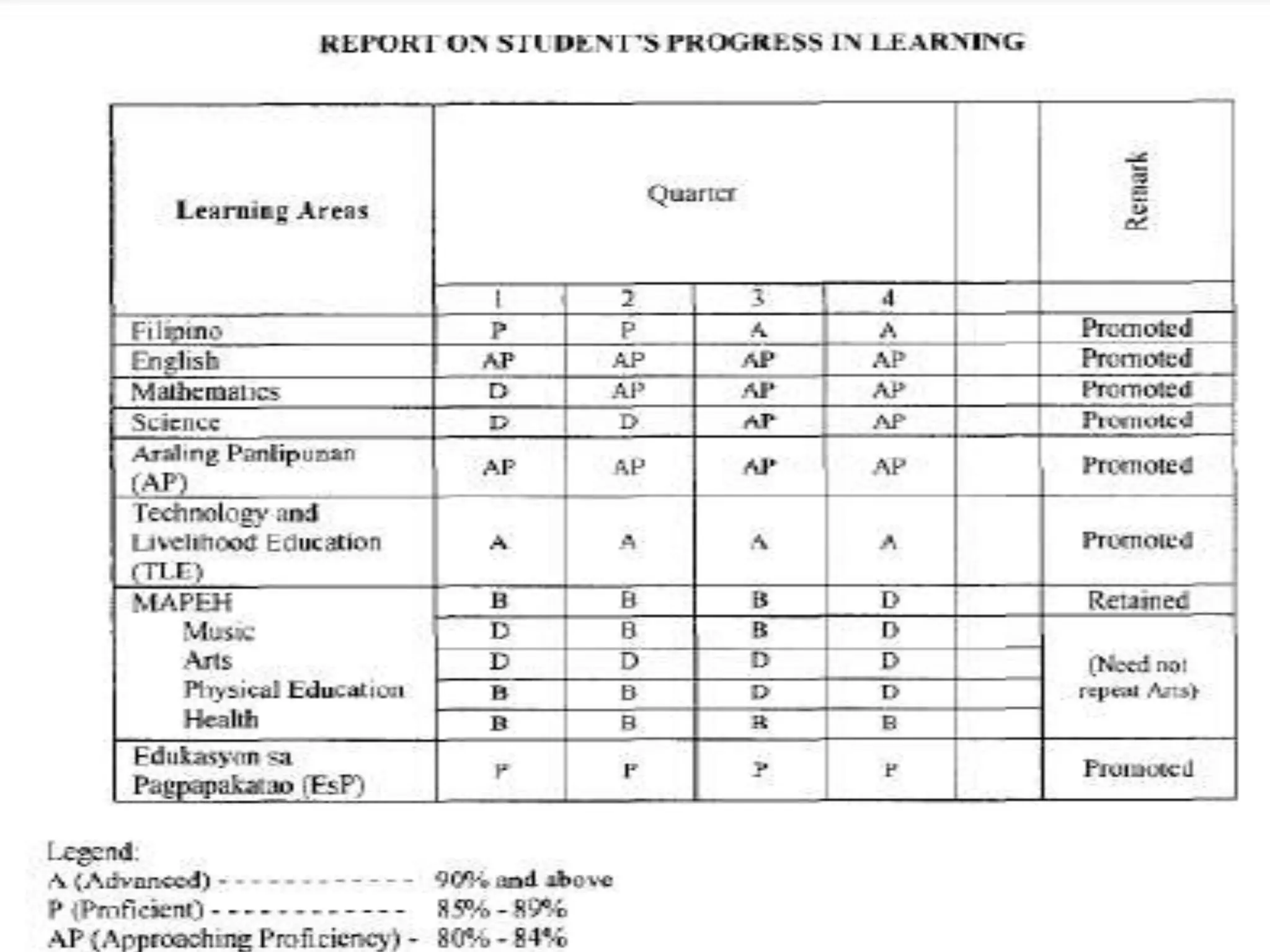
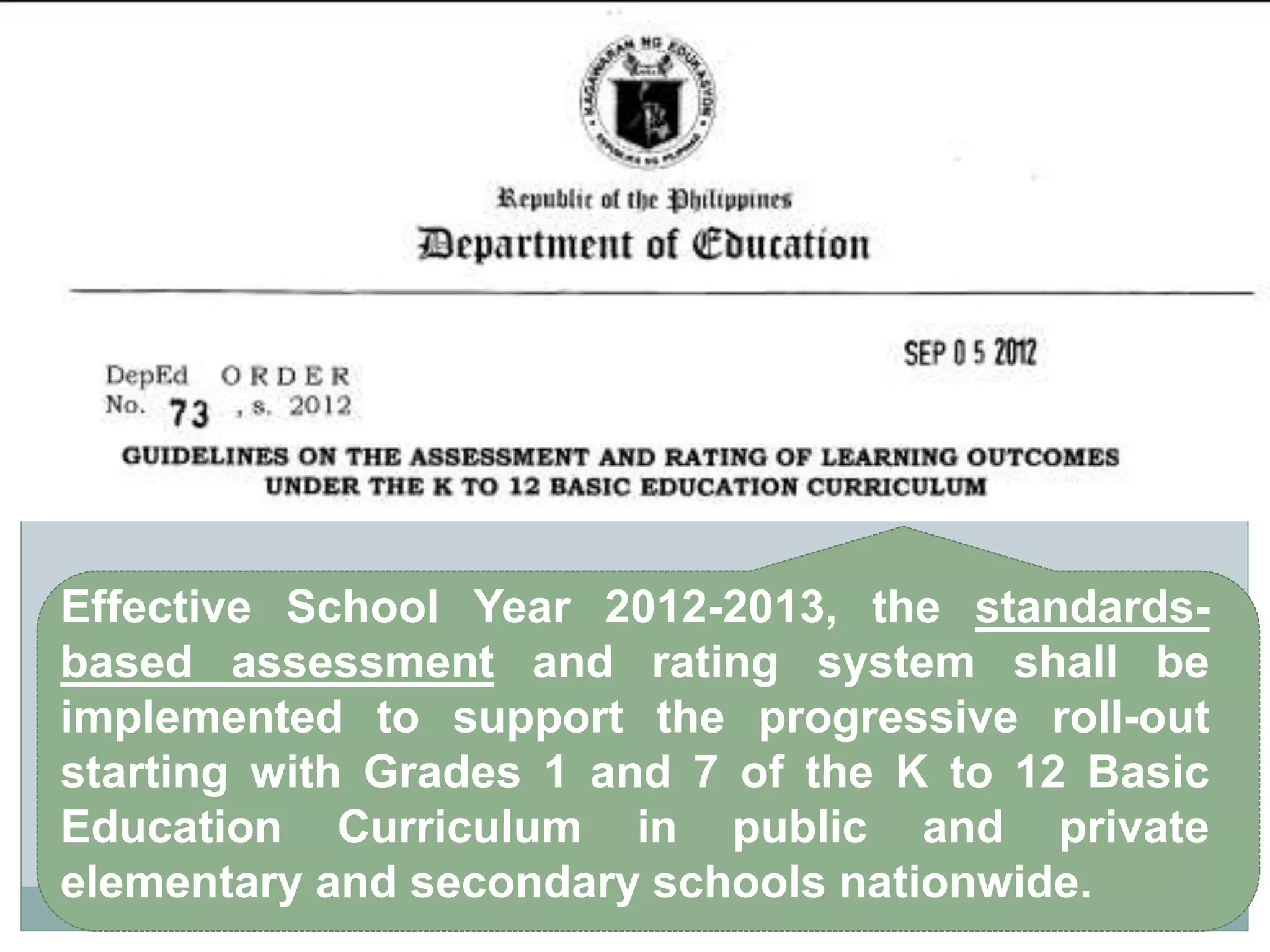
Effective School Year 2012-2013, the standards-
based assessment and rating system shall be
implemented to support the progressive roll-out
starting with Grades 1 and 7 of the K to 12 Basic
Education Curriculum in public and private
elementary and secondary schools nationwide.
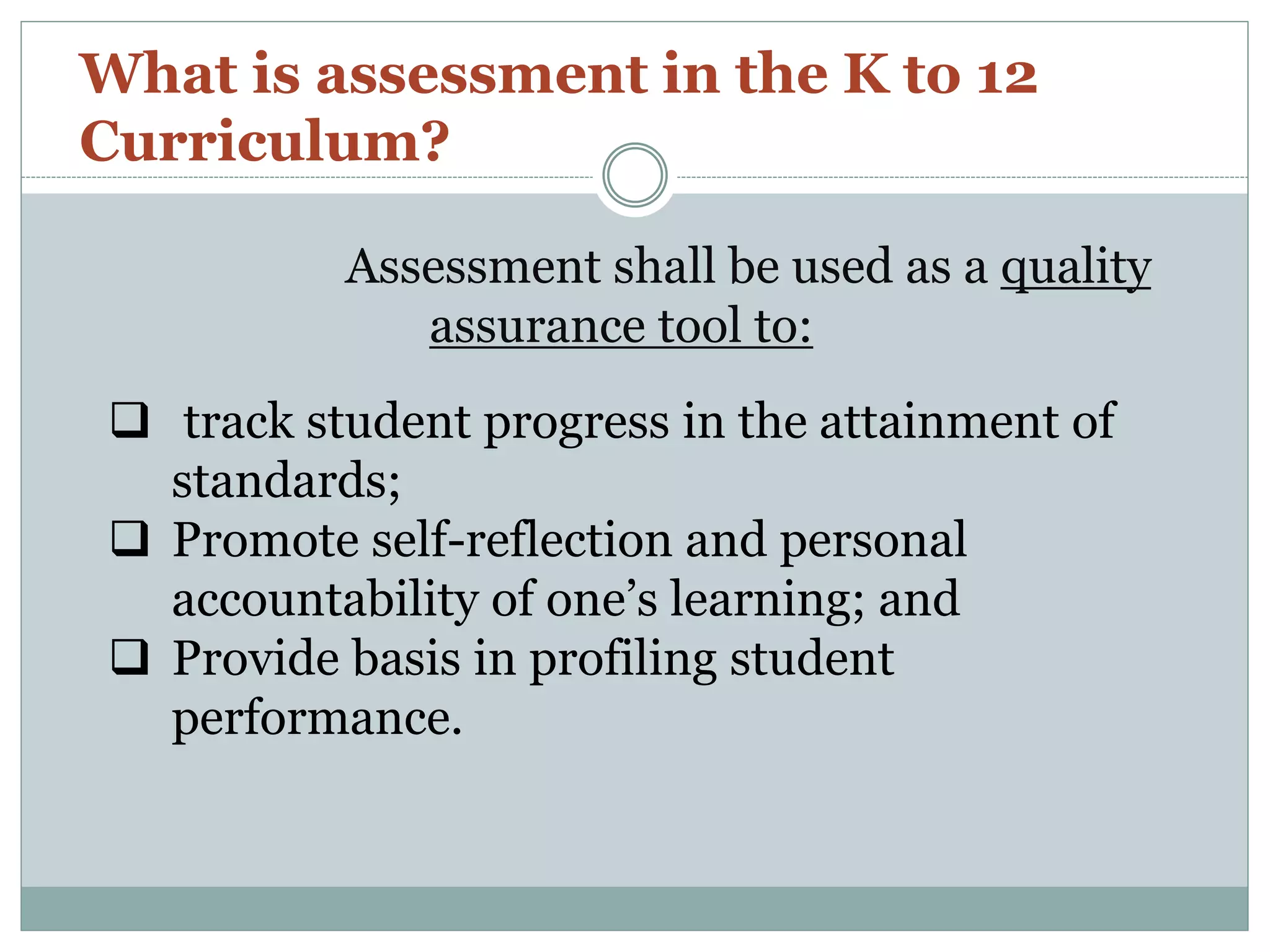
Assessment shall be used as a quality
assurance tool to:
What is assessment in the K to 12
Curriculum?
 track student progress in the attainment of
standards;
 Promote self-reflection and personal
accountability of one’s learning; and
 Provide basis in profiling student
performance.
What is assessment in the K to 12
Curriculum?
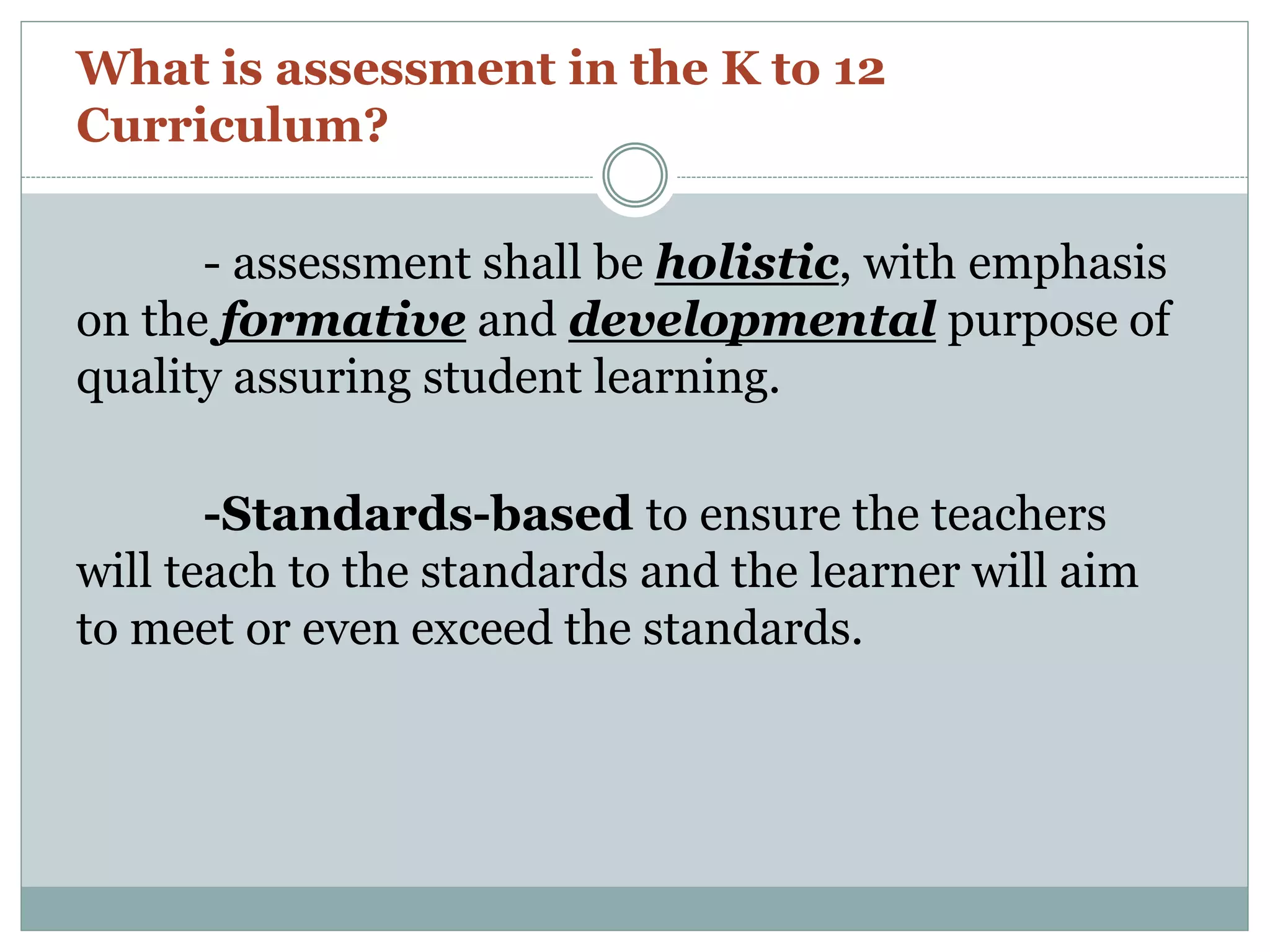
- assessment shall be holistic, with emphasis
on the formative and developmental purpose of
quality assuring student learning.
-Standards-based to ensure the teachers
will teach to the standards and the learner will aim
to meet or even exceed the standards.
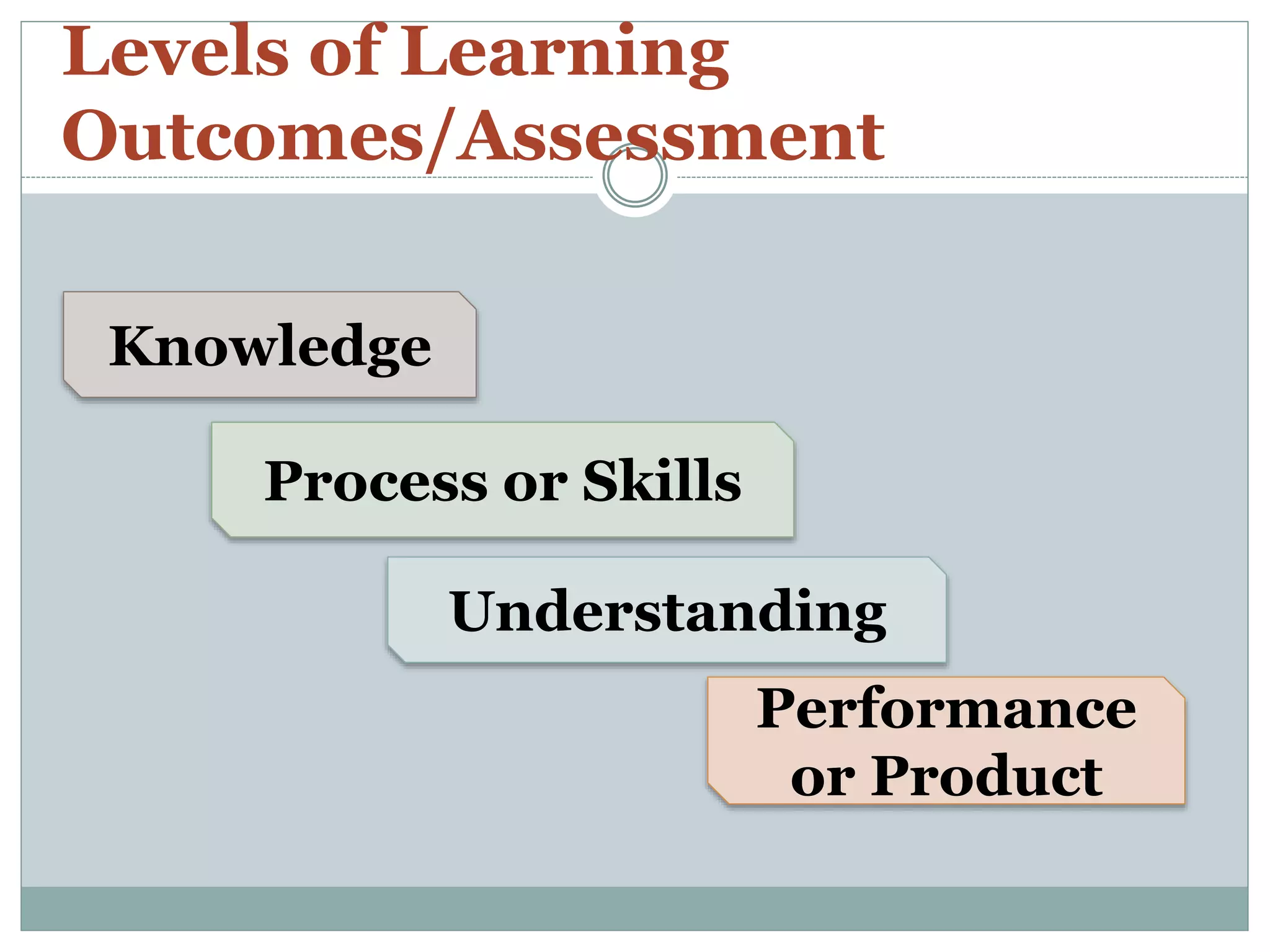
Knowledge
Levels of Learning
Outcomes/Assessment
Process or Skills
Understanding
Performance
or Product
PROTOTYPE RUBRICS
FOR THE DIFFERENT
LEVELS OF
ASSESSMENT
WHAT IS RUBRIC:
 A rubric is a guideline for rating student performance.
 Within this range, there are different levels of
performance which are organized from the lowest level to
the highest level of performance.
 It must define the range of possible performance levels.
 Usually, a scale of possible points is associated with the
continuum in which the highest level receives the
greatest number of points and the lowest level of
performance receives the fewest points.
BENEFITS OF RUBRIC
The rubric provides assessment with exactly
the characteristics for each level of
performance on which the students and the
teacher should base their judgment.
The rubric provides the students with clear
information about how well they performed
and what they need to accomplish in the
future to better their performance.
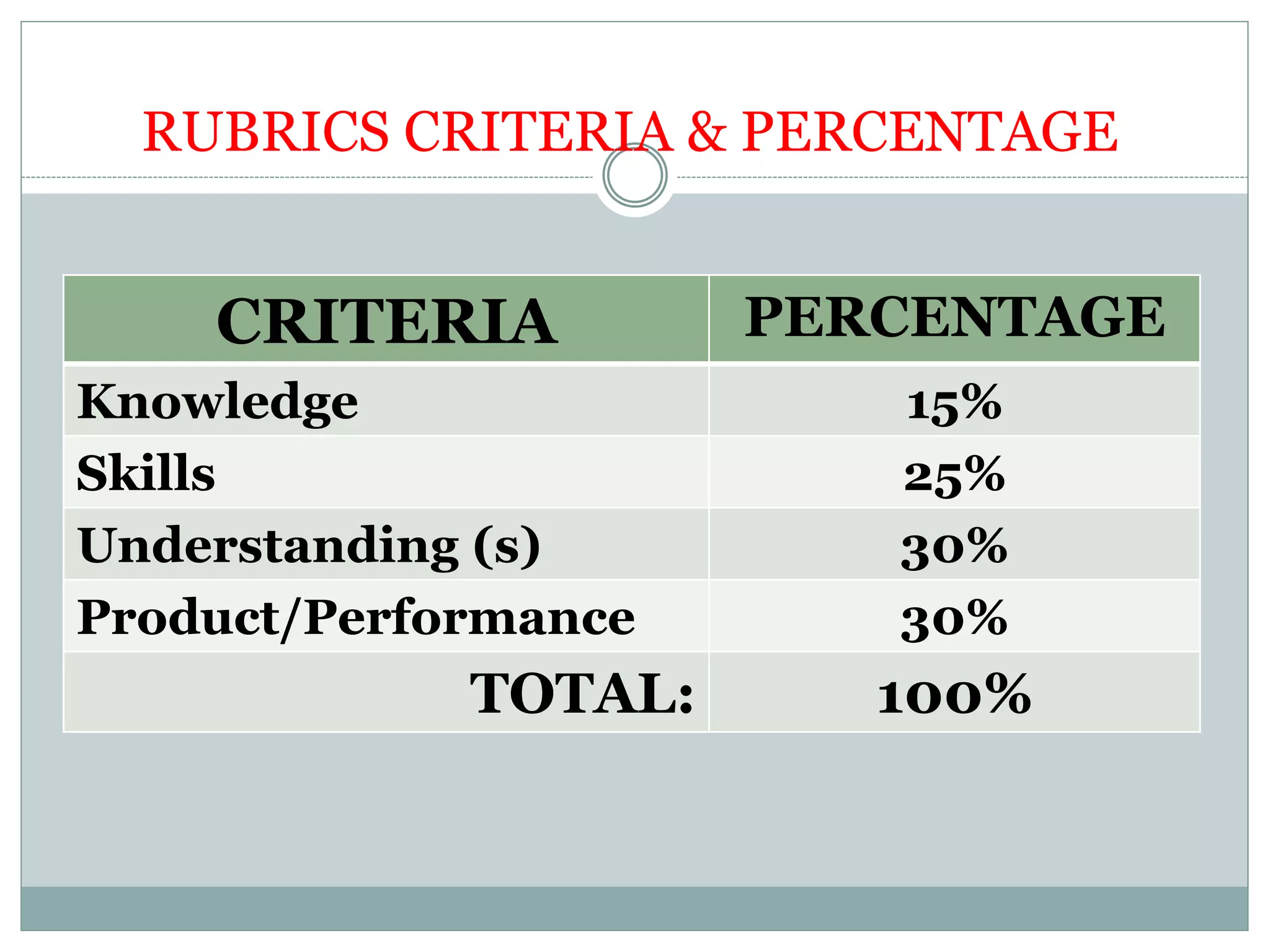
RUBRICS CRITERIA & PERCENTAGE
CRITERIA PERCENTAGE
Knowledge 15%
Skills 25%
Understanding (s) 30%
Product/Performance 30%
TOTAL: 100%
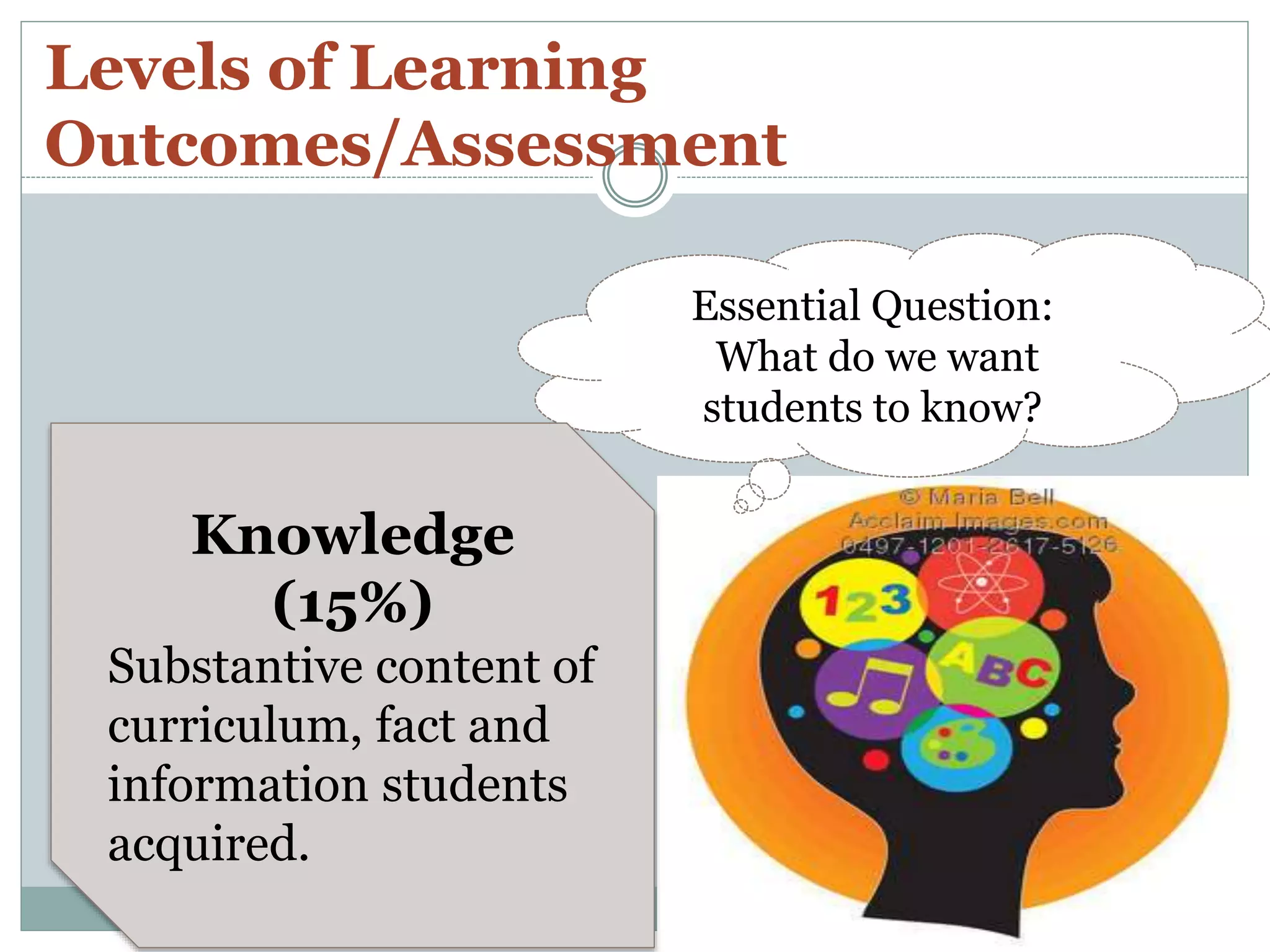
Essential Question:
What do we want
students to know?
Levels of Learning
Outcomes/Assessment
Knowledge
(15%)
Substantive content of
curriculum, fact and
information students
acquired.
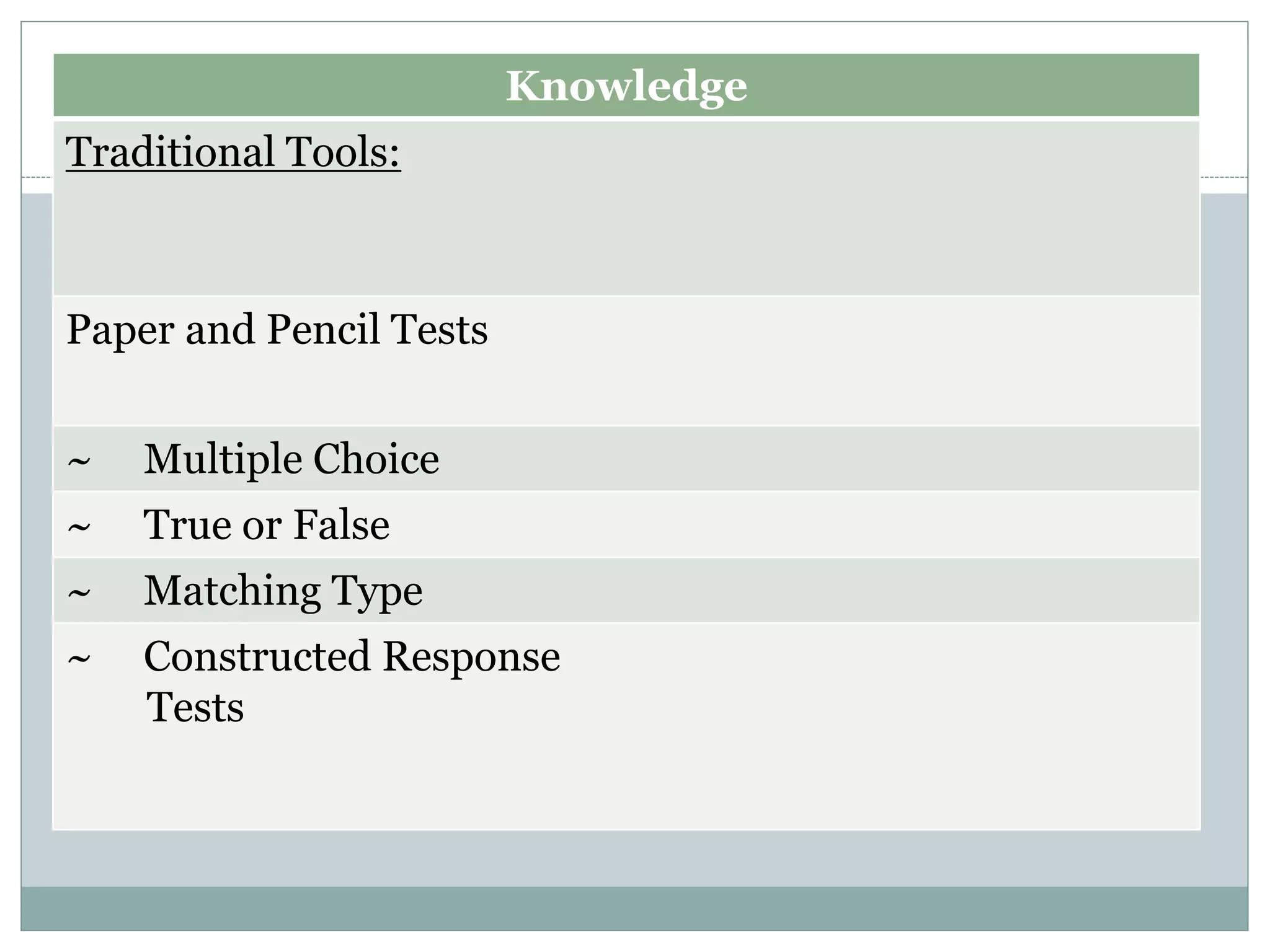
Knowledge
Traditional Tools:
Paper and Pencil Tests
~ Multiple Choice
~ True or False
~ Matching Type
~ Constructed Response
Tests
Levels of Learning Outcomes/Assessment
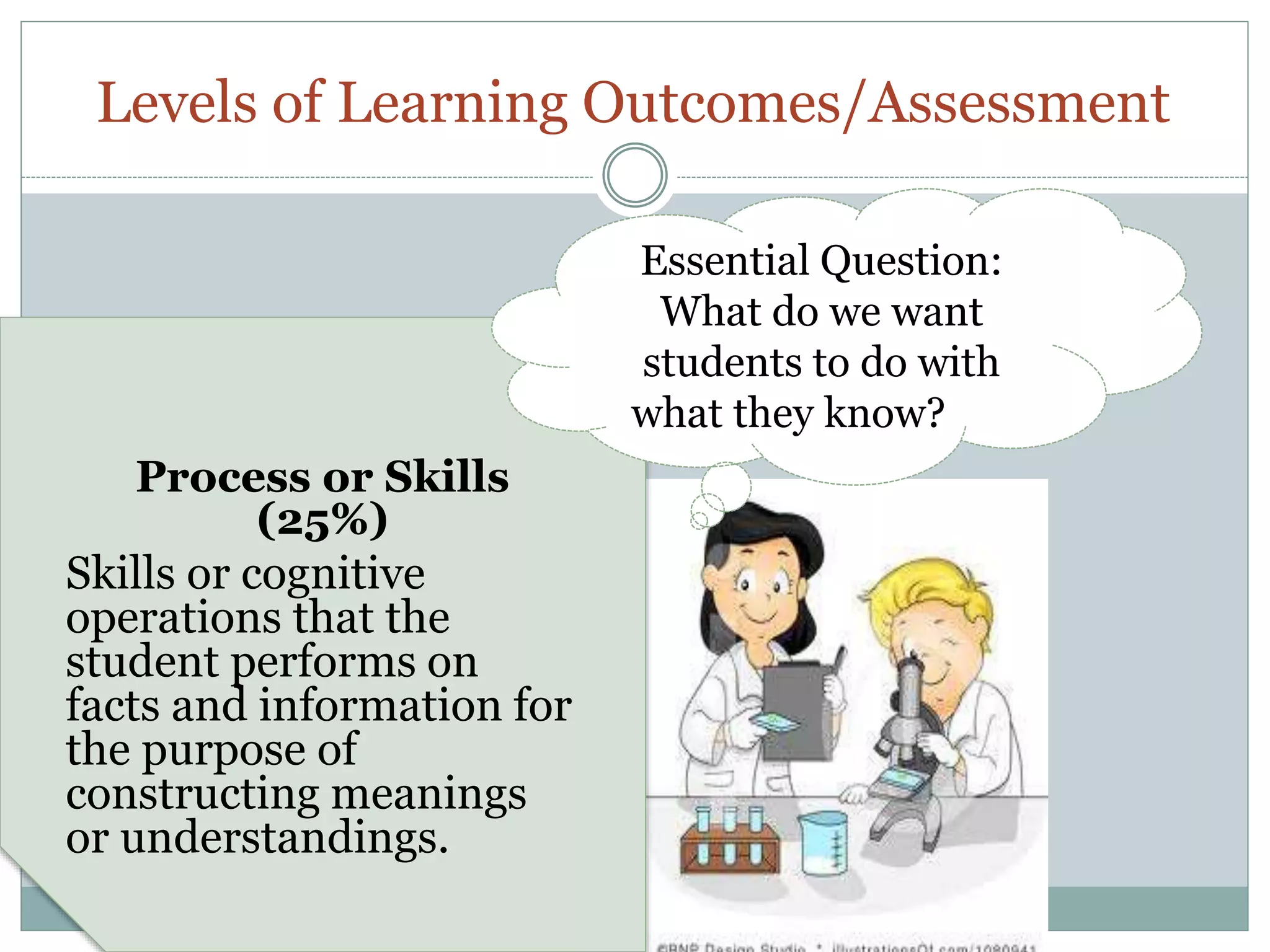
Process or Skills
(25%)
Skills or cognitive
operations that the
student performs on
facts and information for
the purpose of
constructing meanings
or understandings.
Essential Question:
What do we want
students to do with
what they know?
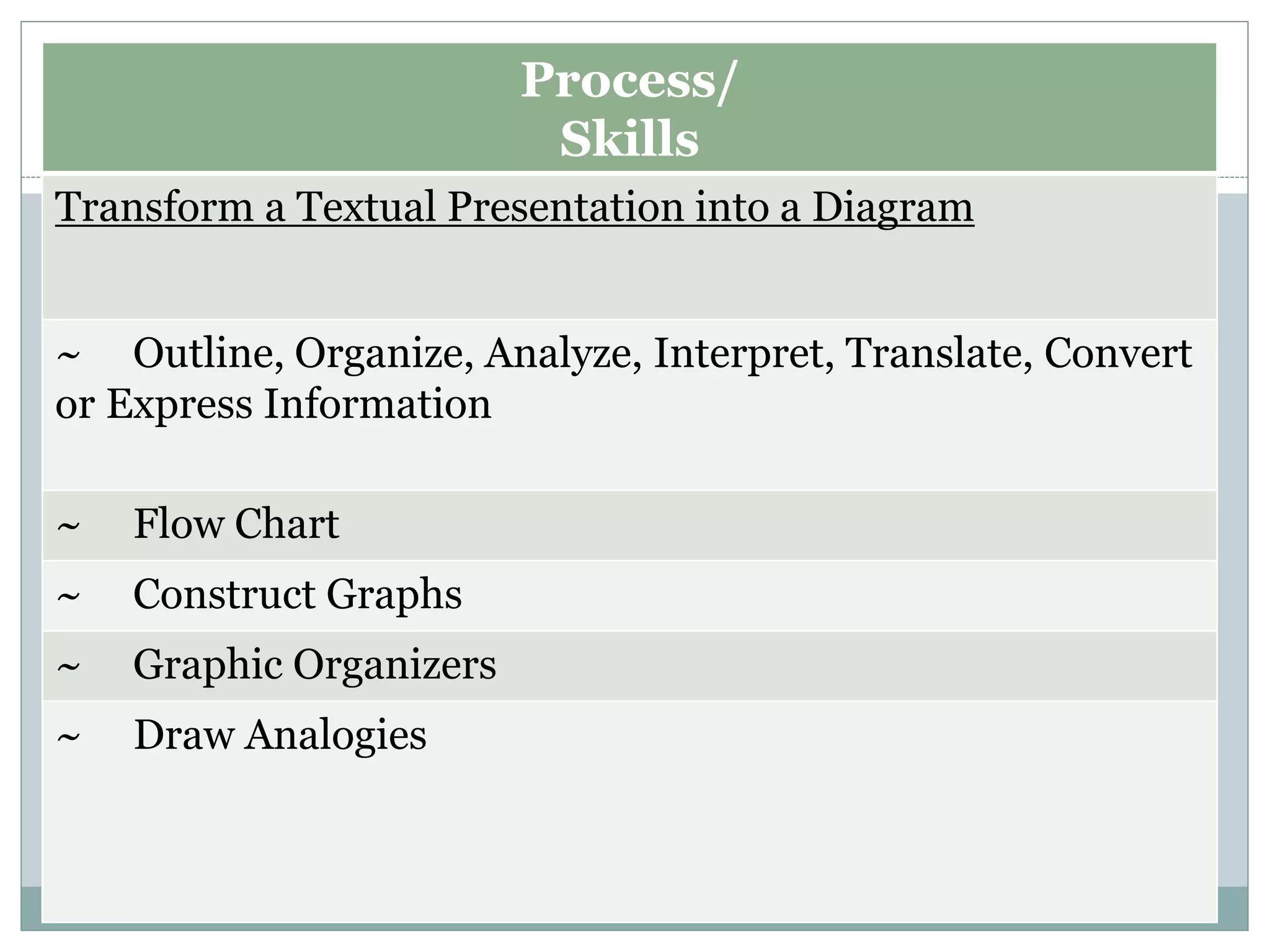
Process/
Skills
Transform a Textual Presentation into a Diagram
~ Outline, Organize, Analyze, Interpret, Translate, Convert
or Express Information
~ Flow Chart
~ Construct Graphs
~ Graphic Organizers
~ Draw Analogies
Levels of Learning Outcomes/Assessment
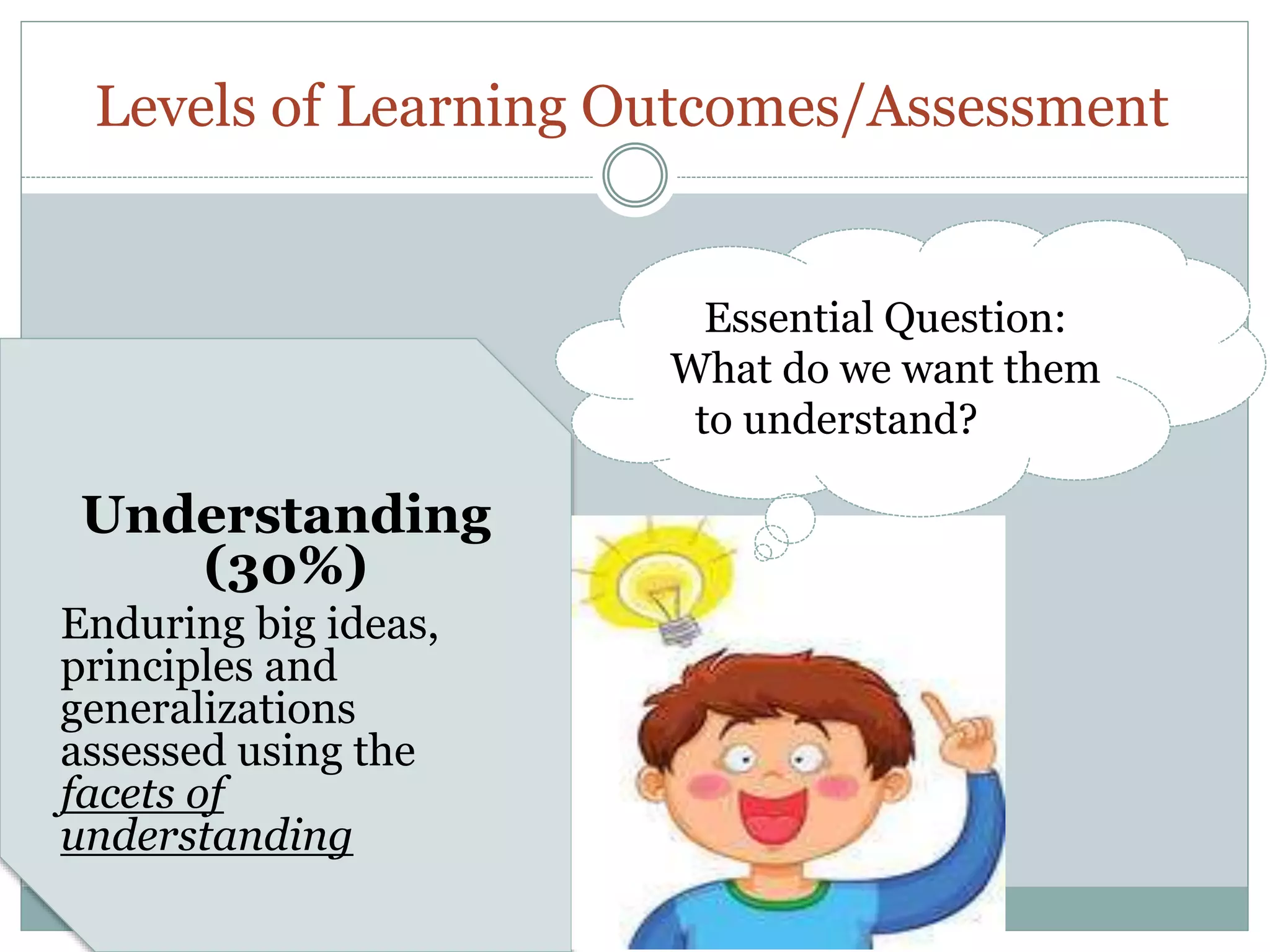
Understanding
(30%)
Enduring big ideas,
principles and
generalizations
assessed using the
facets of
understanding
Essential Question:
What do we want them
to understand?
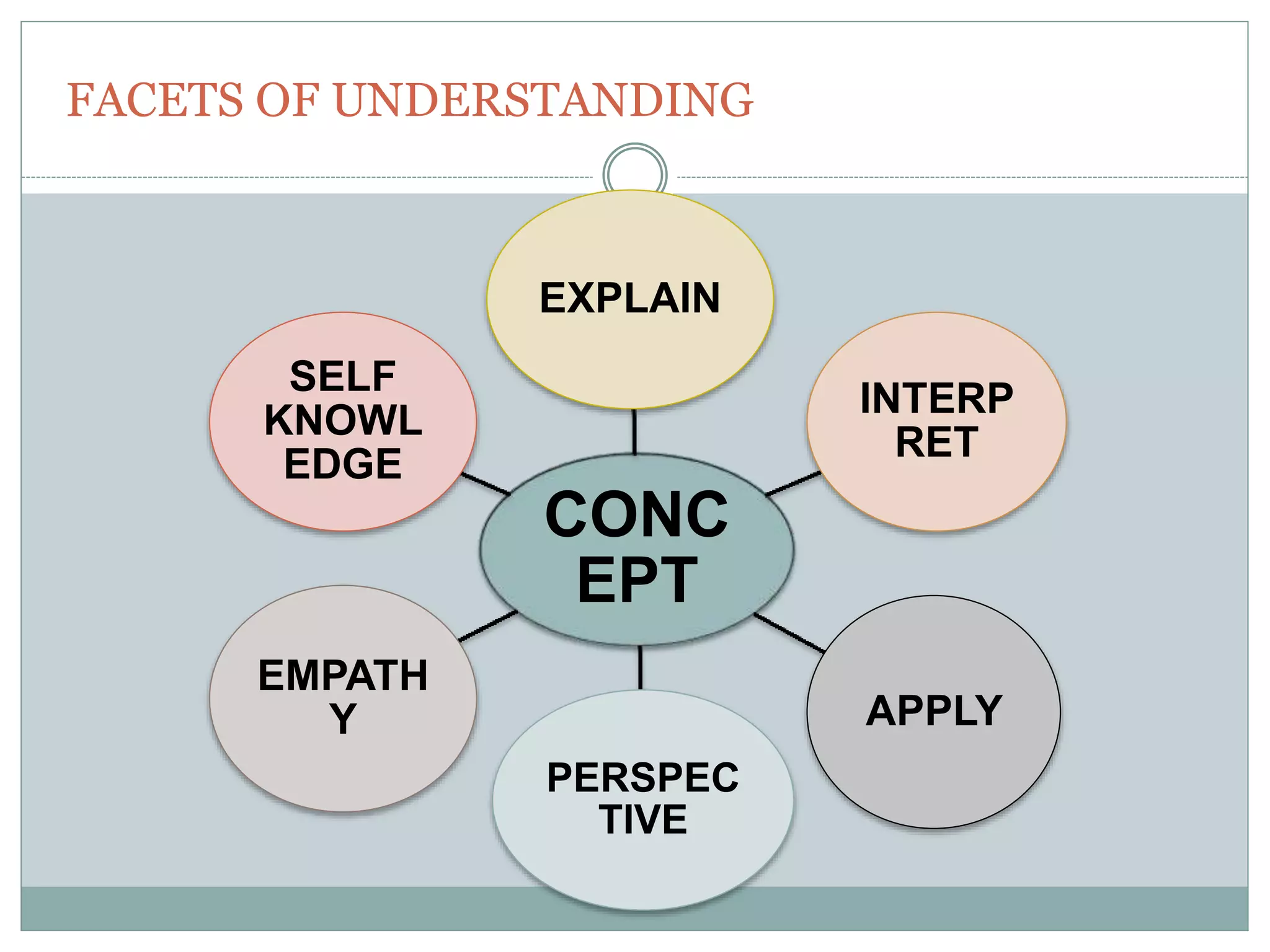
FACETS OF UNDERSTANDING
CONC
EPT
EXPLAIN
INTERP
RET
APPLY
PERSPEC
TIVE
EMPATH
Y
SELF
KNOWL
EDGE
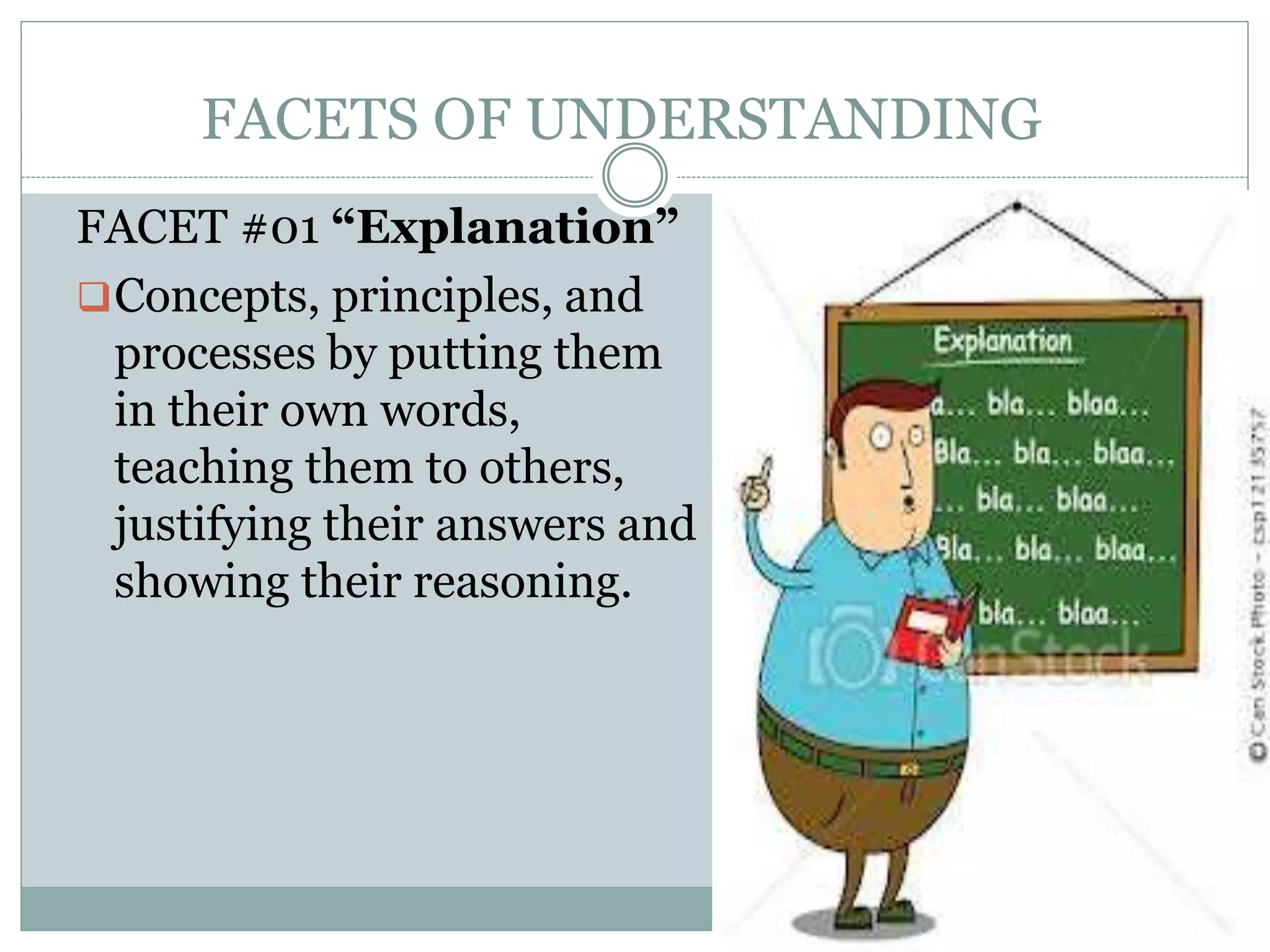
FACETS OF UNDERSTANDING
FACET #01 “Explanation”
Concepts, principles, and
processes by putting them
in their own words,
teaching them to others,
justifying their answers and
showing their reasoning.
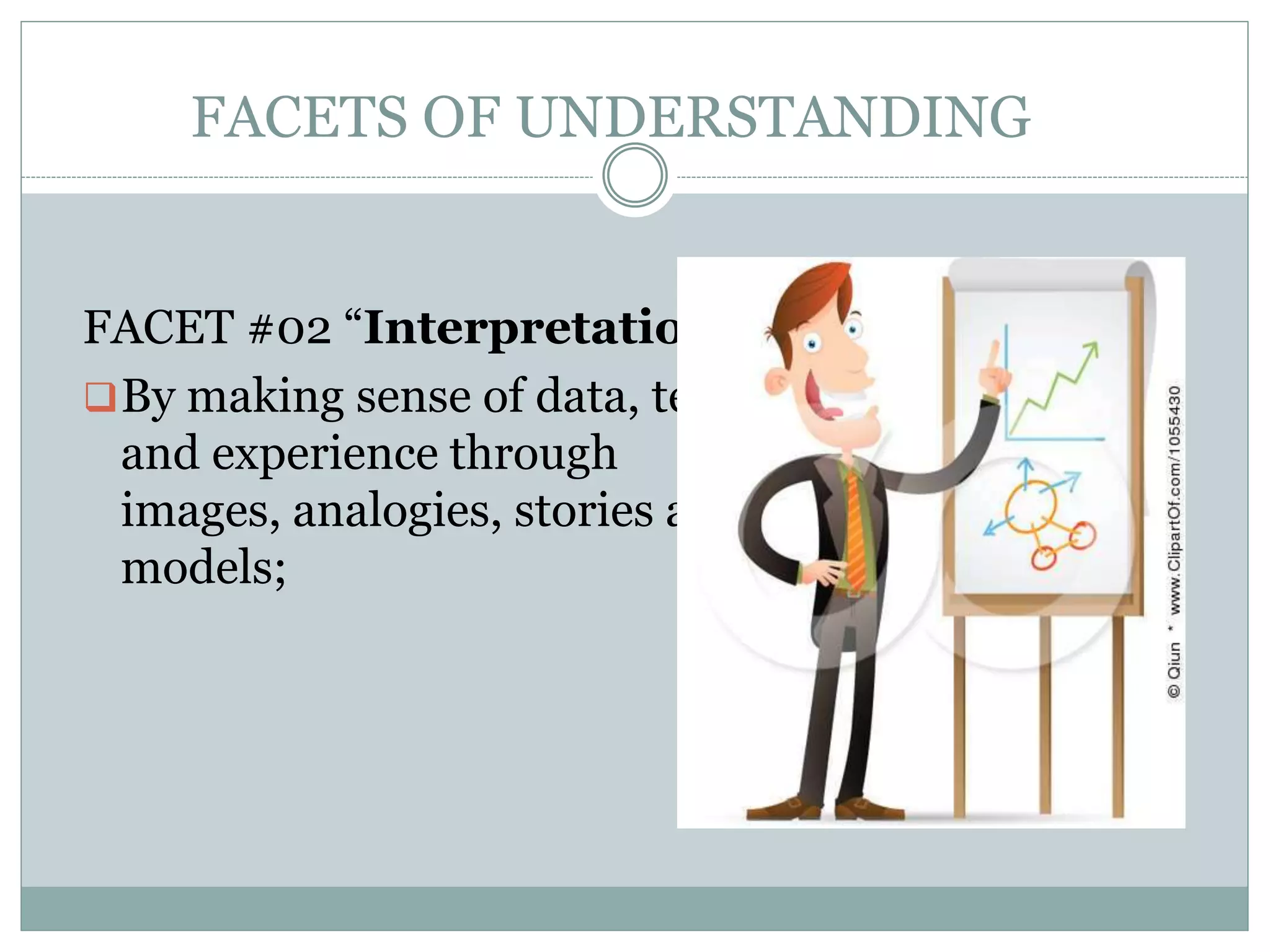
FACETS OF UNDERSTANDING
FACET #02 “Interpretation”
By making sense of data, text,
and experience through
images, analogies, stories and
models;
FACETS OF UNDERSTANDING
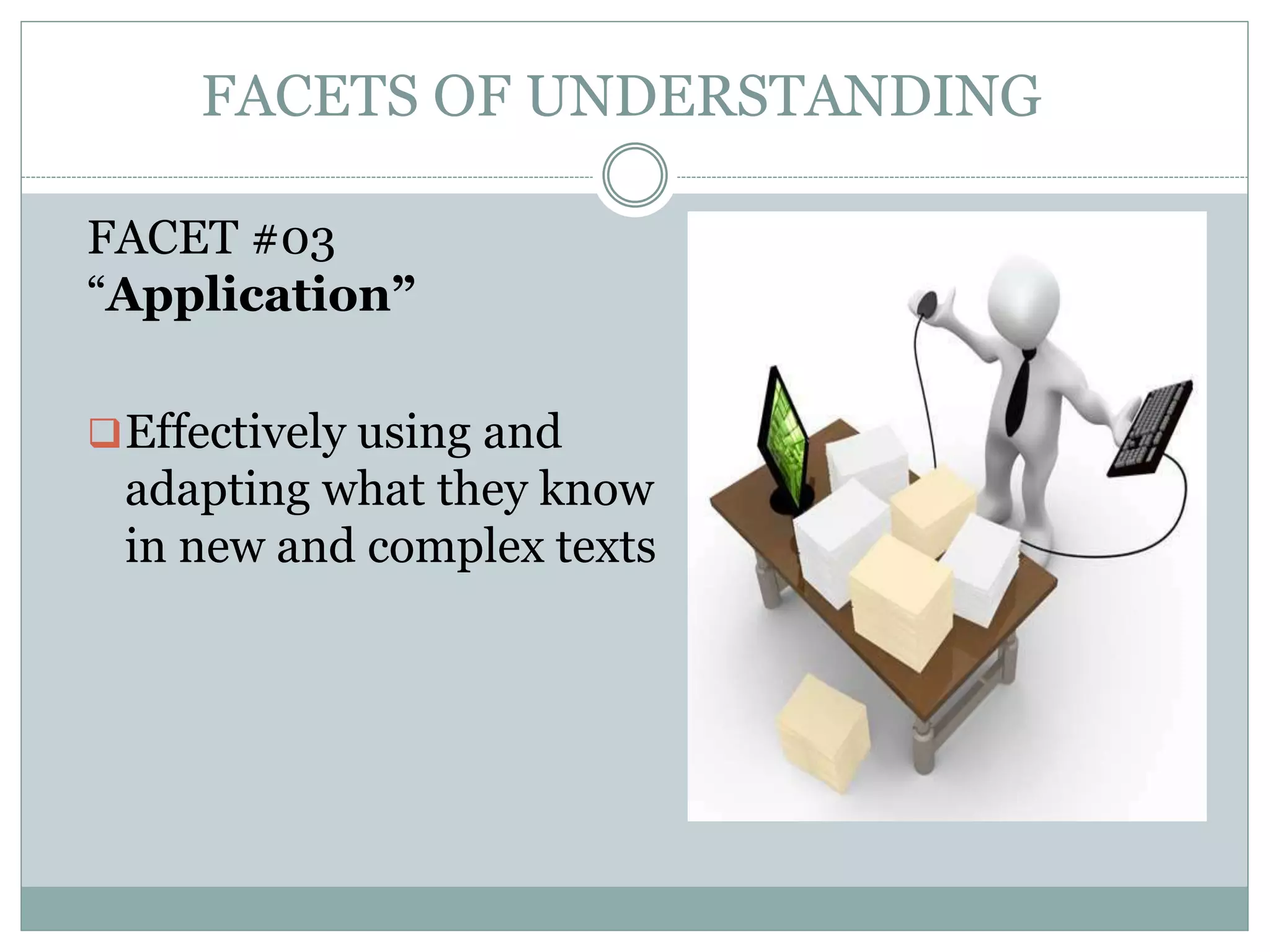
FACET #03
“Application”
Effectively using and
adapting what they know
in new and complex texts
FACETS OF UNDERSTANDING
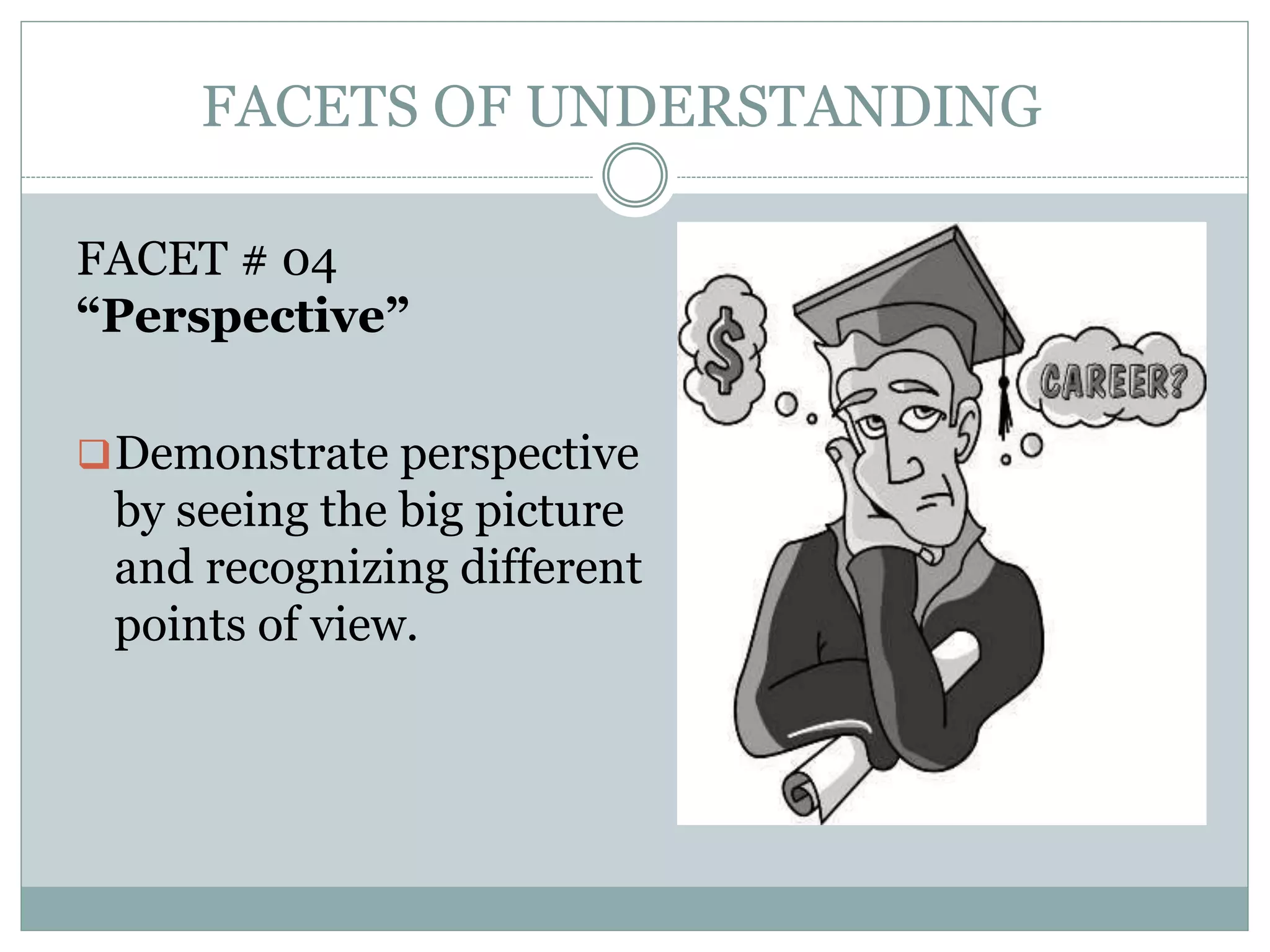
FACET # 04
“Perspective”
Demonstrate perspective
by seeing the big picture
and recognizing different
points of view.
FACETS OF UNDERSTANDING
FACET #05
“Empathy”
Display empathy by
perceiving sensitively
and putting one’s self
in someone else’s
shoes;
FACETS OF UNDERSTANDING
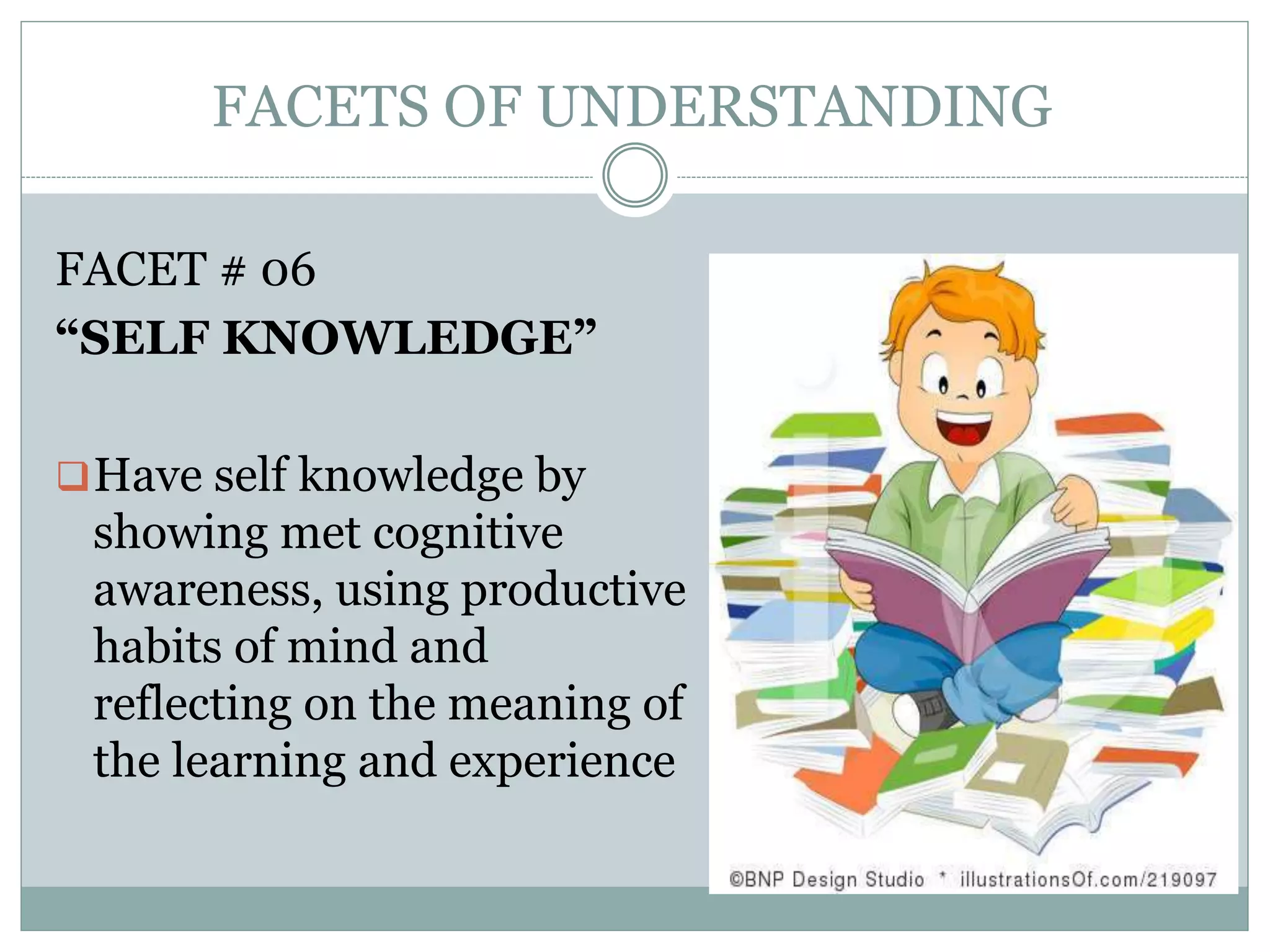
FACET # 06
“SELF KNOWLEDGE”
Have self knowledge by
showing met cognitive
awareness, using productive
habits of mind and
reflecting on the meaning of
the learning and experience
Levels of Learning Outcomes/Assessment
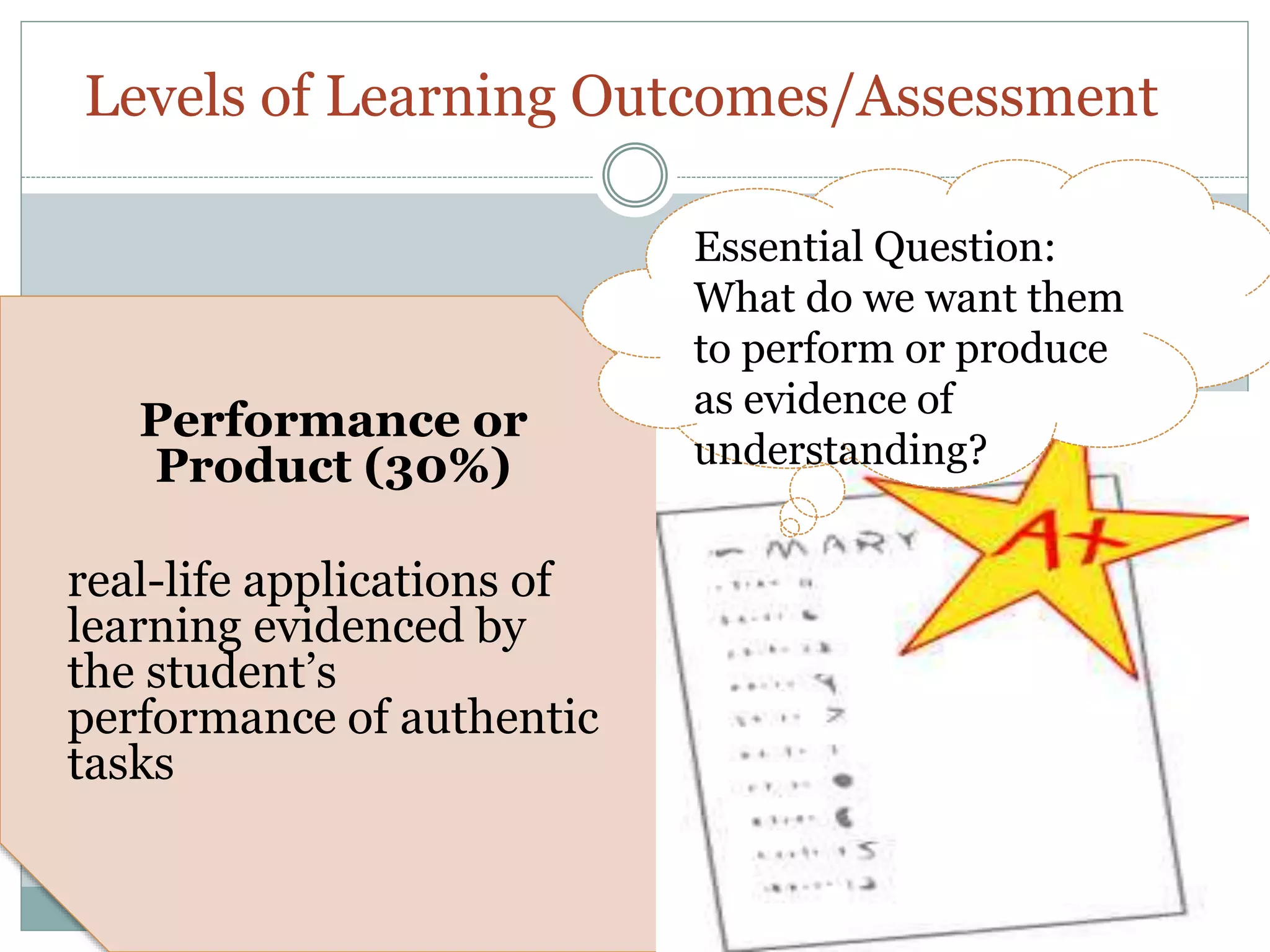
Performance or
Product (30%)
real-life applications of
learning evidenced by
the student’s
performance of authentic
tasks
Essential Question:
What do we want them
to perform or produce
as evidence of
understanding?
Transfer of understanding to life situations maybe
assessed as demonstrated through the following:
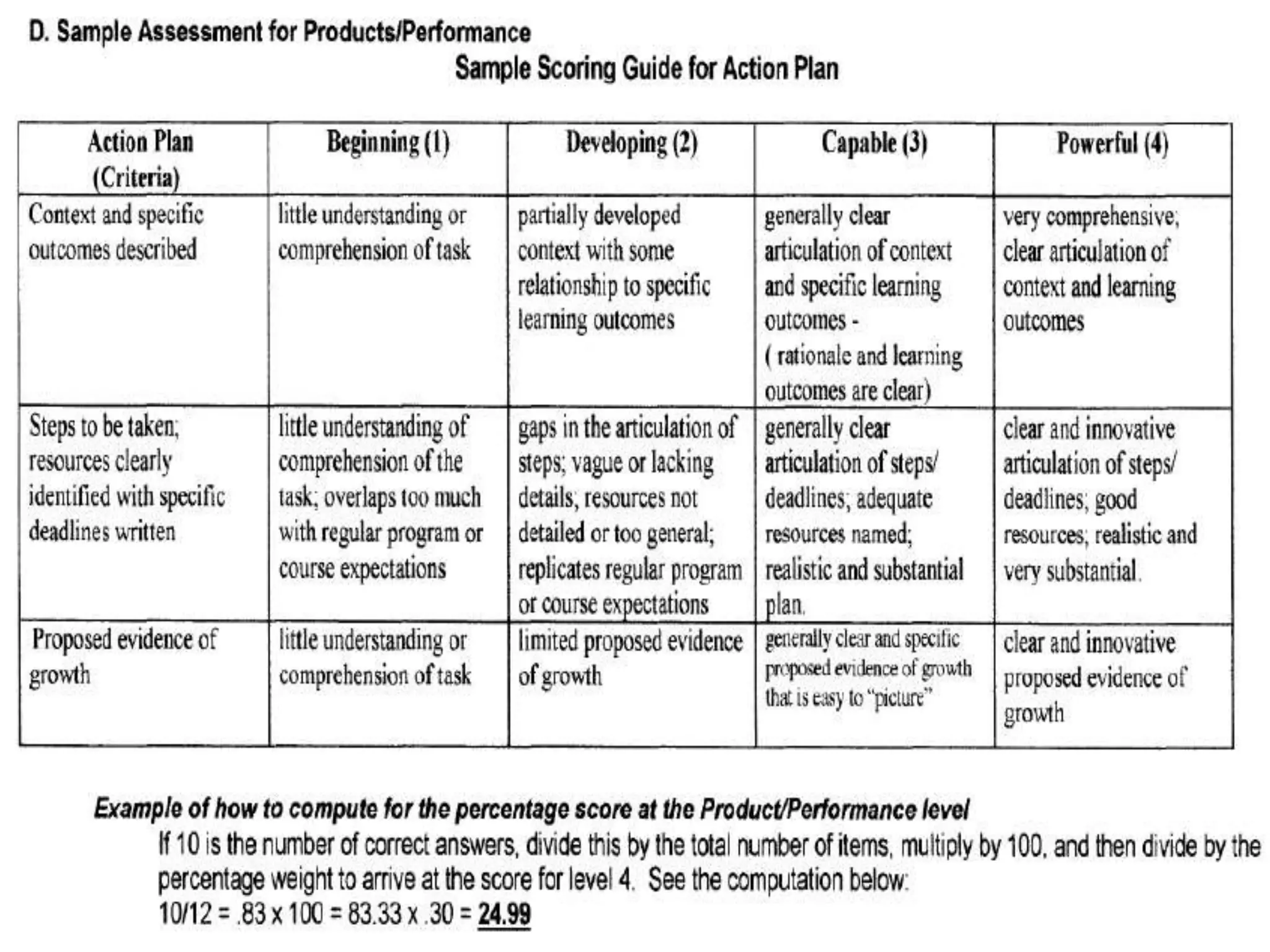
1. PRODUCTS – Outputs which are
reflective of learner’s creative
application of understanding;
2. PERFORMANCES – skillful exhibition or
creative execution of a process, reflective
of masterful application of learning or
understanding.
STUDENT IS EXPECTED TO DEMONSTRATE
HIS/HER UNDERSTANDING BY MEANS OF:
Self Understanding
Self Monitoring
Self Assessment
SELF UNDERSTANDING
Also known as Self
knowledge
Is the ability to understand
one's own actions
SELF MONITORING
Used in behavioral
management where a
person will keep a record of
behavior patterns.
A personality trait for
the ability to change
behavior in response to
different situations.
SELF ASSESSMENT
It is the process of
gathering information
about yourself in order to
make an informed career
decision.
A self assessment should
include a look at the
following: values,
interests, personality, and
skills.
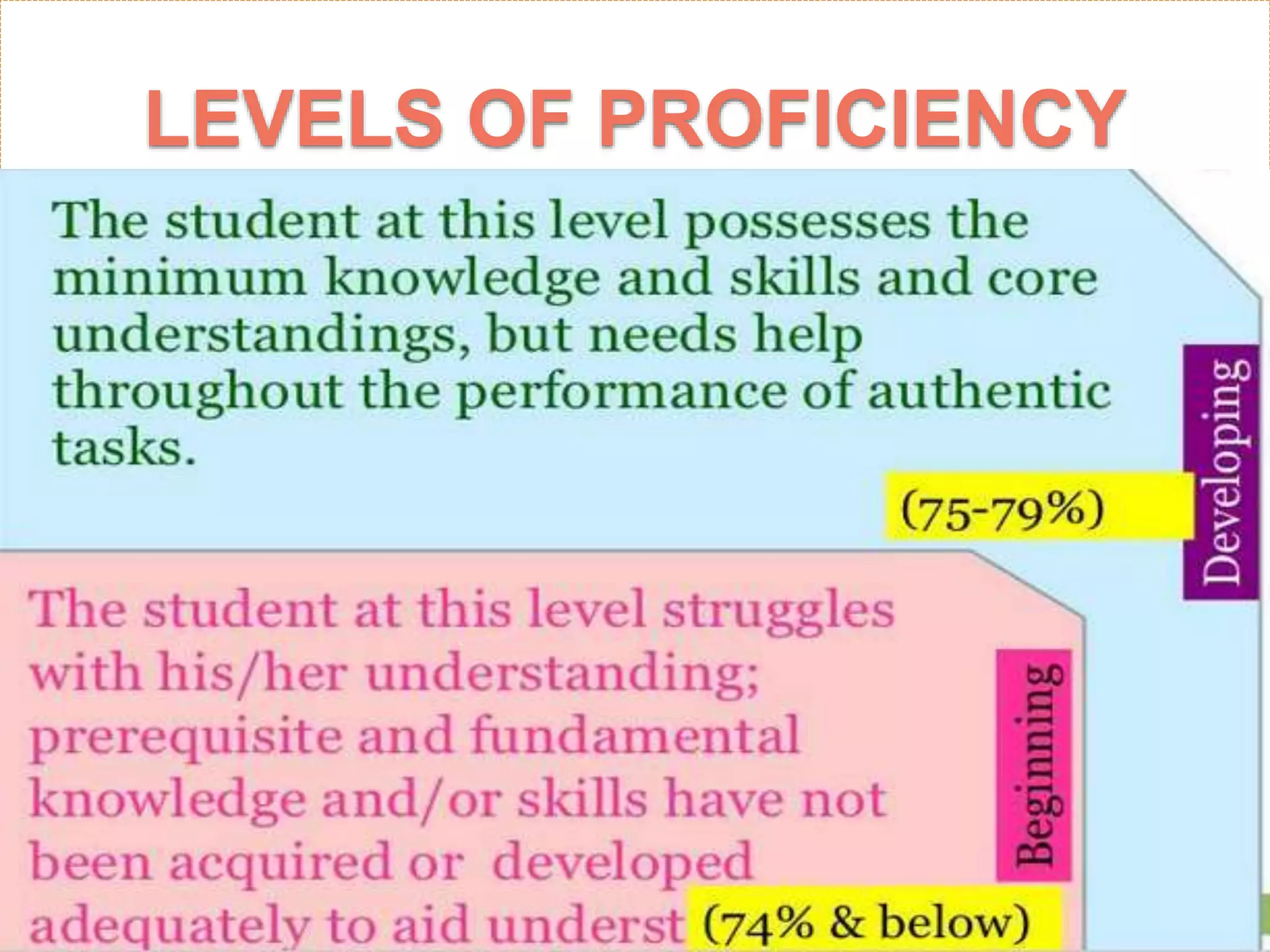
LEVELS OF PROFICIENCY and
NUMERIC EQUIVALENCE
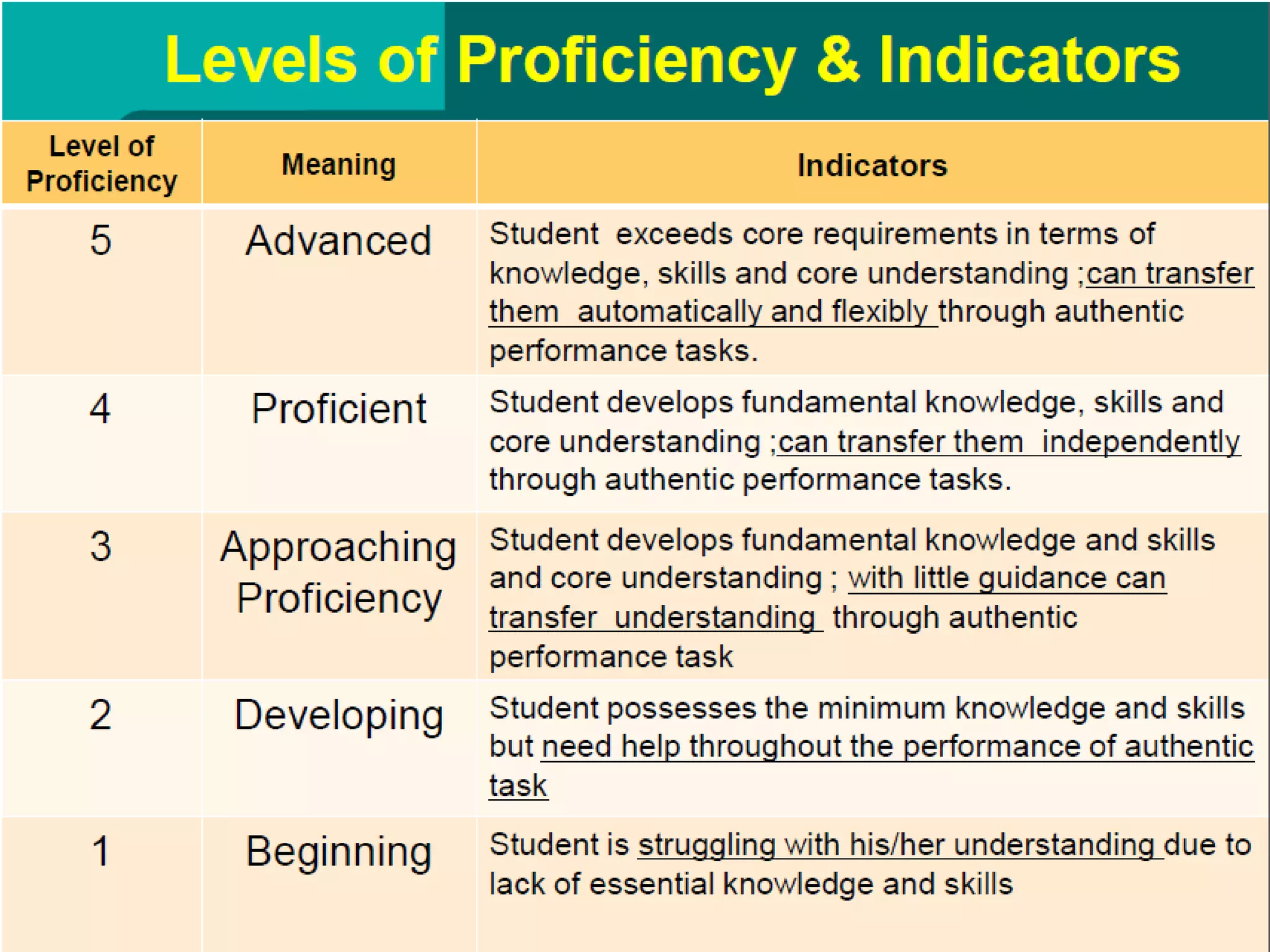
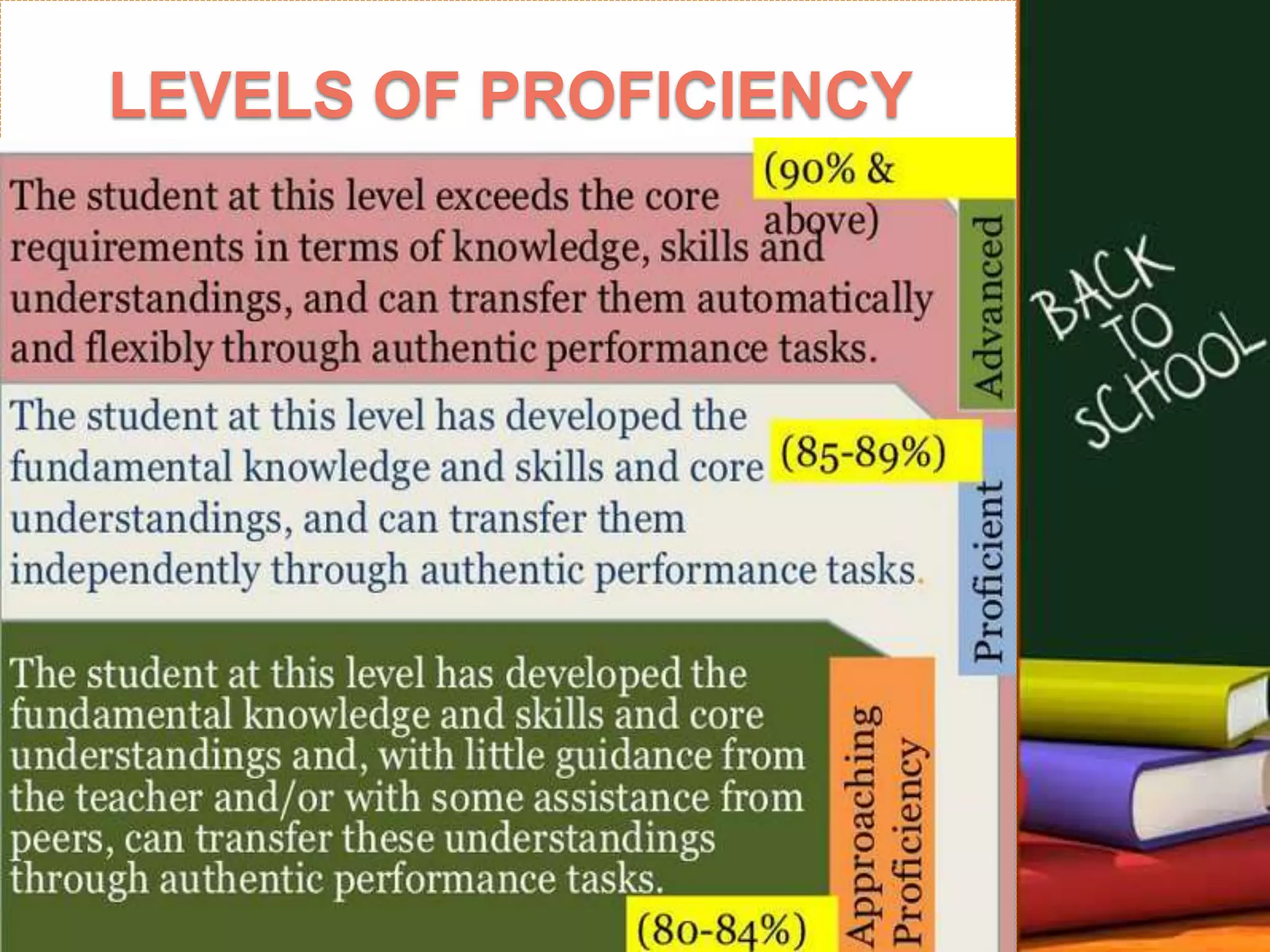
 LEVELS OF PROFICIENCYLEVELS OF PROFICIENCY
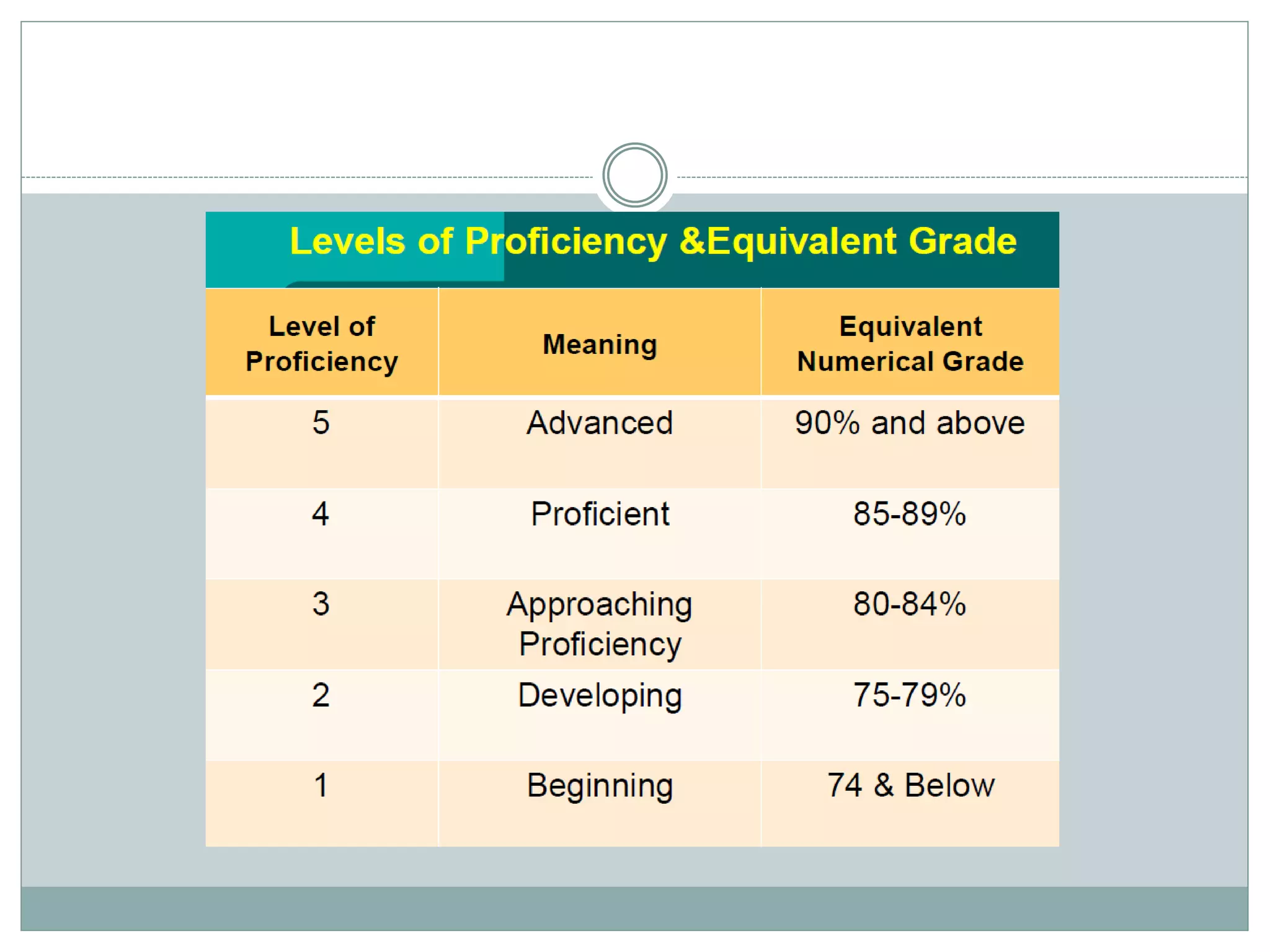
LEVELS OF PROFICIENCY
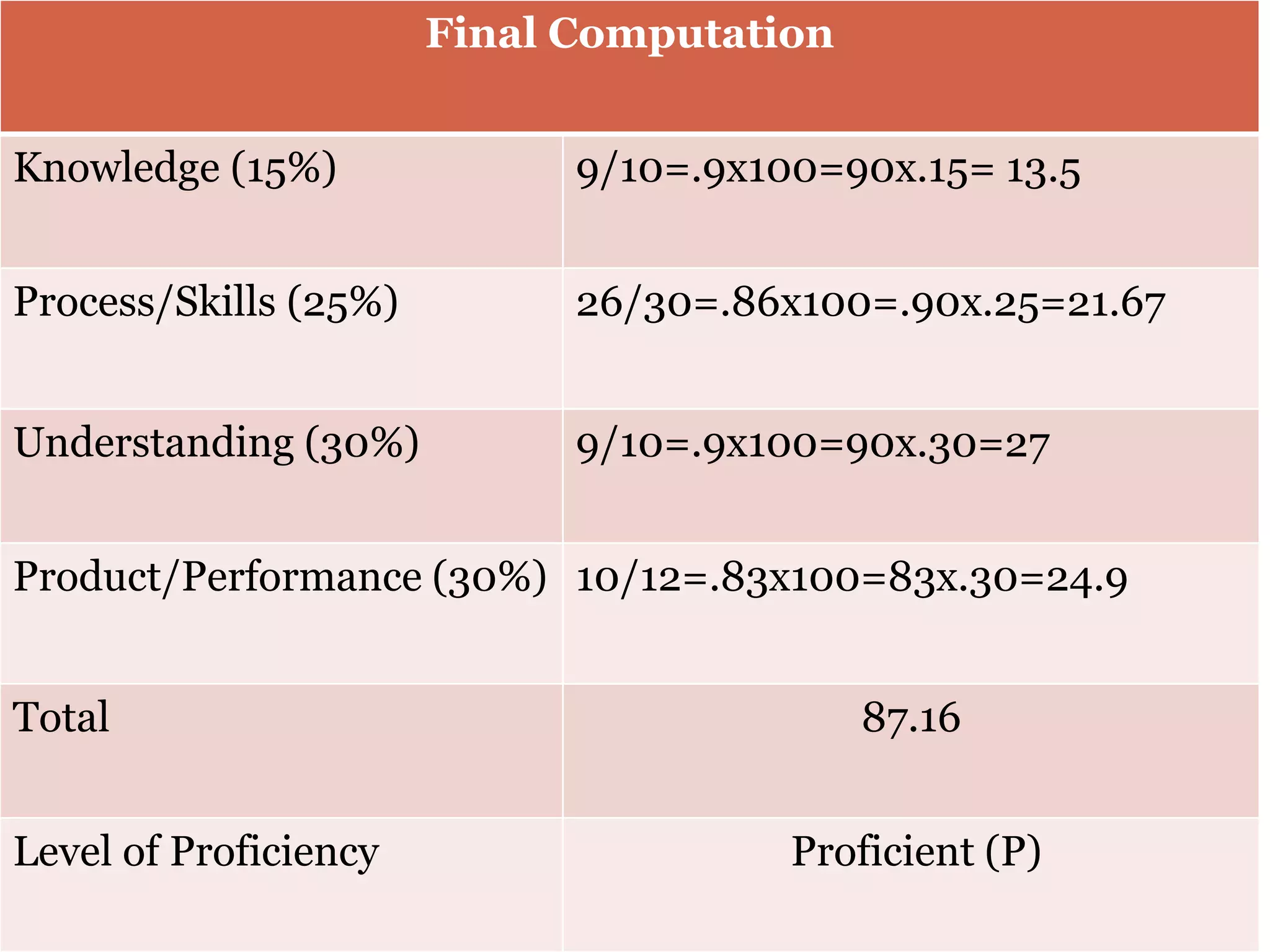
Final Computation
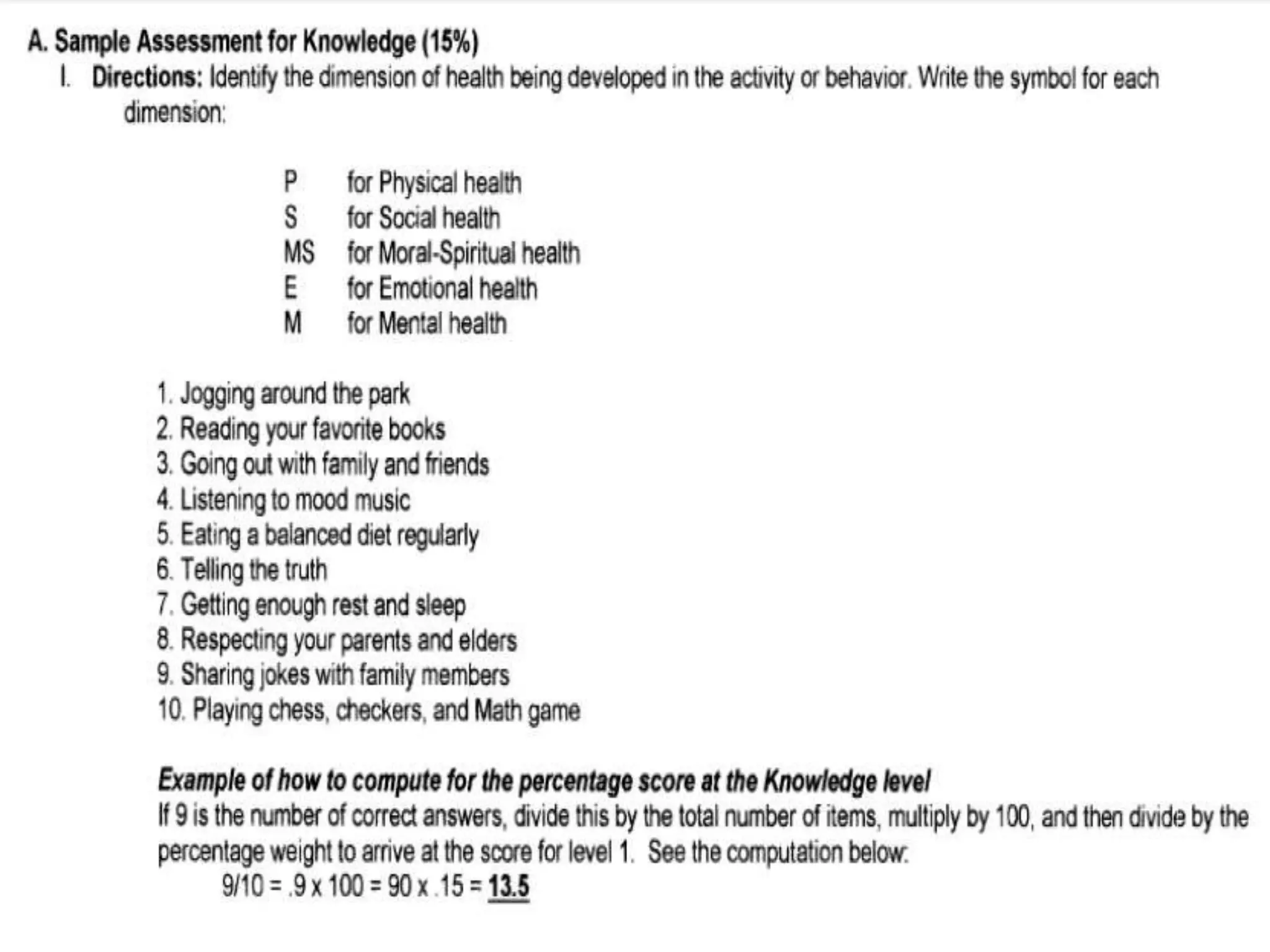
Knowledge (15%) 9/10=.9x100=90x.15= 13.5
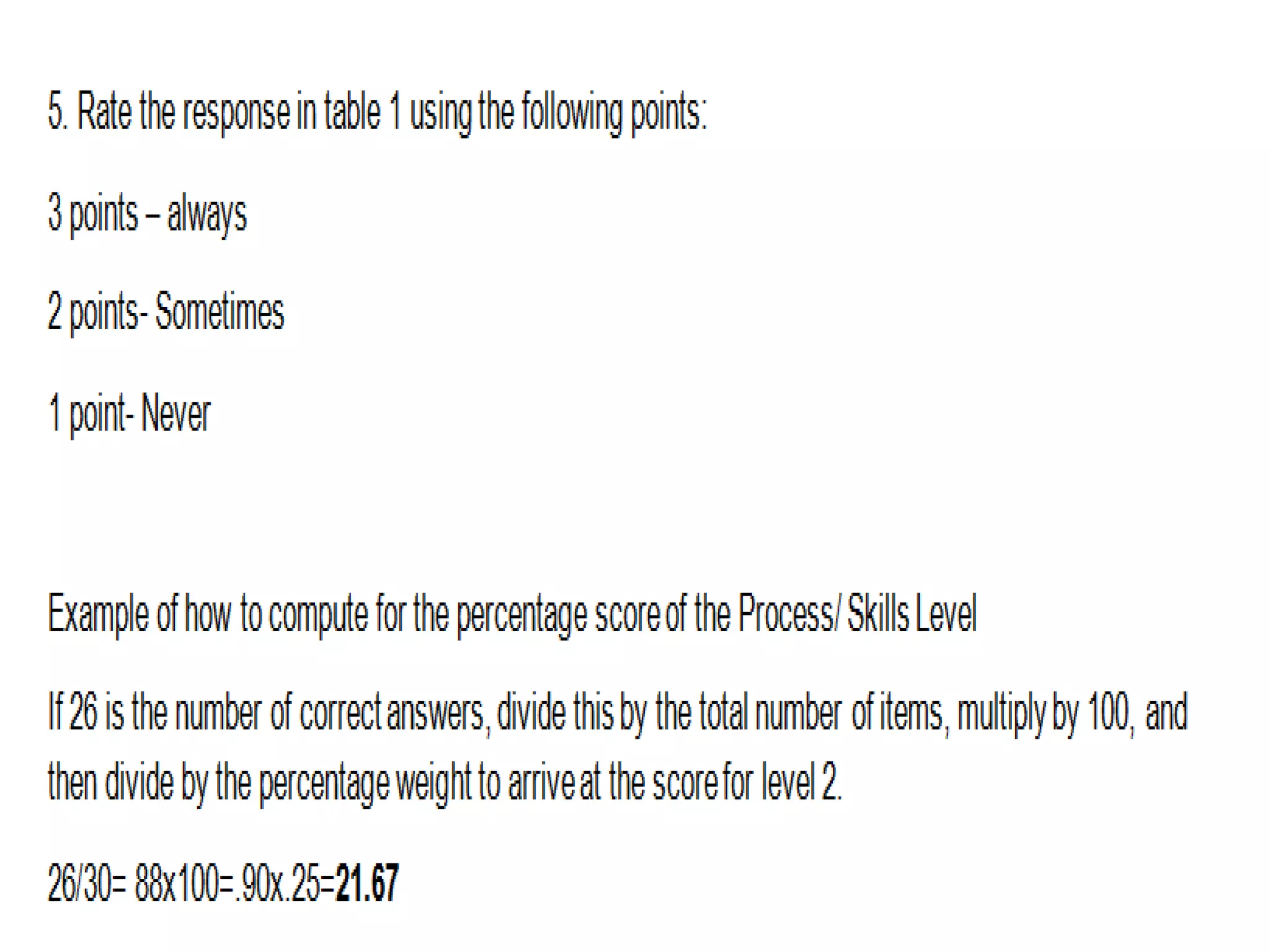
Process/Skills (25%) 26/30=.86x100=.90x.25=21.67
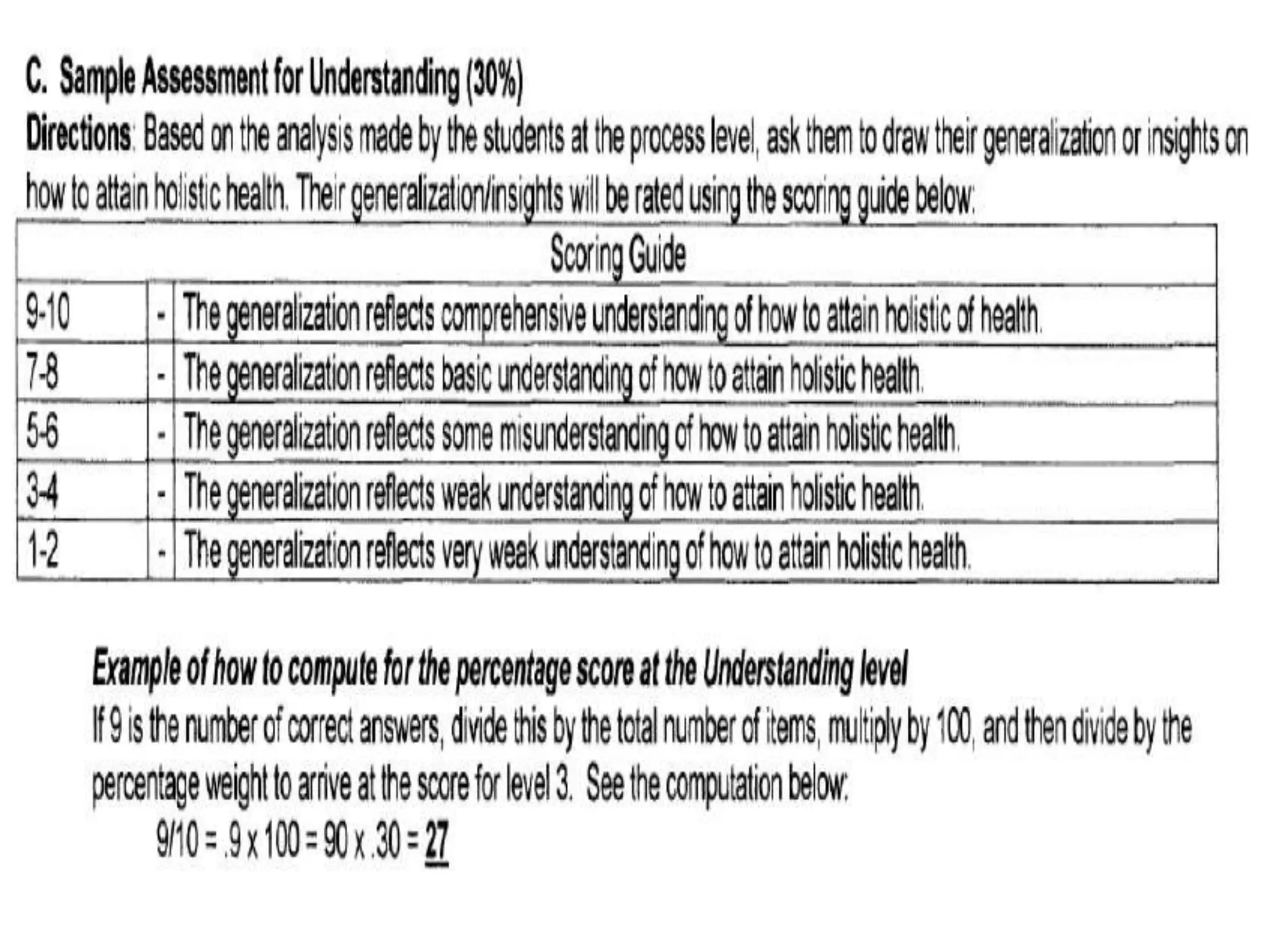
Understanding (30%) 9/10=.9x100=90x.30=27
Product/Performance (30%) 10/12=.83x100=83x.30=24.9
Total 87.16
Level of Proficiency Proficient (P)
Thank You
and Have a
Nice Day!!
References:
retrieved on January 16, 2016
https://www.slideshare.net/mobile/martianne21/k-
to12-assessment-and-rating-of-learning-outcomes
by Yanne Evangelista
Retrieved on January 15, 2016
pacu.org.ph>uploads>2014/07>Assessment inthe
Kto12Curriculum by Marilyn Ubina-Balagtas, Ph.D.
(2014)

Assessment of Learning Outcomes in the k to 12 program

  • 1.
    PREPARED BY: KERWIN D.PALPAL Assessment of Learning Outcomes in the K to 12 program
  • 2.
    THE K TO12 PROGRAM COVERS KINDERGARTEN AND 12 YEARS OF BASIC OF EDUCATION (6 YEARS OF PRIMARY EDUCATION, 4 YEARS OF JUNIOR HIGH SCHOOL AND 2 YEARS OF SENIOR HIGH SCHOOL[SHS])
  • 3.
    Effective School Year2012-2013, the standards- based assessment and rating system shall be implemented to support the progressive roll-out starting with Grades 1 and 7 of the K to 12 Basic Education Curriculum in public and private elementary and secondary schools nationwide.
  • 4.
    Assessment shall beused as a quality assurance tool to: What is assessment in the K to 12 Curriculum?  track student progress in the attainment of standards;  Promote self-reflection and personal accountability of one’s learning; and  Provide basis in profiling student performance.
  • 5.
    What is assessmentin the K to 12 Curriculum? - assessment shall be holistic, with emphasis on the formative and developmental purpose of quality assuring student learning. -Standards-based to ensure the teachers will teach to the standards and the learner will aim to meet or even exceed the standards.
  • 6.
    Knowledge Levels of Learning Outcomes/Assessment Processor Skills Understanding Performance or Product
  • 7.
    PROTOTYPE RUBRICS FOR THEDIFFERENT LEVELS OF ASSESSMENT
  • 8.
    WHAT IS RUBRIC: A rubric is a guideline for rating student performance.  Within this range, there are different levels of performance which are organized from the lowest level to the highest level of performance.  It must define the range of possible performance levels.  Usually, a scale of possible points is associated with the continuum in which the highest level receives the greatest number of points and the lowest level of performance receives the fewest points.
  • 9.
    BENEFITS OF RUBRIC Therubric provides assessment with exactly the characteristics for each level of performance on which the students and the teacher should base their judgment. The rubric provides the students with clear information about how well they performed and what they need to accomplish in the future to better their performance.
  • 10.
    RUBRICS CRITERIA &PERCENTAGE CRITERIA PERCENTAGE Knowledge 15% Skills 25% Understanding (s) 30% Product/Performance 30% TOTAL: 100%
  • 11.
    Essential Question: What dowe want students to know? Levels of Learning Outcomes/Assessment Knowledge (15%) Substantive content of curriculum, fact and information students acquired.
  • 12.
    Knowledge Traditional Tools: Paper andPencil Tests ~ Multiple Choice ~ True or False ~ Matching Type ~ Constructed Response Tests
  • 14.
    Levels of LearningOutcomes/Assessment Process or Skills (25%) Skills or cognitive operations that the student performs on facts and information for the purpose of constructing meanings or understandings. Essential Question: What do we want students to do with what they know?
  • 15.
    Process/ Skills Transform a TextualPresentation into a Diagram ~ Outline, Organize, Analyze, Interpret, Translate, Convert or Express Information ~ Flow Chart ~ Construct Graphs ~ Graphic Organizers ~ Draw Analogies
  • 19.
    Levels of LearningOutcomes/Assessment Understanding (30%) Enduring big ideas, principles and generalizations assessed using the facets of understanding Essential Question: What do we want them to understand?
  • 20.
  • 21.
    FACETS OF UNDERSTANDING FACET#01 “Explanation” Concepts, principles, and processes by putting them in their own words, teaching them to others, justifying their answers and showing their reasoning.
  • 22.
    FACETS OF UNDERSTANDING FACET#02 “Interpretation” By making sense of data, text, and experience through images, analogies, stories and models;
  • 23.
    FACETS OF UNDERSTANDING FACET#03 “Application” Effectively using and adapting what they know in new and complex texts
  • 24.
    FACETS OF UNDERSTANDING FACET# 04 “Perspective” Demonstrate perspective by seeing the big picture and recognizing different points of view.
  • 25.
    FACETS OF UNDERSTANDING FACET#05 “Empathy” Display empathy by perceiving sensitively and putting one’s self in someone else’s shoes;
  • 26.
    FACETS OF UNDERSTANDING FACET# 06 “SELF KNOWLEDGE” Have self knowledge by showing met cognitive awareness, using productive habits of mind and reflecting on the meaning of the learning and experience
  • 28.
    Levels of LearningOutcomes/Assessment Performance or Product (30%) real-life applications of learning evidenced by the student’s performance of authentic tasks Essential Question: What do we want them to perform or produce as evidence of understanding?
  • 29.
    Transfer of understandingto life situations maybe assessed as demonstrated through the following: 1. PRODUCTS – Outputs which are reflective of learner’s creative application of understanding; 2. PERFORMANCES – skillful exhibition or creative execution of a process, reflective of masterful application of learning or understanding.
  • 30.
    STUDENT IS EXPECTEDTO DEMONSTRATE HIS/HER UNDERSTANDING BY MEANS OF: Self Understanding Self Monitoring Self Assessment
  • 31.
    SELF UNDERSTANDING Also knownas Self knowledge Is the ability to understand one's own actions
  • 32.
    SELF MONITORING Used inbehavioral management where a person will keep a record of behavior patterns. A personality trait for the ability to change behavior in response to different situations.
  • 33.
    SELF ASSESSMENT It isthe process of gathering information about yourself in order to make an informed career decision. A self assessment should include a look at the following: values, interests, personality, and skills.
  • 35.
    LEVELS OF PROFICIENCYand NUMERIC EQUIVALENCE
  • 38.
     LEVELS OFPROFICIENCYLEVELS OF PROFICIENCY
  • 39.
  • 40.
    Final Computation Knowledge (15%)9/10=.9x100=90x.15= 13.5 Process/Skills (25%) 26/30=.86x100=.90x.25=21.67 Understanding (30%) 9/10=.9x100=90x.30=27 Product/Performance (30%) 10/12=.83x100=83x.30=24.9 Total 87.16 Level of Proficiency Proficient (P)
  • 42.
    Thank You and Havea Nice Day!!
  • 43.
    References: retrieved on January16, 2016 https://www.slideshare.net/mobile/martianne21/k- to12-assessment-and-rating-of-learning-outcomes by Yanne Evangelista Retrieved on January 15, 2016 pacu.org.ph>uploads>2014/07>Assessment inthe Kto12Curriculum by Marilyn Ubina-Balagtas, Ph.D. (2014)