3.3 scoring
rubrics
Scoring rubrics
• - are descriptive scoring schemes that are
developed by the teachers or other
evaluators to guide the analysis of the
products or process of students’ efforts.
• - are typically employed when a
judgement of quality is required and
maybe used to evaluate a broad range of
projects activities.
3.3 scoring
rubrics
Criteria Setting
• The criteria for a scoring rubrics are
statements which identify “what really
counts” in the final output.
3.3 scoring
rubrics
Major criteria for product
assessment”
• Quality
• Creativity
• Comprehensiveness
• Accuracy
• Aesthetics 3.3 scoring
rubrics
Substatements
Topic: Three hundred years of Spanish rule in the
Philippines
• Interrelates the chronological events in an
interesting manner.
• Identifies the key players in each period of the
Spanish rule and the roles that they played.
• Succeeds in relating the history of Philippine
Spanish rule. 3.3 scoring
rubrics
When are the scoring rubrics an
appropriate evaluation technique?
• - Grading essays is just one example
of performances that may be
evaluated using scoring rubrics.
3.3 scoring
rubrics
Scoring rubrics may be used:
• Evaluate group activities
• Extend projects and oral
presentations
3.3 scoring
rubrics
Authentic assessment
• Checklist may be used rather than
scoring rubrics in the evaluation of
essays.
3.3 scoring
rubrics
Checklist
• Enumerate a set of desirable
characteristics which are actually
observed.
3.3 scoring
rubrics
Scoring rubrics
• Based on descriptive scales and
support the evaluation of the extent to
which criteria have met.
• “purpose of assessment”
3.3 scoring
rubrics
Benefits of scoring rubrics in
the evaluation process
• 1. support the examination of the
extent to which the specified criteria
have been reached.
• 2. provide feedback to students
concerning how to improve their
performances. 3.3 scoring
rubrics
General vs. Task Specific.
3.3 scoring
rubrics
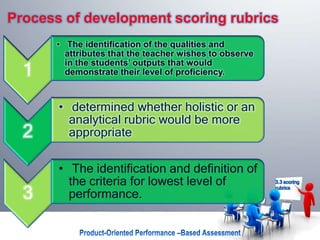
1
• The identification of the qualities and
attributes that the teacher wishes to observe
in the students’ outputs that would
demonstrate their level of proficiency.
2
• determined whether holistic or an
analytical rubric would be more
appropriate
3
• The identification and definition of
the criteria for lowest level of
performance.
Process of development scoring rubrics
3.3 scoring
rubrics
A note of caution:
• It is suggested that each score
category should be defined using
descriptors of the work rather than
value-judgement about the work
(Brookhart, 1999)
• For example,” student’s sentences
contain no errors in subject-verb
agreements,” is preferable over,
“student’s sentences are good”.
•
3.3 scoring
rubrics
Kingsoft Office
published by www.Kingsoftstore.com
@Kingsoft_Office
kingsoftstore

scoring rubrics

  • 1.
  • 2.
    Scoring rubrics • -are descriptive scoring schemes that are developed by the teachers or other evaluators to guide the analysis of the products or process of students’ efforts. • - are typically employed when a judgement of quality is required and maybe used to evaluate a broad range of projects activities. 3.3 scoring rubrics
  • 3.
    Criteria Setting • Thecriteria for a scoring rubrics are statements which identify “what really counts” in the final output. 3.3 scoring rubrics
  • 4.
    Major criteria forproduct assessment” • Quality • Creativity • Comprehensiveness • Accuracy • Aesthetics 3.3 scoring rubrics
  • 5.
    Substatements Topic: Three hundredyears of Spanish rule in the Philippines • Interrelates the chronological events in an interesting manner. • Identifies the key players in each period of the Spanish rule and the roles that they played. • Succeeds in relating the history of Philippine Spanish rule. 3.3 scoring rubrics
  • 6.
    When are thescoring rubrics an appropriate evaluation technique? • - Grading essays is just one example of performances that may be evaluated using scoring rubrics. 3.3 scoring rubrics
  • 7.
    Scoring rubrics maybe used: • Evaluate group activities • Extend projects and oral presentations 3.3 scoring rubrics
  • 8.
    Authentic assessment • Checklistmay be used rather than scoring rubrics in the evaluation of essays. 3.3 scoring rubrics
  • 9.
    Checklist • Enumerate aset of desirable characteristics which are actually observed. 3.3 scoring rubrics
  • 10.
    Scoring rubrics • Basedon descriptive scales and support the evaluation of the extent to which criteria have met. • “purpose of assessment” 3.3 scoring rubrics
  • 11.
    Benefits of scoringrubrics in the evaluation process • 1. support the examination of the extent to which the specified criteria have been reached. • 2. provide feedback to students concerning how to improve their performances. 3.3 scoring rubrics
  • 12.
    General vs. TaskSpecific. 3.3 scoring rubrics
  • 13.
    1 • The identificationof the qualities and attributes that the teacher wishes to observe in the students’ outputs that would demonstrate their level of proficiency. 2 • determined whether holistic or an analytical rubric would be more appropriate 3 • The identification and definition of the criteria for lowest level of performance. Process of development scoring rubrics 3.3 scoring rubrics
  • 14.
    A note ofcaution: • It is suggested that each score category should be defined using descriptors of the work rather than value-judgement about the work (Brookhart, 1999) • For example,” student’s sentences contain no errors in subject-verb agreements,” is preferable over, “student’s sentences are good”. • 3.3 scoring rubrics
  • 15.
    Kingsoft Office published bywww.Kingsoftstore.com @Kingsoft_Office kingsoftstore