







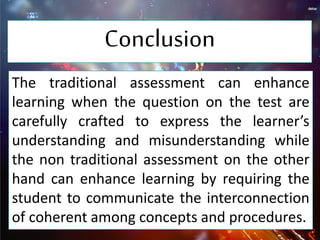

Traditional assessments typically involve multiple choice, true/false, or matching questions and evaluate students through ranked scores and grades. They are reliable and easy to administer but encourage low-level thinking. Non-traditional assessments like performance and portfolio evaluations directly observe students' applied skills and require higher-order thinking. They integrate written and applied measures to demonstrate proficiency in real-world tasks and emphasize cooperation over competition. While traditional tests enhance learning through understanding, non-traditional assessments enhance learning by requiring students to communicate interconnections among concepts and procedures.


