Criterial
assessment in
education:
Watch Them
Grow.
Presenter: Nederita Liliana
META Webinar 4.3
January 25, 2017
Shift
• From “What mark have you got?” to
“What/How did you learn?”
Two concepts
1. Assessment for learning – extends the potential of formative assessment
• where are children now in their learning?
• where are children going in their learning?
• how will children get to the next point in their learning?
2. Assessment of learning
Assessing a child’s learning at the end of a given period, such as the end of a unit of
work, a week, a term, or a year
Definitions
Assessment is the process of gathering information on student
learning. Assessment is an essential element of education used to
inform instruction (Wren, 2004).
Evaluation is the process of analysing, reflecting upon, and
summarising assessment information, and making judgements and/or
decisions based on the information collected.
Reporting involves communicating the summary and interpretation of
information about student learning to various audiences who require
it.
http://examination.irantvto.ir/uploads/assessing_and_evaluating_student_learning.pdf
What is
criterial
assessment
through
descriptors?
• a system of permanent and differential
improvement of learning, teaching and
evaluating through introduction of criteria and
descriptors
• Criterial assessment is the assessment of the
school results, which is carried out through
descriptors, that specify the level of individual
performance of the pupil in the process of
acquiring a competence.
Criteria of
assessment
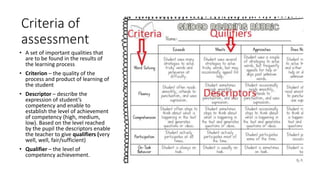
• A set of important qualities that
are to be found in the results of
the learning process
• Criterion – the quality of the
process and product of learning of
the student
• Descriptor – describe the
expression of student’s
competency and enable to
establish the level of achievement
of competency (high, medium,
low). Based on the level reached
by the pupil the descriptors enable
the teacher to give qualifiers (very
well, well, fair/sufficient)
• Qualifier – the level of
competency achievement.
The
characteristics
of the new
approach to
learning
• The emphasis of the evaluation process is on the pupil in action in the process of
learning
• Evaluation is contextualized – a connection between the life experiences and what is
learnt is made
• Measures the present performance, offers qualitative data
• Is interactive and engages the pupils in the process of evaluation
• The whole is more important than the part
• Helps the student to learn, making him aware of what is learnt, how is learnt, why does
s/he manage to learn
• Enables the pupil to correct errors and mistakes immediately and prevents their
accumulation
• Offers an instant feedback and adjusts the process on the go
• Is oriented towards the pupil getting immediate teacher’s help
• Enables a differential approach
• develops the pupils ability to self evaluation
• Reduces the time allotted for complex evaluation and increasing the time for learning
• Establishes the weak points in learning in order to mediate and remediate
• The tools for formative assessment allows the teacher to stimulate and develop the
pupil’s cognitive processes
Principles of the
criterial
assessment
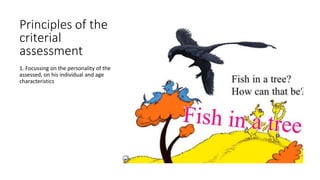
1. Focussing on the personality of the
assessed, on his individual and age
characteristics
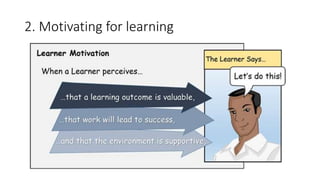
2. Motivating for learning
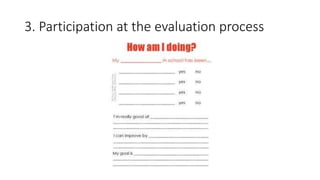
3. Participation at the evaluation process
4. Relevance and efficiency
5. Confidentiality
6. Success
7. Transparency
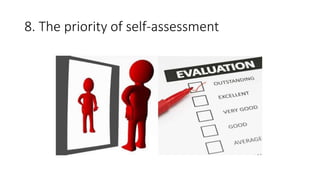
8. The priority of self-assessment
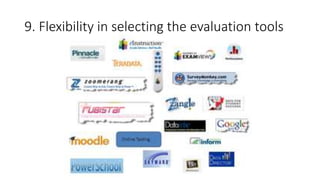
9. Flexibility in selecting the evaluation tools
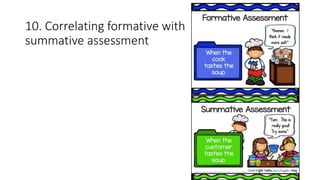
10. Correlating formative with
summative assessment
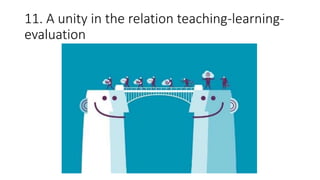
11. A unity in the relation teaching-learning-
evaluation
Objectives of
criterial
evaluation
1. selection of the information concerning the
progress, errors and mistakes of the pupil,
analysis of the information by using a set of
criteria established in advance
2. diagnosis of the causes of difficulties and
hindrances to learning
3. Adjusting the teaching and learning activities
based on the analysis of the evaluations
The purpose
of criterial
assessment
• to identify skills that need review.
Assessment provides teachers with information on what skills students have
and have not mastered. It is needed to help teachers know the skill levels of
their students, since students have varying experiences and knowledge.
• to monitor student progress.
A teacher can learn which students need review before covering additional
content and which students are ready to move forward.
• to guide teacher instruction.
Through consistent assessment, a teacher can make informed decisions about
what instruction is appropriate for each student.
• to demonstrate the effectiveness of instruction.
The information gained from assessment allows teachers to know if all students
are mastering the content covered. It is important for teachers to use
instructional time effectively, and this can be done when teachers are
knowledgeable about what their students are ready to learn and what they
already know. Therefore, the information gained from assessment allows a
teacher to create appropriate instruction for their students.
• to provide teachers with information on how instruction can be improved.
http://www.readingrockets.org/article/early-reading-assessment-guiding-tool-instruction
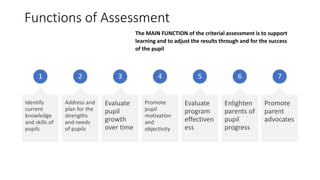
Functions of Assessment
1
Identify
current
knowledge
and skills of
pupils
2
Address and
plan for the
strengths
and needs
of pupils
3
Evaluate
pupil
growth
over time
4
Promote
pupil
motivation
and
objectivity
5
Evaluate
program
effectiven
ess
6
Enlighten
parents of
pupil
progress
7
Promote
parent
advocates
The MAIN FUNCTION of the criterial assessment is to support
learning and to adjust the results through and for the success
of the pupil
Components
of Assessment
• Documentation (data collection)
• Evaluation (comparison to a standard)
• Communication with family (sharing both
progress and performance)
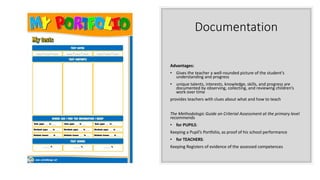
Documentation
Advantages:
• Gives the teacher a well-rounded picture of the student’s
understanding and progress
• unique talents, interests, knowledge, skills, and progress are
documented by observing, collecting, and reviewing children’s
work over time
provides teachers with clues about what and how to teach
The Methodologic Guide on Criterial Assessment at the primary level
recommends
• for PUPILS:
Keeping a Pupil’s Portfolio, as proof of his school performance
• for TEACHERS:
Keeping Registers of evidence of the assessed competences
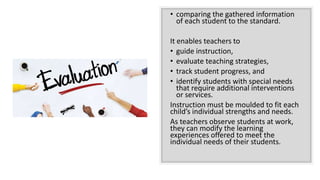
• comparing the gathered information
of each student to the standard.
It enables teachers to
• guide instruction,
• evaluate teaching strategies,
• track student progress, and
• identify students with special needs
that require additional interventions
or services.
Instruction must be moulded to fit each
child’s individual strengths and needs.
As teachers observe students at work,
they can modify the learning
experiences offered to meet the
individual needs of their students.
Family
Communication
• Families want to know how their child is doing in
school, and family members appreciate specific
examples of student progress. Showing examples
from their child over time enables parents to
personally assess the growth and progress of their
child.
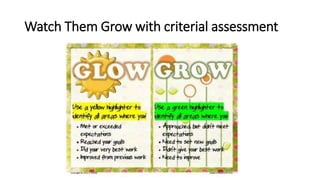
Watch Them Grow with criterial assessment
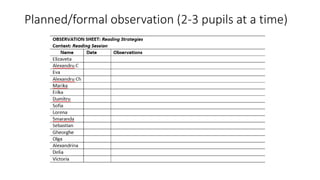
Planned/formal observation (2-3 pupils at a time)
Unplanned
(informal)
Observation
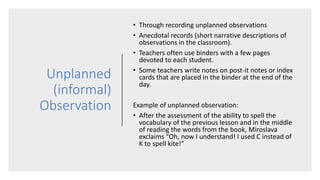
• Through recording unplanned observations
• Anecdotal records (short narrative descriptions of
observations in the classroom).
• Teachers often use binders with a few pages
devoted to each student.
• Some teachers write notes on post-it notes or index
cards that are placed in the binder at the end of the
day.
Example of unplanned observation:
• After the assessment of the ability to spell the
vocabulary of the previous lesson and in the middle
of reading the words from the book, Miroslava
exclaims “Oh, now I understand! I used C instead of
K to spell kite!”
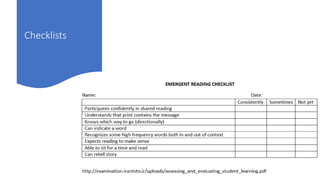
Checklists
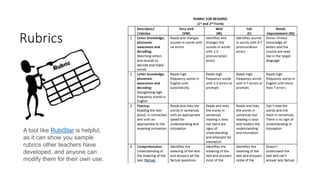
Rubrics
A tool like RubiStar is helpful,
as it can show you sample
rubrics other teachers have
developed, and anyone can
modify them for their own use.
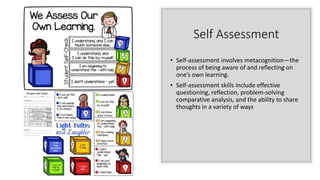
Self Assessment
• Self-assessment involves metacognition—the
process of being aware of and reflecting on
one’s own learning.
• Self-assessment skills include effective
questioning, reflection, problem-solving
comparative analysis, and the ability to share
thoughts in a variety of ways
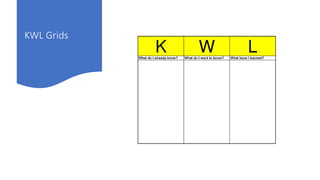
KWL Grids
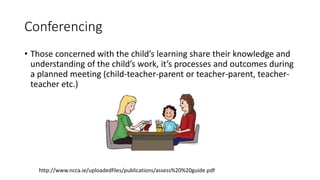
Conferencing
• Those concerned with the child’s learning share their knowledge and
understanding of the child’s work, it’s processes and outcomes during
a planned meeting (child-teacher-parent or teacher-parent, teacher-
teacher etc.)
http://www.ncca.ie/uploadedfiles/publications/assess%20%20guide.pdf
• Includes samples of child’s work across the
curriculum or in a particular subject
Example:
Welcome to my portfolio
• My name is _______________.
• I am in _________________ class.
• I like to ___________________.
• My favourite colour is ___________________.
• My favourite season is ___________________.
• My favourite fruit is _________________.
• My favourite vegetable is _______________.
• I have got a ________________.
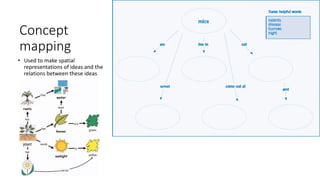
Concept
mapping
• Used to make spatial
representations of ideas and the
relations between these ideas
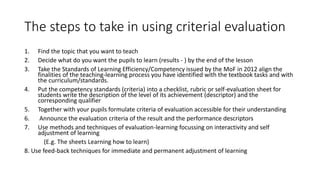
The steps to take in using criterial evaluation
1. Find the topic that you want to teach
2. Decide what do you want the pupils to learn (results - ) by the end of the lesson
3. Take the Standards of Learning Efficiency/Competency issued by the MoF in 2012 align the
finalities of the teaching-learning process you have identified with the textbook tasks and with
the curriculum/standards.
4. Put the competency standards (criteria) into a checklist, rubric or self-evaluation sheet for
students write the description of the level of its achievement (descriptor) and the
corresponding qualifier
5. Together with your pupils formulate criteria of evaluation accessible for their understanding
6. Announce the evaluation criteria of the result and the performance descriptors
7. Use methods and techniques of evaluation-learning focussing on interactivity and self
adjustment of learning
(E.g. The sheets Learning how to learn)
8. Use feed-back techniques for immediate and permanent adjustment of learning
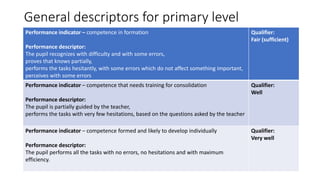
Performance indicator – competence in formation
Performance descriptor:
The pupil recognizes with difficulty and with some errors,
proves that knows partially,
performs the tasks hesitantly, with some errors which do not affect something important,
perceives with some errors
Qualifier:
Fair (sufficient)
Performance indicator – competence that needs training for consolidation
Performance descriptor:
The pupil is partially guided by the teacher,
performs the tasks with very few hesitations, based on the questions asked by the teacher
Qualifier:
Well
Performance indicator – competence formed and likely to develop individually
Performance descriptor:
The pupil performs all the tasks with no errors, no hesitations and with maximum
efficiency.
Qualifier:
Very well
General descriptors for primary level
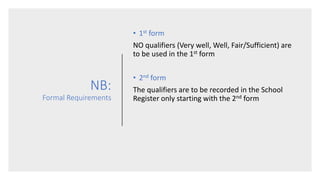
NB:
Formal Requirements
• 1st form
NO qualifiers (Very well, Well, Fair/Sufficient) are
to be used in the 1st form
• 2nd form
The qualifiers are to be recorded in the School
Register only starting with the 2nd form
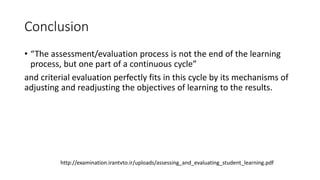
Conclusion
• “The assessment/evaluation process is not the end of the learning
process, but one part of a continuous cycle”
and criterial evaluation perfectly fits in this cycle by its mechanisms of
adjusting and readjusting the objectives of learning to the results.
http://examination.irantvto.ir/uploads/assessing_and_evaluating_student_learning.pdf

Criterial assessment watch them grow

  • 1.
    Criterial assessment in education: Watch Them Grow. Presenter:Nederita Liliana META Webinar 4.3 January 25, 2017
  • 2.
    Shift • From “Whatmark have you got?” to “What/How did you learn?”
  • 3.
    Two concepts 1. Assessmentfor learning – extends the potential of formative assessment • where are children now in their learning? • where are children going in their learning? • how will children get to the next point in their learning? 2. Assessment of learning Assessing a child’s learning at the end of a given period, such as the end of a unit of work, a week, a term, or a year
  • 4.
    Definitions Assessment is theprocess of gathering information on student learning. Assessment is an essential element of education used to inform instruction (Wren, 2004). Evaluation is the process of analysing, reflecting upon, and summarising assessment information, and making judgements and/or decisions based on the information collected. Reporting involves communicating the summary and interpretation of information about student learning to various audiences who require it. http://examination.irantvto.ir/uploads/assessing_and_evaluating_student_learning.pdf
  • 5.
    What is criterial assessment through descriptors? • asystem of permanent and differential improvement of learning, teaching and evaluating through introduction of criteria and descriptors • Criterial assessment is the assessment of the school results, which is carried out through descriptors, that specify the level of individual performance of the pupil in the process of acquiring a competence.
  • 6.
    Criteria of assessment • Aset of important qualities that are to be found in the results of the learning process • Criterion – the quality of the process and product of learning of the student • Descriptor – describe the expression of student’s competency and enable to establish the level of achievement of competency (high, medium, low). Based on the level reached by the pupil the descriptors enable the teacher to give qualifiers (very well, well, fair/sufficient) • Qualifier – the level of competency achievement.
  • 7.
    The characteristics of the new approachto learning • The emphasis of the evaluation process is on the pupil in action in the process of learning • Evaluation is contextualized – a connection between the life experiences and what is learnt is made • Measures the present performance, offers qualitative data • Is interactive and engages the pupils in the process of evaluation • The whole is more important than the part • Helps the student to learn, making him aware of what is learnt, how is learnt, why does s/he manage to learn • Enables the pupil to correct errors and mistakes immediately and prevents their accumulation • Offers an instant feedback and adjusts the process on the go • Is oriented towards the pupil getting immediate teacher’s help • Enables a differential approach • develops the pupils ability to self evaluation • Reduces the time allotted for complex evaluation and increasing the time for learning • Establishes the weak points in learning in order to mediate and remediate • The tools for formative assessment allows the teacher to stimulate and develop the pupil’s cognitive processes
  • 8.
    Principles of the criterial assessment 1.Focussing on the personality of the assessed, on his individual and age characteristics
  • 9.
  • 10.
    3. Participation atthe evaluation process
  • 11.
    4. Relevance andefficiency
  • 12.
  • 13.
  • 14.
  • 15.
    8. The priorityof self-assessment
  • 16.
    9. Flexibility inselecting the evaluation tools
  • 17.
    10. Correlating formativewith summative assessment
  • 18.
    11. A unityin the relation teaching-learning- evaluation
  • 19.
    Objectives of criterial evaluation 1. selectionof the information concerning the progress, errors and mistakes of the pupil, analysis of the information by using a set of criteria established in advance 2. diagnosis of the causes of difficulties and hindrances to learning 3. Adjusting the teaching and learning activities based on the analysis of the evaluations
  • 20.
    The purpose of criterial assessment •to identify skills that need review. Assessment provides teachers with information on what skills students have and have not mastered. It is needed to help teachers know the skill levels of their students, since students have varying experiences and knowledge. • to monitor student progress. A teacher can learn which students need review before covering additional content and which students are ready to move forward. • to guide teacher instruction. Through consistent assessment, a teacher can make informed decisions about what instruction is appropriate for each student. • to demonstrate the effectiveness of instruction. The information gained from assessment allows teachers to know if all students are mastering the content covered. It is important for teachers to use instructional time effectively, and this can be done when teachers are knowledgeable about what their students are ready to learn and what they already know. Therefore, the information gained from assessment allows a teacher to create appropriate instruction for their students. • to provide teachers with information on how instruction can be improved. http://www.readingrockets.org/article/early-reading-assessment-guiding-tool-instruction
  • 21.
    Functions of Assessment 1 Identify current knowledge andskills of pupils 2 Address and plan for the strengths and needs of pupils 3 Evaluate pupil growth over time 4 Promote pupil motivation and objectivity 5 Evaluate program effectiven ess 6 Enlighten parents of pupil progress 7 Promote parent advocates The MAIN FUNCTION of the criterial assessment is to support learning and to adjust the results through and for the success of the pupil
  • 22.
    Components of Assessment • Documentation(data collection) • Evaluation (comparison to a standard) • Communication with family (sharing both progress and performance)
  • 23.
    Documentation Advantages: • Gives theteacher a well-rounded picture of the student’s understanding and progress • unique talents, interests, knowledge, skills, and progress are documented by observing, collecting, and reviewing children’s work over time provides teachers with clues about what and how to teach The Methodologic Guide on Criterial Assessment at the primary level recommends • for PUPILS: Keeping a Pupil’s Portfolio, as proof of his school performance • for TEACHERS: Keeping Registers of evidence of the assessed competences
  • 24.
    • comparing thegathered information of each student to the standard. It enables teachers to • guide instruction, • evaluate teaching strategies, • track student progress, and • identify students with special needs that require additional interventions or services. Instruction must be moulded to fit each child’s individual strengths and needs. As teachers observe students at work, they can modify the learning experiences offered to meet the individual needs of their students.
  • 25.
    Family Communication • Families wantto know how their child is doing in school, and family members appreciate specific examples of student progress. Showing examples from their child over time enables parents to personally assess the growth and progress of their child.
  • 26.
    Watch Them Growwith criterial assessment
  • 28.
  • 29.
    Unplanned (informal) Observation • Through recordingunplanned observations • Anecdotal records (short narrative descriptions of observations in the classroom). • Teachers often use binders with a few pages devoted to each student. • Some teachers write notes on post-it notes or index cards that are placed in the binder at the end of the day. Example of unplanned observation: • After the assessment of the ability to spell the vocabulary of the previous lesson and in the middle of reading the words from the book, Miroslava exclaims “Oh, now I understand! I used C instead of K to spell kite!”
  • 30.
  • 31.
    Rubrics A tool likeRubiStar is helpful, as it can show you sample rubrics other teachers have developed, and anyone can modify them for their own use.
  • 32.
    Self Assessment • Self-assessmentinvolves metacognition—the process of being aware of and reflecting on one’s own learning. • Self-assessment skills include effective questioning, reflection, problem-solving comparative analysis, and the ability to share thoughts in a variety of ways
  • 33.
  • 34.
    Conferencing • Those concernedwith the child’s learning share their knowledge and understanding of the child’s work, it’s processes and outcomes during a planned meeting (child-teacher-parent or teacher-parent, teacher- teacher etc.) http://www.ncca.ie/uploadedfiles/publications/assess%20%20guide.pdf
  • 35.
    • Includes samplesof child’s work across the curriculum or in a particular subject Example: Welcome to my portfolio • My name is _______________. • I am in _________________ class. • I like to ___________________. • My favourite colour is ___________________. • My favourite season is ___________________. • My favourite fruit is _________________. • My favourite vegetable is _______________. • I have got a ________________.
  • 36.
    Concept mapping • Used tomake spatial representations of ideas and the relations between these ideas
  • 38.
    The steps totake in using criterial evaluation 1. Find the topic that you want to teach 2. Decide what do you want the pupils to learn (results - ) by the end of the lesson 3. Take the Standards of Learning Efficiency/Competency issued by the MoF in 2012 align the finalities of the teaching-learning process you have identified with the textbook tasks and with the curriculum/standards. 4. Put the competency standards (criteria) into a checklist, rubric or self-evaluation sheet for students write the description of the level of its achievement (descriptor) and the corresponding qualifier 5. Together with your pupils formulate criteria of evaluation accessible for their understanding 6. Announce the evaluation criteria of the result and the performance descriptors 7. Use methods and techniques of evaluation-learning focussing on interactivity and self adjustment of learning (E.g. The sheets Learning how to learn) 8. Use feed-back techniques for immediate and permanent adjustment of learning
  • 39.
    Performance indicator –competence in formation Performance descriptor: The pupil recognizes with difficulty and with some errors, proves that knows partially, performs the tasks hesitantly, with some errors which do not affect something important, perceives with some errors Qualifier: Fair (sufficient) Performance indicator – competence that needs training for consolidation Performance descriptor: The pupil is partially guided by the teacher, performs the tasks with very few hesitations, based on the questions asked by the teacher Qualifier: Well Performance indicator – competence formed and likely to develop individually Performance descriptor: The pupil performs all the tasks with no errors, no hesitations and with maximum efficiency. Qualifier: Very well General descriptors for primary level
  • 40.
    NB: Formal Requirements • 1stform NO qualifiers (Very well, Well, Fair/Sufficient) are to be used in the 1st form • 2nd form The qualifiers are to be recorded in the School Register only starting with the 2nd form
  • 41.
    Conclusion • “The assessment/evaluationprocess is not the end of the learning process, but one part of a continuous cycle” and criterial evaluation perfectly fits in this cycle by its mechanisms of adjusting and readjusting the objectives of learning to the results. http://examination.irantvto.ir/uploads/assessing_and_evaluating_student_learning.pdf