
K TO 12
BASIC EDUCATION PROGRAM
Embarking on the most
comprehensive basic education
reform
Poor quality of Basic Education (low achievement
scores of students in local and international
tests
Why K to 12?
Congested Curriculum (the current 10-year basic
education curriculum is designed to be taught in
12 years)
HS graduates are not adequately prepared
for the world of work (too young to enter
the labor force  below 18)
Filipino students are not globally competitive
K TO 12 EDUCATION STRUCTURE
The K to 12 Basic Education
Curriculum will be enhanced.
Learner-
Centered
Decongested
Seamless
Responsive
Enriched
Integrative, Inquiry-
based, Constructivist
Flexible to local
needs
Focuses on the optimum
development of the
Filipino
Allows for mastery of
competencies
Continuum following an
expanding spiral progression
model
• Healthy mind and body
• Solid moral and spiritual grounding
• Essential skills for lifelong learning
• Proud to be a Filipino
• Development of critical-thinking and creative
problem solving skills
• Care for the environment
The K to 12 Curriculum will
produce holistically developed
learners with 21st century skills
• K to 12 curriculum will be decongested and
learner-centered
• Kindergarten will be integrated into the basic
education system... a bold step toward making
all Grade 1 pupils a reader
• Senior HS will be in alignment with the 21st
century skills and college readiness standards
of CHED
• Curriculum will focus on core subjects, namely
Math, Science, and English
• Graduates will be accredited in their areas of
specializations (Academics, Tech-Voc, and
Sports and Arts)
Framework for 21st Century Learning
Basic Skills:
reading, comprehension, writing, mathematical
problem solving, speaking and listening
People Skills: social skills (demonstrating
understanding and
empathy), negotiation, leadership, teamwork and
cultural diversity
Personal Qualities: self-esteem, self-
management and responsibility
Thinking Skills: creative thinking, problem
solving, decision making and visualization
Skills for Workplace Competencies
• Core Subjects and their themes
The 21st Century Skills
global awareness
financial, economic, business and
entrepreneurial literacy
civic literacy
health literacy
environmental literacy
• Learning and Innovation Skills
The 21st Century Skills
creativity
innovation
critical thinking/ problem solving
communication and collaboration
• Information, Media and Technology Skills
The 21st Century Skills
Information and Media Literacy
ICT
(Information, Communications
and Technology) literacy
• Life and Career Skills
The 21st Century Skills
- flexibility and adaptability
- initiative and self-direction
- productivity and accountability
- social and cross-cultural skills
- leadership and responsibility
The most effective learning processes actively
engage student interest and have a sense of
authenticity.
Learners must actively, and on an ongoing
basis, monitor and adjust their own learning
processes.
The learning goals for which the student is
responsible must be
comprehensible, transparent and purposeful.
21st Century Learning Theory
Maximum learning occurs when the teacher
diagnoses and pre-assesses students’ varying
readiness levels, interests and learning profiles
and adjusts the teaching-learning process to
accommodate them.
21st century learning is anchored on authentic
culminating performance tasks and projects.
21st Century Learning Theory
How then do we apply the
learning theory and the 21st
century skills to assessment?
Three Types of Classroom Assessment
Assessment for
Learning
Assessment as
Learning
Assessment of Learning
Diagnostic Formative Summative
Assessment that
precedes instruction to
check students’ prior
knowledge and
experience,
misconceptions,
interests, and/ or
learning style
preferences.
Ongoing assessments
that provide
information o guide
teaching and learning
for improving learning
and performance.
Culminating assessments
conducted at the end of a
unit, course, or grade level to
determine the degree of
mastery or proficiency
according to identified
achievement targets.
Teacher pre-assesses knowledge and skills.
Results are used to examine teaching and
improve learning.
Teacher regularly checks whether students are
attaining the objectives of the lesson.
Results are recorded but are not used for
grading purposes.
Results are used for improving learning.
• Teacher makes a judgment on the level of
proficiency the learner has attained.
• Results are used to improve future learning.
Three Types of Classroom Assessment
Assessment for
Learning
Assessment as
Learning
Assessment of
Learning
Diagnostic Formative Summative
Diagnostics
assessments
provide
information to
assist teacher
planning and guide
differentiated
instruction.
Formative
assessments
include both
formal and
informal methods.
Summative assessments
are evaluative in nature,
generally resulting in a
score or a grade.
Assessments serve different purposes…
Two Views of Assessment
Assessment is for:
Judging
Assessment is for:
Right Answers
Control
Comparison to others
Use with single activities
Guiding
Self-Reflection
Information
Comparison to task
Use over multiple activities
On-going Assessment
Some teachers
talk about …
Some teachers
talk about …
-Can these two coexist peacefully?
- Should one receive emphasis over the other?
FORMATIVE ASSESSMENT is CRITICAL
We do too much “testing” and not enough
“feedbacking”.
Understanding is transferability.
Without
understanding
Rigid
knowledge
Assessment shall be at four levels and shall be
weighed as follows:
Level of Assessment Percentage Weight
Knowledge 15
Process or skills 25
Understanding(s) 30
Products/Performances 30
Total 100%
The levels are defined as follows:
1. “Knowledge” refers to the substantive content of the
curriculum, the facts and information that the student
acquires.
ASSESMENT TOOLS for KNOWLEDGE (Facts and
Information)
– Paper and pencil tests
– Matching type
– Multiple choice
– Constructed response type (situational)
What facts do you need to consider first? (not
prompted)
traditional
2. “Process” refers to cognitive
operations that the student performs
on facts and information for the
purpose of constructing meanings
and understanding
ASSESMENT TOOLS for PROCESS
• Outline
• Organize
• Analyze
• Interpret
• Express creativity
• Translate
• Convert
• Draw analogies
• Construct graphs,
flowcharts
• Graphic organizers
• Distinguishing fact and
opinion; truth vs.
hearsay; essential vs.
trivial
3. “Understandings” refers to
enduring big ideas, principles
and generalizations inherent to
discipline, which are assessed
using the facets of
understanding.
ASSESSMENT TOOLS for
UNDERSTANDING
– Understanding of the EU
using the facets of
understanding
4. “Products/Performances” refers to real-life
application of understanding as evidenced by the
student’s performance of authentic tasks.
ASSESSMENT TOOLS for PRODUCTS/PERFORMANCES
The highest level of assessment focuses on the
products/performances which students are expected
to produce through authentic performance task
using GRASPS.
At the end of the quarter, the
performance of students shall be
described in the report card, based on the
following levels of proficiency:
• Beginning – the student at this level struggles with his/her
understanding; prerequisite and fundamental knowledge and/or
skills have not been acquired or developed adequately to aid
understanding
• Developing – the student at this level possesses the minimum
knowledge and skills and core understandings, but needs help
throughout the performance of authentic tasks
• Approaching Proficiency – the student at this level has developed
the fundamental knowledge and skills and core understandings
and, with little guidance from the teacher and/or with some
assistance from peers, can transfer these understandings through
authentic performance tasks
• Proficient – The student at this level has developed the
fundamental knowledge and skills and core
understandings, and can transfer them independently
through authentic performance tasks
• Advanced – The student at this level exceeds the core
requirements in terms of knowledge, skills and
understandings, and can transfer them automatically and
flexibly through authentic performance tasks
The level of proficiency at which the student is performing shall
be based on a numerical value which is arrived at after
summing up the results of the student’s performance on the
various levels of assessment. The numerical values are as
follows:
Level of Proficiency Equivalent Numerical Value
Beginning 74% and below
Developing 75-79%
Approaching Proficiency 80-84%
Proficient 85-89%
Advanced 90% and above
What should appear in the report card is not the numerical
value, but the equivalent level of proficiency, abbreviated as
follows:
B for Beginning;
D for Developing;
AP for Approaching Proficiency
P for Proficient; and
A for Advanced
At the end of the four
quarters, the Final Grade shall be
reported as the average of the
four quarterly ratings, expressed
in terms of the level of
proficiency.
Honor students shall be
drawn from among those who
performed at the Advanced Level.
Subsequent guidelines shall be
issued as basis for ranking of
honors.
• Technically competent
• Innovative and creative
• Knowledge-based with higher order thinking
skills
• With foundational life skills
• In pursuit of lifelong learning opportunities
• Possessing desirable work attitudes and
behavior
Who is the 21st Skilled Filipino
Workforce?
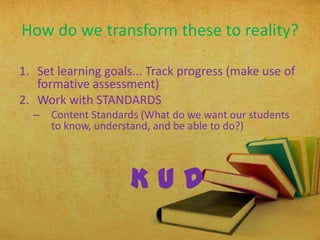
1. Set learning goals... Track progress (make use of
formative assessment)
2. Work with STANDARDS
– Content Standards (What do we want our students
to know, understand, and be able to do?)
K U D
How do we transform these to reality?
- Performance Standards (What do we want
our students to do with their
learning/understanding? How do we want
them to use their learning/understanding?)
Acquisition
Meaning-Making
Transfer
Learning  for UNDERSTANDING and
TRANSFER
vs
Facts and Memorization
multidimensional
complicated
45
Facet 1: EXPLANATION
- Inference about why and
how, with specific evidence
and logic
46
real + real = real
7.5
+ 2.5
10
Facet 2: INTERPRETATION
- Meaning derived from shedding
interesting and significant light
on current or past experience
48
49
Facet 3: APPLICATION
- Ability to use knowledge
effectively in new situations and
diverse, realistic contexts
50
The instuctorThe learner
51
Facet 4: PERSPECTIVE
- Critical and insightful
points of view
52
53
Facet 5: EMPATHY
- Ability to get inside
another persons feelings
and world view
54
55
Facet 6: SELF-KNOWLEDGE
- Wisdom to know one’s ignorance and
how one’s patterns of thought and actions
inform as well as prejudice understanding
Lesson: Nouns/Naming Words
Competencies/Skills
The students will know:
1.What nouns are
2.The types of nouns
3.The functions of nouns
4.How to distinguish nouns
Examples
At the end of the period the students should
be able to:
• Know what nouns are for in their lives
• Realize that without nouns they can have no
identity
• Function efficiently in society because they
are labeled appropriately
• Find more meaning in who and what they are
The interface (UBD and K to 12)
The students will know:
1. The three food groups
2. How to classify food samples
3. Prepare a healthy diet
Lesson: Food Groups
competencies/Skills
At the end of the period the students should
be able to:
1.Classify food samples correctly to promote
healthy living
2.Prepare healthy diets to prolong life
3.Realize that even a healthy diet is not for
everyone.
The interface (UBD and K to 12)
The students will know:
1. How to tell time
2. How to identify the parts of a clock
3. How to describe the function/s of the parts
of a clock
Competencies/ Skills
At the end of the period the students should be
able to:
1. Tell time so that they can manage their lives
efficiently and competently
2. Realize that events in life are based on
proper time management
The Interface (UBD and K to 12)
• Acquire mastery of basic competencies
• Be emotionally mature
• Be socially aware, pro-active, involved in public
and civic affairs
• Be adequately prepared for the world of work or
entrepreneurship or higher education
• Be legally employable with potential for better
earnings
• Be globally competitive
Graduates of K to 12 will be
holistically-developed Filipinos with
21st Century Skills
• Mathematical
• Technological
• Visual
• Cultural
• Global awareness
• Critical/Creative thinking skills
• Social responsibility
Develop 21st Century Literacies
Do remember these two difficult truths
about teaching:
1. No matter how much you do, you’ll
feel it’s not enough.
2. Just because you can only do a little,
is no excuse to do nothing.
- Susan Ohanian
The essential questions at this
time are not WHAT and
WHY, the essential question
is HOW?
“Education is the key to the long-term
problems of the country. If we fix basic
education, we fix the long-term
problems of the country. And if we fix
the country’s problems, we will build a
truly strong society we can proudly
call the Philippines.”
On K to 12 Program
- President Benigno S. Aquino III
K to 12

K to 12

  • 1.
    K TO 12 BASICEDUCATION PROGRAM Embarking on the most comprehensive basic education reform
  • 2.
    Poor quality ofBasic Education (low achievement scores of students in local and international tests Why K to 12? Congested Curriculum (the current 10-year basic education curriculum is designed to be taught in 12 years) HS graduates are not adequately prepared for the world of work (too young to enter the labor force  below 18) Filipino students are not globally competitive
  • 3.
    K TO 12EDUCATION STRUCTURE
  • 4.
    The K to12 Basic Education Curriculum will be enhanced. Learner- Centered Decongested Seamless Responsive Enriched Integrative, Inquiry- based, Constructivist Flexible to local needs Focuses on the optimum development of the Filipino Allows for mastery of competencies Continuum following an expanding spiral progression model
  • 5.
    • Healthy mindand body • Solid moral and spiritual grounding • Essential skills for lifelong learning • Proud to be a Filipino • Development of critical-thinking and creative problem solving skills • Care for the environment The K to 12 Curriculum will produce holistically developed learners with 21st century skills
  • 6.
    • K to12 curriculum will be decongested and learner-centered • Kindergarten will be integrated into the basic education system... a bold step toward making all Grade 1 pupils a reader • Senior HS will be in alignment with the 21st century skills and college readiness standards of CHED
  • 7.
    • Curriculum willfocus on core subjects, namely Math, Science, and English • Graduates will be accredited in their areas of specializations (Academics, Tech-Voc, and Sports and Arts)
  • 8.
    Framework for 21stCentury Learning
  • 9.
    Basic Skills: reading, comprehension,writing, mathematical problem solving, speaking and listening People Skills: social skills (demonstrating understanding and empathy), negotiation, leadership, teamwork and cultural diversity Personal Qualities: self-esteem, self- management and responsibility Thinking Skills: creative thinking, problem solving, decision making and visualization Skills for Workplace Competencies
  • 10.
    • Core Subjectsand their themes The 21st Century Skills global awareness financial, economic, business and entrepreneurial literacy civic literacy health literacy environmental literacy
  • 11.
    • Learning andInnovation Skills The 21st Century Skills creativity innovation critical thinking/ problem solving communication and collaboration
  • 12.
    • Information, Mediaand Technology Skills The 21st Century Skills Information and Media Literacy ICT (Information, Communications and Technology) literacy
  • 13.
    • Life andCareer Skills The 21st Century Skills - flexibility and adaptability - initiative and self-direction - productivity and accountability - social and cross-cultural skills - leadership and responsibility
  • 14.
    The most effectivelearning processes actively engage student interest and have a sense of authenticity. Learners must actively, and on an ongoing basis, monitor and adjust their own learning processes. The learning goals for which the student is responsible must be comprehensible, transparent and purposeful. 21st Century Learning Theory
  • 15.
    Maximum learning occurswhen the teacher diagnoses and pre-assesses students’ varying readiness levels, interests and learning profiles and adjusts the teaching-learning process to accommodate them. 21st century learning is anchored on authentic culminating performance tasks and projects. 21st Century Learning Theory
  • 16.
    How then dowe apply the learning theory and the 21st century skills to assessment?
  • 17.
    Three Types ofClassroom Assessment Assessment for Learning Assessment as Learning Assessment of Learning Diagnostic Formative Summative Assessment that precedes instruction to check students’ prior knowledge and experience, misconceptions, interests, and/ or learning style preferences. Ongoing assessments that provide information o guide teaching and learning for improving learning and performance. Culminating assessments conducted at the end of a unit, course, or grade level to determine the degree of mastery or proficiency according to identified achievement targets.
  • 18.
    Teacher pre-assesses knowledgeand skills. Results are used to examine teaching and improve learning.
  • 19.
    Teacher regularly checkswhether students are attaining the objectives of the lesson. Results are recorded but are not used for grading purposes. Results are used for improving learning.
  • 20.
    • Teacher makesa judgment on the level of proficiency the learner has attained. • Results are used to improve future learning.
  • 21.
    Three Types ofClassroom Assessment Assessment for Learning Assessment as Learning Assessment of Learning Diagnostic Formative Summative Diagnostics assessments provide information to assist teacher planning and guide differentiated instruction. Formative assessments include both formal and informal methods. Summative assessments are evaluative in nature, generally resulting in a score or a grade.
  • 22.
  • 23.
    Two Views ofAssessment Assessment is for: Judging Assessment is for: Right Answers Control Comparison to others Use with single activities Guiding Self-Reflection Information Comparison to task Use over multiple activities
  • 24.
    On-going Assessment Some teachers talkabout … Some teachers talk about … -Can these two coexist peacefully? - Should one receive emphasis over the other?
  • 25.
    FORMATIVE ASSESSMENT isCRITICAL We do too much “testing” and not enough “feedbacking”.
  • 26.
  • 27.
    Assessment shall beat four levels and shall be weighed as follows: Level of Assessment Percentage Weight Knowledge 15 Process or skills 25 Understanding(s) 30 Products/Performances 30 Total 100%
  • 28.
    The levels aredefined as follows:
  • 29.
    1. “Knowledge” refersto the substantive content of the curriculum, the facts and information that the student acquires. ASSESMENT TOOLS for KNOWLEDGE (Facts and Information) – Paper and pencil tests – Matching type – Multiple choice – Constructed response type (situational) What facts do you need to consider first? (not prompted) traditional
  • 30.
    2. “Process” refersto cognitive operations that the student performs on facts and information for the purpose of constructing meanings and understanding
  • 31.
    ASSESMENT TOOLS forPROCESS • Outline • Organize • Analyze • Interpret • Express creativity • Translate • Convert • Draw analogies • Construct graphs, flowcharts • Graphic organizers • Distinguishing fact and opinion; truth vs. hearsay; essential vs. trivial
  • 32.
    3. “Understandings” refersto enduring big ideas, principles and generalizations inherent to discipline, which are assessed using the facets of understanding. ASSESSMENT TOOLS for UNDERSTANDING – Understanding of the EU using the facets of understanding
  • 33.
    4. “Products/Performances” refersto real-life application of understanding as evidenced by the student’s performance of authentic tasks. ASSESSMENT TOOLS for PRODUCTS/PERFORMANCES The highest level of assessment focuses on the products/performances which students are expected to produce through authentic performance task using GRASPS.
  • 34.
    At the endof the quarter, the performance of students shall be described in the report card, based on the following levels of proficiency:
  • 35.
    • Beginning –the student at this level struggles with his/her understanding; prerequisite and fundamental knowledge and/or skills have not been acquired or developed adequately to aid understanding • Developing – the student at this level possesses the minimum knowledge and skills and core understandings, but needs help throughout the performance of authentic tasks • Approaching Proficiency – the student at this level has developed the fundamental knowledge and skills and core understandings and, with little guidance from the teacher and/or with some assistance from peers, can transfer these understandings through authentic performance tasks
  • 36.
    • Proficient –The student at this level has developed the fundamental knowledge and skills and core understandings, and can transfer them independently through authentic performance tasks • Advanced – The student at this level exceeds the core requirements in terms of knowledge, skills and understandings, and can transfer them automatically and flexibly through authentic performance tasks
  • 37.
    The level ofproficiency at which the student is performing shall be based on a numerical value which is arrived at after summing up the results of the student’s performance on the various levels of assessment. The numerical values are as follows: Level of Proficiency Equivalent Numerical Value Beginning 74% and below Developing 75-79% Approaching Proficiency 80-84% Proficient 85-89% Advanced 90% and above
  • 38.
    What should appearin the report card is not the numerical value, but the equivalent level of proficiency, abbreviated as follows: B for Beginning; D for Developing; AP for Approaching Proficiency P for Proficient; and A for Advanced
  • 39.
    At the endof the four quarters, the Final Grade shall be reported as the average of the four quarterly ratings, expressed in terms of the level of proficiency. Honor students shall be drawn from among those who performed at the Advanced Level. Subsequent guidelines shall be issued as basis for ranking of honors.
  • 40.
    • Technically competent •Innovative and creative • Knowledge-based with higher order thinking skills • With foundational life skills • In pursuit of lifelong learning opportunities • Possessing desirable work attitudes and behavior Who is the 21st Skilled Filipino Workforce?
  • 41.
    1. Set learninggoals... Track progress (make use of formative assessment) 2. Work with STANDARDS – Content Standards (What do we want our students to know, understand, and be able to do?) K U D How do we transform these to reality?
  • 42.
    - Performance Standards(What do we want our students to do with their learning/understanding? How do we want them to use their learning/understanding?) Acquisition Meaning-Making Transfer
  • 43.
    Learning  forUNDERSTANDING and TRANSFER vs Facts and Memorization
  • 44.
  • 45.
    45 Facet 1: EXPLANATION -Inference about why and how, with specific evidence and logic
  • 46.
    46 real + real= real 7.5 + 2.5 10
  • 47.
    Facet 2: INTERPRETATION -Meaning derived from shedding interesting and significant light on current or past experience
  • 48.
  • 49.
    49 Facet 3: APPLICATION -Ability to use knowledge effectively in new situations and diverse, realistic contexts
  • 50.
  • 51.
    51 Facet 4: PERSPECTIVE -Critical and insightful points of view
  • 52.
  • 53.
    53 Facet 5: EMPATHY -Ability to get inside another persons feelings and world view
  • 54.
  • 55.
    55 Facet 6: SELF-KNOWLEDGE -Wisdom to know one’s ignorance and how one’s patterns of thought and actions inform as well as prejudice understanding
  • 56.
    Lesson: Nouns/Naming Words Competencies/Skills Thestudents will know: 1.What nouns are 2.The types of nouns 3.The functions of nouns 4.How to distinguish nouns Examples
  • 57.
    At the endof the period the students should be able to: • Know what nouns are for in their lives • Realize that without nouns they can have no identity • Function efficiently in society because they are labeled appropriately • Find more meaning in who and what they are The interface (UBD and K to 12)
  • 58.
    The students willknow: 1. The three food groups 2. How to classify food samples 3. Prepare a healthy diet Lesson: Food Groups competencies/Skills
  • 59.
    At the endof the period the students should be able to: 1.Classify food samples correctly to promote healthy living 2.Prepare healthy diets to prolong life 3.Realize that even a healthy diet is not for everyone. The interface (UBD and K to 12)
  • 60.
    The students willknow: 1. How to tell time 2. How to identify the parts of a clock 3. How to describe the function/s of the parts of a clock Competencies/ Skills
  • 61.
    At the endof the period the students should be able to: 1. Tell time so that they can manage their lives efficiently and competently 2. Realize that events in life are based on proper time management The Interface (UBD and K to 12)
  • 62.
    • Acquire masteryof basic competencies • Be emotionally mature • Be socially aware, pro-active, involved in public and civic affairs • Be adequately prepared for the world of work or entrepreneurship or higher education • Be legally employable with potential for better earnings • Be globally competitive Graduates of K to 12 will be holistically-developed Filipinos with 21st Century Skills
  • 63.
    • Mathematical • Technological •Visual • Cultural • Global awareness • Critical/Creative thinking skills • Social responsibility Develop 21st Century Literacies
  • 64.
    Do remember thesetwo difficult truths about teaching: 1. No matter how much you do, you’ll feel it’s not enough. 2. Just because you can only do a little, is no excuse to do nothing. - Susan Ohanian
  • 66.
    The essential questionsat this time are not WHAT and WHY, the essential question is HOW? “Education is the key to the long-term problems of the country. If we fix basic education, we fix the long-term problems of the country. And if we fix the country’s problems, we will build a truly strong society we can proudly call the Philippines.” On K to 12 Program - President Benigno S. Aquino III