PLANNING FOR
ASSESSMENT:
CORE PRINCIPLES
Assessment
• Assessment is part of “teaching for
success.”
• Assessment information helps students
chart and contribute to their own growth.
• Assessment is more focused on personal
growth than on peer competition.
• Assessment information is more useful to
the teacher than grades.
for
Interest – Readiness – Learning Profile
by
Self – Peers - Teachers
WHAT CAN BE ASSESSED?
Skills
Concepts
READINESS INTEREST LEARNING
PROFILE
Content
Knowledge
• Interest Surveys
• Interest Centers
• Self-Selection
• Areas of Strength
and Weakness
• Work Preferences
• Self Awareness
Most teachers assess students at the
end of an instructional unit or sequence.
When assessment and instruction are
interwoven, both the students and the
teacher benefit. The next slide suggests
a diagnostic continuum for
ongoing assessment.
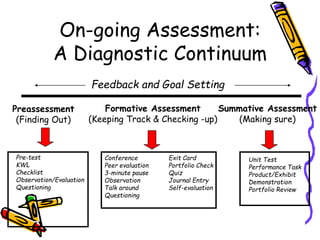
On-going Assessment:
A Diagnostic Continuum
Preassessment
(Finding Out)
Formative Assessment
(Keeping Track & Checking -up)
Summative Assessment
(Making sure)
On-going Assessment:
A Diagnostic Continuum
Preassessment
(Finding Out)
Formative Assessment
(Keeping Track & Checking -up)
Summative Assessment
(Making sure)
Feedback and Goal Setting
Pre-test
KWL
Checklist
Observation/Evaluation
Questioning
Conference Exit Card
Peer evaluation Portfolio Check
3-minute pause Quiz
Observation Journal Entry
Talk around Self-evaluation
Questioning
Unit Test
Performance Task
Product/Exhibit
Demonstration
Portfolio Review
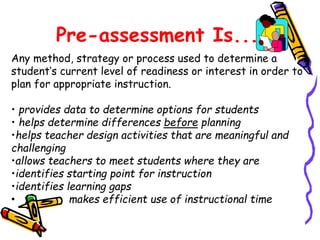
Pre-assessment Is...
Any method, strategy or process used to determine a
student’s current level of readiness or interest in order to
plan for appropriate instruction.
• provides data to determine options for students
• helps determine differences before planning
•helps teacher design activities that are meaningful and
challenging
•allows teachers to meet students where they are
•identifies starting point for instruction
•identifies learning gaps
• makes efficient use of instructional time
Examples of Pre-Assessments:
What Do You Want to Learn About Rome?
Name: _______________________
These are some of the topics we will be studying in our unit on Ancient Rome.
We want to know what you want to learn about. Number your choices from 1
to 8. Make sure that 1 is your favorite and 8 is your least favorite.
____ geography
____ government (laws)
____ agriculture (foods they grew)
____ architecture (buildings)
____ music and art
____ religion and sports
____ roles of men, women, and children
What Can You Tell Us About Rome?
1. What country is Rome in? ________________________________________________
2. What does the word civilization mean?_______________________________________
_________________________________________________________________.
3. Can you give us some examples of different civilizations? ________________________
__________________________________________________________________.
4. Can you name any famous Roman people? ___________________________________
__________________________________________________________________.
5. Many things in our country and culture came from the Romans. Can you think of any?
___________________________________________________________________
___________________________________________________________________
___________________________________________________________________.
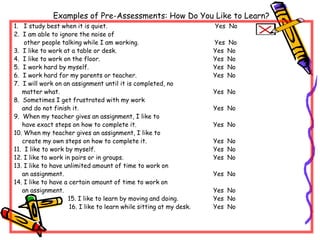
Examples of Pre-Assessments: How Do You Like to Learn?
1. I study best when it is quiet. Yes No
2. I am able to ignore the noise of
other people talking while I am working. Yes No
3. I like to work at a table or desk. Yes No
4. I like to work on the floor. Yes No
5. I work hard by myself. Yes No
6. I work hard for my parents or teacher. Yes No
7. I will work on an assignment until it is completed, no
matter what. Yes No
8. Sometimes I get frustrated with my work
and do not finish it. Yes No
9. When my teacher gives an assignment, I like to
have exact steps on how to complete it. Yes No
10. When my teacher gives an assignment, I like to
create my own steps on how to complete it. Yes No
11. I like to work by myself. Yes No
12. I like to work in pairs or in groups. Yes No
13. I like to have unlimited amount of time to work on
an assignment. Yes No
14. I like to have a certain amount of time to work on
an assignment. Yes No
15. I like to learn by moving and doing. Yes No
16. I like to learn while sitting at my desk. Yes No
Formative Assessment Is...
A process of accumulating information about a student’s
progress to help make instructional decisions that will
improve his/her understandings and achievement levels.
• Depicts student’s life as a learner
• used to make instructional adjustments
• alerts the teacher about student misconceptions
“early warning signal”
• allows students to build on previous experiences
• provides regular feedback
• provides evidence of progress
• aligns with instructional/curricular outcomes
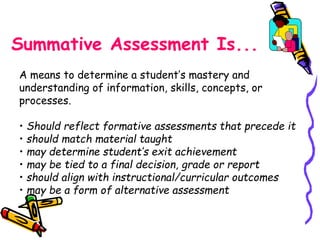
Summative Assessment Is...
A means to determine a student’s mastery and
understanding of information, skills, concepts, or
processes.
• Should reflect formative assessments that precede it
• should match material taught
• may determine student’s exit achievement
• may be tied to a final decision, grade or report
• should align with instructional/curricular outcomes
• may be a form of alternative assessment
. “Teaching facts in
isolation is like
trying to pump
water uphill.”
(Carol Tomlinson)
DEPED ORDER NO. 73
S. 2012
GUIDELINES ON THE ASSESSMENT
AND RATING OF LEARNING
OUTCOMES UNDER THE K TO 12
BASIC EDUCATION CURRICULUM
Effective SY 2012-2013, the standards
based assessment and rating system
shall be implemented to support the
progressive roll-out starting with Grade 1
and 7 of the K to 12 Basic Education
Curriculum to public and private
elementary and secondary schools
nationwide.
ENCLOSURES:
1. General Guidelines for the
Assessment and Rating of
Learning Outcomes
2. Prototype Rubrics for the
different levels of Assessment
3. Prototype Formative and
Summative Assessment Tools
4. Sample Assessment Matrices
and Rubrics for Grade 1
5. Guidelines for Assessing Learning
Outcomes for Grade 1
6. Sample Assessment Matrices and
Rubrics for Grade 1
7. Sample Report Card (Grade 1 and
7
General Guidelines for the
Assessment and Rating of
Learning Outcomes
Assessment shall be used primarily as a
quality assurance tool to track student
progress in the attainment of
standards, promote self-reflection and
personal accountability for one’s learning
and provide a basis for the profiling of
student performance.
Nature and Purpose of
Assessment
Assessment shall be holistic with emphasis
on the formative or developmental purpose
of quality assuring student learning. It is
also standard-based as it seeks to ensure
that teachers will teach to the standards
and students will aim to meet or even
exceed the standards. The students’
attainment of standards in terms of
content and performance , a critical
evidence of learning.
LEVEL OF ASSESSMENT
Level of Assessment Percentage
Weight
Knowledge 15%
Process o Skills 25%
Understanding(s) 30%
Products/Performance 30%
Total 100%
Use of Multiple Measures
KNOWLEDGE
What do we want students to know?
How do we want them to express or
provide evidence of what they
know?
PROCESS OR SKILLS
What do we want students to do
with what they know?
How do we want them to provide
evidence of what they can do with what
they know?
Understanding
What do we want students to
understand?
How we want them to provide
evidence of their understanding?
Products/ Performances
What products or performances do
we want students to produce as evidence
of their learning?
How do we want them to provide
evidence that they can use or transfer
their learning to real-life situations?
LEVELS OF PROFICIENCY
Level of
Proficiency
Equivalent
Numerical Value
Beginning 74% and below
Developing 75-79%
Approaching
Proficient
Advanced
80-84%
85-89%
90% and above
PROMOTION AND
RETENTION
Promotion and retention of students
shall be by subject. Students whose
proficiency level is Beginning (B) at the
end of the quarter or grading period
shall be required to undergo remediation
after class hours so that they can
immediately catch up as they move to
the next grading period. If by the end
of the school year, the students are still
at the Beginning level, then they shall be
required to take summer classes.
PROTOTYPE RUBRICS FOR THE
DIFFERENT LEVELS OF
ASSESSMENT
A. KNOWLEDGE (15%)- information
acquired
Relevance- 8%
Adequacy – 7%
B. SKILLS (25%)- ability to process
and make sense of information
Understanding of Content- 10%
Critical Thinking- 15%
C. UNDERSTANDING/S (30%)-
expressed using any three of the
six facets of understanding:
Explanation, Interpretation,
Application, Empathy, Perspective,
and Self-knowledge
Breadth of Understanding (connection
to a wide range of contexts)
Depth of Understanding ( use of
insights, reflection)
D. TRANSFER OF
UNDERSTANDING (30%)
(life situation)
Products/outputs which are
reflective of learner’s creative
application of understanding
Performances- skillful exhibition or
creative execution of a process,
reflective of masterful application of
learning or understanding
PROTOTYPE FORMATIVE
AND SUMMATIVE
ASSESSMENT TOOLS
A. PRE-ASSESSMENT TOOLS
What I know about ______________
What I can do in relation to ________
What I understand about__________
What I want to know about________
B. FORMATIVE ASSESSMENT
TOOLS
- Quizzes
- Games (puzzles)
- Focus group discussion
- Questions from the students
- Teacher questions to the class
C. SUMMATIVE ASSESSMENT
TOOLS
The students’ attainment of
the content standard may be
evaluated through authentic
performance tasks.
Scoring guides and rubrics are
used for assessing products/
performance.
PAGTATASA
SA
EDUKASYON
SA
KP1:
(Kaalaman)
KP2:
(Kasanayan
)
KP3:
(Pag-
unawa)
KP4:
(Produkto o
Pagganap)
Pre-
Assessmen
t
Formative
Assessmen
t
Summative
Assessmen
t
Aralin
Pamantayan
g
Pangnilalama
n
Pamantayan
sa Pagganap
Pagtatasa
Paraan sa
Pagmamarka
GRASPS
G - GOAL (Layunin)
R - ROLE (Gampanin/Papel)
A - AUDIENCE (Paglilingkuran)
S - SITUATION (Sitwasyon)
P - PRODUCT /PERFORMANCE (Inaasahang
Pagganap at Layunin)
S - STANDARDS & CRITERIA (Mga
Pamantayan at Kraytirya)
GRASPS
BK: Ang tao ay likas na panlipunang nilalang,
kaya’t nakikipag-ugnayan siya sa kanyang
kapwa upang malinang siya sa aspetong
panlipunan, intelektwal, politikal at
pangkabuhayan.
ANG PAKIKIPAGKAPWA (Ikalawang Markahan)
GOAL (Layunin): Bigyan ng kakayahan o
tulungan ang kapitbahayan sa isang mahirap na
baranggay sa tamang paglinis at pagbigay ng
kaayusan sa kanilang lugar.
GRASPS
R- ROLE (Gampanin/Role)
Isa kang Barangay Kagawad o
Assistant sa Barangay Health Center
A- AUDIENCE (Paglilingkuran)
Mga kapitbahayan sa mahirap na
barangay
GRASPS
S - SITUATION
Inatasan ka ng inyong Kapitan ng
Barangay na mamuno sa pagpaplano
ng pagbibigay-kaalaman tungkol sa
kalinisan, kaayusan at tamang nutrisyon
sa isang barangay kung saan maraming
batang marumi at may pangangati, ubo
at sipon.
GRASPS
S – SITUATION
Gagawa ka ng plano upang isagawa ang
mga sumusunod:
A. Lecturette o orientasyon sa tamang
paghugas ng kamay
B. Pagpapakain ng masustansya at murang
meryenda
C. Paglilinis ng lugar (hal., pagwawalis,
pagtatapon at paghakot ng basura)
GRASPS
S- SITUATION
Isasagawa ang mga ito ng iyong team
sa isang Sabado. Makipag-ugnayan
kayo sa mga ahensyang:
 Dept. of Health
 Health and Nutrition Center, depEd
 Local Govt. Unit in charge of
Waste Management in the
Barangay
GRASPS
P- PRODUCT /PERFORMANCE
(Inaasahang Pagganap at Layunin)
Gagawa ka ng plano. Kailangang i-
document ng team mo ang aktwal na
pagsasagawa.
Tatayahin ang Plano at aktwal na
pagsasagawa gamit ang rubric
GRASPS
S – STANDARDS AND CRITERIA
(Mga Pamantayan at Criteria)
1.Nilalaman ng plano
a. Layunin
b. Gawain at panahong ilalan
c. Mga taong gagawa
d. Mga kakailanganing gamit
e. Mga ahensyang makatutulong
2. Pagsasagawa ng plano
THINK ABOUT
ON-GOING ASSESSMENT
STUDENT DATA
Open response test
Oral response
Portfolio entry
Exhibition
Culminating product
Question writing
Problem solving
Journal Entry
Short Answer Test
TEACHER DATA
Anecdotal records
Observation by checklist
Skills checklist
Class discussion
Small group interaction
Teacher – student
conference
Assessment stations
Exit cards
Performance tasks and
rubrics
DIFFERENTIATED
INSTRUCTION
JUST DO IT!!!
Thank You
and
God Bless..

Planning for assessment

  • 1.
  • 2.
    Assessment • Assessment ispart of “teaching for success.” • Assessment information helps students chart and contribute to their own growth. • Assessment is more focused on personal growth than on peer competition. • Assessment information is more useful to the teacher than grades.
  • 3.
    for Interest – Readiness– Learning Profile by Self – Peers - Teachers
  • 4.
    WHAT CAN BEASSESSED? Skills Concepts READINESS INTEREST LEARNING PROFILE Content Knowledge • Interest Surveys • Interest Centers • Self-Selection • Areas of Strength and Weakness • Work Preferences • Self Awareness
  • 5.
    Most teachers assessstudents at the end of an instructional unit or sequence. When assessment and instruction are interwoven, both the students and the teacher benefit. The next slide suggests a diagnostic continuum for ongoing assessment.
  • 6.
    On-going Assessment: A DiagnosticContinuum Preassessment (Finding Out) Formative Assessment (Keeping Track & Checking -up) Summative Assessment (Making sure)
  • 7.
    On-going Assessment: A DiagnosticContinuum Preassessment (Finding Out) Formative Assessment (Keeping Track & Checking -up) Summative Assessment (Making sure) Feedback and Goal Setting Pre-test KWL Checklist Observation/Evaluation Questioning Conference Exit Card Peer evaluation Portfolio Check 3-minute pause Quiz Observation Journal Entry Talk around Self-evaluation Questioning Unit Test Performance Task Product/Exhibit Demonstration Portfolio Review
  • 8.
    Pre-assessment Is... Any method,strategy or process used to determine a student’s current level of readiness or interest in order to plan for appropriate instruction. • provides data to determine options for students • helps determine differences before planning •helps teacher design activities that are meaningful and challenging •allows teachers to meet students where they are •identifies starting point for instruction •identifies learning gaps • makes efficient use of instructional time
  • 9.
    Examples of Pre-Assessments: WhatDo You Want to Learn About Rome? Name: _______________________ These are some of the topics we will be studying in our unit on Ancient Rome. We want to know what you want to learn about. Number your choices from 1 to 8. Make sure that 1 is your favorite and 8 is your least favorite. ____ geography ____ government (laws) ____ agriculture (foods they grew) ____ architecture (buildings) ____ music and art ____ religion and sports ____ roles of men, women, and children What Can You Tell Us About Rome? 1. What country is Rome in? ________________________________________________ 2. What does the word civilization mean?_______________________________________ _________________________________________________________________. 3. Can you give us some examples of different civilizations? ________________________ __________________________________________________________________. 4. Can you name any famous Roman people? ___________________________________ __________________________________________________________________. 5. Many things in our country and culture came from the Romans. Can you think of any? ___________________________________________________________________ ___________________________________________________________________ ___________________________________________________________________.
  • 10.
    Examples of Pre-Assessments:How Do You Like to Learn? 1. I study best when it is quiet. Yes No 2. I am able to ignore the noise of other people talking while I am working. Yes No 3. I like to work at a table or desk. Yes No 4. I like to work on the floor. Yes No 5. I work hard by myself. Yes No 6. I work hard for my parents or teacher. Yes No 7. I will work on an assignment until it is completed, no matter what. Yes No 8. Sometimes I get frustrated with my work and do not finish it. Yes No 9. When my teacher gives an assignment, I like to have exact steps on how to complete it. Yes No 10. When my teacher gives an assignment, I like to create my own steps on how to complete it. Yes No 11. I like to work by myself. Yes No 12. I like to work in pairs or in groups. Yes No 13. I like to have unlimited amount of time to work on an assignment. Yes No 14. I like to have a certain amount of time to work on an assignment. Yes No 15. I like to learn by moving and doing. Yes No 16. I like to learn while sitting at my desk. Yes No
  • 11.
    Formative Assessment Is... Aprocess of accumulating information about a student’s progress to help make instructional decisions that will improve his/her understandings and achievement levels. • Depicts student’s life as a learner • used to make instructional adjustments • alerts the teacher about student misconceptions “early warning signal” • allows students to build on previous experiences • provides regular feedback • provides evidence of progress • aligns with instructional/curricular outcomes
  • 12.
    Summative Assessment Is... Ameans to determine a student’s mastery and understanding of information, skills, concepts, or processes. • Should reflect formative assessments that precede it • should match material taught • may determine student’s exit achievement • may be tied to a final decision, grade or report • should align with instructional/curricular outcomes • may be a form of alternative assessment
  • 13.
    . “Teaching factsin isolation is like trying to pump water uphill.” (Carol Tomlinson)
  • 14.
    DEPED ORDER NO.73 S. 2012 GUIDELINES ON THE ASSESSMENT AND RATING OF LEARNING OUTCOMES UNDER THE K TO 12 BASIC EDUCATION CURRICULUM
  • 15.
    Effective SY 2012-2013,the standards based assessment and rating system shall be implemented to support the progressive roll-out starting with Grade 1 and 7 of the K to 12 Basic Education Curriculum to public and private elementary and secondary schools nationwide.
  • 16.
    ENCLOSURES: 1. General Guidelinesfor the Assessment and Rating of Learning Outcomes 2. Prototype Rubrics for the different levels of Assessment 3. Prototype Formative and Summative Assessment Tools 4. Sample Assessment Matrices and Rubrics for Grade 1
  • 17.
    5. Guidelines forAssessing Learning Outcomes for Grade 1 6. Sample Assessment Matrices and Rubrics for Grade 1 7. Sample Report Card (Grade 1 and 7
  • 18.
    General Guidelines forthe Assessment and Rating of Learning Outcomes Assessment shall be used primarily as a quality assurance tool to track student progress in the attainment of standards, promote self-reflection and personal accountability for one’s learning and provide a basis for the profiling of student performance.
  • 19.
    Nature and Purposeof Assessment Assessment shall be holistic with emphasis on the formative or developmental purpose of quality assuring student learning. It is also standard-based as it seeks to ensure that teachers will teach to the standards and students will aim to meet or even exceed the standards. The students’ attainment of standards in terms of content and performance , a critical evidence of learning.
  • 20.
    LEVEL OF ASSESSMENT Levelof Assessment Percentage Weight Knowledge 15% Process o Skills 25% Understanding(s) 30% Products/Performance 30% Total 100%
  • 21.
    Use of MultipleMeasures KNOWLEDGE What do we want students to know? How do we want them to express or provide evidence of what they know? PROCESS OR SKILLS What do we want students to do with what they know? How do we want them to provide evidence of what they can do with what they know?
  • 22.
    Understanding What do wewant students to understand? How we want them to provide evidence of their understanding? Products/ Performances What products or performances do we want students to produce as evidence of their learning? How do we want them to provide evidence that they can use or transfer their learning to real-life situations?
  • 23.
    LEVELS OF PROFICIENCY Levelof Proficiency Equivalent Numerical Value Beginning 74% and below Developing 75-79% Approaching Proficient Advanced 80-84% 85-89% 90% and above
  • 24.
    PROMOTION AND RETENTION Promotion andretention of students shall be by subject. Students whose proficiency level is Beginning (B) at the end of the quarter or grading period shall be required to undergo remediation after class hours so that they can immediately catch up as they move to the next grading period. If by the end of the school year, the students are still at the Beginning level, then they shall be required to take summer classes.
  • 25.
    PROTOTYPE RUBRICS FORTHE DIFFERENT LEVELS OF ASSESSMENT A. KNOWLEDGE (15%)- information acquired Relevance- 8% Adequacy – 7% B. SKILLS (25%)- ability to process and make sense of information Understanding of Content- 10% Critical Thinking- 15%
  • 26.
    C. UNDERSTANDING/S (30%)- expressedusing any three of the six facets of understanding: Explanation, Interpretation, Application, Empathy, Perspective, and Self-knowledge Breadth of Understanding (connection to a wide range of contexts) Depth of Understanding ( use of insights, reflection)
  • 27.
    D. TRANSFER OF UNDERSTANDING(30%) (life situation) Products/outputs which are reflective of learner’s creative application of understanding Performances- skillful exhibition or creative execution of a process, reflective of masterful application of learning or understanding
  • 28.
    PROTOTYPE FORMATIVE AND SUMMATIVE ASSESSMENTTOOLS A. PRE-ASSESSMENT TOOLS What I know about ______________ What I can do in relation to ________ What I understand about__________ What I want to know about________
  • 29.
    B. FORMATIVE ASSESSMENT TOOLS -Quizzes - Games (puzzles) - Focus group discussion - Questions from the students - Teacher questions to the class
  • 30.
    C. SUMMATIVE ASSESSMENT TOOLS Thestudents’ attainment of the content standard may be evaluated through authentic performance tasks. Scoring guides and rubrics are used for assessing products/ performance.
  • 31.
  • 32.
  • 33.
  • 34.
    GRASPS G - GOAL(Layunin) R - ROLE (Gampanin/Papel) A - AUDIENCE (Paglilingkuran) S - SITUATION (Sitwasyon) P - PRODUCT /PERFORMANCE (Inaasahang Pagganap at Layunin) S - STANDARDS & CRITERIA (Mga Pamantayan at Kraytirya)
  • 35.
    GRASPS BK: Ang taoay likas na panlipunang nilalang, kaya’t nakikipag-ugnayan siya sa kanyang kapwa upang malinang siya sa aspetong panlipunan, intelektwal, politikal at pangkabuhayan. ANG PAKIKIPAGKAPWA (Ikalawang Markahan) GOAL (Layunin): Bigyan ng kakayahan o tulungan ang kapitbahayan sa isang mahirap na baranggay sa tamang paglinis at pagbigay ng kaayusan sa kanilang lugar.
  • 36.
    GRASPS R- ROLE (Gampanin/Role) Isakang Barangay Kagawad o Assistant sa Barangay Health Center A- AUDIENCE (Paglilingkuran) Mga kapitbahayan sa mahirap na barangay
  • 37.
    GRASPS S - SITUATION Inatasanka ng inyong Kapitan ng Barangay na mamuno sa pagpaplano ng pagbibigay-kaalaman tungkol sa kalinisan, kaayusan at tamang nutrisyon sa isang barangay kung saan maraming batang marumi at may pangangati, ubo at sipon.
  • 38.
    GRASPS S – SITUATION Gagawaka ng plano upang isagawa ang mga sumusunod: A. Lecturette o orientasyon sa tamang paghugas ng kamay B. Pagpapakain ng masustansya at murang meryenda C. Paglilinis ng lugar (hal., pagwawalis, pagtatapon at paghakot ng basura)
  • 39.
    GRASPS S- SITUATION Isasagawa angmga ito ng iyong team sa isang Sabado. Makipag-ugnayan kayo sa mga ahensyang:  Dept. of Health  Health and Nutrition Center, depEd  Local Govt. Unit in charge of Waste Management in the Barangay
  • 40.
    GRASPS P- PRODUCT /PERFORMANCE (InaasahangPagganap at Layunin) Gagawa ka ng plano. Kailangang i- document ng team mo ang aktwal na pagsasagawa. Tatayahin ang Plano at aktwal na pagsasagawa gamit ang rubric
  • 41.
    GRASPS S – STANDARDSAND CRITERIA (Mga Pamantayan at Criteria) 1.Nilalaman ng plano a. Layunin b. Gawain at panahong ilalan c. Mga taong gagawa d. Mga kakailanganing gamit e. Mga ahensyang makatutulong 2. Pagsasagawa ng plano
  • 42.
    THINK ABOUT ON-GOING ASSESSMENT STUDENTDATA Open response test Oral response Portfolio entry Exhibition Culminating product Question writing Problem solving Journal Entry Short Answer Test TEACHER DATA Anecdotal records Observation by checklist Skills checklist Class discussion Small group interaction Teacher – student conference Assessment stations Exit cards Performance tasks and rubrics
  • 43.
  • 44.