A PHILOSOPHY OF ASSESSMENT (and evaluation) Peter Gow
 
Assessment IS curriculum (and vice versa)
Why assess? Assessment has several purposes, listed here in order of importance: To  improve student learning , by giving students meaningful feedback on their mastery of skills and content knowledge To  improve teaching , by providing teachers with a means of measuring and/or describing individual and aggregate student learning To  facilitate communication  about ongoing learning To  audit  student performance
What does assessment look like? Assessment is a  broad range of methods and techniques . A few examples: elaborate long-term, interdisciplinary, collaborative projects  essays  paper-and-pencil quizzes standardized multiple-choice tests  The assessments you use should be based on the skill(s) or knowledge that you mean to assess.
How would you? Assess students’ knowledge of the parts of a cell Assess students’ understanding of how the parts of a cell function Assess students’ understanding of the functions of the three branches of the United States government Assess students’ ability to read and understand a novel in Spanish Assess students’ mastery of a list of vocabulary words
Or? Assess students’ understanding of Chinese culture Assess students’ ability to solve equations containing inequalities Assess students’ ability to apply the mathematical notion of “inequality” to a real-world situation Assess students’ understanding of the Civil Rights Movement of the 1960s Assess students’ readiness to study calculus
Or? Assess students’ ability to understand a graph Assess students’ ability to write persuasively Assess students’ intellectual curiosity Assess students’ ability to make connections between the film  American Beauty  and  The Great Gatsby  (the book, of course) Assess whether your students understand the utility of the binomial theorem
EFFECTIVE ASSESSMENT
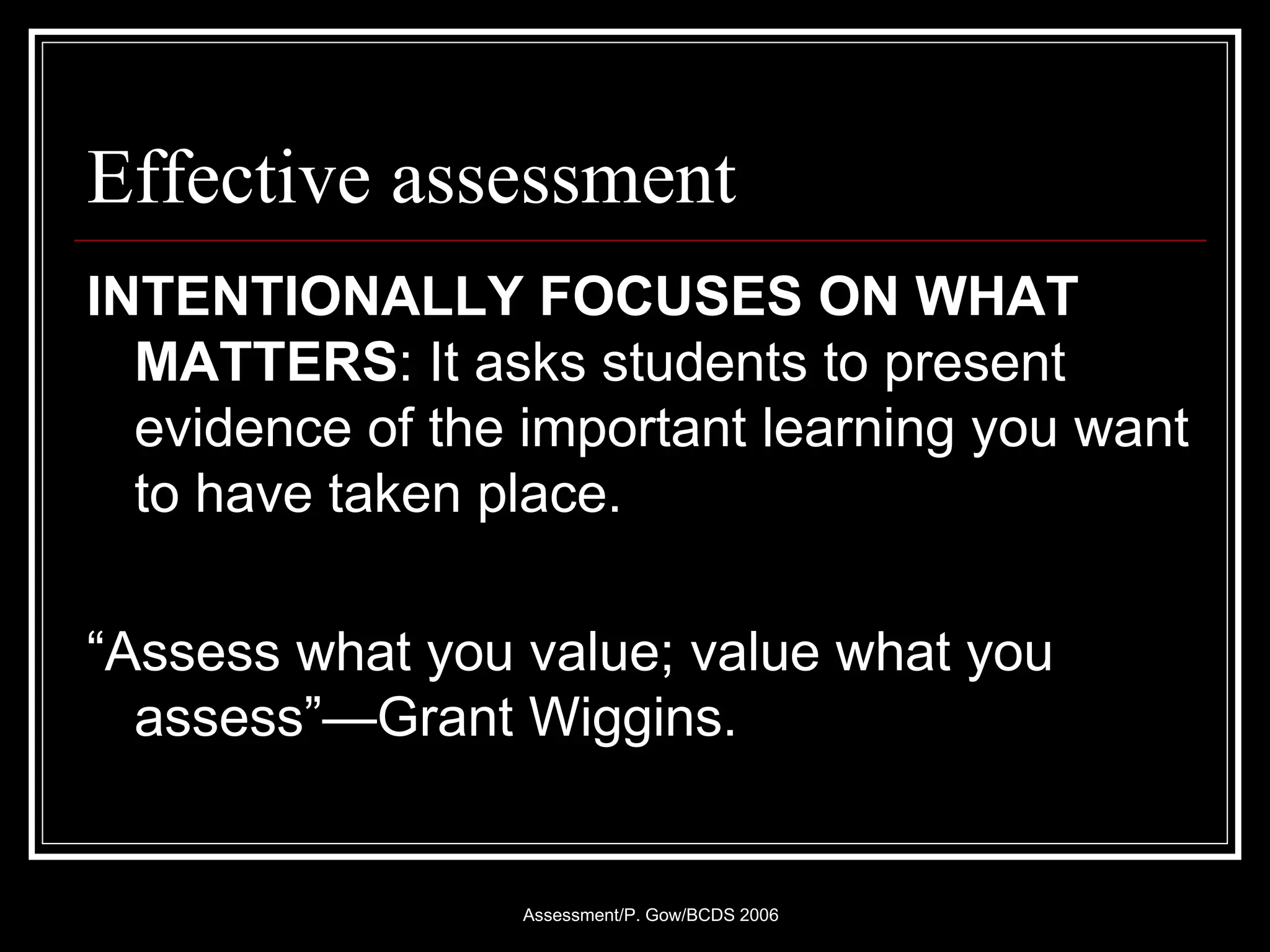
Effective assessment INTENTIONALLY FOCUSES ON WHAT MATTERS : It asks students to present evidence of the important learning you want to have taken place.  “Assess what you value; value what you assess”—Grant Wiggins.
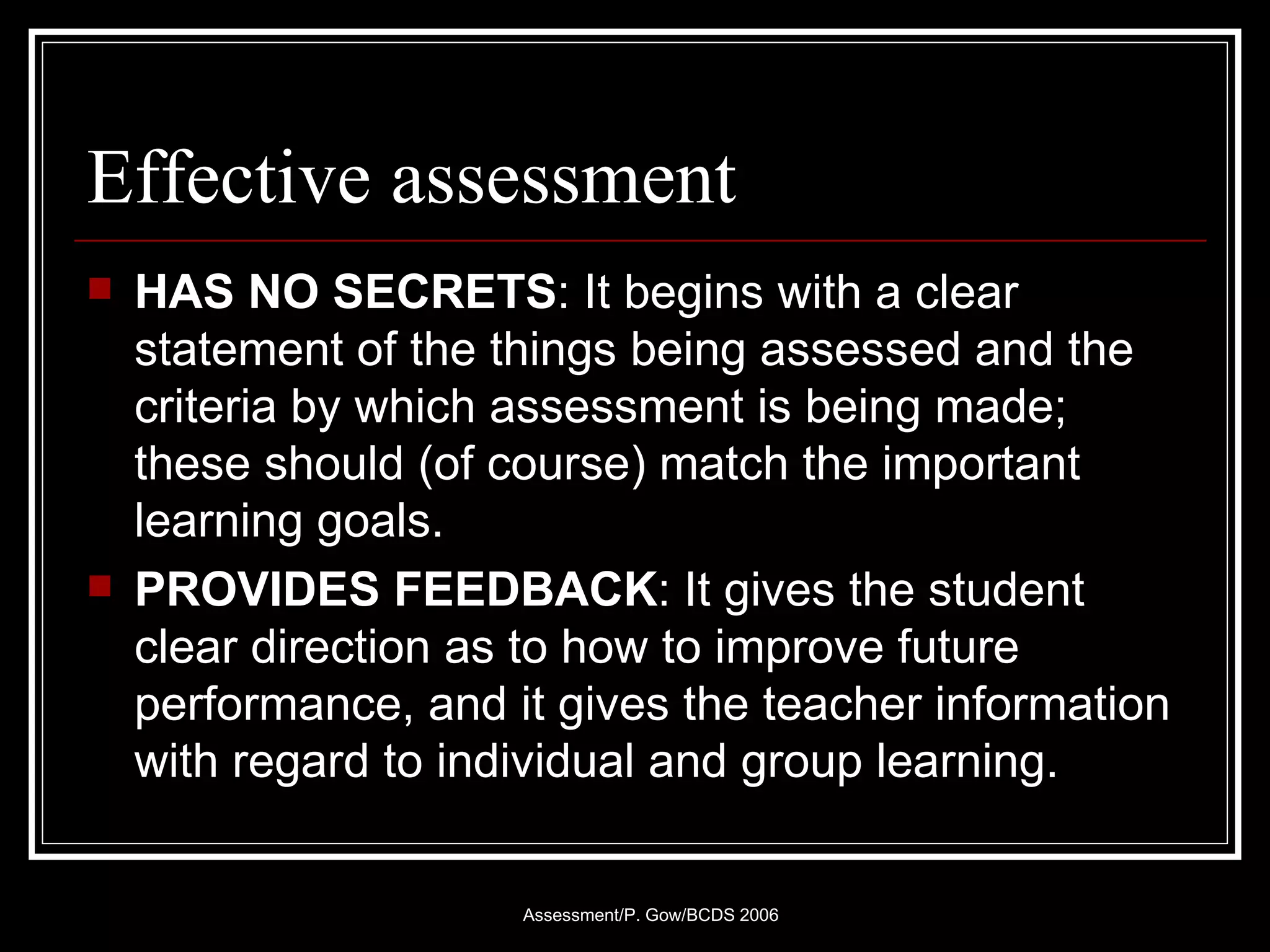
Effective assessment HAS NO SECRETS : It begins with a clear statement of the things being assessed and the criteria by which assessment is being made; these should (of course) match the important learning goals. PROVIDES FEEDBACK : It gives the student clear direction as to how to improve future performance, and it gives the teacher information with regard to individual and group learning.
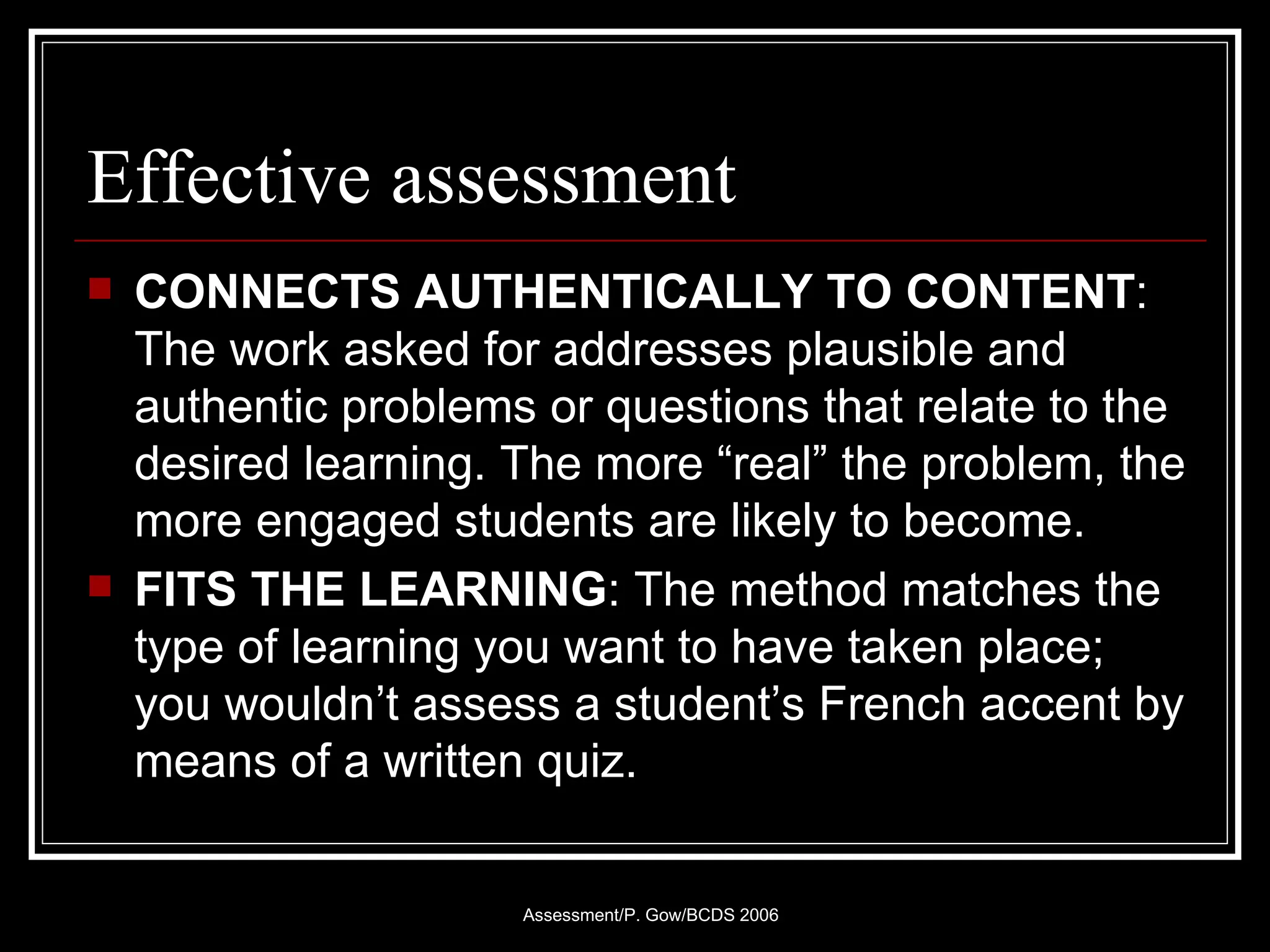
Effective assessment CONNECTS AUTHENTICALLY TO CONTENT : The work asked for addresses plausible and authentic problems or questions that relate to the desired learning. The more “real” the problem, the more engaged students are likely to become. FITS THE LEARNING : The method matches the type of learning you want to have taken place; you wouldn’t assess a student’s French accent by means of a written quiz.
Effective assessment IS FAIR : The method is designed to give each student an equal opportunity to succeed.  IS SAFE : The method is designed to encourage questioning and risk-taking. IS CREDIBLE : The method is designed to relate in a clear and explicable fashion to the total learning experience.
Effective assessment IS VARIED : It comes in a variety of flavors for each unit, topic, or course. The broader the range of assessments given, the more complete and useful a picture of learning will be developed—and the greater the range of individual student strengths, weaknesses, and learning styles that will be tapped and revealed.
Effective assessment IS TIMELY : Evaluation takes place close to the learning experience, and feedback and critique are received in a time frame that allows students to use it to improve performance.  IS MANAGEABLE : The average human teacher can use it in a timely and effective fashion; writing may be a valuable skill, but the solution to every math problem 1-29 (odd) doesn’t need to be presented in essay form.
Effective assessment Follows a trajectory based on the cognitive complexity of the learning being assessed. Use the ASSESS-O-MATIC to plan the assessment tasks for a unit or to design a text or examination based on an ascending hierarchy of complexity.
THINGS TO THINK ABOUT IN ASSESSMENT DESIGN
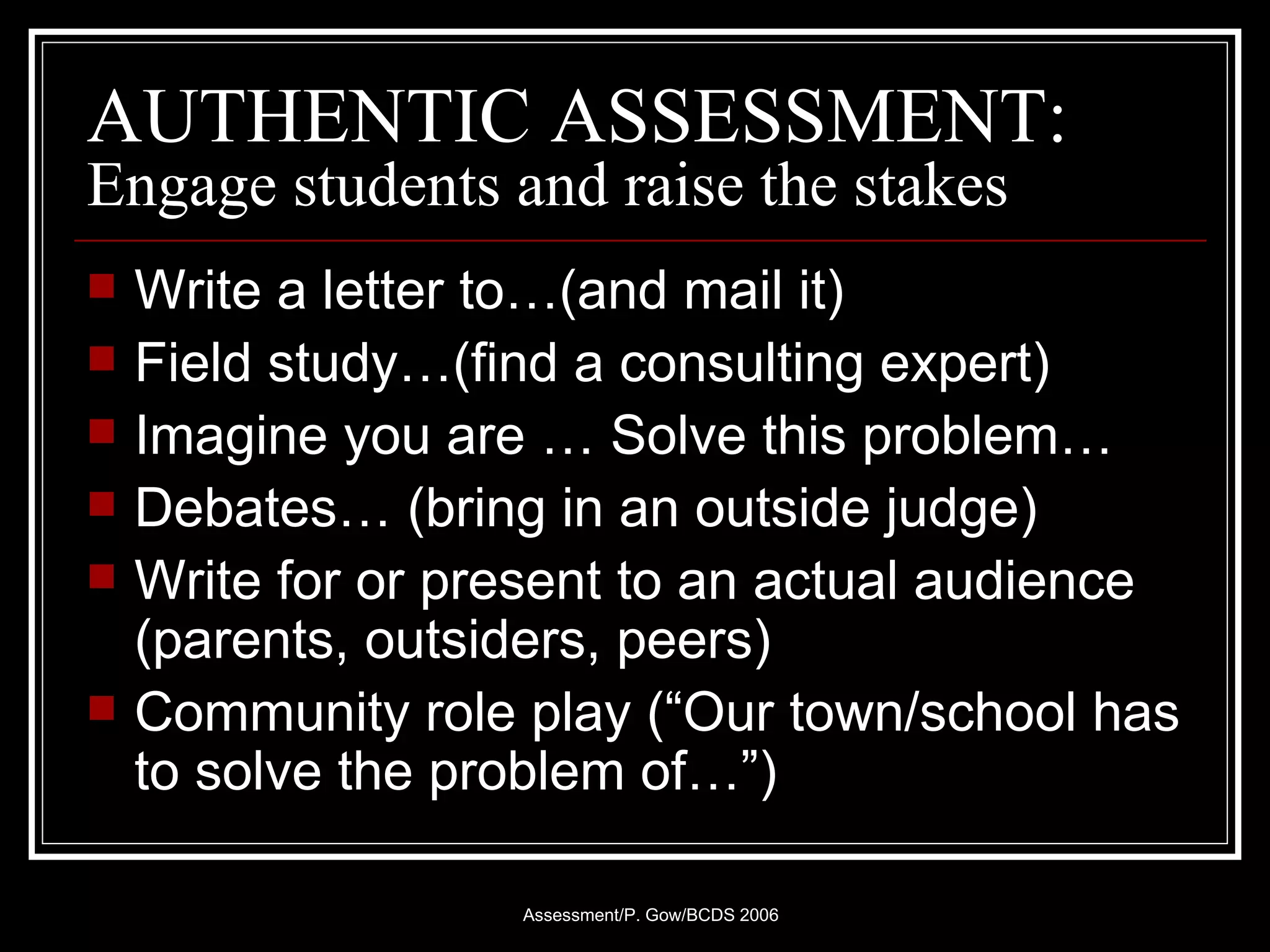
AUTHENTIC ASSESSMENT: Engage students and raise the stakes Write a letter to…(and mail it) Field study…(find a consulting expert) Imagine you are … Solve this problem… Debates… (bring in an outside judge) Write for or present to an actual audience (parents, outsiders, peers) Community role play (“Our town/school has to solve the problem of…”)
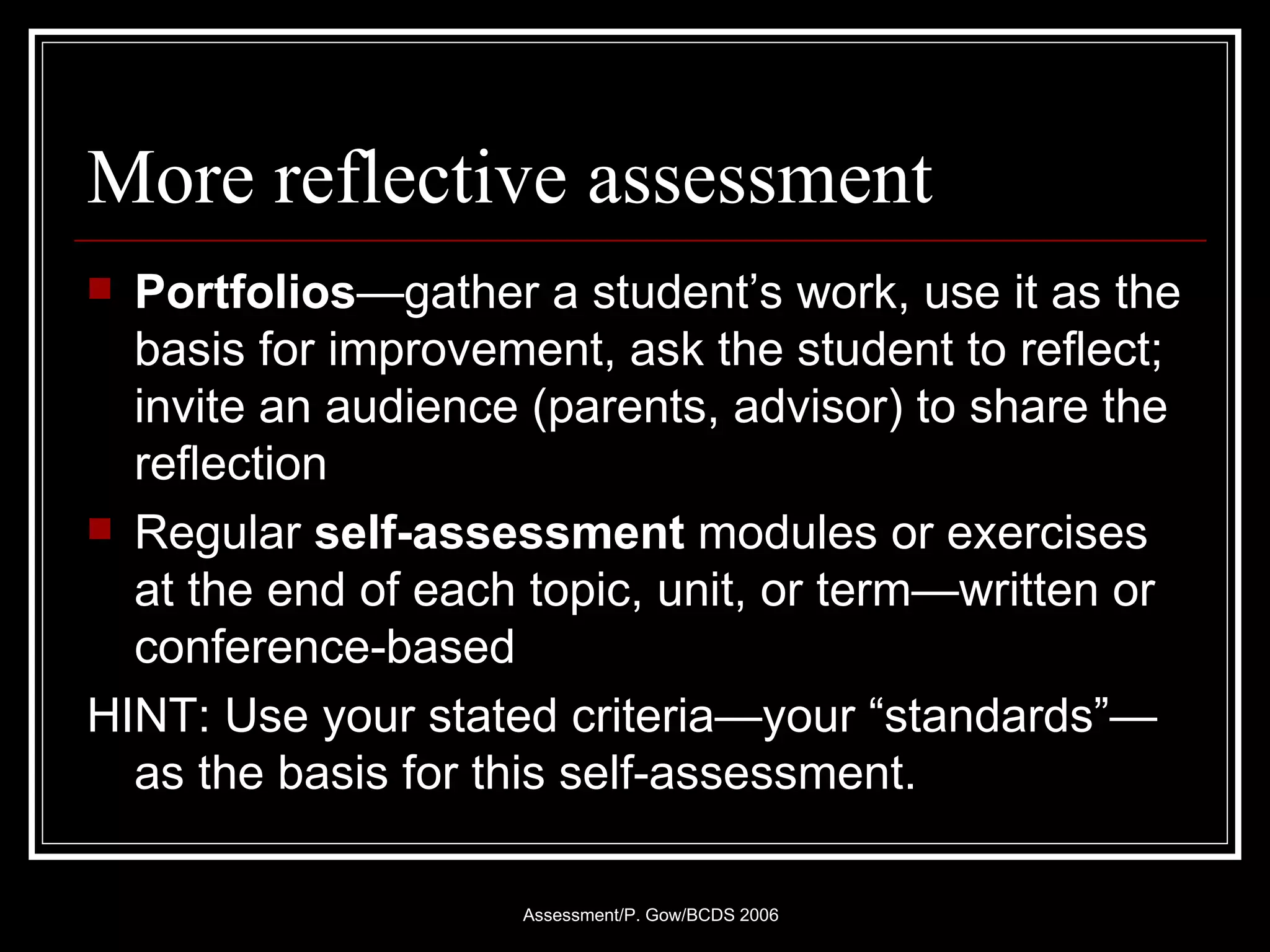
More reflective assessment Portfolios —gather a student’s work, use it as the basis for improvement, ask the student to reflect; invite an audience (parents, advisor) to share the reflection Regular  self-assessment  modules or exercises at the end of each topic, unit, or term—written or conference-based HINT: Use your stated criteria—your “standards”—as the basis for this self-assessment.
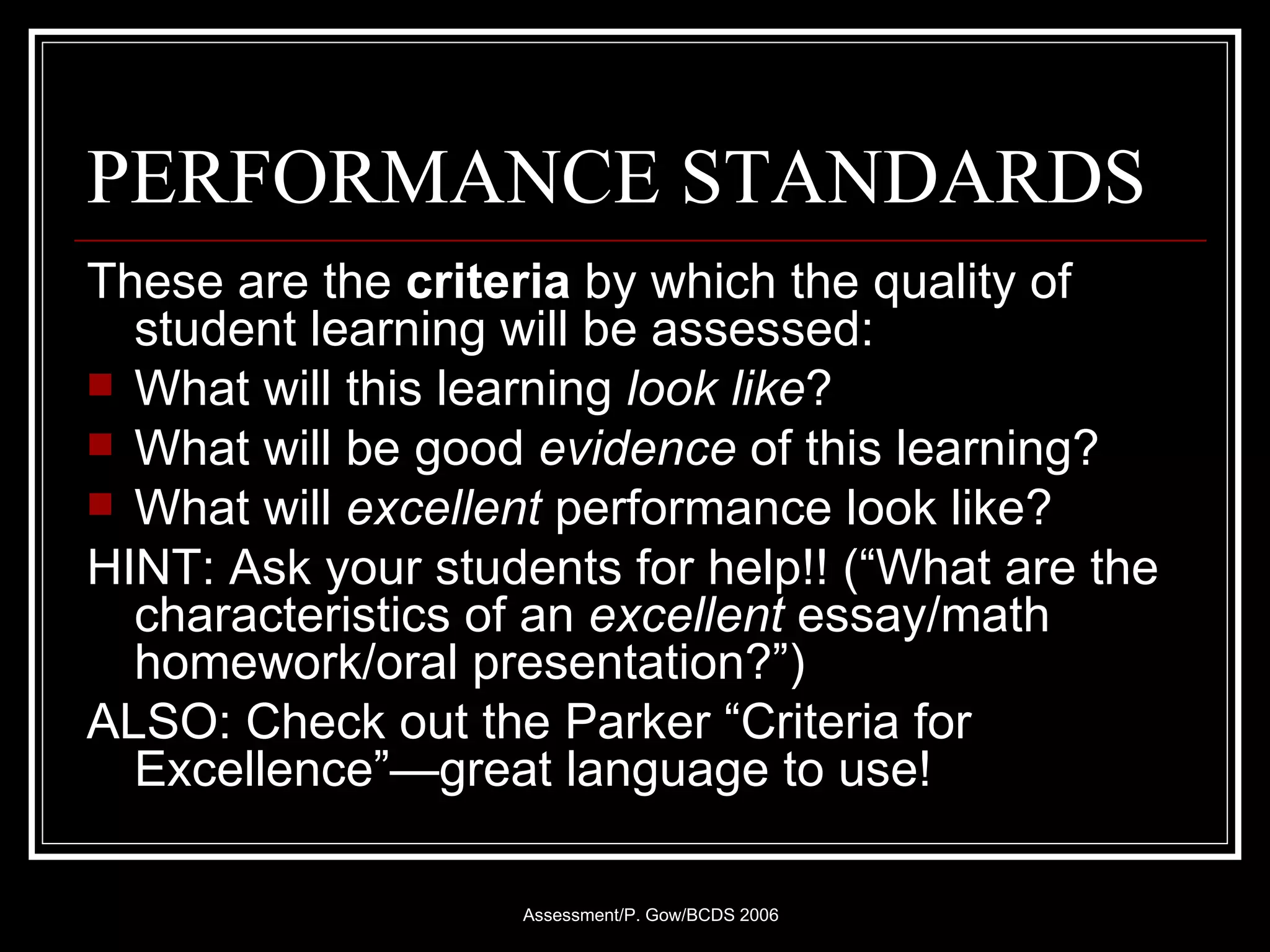
PERFORMANCE STANDARDS  These are the  criteria  by which the quality of student learning will be assessed: What will this learning  look like ?  What will be good  evidence  of this learning? What will  excellent  performance look like? HINT: Ask your students for help!! (“What are the characteristics of an  excellent   essay/math homework/oral presentation?”) ALSO: Check out the Parker “Criteria for Excellence”—great language to use!
RUBRICS in two slides Evaluation rubrics are a tool combining stated standards for LEVELS of performance with clearly delineated CATEGORIES of performance E.g.,  They show students what excellent work is supposed to look like and tell them what parts of the work are important
Rubrics are Easy to create--ask your students to describe excellent work or to tell you what should be important on a certain kind of work Easy to use--they save time and eliminate some decision-making about what matters Danger! Posters, videos, … Great ways to give clear, specific feedback to students--and they help the teacher see what is working, as well
Why grades? To provide a record of student performance  To provide evidence of a progression of learning To sort out a student’s performance against a standard To give students FEEDBACK on their performance
Weighting grades Give a piece of work a weight proportionate to its relative degree of importance and difficulty Quizzes worth less than tests Big projects worth more than homework Use simple grading system (check, check-plus) for simple work Take a tip from your college professors, and assign specific weights in advance Don’t forget to weigh in class participation
Just for Middle School… The dreaded grid: Think of a “standard”--what you want students to be able to do Then think of how to describe progress toward that standard: Beginning Working Approaching Meeting and at last, “Proficient”
Rubrics to grades Top level of performance = A Satisfactory but nothing special = C(+) Really unsatisfactory = NP Not usually a mathematical equivalency--12/16 may not = 75% or C; may be closer to B- You gotta do what works for you The 16-point rubric trick
Keeping a grade book Your gradebook is PRIVATE Your gradebook should allow plenty of space to describe performance tasks and to keep track of each student’s grades If using a paper gradebook, skip lines between kids Consider keeping a more descriptive kind of record--a notebook with a page for each student; comment on work alonmg with grading it
“Averages” If you use a spreadsheet or “electronic grade book,” make sure you have an escape clause--just because a number was arrived at by a computer calculation doesn’t mean that number is “true” or objective--because the grades you entered are subjective Remember the “feedback” function--grades send a message to students; it’s okay to have that message be an encouraging one
Evaluating effort Danger, danger! (Did you ever fool anyone?) Evaluate effort based on clear standards that you feel comfortable about--work completed, details included, …--against clearly stated criteria You probably can’t really ever know how hard a kid is working in other ways

An Overview of Assessment Design

  • 1.
    A PHILOSOPHY OFASSESSMENT (and evaluation) Peter Gow
  • 2.
  • 3.
    Assessment IS curriculum(and vice versa)
  • 4.
    Why assess? Assessmenthas several purposes, listed here in order of importance: To improve student learning , by giving students meaningful feedback on their mastery of skills and content knowledge To improve teaching , by providing teachers with a means of measuring and/or describing individual and aggregate student learning To facilitate communication about ongoing learning To audit student performance
  • 5.
    What does assessmentlook like? Assessment is a broad range of methods and techniques . A few examples: elaborate long-term, interdisciplinary, collaborative projects essays paper-and-pencil quizzes standardized multiple-choice tests The assessments you use should be based on the skill(s) or knowledge that you mean to assess.
  • 6.
    How would you?Assess students’ knowledge of the parts of a cell Assess students’ understanding of how the parts of a cell function Assess students’ understanding of the functions of the three branches of the United States government Assess students’ ability to read and understand a novel in Spanish Assess students’ mastery of a list of vocabulary words
  • 7.
    Or? Assess students’understanding of Chinese culture Assess students’ ability to solve equations containing inequalities Assess students’ ability to apply the mathematical notion of “inequality” to a real-world situation Assess students’ understanding of the Civil Rights Movement of the 1960s Assess students’ readiness to study calculus
  • 8.
    Or? Assess students’ability to understand a graph Assess students’ ability to write persuasively Assess students’ intellectual curiosity Assess students’ ability to make connections between the film American Beauty and The Great Gatsby (the book, of course) Assess whether your students understand the utility of the binomial theorem
  • 9.
  • 10.
    Effective assessment INTENTIONALLYFOCUSES ON WHAT MATTERS : It asks students to present evidence of the important learning you want to have taken place. “Assess what you value; value what you assess”—Grant Wiggins.
  • 11.
    Effective assessment HASNO SECRETS : It begins with a clear statement of the things being assessed and the criteria by which assessment is being made; these should (of course) match the important learning goals. PROVIDES FEEDBACK : It gives the student clear direction as to how to improve future performance, and it gives the teacher information with regard to individual and group learning.
  • 12.
    Effective assessment CONNECTSAUTHENTICALLY TO CONTENT : The work asked for addresses plausible and authentic problems or questions that relate to the desired learning. The more “real” the problem, the more engaged students are likely to become. FITS THE LEARNING : The method matches the type of learning you want to have taken place; you wouldn’t assess a student’s French accent by means of a written quiz.
  • 13.
    Effective assessment ISFAIR : The method is designed to give each student an equal opportunity to succeed. IS SAFE : The method is designed to encourage questioning and risk-taking. IS CREDIBLE : The method is designed to relate in a clear and explicable fashion to the total learning experience.
  • 14.
    Effective assessment ISVARIED : It comes in a variety of flavors for each unit, topic, or course. The broader the range of assessments given, the more complete and useful a picture of learning will be developed—and the greater the range of individual student strengths, weaknesses, and learning styles that will be tapped and revealed.
  • 15.
    Effective assessment ISTIMELY : Evaluation takes place close to the learning experience, and feedback and critique are received in a time frame that allows students to use it to improve performance. IS MANAGEABLE : The average human teacher can use it in a timely and effective fashion; writing may be a valuable skill, but the solution to every math problem 1-29 (odd) doesn’t need to be presented in essay form.
  • 16.
    Effective assessment Followsa trajectory based on the cognitive complexity of the learning being assessed. Use the ASSESS-O-MATIC to plan the assessment tasks for a unit or to design a text or examination based on an ascending hierarchy of complexity.
  • 17.
    THINGS TO THINKABOUT IN ASSESSMENT DESIGN
  • 18.
    AUTHENTIC ASSESSMENT: Engagestudents and raise the stakes Write a letter to…(and mail it) Field study…(find a consulting expert) Imagine you are … Solve this problem… Debates… (bring in an outside judge) Write for or present to an actual audience (parents, outsiders, peers) Community role play (“Our town/school has to solve the problem of…”)
  • 19.
    More reflective assessmentPortfolios —gather a student’s work, use it as the basis for improvement, ask the student to reflect; invite an audience (parents, advisor) to share the reflection Regular self-assessment modules or exercises at the end of each topic, unit, or term—written or conference-based HINT: Use your stated criteria—your “standards”—as the basis for this self-assessment.
  • 20.
    PERFORMANCE STANDARDS These are the criteria by which the quality of student learning will be assessed: What will this learning look like ? What will be good evidence of this learning? What will excellent performance look like? HINT: Ask your students for help!! (“What are the characteristics of an excellent essay/math homework/oral presentation?”) ALSO: Check out the Parker “Criteria for Excellence”—great language to use!
  • 21.
    RUBRICS in twoslides Evaluation rubrics are a tool combining stated standards for LEVELS of performance with clearly delineated CATEGORIES of performance E.g., They show students what excellent work is supposed to look like and tell them what parts of the work are important
  • 22.
    Rubrics are Easyto create--ask your students to describe excellent work or to tell you what should be important on a certain kind of work Easy to use--they save time and eliminate some decision-making about what matters Danger! Posters, videos, … Great ways to give clear, specific feedback to students--and they help the teacher see what is working, as well
  • 23.
    Why grades? Toprovide a record of student performance To provide evidence of a progression of learning To sort out a student’s performance against a standard To give students FEEDBACK on their performance
  • 24.
    Weighting grades Givea piece of work a weight proportionate to its relative degree of importance and difficulty Quizzes worth less than tests Big projects worth more than homework Use simple grading system (check, check-plus) for simple work Take a tip from your college professors, and assign specific weights in advance Don’t forget to weigh in class participation
  • 25.
    Just for MiddleSchool… The dreaded grid: Think of a “standard”--what you want students to be able to do Then think of how to describe progress toward that standard: Beginning Working Approaching Meeting and at last, “Proficient”
  • 26.
    Rubrics to gradesTop level of performance = A Satisfactory but nothing special = C(+) Really unsatisfactory = NP Not usually a mathematical equivalency--12/16 may not = 75% or C; may be closer to B- You gotta do what works for you The 16-point rubric trick
  • 27.
    Keeping a gradebook Your gradebook is PRIVATE Your gradebook should allow plenty of space to describe performance tasks and to keep track of each student’s grades If using a paper gradebook, skip lines between kids Consider keeping a more descriptive kind of record--a notebook with a page for each student; comment on work alonmg with grading it
  • 28.
    “Averages” If youuse a spreadsheet or “electronic grade book,” make sure you have an escape clause--just because a number was arrived at by a computer calculation doesn’t mean that number is “true” or objective--because the grades you entered are subjective Remember the “feedback” function--grades send a message to students; it’s okay to have that message be an encouraging one
  • 29.
    Evaluating effort Danger,danger! (Did you ever fool anyone?) Evaluate effort based on clear standards that you feel comfortable about--work completed, details included, …--against clearly stated criteria You probably can’t really ever know how hard a kid is working in other ways