
Dr. Madhu Singh
Associate Professor
St. Xavier’s College of Education,
Patna
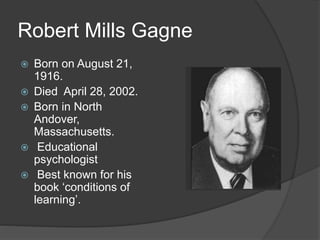
Robert Mills Gagne
 Born on August 21,
1916.
 Died April 28, 2002.
 Born in North
Andover,
Massachusetts.
 Educational
psychologist
 Best known for his
book ‘conditions of
learning’.
What is learning to Gagné
?
Learning is cumulative.
Human intellectual development is
the building of increasing complex
structures of human capabilities.
Learning is the mechanism by which
an individual becomes a competently
functioning member of society.
What is learning to
Gagné?
Learning results in different
kinds of human behaviors,
 i.e. different human capabilities,
which are required both from the
stimulation from the environment
and the cognitive processing
undertaken by the learners.
Assumptions Derived From Gagné's
Ideas About Learning And Instruction
 Because learning is complex and diverse,
different learning outcomes (capabilities)
requires different instructions, prerequisites
and processing by the learners.
 In other words, the specific operations that
constitute instructional events are different for
each different type of learning outcome.
Assumptions Derived From Gagné's
Ideas
About Learning And Instruction
 Events of learning operate on the learner in
ways that constitute the conditions of learning.
 The internal states required in the learner to
acquire the new skills are internal conditions
of learning, and the environmental stimuli
required to support the internal learning
process are external conditions of learning.
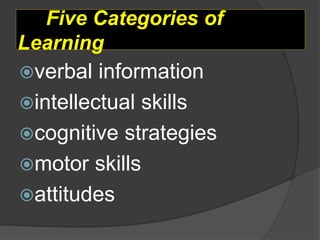
Five Categories of
Learning
verbal information
intellectual skills
cognitive strategies
motor skills
attitudes
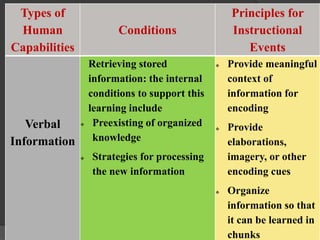
Types of
Human
Capabilities
Conditions
Principles for
Instructional
Events
Verbal
Information
Retrieving stored
information: the internal
conditions to support this
learning include
 Preexisting of organized
knowledge
 Strategies for processing
the new information
 Provide meaningful
context of
information for
encoding
 Provide
elaborations,
imagery, or other
encoding cues
 Organize
information so that
it can be learned in
chunks
Types of
Human
Capabilities
Conditions
Principles for
Instructional
Events
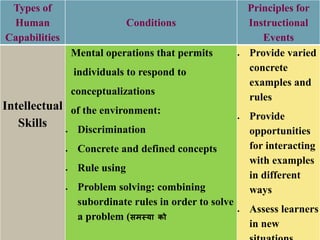
Intellectual
Skills
Mental operations that permits
individuals to respond to
conceptualizations
of the environment:
 Discrimination
 Concrete and defined concepts
 Rule using
 Problem solving: combining
subordinate rules in order to solve
a problem (समस्या को
 Provide varied
concrete
examples and
rules
 Provide
opportunities
for interacting
with examples
in different
ways
 Assess learners
in new
Types of
Human
Capabilities
Conditions Principles for
Instructional
Events
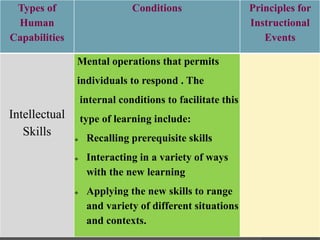
Intellectual
Skills
Mental operations that permits
individuals to respond . The
internal conditions to facilitate this
type of learning include:
 Recalling prerequisite skills
 Interacting in a variety of ways
with the new learning
 Applying the new skills to range
and variety of different situations
and contexts.
Types of
Human
Capabilities
Conditions Principles for
Instructional Events
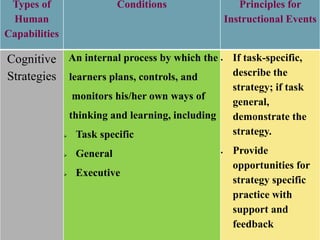
Cognitive
Strategies
An internal process by which the
learners plans, controls, and
monitors his/her own ways of
thinking and learning, including
 Task specific
 General
 Executive
 If task-specific,
describe the
strategy; if task
general,
demonstrate the
strategy.
 Provide
opportunities for
strategy specific
practice with
support and
feedback
Types of
Human
Capabilities
Conditions Principles for
Instructional
Events
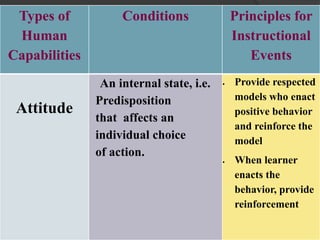
Attitude
An internal state, i.e.
Predisposition
that affects an
individual choice
of action.
 Provide respected
models who enact
positive behavior
and reinforce the
model
 When learner
enacts the
behavior, provide
reinforcement
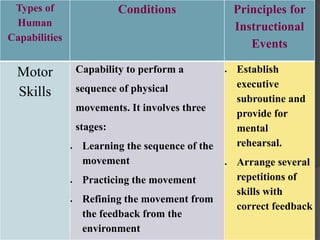
Types of
Human
Capabilities
Conditions Principles for
Instructional
Events
Motor
Skills
Capability to perform a
sequence of physical
movements. It involves three
stages:
 Learning the sequence of the
movement
 Practicing the movement
 Refining the movement from
the feedback from the
environment
 Establish
executive
subroutine and
provide for
mental
rehearsal.
 Arrange several
repetitions of
skills with
correct feedback
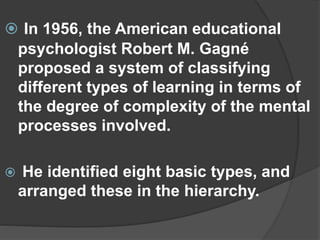
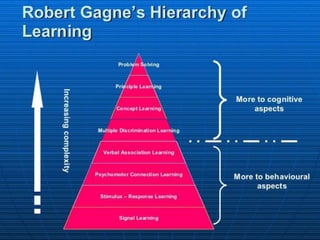
 In 1956, the American educational
psychologist Robert M. Gagné
proposed a system of classifying
different types of learning in terms of
the degree of complexity of the mental
processes involved.
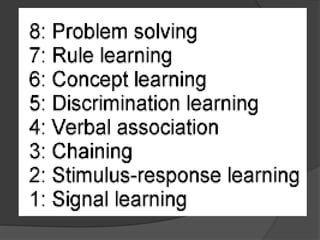
 He identified eight basic types, and
arranged these in the hierarchy.
1. SIGNAL LEARNING
 This is the simplest form of learning, and
consists essentially of the classical
conditioning first described by the behavioural
psychologist Pavlov.
 In this, the subject is 'conditioned' to emit a
desired response as a result of a stimulus that
would not normally produce that response.
 The applications of classical conditioning in
facilitating human learning are, however, very
limited.
2. STIMULUS - RESPONSE
LEARNING.
 This somewhat more sophisticated form of
learning, which is also known as operant
conditioning, was originally developed by
Skinner.
 It involves developing desired stimulus-
response bonds in the subject through a
carefully-planned reinforcement schedule
based on the use of 'rewards' and
'punishments'.
 Operant conditioning differs from classical
conditioning in that the reinforcing agent (the
'reward' or 'punishment') is presented after the
response.
3. CHAINING
 This is a more advanced form of
learning in which the subject
develops the ability to connect two
or more previously-learned
stimulus-response bonds into a
linked sequence.
 It is the process whereby most
complex psychomotor skills (eg
riding a bicycle or playing the
piano) are learned.
4. VERBAL
ASSOCIATION.
This is a form of chaining in
which the links between the
items being connected are
verbal in nature.
Verbal association is one of
the key processes in the
development of language
skills
5. DISCRIMINATION
LEARNING.
 This involves developing the ability to
make appropriate (different) responses
to a series of similar stimuli that differ in
a systematic way.
 The process is made more complex
(and hence more difficult) by the
phenomenon of interference, whereby
one piece of learning inhibits another.
 Interference is thought to be one of the
main causes of forgetting.
6. CONCEPT LEARNING
This involves developing the
ability to make a consistent
response to different stimuli
that form a common class
or category of some sort.
It forms the basis of the
ability to generalise,
classify etc.
7. RULE LEARNING
 This is a very-high-level cognitive
process
 that involves being able to learn
relationships between concepts
and apply these relationships in
different situations, including
situations not previously
encountered.
 It forms the basis of the learning of
general rules, procedures, etc.
8. PROBLEM SOLVING
 This is the highest level of cognitive
process according to Gagné.
 It involves developing the ability to
invent a complex rule, algorithm or
procedure for the purpose of solving
one particular problem, and then using
the method to solve other problems of
a similar nature.
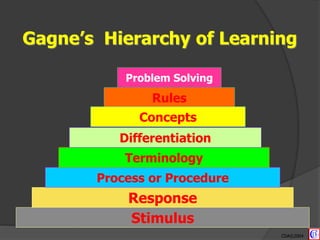
Gagne’s Hierarchy of Learning
Response
Process or Procedure
Rules
Problem Solving
CDA©2004
Terminology
Differentiation
Concepts
Stimulus
Eight Conditions Of Learning (Summary)
1. signal learning: the learner makes a
general response to a signal.
2. stimulus - response learning: the learner
makes a precise response to a signal.
3. Chaining: the connection of a set of
individual stimulus and responses in a
sequence.
4. verbal association : the learner makes
association using verbal connections.
Eight Conditions Of Learning (Summary)
5. discrimination learning: the learner make
different responses to different stimuli that are
somewhat alike
6. concept learning: the learner develops the
ability to make the generalized response based
on a class of stimuli.
7. rule learning : a rule is a chain of concepts
linked to a demonstrated behaviour.
8. problem solving: the learner discovers a
combination of previously learned rules and
applies them to solve a novel situation.
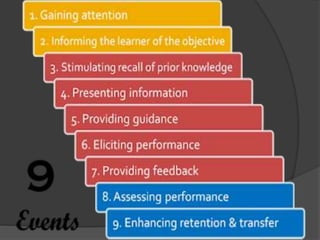
Robert’s Nine Events of
Instruction
 He is father of Instructional Design
 He gave Nine events of Instruction
 Organization is the hallmark of
effective instructional materials.
Gagne conditions of learning

Gagne conditions of learning

  • 1.
    Dr. Madhu Singh AssociateProfessor St. Xavier’s College of Education, Patna
  • 2.
    Robert Mills Gagne Born on August 21, 1916.  Died April 28, 2002.  Born in North Andover, Massachusetts.  Educational psychologist  Best known for his book ‘conditions of learning’.
  • 3.
    What is learningto Gagné ? Learning is cumulative. Human intellectual development is the building of increasing complex structures of human capabilities. Learning is the mechanism by which an individual becomes a competently functioning member of society.
  • 4.
    What is learningto Gagné? Learning results in different kinds of human behaviors,  i.e. different human capabilities, which are required both from the stimulation from the environment and the cognitive processing undertaken by the learners.
  • 5.
    Assumptions Derived FromGagné's Ideas About Learning And Instruction  Because learning is complex and diverse, different learning outcomes (capabilities) requires different instructions, prerequisites and processing by the learners.  In other words, the specific operations that constitute instructional events are different for each different type of learning outcome.
  • 6.
    Assumptions Derived FromGagné's Ideas About Learning And Instruction  Events of learning operate on the learner in ways that constitute the conditions of learning.  The internal states required in the learner to acquire the new skills are internal conditions of learning, and the environmental stimuli required to support the internal learning process are external conditions of learning.
  • 7.
    Five Categories of Learning verbalinformation intellectual skills cognitive strategies motor skills attitudes
  • 8.
    Types of Human Capabilities Conditions Principles for Instructional Events Verbal Information Retrievingstored information: the internal conditions to support this learning include  Preexisting of organized knowledge  Strategies for processing the new information  Provide meaningful context of information for encoding  Provide elaborations, imagery, or other encoding cues  Organize information so that it can be learned in chunks
  • 9.
    Types of Human Capabilities Conditions Principles for Instructional Events Intellectual Skills Mentaloperations that permits individuals to respond to conceptualizations of the environment:  Discrimination  Concrete and defined concepts  Rule using  Problem solving: combining subordinate rules in order to solve a problem (समस्या को  Provide varied concrete examples and rules  Provide opportunities for interacting with examples in different ways  Assess learners in new
  • 10.
    Types of Human Capabilities Conditions Principlesfor Instructional Events Intellectual Skills Mental operations that permits individuals to respond . The internal conditions to facilitate this type of learning include:  Recalling prerequisite skills  Interacting in a variety of ways with the new learning  Applying the new skills to range and variety of different situations and contexts.
  • 11.
    Types of Human Capabilities Conditions Principlesfor Instructional Events Cognitive Strategies An internal process by which the learners plans, controls, and monitors his/her own ways of thinking and learning, including  Task specific  General  Executive  If task-specific, describe the strategy; if task general, demonstrate the strategy.  Provide opportunities for strategy specific practice with support and feedback
  • 12.
    Types of Human Capabilities Conditions Principlesfor Instructional Events Attitude An internal state, i.e. Predisposition that affects an individual choice of action.  Provide respected models who enact positive behavior and reinforce the model  When learner enacts the behavior, provide reinforcement
  • 13.
    Types of Human Capabilities Conditions Principlesfor Instructional Events Motor Skills Capability to perform a sequence of physical movements. It involves three stages:  Learning the sequence of the movement  Practicing the movement  Refining the movement from the feedback from the environment  Establish executive subroutine and provide for mental rehearsal.  Arrange several repetitions of skills with correct feedback
  • 15.
     In 1956,the American educational psychologist Robert M. Gagné proposed a system of classifying different types of learning in terms of the degree of complexity of the mental processes involved.  He identified eight basic types, and arranged these in the hierarchy.
  • 17.
    1. SIGNAL LEARNING This is the simplest form of learning, and consists essentially of the classical conditioning first described by the behavioural psychologist Pavlov.  In this, the subject is 'conditioned' to emit a desired response as a result of a stimulus that would not normally produce that response.  The applications of classical conditioning in facilitating human learning are, however, very limited.
  • 18.
    2. STIMULUS -RESPONSE LEARNING.  This somewhat more sophisticated form of learning, which is also known as operant conditioning, was originally developed by Skinner.  It involves developing desired stimulus- response bonds in the subject through a carefully-planned reinforcement schedule based on the use of 'rewards' and 'punishments'.  Operant conditioning differs from classical conditioning in that the reinforcing agent (the 'reward' or 'punishment') is presented after the response.
  • 19.
    3. CHAINING  Thisis a more advanced form of learning in which the subject develops the ability to connect two or more previously-learned stimulus-response bonds into a linked sequence.  It is the process whereby most complex psychomotor skills (eg riding a bicycle or playing the piano) are learned.
  • 20.
    4. VERBAL ASSOCIATION. This isa form of chaining in which the links between the items being connected are verbal in nature. Verbal association is one of the key processes in the development of language skills
  • 21.
    5. DISCRIMINATION LEARNING.  Thisinvolves developing the ability to make appropriate (different) responses to a series of similar stimuli that differ in a systematic way.  The process is made more complex (and hence more difficult) by the phenomenon of interference, whereby one piece of learning inhibits another.  Interference is thought to be one of the main causes of forgetting.
  • 22.
    6. CONCEPT LEARNING Thisinvolves developing the ability to make a consistent response to different stimuli that form a common class or category of some sort. It forms the basis of the ability to generalise, classify etc.
  • 23.
    7. RULE LEARNING This is a very-high-level cognitive process  that involves being able to learn relationships between concepts and apply these relationships in different situations, including situations not previously encountered.  It forms the basis of the learning of general rules, procedures, etc.
  • 24.
    8. PROBLEM SOLVING This is the highest level of cognitive process according to Gagné.  It involves developing the ability to invent a complex rule, algorithm or procedure for the purpose of solving one particular problem, and then using the method to solve other problems of a similar nature.
  • 25.
    Gagne’s Hierarchy ofLearning Response Process or Procedure Rules Problem Solving CDA©2004 Terminology Differentiation Concepts Stimulus
  • 26.
    Eight Conditions OfLearning (Summary) 1. signal learning: the learner makes a general response to a signal. 2. stimulus - response learning: the learner makes a precise response to a signal. 3. Chaining: the connection of a set of individual stimulus and responses in a sequence. 4. verbal association : the learner makes association using verbal connections.
  • 27.
    Eight Conditions OfLearning (Summary) 5. discrimination learning: the learner make different responses to different stimuli that are somewhat alike 6. concept learning: the learner develops the ability to make the generalized response based on a class of stimuli. 7. rule learning : a rule is a chain of concepts linked to a demonstrated behaviour. 8. problem solving: the learner discovers a combination of previously learned rules and applies them to solve a novel situation.
  • 29.
    Robert’s Nine Eventsof Instruction  He is father of Instructional Design  He gave Nine events of Instruction  Organization is the hallmark of effective instructional materials.

Editor's Notes

  • #18 Eg. Withdrawl of hand upon sight of hot object, tearing of eyes while seeing onion, salivation upon seeing favourite food
  • #20 Concepts are abstracts. Eg cubes
  • #22 Maa and aunt