Presented By: Nazish Jamali - 008
Effects of Individual
Differences on Learning
Objectives
• After this presentation students will be able to
know about:
1. Individual Difference
2. Effects of individual difference on learning
3. Differences in learning and thinking styles
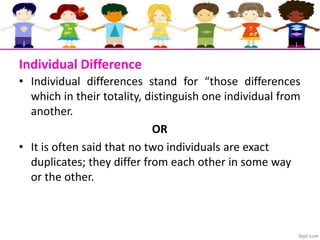
Individual Difference
• Individual differences stand for “those differences
which in their totality, distinguish one individual from
another.
OR
• It is often said that no two individuals are exact
duplicates; they differ from each other in some way
or the other.
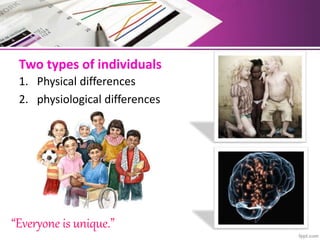
Two types of individuals
1. Physical differences
2. physiological differences
“Everyone is unique.”
Effects of Individual Differences on
Learning
There are three types of individuals
which effects on Learning
1. Socioeconomic Status
2. Thinking/Learning Style
3. Exceptionalities
Socioeconomic Status
The millionaires’ lifestyle differs from that of the
middle income or lower income group.
Thinking/Learning Style
• Some of you learn better by seeing something; others
by just listening; and still others by manipulating
something.
Exceptionalities
In class there maybe one who has difficulty in spoken
language comprehension or in seeing, hearing, etc.
Differences in learning and thinking style
Some learn more easily and are able to make use of
their learning more comfortably than others.
For some, one method of learning or memorization is
more suitable, while for others, a different method
suits.
Parents and teachers are able to perceive children
and their natural tendencies of how they think, act
and learn in different ways and in different
situations.
Differences in learning and thinking style
 For example, one child may welcome structure in
learning while another may welcome new ways of
doing things. One child may perform tasks in an
orderly and systematic pattern and another may
perform tasks in an unsystematic pattern. This is due
to individual differences in their style of learning and
thinking
Differences in learning and thinking style
• Some of you learn better by seeing something;
others by just listening; and still others by
manipulating something.
Conclusion
1. Definition of Individual Difference
2. Types of Individual Difference
3. Effects of individual difference on learning
4. Three effects of Individual Difference
– Socioeconomic Status
– Thinking/Learning Style
– Exceptionalities
5. Differences in learning and thinking styles
Reference
1. http://www.slideshare.net/redmivc/module-4-individual-
differences
2. http://wilderdom.com/personality/L1-1Introduction.html
3. http://www.nos.org/media/documents/secpsycour/Englis
h/Chapter-3.pdf
4. http://www2.le.ac.uk/offices/accessability/staff/including-
students-with-asperger-syndrome/theoretical-
perspectives/the-triad-2/thinking-and-learning-style

Individual difference and its effects on learning

  • 1.
  • 2.
  • 3.
    Objectives • After thispresentation students will be able to know about: 1. Individual Difference 2. Effects of individual difference on learning 3. Differences in learning and thinking styles
  • 4.
    Individual Difference • Individualdifferences stand for “those differences which in their totality, distinguish one individual from another. OR • It is often said that no two individuals are exact duplicates; they differ from each other in some way or the other.
  • 5.
    Two types ofindividuals 1. Physical differences 2. physiological differences “Everyone is unique.”
  • 6.
    Effects of IndividualDifferences on Learning There are three types of individuals which effects on Learning 1. Socioeconomic Status 2. Thinking/Learning Style 3. Exceptionalities
  • 7.
    Socioeconomic Status The millionaires’lifestyle differs from that of the middle income or lower income group.
  • 8.
    Thinking/Learning Style • Someof you learn better by seeing something; others by just listening; and still others by manipulating something.
  • 9.
    Exceptionalities In class theremaybe one who has difficulty in spoken language comprehension or in seeing, hearing, etc.
  • 10.
    Differences in learningand thinking style Some learn more easily and are able to make use of their learning more comfortably than others. For some, one method of learning or memorization is more suitable, while for others, a different method suits. Parents and teachers are able to perceive children and their natural tendencies of how they think, act and learn in different ways and in different situations.
  • 11.
    Differences in learningand thinking style  For example, one child may welcome structure in learning while another may welcome new ways of doing things. One child may perform tasks in an orderly and systematic pattern and another may perform tasks in an unsystematic pattern. This is due to individual differences in their style of learning and thinking
  • 12.
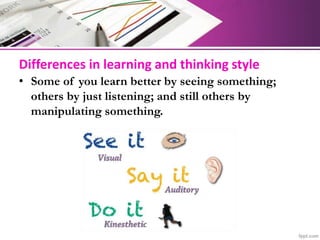
    Differences in learningand thinking style • Some of you learn better by seeing something; others by just listening; and still others by manipulating something.
  • 15.
    Conclusion 1. Definition ofIndividual Difference 2. Types of Individual Difference 3. Effects of individual difference on learning 4. Three effects of Individual Difference – Socioeconomic Status – Thinking/Learning Style – Exceptionalities 5. Differences in learning and thinking styles
  • 16.
    Reference 1. http://www.slideshare.net/redmivc/module-4-individual- differences 2. http://wilderdom.com/personality/L1-1Introduction.html 3.http://www.nos.org/media/documents/secpsycour/Englis h/Chapter-3.pdf 4. http://www2.le.ac.uk/offices/accessability/staff/including- students-with-asperger-syndrome/theoretical- perspectives/the-triad-2/thinking-and-learning-style