SAIQUA MAITLO
PRESENTED TO : DR. AMJAD ALI ARAIN
FACULTY OF EDUCATION
UNIVERSITY OF SINDH, PAKISTAN
INTRODUCTION
Taxonomy comes from Greek word.
“Taxis = arrangements” and “Nomo's = Science”
Science of arrangements means a set of classification ,
principles or structures and Domain simply means
category.
Taxonomy of Objectives
 Educational Taxonomy is classified into three domains
namely:
A. Cognitive Domain ( knowing )
B. Affective Domain ( Feeling )
C. Psychomotor Domain ( Doing )
A. Cognitive Domain ( knowing )
 Taxonomy of objectives in the cognitive domain
given by Bloom, etal in 1956. Instructional objectives
are arranged from lowest to highest level . They are
as follows.
1. Knowledge: knowledge is the psychological
process of remembering. Knowledge refers such
objects as memorizing facts & principles and
recalling information.
For example:
 Recite a policy/poem.
2. Comprehension: It is based on knowledge. If there
is no knowledge, there will be no comprehension.
To interpret information in one’s own words.
For example :
 Re writes the principles of test writing .
3. Application: Apply knowledge or generalization to
new situation. Knowledge is useful only when it is
to be applied.
For example :
 Apply laws of statistics to evaluate a reliability of a written test.
4. Analysis: It refers to the break down of knowledge
into parts and show relationship among parts.
For example :
 Gathers information from a departments and select the
required task for training.
5. Synthesis: It refers to the “bring together parts of
knowledge to form as whole and built a
relationship for new situation”.
For example :
 Design a machine to perform a specific task.
6. Evaluation: It is concerned with the “to give value to
something”. Make judgment on the basis of
criterion.
For example:
 Explain and justify a new budget.
B. Affective Domain ( Feeling )
Taxonomy of objectives in the affective domain given by
David Reading Krathwohl , etal in 1964.They are as
follows.
1. Receiving: For the inculcation of certain
interst,values or ideas. It is essential that the
learner is made to receive or attend the desired
ideas or events.
For example:
 Listen to others with respect.
2. Responding: Once a learner, receives or
attends to a particular area of thing. He must be
made to respond as actively as possible.
For example:
 Participates in Class discussions.
3. Valuing: When one attends as well as responds to a
particular idea, event or thing. He/She is naturally
drifted towards taking value judgment.
For example:
 Demonstrates belief in the democratic process.
4. Organizanizing: This category of objectives lead the
learners to form a set value structure or philosophy
of life.
For example:
 Accepts responsibility for one's behavior.
5. Characterization By A Value Or Value Complex:
By value or value set is to act consistently in
according to the value that He/She internalized.
For example:
 Shows self-reliance when
working independently.
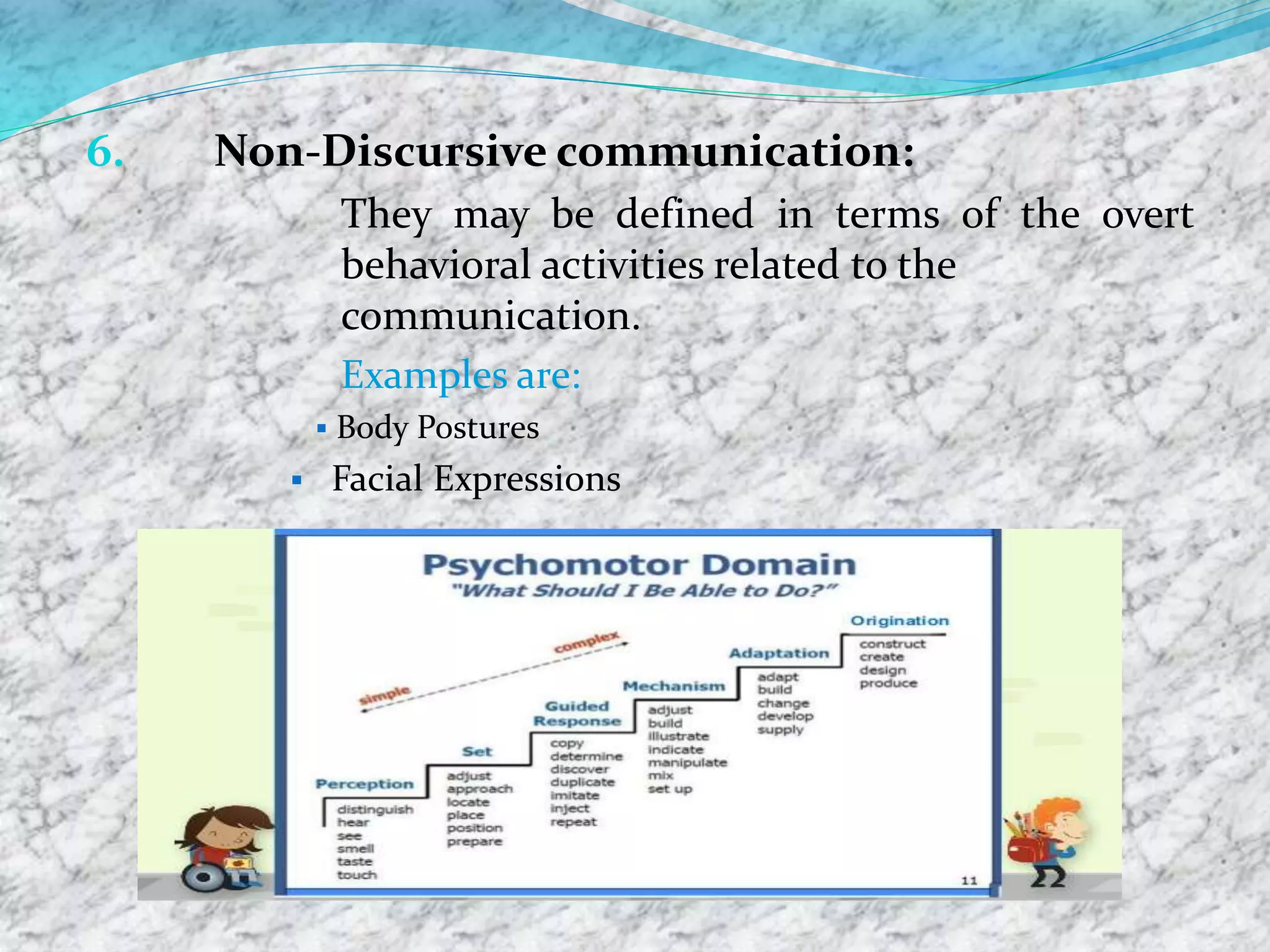
C. Psychomotor Domain ( Doing )
Taxonomy of objectives in the psychomotor domain
given by Simpson , in 1972.They are as follows.
1. Reflex Movements :
They may be considered as the involuntary motor
responses to various stimuli in environment.
Examples are:
 Extension
 Stretch
2. Basic Fundamental Movements:
They are not in born and innate as reflex movements but
a child may be seen to demonstrate such movements
from very early days of life.
Examples are:
 Pushing
 Pulling
3. Perceptual Abilities:
When some meaning is attached to sensation it is
termed as perception.
Examples are:
 Co ordinate movements such as jumping,roping,catching.
4. Physical Abilities:
There is an urgent need of the development
of desirable physical abilities.
Examples are:
 Muscular exertion
 Quick, Precise movements
5. Skilled movements:
These are complex bodily movements which
help in performing skilled task.
Examples are:
 Sports
 Kicking
6. Non-Discursive communication:
They may be defined in terms of the overt
behavioral activities related to the
communication.
Examples are:
 Body Postures
 Facial Expressions
Thank You All

Bloom's Taxonomy

  • 1.
    SAIQUA MAITLO PRESENTED TO: DR. AMJAD ALI ARAIN FACULTY OF EDUCATION UNIVERSITY OF SINDH, PAKISTAN
  • 2.
    INTRODUCTION Taxonomy comes fromGreek word. “Taxis = arrangements” and “Nomo's = Science” Science of arrangements means a set of classification , principles or structures and Domain simply means category.
  • 3.
    Taxonomy of Objectives Educational Taxonomy is classified into three domains namely: A. Cognitive Domain ( knowing ) B. Affective Domain ( Feeling ) C. Psychomotor Domain ( Doing )
  • 4.
    A. Cognitive Domain( knowing )  Taxonomy of objectives in the cognitive domain given by Bloom, etal in 1956. Instructional objectives are arranged from lowest to highest level . They are as follows. 1. Knowledge: knowledge is the psychological process of remembering. Knowledge refers such objects as memorizing facts & principles and recalling information. For example:  Recite a policy/poem.
  • 5.
    2. Comprehension: Itis based on knowledge. If there is no knowledge, there will be no comprehension. To interpret information in one’s own words. For example :  Re writes the principles of test writing . 3. Application: Apply knowledge or generalization to new situation. Knowledge is useful only when it is to be applied. For example :  Apply laws of statistics to evaluate a reliability of a written test.
  • 6.
    4. Analysis: Itrefers to the break down of knowledge into parts and show relationship among parts. For example :  Gathers information from a departments and select the required task for training.
  • 7.
    5. Synthesis: Itrefers to the “bring together parts of knowledge to form as whole and built a relationship for new situation”. For example :  Design a machine to perform a specific task. 6. Evaluation: It is concerned with the “to give value to something”. Make judgment on the basis of criterion. For example:  Explain and justify a new budget.
  • 8.
    B. Affective Domain( Feeling ) Taxonomy of objectives in the affective domain given by David Reading Krathwohl , etal in 1964.They are as follows. 1. Receiving: For the inculcation of certain interst,values or ideas. It is essential that the learner is made to receive or attend the desired ideas or events. For example:  Listen to others with respect.
  • 9.
    2. Responding: Oncea learner, receives or attends to a particular area of thing. He must be made to respond as actively as possible. For example:  Participates in Class discussions. 3. Valuing: When one attends as well as responds to a particular idea, event or thing. He/She is naturally drifted towards taking value judgment. For example:  Demonstrates belief in the democratic process.
  • 10.
    4. Organizanizing: Thiscategory of objectives lead the learners to form a set value structure or philosophy of life. For example:  Accepts responsibility for one's behavior. 5. Characterization By A Value Or Value Complex: By value or value set is to act consistently in according to the value that He/She internalized. For example:  Shows self-reliance when working independently.
  • 11.
    C. Psychomotor Domain( Doing ) Taxonomy of objectives in the psychomotor domain given by Simpson , in 1972.They are as follows. 1. Reflex Movements : They may be considered as the involuntary motor responses to various stimuli in environment. Examples are:  Extension  Stretch
  • 12.
    2. Basic FundamentalMovements: They are not in born and innate as reflex movements but a child may be seen to demonstrate such movements from very early days of life. Examples are:  Pushing  Pulling 3. Perceptual Abilities: When some meaning is attached to sensation it is termed as perception. Examples are:  Co ordinate movements such as jumping,roping,catching.
  • 13.
    4. Physical Abilities: Thereis an urgent need of the development of desirable physical abilities. Examples are:  Muscular exertion  Quick, Precise movements 5. Skilled movements: These are complex bodily movements which help in performing skilled task. Examples are:  Sports  Kicking
  • 14.
    6. Non-Discursive communication: Theymay be defined in terms of the overt behavioral activities related to the communication. Examples are:  Body Postures  Facial Expressions
  • 15.