TOPIC
ASPHALT
PREPARED
BY
ER. SANJEEV SINGH
SNJV432@GMAIL.COM
CONTENT
• Asphalt
• Classification of asphalt
• Forms of asphalt
• Properties of asphalt
• Uses of asphalt
ASPHALT
• The asphalt is a mechanical mixture of inert material matter like
alumina, lime, silica etc. and the asphaltic bitumen.
• It is black or brownish-black in colour.
• It remains in solid state at low temperature and become liquid at a
temperature of about 500
𝑐 𝑡𝑜 1000
𝑐.
CLASSIFICATION OF ASPHALT
• Natural asphalt
• Residual asphalt
NATURAL ASPHALT
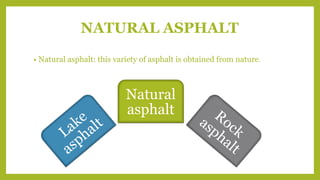
• Natural asphalt: this variety of asphalt is obtained from nature.
Natural
asphalt
LAKE ASPHALT
• This asphalt is obtained from lakes at Trinidad and Bermudez ( south
America ) at depth varying from 3 to 60 metres.
• It contains about 40% to 70%of pure bitumen.
• The water content is about 30%. The rest is impurities. It refined by
boiling in a tank.
• The water evaporates and impurities collect at the top. These
impurities are removed.
• This refined lake asphalt is used widely for road and pavement
construction.
RESIDUAL ASPHALT
• This variety is also known as the artificial asphalt.
• It is obtained by the fractional distillation of crude petroleum oil with
an asphaltic base.
• Such process leaves a solid substance in the retort. This solid
substance is the residual asphalt.
FORMS OF ASPHALT
• Asphaltic cement.
• Asphaltic emulsion.
• Cut-back asphaltic .
• Mastic Asphaltic .
ASPHALTIC CEMENT
• It is prepared by blowing air through melted asphalt at high
temperature.
• The asphalt is oxidized and the resulting product is plastic in nature
and it is highly resistant to varying climatic conditions.
• It is used for flooring, roofing, water-proofing and filler in expansion
joints in concrete.
ASPHALTIC EMULSION
• It is produced by mixing asphalt with 50 to 60 %water in presence of 1
% of emulsifying agent.
• When water evaporates ,the emulsion breaks and it forms a water
proofing layers.
• It can be applied in cold conditions.
CUT-BACK ASPHALTIC
• This is a liquid asphalt. It is prepared by dissolving asphalt in a
volatile solvent.
• It can be applied at normal temperature in cold condition.
• It is used for preparing bituminous paints, for repairing roofs etc.
MASTIC ASPHALTIC
• It is produced by heating natural asphalt with sand and mineral
fillers. The resulting product is a voidless impermeable mass.
• The hardness and melting point of mastic asphalt can be controlled
during its manufacture.
• It may either be in solid or semi solid state.
• It is used as a material for damp-proofing and water –proofing.
PROPERTIES OF ASPHALT
• It is a tough and durable material.
• It is a water-proof material and used can be easily cleaned.
• It is a good insulator of electricity, heat and sound.
• It is non-inflammable and non absorbent.
• It is not attacked by acids and is safe against vermin.
• It is resilient and reasonably elastic.
USES OF ASPHALT
• As damp-proof courses.
• As water – proof layer for tanks, basements, swimming pools etc.
• For preparing paints and roofing felts.
• For constructing roads and pavements etc.
asphalt

asphalt

  • 1.
  • 2.
    CONTENT • Asphalt • Classificationof asphalt • Forms of asphalt • Properties of asphalt • Uses of asphalt
  • 3.
    ASPHALT • The asphaltis a mechanical mixture of inert material matter like alumina, lime, silica etc. and the asphaltic bitumen. • It is black or brownish-black in colour. • It remains in solid state at low temperature and become liquid at a temperature of about 500 𝑐 𝑡𝑜 1000 𝑐.
  • 4.
    CLASSIFICATION OF ASPHALT •Natural asphalt • Residual asphalt
  • 5.
    NATURAL ASPHALT • Naturalasphalt: this variety of asphalt is obtained from nature. Natural asphalt
  • 6.
    LAKE ASPHALT • Thisasphalt is obtained from lakes at Trinidad and Bermudez ( south America ) at depth varying from 3 to 60 metres. • It contains about 40% to 70%of pure bitumen. • The water content is about 30%. The rest is impurities. It refined by boiling in a tank. • The water evaporates and impurities collect at the top. These impurities are removed. • This refined lake asphalt is used widely for road and pavement construction.
  • 7.
    RESIDUAL ASPHALT • Thisvariety is also known as the artificial asphalt. • It is obtained by the fractional distillation of crude petroleum oil with an asphaltic base. • Such process leaves a solid substance in the retort. This solid substance is the residual asphalt.
  • 8.
    FORMS OF ASPHALT •Asphaltic cement. • Asphaltic emulsion. • Cut-back asphaltic . • Mastic Asphaltic .
  • 9.
    ASPHALTIC CEMENT • Itis prepared by blowing air through melted asphalt at high temperature. • The asphalt is oxidized and the resulting product is plastic in nature and it is highly resistant to varying climatic conditions. • It is used for flooring, roofing, water-proofing and filler in expansion joints in concrete.
  • 10.
    ASPHALTIC EMULSION • Itis produced by mixing asphalt with 50 to 60 %water in presence of 1 % of emulsifying agent. • When water evaporates ,the emulsion breaks and it forms a water proofing layers. • It can be applied in cold conditions.
  • 11.
    CUT-BACK ASPHALTIC • Thisis a liquid asphalt. It is prepared by dissolving asphalt in a volatile solvent. • It can be applied at normal temperature in cold condition. • It is used for preparing bituminous paints, for repairing roofs etc.
  • 12.
    MASTIC ASPHALTIC • Itis produced by heating natural asphalt with sand and mineral fillers. The resulting product is a voidless impermeable mass. • The hardness and melting point of mastic asphalt can be controlled during its manufacture. • It may either be in solid or semi solid state. • It is used as a material for damp-proofing and water –proofing.
  • 13.
    PROPERTIES OF ASPHALT •It is a tough and durable material. • It is a water-proof material and used can be easily cleaned. • It is a good insulator of electricity, heat and sound. • It is non-inflammable and non absorbent. • It is not attacked by acids and is safe against vermin. • It is resilient and reasonably elastic.
  • 14.
    USES OF ASPHALT •As damp-proof courses. • As water – proof layer for tanks, basements, swimming pools etc. • For preparing paints and roofing felts. • For constructing roads and pavements etc.