Group 5
1. Raza Hussain
2. Ram Chand
3. Syed Ishfaq Ahmad
4. Khizer Arshad
5. Abdullah
Civil Engineering
Materials
Presentation
Presented To
>> Dr. Khan Shahzada
>>
UET
Peshawar
Raza Hussain & Abdullah
Properties of paints
There are of a number ways to judge paint quality:
Wearability
Covering ability
Ease of cleaning
Protection of the substrate
Environmentally friendly
Practical and cost effective
A well decorated bedroom
with paints
Composition Of Paints
• Fundamental components of an oil-based paint are
• Body
• Vehicle
• Pigment
• Thinner
• Dryer
Body
• Makes the paint film harder and more resistant to
abrasion.
• Reduces shrinkage cracks on drying
• In white paint > > body is also the pigment
• Commonly used bases (body) areWhite lead, Zinc
oxide, Iron oxide, Metallic powder such as Al, Cu, Br.
• Paints more often named the base as lead paint, zinc
paint and aluminium paint
• The Binder or resin, is the actual film
forming component of paint.
•It impacts adhesion, binds the pigments
together and strongly influences such
properties as gloss potential, exterior
durability, flexibility and toughness.
Vehicle
• Oily liquid in which the body and pigment are
soluble.
• Facilities the paint to be conveniently spread over the
surface.
• Oils most commonly used as vehicle.
Cont…
• The main purpose of the vehicle is to adjust the
viscosity of the paint.
• It is volatile and does not become part of the paint
film.
• It’s main function is as the carrier for the non volatile
components.
• Water is the main vehicle for water based paints.
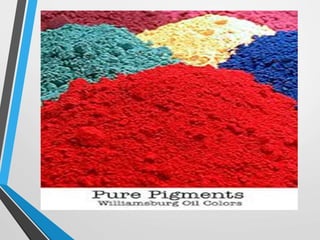
Pigments
• Pigments are materials which gives the paint its
colour. In white paint the body is the pigment. Natural
pigments (natural iron oxides). Synthetic pigments
(phthalocynines > > coal tar derivatives).
• Pigments imparts qualities such as color and opacity
(sometimes inappropriately called ‘hiding’), and
influences properties such as gloss, film flow and
protective abilities
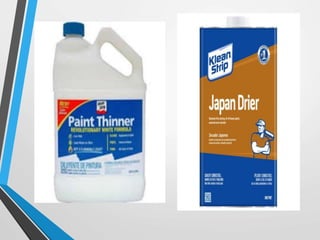
Thinner
• Liquid thinner is added in the paint to
• Increases fluidity
• Making paint more smooth
• Help penetration into porous surfaces
Dryers
• Added to quicken the drying of vehicle.
• Organic salts of iron, zinc, lead,, manganese Ca
• To accelerate the oxidation and hardening of vehicle.
Ram Chand
Bitumen
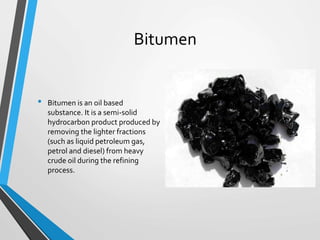
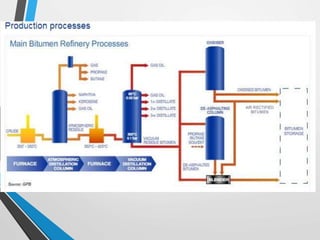
• Bitumen is an oil based
substance. It is a semi-solid
hydrocarbon product produced by
removing the lighter fractions
(such as liquid petroleum gas,
petrol and diesel) from heavy
crude oil during the refining
process.
Bitumen
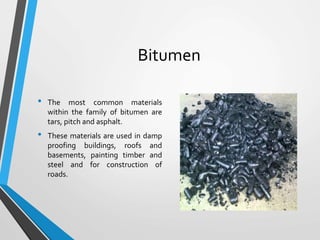
• The most common materials
within the family of bitumen are
tars, pitch and asphalt.
• These materials are used in damp
proofing buildings, roofs and
basements, painting timber and
steel and for construction of
roads.
Bitumen
• Bitumens are engineering materials produced
• by the distillation of crude oil during petroleum refining
and exist in numerous forms and types.
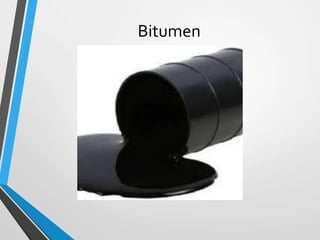
• Bitumens are dark viscous liquids or semi-solids that are
non-volatile at ambient temperatures and soften
gradually when heated
Bitumen
Cont…
• Tar, bitumen and asphalt forms group of interrelated
materials widely used in the field of civil engineering in
damp proofing buildings, water proofing roofs, water
proofing basements, painting timber, and steel and for
constructing metalled roads.
Tar
• Coal tar is a brown or dark black liquid of high viscosity,
which smells of aromatic hydrocarbons (sweet-smelling).
• Being flammable, coal tar is sometime used for heating or
to fire boilers.
• It can be used in coal tar soap and is used in medicated
shampoo to kill and repel parasites and as a treatment for
dandruff.
CoalTar
• Coal tar is the liquid by-product of the distillation of coal
to make coke(fuel).
• Gaseous by-product of this process is commonly known
as town gas.
• It is used for coating of sleepers and woolen poles
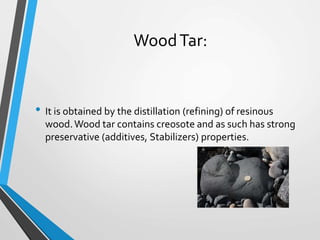
WoodTar:
• It is obtained by the distillation (refining) of resinous
wood.Wood tar contains creosote and as such has strong
preservative (additives, Stabilizers) properties.
MineralTar:
• It is obtained by the distillation of bituminous shale.
• Pitch is the name for any of a number of viscoelastic, solid
polymers. Pitch can be made from petroleum products or
plants
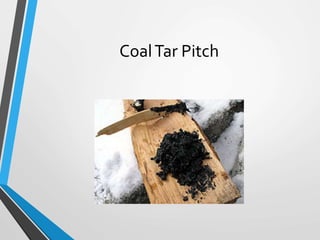
• COALTAR PITCH:
• It is the residue of the direct distillation of crude tar produced
by the high temperature carbonization of coal.
• It is used as a water proofing compound in masonry, steel and
timber structure. It is also used for water proofing concrete
structures.
CoalTar Pitch
Properties of Bitumen
• 1) Adhesion:
• Bitumen has the ability to adhere to a solid surface in a fluid state
depending on the nature of the surface.The presence of water on the
surface will prevent adhesion.
• 2) Resistance to water:
• Bitumen is water resistant.
• 3) Hardness:
• To measure the hardness of bitumen, the penetration test is conducted,
which measures the depth of penetration in tenths of mm. of a weighted
needle in bitumen after a given time, at a known temperature.
Cont…
• 4) Ductility:
• Ductility test is conducted to determine the amount of
bitumen that will stretch at temperature below its softening
point.
• Ductility values ranges from 0 to over 150 depending on the
type of bitumen. A briquette having a cross sectional area of 1
in2 is placed in a tester at
• 77 0F. Ductility values ranges from 0 to over 150 depending on
the type of bitumen.
Syed Ishfaq Ahmad
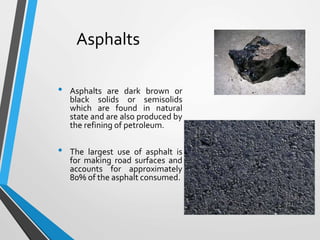
Asphalts
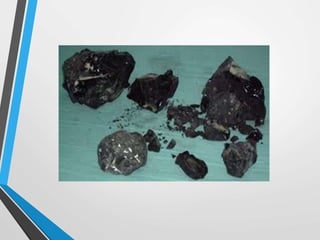
• Asphalts are dark brown or
black solids or semisolids
which are found in natural
state and are also produced by
the refining of petroleum.
• The largest use of asphalt is
for making road surfaces and
accounts for approximately
80% of the asphalt consumed.
Asphalt
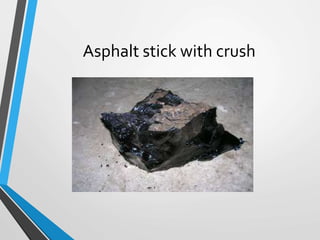
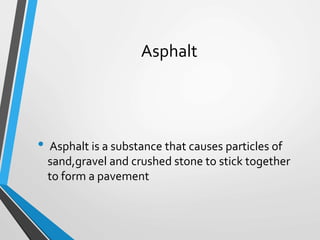
• Asphalt is a substance that causes particles of
sand,gravel and crushed stone to stick together
to form a pavement
Asphalt stick with crush
Types of Asphalt
• There are three types of Asphalt
• Hot Asphalt
• Cutback Asphalt
• Emulsion Asphalt
Hot Asphalt
• Those asphalt which are softened by heat
• Hot asphalt can be use directly or it can be processed
further to produce a harder material.
• Hot asphalts have good resistance to the transmission of
water and water vapour
Hot Asphalt cont…
• Hot asphalt bond poorly to damp or wet surfaces, have
relatively poor flexibility , oxidize under the sun’s rays,and
are brittle at low temperature.
Cutback Asphalt
• Those asphalts which are dissolved in mineral solvents.
• Such asphalts have poor bonding power on wet surfaces
but some of them have damp bonding ability.
•
Emulsion Asphalt
• Those asphalts which are dispersed or suspended in a
water base.
• They have good bonding qualities ,even to damp or wet
surfaces.
• Undergo less deterioration(decay) from weather
exposure than other forms of asphalts
Types of Asphalts
• There are three main groups of asphalt
• Hot Asphalt: those softened by heat
• Cut back Asphalt: those dissolved in mineral solvent
• Emulsion Asphalt: those dispersed or suspended in a
water base.
Uses of Asphalt
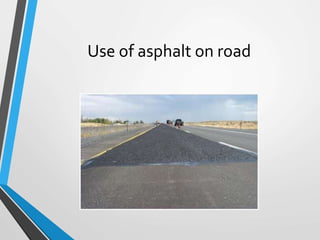
• Its greatest use as in road construction, side walk, airports
runways etc.
• It can also be used in the manufacture of sealants,
acoustical coatings ,paints, floor tile, and mastic flooring.
• Also used for paving.
• Some Industrial uses are logyards, ports, landfill caps.
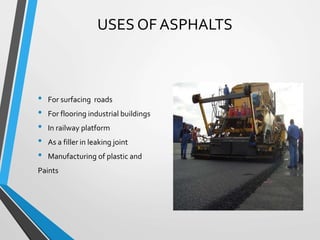
USES OF ASPHALTS
• For surfacing roads
• For flooring industrial buildings
• In railway platform
• As a filler in leaking joint
• Manufacturing of plastic and
Paints
Use of asphalt on road
Khizer Arshad
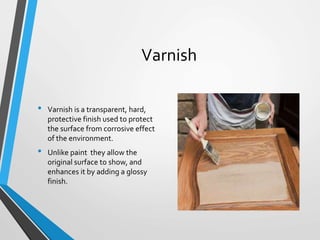
Varnish
• Varnish is a transparent, hard,
protective finish used to protect
the surface from corrosive effect
of the environment.
• Unlike paint they allow the
original surface to show, and
enhances it by adding a glossy
finish.
Types ofVarnishes
• Natural resin varnishes :-
• Obtained from natural resin of certain trees .They are useful for outside
works on walls.
Prepared by dissolving resin in oil heating mixture up to 500-600 C . Greater
the temp greater the gloss of varnish.
• Modified natural resin varnish :-
• Made from natural resin but altered by chemical reactions.
Prepared by heating common resin with glycerin to form a gum which is
considered as a body for varnish.These are less expansive then oleo resinous
varnishes.
• Synthetic resin varnishes :-
• Produced by plastic industry.These are chemically prepared .The chemicals
include nitrocellulose , amino resins and silicon.
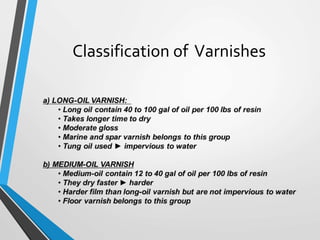
Classification of Varnishes
Cont…
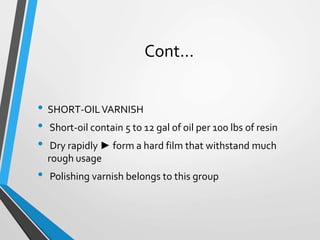
• SHORT-OILVARNISH
• Short-oil contain 5 to 12 gal of oil per 100 lbs of resin
• Dry rapidly ► form a hard film that withstand much
rough usage
• Polishing varnish belongs to this group
Paint bitumen varnish ashpalt

Paint bitumen varnish ashpalt

  • 2.
    Group 5 1. RazaHussain 2. Ram Chand 3. Syed Ishfaq Ahmad 4. Khizer Arshad 5. Abdullah Civil Engineering Materials
  • 3.
    Presentation Presented To >> Dr.Khan Shahzada >> UET Peshawar
  • 4.
  • 6.
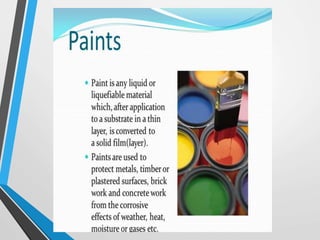
    Properties of paints Thereare of a number ways to judge paint quality: Wearability Covering ability Ease of cleaning Protection of the substrate Environmentally friendly Practical and cost effective
  • 7.
    A well decoratedbedroom with paints
  • 8.
    Composition Of Paints •Fundamental components of an oil-based paint are • Body • Vehicle • Pigment • Thinner • Dryer
  • 9.
    Body • Makes thepaint film harder and more resistant to abrasion. • Reduces shrinkage cracks on drying • In white paint > > body is also the pigment • Commonly used bases (body) areWhite lead, Zinc oxide, Iron oxide, Metallic powder such as Al, Cu, Br. • Paints more often named the base as lead paint, zinc paint and aluminium paint
  • 10.
    • The Binderor resin, is the actual film forming component of paint. •It impacts adhesion, binds the pigments together and strongly influences such properties as gloss potential, exterior durability, flexibility and toughness.
  • 11.
    Vehicle • Oily liquidin which the body and pigment are soluble. • Facilities the paint to be conveniently spread over the surface. • Oils most commonly used as vehicle.
  • 12.
    Cont… • The mainpurpose of the vehicle is to adjust the viscosity of the paint. • It is volatile and does not become part of the paint film. • It’s main function is as the carrier for the non volatile components. • Water is the main vehicle for water based paints.
  • 13.
    Pigments • Pigments arematerials which gives the paint its colour. In white paint the body is the pigment. Natural pigments (natural iron oxides). Synthetic pigments (phthalocynines > > coal tar derivatives). • Pigments imparts qualities such as color and opacity (sometimes inappropriately called ‘hiding’), and influences properties such as gloss, film flow and protective abilities
  • 15.
    Thinner • Liquid thinneris added in the paint to • Increases fluidity • Making paint more smooth • Help penetration into porous surfaces
  • 16.
    Dryers • Added toquicken the drying of vehicle. • Organic salts of iron, zinc, lead,, manganese Ca • To accelerate the oxidation and hardening of vehicle.
  • 22.
  • 23.
    Bitumen • Bitumen isan oil based substance. It is a semi-solid hydrocarbon product produced by removing the lighter fractions (such as liquid petroleum gas, petrol and diesel) from heavy crude oil during the refining process.
  • 24.
    Bitumen • The mostcommon materials within the family of bitumen are tars, pitch and asphalt. • These materials are used in damp proofing buildings, roofs and basements, painting timber and steel and for construction of roads.
  • 26.
    Bitumen • Bitumens areengineering materials produced • by the distillation of crude oil during petroleum refining and exist in numerous forms and types. • Bitumens are dark viscous liquids or semi-solids that are non-volatile at ambient temperatures and soften gradually when heated
  • 27.
  • 28.
    Cont… • Tar, bitumenand asphalt forms group of interrelated materials widely used in the field of civil engineering in damp proofing buildings, water proofing roofs, water proofing basements, painting timber, and steel and for constructing metalled roads.
  • 29.
    Tar • Coal taris a brown or dark black liquid of high viscosity, which smells of aromatic hydrocarbons (sweet-smelling). • Being flammable, coal tar is sometime used for heating or to fire boilers. • It can be used in coal tar soap and is used in medicated shampoo to kill and repel parasites and as a treatment for dandruff.
  • 30.
    CoalTar • Coal taris the liquid by-product of the distillation of coal to make coke(fuel). • Gaseous by-product of this process is commonly known as town gas. • It is used for coating of sleepers and woolen poles
  • 31.
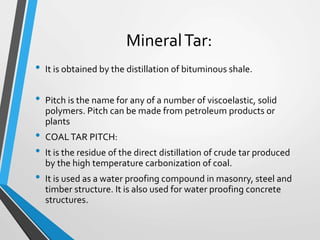
    WoodTar: • It isobtained by the distillation (refining) of resinous wood.Wood tar contains creosote and as such has strong preservative (additives, Stabilizers) properties.
  • 32.
    MineralTar: • It isobtained by the distillation of bituminous shale. • Pitch is the name for any of a number of viscoelastic, solid polymers. Pitch can be made from petroleum products or plants • COALTAR PITCH: • It is the residue of the direct distillation of crude tar produced by the high temperature carbonization of coal. • It is used as a water proofing compound in masonry, steel and timber structure. It is also used for water proofing concrete structures.
  • 33.
  • 34.
    Properties of Bitumen •1) Adhesion: • Bitumen has the ability to adhere to a solid surface in a fluid state depending on the nature of the surface.The presence of water on the surface will prevent adhesion. • 2) Resistance to water: • Bitumen is water resistant. • 3) Hardness: • To measure the hardness of bitumen, the penetration test is conducted, which measures the depth of penetration in tenths of mm. of a weighted needle in bitumen after a given time, at a known temperature.
  • 35.
    Cont… • 4) Ductility: •Ductility test is conducted to determine the amount of bitumen that will stretch at temperature below its softening point. • Ductility values ranges from 0 to over 150 depending on the type of bitumen. A briquette having a cross sectional area of 1 in2 is placed in a tester at • 77 0F. Ductility values ranges from 0 to over 150 depending on the type of bitumen.
  • 36.
  • 37.
    Asphalts • Asphalts aredark brown or black solids or semisolids which are found in natural state and are also produced by the refining of petroleum. • The largest use of asphalt is for making road surfaces and accounts for approximately 80% of the asphalt consumed.
  • 38.
    Asphalt • Asphalt isa substance that causes particles of sand,gravel and crushed stone to stick together to form a pavement
  • 39.
  • 41.
    Types of Asphalt •There are three types of Asphalt • Hot Asphalt • Cutback Asphalt • Emulsion Asphalt
  • 42.
    Hot Asphalt • Thoseasphalt which are softened by heat • Hot asphalt can be use directly or it can be processed further to produce a harder material. • Hot asphalts have good resistance to the transmission of water and water vapour
  • 43.
    Hot Asphalt cont… •Hot asphalt bond poorly to damp or wet surfaces, have relatively poor flexibility , oxidize under the sun’s rays,and are brittle at low temperature.
  • 44.
    Cutback Asphalt • Thoseasphalts which are dissolved in mineral solvents. • Such asphalts have poor bonding power on wet surfaces but some of them have damp bonding ability. •
  • 45.
    Emulsion Asphalt • Thoseasphalts which are dispersed or suspended in a water base. • They have good bonding qualities ,even to damp or wet surfaces. • Undergo less deterioration(decay) from weather exposure than other forms of asphalts
  • 46.
    Types of Asphalts •There are three main groups of asphalt • Hot Asphalt: those softened by heat • Cut back Asphalt: those dissolved in mineral solvent • Emulsion Asphalt: those dispersed or suspended in a water base.
  • 47.
    Uses of Asphalt •Its greatest use as in road construction, side walk, airports runways etc. • It can also be used in the manufacture of sealants, acoustical coatings ,paints, floor tile, and mastic flooring. • Also used for paving. • Some Industrial uses are logyards, ports, landfill caps.
  • 48.
    USES OF ASPHALTS •For surfacing roads • For flooring industrial buildings • In railway platform • As a filler in leaking joint • Manufacturing of plastic and Paints
  • 49.
  • 50.
  • 51.
    Varnish • Varnish isa transparent, hard, protective finish used to protect the surface from corrosive effect of the environment. • Unlike paint they allow the original surface to show, and enhances it by adding a glossy finish.
  • 52.
    Types ofVarnishes • Naturalresin varnishes :- • Obtained from natural resin of certain trees .They are useful for outside works on walls. Prepared by dissolving resin in oil heating mixture up to 500-600 C . Greater the temp greater the gloss of varnish. • Modified natural resin varnish :- • Made from natural resin but altered by chemical reactions. Prepared by heating common resin with glycerin to form a gum which is considered as a body for varnish.These are less expansive then oleo resinous varnishes. • Synthetic resin varnishes :- • Produced by plastic industry.These are chemically prepared .The chemicals include nitrocellulose , amino resins and silicon.
  • 53.
  • 54.
    Cont… • SHORT-OILVARNISH • Short-oilcontain 5 to 12 gal of oil per 100 lbs of resin • Dry rapidly ► form a hard film that withstand much rough usage • Polishing varnish belongs to this group