Bitumen
and
modified bitumen
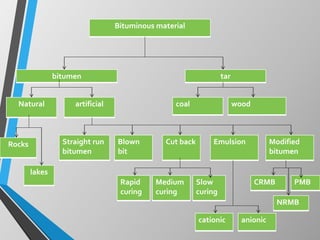
bitumen tar
Natural
Straight run
bitumen
coal
Blown
bit
wood
Cut back Emulsion Modified
bitumen
Rapid
curing
Medium
curing
Slow
curing
cationic anionic
CRMB
NRMB
PMB
artificial
Rocks
lakes
Bituminous material
BITUMEN
• Bitumen is defined as a viscous liquid , or a solid
consisting essentially of hydrocarbons and their
derivatives, which is soluble in carbon disulphate.
TAR
• Obtained by destructive distillation of coal or wood.
• Tar contain more free carbon which is insoluble in carbon
trichloroethylene.
• They are also readily distinguished by odour.
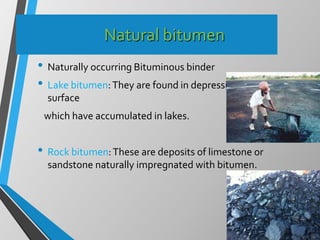
Natural bitumen
• Naturally occurring Bituminous binder
• Lake bitumen:They are found in depression in earth’s
surface
which have accumulated in lakes.
• Rock bitumen:These are deposits of limestone or
sandstone naturally impregnated with bitumen.
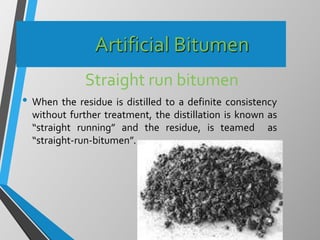
Artificial Bitumen
Straight run bitumen
• When the residue is distilled to a definite consistency
without further treatment, the distillation is known as
“straight running” and the residue, is teamed as
“straight-run-bitumen”.
Blown bitumen
• Blown bitumen is a bitumen obtained by further
treatment of straight run bitumen by running it, while
hot, into a vertical column and blowing air through it.
Cut back
• Cut back is defined as bitumen whose viscosity has been
reduced by the addition of a volatile diluents.
• Depending upon the diluent used, there are three types of
cut-backs.
• Rapid curing: Bitumen which has been fluxed with a naphtha
type of distillate.
• Medium curing: Bitumen which has been fluxed with a
kerosene type of distillate
• Slow curing: A liquid residue produced in the refining process,
containing little or no volatile constituents.
Emulsion
• Emulsion is relatively stable dispersion of a liquid,
subdivided in another liquid in which it is not soluble.
• Emulsion of bitumen =bitumen+ emulsifier/additives +
water
• Free flowing dark brown liquid
• Emulsions of bitumen can be of two type:
1.Anionic - bitumen particle has negative charge
2. Cationic - bitumen particle has positive charge
Properties of bitumen
1. They contain predominantly hydrocarbons, with small
quantities of sulphur, oxygen, nitrogen and metals.
2. They are predominantly soluble in carbon disulphide (CS2)
the portion insoluble in CS2 being generally less than 0.1 %.
3. Most bitumens are colloidal in nature.
4. Bitumens are thermoplastic, i.e. they soften on heating and
harden on cooling.
5. They have no specific melting point, boiling point or freezing
point, though a form of softening point is used in their
characterization.
6. Bitumens are insoluble in water.
7. They are highly impermeable to the passage of water.
8. They are generally hydrophobic(water-repellent), but
may be made hydrophilic(water liking) by the addition
of small quantity of surface active agents.
9. They are chemically inert.
10.They oxidize slowly.
Advantage of Bitumen
 They are more tolerant.
 They can be used in relatively cold weather.
 They are ideal for patching and repair work.
 They are useful for sealing cracks.
Tests on bitumen
• Consistency test
1. penetration test
2. viscosity test
3. softening point test
4. float test
• Ductility test
• Flash and fire point test
• Specific gravity test
• Distillation test
• Water content test
• Solubility test
Consistency tests:
• Consistency defined as the resistance of a material to
flow.
• Since this property changes as the temperature varies, it
must be realized that there is no single method of the
test that can readily evaluate all bituminous binders for
consistency over such a wide range
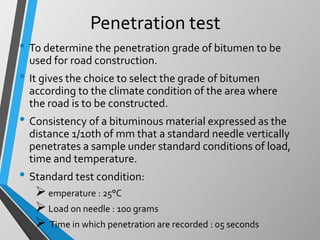
Penetration test
• To determine the penetration grade of bitumen to be
used for road construction.
• It gives the choice to select the grade of bitumen
according to the climate condition of the area where
the road is to be constructed.
• Consistency of a bituminous material expressed as the
distance 1/10th of mm that a standard needle vertically
penetrates a sample under standard conditions of load,
time and temperature.
• Standard test condition:
emperature : 25°C
Load on needle : 100 grams
 Time in which penetration are recorded : 05 seconds
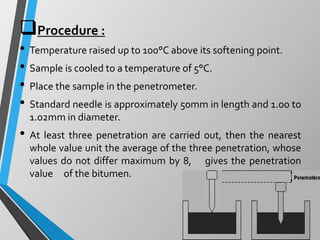
Procedure :
• Temperature raised up to 100°C above its softening point.
• Sample is cooled to a temperature of 5°C.
• Place the sample in the penetrometer.
• Standard needle is approximately 50mm in length and 1.00 to
1.02mm in diameter.
• At least three penetration are carried out, then the nearest
whole value unit the average of the three penetration, whose
values do not differ maximum by 8, gives the penetration
value of the bitumen.
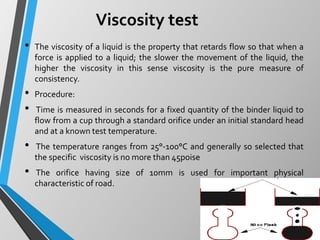
Viscosity test
• The viscosity of a liquid is the property that retards flow so that when a
force is applied to a liquid; the slower the movement of the liquid, the
higher the viscosity in this sense viscosity is the pure measure of
consistency.
• Procedure:
• Time is measured in seconds for a fixed quantity of the binder liquid to
flow from a cup through a standard orifice under an initial standard head
and at a known test temperature.
• The temperature ranges from 25°-100°C and generally so selected that
the specific viscosity is no more than 45poise
• The orifice having size of 10mm is used for important physical
characteristic of road.
Softening point test
• Softening point is not a melting point; bituminous binders do not melt
but instead gradually changes from semi solids to liquids when heated.
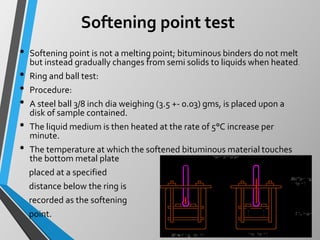
• Ring and ball test:
• Procedure:
• A steel ball 3/8 inch dia weighing (3.5 +- 0.03) gms, is placed upon a
disk of sample contained.
• The liquid medium is then heated at the rate of 5°C increase per
minute.
• The temperature at which the softened bituminous material touches
the bottom metal plate
placed at a specified
distance below the ring is
recorded as the softening
point.
Float test
• For the certain range of consistency of the bitumen materials,
orifice viscometer test or penetration test can’t be used to
define consistency of material.
• Float test measures the material of this group.
Procedure:
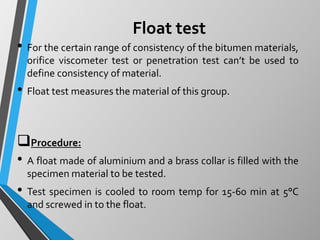
• A float made of aluminium and a brass collar is filled with the
specimen material to be tested.
• Test specimen is cooled to room temp for 15-60 min at 5°C
and screwed in to the float.
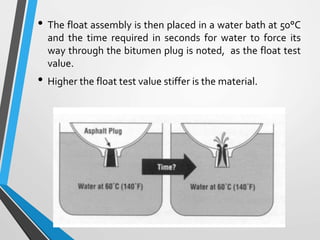
• The float assembly is then placed in a water bath at 50°C
and the time required in seconds for water to force its
way through the bitumen plug is noted, as the float test
value.
• Higher the float test value stiffer is the material.
Ductility test
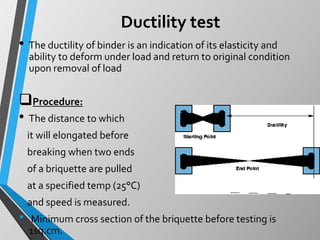
• The ductility of binder is an indication of its elasticity and
ability to deform under load and return to original condition
upon removal of load
Procedure:
• The distance to which
it will elongated before
breaking when two ends
of a briquette are pulled
at a specified temp (25°C)
and speed is measured.
• Minimum cross section of the briquette before testing is
1sq.cm.
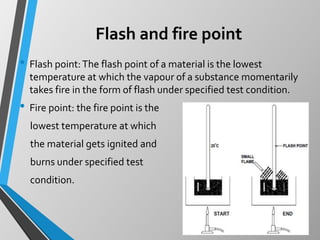
Flash and fire point
• Flash point:The flash point of a material is the lowest
temperature at which the vapour of a substance momentarily
takes fire in the form of flash under specified test condition.
• Fire point: the fire point is the
lowest temperature at which
the material gets ignited and
burns under specified test
condition.
Procedure:
• The bitumen is filled in the cup upto a filling marks and
bitumen sample is heated at the rate of 5°C to 6°C per
minute, stirring the material.
• The test flame is applied at the intervals.
• the flash point is taken as the temperature read on the
thermometer.
• If heating is continued beyond the flash point vapours
ignite in the presence of a flame and continues to burn,
indicating the fire point temperature.
Specific gravity test
• Sp gravity is defined as the ratio of the weight of given
volume of material at a given temp to that of an equal volume
of water at the same temp.
Procedure:
• Take clean and dry sp. Gravity bottle and weigh along with
the stopper(weight ‘A’)
• Fill the sp. gr. Bottle with distilled water and keep in water
bath having a temperature of 27°C+1°C for not less then half
an hour and weigh it(weight ’B’)
• Weigh the sp. Gr. Bottle about half filled with the
material(weight ‘C’)
• Weigh the sp.gr. Bottle about half filled with the material and
other half with distilled water(weight ‘D’)Weigh the sp.gr.
Bottle completely filled with the material. (weight ‘E’)
Specific gravity =
(C−A)
[(B−A) – (D−C)]
Distillation test
• It is used to find out the quantity and quality of volatile
constituents.
• The amount of non volatile residues presents in road tars, cut
back bitumen and binder emulsions.
Procedure:
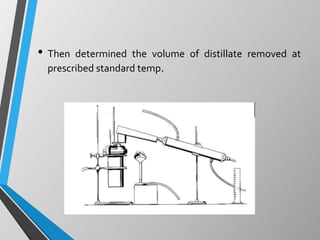
• Two hundred millilitres of the sample is distilled in a 500ml
flask at the a controlled rate to a temp of 360°C for 15
minutes.
• Then determined the volume of distillate removed at
prescribed standard temp.
Water content test
• This test is carried out to know the content of water in a
sample of bitumen.
• Procedure:
• The specimen of known weight is mixed in a pure petroleum
distillate free from water.
• It is then heated and the water is distilled off.
• The condensed water is collected and its weight is recorded.
• The water content of the specimen is expressed as the
percentage of the weight of condensed water to the weight
of the original sample.
• The maximum water in the bitumen should not exceed 0.2
percent by weight.
Solubility test
Procedure:
• Different solvents are used in determining the
percentage of the binder present in bitumen or tar.
• In the case of bitumen the accepted solvent is carbon
disulphide.
• A specified quantity of binder usually about 2gms is
dissolved in a given quantity of solvent.
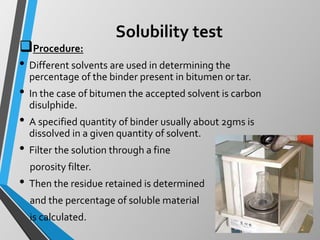
• Filter the solution through a fine
porosity filter.
• Then the residue retained is determined
and the percentage of soluble material
is calculated.
Modified bitumen
• A heavy roofing material employing multiple layers of
asphalt and reinforcers around a core of plastic or
rubber modifiers
Guidelines on use of Modified
Bitumen
• MORTH letter No. RW/NH-34041/36/90-S&R(Vol. II) dated April 21, 1999
advised all States/UTs to use Modified Bitumen upto 10% for all works “as it
has been proved by field trials that the life of the road increases by 1.5
times”.
• IRC released new Specifications vide publication No. IRC-SP:53:2002 FOR
USE OF MODIFIED BITUMEN in road development activities in India.
• MORTH vide letter No. RW/NH-34041/36/90-S&R(Vol. II) dated 17, January
2000 requested all States to start using MODIFIED BITUMEN.
• MORTH letter No. RW/NH-34041/36/90-S&R(Vol. II) dated April 14, 2000
requested MOP&NG to start Modified Bitumen production at Refinery level.
Guidelines on use of Modified
Bitumen
• MORTH vide their letter No. RW/NH-35072/1/2001-S&R( R ) dated June 21,
2001 has requested all States to encourage use of Modified Bitumen in view
of its various advantages and improved performance over conventional
Bitumen.
• MORTH vide their letter No. RW/NH-33041/3/2001-S&R dated June 13, 2002
has stated that “It has been decided that keeping in view its advantages,
polymer/rubber modified bitumen may be adopted in surfacing for the
whole length, subject to availability”.
Advantage of modified bitumen
• Lower susceptibility to daily and seasonal temperature
variation.
• Higher resistance to deformation at high pavement
temperature.
• Better age resistance properties.
• Higher fatigue life for mixes.
• Better adhesion between aggregate and binder.
• Prevention of cracking and reflective cracking.
Crumb rubber
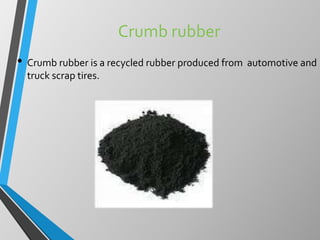
• Crumb rubber is a recycled rubber produced from automotive and
truck scrap tires.
Crumb rubber modified
bitumen
Bitumen
+
Additives (Modifiers/Treated Crumb Rubber)
What is Crumb Rubber Modified
Bitumen?
• Crumb Rubber Modified Bitumen is Conventional
Bitumen with treated Crumb Rubber Additive at high
temperature which results in
• Lower susceptibility to temp. variation
• Higher resistance to deformation at high temperature
• Better Age Resistance Properties
• Higher Fatigue Life of Mixes
• Better Adhesion Properties
Grades of CRMB
• CRMB is manufactured in three grades for differing
weathering conditions.
• Grade 50 is used for colder climates when minimum
modification is sufficient.
• Grade 55 is used in moderate climatic conditions where
moderate modification is required.
• Grade 60 is used in hot conditions where high
modification is required to withstand the extra heat.
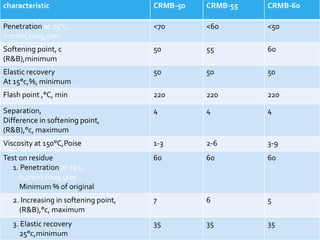
characteristic CRMB-50 CRMB-55 CRMB-60
Penetration at 25°c,
0.1mm,100g,5sec
<70 <60 <50
Softening point, c
(R&B),minimum
50 55 60
Elastic recovery
At 15°c,%, minimum
50 50 50
Flash point ,°C, min 220 220 220
Separation,
Difference in softening point,
(R&B),°c, maximum
4 4 4
Viscosity at 150°C,Poise 1-3 2-6 3-9
Test on residue
1. Penetration at 25 c,
0.1mm,100g,5sec
Minimum % of original
60 60 60
2. Increasing in softening point,
(R&B),°c, maximum
7 6 5
3. Elastic recovery
25°c,minimum
35 35 35
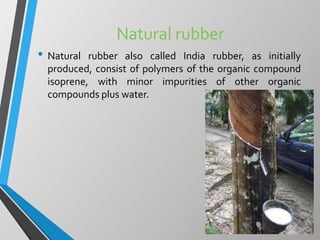
Natural rubber
• Natural rubber also called India rubber, as initially
produced, consist of polymers of the organic compound
isoprene, with minor impurities of other organic
compounds plus water.
Natural rubber modified bitumen
• Natural rubber modified bitumen is used for prolongation
of life of state roads.
• The need to adopt rubber for the use of construction of
the roads mainly that it reduces the cost of construction
and also recycled rubber is used as it minimize the
environment pollution.
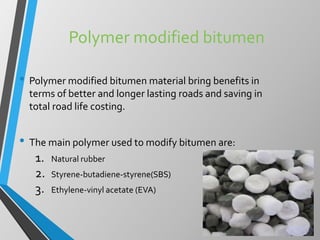
Polymer modified bitumen
• Polymer modified bitumen material bring benefits in
terms of better and longer lasting roads and saving in
total road life costing.
• The main polymer used to modify bitumen are:
1. Natural rubber
2. Styrene-butadiene-styrene(SBS)
3. Ethylene-vinyl acetate (EVA)
General Requirements of
Modifiers:
• Be compatible with bitumen.
• Resist degradation of bitumen at mixing temperature.
• Be capable of being processed by conventional mixing
and laying machinery.
• Produce coating viscosity at application temperature.
• Maintain premium properties during storage, application
and in service.
• Be cost-effective on a Life-cycle-cost basis.
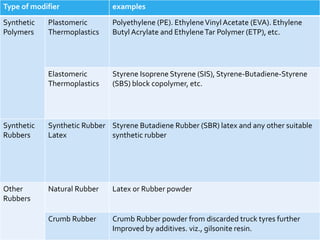
Type of modifier examples
Synthetic
Polymers
Plastomeric
Thermoplastics
Polyethylene (PE). EthyleneVinylAcetate (EVA). Ethylene
Butyl Acrylate and EthyleneTar Polymer (ETP), etc.
Elastomeric
Thermoplastics
Styrene Isoprene Styrene (SIS), Styrene-Butadiene-Styrene
(SBS) block copolymer, etc.
Synthetic
Rubbers
Synthetic Rubber
Latex
Styrene Butadiene Rubber (SBR) latex and any other suitable
synthetic rubber
Other
Rubbers
Natural Rubber Latex or Rubber powder
Crumb Rubber Crumb Rubber powder from discarded truck tyres further
Improved by additives. viz., gilsonite resin.
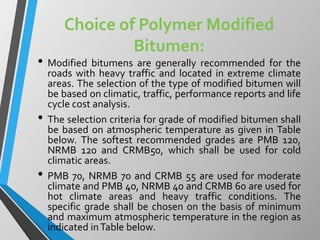
Choice of Polymer Modified
Bitumen:
• Modified bitumens are generally recommended for the
roads with heavy traffic and located in extreme climate
areas. The selection of the type of modified bitumen will
be based on climatic, traffic, performance reports and life
cycle cost analysis.
• The selection criteria for grade of modified bitumen shall
be based on atmospheric temperature as given in Table
below. The softest recommended grades are PMB 120,
NRMB 120 and CRMB50, which shall be used for cold
climatic areas.
• PMB 70, NRMB 70 and CRMB 55 are used for moderate
climate and PMB 40, NRMB 40 and CRMB 60 are used for
hot climate areas and heavy traffic conditions. The
specific grade shall be chosen on the basis of minimum
and maximum atmospheric temperature in the region as
indicated inTable below.
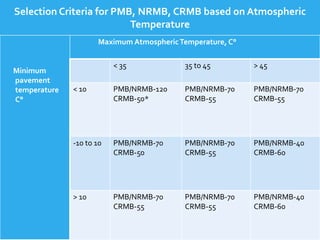
Selection Criteria for PMB, NRMB, CRMB based on Atmospheric
Temperature
Minimum
pavement
temperature
C°
Maximum AtmosphericTemperature, C°
< 35 35 to 45 > 45
< 10 PMB/NRMB-120
CRMB-50*
PMB/NRMB-70
CRMB-55
PMB/NRMB-70
CRMB-55
-10 to 10 PMB/NRMB-70
CRMB-50
PMB/NRMB-70
CRMB-55
PMB/NRMB-40
CRMB-60
> 10 PMB/NRMB-70
CRMB-55
PMB/NRMB-70
CRMB-55
PMB/NRMB-40
CRMB-60
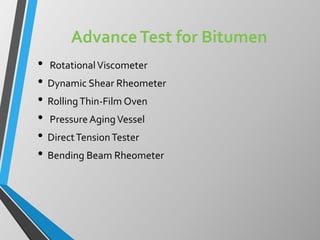
AdvanceTest for Bitumen
• RotationalViscometer
• Dynamic Shear Rheometer
• RollingThin-Film Oven
• Pressure AgingVessel
• DirectTensionTester
• Bending Beam Rheometer
RotationalViscometer:
• The Rotational Viscometer (RV) is used to determine the
viscosity of asphalt binders in the high temperature range of
manufacturing and construction.
ApproximateTestTime:
• 1.5 hours from sample preparation to final viscosity reading
for one temperature. 2.5 hours for two temperatures.
Basic Procedure:
1. Preheat spindle, sample chamber, and viscometer
environmental chamber to 275°F (135°C).
2. Heat unaged asphalt binder until fluid enough to pour. Stir
the sample, being careful not to entrap air bubbles.
3. Pour appropriate amount of asphalt binder into sample
chamber. The sample size varies according to the selected
spindle and equipment manufacturer.
4. Insert sample chamber into RV temperature
controller unit and carefully lower spindle into
sample.
5. Bring sample to the desired test temperature
(typically 275°F (135°C)) within approximately 30
minutes and allow it to equilibrate at test
temperature for 10 minutes.
6. Rotate spindle at 20 RPM, making sure the percent
torque as indicated by the RV readout remains
between 2 and 98 percent.
7. Once the sample has reached temperature and
equilibrated, take 3 viscosity readings from RV
display, allowing 1 minute between each reading.
Viscosity is reported as the average of 3 readings.
Dynamic Shear Rheometer:
• The dynamic shear rheometer (DSR) is used to characterize
the viscous and elastic behaviour of asphalt binders at
medium to high temperatures.
ApproximateTestTime:
• 1 to 2 hours depending upon the number of test temperatures
needed.
Basic Procedure:
1. Heat the asphalt binder from which the test specimens are
to be selected until the binder is sufficiently fluid to pour the
test specimens.
2. Select the testing temperature according to the
asphalt binder grade or testing schedule. Heat the
DSR to the test temperature. This preheats the upper
and lower plates, which allows the specimen to
adhere to them.
3. Place the asphalt binder sample between the test
plates.
4. Move the test plates together until the gap between
them equals the test gap plus 0.002 inches (0.05 mm).
5. Trim the specimen around the edge of the test plates
using a heated trimming tool.
6. Move the test plates together to the desired testing
gap. This creates a slight bulge in the asphalt binder
specimen’s perimeter.
7. Bring the specimen to the test temperature. Start the
test only after the specimen has been at the desired
temperature for at least 10 minutes.
8. The DSR software determines a target torque at which
to rotate the upper plate based on the material being
tested.
9. The DSR conditions the specimen for 10 cycles at a
frequency of 10 rad/sec (1.59 Hz).
10.The DSR takes test measurements over the next 10
cycles and then the software reduces the data to
produce a value for complex modulus (G*) and phase
angle (δ).
RollingThin-Film Oven:
• The Rolling Thin-Film Oven (RTFO) procedure provides
simulated short term aged asphalt binder for physical
property testing.
ApproximateTestTime:
• 3hours from sample preparation to scraping of final bottle.
Basic Procedure:
1. Heat a sample of asphalt binder until it is fluid to pour. Stir
sample to ensure homogeneity and remove air bubbles.
2. If a determination of mass change is desired, label two RTFO
bottles and weigh them empty. These are designated as the
“mass change” bottles. Record the weights.
3. Pour 1.23 oz (35 g) of asphalt binder into each bottle
(Figure 5). Immediately after pouring each bottle, turn
the bottles on their side without rotating or twisting
and place them on a cooling rack.
4. Allow all bottles to cool 60 to 180 minutes.
5. After cooling, weigh the two mass change bottles
again. Record the weights.
6. Place the bottles in the RTFO oven carousel, close the
door, and rotate carousel at 15 RPM for 85 minutes.
During this time, maintain the oven temperature at
325°F (163°C) and the airflow into the bottles at 244 in
3/min (4000 ml/min).
7. Remove the bottles one at a time from the carousel,
setting the mass change bottles aside. Residue from the
remaining bottles should be transferred to a single
container. Remove residue from each bottle by first
pouring as much material as possible, then scraping the
sides of the bottle to remove any remaining residue.
There is no standard scraping utensil but at least 90
percent of the asphalt binder should be removed from
the bottle. RTFO residue should be tested within 72
hours of aging.
8. After cooling the two mass change bottles for 60 – 180
minutes, weigh them and discard their residue. Record
the weights.
Pressure AgingVessel
• The Pressure Aging Vessel (PAV) provides simulated long term
aged asphalt binder for physical property testing. Asphalt
binder is exposed to heat and pressure to simulate in-service
aging over a 7 to 10 year period.
ApproximateTestTime:
• 22 hours from sample preparation to end of vacuum
degassing procedure.
Basic Procedure:
1. Heat RTFO aged asphalt binder until fluid enough to pour.
Stir sample and pour 50 g into a preheated thin film oven
pan Pour as many pans as needed for intermediate and cold
temperature testing (usually 1 – 3 pans will suffice).
2. Place pans in a pan holder and place inside preheated
PAV.
3. Seal the PAV and allow it to return to the aging
temperature. Aging temperature is based on the
climate where the material is expected to be used. For
climates where a PG 52 or lower is specified, the PAV
is performed at 194°F (90°C). For climates where a PG
58 or higher is specified, the PAV is performed at
212°F (100°C). For desert climates, it is recommended
to perform the PAV at 230°F (110°C).
4. Once the PAV has reached the desired temperature,
pressurize the PAV to 300 psi (2.07 MPa) and
maintained the pressure for 20 hours.
5. At the end of the aging period, gradually release the
pressure and remove the pans from the PAV.
6. Place the pans in an oven set at 325°F (163°C) for 15
minutes, then scrape into a single container sized so
that the depth of the residue in the container is between
0.55 and 1.57 inches (14 and 40 mm).
7. Place the container in a vacuum oven at 338°F (170°C)
and degas the sample for 30 minutes to remove
entrapped air. If not degassed, entrapped air bubbles
may cause premature breaking in the DTT test.
DirectTensionTester
• The DirectTensionTester (DTT) test provides a measure of
low temperature stiffness and relaxation properties of
asphalt binders.
ApproximateTestTime:
• About 4 hours including sample preparation time.
Basic Procedure:
1. Heat long term aged (PAV) asphalt binder until fluid to pour.
During heating the sample should be covered and
occasionally stirred to ensure homogeneity.
2. Pour the heated sample into two DTT molds, making
sure to overpour so that there is excess along the top
of the mold. This overpouring will ensure enough
asphalt binder to completely fill the mold. Sample
preparation is critical and is the largest source of test
variation.
3. Allow molds to cool for 30 – 60 minutes at room
temperature, then trim the top of sample flush with
mold using a hot spatula.
4. To demold samples, cool mold in an ice bath or freezer
at 23°F ( -5°C) for 5 to 10 minutes; just long enough
that the beam can be easily removed from the mold
without damaging it.
5. Mount the sample in the loading frame of the DTT.
Match the holes on the end tabs of the sample with
the loading pins on the load frame.
6. Remove the slack between the sample and the loading
pins. Ideally this can be done automatically by the
testing apparatus.
7. Start the test when the load reaches 0.45 lb (2 N). Set
the strain rate to 3 percent/minute .
8. Test a total of 6 samples as described in steps 1 through
7.
9. Failure identification. Failure of the sample can occur by
two means: fracture (breaks apart in 2 pieces) or
unrestrained flow without fracture. In the case of
fracture, failure strain is defined as the strain at the
moment of fracture. in the case of flow without
fracture, failure strain is defined as the strain
corresponding to the maximum stress observed. The
test should not be continued past 10 percent strain; if
the sample has not failed by 10 percent strain, record
failure strain as “greater than 10 percent”.
10.Failure location. Ideally failure should occur in the gage
section (the 18 mm long section of constant cross-
sectional area). If failure occurs in the throat section,
note and record this occurrence. The location of failure
and its repeatability is highly dependent on sample
preparation, straightness and proper mounting.
Bending Beam Rheometer
• The Bending Beam Rheometer (BBR) test provides a measure
of low temperature stiffness and relaxation properties of
asphalt binders.
ApproximateTestTime:
• 3 hours (from sample preparation to end of test).
Basic Procedure:
1. Set the BBR fluid bath to the desired test temperature.
The fluid should be clear at all test temperatures. Suitable
fluids are ethanol, methanol and glycol-methanol
mixtures. The specific gravity of the fluid should be less
than 0.0655 lb/ft3 (1.05 kg/m3) to prevent the asphalt
binder beam from floating.
2. Heat long term aged (PAV) asphalt binder until fluid
enough to pour. During heating the sample should be
covered and occasionally stirred to ensure homogeneity.
3. Stir the heated sample to remove air bubbles and pour into
two aluminium BBR moulds, making sure to overpour so
that there is excess sample along the top of the mold. This
overpouring will ensure enough asphalt binder to
completely fill the mold.
4. Allow molds to cool for 45 to 60 minutes at room
temperature, then trim the top of sample flush with mold
using a hot spatula.
5. To demold samples, cool mold in an ice bath or freezer at -
5°C for 5 to 10 minutes; just long enough that the beam
can be easily removed from the mold without damaging it.
6. Place beams in the BBR bath at test temperature for 60
minutes to condition them.
7. Place the test beam on the test supports.
8. To ensure that the loading head and the beam remain in
contact for the entire test, manually apply a 0.008 lb (35
mN) contact load for no more than 10 seconds.
9. Activate the automatic testing system. This system
does the following:
• Apply a (0.22 lb) 980 mN seating load for 1.0 second.
• Reduce the seating load to 0.008 lb (35 mN) and allow the beam
to recover for 20 seconds.
• Apply the 0.22 lb (980 mN) test load and maintain the load
constant for 240 seconds. During this period, readings of
deflection over time are recorded .
10.Remove the test load and end the test. Repeat steps 7 –
10 for the second beam.
References:
• L.R. Kadiyali “principles and practices of Highway Engineering “by
Khanna Publishers
• S.G. RANGWALA “Highway engineering” by Charotar Publication
House
• Dr. D.K.SHARMA “Principles, Practices and Design of Highway
Engineering”
• www.transportation.org
• www.google.com
• www.pavementinteractive.org
Bitumen and modified bitumen

Bitumen and modified bitumen

  • 1.
  • 2.
    bitumen tar Natural Straight run bitumen coal Blown bit wood Cutback Emulsion Modified bitumen Rapid curing Medium curing Slow curing cationic anionic CRMB NRMB PMB artificial Rocks lakes Bituminous material
  • 3.
    BITUMEN • Bitumen isdefined as a viscous liquid , or a solid consisting essentially of hydrocarbons and their derivatives, which is soluble in carbon disulphate.
  • 4.
    TAR • Obtained bydestructive distillation of coal or wood. • Tar contain more free carbon which is insoluble in carbon trichloroethylene. • They are also readily distinguished by odour.
  • 5.
    Natural bitumen • Naturallyoccurring Bituminous binder • Lake bitumen:They are found in depression in earth’s surface which have accumulated in lakes. • Rock bitumen:These are deposits of limestone or sandstone naturally impregnated with bitumen.
  • 6.
    Artificial Bitumen Straight runbitumen • When the residue is distilled to a definite consistency without further treatment, the distillation is known as “straight running” and the residue, is teamed as “straight-run-bitumen”.
  • 7.
    Blown bitumen • Blownbitumen is a bitumen obtained by further treatment of straight run bitumen by running it, while hot, into a vertical column and blowing air through it.
  • 8.
    Cut back • Cutback is defined as bitumen whose viscosity has been reduced by the addition of a volatile diluents. • Depending upon the diluent used, there are three types of cut-backs. • Rapid curing: Bitumen which has been fluxed with a naphtha type of distillate. • Medium curing: Bitumen which has been fluxed with a kerosene type of distillate • Slow curing: A liquid residue produced in the refining process, containing little or no volatile constituents.
  • 9.
    Emulsion • Emulsion isrelatively stable dispersion of a liquid, subdivided in another liquid in which it is not soluble. • Emulsion of bitumen =bitumen+ emulsifier/additives + water • Free flowing dark brown liquid • Emulsions of bitumen can be of two type: 1.Anionic - bitumen particle has negative charge 2. Cationic - bitumen particle has positive charge
  • 10.
    Properties of bitumen 1.They contain predominantly hydrocarbons, with small quantities of sulphur, oxygen, nitrogen and metals. 2. They are predominantly soluble in carbon disulphide (CS2) the portion insoluble in CS2 being generally less than 0.1 %. 3. Most bitumens are colloidal in nature. 4. Bitumens are thermoplastic, i.e. they soften on heating and harden on cooling. 5. They have no specific melting point, boiling point or freezing point, though a form of softening point is used in their characterization. 6. Bitumens are insoluble in water.
  • 11.
    7. They arehighly impermeable to the passage of water. 8. They are generally hydrophobic(water-repellent), but may be made hydrophilic(water liking) by the addition of small quantity of surface active agents. 9. They are chemically inert. 10.They oxidize slowly.
  • 12.
    Advantage of Bitumen They are more tolerant.  They can be used in relatively cold weather.  They are ideal for patching and repair work.  They are useful for sealing cracks.
  • 13.
    Tests on bitumen •Consistency test 1. penetration test 2. viscosity test 3. softening point test 4. float test • Ductility test • Flash and fire point test • Specific gravity test • Distillation test • Water content test • Solubility test
  • 14.
    Consistency tests: • Consistencydefined as the resistance of a material to flow. • Since this property changes as the temperature varies, it must be realized that there is no single method of the test that can readily evaluate all bituminous binders for consistency over such a wide range
  • 15.
    Penetration test • Todetermine the penetration grade of bitumen to be used for road construction. • It gives the choice to select the grade of bitumen according to the climate condition of the area where the road is to be constructed. • Consistency of a bituminous material expressed as the distance 1/10th of mm that a standard needle vertically penetrates a sample under standard conditions of load, time and temperature. • Standard test condition: emperature : 25°C Load on needle : 100 grams  Time in which penetration are recorded : 05 seconds
  • 16.
    Procedure : • Temperatureraised up to 100°C above its softening point. • Sample is cooled to a temperature of 5°C. • Place the sample in the penetrometer. • Standard needle is approximately 50mm in length and 1.00 to 1.02mm in diameter. • At least three penetration are carried out, then the nearest whole value unit the average of the three penetration, whose values do not differ maximum by 8, gives the penetration value of the bitumen.
  • 17.
    Viscosity test • Theviscosity of a liquid is the property that retards flow so that when a force is applied to a liquid; the slower the movement of the liquid, the higher the viscosity in this sense viscosity is the pure measure of consistency. • Procedure: • Time is measured in seconds for a fixed quantity of the binder liquid to flow from a cup through a standard orifice under an initial standard head and at a known test temperature. • The temperature ranges from 25°-100°C and generally so selected that the specific viscosity is no more than 45poise • The orifice having size of 10mm is used for important physical characteristic of road.
  • 18.
    Softening point test •Softening point is not a melting point; bituminous binders do not melt but instead gradually changes from semi solids to liquids when heated. • Ring and ball test: • Procedure: • A steel ball 3/8 inch dia weighing (3.5 +- 0.03) gms, is placed upon a disk of sample contained. • The liquid medium is then heated at the rate of 5°C increase per minute. • The temperature at which the softened bituminous material touches the bottom metal plate placed at a specified distance below the ring is recorded as the softening point.
  • 19.
    Float test • Forthe certain range of consistency of the bitumen materials, orifice viscometer test or penetration test can’t be used to define consistency of material. • Float test measures the material of this group. Procedure: • A float made of aluminium and a brass collar is filled with the specimen material to be tested. • Test specimen is cooled to room temp for 15-60 min at 5°C and screwed in to the float.
  • 20.
    • The floatassembly is then placed in a water bath at 50°C and the time required in seconds for water to force its way through the bitumen plug is noted, as the float test value. • Higher the float test value stiffer is the material.
  • 21.
    Ductility test • Theductility of binder is an indication of its elasticity and ability to deform under load and return to original condition upon removal of load Procedure: • The distance to which it will elongated before breaking when two ends of a briquette are pulled at a specified temp (25°C) and speed is measured. • Minimum cross section of the briquette before testing is 1sq.cm.
  • 22.
    Flash and firepoint • Flash point:The flash point of a material is the lowest temperature at which the vapour of a substance momentarily takes fire in the form of flash under specified test condition. • Fire point: the fire point is the lowest temperature at which the material gets ignited and burns under specified test condition.
  • 23.
    Procedure: • The bitumenis filled in the cup upto a filling marks and bitumen sample is heated at the rate of 5°C to 6°C per minute, stirring the material. • The test flame is applied at the intervals. • the flash point is taken as the temperature read on the thermometer. • If heating is continued beyond the flash point vapours ignite in the presence of a flame and continues to burn, indicating the fire point temperature.
  • 24.
    Specific gravity test •Sp gravity is defined as the ratio of the weight of given volume of material at a given temp to that of an equal volume of water at the same temp. Procedure: • Take clean and dry sp. Gravity bottle and weigh along with the stopper(weight ‘A’) • Fill the sp. gr. Bottle with distilled water and keep in water bath having a temperature of 27°C+1°C for not less then half an hour and weigh it(weight ’B’) • Weigh the sp. Gr. Bottle about half filled with the material(weight ‘C’) • Weigh the sp.gr. Bottle about half filled with the material and other half with distilled water(weight ‘D’)Weigh the sp.gr. Bottle completely filled with the material. (weight ‘E’)
  • 25.
  • 26.
    Distillation test • Itis used to find out the quantity and quality of volatile constituents. • The amount of non volatile residues presents in road tars, cut back bitumen and binder emulsions. Procedure: • Two hundred millilitres of the sample is distilled in a 500ml flask at the a controlled rate to a temp of 360°C for 15 minutes.
  • 27.
    • Then determinedthe volume of distillate removed at prescribed standard temp.
  • 28.
    Water content test •This test is carried out to know the content of water in a sample of bitumen. • Procedure: • The specimen of known weight is mixed in a pure petroleum distillate free from water. • It is then heated and the water is distilled off. • The condensed water is collected and its weight is recorded. • The water content of the specimen is expressed as the percentage of the weight of condensed water to the weight of the original sample. • The maximum water in the bitumen should not exceed 0.2 percent by weight.
  • 29.
    Solubility test Procedure: • Differentsolvents are used in determining the percentage of the binder present in bitumen or tar. • In the case of bitumen the accepted solvent is carbon disulphide. • A specified quantity of binder usually about 2gms is dissolved in a given quantity of solvent. • Filter the solution through a fine porosity filter. • Then the residue retained is determined and the percentage of soluble material is calculated.
  • 30.
    Modified bitumen • Aheavy roofing material employing multiple layers of asphalt and reinforcers around a core of plastic or rubber modifiers
  • 31.
    Guidelines on useof Modified Bitumen • MORTH letter No. RW/NH-34041/36/90-S&R(Vol. II) dated April 21, 1999 advised all States/UTs to use Modified Bitumen upto 10% for all works “as it has been proved by field trials that the life of the road increases by 1.5 times”. • IRC released new Specifications vide publication No. IRC-SP:53:2002 FOR USE OF MODIFIED BITUMEN in road development activities in India. • MORTH vide letter No. RW/NH-34041/36/90-S&R(Vol. II) dated 17, January 2000 requested all States to start using MODIFIED BITUMEN. • MORTH letter No. RW/NH-34041/36/90-S&R(Vol. II) dated April 14, 2000 requested MOP&NG to start Modified Bitumen production at Refinery level.
  • 32.
    Guidelines on useof Modified Bitumen • MORTH vide their letter No. RW/NH-35072/1/2001-S&R( R ) dated June 21, 2001 has requested all States to encourage use of Modified Bitumen in view of its various advantages and improved performance over conventional Bitumen. • MORTH vide their letter No. RW/NH-33041/3/2001-S&R dated June 13, 2002 has stated that “It has been decided that keeping in view its advantages, polymer/rubber modified bitumen may be adopted in surfacing for the whole length, subject to availability”.
  • 33.
    Advantage of modifiedbitumen • Lower susceptibility to daily and seasonal temperature variation. • Higher resistance to deformation at high pavement temperature. • Better age resistance properties. • Higher fatigue life for mixes. • Better adhesion between aggregate and binder. • Prevention of cracking and reflective cracking.
  • 34.
    Crumb rubber • Crumbrubber is a recycled rubber produced from automotive and truck scrap tires.
  • 35.
    Crumb rubber modified bitumen Bitumen + Additives(Modifiers/Treated Crumb Rubber)
  • 36.
    What is CrumbRubber Modified Bitumen? • Crumb Rubber Modified Bitumen is Conventional Bitumen with treated Crumb Rubber Additive at high temperature which results in • Lower susceptibility to temp. variation • Higher resistance to deformation at high temperature • Better Age Resistance Properties • Higher Fatigue Life of Mixes • Better Adhesion Properties
  • 37.
    Grades of CRMB •CRMB is manufactured in three grades for differing weathering conditions. • Grade 50 is used for colder climates when minimum modification is sufficient. • Grade 55 is used in moderate climatic conditions where moderate modification is required. • Grade 60 is used in hot conditions where high modification is required to withstand the extra heat.
  • 38.
    characteristic CRMB-50 CRMB-55CRMB-60 Penetration at 25°c, 0.1mm,100g,5sec <70 <60 <50 Softening point, c (R&B),minimum 50 55 60 Elastic recovery At 15°c,%, minimum 50 50 50 Flash point ,°C, min 220 220 220 Separation, Difference in softening point, (R&B),°c, maximum 4 4 4 Viscosity at 150°C,Poise 1-3 2-6 3-9 Test on residue 1. Penetration at 25 c, 0.1mm,100g,5sec Minimum % of original 60 60 60 2. Increasing in softening point, (R&B),°c, maximum 7 6 5 3. Elastic recovery 25°c,minimum 35 35 35
  • 39.
    Natural rubber • Naturalrubber also called India rubber, as initially produced, consist of polymers of the organic compound isoprene, with minor impurities of other organic compounds plus water.
  • 40.
    Natural rubber modifiedbitumen • Natural rubber modified bitumen is used for prolongation of life of state roads. • The need to adopt rubber for the use of construction of the roads mainly that it reduces the cost of construction and also recycled rubber is used as it minimize the environment pollution.
  • 41.
    Polymer modified bitumen •Polymer modified bitumen material bring benefits in terms of better and longer lasting roads and saving in total road life costing. • The main polymer used to modify bitumen are: 1. Natural rubber 2. Styrene-butadiene-styrene(SBS) 3. Ethylene-vinyl acetate (EVA)
  • 42.
    General Requirements of Modifiers: •Be compatible with bitumen. • Resist degradation of bitumen at mixing temperature. • Be capable of being processed by conventional mixing and laying machinery. • Produce coating viscosity at application temperature. • Maintain premium properties during storage, application and in service. • Be cost-effective on a Life-cycle-cost basis.
  • 43.
    Type of modifierexamples Synthetic Polymers Plastomeric Thermoplastics Polyethylene (PE). EthyleneVinylAcetate (EVA). Ethylene Butyl Acrylate and EthyleneTar Polymer (ETP), etc. Elastomeric Thermoplastics Styrene Isoprene Styrene (SIS), Styrene-Butadiene-Styrene (SBS) block copolymer, etc. Synthetic Rubbers Synthetic Rubber Latex Styrene Butadiene Rubber (SBR) latex and any other suitable synthetic rubber Other Rubbers Natural Rubber Latex or Rubber powder Crumb Rubber Crumb Rubber powder from discarded truck tyres further Improved by additives. viz., gilsonite resin.
  • 44.
    Choice of PolymerModified Bitumen: • Modified bitumens are generally recommended for the roads with heavy traffic and located in extreme climate areas. The selection of the type of modified bitumen will be based on climatic, traffic, performance reports and life cycle cost analysis. • The selection criteria for grade of modified bitumen shall be based on atmospheric temperature as given in Table below. The softest recommended grades are PMB 120, NRMB 120 and CRMB50, which shall be used for cold climatic areas. • PMB 70, NRMB 70 and CRMB 55 are used for moderate climate and PMB 40, NRMB 40 and CRMB 60 are used for hot climate areas and heavy traffic conditions. The specific grade shall be chosen on the basis of minimum and maximum atmospheric temperature in the region as indicated inTable below.
  • 45.
    Selection Criteria forPMB, NRMB, CRMB based on Atmospheric Temperature Minimum pavement temperature C° Maximum AtmosphericTemperature, C° < 35 35 to 45 > 45 < 10 PMB/NRMB-120 CRMB-50* PMB/NRMB-70 CRMB-55 PMB/NRMB-70 CRMB-55 -10 to 10 PMB/NRMB-70 CRMB-50 PMB/NRMB-70 CRMB-55 PMB/NRMB-40 CRMB-60 > 10 PMB/NRMB-70 CRMB-55 PMB/NRMB-70 CRMB-55 PMB/NRMB-40 CRMB-60
  • 46.
    AdvanceTest for Bitumen •RotationalViscometer • Dynamic Shear Rheometer • RollingThin-Film Oven • Pressure AgingVessel • DirectTensionTester • Bending Beam Rheometer
  • 47.
    RotationalViscometer: • The RotationalViscometer (RV) is used to determine the viscosity of asphalt binders in the high temperature range of manufacturing and construction. ApproximateTestTime: • 1.5 hours from sample preparation to final viscosity reading for one temperature. 2.5 hours for two temperatures. Basic Procedure: 1. Preheat spindle, sample chamber, and viscometer environmental chamber to 275°F (135°C). 2. Heat unaged asphalt binder until fluid enough to pour. Stir the sample, being careful not to entrap air bubbles. 3. Pour appropriate amount of asphalt binder into sample chamber. The sample size varies according to the selected spindle and equipment manufacturer.
  • 48.
    4. Insert samplechamber into RV temperature controller unit and carefully lower spindle into sample. 5. Bring sample to the desired test temperature (typically 275°F (135°C)) within approximately 30 minutes and allow it to equilibrate at test temperature for 10 minutes. 6. Rotate spindle at 20 RPM, making sure the percent torque as indicated by the RV readout remains between 2 and 98 percent. 7. Once the sample has reached temperature and equilibrated, take 3 viscosity readings from RV display, allowing 1 minute between each reading. Viscosity is reported as the average of 3 readings.
  • 49.
    Dynamic Shear Rheometer: •The dynamic shear rheometer (DSR) is used to characterize the viscous and elastic behaviour of asphalt binders at medium to high temperatures. ApproximateTestTime: • 1 to 2 hours depending upon the number of test temperatures needed. Basic Procedure: 1. Heat the asphalt binder from which the test specimens are to be selected until the binder is sufficiently fluid to pour the test specimens.
  • 50.
    2. Select thetesting temperature according to the asphalt binder grade or testing schedule. Heat the DSR to the test temperature. This preheats the upper and lower plates, which allows the specimen to adhere to them. 3. Place the asphalt binder sample between the test plates. 4. Move the test plates together until the gap between them equals the test gap plus 0.002 inches (0.05 mm). 5. Trim the specimen around the edge of the test plates using a heated trimming tool. 6. Move the test plates together to the desired testing gap. This creates a slight bulge in the asphalt binder specimen’s perimeter.
  • 51.
    7. Bring thespecimen to the test temperature. Start the test only after the specimen has been at the desired temperature for at least 10 minutes. 8. The DSR software determines a target torque at which to rotate the upper plate based on the material being tested. 9. The DSR conditions the specimen for 10 cycles at a frequency of 10 rad/sec (1.59 Hz). 10.The DSR takes test measurements over the next 10 cycles and then the software reduces the data to produce a value for complex modulus (G*) and phase angle (δ).
  • 52.
    RollingThin-Film Oven: • TheRolling Thin-Film Oven (RTFO) procedure provides simulated short term aged asphalt binder for physical property testing. ApproximateTestTime: • 3hours from sample preparation to scraping of final bottle. Basic Procedure: 1. Heat a sample of asphalt binder until it is fluid to pour. Stir sample to ensure homogeneity and remove air bubbles. 2. If a determination of mass change is desired, label two RTFO bottles and weigh them empty. These are designated as the “mass change” bottles. Record the weights.
  • 53.
    3. Pour 1.23oz (35 g) of asphalt binder into each bottle (Figure 5). Immediately after pouring each bottle, turn the bottles on their side without rotating or twisting and place them on a cooling rack. 4. Allow all bottles to cool 60 to 180 minutes. 5. After cooling, weigh the two mass change bottles again. Record the weights. 6. Place the bottles in the RTFO oven carousel, close the door, and rotate carousel at 15 RPM for 85 minutes. During this time, maintain the oven temperature at 325°F (163°C) and the airflow into the bottles at 244 in 3/min (4000 ml/min).
  • 54.
    7. Remove thebottles one at a time from the carousel, setting the mass change bottles aside. Residue from the remaining bottles should be transferred to a single container. Remove residue from each bottle by first pouring as much material as possible, then scraping the sides of the bottle to remove any remaining residue. There is no standard scraping utensil but at least 90 percent of the asphalt binder should be removed from the bottle. RTFO residue should be tested within 72 hours of aging. 8. After cooling the two mass change bottles for 60 – 180 minutes, weigh them and discard their residue. Record the weights.
  • 55.
    Pressure AgingVessel • ThePressure Aging Vessel (PAV) provides simulated long term aged asphalt binder for physical property testing. Asphalt binder is exposed to heat and pressure to simulate in-service aging over a 7 to 10 year period. ApproximateTestTime: • 22 hours from sample preparation to end of vacuum degassing procedure. Basic Procedure: 1. Heat RTFO aged asphalt binder until fluid enough to pour. Stir sample and pour 50 g into a preheated thin film oven pan Pour as many pans as needed for intermediate and cold temperature testing (usually 1 – 3 pans will suffice).
  • 56.
    2. Place pansin a pan holder and place inside preheated PAV. 3. Seal the PAV and allow it to return to the aging temperature. Aging temperature is based on the climate where the material is expected to be used. For climates where a PG 52 or lower is specified, the PAV is performed at 194°F (90°C). For climates where a PG 58 or higher is specified, the PAV is performed at 212°F (100°C). For desert climates, it is recommended to perform the PAV at 230°F (110°C). 4. Once the PAV has reached the desired temperature, pressurize the PAV to 300 psi (2.07 MPa) and maintained the pressure for 20 hours. 5. At the end of the aging period, gradually release the pressure and remove the pans from the PAV.
  • 57.
    6. Place thepans in an oven set at 325°F (163°C) for 15 minutes, then scrape into a single container sized so that the depth of the residue in the container is between 0.55 and 1.57 inches (14 and 40 mm). 7. Place the container in a vacuum oven at 338°F (170°C) and degas the sample for 30 minutes to remove entrapped air. If not degassed, entrapped air bubbles may cause premature breaking in the DTT test.
  • 58.
    DirectTensionTester • The DirectTensionTester(DTT) test provides a measure of low temperature stiffness and relaxation properties of asphalt binders. ApproximateTestTime: • About 4 hours including sample preparation time. Basic Procedure: 1. Heat long term aged (PAV) asphalt binder until fluid to pour. During heating the sample should be covered and occasionally stirred to ensure homogeneity.
  • 59.
    2. Pour theheated sample into two DTT molds, making sure to overpour so that there is excess along the top of the mold. This overpouring will ensure enough asphalt binder to completely fill the mold. Sample preparation is critical and is the largest source of test variation. 3. Allow molds to cool for 30 – 60 minutes at room temperature, then trim the top of sample flush with mold using a hot spatula. 4. To demold samples, cool mold in an ice bath or freezer at 23°F ( -5°C) for 5 to 10 minutes; just long enough that the beam can be easily removed from the mold without damaging it. 5. Mount the sample in the loading frame of the DTT. Match the holes on the end tabs of the sample with the loading pins on the load frame.
  • 60.
    6. Remove theslack between the sample and the loading pins. Ideally this can be done automatically by the testing apparatus. 7. Start the test when the load reaches 0.45 lb (2 N). Set the strain rate to 3 percent/minute . 8. Test a total of 6 samples as described in steps 1 through 7. 9. Failure identification. Failure of the sample can occur by two means: fracture (breaks apart in 2 pieces) or unrestrained flow without fracture. In the case of fracture, failure strain is defined as the strain at the moment of fracture. in the case of flow without fracture, failure strain is defined as the strain corresponding to the maximum stress observed. The test should not be continued past 10 percent strain; if the sample has not failed by 10 percent strain, record failure strain as “greater than 10 percent”.
  • 61.
    10.Failure location. Ideallyfailure should occur in the gage section (the 18 mm long section of constant cross- sectional area). If failure occurs in the throat section, note and record this occurrence. The location of failure and its repeatability is highly dependent on sample preparation, straightness and proper mounting.
  • 62.
    Bending Beam Rheometer •The Bending Beam Rheometer (BBR) test provides a measure of low temperature stiffness and relaxation properties of asphalt binders. ApproximateTestTime: • 3 hours (from sample preparation to end of test). Basic Procedure: 1. Set the BBR fluid bath to the desired test temperature. The fluid should be clear at all test temperatures. Suitable fluids are ethanol, methanol and glycol-methanol mixtures. The specific gravity of the fluid should be less than 0.0655 lb/ft3 (1.05 kg/m3) to prevent the asphalt binder beam from floating.
  • 63.
    2. Heat longterm aged (PAV) asphalt binder until fluid enough to pour. During heating the sample should be covered and occasionally stirred to ensure homogeneity. 3. Stir the heated sample to remove air bubbles and pour into two aluminium BBR moulds, making sure to overpour so that there is excess sample along the top of the mold. This overpouring will ensure enough asphalt binder to completely fill the mold. 4. Allow molds to cool for 45 to 60 minutes at room temperature, then trim the top of sample flush with mold using a hot spatula. 5. To demold samples, cool mold in an ice bath or freezer at - 5°C for 5 to 10 minutes; just long enough that the beam can be easily removed from the mold without damaging it. 6. Place beams in the BBR bath at test temperature for 60 minutes to condition them.
  • 64.
    7. Place thetest beam on the test supports. 8. To ensure that the loading head and the beam remain in contact for the entire test, manually apply a 0.008 lb (35 mN) contact load for no more than 10 seconds. 9. Activate the automatic testing system. This system does the following: • Apply a (0.22 lb) 980 mN seating load for 1.0 second. • Reduce the seating load to 0.008 lb (35 mN) and allow the beam to recover for 20 seconds. • Apply the 0.22 lb (980 mN) test load and maintain the load constant for 240 seconds. During this period, readings of deflection over time are recorded . 10.Remove the test load and end the test. Repeat steps 7 – 10 for the second beam.
  • 65.
    References: • L.R. Kadiyali“principles and practices of Highway Engineering “by Khanna Publishers • S.G. RANGWALA “Highway engineering” by Charotar Publication House • Dr. D.K.SHARMA “Principles, Practices and Design of Highway Engineering” • www.transportation.org • www.google.com • www.pavementinteractive.org