IMPACT FIELD WORK REPORT
 NAME – BALBIR SINGH
 S.No. – 664
 DESIGNATION – TEACHER GRADE –II
 SCHOOL – GOVT PRIMARY SCHOOL DHOON
KATHAR
 ZONE - DANSAL
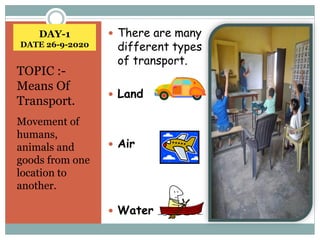
DAY-1
DATE 26-9-2020
TOPIC :-
Means Of
Transport.
Movement of
humans,
animals and
goods from one
location to
another.
 There are many
different types
of transport.
 Land
 Air
 Water
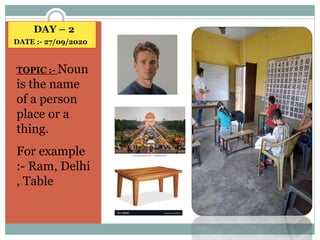
DAY – 2
DATE :- 27/09/2020
TOPIC :- Noun
is the name
of a person
place or a
thing.
For example
:- Ram, Delhi
, Table
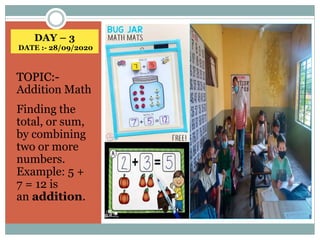
DAY – 3
DATE :- 28/09/2020
TOPIC:-
Addition Math
Finding the
total, or sum,
by combining
two or more
numbers.
Example: 5 +
7 = 12 is
an addition.
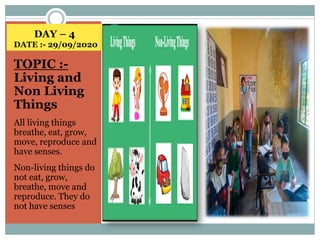
DAY – 4
DATE :- 29/09/2020
TOPIC :-
Living and
Non Living
Things
All living things
breathe, eat, grow,
move, reproduce and
have senses.
Non-living things do
not eat, grow,
breathe, move and
reproduce. They do
not have senses
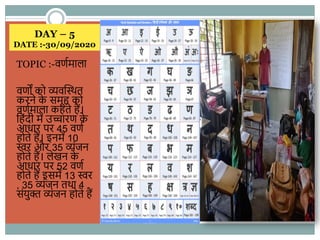
DAY – 5
DATE :-30/09/2020
TOPIC :-वर्णमाला
वर्ों को व्यवस्थित
करने के समूह को
वर्णमाला कहते हैं।
हहिंदी में उच्चारर् के
आधार पर 45 वर्ण
होते हैं। इनमें 10
स्वर और 35 व्यिंजन
होते हैं। लेखन के
आधार पर 52 वर्ण
होते हैं इसमें 13 स्वर
, 35 व्यिंजन तिा 4
सिंयुक्त व्यिंजन होते हैं
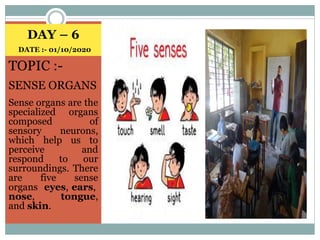
DAY – 6
DATE :- 01/10/2020
TOPIC :-
SENSE ORGANS
Sense organs are the
specialized organs
composed of
sensory neurons,
which help us to
perceive and
respond to our
surroundings. There
are five sense
organs eyes, ears,
nose, tongue,
and skin.
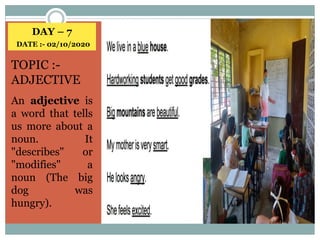
DAY – 7
DATE :- 02/10/2020
TOPIC :-
ADJECTIVE
An adjective is
a word that tells
us more about a
noun. It
"describes" or
"modifies" a
noun (The big
dog was
hungry).
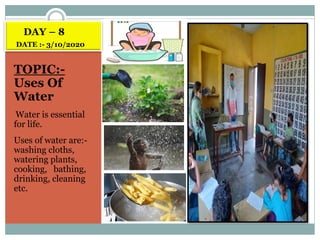
DAY – 8
DATE :- 3/10/2020
TOPIC:-
Uses Of
Water
Water is essential
for life.
Uses of water are:-
washing cloths,
watering plants,
cooking, bathing,
drinking, cleaning
etc.
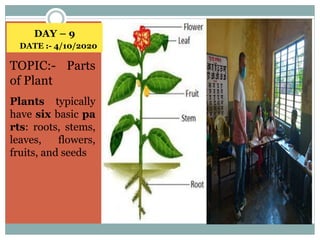
DAY – 9
DATE :- 4/10/2020
TOPIC:- Parts
of Plant
Plants typically
have six basic pa
rts: roots, stems,
leaves, flowers,
fruits, and seeds
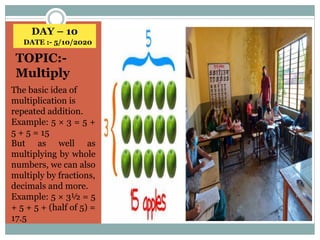
DAY – 10
DATE :- 5/10/2020
TOPIC:-
Multiply
The basic idea of
multiplication is
repeated addition.
Example: 5 × 3 = 5 +
5 + 5 = 15
But as well as
multiplying by whole
numbers, we can also
multiply by fractions,
decimals and more.
Example: 5 × 3½ = 5
+ 5 + 5 + (half of 5) =
17.5
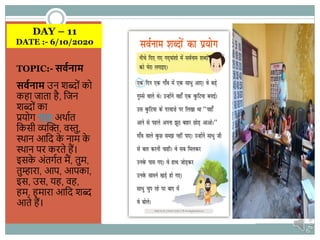
DAY – 11
DATE :- 6/10/2020
TOPIC:- सर्वनाम
सर्वनाम उन शब्ोिं को
कहा जाता है, हजन
शब्ोिं का
प्रयोग सिंज्ञा अिाणत
हकसी व्यस्क्त, वस्तु,
थिान आहद के नाम के
थिान पर करते हैं।
इसके अिंतगणत मैं, तुम,
तुम्हारा, आप, आपका,
इस, उस, यह, वह,
हम, हमारा आहद शब्
आते हैं।
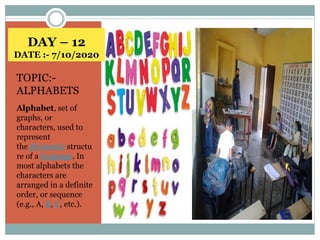
DAY – 12
DATE :- 7/10/2020
TOPIC:-
ALPHABETS
Alphabet, set of
graphs, or
characters, used to
represent
the phonemic structu
re of a language. In
most alphabets the
characters are
arranged in a definite
order, or sequence
(e.g., A, B, C, etc.).
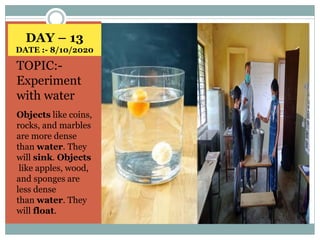
DAY – 13
DATE :- 8/10/2020
TOPIC:-
Experiment
with water
Objects like coins,
rocks, and marbles
are more dense
than water. They
will sink. Objects
like apples, wood,
and sponges are
less dense
than water. They
will float.
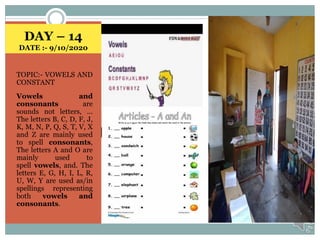
DAY – 14
DATE :- 9/10/2020
TOPIC:- VOWELS AND
CONSTANT
Vowels and
consonants are
sounds not letters, ...
The letters B, C, D, F, J,
K, M, N, P, Q, S, T, V, X
and Z are mainly used
to spell consonants,
The letters A and O are
mainly used to
spell vowels, and. The
letters E, G, H, I, L, R,
U, W, Y are used as/in
spellings representing
both vowels and
consonants.
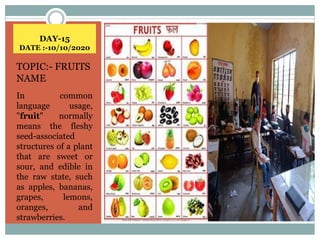
DAY-15
DATE :-10/10/2020
TOPIC:- FRUITS
NAME
In common
language usage,
"fruit" normally
means the fleshy
seed-associated
structures of a plant
that are sweet or
sour, and edible in
the raw state, such
as apples, bananas,
grapes, lemons,
oranges, and
strawberries.
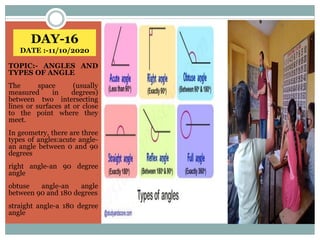
DAY-16
DATE :-11/10/2020
TOPIC:- ANGLES AND
TYPES OF ANGLE
The space (usually
measured in degrees)
between two intersecting
lines or surfaces at or close
to the point where they
meet.
In geometry, there are three
types of angles:acute angle-
an angle between 0 and 90
degrees
right angle-an 90 degree
angle
obtuse angle-an angle
between 90 and 180 degrees
straight angle-a 180 degree
angle
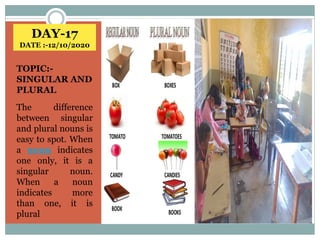
DAY-17
DATE :-12/10/2020
TOPIC:-
SINGULAR AND
PLURAL
The difference
between singular
and plural nouns is
easy to spot. When
a noun indicates
one only, it is a
singular noun.
When a noun
indicates more
than one, it is
plural
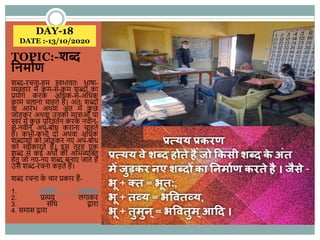
DAY-18
DATE :-13/10/2020
TOPIC:-शब्द
ननमावण
शब्-रचना-हम स्वभावतः भाषा-
व्यवहार में कम-से-कम शब्ोिं का
प्रयोग करके अहधक-से-अहधक
काम चलाना चाहते हैं। अतः शब्ोिं
के आरिंभ अिवा अिंत में कु छ
जोड़कर अिवा उनकी मात्राओिं या
स्वर में कु छ पररवतणन करके नवीन-
से-नवीन अिण-बोध कराना चाहते
हैं। कभी-कभी दो अिवा अहधक
शब्ािंशोिं को जोड़कर नए अिण-बोध
को स्वीकारते हैं। इस तरह एक
शब् से कई अिों की अहभव्यस्क्त
हेतु जो नए-नए शब् बनाए जाते हैं
उसे शब्-रचना कहते हैं।
शब् रचना के चार प्रकार हैं-
1. उपसगण लगाकर
2. प्रत्यय लगाकर
3. सिंहध द्वारा
4. समास द्वारा
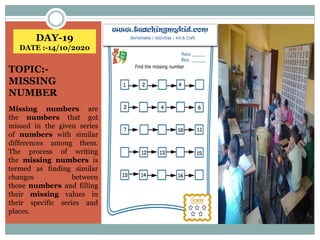
DAY-19
DATE :-14/10/2020
TOPIC:-
MISSING
NUMBER
Missing numbers are
the numbers that got
missed in the given series
of numbers with similar
differences among them.
The process of writing
the missing numbers is
termed as finding similar
changes between
those numbers and filling
their missing values in
their specific series and
places.
DAY-20
DATE :-15/10/2020
TOPIC:-
VEGITABLES NAME
Vegetables are colorful, ta
sty and they come in
a myriad of
tastes and textures! They
are also a great source of
vitamins and nutrients,
whether cooked or raw,
which makes them an
excellent meal choice for
children and adults to
stay strong and healthy.
However, it’s not always
easy to get the little ones to
enjoy their veggies. It’s a
fact that most children
prefer sweeter tastes, and
when they eat vegetables
they might find them too
bland.
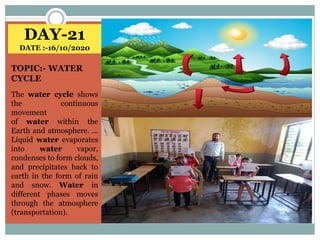
DAY-21
DATE :-16/10/2020
TOPIC:- WATER
CYCLE
The water cycle shows
the continuous
movement
of water within the
Earth and atmosphere. ...
Liquid water evaporates
into water vapor,
condenses to form clouds,
and precipitates back to
earth in the form of rain
and snow. Water in
different phases moves
through the atmosphere
(transportation).
 impact field work report

impact field work report

  • 1.
    IMPACT FIELD WORKREPORT  NAME – BALBIR SINGH  S.No. – 664  DESIGNATION – TEACHER GRADE –II  SCHOOL – GOVT PRIMARY SCHOOL DHOON KATHAR  ZONE - DANSAL
  • 2.
    DAY-1 DATE 26-9-2020 TOPIC :- MeansOf Transport. Movement of humans, animals and goods from one location to another.  There are many different types of transport.  Land  Air  Water
  • 3.
    DAY – 2 DATE:- 27/09/2020 TOPIC :- Noun is the name of a person place or a thing. For example :- Ram, Delhi , Table
  • 4.
    DAY – 3 DATE:- 28/09/2020 TOPIC:- Addition Math Finding the total, or sum, by combining two or more numbers. Example: 5 + 7 = 12 is an addition.
  • 5.
    DAY – 4 DATE:- 29/09/2020 TOPIC :- Living and Non Living Things All living things breathe, eat, grow, move, reproduce and have senses. Non-living things do not eat, grow, breathe, move and reproduce. They do not have senses
  • 6.
    DAY – 5 DATE:-30/09/2020 TOPIC :-वर्णमाला वर्ों को व्यवस्थित करने के समूह को वर्णमाला कहते हैं। हहिंदी में उच्चारर् के आधार पर 45 वर्ण होते हैं। इनमें 10 स्वर और 35 व्यिंजन होते हैं। लेखन के आधार पर 52 वर्ण होते हैं इसमें 13 स्वर , 35 व्यिंजन तिा 4 सिंयुक्त व्यिंजन होते हैं
  • 7.
    DAY – 6 DATE:- 01/10/2020 TOPIC :- SENSE ORGANS Sense organs are the specialized organs composed of sensory neurons, which help us to perceive and respond to our surroundings. There are five sense organs eyes, ears, nose, tongue, and skin.
  • 8.
    DAY – 7 DATE:- 02/10/2020 TOPIC :- ADJECTIVE An adjective is a word that tells us more about a noun. It "describes" or "modifies" a noun (The big dog was hungry).
  • 9.
    DAY – 8 DATE:- 3/10/2020 TOPIC:- Uses Of Water Water is essential for life. Uses of water are:- washing cloths, watering plants, cooking, bathing, drinking, cleaning etc.
  • 10.
    DAY – 9 DATE:- 4/10/2020 TOPIC:- Parts of Plant Plants typically have six basic pa rts: roots, stems, leaves, flowers, fruits, and seeds
  • 11.
    DAY – 10 DATE:- 5/10/2020 TOPIC:- Multiply The basic idea of multiplication is repeated addition. Example: 5 × 3 = 5 + 5 + 5 = 15 But as well as multiplying by whole numbers, we can also multiply by fractions, decimals and more. Example: 5 × 3½ = 5 + 5 + 5 + (half of 5) = 17.5
  • 12.
    DAY – 11 DATE:- 6/10/2020 TOPIC:- सर्वनाम सर्वनाम उन शब्ोिं को कहा जाता है, हजन शब्ोिं का प्रयोग सिंज्ञा अिाणत हकसी व्यस्क्त, वस्तु, थिान आहद के नाम के थिान पर करते हैं। इसके अिंतगणत मैं, तुम, तुम्हारा, आप, आपका, इस, उस, यह, वह, हम, हमारा आहद शब् आते हैं।
  • 13.
    DAY – 12 DATE:- 7/10/2020 TOPIC:- ALPHABETS Alphabet, set of graphs, or characters, used to represent the phonemic structu re of a language. In most alphabets the characters are arranged in a definite order, or sequence (e.g., A, B, C, etc.).
  • 14.
    DAY – 13 DATE:- 8/10/2020 TOPIC:- Experiment with water Objects like coins, rocks, and marbles are more dense than water. They will sink. Objects like apples, wood, and sponges are less dense than water. They will float.
  • 15.
    DAY – 14 DATE:- 9/10/2020 TOPIC:- VOWELS AND CONSTANT Vowels and consonants are sounds not letters, ... The letters B, C, D, F, J, K, M, N, P, Q, S, T, V, X and Z are mainly used to spell consonants, The letters A and O are mainly used to spell vowels, and. The letters E, G, H, I, L, R, U, W, Y are used as/in spellings representing both vowels and consonants.
  • 16.
    DAY-15 DATE :-10/10/2020 TOPIC:- FRUITS NAME Incommon language usage, "fruit" normally means the fleshy seed-associated structures of a plant that are sweet or sour, and edible in the raw state, such as apples, bananas, grapes, lemons, oranges, and strawberries.
  • 17.
    DAY-16 DATE :-11/10/2020 TOPIC:- ANGLESAND TYPES OF ANGLE The space (usually measured in degrees) between two intersecting lines or surfaces at or close to the point where they meet. In geometry, there are three types of angles:acute angle- an angle between 0 and 90 degrees right angle-an 90 degree angle obtuse angle-an angle between 90 and 180 degrees straight angle-a 180 degree angle
  • 18.
    DAY-17 DATE :-12/10/2020 TOPIC:- SINGULAR AND PLURAL Thedifference between singular and plural nouns is easy to spot. When a noun indicates one only, it is a singular noun. When a noun indicates more than one, it is plural
  • 19.
    DAY-18 DATE :-13/10/2020 TOPIC:-शब्द ननमावण शब्-रचना-हम स्वभावतःभाषा- व्यवहार में कम-से-कम शब्ोिं का प्रयोग करके अहधक-से-अहधक काम चलाना चाहते हैं। अतः शब्ोिं के आरिंभ अिवा अिंत में कु छ जोड़कर अिवा उनकी मात्राओिं या स्वर में कु छ पररवतणन करके नवीन- से-नवीन अिण-बोध कराना चाहते हैं। कभी-कभी दो अिवा अहधक शब्ािंशोिं को जोड़कर नए अिण-बोध को स्वीकारते हैं। इस तरह एक शब् से कई अिों की अहभव्यस्क्त हेतु जो नए-नए शब् बनाए जाते हैं उसे शब्-रचना कहते हैं। शब् रचना के चार प्रकार हैं- 1. उपसगण लगाकर 2. प्रत्यय लगाकर 3. सिंहध द्वारा 4. समास द्वारा
  • 20.
    DAY-19 DATE :-14/10/2020 TOPIC:- MISSING NUMBER Missing numbersare the numbers that got missed in the given series of numbers with similar differences among them. The process of writing the missing numbers is termed as finding similar changes between those numbers and filling their missing values in their specific series and places.
  • 21.
    DAY-20 DATE :-15/10/2020 TOPIC:- VEGITABLES NAME Vegetablesare colorful, ta sty and they come in a myriad of tastes and textures! They are also a great source of vitamins and nutrients, whether cooked or raw, which makes them an excellent meal choice for children and adults to stay strong and healthy. However, it’s not always easy to get the little ones to enjoy their veggies. It’s a fact that most children prefer sweeter tastes, and when they eat vegetables they might find them too bland.
  • 22.
    DAY-21 DATE :-16/10/2020 TOPIC:- WATER CYCLE Thewater cycle shows the continuous movement of water within the Earth and atmosphere. ... Liquid water evaporates into water vapor, condenses to form clouds, and precipitates back to earth in the form of rain and snow. Water in different phases moves through the atmosphere (transportation).