Overhead Costs
• Overheads or overhead costs are brief expression
for all indirect expenses.
• It indicates the expenditure incurred over and
above the direct material and direct labour.
• According to CIMA, London- Overhead is an
aggregate of indirect materials, indirect labour
and indirect expenses.
• According to National Accounting Association,
these are the costs that have to be incurred
although they have no directly measurable
relationship to specific activity units, production
or cost objectives.
Procedure for accounting and control
• Classification and codification
• Collection and accumulation
• Departmentalization through allocation and
apportionment
• Re-apportionment to production department
• Absorption or charge to production unit
Classification of Overheads
• Factory Overhead
- Indirect Material,
-Indirect Labour
- Indirect Expenses
• Office & Administrative
- Indirect Material,
-Indirect Labour
- Indirect Expenses
• Selling & Distribution
- Indirect Material,
-Indirect Labour
- Indirect Expenses
Allocation of Overhead
• According to CIMA, allocation is defined as allotment of
whole item of cost to cost centres or cost units.
• Expenses which originates directly and completed in a
department are identified with the foreman responsible for
the supervision of the department.
• Direct departmental overhead in production and service
department can be categorized as under:
-supervision, indirect labour and overtime
-labour fringe benefits
-indirect material & factory supplies
-R & M
- Equipment depreciation
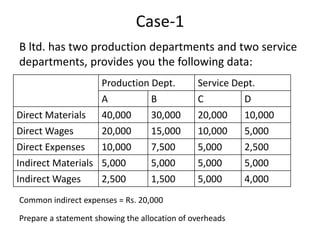
Case-1
B ltd. has two production departments and two service
departments, provides you the following data:
Production Dept. Service Dept.
A B C D
Direct Materials 40,000 30,000 20,000 10,000
Direct Wages 20,000 15,000 10,000 5,000
Direct Expenses 10,000 7,500 5,000 2,500
Indirect Materials 5,000 5,000 5,000 5,000
Indirect Wages 2,500 1,500 5,000 4,000
Common indirect expenses = Rs. 20,000
Prepare a statement showing the allocation of overheads
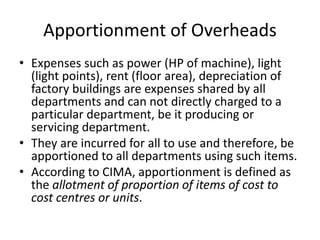
Apportionment of Overheads
• Expenses such as power (HP of machine), light
(light points), rent (floor area), depreciation of
factory buildings are expenses shared by all
departments and can not directly charged to a
particular department, be it producing or
servicing department.
• They are incurred for all to use and therefore, be
apportioned to all departments using such items.
• According to CIMA, apportionment is defined as
the allotment of proportion of items of cost to
cost centres or units.
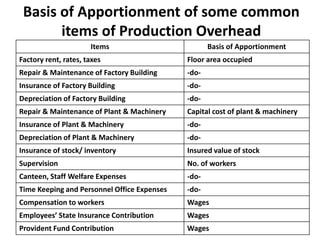
Basis of Apportionment of some common
items of Production Overhead
Items Basis of Apportionment
Factory rent, rates, taxes Floor area occupied
Repair & Maintenance of Factory Building -do-
Insurance of Factory Building -do-
Depreciation of Factory Building -do-
Repair & Maintenance of Plant & Machinery Capital cost of plant & machinery
Insurance of Plant & Machinery -do-
Depreciation of Plant & Machinery -do-
Insurance of stock/ inventory Insured value of stock
Supervision No. of workers
Canteen, Staff Welfare Expenses -do-
Time Keeping and Personnel Office Expenses -do-
Compensation to workers Wages
Employees’ State Insurance Contribution Wages
Provident Fund Contribution Wages
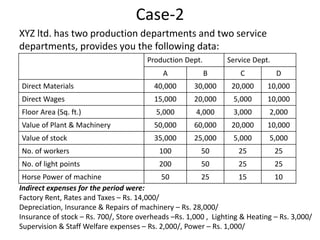
Case-2
XYZ ltd. has two production departments and two service
departments, provides you the following data:
Production Dept. Service Dept.
A B C D
Direct Materials 40,000 30,000 20,000 10,000
Direct Wages 15,000 20,000 5,000 10,000
Floor Area (Sq. ft.) 5,000 4,000 3,000 2,000
Value of Plant & Machinery 50,000 60,000 20,000 10,000
Value of stock 35,000 25,000 5,000 5,000
No. of workers 100 50 25 25
No. of light points 200 50 25 25
Horse Power of machine 50 25 15 10
Indirect expenses for the period were:
Factory Rent, Rates and Taxes – Rs. 14,000/
Depreciation, Insurance & Repairs of machinery – Rs. 28,000/
Insurance of stock – Rs. 700/, Store overheads –Rs. 1,000 , Lighting & Heating – Rs. 3,000/
Supervision & Staff Welfare expenses – Rs. 2,000/, Power – Rs. 1,000/
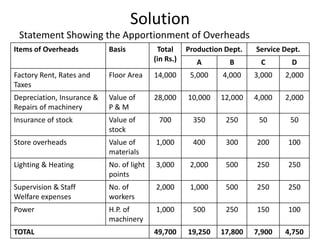
Solution
Statement Showing the Apportionment of Overheads
Items of Overheads Basis Total
(in Rs.)
Production Dept. Service Dept.
A B C D
Factory Rent, Rates and
Taxes
Floor Area 14,000 5,000 4,000 3,000 2,000
Depreciation, Insurance &
Repairs of machinery
Value of
P & M
28,000 10,000 12,000 4,000 2,000
Insurance of stock Value of
stock
700 350 250 50 50
Store overheads Value of
materials
1,000 400 300 200 100
Lighting & Heating No. of light
points
3,000 2,000 500 250 250
Supervision & Staff
Welfare expenses
No. of
workers
2,000 1,000 500 250 250
Power H.P. of
machinery
1,000 500 250 150 100
TOTAL 49,700 19,250 17,800 7,900 4,750
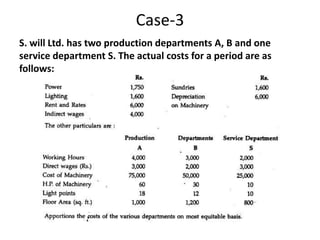
Case-3
S. will Ltd. has two production departments A, B and one
service department S. The actual costs for a period are as
follows:
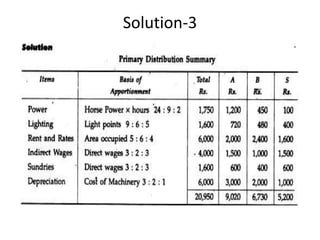
Solution-3
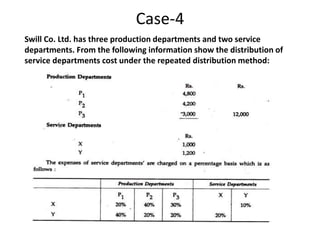
Case-4
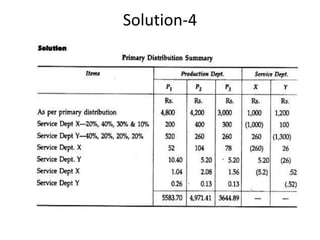
Swill Co. Ltd. has three production departments and two service
departments. From the following information show the distribution of
service departments cost under the repeated distribution method:
Solution-4
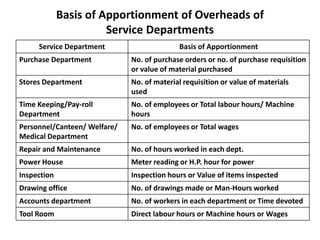
Basis of Apportionment of Overheads of
Service Departments
Service Department Basis of Apportionment
Purchase Department No. of purchase orders or no. of purchase requisition
or value of material purchased
Stores Department No. of material requisition or value of materials
used
Time Keeping/Pay-roll
Department
No. of employees or Total labour hours/ Machine
hours
Personnel/Canteen/ Welfare/
Medical Department
No. of employees or Total wages
Repair and Maintenance No. of hours worked in each dept.
Power House Meter reading or H.P. hour for power
Inspection Inspection hours or Value of items inspected
Drawing office No. of drawings made or Man-Hours worked
Accounts department No. of workers in each department or Time devoted
Tool Room Direct labour hours or Machine hours or Wages
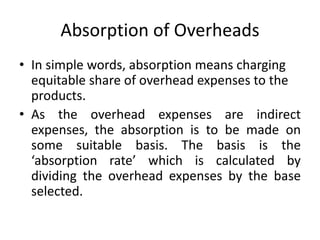
Absorption of Overheads
• In simple words, absorption means charging
equitable share of overhead expenses to the
products.
• As the overhead expenses are indirect
expenses, the absorption is to be made on
some suitable basis. The basis is the
‘absorption rate’ which is calculated by
dividing the overhead expenses by the base
selected.
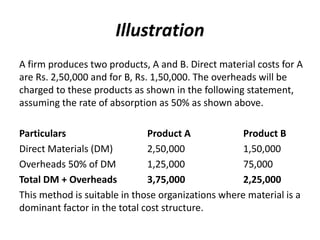
Illustration
A firm produces two products, A and B. Direct material costs for A
are Rs. 2,50,000 and for B, Rs. 1,50,000. The overheads will be
charged to these products as shown in the following statement,
assuming the rate of absorption as 50% as shown above.
Particulars Product A Product B
Direct Materials (DM) 2,50,000 1,50,000
Overheads 50% of DM 1,25,000 75,000
Total DM + Overheads 3,75,000 2,25,000
This method is suitable in those organizations where material is a
dominant factor in the total cost structure.
Over Vs. Under Absorption
• If actual production overheads of a period is absorbed at an
absorption rate on actual production during a period, the
overhead absorbed must be equal to the actual overhead
costs incurred. But this seldom happens especially when pre-
determined overhead rates are applied.
• Since there are seasonal differences, the difference between
the budgeted overheads and actual overheads incurred is
bound to happen.
• The difference between overheads charged and the
overheads incurred is called the “under or over-absorption of
overheads.
• When overheads absorbed exceeds the actual overheads, it is
called over-absorption and when actual overheads exceeds
the overheads absorbed , it is called under-absorption of OH.

Overhead cost

  • 1.
    Overhead Costs • Overheadsor overhead costs are brief expression for all indirect expenses. • It indicates the expenditure incurred over and above the direct material and direct labour. • According to CIMA, London- Overhead is an aggregate of indirect materials, indirect labour and indirect expenses. • According to National Accounting Association, these are the costs that have to be incurred although they have no directly measurable relationship to specific activity units, production or cost objectives.
  • 2.
    Procedure for accountingand control • Classification and codification • Collection and accumulation • Departmentalization through allocation and apportionment • Re-apportionment to production department • Absorption or charge to production unit
  • 3.
    Classification of Overheads •Factory Overhead - Indirect Material, -Indirect Labour - Indirect Expenses • Office & Administrative - Indirect Material, -Indirect Labour - Indirect Expenses • Selling & Distribution - Indirect Material, -Indirect Labour - Indirect Expenses
  • 4.
    Allocation of Overhead •According to CIMA, allocation is defined as allotment of whole item of cost to cost centres or cost units. • Expenses which originates directly and completed in a department are identified with the foreman responsible for the supervision of the department. • Direct departmental overhead in production and service department can be categorized as under: -supervision, indirect labour and overtime -labour fringe benefits -indirect material & factory supplies -R & M - Equipment depreciation
  • 5.
    Case-1 B ltd. hastwo production departments and two service departments, provides you the following data: Production Dept. Service Dept. A B C D Direct Materials 40,000 30,000 20,000 10,000 Direct Wages 20,000 15,000 10,000 5,000 Direct Expenses 10,000 7,500 5,000 2,500 Indirect Materials 5,000 5,000 5,000 5,000 Indirect Wages 2,500 1,500 5,000 4,000 Common indirect expenses = Rs. 20,000 Prepare a statement showing the allocation of overheads
  • 6.
    Apportionment of Overheads •Expenses such as power (HP of machine), light (light points), rent (floor area), depreciation of factory buildings are expenses shared by all departments and can not directly charged to a particular department, be it producing or servicing department. • They are incurred for all to use and therefore, be apportioned to all departments using such items. • According to CIMA, apportionment is defined as the allotment of proportion of items of cost to cost centres or units.
  • 7.
    Basis of Apportionmentof some common items of Production Overhead Items Basis of Apportionment Factory rent, rates, taxes Floor area occupied Repair & Maintenance of Factory Building -do- Insurance of Factory Building -do- Depreciation of Factory Building -do- Repair & Maintenance of Plant & Machinery Capital cost of plant & machinery Insurance of Plant & Machinery -do- Depreciation of Plant & Machinery -do- Insurance of stock/ inventory Insured value of stock Supervision No. of workers Canteen, Staff Welfare Expenses -do- Time Keeping and Personnel Office Expenses -do- Compensation to workers Wages Employees’ State Insurance Contribution Wages Provident Fund Contribution Wages
  • 8.
    Case-2 XYZ ltd. hastwo production departments and two service departments, provides you the following data: Production Dept. Service Dept. A B C D Direct Materials 40,000 30,000 20,000 10,000 Direct Wages 15,000 20,000 5,000 10,000 Floor Area (Sq. ft.) 5,000 4,000 3,000 2,000 Value of Plant & Machinery 50,000 60,000 20,000 10,000 Value of stock 35,000 25,000 5,000 5,000 No. of workers 100 50 25 25 No. of light points 200 50 25 25 Horse Power of machine 50 25 15 10 Indirect expenses for the period were: Factory Rent, Rates and Taxes – Rs. 14,000/ Depreciation, Insurance & Repairs of machinery – Rs. 28,000/ Insurance of stock – Rs. 700/, Store overheads –Rs. 1,000 , Lighting & Heating – Rs. 3,000/ Supervision & Staff Welfare expenses – Rs. 2,000/, Power – Rs. 1,000/
  • 9.
    Solution Statement Showing theApportionment of Overheads Items of Overheads Basis Total (in Rs.) Production Dept. Service Dept. A B C D Factory Rent, Rates and Taxes Floor Area 14,000 5,000 4,000 3,000 2,000 Depreciation, Insurance & Repairs of machinery Value of P & M 28,000 10,000 12,000 4,000 2,000 Insurance of stock Value of stock 700 350 250 50 50 Store overheads Value of materials 1,000 400 300 200 100 Lighting & Heating No. of light points 3,000 2,000 500 250 250 Supervision & Staff Welfare expenses No. of workers 2,000 1,000 500 250 250 Power H.P. of machinery 1,000 500 250 150 100 TOTAL 49,700 19,250 17,800 7,900 4,750
  • 10.
    Case-3 S. will Ltd.has two production departments A, B and one service department S. The actual costs for a period are as follows:
  • 11.
  • 12.
    Case-4 Swill Co. Ltd.has three production departments and two service departments. From the following information show the distribution of service departments cost under the repeated distribution method:
  • 13.
  • 14.
    Basis of Apportionmentof Overheads of Service Departments Service Department Basis of Apportionment Purchase Department No. of purchase orders or no. of purchase requisition or value of material purchased Stores Department No. of material requisition or value of materials used Time Keeping/Pay-roll Department No. of employees or Total labour hours/ Machine hours Personnel/Canteen/ Welfare/ Medical Department No. of employees or Total wages Repair and Maintenance No. of hours worked in each dept. Power House Meter reading or H.P. hour for power Inspection Inspection hours or Value of items inspected Drawing office No. of drawings made or Man-Hours worked Accounts department No. of workers in each department or Time devoted Tool Room Direct labour hours or Machine hours or Wages
  • 15.
    Absorption of Overheads •In simple words, absorption means charging equitable share of overhead expenses to the products. • As the overhead expenses are indirect expenses, the absorption is to be made on some suitable basis. The basis is the ‘absorption rate’ which is calculated by dividing the overhead expenses by the base selected.
  • 16.
    Illustration A firm producestwo products, A and B. Direct material costs for A are Rs. 2,50,000 and for B, Rs. 1,50,000. The overheads will be charged to these products as shown in the following statement, assuming the rate of absorption as 50% as shown above. Particulars Product A Product B Direct Materials (DM) 2,50,000 1,50,000 Overheads 50% of DM 1,25,000 75,000 Total DM + Overheads 3,75,000 2,25,000 This method is suitable in those organizations where material is a dominant factor in the total cost structure.
  • 17.
    Over Vs. UnderAbsorption • If actual production overheads of a period is absorbed at an absorption rate on actual production during a period, the overhead absorbed must be equal to the actual overhead costs incurred. But this seldom happens especially when pre- determined overhead rates are applied. • Since there are seasonal differences, the difference between the budgeted overheads and actual overheads incurred is bound to happen. • The difference between overheads charged and the overheads incurred is called the “under or over-absorption of overheads. • When overheads absorbed exceeds the actual overheads, it is called over-absorption and when actual overheads exceeds the overheads absorbed , it is called under-absorption of OH.