OrganisationThe classicists have used the term Organisation in the form of organising which is a part of management process.Presently, the term Organisation is used in following ways:As entity
As process
As structure
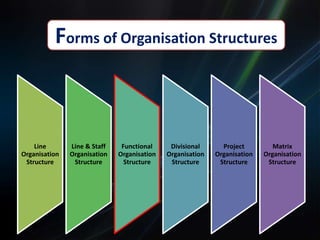
As group of peopleForms of Organisation Structures
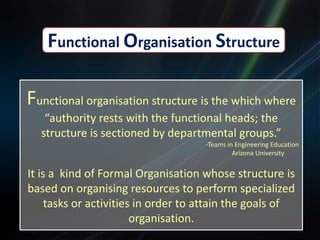
Functional Organisation StructureFunctional organisation structure is the which where “authority rests with the functional heads; the structure is sectioned by departmental groups.”                                                                                                                 -Teams in Engineering Education 						 Arizona UniversityIt is a  kind of Formal Organisation whose structure is based on organising resources to perform specialized tasks or activities in order to attain the goals of organisation.
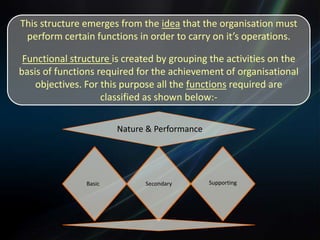
This structure emerges from the idea that the organisation must perform certain functions in order to carry on it’s operations.Functional structure is created by grouping the activities on the basis of functions required for the achievement of organisational objectives. For this purpose all the functions required are classified as shown below:-
The basic  or major functions are those which are essential for the organisation. Consider , the following examples,Movie-making : The key person is the castingdirector.  The concept of casting extends not only to the actors, but also to choosing the array of technical and support people.  These decisions are critical to the success of the movie.  Everyone has a unique and special personality.  It is the job of the casting director to coordinate these personalities in such a fashion that everyone can function together.  Such decisions can make or break the movie.  
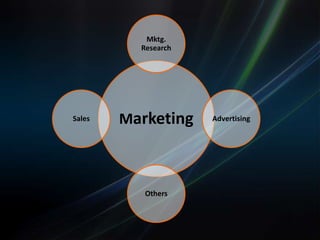
Manufacturing  Organisation : Production and Marketing are basic functions when departments are created on the basis of functions and a manager feels that his span of management is too wide to manage effectively , which  normally happens in a large organisation. Several departments are created  on the basis of dividing basic function into sub-functions.Eg. Marketing can be sub-divided as shown ,
Apart from basic and secondary functions , departments are also created  to take advantages of specialization  & to support basic  and secondary activities.Such departments may be finance , accounting , personal , industrial relations , legal etc.
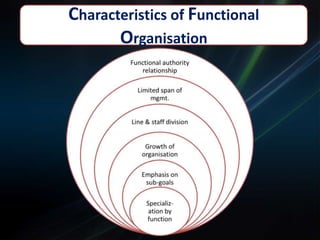
Characteristics of Functional Organisation
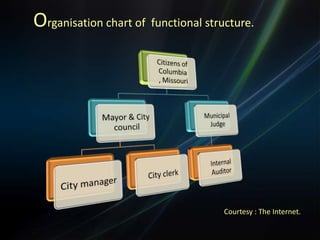
Organisation chart of  functional structure.Courtesy : The Internet.
Suitability of Functional StructureThe establishment of a functional structure is necessary  when a small organisation grows & it’s business activities become more complex.
In such a case more formalized and systematic approach is required to handle situations.
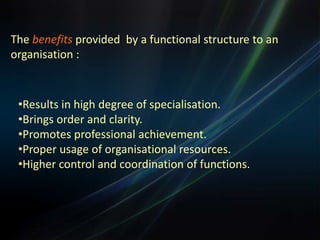
However , the top management will continue to control decisions involving strategies & co-ordination.The benefits provided  by a functional structure to an organisation :Results in high degree of specialisation.
Brings order and clarity.
Promotes professional achievement.
Proper usage of organisational resources.
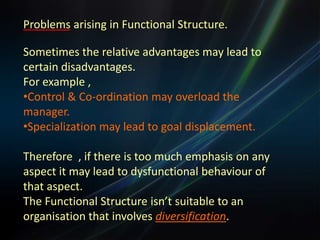
Higher control and coordination of functions.Problems arising in Functional Structure.Sometimes the relative advantages may lead to certain disadvantages.For example , Control & Co-ordination may overload the manager.
Specialization may lead to goal displacement.Therefore  , if there is too much emphasis on any aspect it may lead to dysfunctional behaviour of that aspect.The Functional Structure isn’t suitable to an organisation that involves diversification.
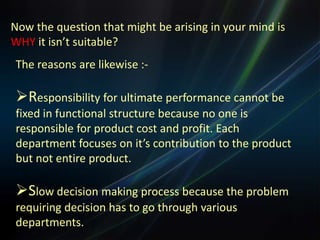
Now the question that might be arising in your mind is WHY it isn’t suitable?The reasons are likewise :-Responsibility for ultimate performance cannot be fixed in functional structure because no one is responsible for product cost and profit. Each department focuses on it’s contribution to the product but not entire product.
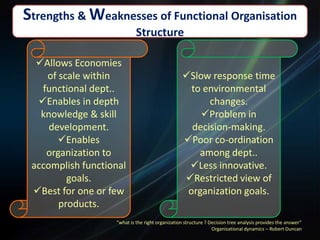
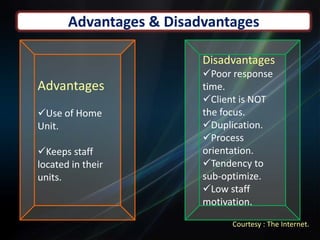
Slow decision making process because the problem requiring decision has to go through various departments.Strengths & Weaknesses of Functional Organisation StructureAllows Economies of scale within functional dept..
Enables in depth knowledge & skill development.
Enables organization to accomplish functional goals.
Best for one or few products.
Slow response time to environmental changes.

Organization Structure & Details

  • 1.
    OrganisationThe classicists haveused the term Organisation in the form of organising which is a part of management process.Presently, the term Organisation is used in following ways:As entity
  • 2.
  • 3.
  • 4.
    As group ofpeopleForms of Organisation Structures
  • 5.
    Functional Organisation StructureFunctionalorganisation structure is the which where “authority rests with the functional heads; the structure is sectioned by departmental groups.” -Teams in Engineering Education Arizona UniversityIt is a kind of Formal Organisation whose structure is based on organising resources to perform specialized tasks or activities in order to attain the goals of organisation.
  • 6.
    This structure emergesfrom the idea that the organisation must perform certain functions in order to carry on it’s operations.Functional structure is created by grouping the activities on the basis of functions required for the achievement of organisational objectives. For this purpose all the functions required are classified as shown below:-
  • 7.
    The basic or major functions are those which are essential for the organisation. Consider , the following examples,Movie-making : The key person is the castingdirector.  The concept of casting extends not only to the actors, but also to choosing the array of technical and support people.  These decisions are critical to the success of the movie.  Everyone has a unique and special personality.  It is the job of the casting director to coordinate these personalities in such a fashion that everyone can function together.  Such decisions can make or break the movie.  
  • 8.
    Manufacturing Organisation: Production and Marketing are basic functions when departments are created on the basis of functions and a manager feels that his span of management is too wide to manage effectively , which normally happens in a large organisation. Several departments are created on the basis of dividing basic function into sub-functions.Eg. Marketing can be sub-divided as shown ,
  • 10.
    Apart from basicand secondary functions , departments are also created to take advantages of specialization & to support basic and secondary activities.Such departments may be finance , accounting , personal , industrial relations , legal etc.
  • 11.
  • 12.
    Organisation chart of functional structure.Courtesy : The Internet.
  • 13.
    Suitability of FunctionalStructureThe establishment of a functional structure is necessary when a small organisation grows & it’s business activities become more complex.
  • 14.
    In such acase more formalized and systematic approach is required to handle situations.
  • 15.
    However , thetop management will continue to control decisions involving strategies & co-ordination.The benefits provided by a functional structure to an organisation :Results in high degree of specialisation.
  • 16.
  • 17.
  • 18.
    Proper usage oforganisational resources.
  • 19.
    Higher control andcoordination of functions.Problems arising in Functional Structure.Sometimes the relative advantages may lead to certain disadvantages.For example , Control & Co-ordination may overload the manager.
  • 20.
    Specialization may leadto goal displacement.Therefore , if there is too much emphasis on any aspect it may lead to dysfunctional behaviour of that aspect.The Functional Structure isn’t suitable to an organisation that involves diversification.
  • 21.
    Now the questionthat might be arising in your mind is WHY it isn’t suitable?The reasons are likewise :-Responsibility for ultimate performance cannot be fixed in functional structure because no one is responsible for product cost and profit. Each department focuses on it’s contribution to the product but not entire product.
  • 22.
    Slow decision makingprocess because the problem requiring decision has to go through various departments.Strengths & Weaknesses of Functional Organisation StructureAllows Economies of scale within functional dept..
  • 23.
    Enables in depthknowledge & skill development.
  • 24.
    Enables organization toaccomplish functional goals.
  • 25.
    Best for oneor few products.
  • 26.
    Slow response timeto environmental changes.