Nature & Components of Environmental ScanningPresented by:Ashutosh MishraMBA (Mrktg.)
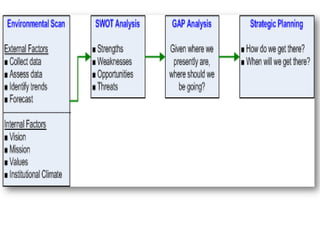
What is Environmental Scanning?Environmental Scanning: “A term coined in the mid-1960’s by Francis Aguilar, a Harvard Business School professor, to describe the action of watching and collecting information on a company’s rivals and the overall market.”Source: Fuld & Company, Inc.Environmental scanning is a process of gathering, analyzing, and dispensing information for tactical or strategic purposes. The environmental scanning process entails obtaining both factual and subjective information on the business environments in which a company is operating or consider entering.
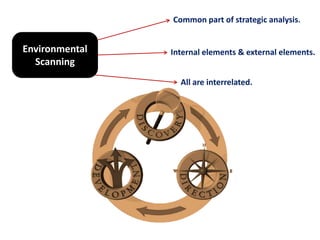
Common part of strategic analysis.Environmental ScanningInternal elements & external elements.All are interrelated.
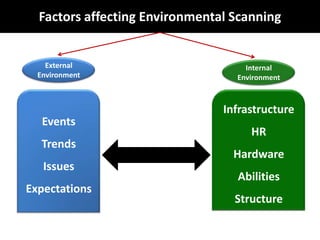
Factors affecting Environmental ScanningExternal EnvironmentInternal EnvironmentEventsTrendsIssuesExpectationsInfrastructureHRHardwareAbilitiesStructure
Three approaches to ScanningKubr has suggested three approaches to scanning,Systematic: Information related to markets & customers, changes in legislation & regulations that have a direct impact on organization’s activities that could be collected continuously to monitor changes.
Ad-hoc: Conduction of special surveys & studies to deal with specific environmental issues.
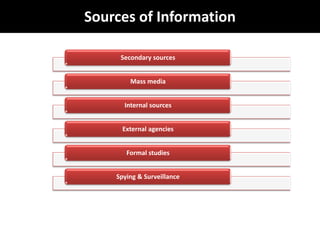
Processed form: Information available from different sources both internal & external of the organization in processed form.Sources of Information
What scanning can accomplish?It helps an organization capitalize on early opportunities rather than lose these to competitors.
It provides an early signal of impending problems, which can be defused if recognized well in advance.
It sensitizes an organization to the changing needs and wishes of its customers.
It provides a base of objective qualitative information about the environment that strategists can utilize.
It provides intellectual stimulation to strategists in their decision making.
It improves the image of the organization with its publics by showing that it is sensitive to its environment and responsive to it.
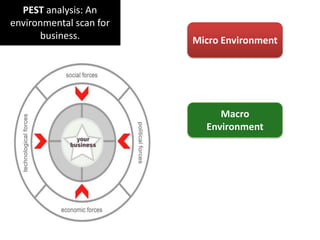
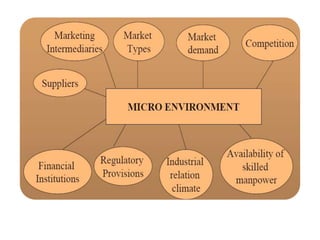
It is a means of continuing broad-based education for executives, especially for strategy developers.PEST analysis: An  environmental scan for business.Micro EnvironmentMacro Environment
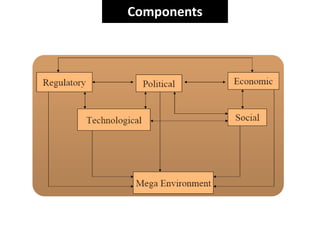
Components
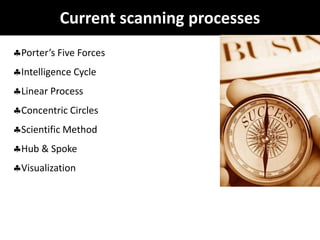
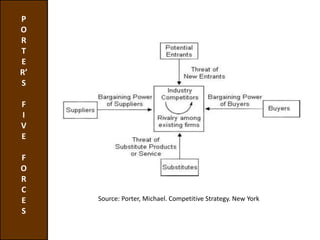
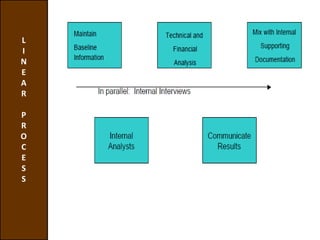
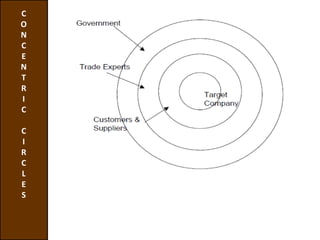
Current scanning processesPorter’s Five Forces
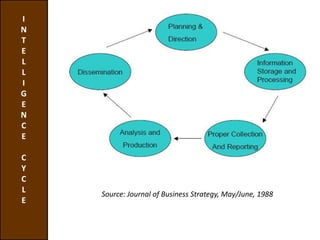
Intelligence Cycle

Environmental Scanning:complete concept.

  • 1.
    Nature & Componentsof Environmental ScanningPresented by:Ashutosh MishraMBA (Mrktg.)
  • 2.
    What is EnvironmentalScanning?Environmental Scanning: “A term coined in the mid-1960’s by Francis Aguilar, a Harvard Business School professor, to describe the action of watching and collecting information on a company’s rivals and the overall market.”Source: Fuld & Company, Inc.Environmental scanning is a process of gathering, analyzing, and dispensing information for tactical or strategic purposes. The environmental scanning process entails obtaining both factual and subjective information on the business environments in which a company is operating or consider entering.
  • 3.
    Common part ofstrategic analysis.Environmental ScanningInternal elements & external elements.All are interrelated.
  • 4.
    Factors affecting EnvironmentalScanningExternal EnvironmentInternal EnvironmentEventsTrendsIssuesExpectationsInfrastructureHRHardwareAbilitiesStructure
  • 5.
    Three approaches toScanningKubr has suggested three approaches to scanning,Systematic: Information related to markets & customers, changes in legislation & regulations that have a direct impact on organization’s activities that could be collected continuously to monitor changes.
  • 6.
    Ad-hoc: Conduction ofspecial surveys & studies to deal with specific environmental issues.
  • 7.
    Processed form: Informationavailable from different sources both internal & external of the organization in processed form.Sources of Information
  • 9.
    What scanning canaccomplish?It helps an organization capitalize on early opportunities rather than lose these to competitors.
  • 10.
    It provides anearly signal of impending problems, which can be defused if recognized well in advance.
  • 11.
    It sensitizes anorganization to the changing needs and wishes of its customers.
  • 12.
    It provides abase of objective qualitative information about the environment that strategists can utilize.
  • 13.
    It provides intellectualstimulation to strategists in their decision making.
  • 14.
    It improves theimage of the organization with its publics by showing that it is sensitive to its environment and responsive to it.
  • 15.
    It is ameans of continuing broad-based education for executives, especially for strategy developers.PEST analysis: An environmental scan for business.Micro EnvironmentMacro Environment
  • 16.
  • 18.
  • 19.