Theory of DemandIf necessity is the mother of invention, then demand is the mother of production.Presented  by :Ashutosh MishraMBA- Ist. Semester
2What is Demand ?
Leon Walras (1834-1910) a French economist, gave demand theory  as a fundamental principle of microeconomics  which gives the analysis of the relationship between the demand for goods or services and prices or incomes.A Bit of History…The theory was subsequently developed by English economist Alfred Marshall (1842-1924), Italian Vilfredo Pareto (1848-1923), Soviet EugenSlutsky (1880-1948), American Kenneth Arrow (1921- ) and the French-born Gerard Debreu (1921- ).-economyprofessor.com3
Demand is the basis of all productive activities. Demand theory is an economic theory that concerns the relationship between the demand for goods and their prices; it forms the core of microeconomics. The generation of demand can be pictorially shown as below,DEMANDNEEDWANT4
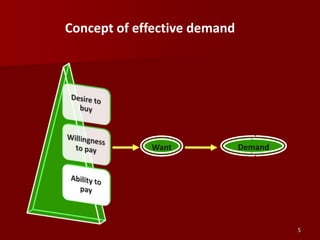
Concept of effective demand DemandWant5
DemandLaw of DemandHedonic theoryThe law of demand is normally depicted as an inverse relation of quantity demanded and price: the higher the price of the product, the less the consumer will demand, ceteris paribus ("all other things being equal").It is an economic theory that the price an individual will pay for a good reflects the sum of the characteristics of that good. 6
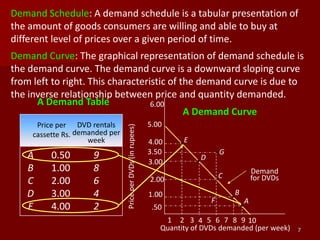
A Demand TablePrice per cassette Rs.DVD rentals demanded per weekEGDABCDE0.501.002.003.004.0098642Demand for DVDsCBADemand Schedule: A demand schedule is a tabular presentation of the amount of goods consumers are willing and able to buy at different level of prices over a given period of time. Demand Curve: The graphical representation of demand schedule is the demand curve. The demand curve is a downward sloping curve from left to right. This characteristic of the demand curve is due to the inverse relationship between price and quantity demanded. 6.00A Demand Curve5.004.003.503.00Price per DVDs (in rupees)2.001.00F.50 12356789104Quantity of DVDs demanded (per week)7
8Reasons behind DemandThe Income Effect: There is an income effect when the price of a good falls because the consumer can maintain current consumption for less expenditure.The Substitution Effect: There is also a substitution effect when the price of a good falls because the product is now relatively cheaper than an alternative item and so some consumers switch their spending from the good in competitive demand to this product.
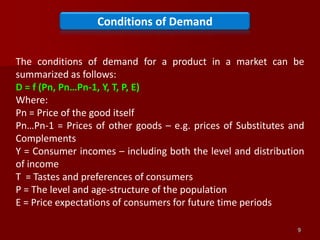
9Conditions of DemandThe conditions of demand for a product in a market can be summarized as follows:D = f (Pn, Pn…Pn-1, Y, T, P, E)Where: Pn = Price of the good itselfPn…Pn-1 = Prices of other goods – e.g. prices of Substitutes and ComplementsY = Consumer incomes – including both the level and distribution of incomeT  = Tastes and preferences of consumersP = The level and age-structure of the populationE = Price expectations of consumers for future time periods
10Exceptions to the Law of Demandostentatious consumptioneffects of speculative demandThe demand for the product is a direct function of its price. It comprises of luxury items. They are called Veblen goods.Eg. Expensive perfumes, designer clothes etc.The potential buyers are interested not just in the satisfaction they may get from consuming the product, but also the potential rise in market price leading to a capital gain or profit.Eg. Housing & shares etc.
11Integrability & Aggregation in Theory of DemandHarold Hotelling believed that integrability was a necessary characteristic of both individual and market demand equations, and he demonstrated that it would hold if consumers did not have a budget constraint. If there was a budget constraint, he contended, the usual integrability condition would be replaced by a condition which assures that an integrating factor can be introduced.Aggregation by summation of individual demands is considered, and it is shown that this form of aggregation is valid if there is a budget constraint only when income effects are the same for all individuals.
12An Insight into a new era of Demand Theory
13Demand ShocksA model of business cycles driven by shocks to consumer expectations regarding aggregate productivity. Agents are hit by heterogeneous productivity shocks, they observe their own productivity and a noisy public signal regarding aggregate productivity.A calibrated version of the model is able to generate realistic amounts of short-run volatility due to demand shocks, in line with existing time-series evidence.Guido LorenzoniMIT Department of EconomicsE52-251C50 Memorial DriveCambridge, MA 02142 and NBER.
14MASSIVE DROP IN U.S. DEMAND IN APRILU.S. oil demand in April was 863,000 barrels per day less than previously estimated and down 811,000 bpd from a year earlier, putting petroleum consumption at the lowest level for any April month in six years, the Energy Information Administration said on Monday.The lower oil demand was due to rising fuel prices and a faltering U.S. economy that has cut into petroleum use.The size of this drop (down 811,000bpd, year-on-year) is massive. Indeed it's almost enough to wipe out total worldwide growth in oil consumption from 2006 to 2007 (990,000bpd, according to the BP Statistical Review 2008).Monday, June 30, 2008-Reuters Washington
15It is enough to wipe out two years worth of consumption growth from China.
16The benefits a person gets from a product depend on his goals. These goals are referred to in many ways in discussions of demand. The words "tastes," "wants," "needs," "preferences" and "usefulness" all refer to goals. When people's goals change, the amount of benefitthey get from the good changes, and this will cause them to change the amount of the good they want to buy.
17It differs from being to being !
18Thank You !

Demand Theory-Managerial Economics

  • 1.
    Theory of DemandIfnecessity is the mother of invention, then demand is the mother of production.Presented by :Ashutosh MishraMBA- Ist. Semester
  • 2.
  • 3.
    Leon Walras (1834-1910)a French economist, gave demand theory as a fundamental principle of microeconomics which gives the analysis of the relationship between the demand for goods or services and prices or incomes.A Bit of History…The theory was subsequently developed by English economist Alfred Marshall (1842-1924), Italian Vilfredo Pareto (1848-1923), Soviet EugenSlutsky (1880-1948), American Kenneth Arrow (1921- ) and the French-born Gerard Debreu (1921- ).-economyprofessor.com3
  • 4.
    Demand is thebasis of all productive activities. Demand theory is an economic theory that concerns the relationship between the demand for goods and their prices; it forms the core of microeconomics. The generation of demand can be pictorially shown as below,DEMANDNEEDWANT4
  • 5.
    Concept of effectivedemand DemandWant5
  • 6.
    DemandLaw of DemandHedonictheoryThe law of demand is normally depicted as an inverse relation of quantity demanded and price: the higher the price of the product, the less the consumer will demand, ceteris paribus ("all other things being equal").It is an economic theory that the price an individual will pay for a good reflects the sum of the characteristics of that good. 6
  • 7.
    A Demand TablePriceper cassette Rs.DVD rentals demanded per weekEGDABCDE0.501.002.003.004.0098642Demand for DVDsCBADemand Schedule: A demand schedule is a tabular presentation of the amount of goods consumers are willing and able to buy at different level of prices over a given period of time. Demand Curve: The graphical representation of demand schedule is the demand curve. The demand curve is a downward sloping curve from left to right. This characteristic of the demand curve is due to the inverse relationship between price and quantity demanded. 6.00A Demand Curve5.004.003.503.00Price per DVDs (in rupees)2.001.00F.50 12356789104Quantity of DVDs demanded (per week)7
  • 8.
    8Reasons behind DemandTheIncome Effect: There is an income effect when the price of a good falls because the consumer can maintain current consumption for less expenditure.The Substitution Effect: There is also a substitution effect when the price of a good falls because the product is now relatively cheaper than an alternative item and so some consumers switch their spending from the good in competitive demand to this product.
  • 9.
    9Conditions of DemandTheconditions of demand for a product in a market can be summarized as follows:D = f (Pn, Pn…Pn-1, Y, T, P, E)Where: Pn = Price of the good itselfPn…Pn-1 = Prices of other goods – e.g. prices of Substitutes and ComplementsY = Consumer incomes – including both the level and distribution of incomeT = Tastes and preferences of consumersP = The level and age-structure of the populationE = Price expectations of consumers for future time periods
  • 10.
    10Exceptions to theLaw of Demandostentatious consumptioneffects of speculative demandThe demand for the product is a direct function of its price. It comprises of luxury items. They are called Veblen goods.Eg. Expensive perfumes, designer clothes etc.The potential buyers are interested not just in the satisfaction they may get from consuming the product, but also the potential rise in market price leading to a capital gain or profit.Eg. Housing & shares etc.
  • 11.
    11Integrability & Aggregationin Theory of DemandHarold Hotelling believed that integrability was a necessary characteristic of both individual and market demand equations, and he demonstrated that it would hold if consumers did not have a budget constraint. If there was a budget constraint, he contended, the usual integrability condition would be replaced by a condition which assures that an integrating factor can be introduced.Aggregation by summation of individual demands is considered, and it is shown that this form of aggregation is valid if there is a budget constraint only when income effects are the same for all individuals.
  • 12.
    12An Insight intoa new era of Demand Theory
  • 13.
    13Demand ShocksA modelof business cycles driven by shocks to consumer expectations regarding aggregate productivity. Agents are hit by heterogeneous productivity shocks, they observe their own productivity and a noisy public signal regarding aggregate productivity.A calibrated version of the model is able to generate realistic amounts of short-run volatility due to demand shocks, in line with existing time-series evidence.Guido LorenzoniMIT Department of EconomicsE52-251C50 Memorial DriveCambridge, MA 02142 and NBER.
  • 14.
    14MASSIVE DROP INU.S. DEMAND IN APRILU.S. oil demand in April was 863,000 barrels per day less than previously estimated and down 811,000 bpd from a year earlier, putting petroleum consumption at the lowest level for any April month in six years, the Energy Information Administration said on Monday.The lower oil demand was due to rising fuel prices and a faltering U.S. economy that has cut into petroleum use.The size of this drop (down 811,000bpd, year-on-year) is massive. Indeed it's almost enough to wipe out total worldwide growth in oil consumption from 2006 to 2007 (990,000bpd, according to the BP Statistical Review 2008).Monday, June 30, 2008-Reuters Washington
  • 15.
    15It is enoughto wipe out two years worth of consumption growth from China.
  • 16.
    16The benefits aperson gets from a product depend on his goals. These goals are referred to in many ways in discussions of demand. The words "tastes," "wants," "needs," "preferences" and "usefulness" all refer to goals. When people's goals change, the amount of benefitthey get from the good changes, and this will cause them to change the amount of the good they want to buy.
  • 17.
    17It differs frombeing to being !
  • 18.