Activity Based Costing
What is ABC?Activity Based Costing is a management accounting approach which allocate all direct and indirect (overhead) costs to cost objects (products and services) in order to help management understand critical business information.It allocates direct and indirect costs to products and services based on the level of activities used to create and deliver those products and services.
Direct & Indirect Costs?Direct costs A cost that can be directly traced to producing specific goods or services., e.g., salaries for project staff and materials required for a particular project.Indirect costs are costs that are not directly accountable to a cost object (such as a particular function or product). Indirect costs may be either fixed or variable. Indirect costs include taxes, administration, personnel and security costs, and are also known as overhead.
Activities such as purchasing, design, production, sales, marketing and customer service are utilized by different products and services (cost objects) based on their complexity and business requirements.Compared to traditional accounting, activity based costing is a decision making tool which provides more accurate cost and profit information and allows management to understand the cost and profit drivers and improve their business.
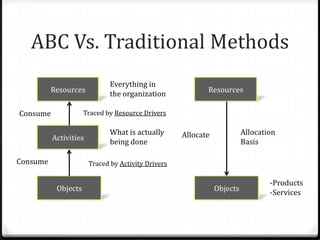
ABC Vs. Traditional MethodsResourcesResourcesEverything in the organizationConsumeTraced by Resource DriversActivitiesWhat is actually being doneAllocation BasisAllocateConsumeTraced by Activity DriversObjectsObjects-Products-Services
Difference between Traditional & ABC MethodIn traditional cost accounting it is assumed that cost objects consume resources whereas in ABC it is assumed that cost objects consume activities.Traditional cost accounting mostly utilizes volume related allocation bases while ABC uses drivers at various levels.Traditional cost accounting is structure-oriented whereas ABC is process-oriented.
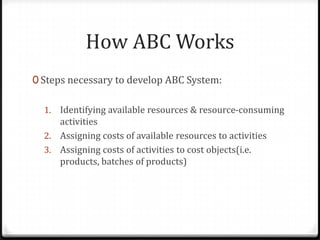
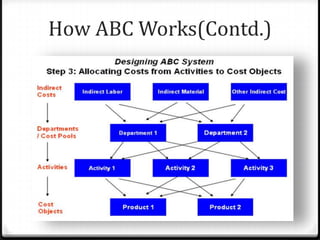
Steps necessary to develop ABC System:Identifying available resources & resource-consuming activitiesAssigning costs of available resources to activitiesAssigning costs of activities to cost objects(i.e. products, batches of products)How ABC Works
1. Identifying available resources & resource-consuming activitiesIdentify resourcesResource Consumption Cost DriversTransaction DriversDuration DriversActivity Levels: There are different activity levels such as:unit level activities (activities performed on each unit such as packaging), batch level activities (activities performed on batch level such as scheduling and set up), product level activities (activities performed on each product such as design, engineering and marketing) and facility level activities (activities performed at each facility such as safety and maintenance).
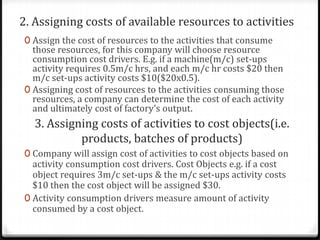
2. Assigning costs of available resources to activitiesAssign the cost of resources to the activities that consume those resources, for this company will choose resource consumption cost drivers. E.g. if a machine(m/c) set-ups activity requires 0.5m/c hrs, and each m/c hr costs $20 then m/c set-ups activity costs $10($20x0.5).Assigning cost of resources to the activities consuming those resources, a company can determine the cost of each activity and ultimately cost of factory’s output.3. Assigning costs of activities to cost objects(i.e. products, batches of products)Company will assign cost of activities to cost objects based on activity consumption cost drivers. Cost Objects e.g. if a cost object requires 3m/c set-ups & the m/c set-ups activity costs $10 then the cost object will be assigned $30.
Activity consumption drivers measure amount of activity consumed by a cost object.How ABC Works(Contd.)
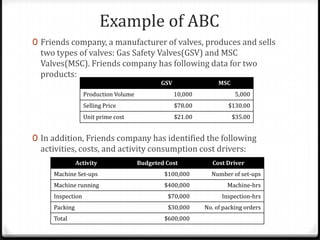
Example of ABCFriends company, a manufacturer of valves, produces and sells two types of valves: Gas Safety Valves(GSV) and MSC Valves(MSC). Friends company has following data for two products:In addition, Friends company has identified the following activities, costs, and activity consumption cost drivers:
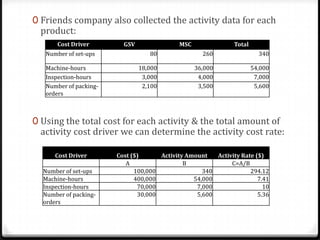
Friends company also collected the activity data for each product:Using the total cost for each activity & the total amount of activity cost driver we can determine the activity cost rate:
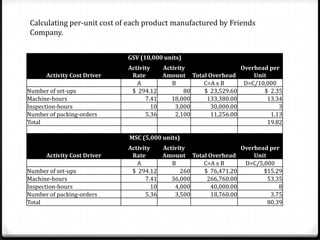
Calculating per-unit cost of each product manufactured by Friends Company.
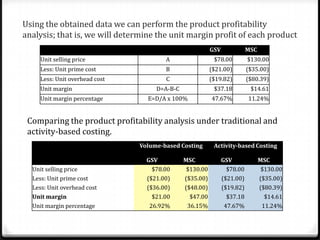
Using the obtained data we can perform the product profitability analysis; that is, we will determine the unit margin profit of each productComparing the product profitability analysis under traditional and activity-based costing.

Activity based costing

  • 1.
  • 2.
    What is ABC?ActivityBased Costing is a management accounting approach which allocate all direct and indirect (overhead) costs to cost objects (products and services) in order to help management understand critical business information.It allocates direct and indirect costs to products and services based on the level of activities used to create and deliver those products and services.
  • 3.
    Direct & IndirectCosts?Direct costs A cost that can be directly traced to producing specific goods or services., e.g., salaries for project staff and materials required for a particular project.Indirect costs are costs that are not directly accountable to a cost object (such as a particular function or product). Indirect costs may be either fixed or variable. Indirect costs include taxes, administration, personnel and security costs, and are also known as overhead.
  • 4.
    Activities such aspurchasing, design, production, sales, marketing and customer service are utilized by different products and services (cost objects) based on their complexity and business requirements.Compared to traditional accounting, activity based costing is a decision making tool which provides more accurate cost and profit information and allows management to understand the cost and profit drivers and improve their business.
  • 5.
    ABC Vs. TraditionalMethodsResourcesResourcesEverything in the organizationConsumeTraced by Resource DriversActivitiesWhat is actually being doneAllocation BasisAllocateConsumeTraced by Activity DriversObjectsObjects-Products-Services
  • 6.
    Difference between Traditional& ABC MethodIn traditional cost accounting it is assumed that cost objects consume resources whereas in ABC it is assumed that cost objects consume activities.Traditional cost accounting mostly utilizes volume related allocation bases while ABC uses drivers at various levels.Traditional cost accounting is structure-oriented whereas ABC is process-oriented.
  • 7.
    Steps necessary todevelop ABC System:Identifying available resources & resource-consuming activitiesAssigning costs of available resources to activitiesAssigning costs of activities to cost objects(i.e. products, batches of products)How ABC Works
  • 8.
    1. Identifying availableresources & resource-consuming activitiesIdentify resourcesResource Consumption Cost DriversTransaction DriversDuration DriversActivity Levels: There are different activity levels such as:unit level activities (activities performed on each unit such as packaging), batch level activities (activities performed on batch level such as scheduling and set up), product level activities (activities performed on each product such as design, engineering and marketing) and facility level activities (activities performed at each facility such as safety and maintenance).
  • 9.
    2. Assigning costsof available resources to activitiesAssign the cost of resources to the activities that consume those resources, for this company will choose resource consumption cost drivers. E.g. if a machine(m/c) set-ups activity requires 0.5m/c hrs, and each m/c hr costs $20 then m/c set-ups activity costs $10($20x0.5).Assigning cost of resources to the activities consuming those resources, a company can determine the cost of each activity and ultimately cost of factory’s output.3. Assigning costs of activities to cost objects(i.e. products, batches of products)Company will assign cost of activities to cost objects based on activity consumption cost drivers. Cost Objects e.g. if a cost object requires 3m/c set-ups & the m/c set-ups activity costs $10 then the cost object will be assigned $30.
  • 10.
    Activity consumption driversmeasure amount of activity consumed by a cost object.How ABC Works(Contd.)
  • 11.
    Example of ABCFriendscompany, a manufacturer of valves, produces and sells two types of valves: Gas Safety Valves(GSV) and MSC Valves(MSC). Friends company has following data for two products:In addition, Friends company has identified the following activities, costs, and activity consumption cost drivers:
  • 12.
    Friends company alsocollected the activity data for each product:Using the total cost for each activity & the total amount of activity cost driver we can determine the activity cost rate:
  • 13.
    Calculating per-unit costof each product manufactured by Friends Company.
  • 14.
    Using the obtaineddata we can perform the product profitability analysis; that is, we will determine the unit margin profit of each productComparing the product profitability analysis under traditional and activity-based costing.