INDEX
Definition ofstandard
Steps in standard costing
Types of standards
Variance
Types of variance
Variance Analysis
Advantages & disadvantages of Std costing
2
3.
3
STANDARD
It’s a normor bench mark
It is useful for comparison
it may indicate minimum quality
Eg. Standard of passing
4.
4
STANDARD COST
An estimatedor pre-determined
cost of performing an operation
or producing a good or service,
under normal conditions.
It is used as a basis for cost
control through variance
analysis.
5.
5
It ischosen to serve as a
benchmark in the standard
costing/ budgetary control
system.
It is a budget for the production
of one unit of product or service.
Standard Cost
6.
6
STANDARD COST
Itis a pre-determined cost which is
calculated from management’s standards
of efficient operation and the relevant
necessary expenditure.
It is a cost accounting technique for
cost control where standard costs are
determined and compared with
actual costs, to initiate corrective action.
7.
7
STANDARD COSTING
It isa control method involving
the preparation of detailed cost
and sales budgets.
A management tool used to
facilitate management by
exception.
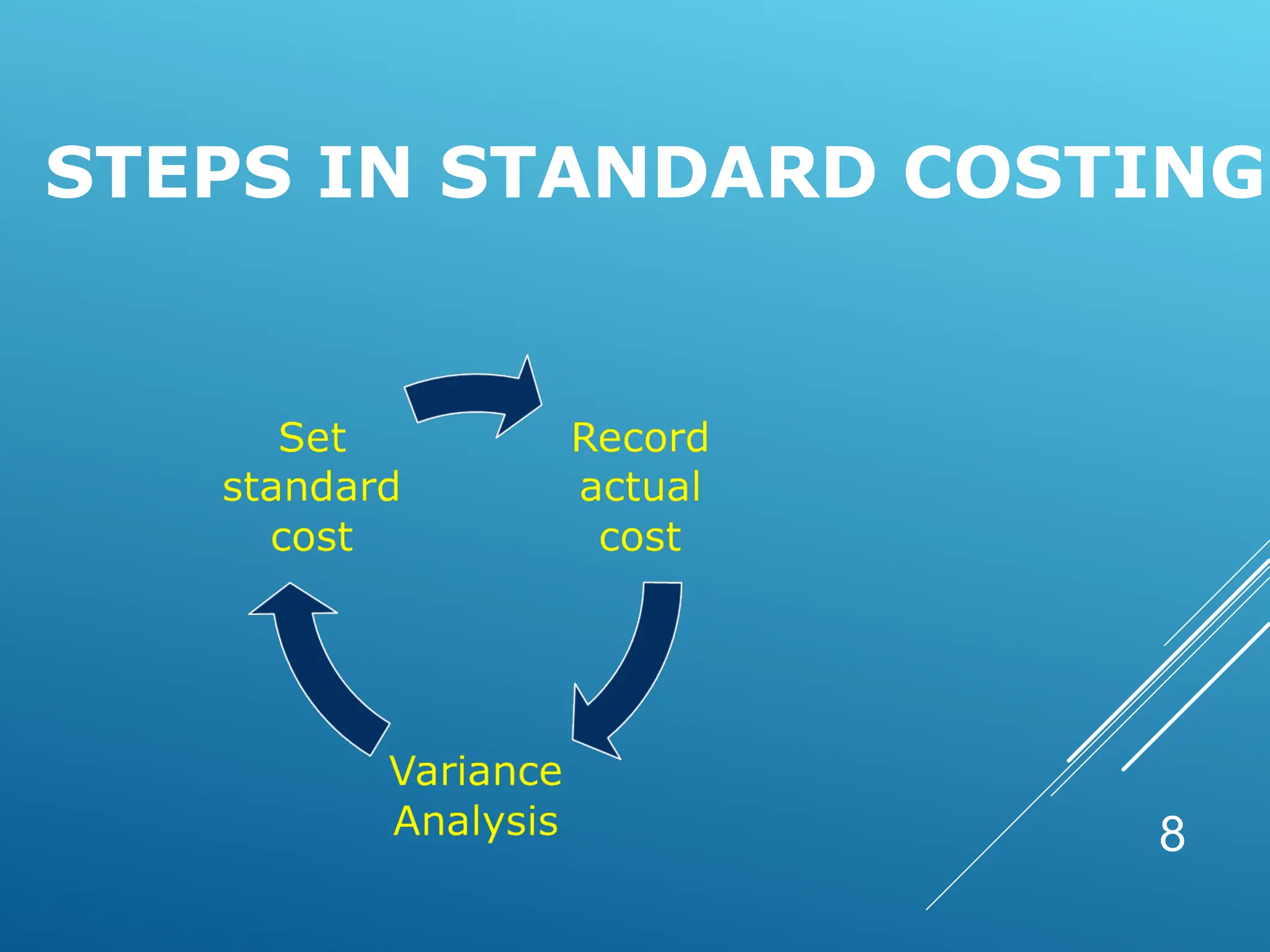
STEPS IN STANDARD
COSTING
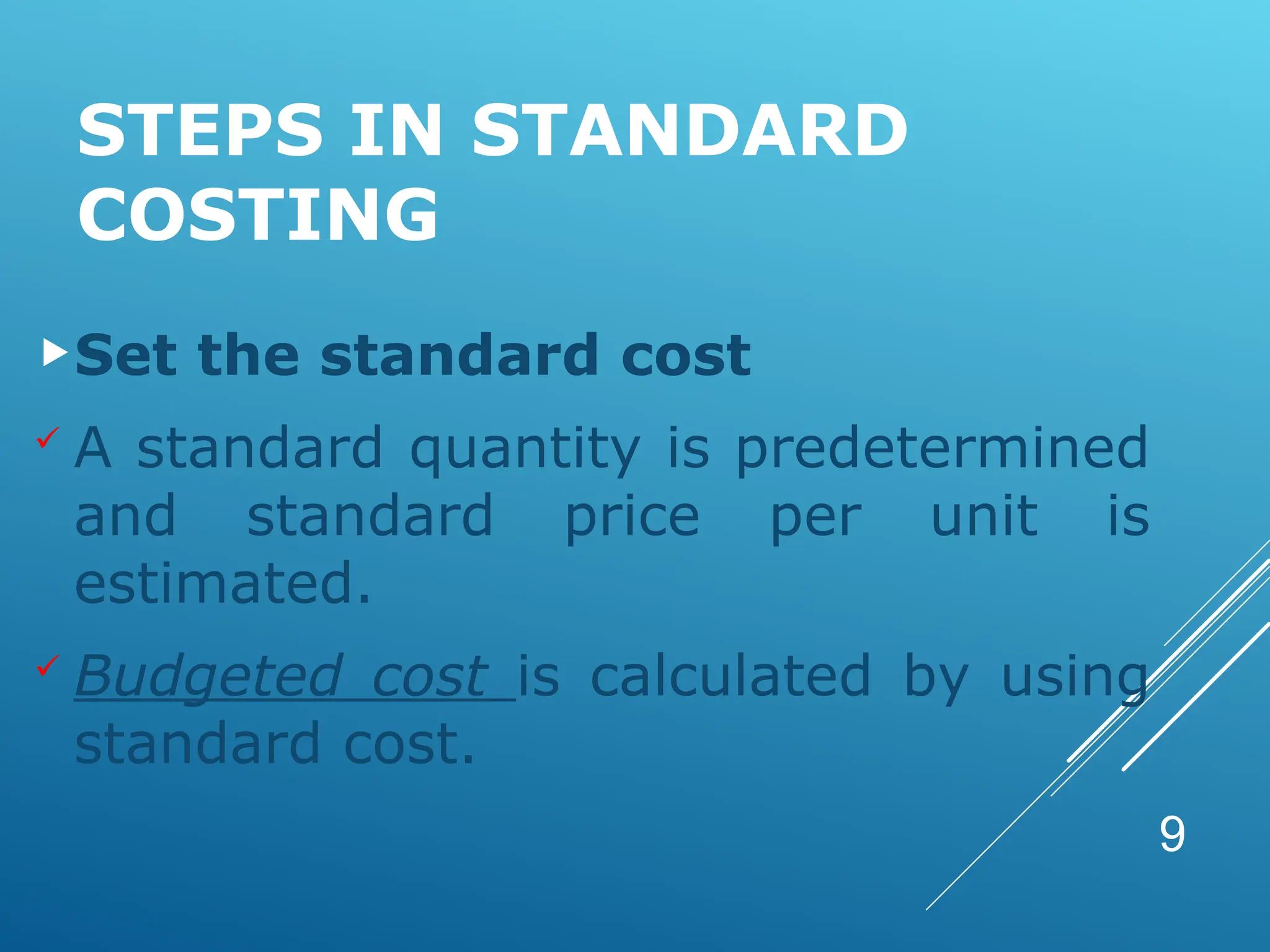
Setthe standard cost
A standard quantity is predetermined
and standard price per unit is
estimated.
Budgeted cost is calculated by using
standard cost.
9
10.
STEPS IN STANDARDCOSTING
• Record the actual cost
Calculate actual quantity and
cost incurred giving full details.
10
11.
STEPS IN STANDARDCOSTING
Variance Analysis
Comparison of the actual cost with the
budgeted cost.
The cost variance is used in controlling cost.
Create effective control system.
Resetting the budget, if required.
11
12.
TYPES OF STANDARDS
IdealStandards:
These represents the level of performance attainable
when prices for material and labour are most
favorable, when the highest output is achieved with
the best equipment and layout and when maximum
efficiency in utilization of resources results in
maximum output with minimum cost.
12
13.
Normal Standards:
These arethe standards that may be achieved
under normal operating conditions. The normal
activity has been defined as number of standard
hours which will produce normal efficiency
sufficient goods to meet the average sales
demand over a term of years.
13
14.
Basic orBogey standards:
When basic standards are in use, variances are not
calculated as the difference between standard and
actual cost. Instead, the actual cost is expressed
as a percentage of basic cost.
Does not consider the variable costs
14
15.
Current Standard:
Thesestandards reflect the management’s anticipation of
what actual cost will be for the current period. These
are the costs which the business will incur if the
anticipated prices are paid for goods and services and
the usage corresponds to that believed to be necessary
to produce the planned output.
15
16.
VARIANCE
The differencebetween standard cost and actual cost of the
actual output is defined as Variance. A variance may be
favorable or unfavorable.
If the actual cost is less than the standard cost, the
variance is favorable and if the actual cost is more than the
standard cost, the variance will be unfavorable.
It is not enough to know the figures of these variances in
fact it is required to trace their origin and causes of
occurrence for taking necessary remedial steps to reduce /
eliminate them.
16
17.
17
Variance - Types
Thepurpose of standard costing reports is
to investigate the reasons for significant
variances so as to identify the problems
and take corrective action. Variances are
broadly of two types, namely, controllable
and uncontrollable.
18.
VARIANCE ANALYSIS
Variance analysisis the dividing
of the cost variance into its
components to know their
causes, so that one can approach
for corrective measures.
18
19.
VARIANCE ANALYSIS
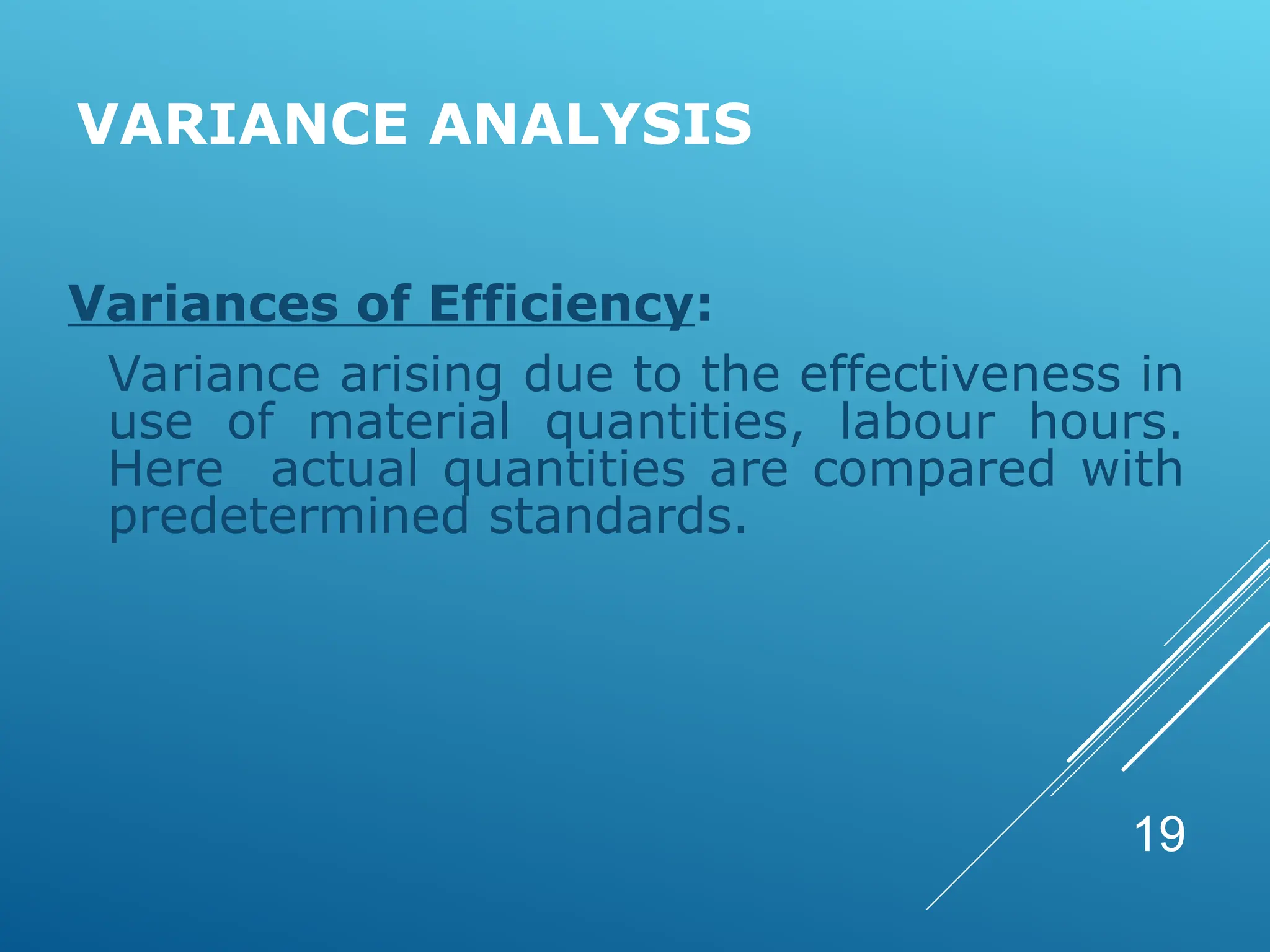
Variances ofEfficiency:
Variance arising due to the effectiveness in
use of material quantities, labour hours.
Here actual quantities are compared with
predetermined standards.
19
20.
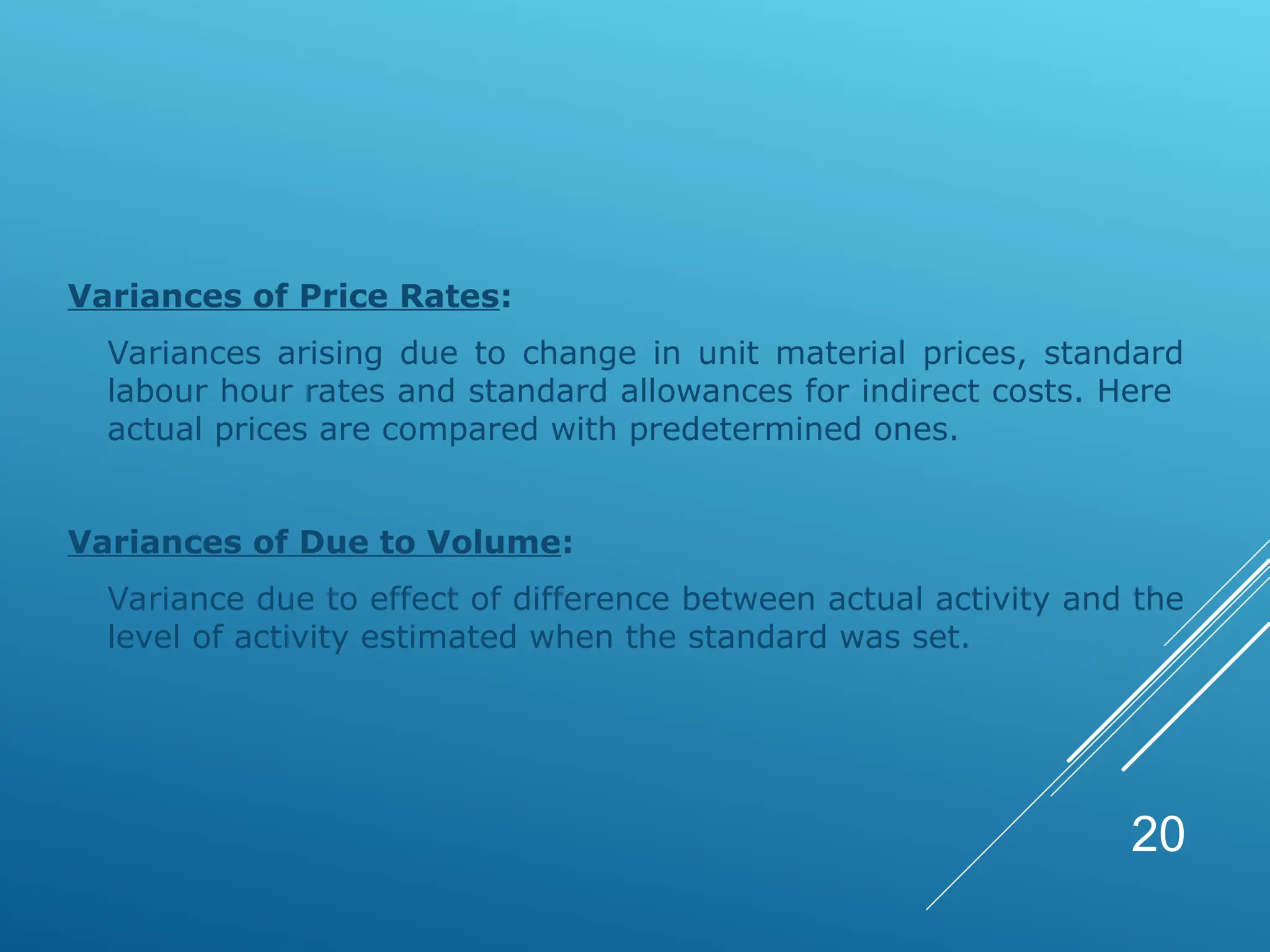
Variances of PriceRates:
Variances arising due to change in unit material prices, standard
labour hour rates and standard allowances for indirect costs. Here
actual prices are compared with predetermined ones.
Variances of Due to Volume:
Variance due to effect of difference between actual activity and the
level of activity estimated when the standard was set.
20
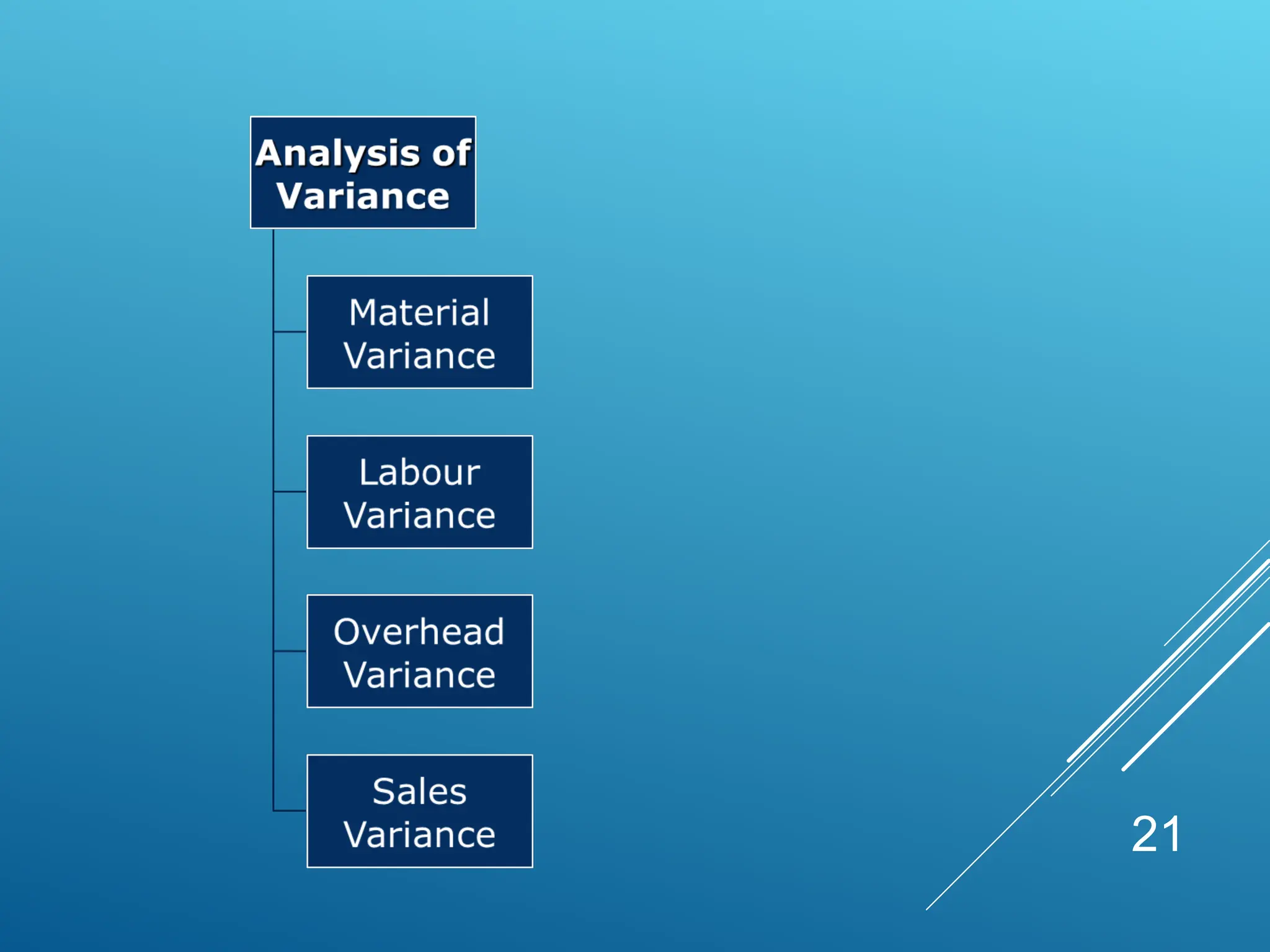
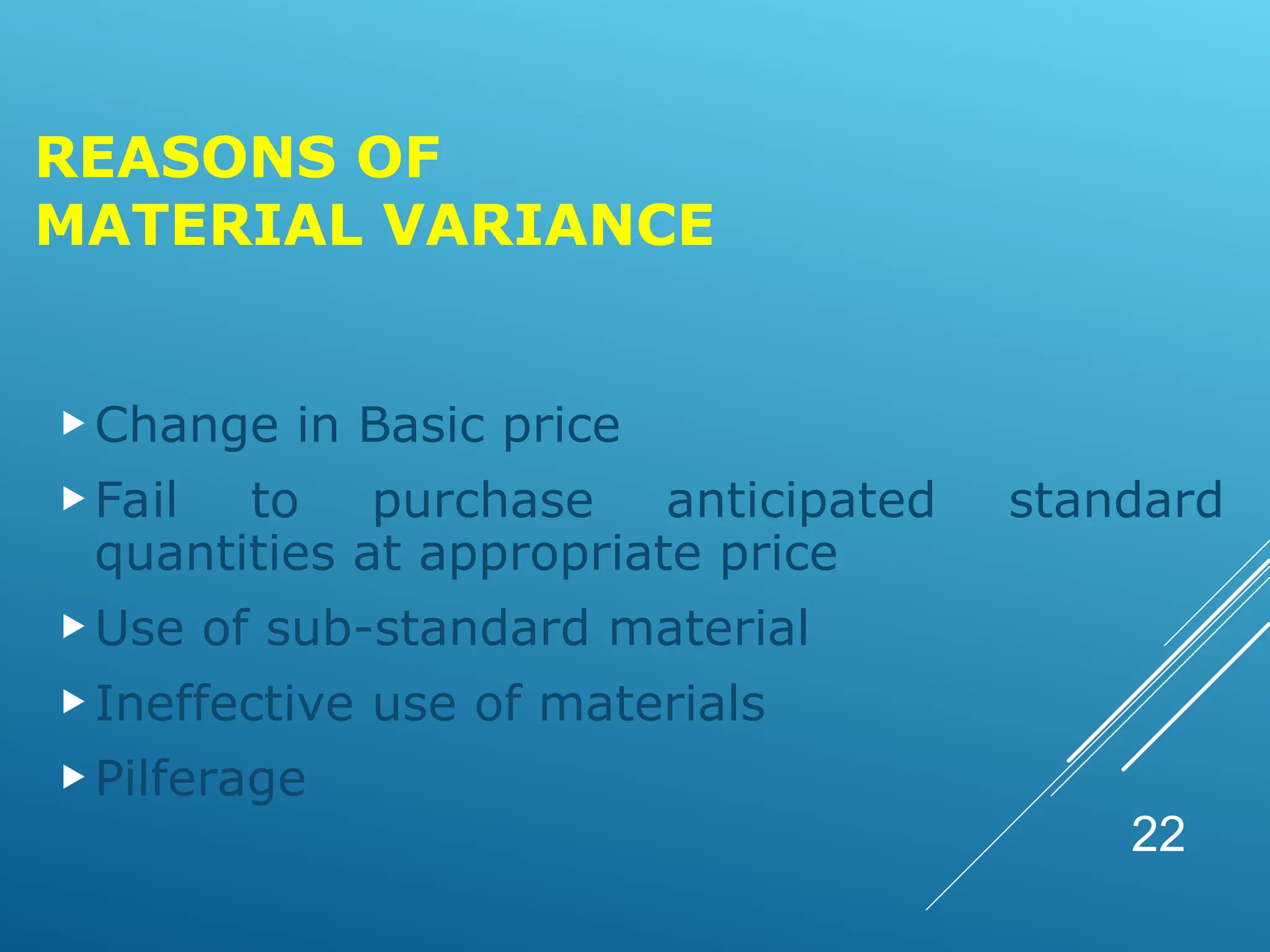
REASONS OF
MATERIAL VARIANCE
Changein Basic price
Fail to purchase anticipated standard
quantities at appropriate price
Use of sub-standard material
Ineffective use of materials
Pilferage
22
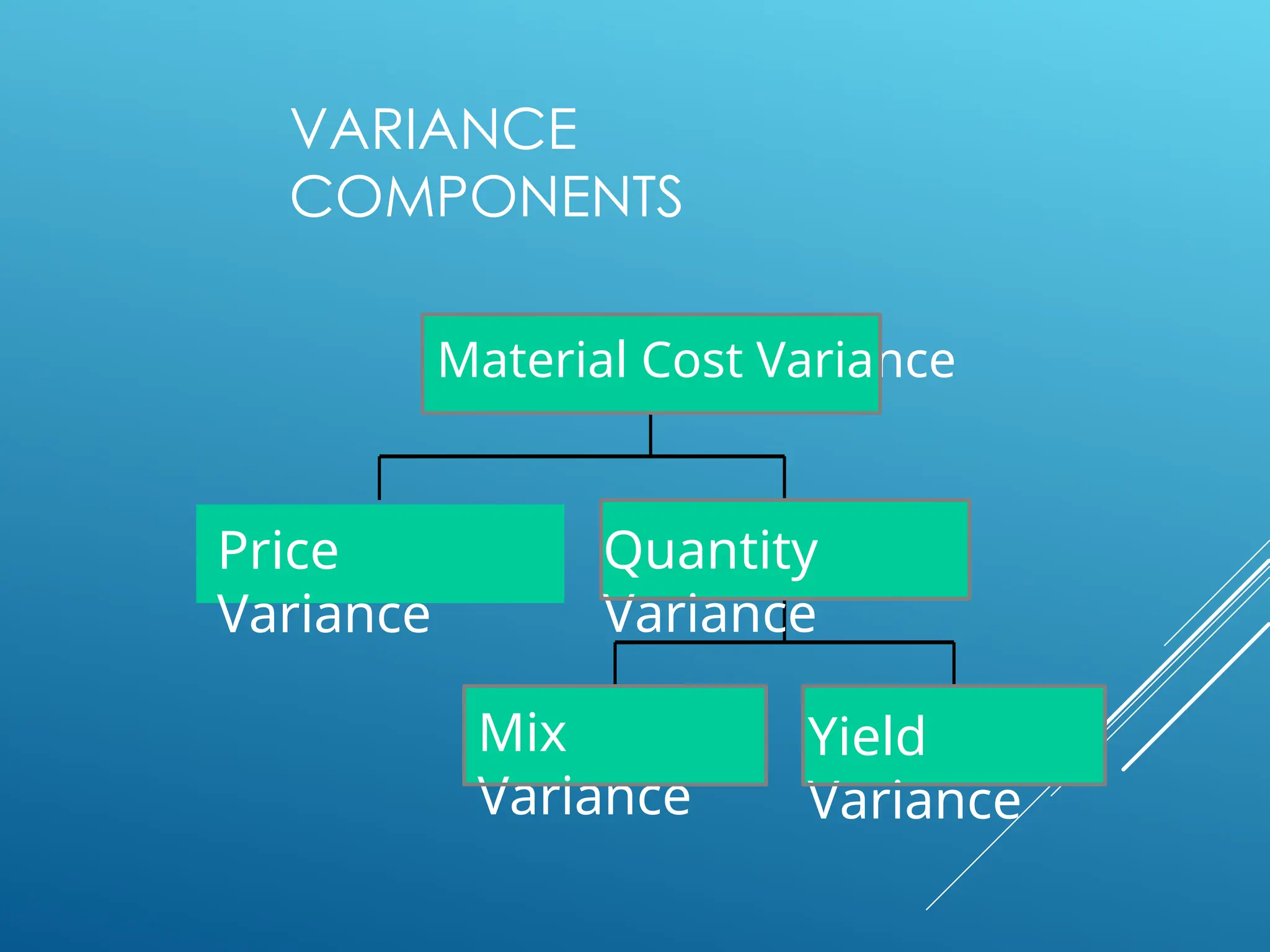
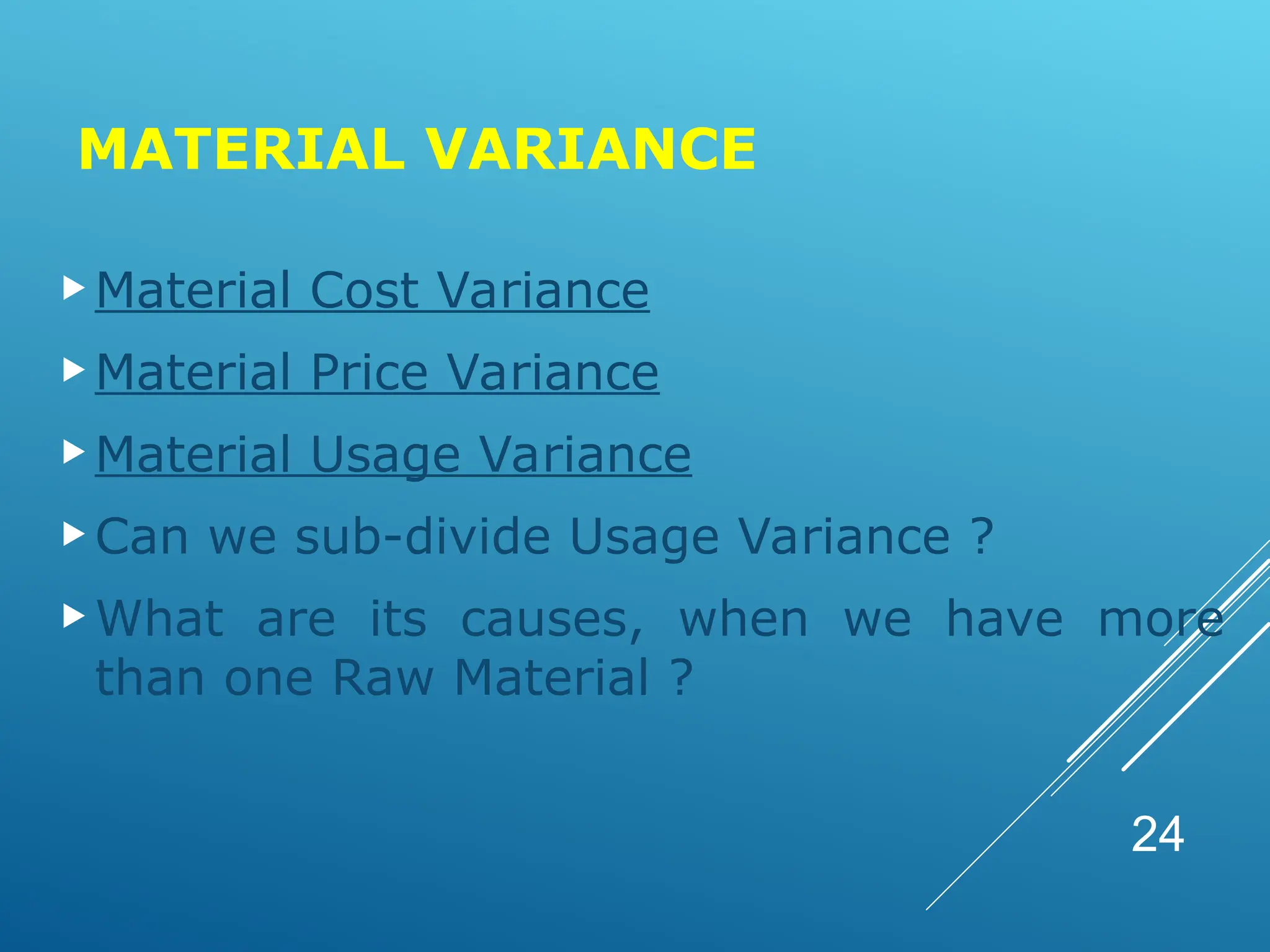
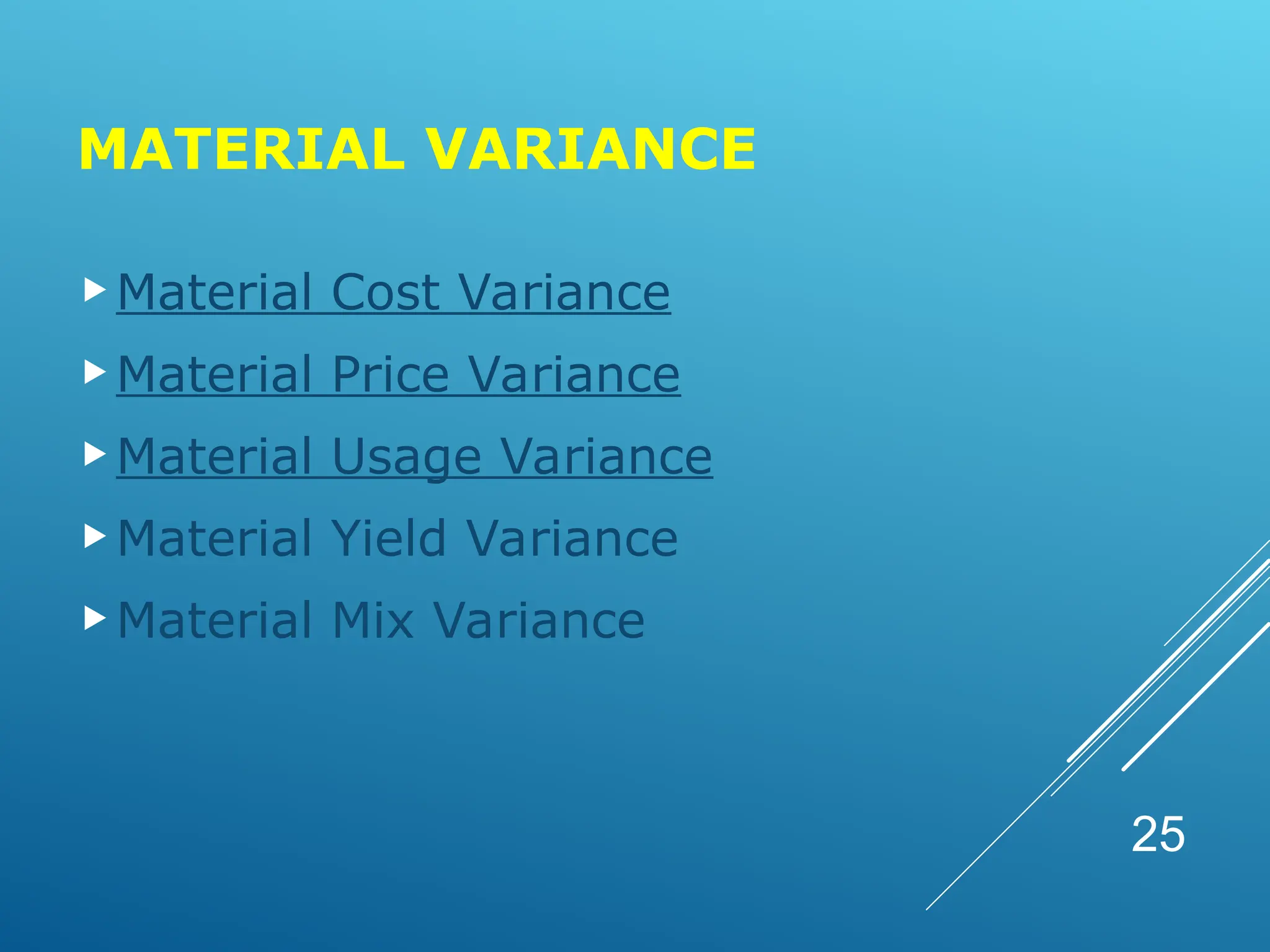
MATERIAL VARIANCE
Material CostVariance
Material Price Variance
Material Usage Variance
Can we sub-divide Usage Variance ?
What are its causes, when we have more
than one Raw Material ?
24
MATERIAL VARIANCE
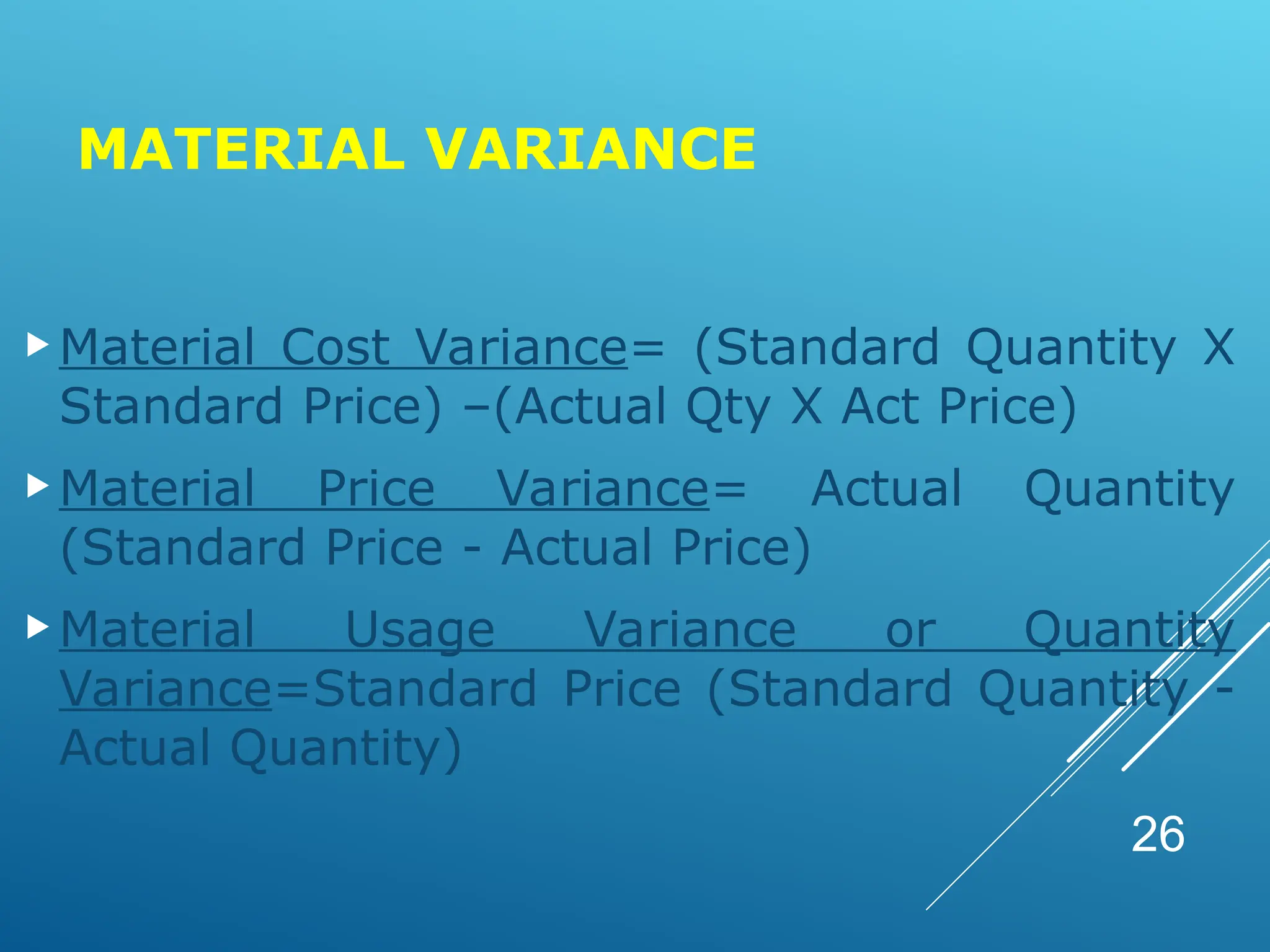
Material CostVariance= (Standard Quantity X
Standard Price) –(Actual Qty X Act Price)
Material Price Variance= Actual Quantity
(Standard Price - Actual Price)
Material Usage Variance or Quantity
Variance=Standard Price (Standard Quantity -
Actual Quantity)
26
27.
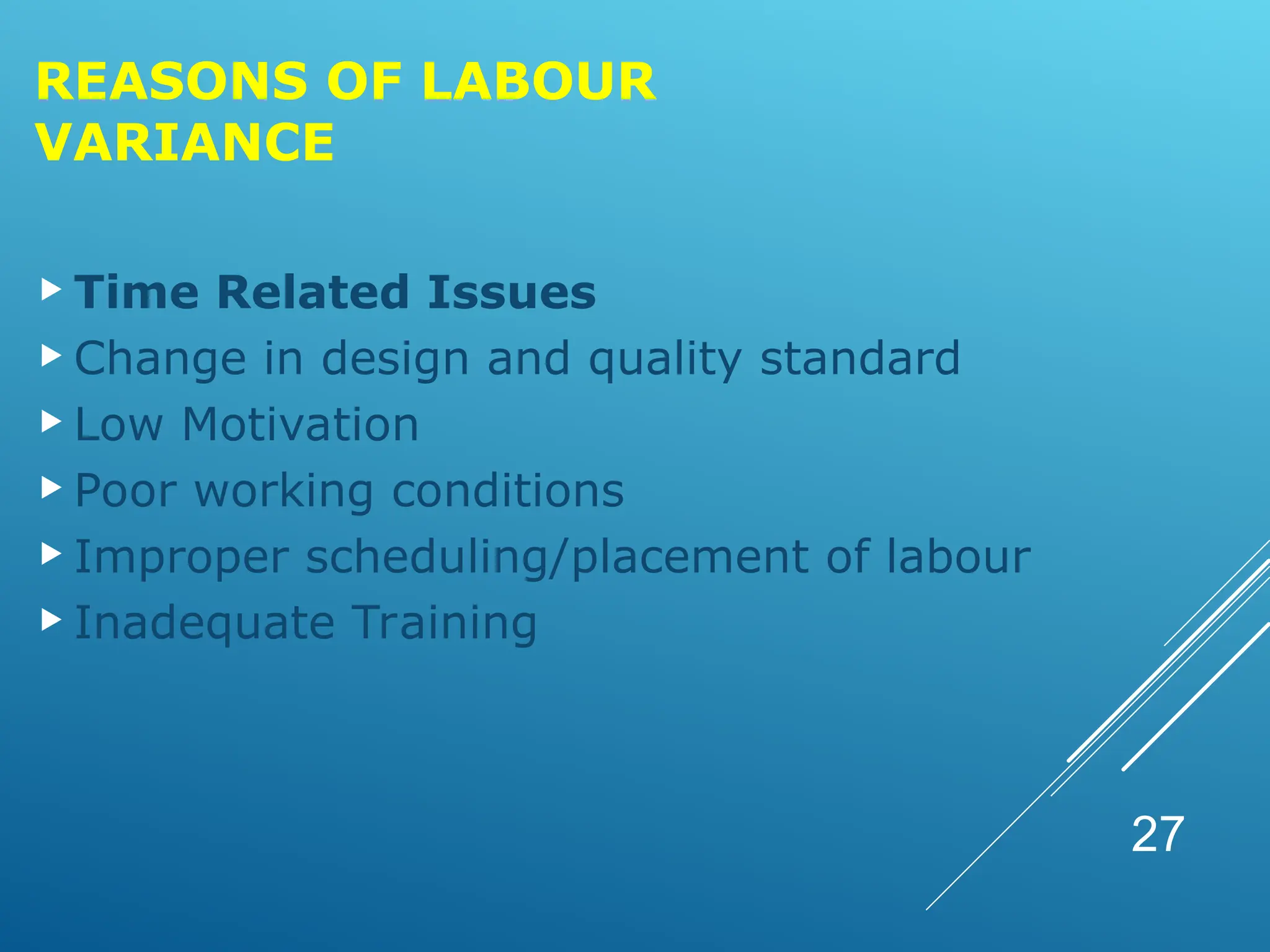
REASONS OF LABOUR
VARIANCE
Time Related Issues
Change in design and quality standard
Low Motivation
Poor working conditions
Improper scheduling/placement of labour
Inadequate Training
27
28.
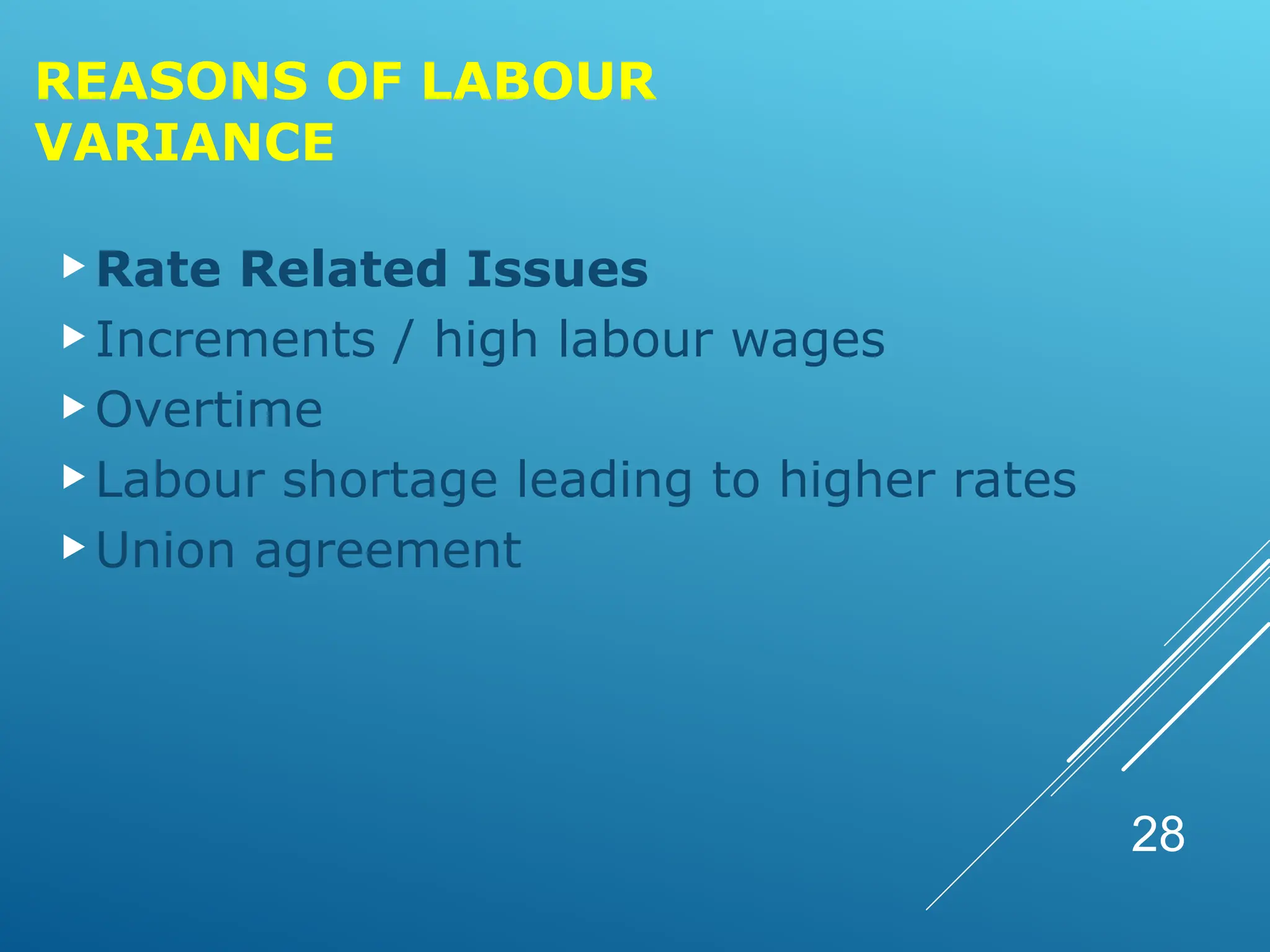
REASONS OF LABOUR
VARIANCE
RateRelated Issues
Increments / high labour wages
Overtime
Labour shortage leading to higher rates
Union agreement
28
LABOUR VARINACE
When outputis not given:
1.Labour Cost Variance: Total Standard
Labour Cost-Total Actual Labour Cost
2.Labour Rate Variance: AH[SR-AR]
3.Labour Efficiency Variance: SR[SH-
AH]
where
AH---Actual Hours SR---Standard Rate
AR---Actual Rate
SH---Standard Hours
31.
LABOUR VARINACE
When outputis given
1. Labor cost
variance:
Standard cost
Standard output
X Actual Output –Total actual
labour cost
2.Labour Rate Variance: AH[SR-AR]
3.Labour Efficiency Variance:
SR[Standard Hrs. of A X Actual Output –Actual
Hrs.A] Standard Output
32.
LABOUR VARINACE
4. LabourMix Variance:
SR[Standard Hrs. of A X Total Actual Hrs -Actual Hrs. of A]
Total Standard Hrs
5. Labour Yield Variance:
SR[Actual Yield-Standard output X Total Actual Hrs.
Total Standard Hrs.
Where SR=Standard Cost
Standard Output
6. Idle Time Variance:
Idle Time X Standard Rate
When Idle time=0,then LTEV=LEV
33.
ADVANTAGES OF STANDARD
COSTING
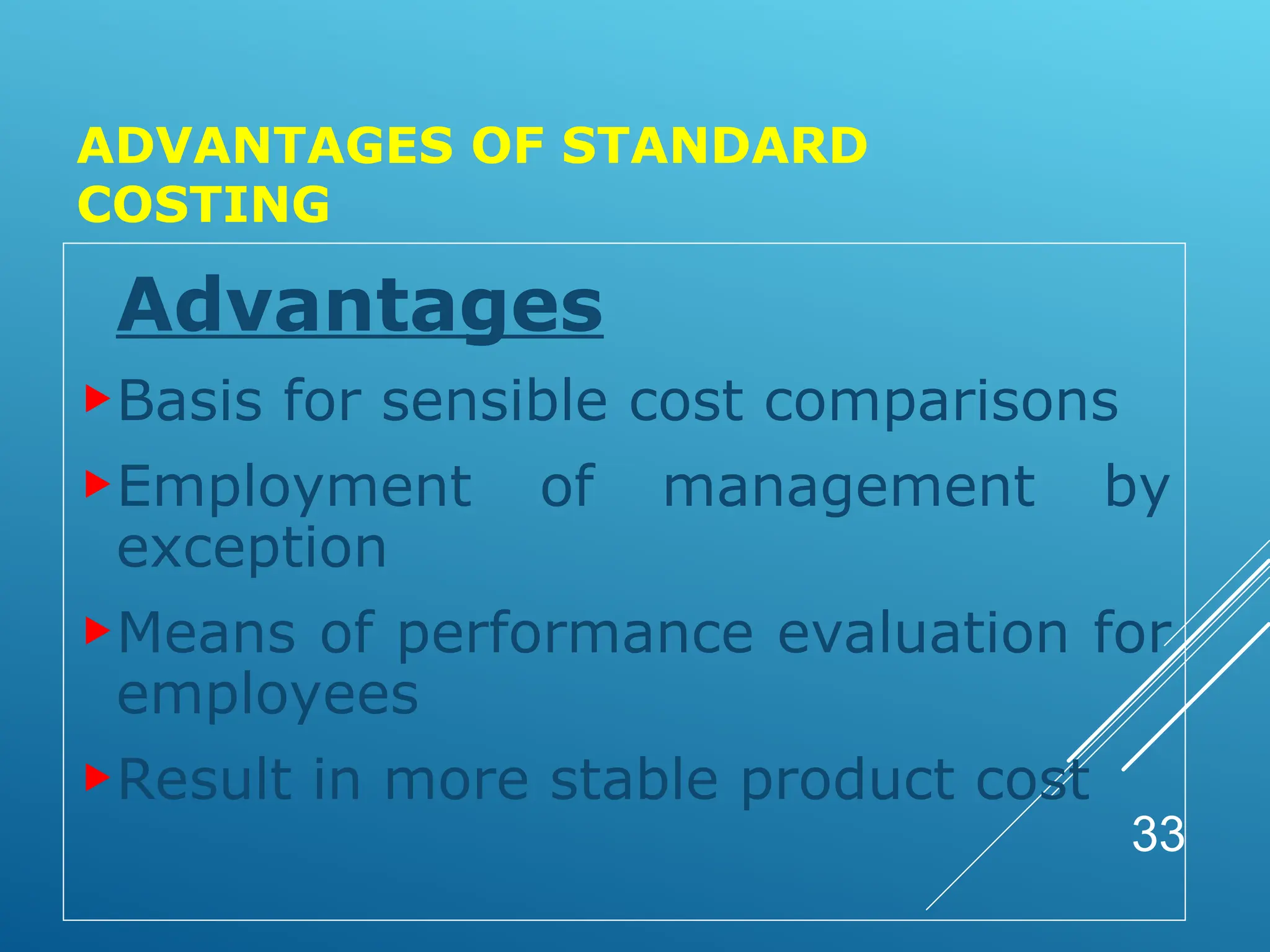
Advantages
Basisfor sensible cost comparisons
Employment of management by
exception
Means of performance evaluation for
employees
Result in more stable product cost
33
PRACTICAL PROBLEMS
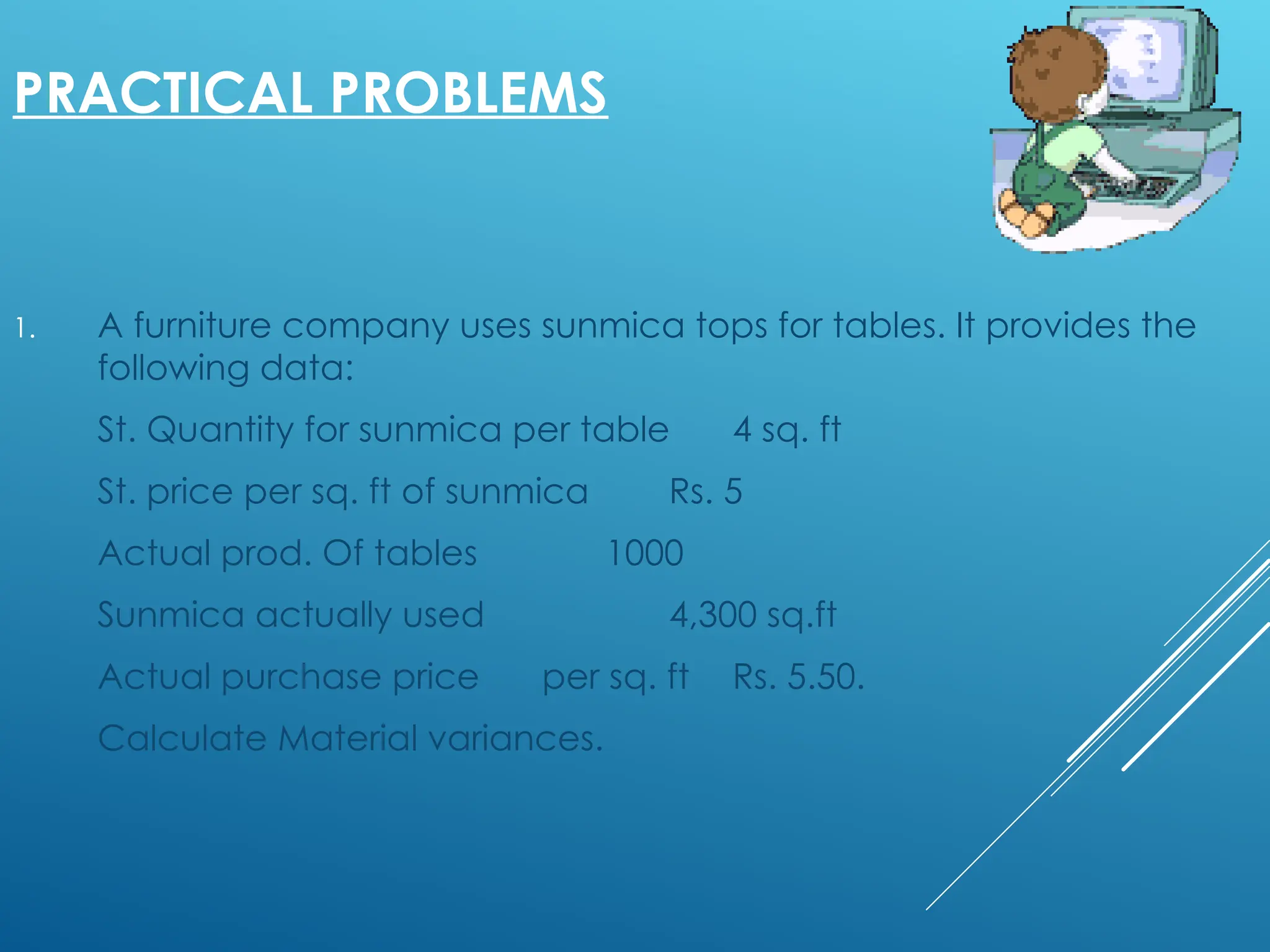
1. Afurniture company uses sunmica tops for tables. It provides the
following data:
St. Quantity for sunmica per table 4 sq. ft
St. price per sq. ft of sunmica Rs. 5
Actual prod. Of tables 1000
Sunmica actually used 4,300 sq.ft
Actual purchase price per sq. ft Rs. 5.50.
Calculate Material variances.
36.
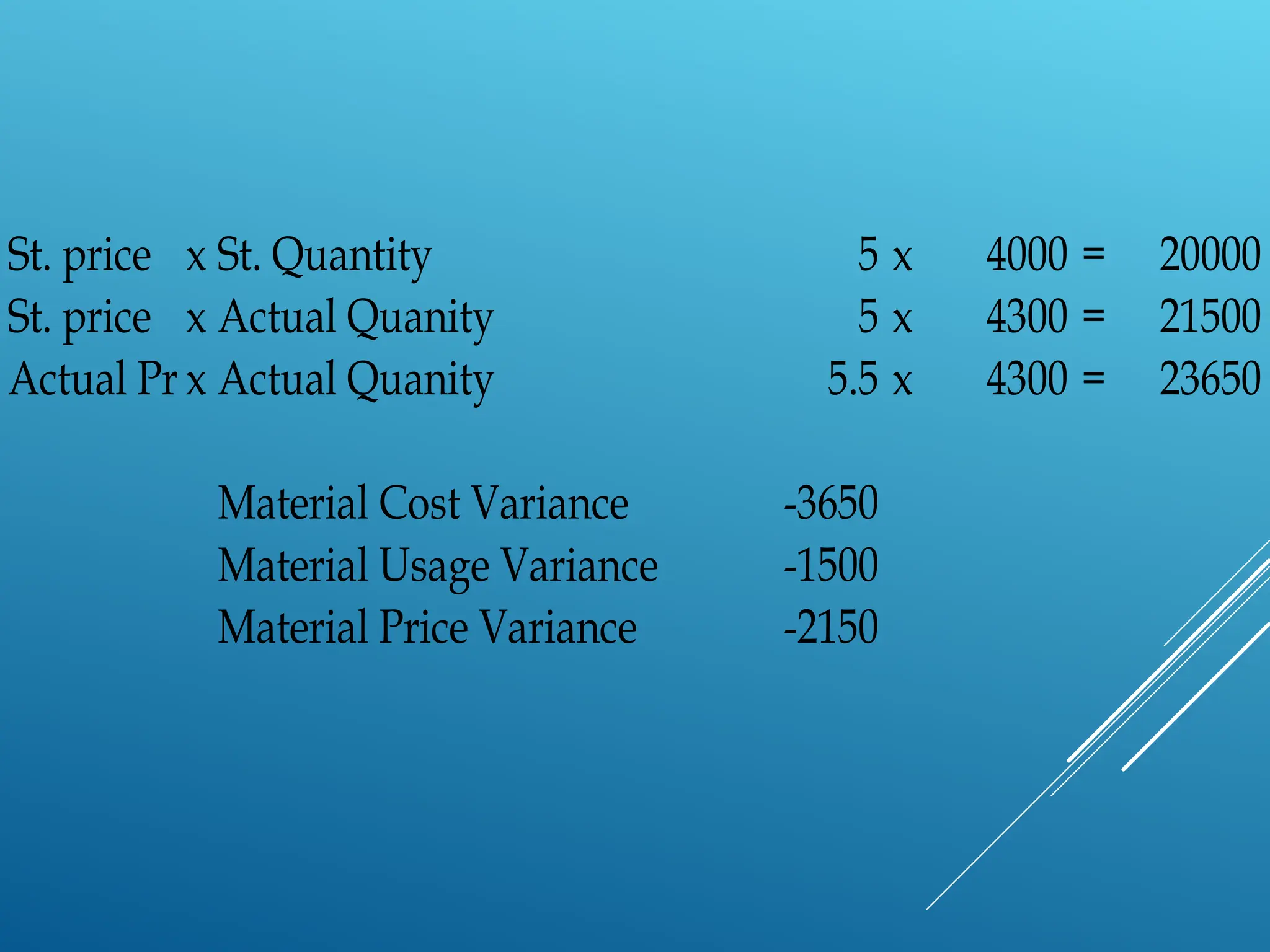
St. price xSt. Quantity 5 x 4000 = 20000
St. price x Actual Quanity 5 x 4300 = 21500
Actual Price
x Actual Quanity 5.5 x 4300 = 23650
Material Cost Variance -3650
Material Usage Variance -1500
Material Price Variance -2150
37.
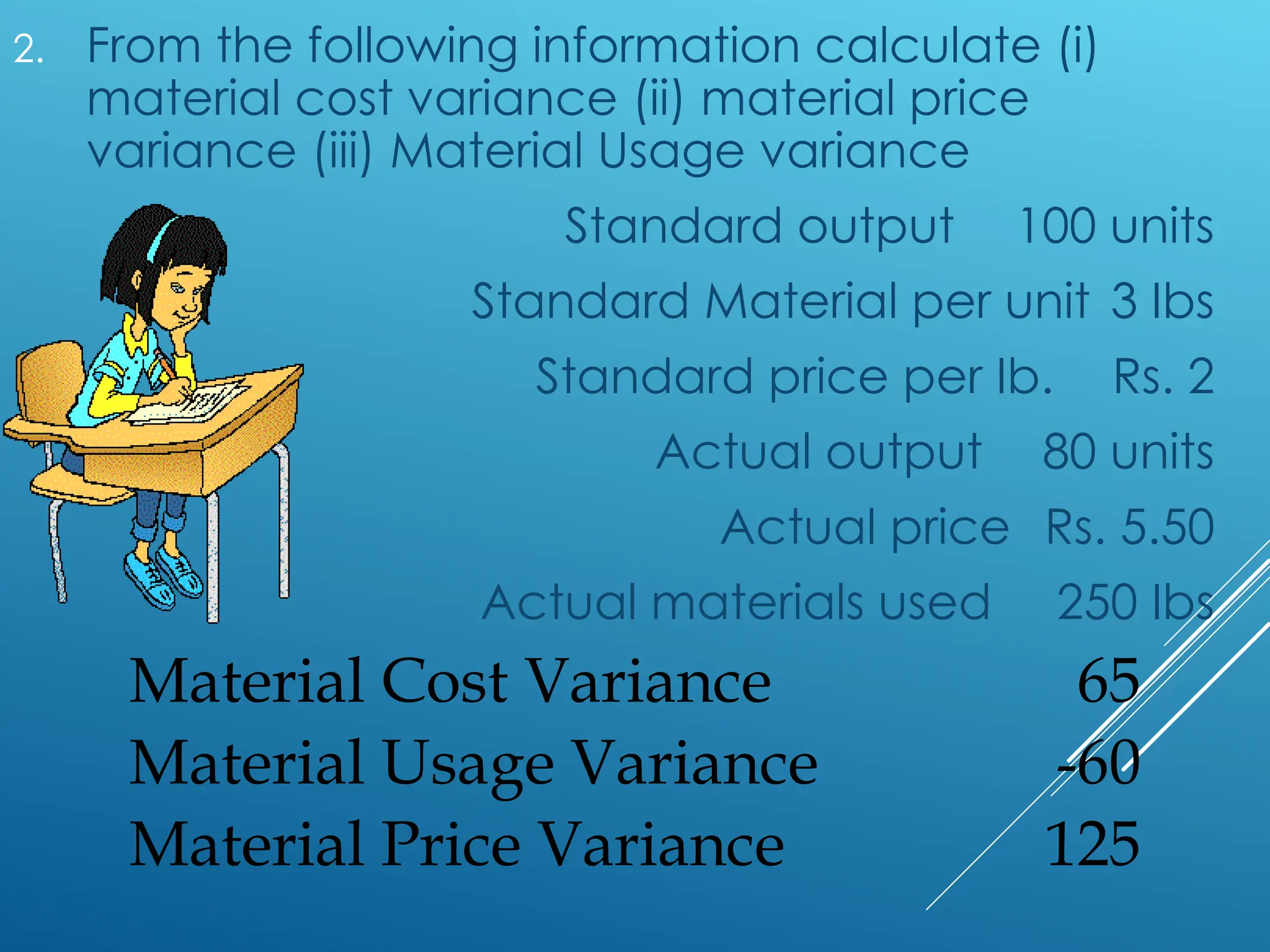
2. From thefollowing information calculate (i)
material cost variance (ii) material price
variance (iii) Material Usage variance
Standard output 100 units
Standard Material per unit 3 Ibs
Standard price per Ib. Rs. 2
Actual output 80 units
Actual price Rs. 5.50
Actual materials used 250 Ibs
Material Cost Variance 65
Material Usage Variance -60
Material Price Variance 125
38.
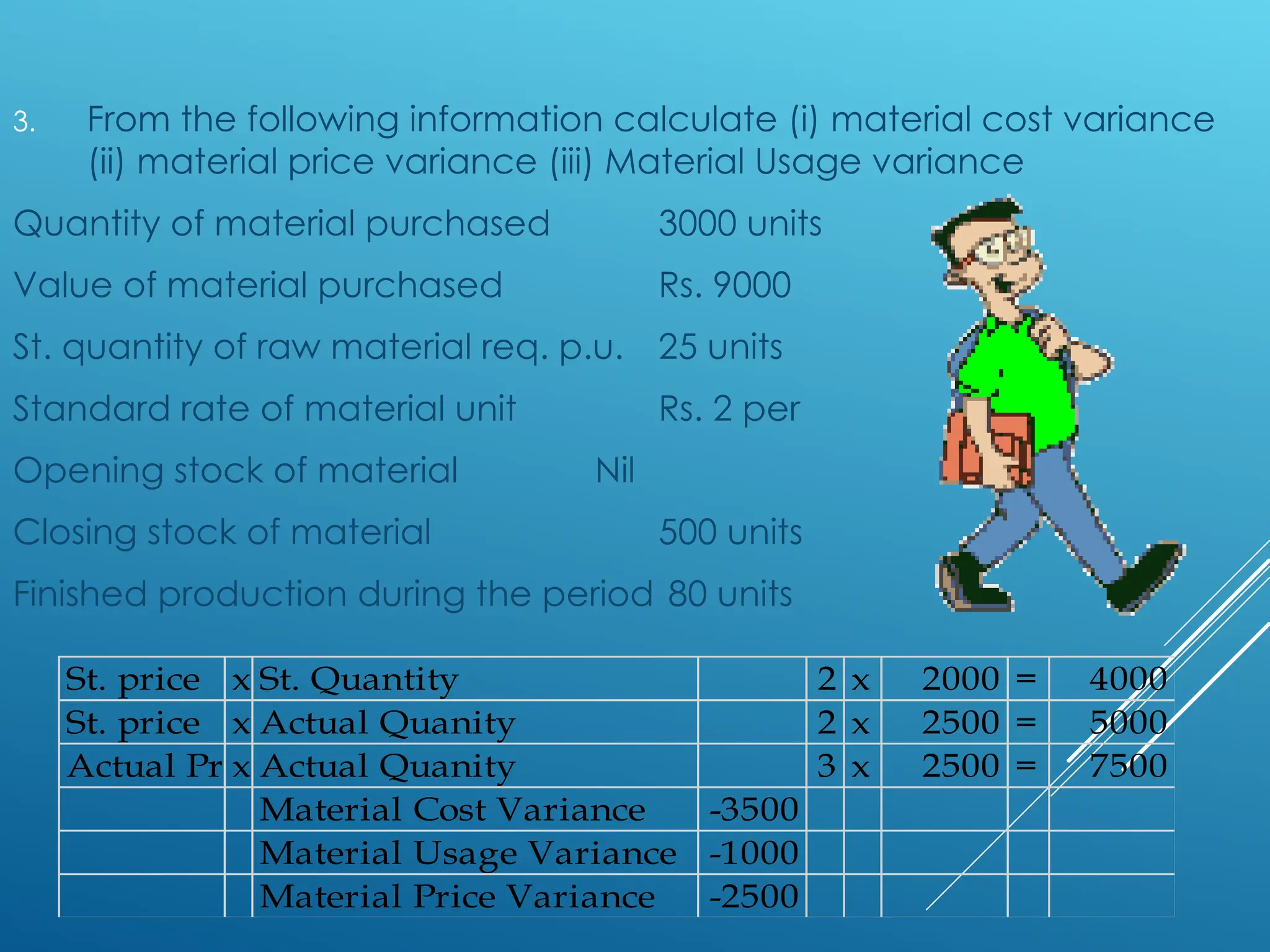
3. From thefollowing information calculate (i) material cost variance
(ii) material price variance (iii) Material Usage variance
Quantity of material purchased 3000 units
Value of material purchased Rs. 9000
St. quantity of raw material req. p.u. 25 units
Standard rate of material unit Rs. 2 per
Opening stock of material Nil
Closing stock of material 500 units
Finished production during the period 80 units
St. price x St. Quantity 2 x 2000 = 4000
St. price x Actual Quanity 2 x 2500 = 5000
Actual Price
x Actual Quanity 3 x 2500 = 7500
Material Cost Variance -3500
Material Usage Variance -1000
Material Price Variance -2500
39.
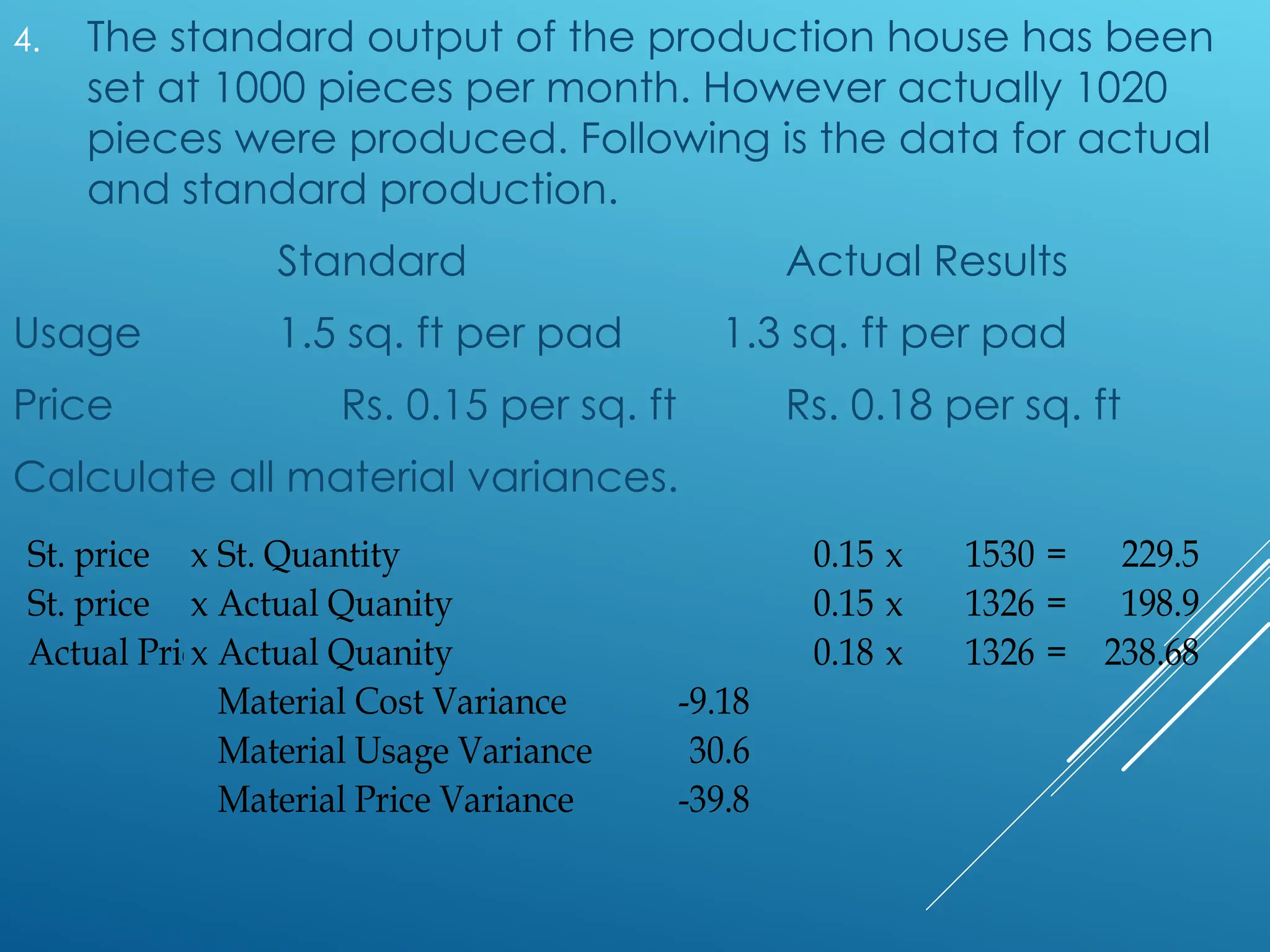
4. The standardoutput of the production house has been
set at 1000 pieces per month. However actually 1020
pieces were produced. Following is the data for actual
and standard production.
Standard Actual Results
Usage 1.5 sq. ft per pad 1.3 sq. ft per pad
Price Rs. 0.15 per sq. ft Rs. 0.18 per sq. ft
Calculate all material variances.
St. price x St. Quantity 0.15 x 1530 = 229.5
St. price x Actual Quanity 0.15 x 1326 = 198.9
Actual Price
x Actual Quanity 0.18 x 1326 = 238.68
Material Cost Variance -9.18
Material Usage Variance 30.6
Material Price Variance -39.8
40.
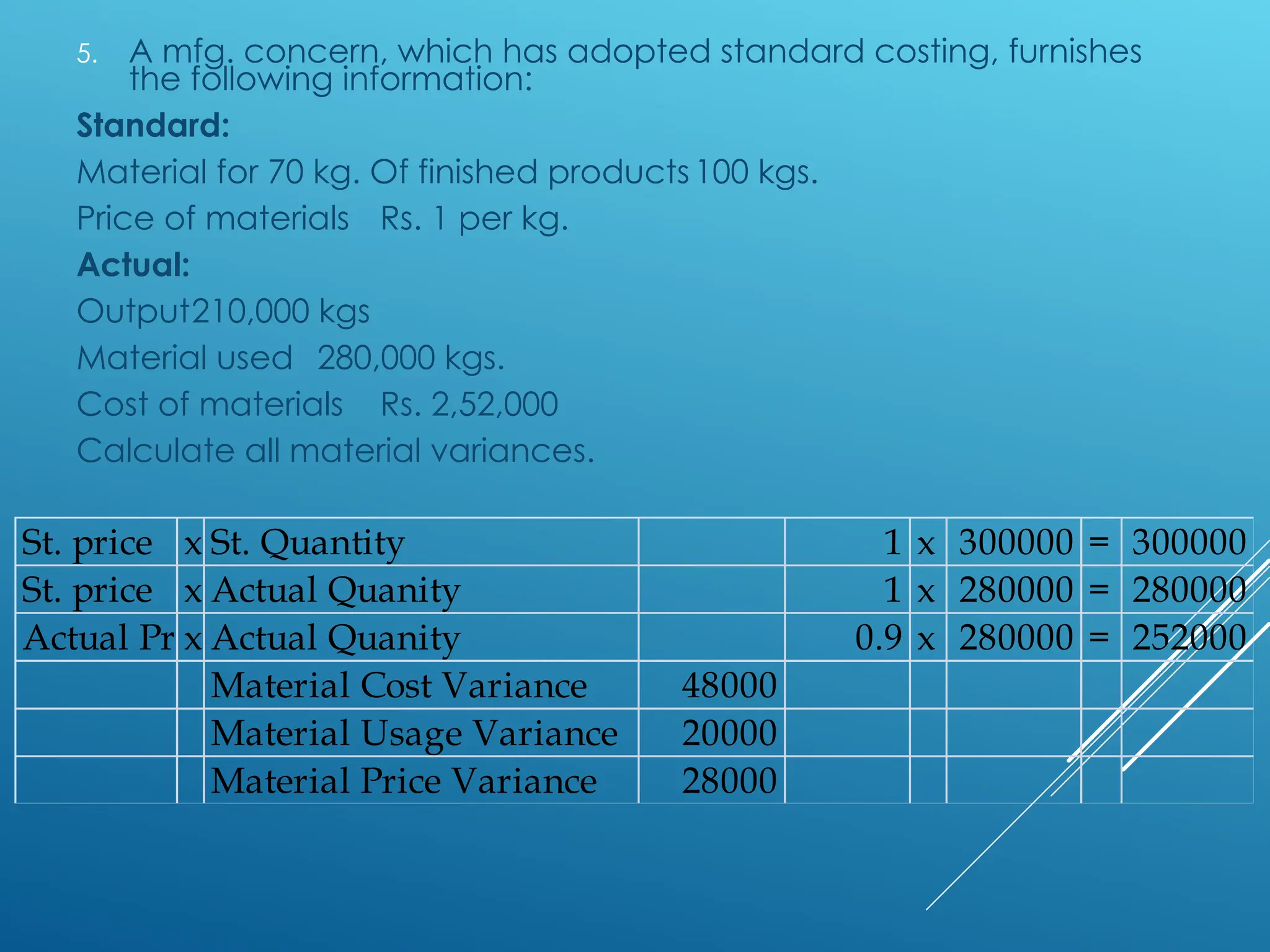
St. price xSt. Quantity 1 x 300000 = 300000
St. price x Actual Quanity 1 x 280000 = 280000
Actual Price
x Actual Quanity 0.9 x 280000 = 252000
Material Cost Variance 48000
Material Usage Variance 20000
Material Price Variance 28000
5. A mfg. concern, which has adopted standard costing, furnishes
the following information:
Standard:
Material for 70 kg. Of finished products100 kgs.
Price of materials Rs. 1 per kg.
Actual:
Output210,000 kgs
Material used 280,000 kgs.
Cost of materials Rs. 2,52,000
Calculate all material variances.
41.
MATERIAL MIX VARIANCE
Material Mix Variance
= [Revised St. Qty – Actual Qty] x St. Price
Rev. St. Qty = St. Qty of 1 Mat. x Actual Total
Standard Total
42.
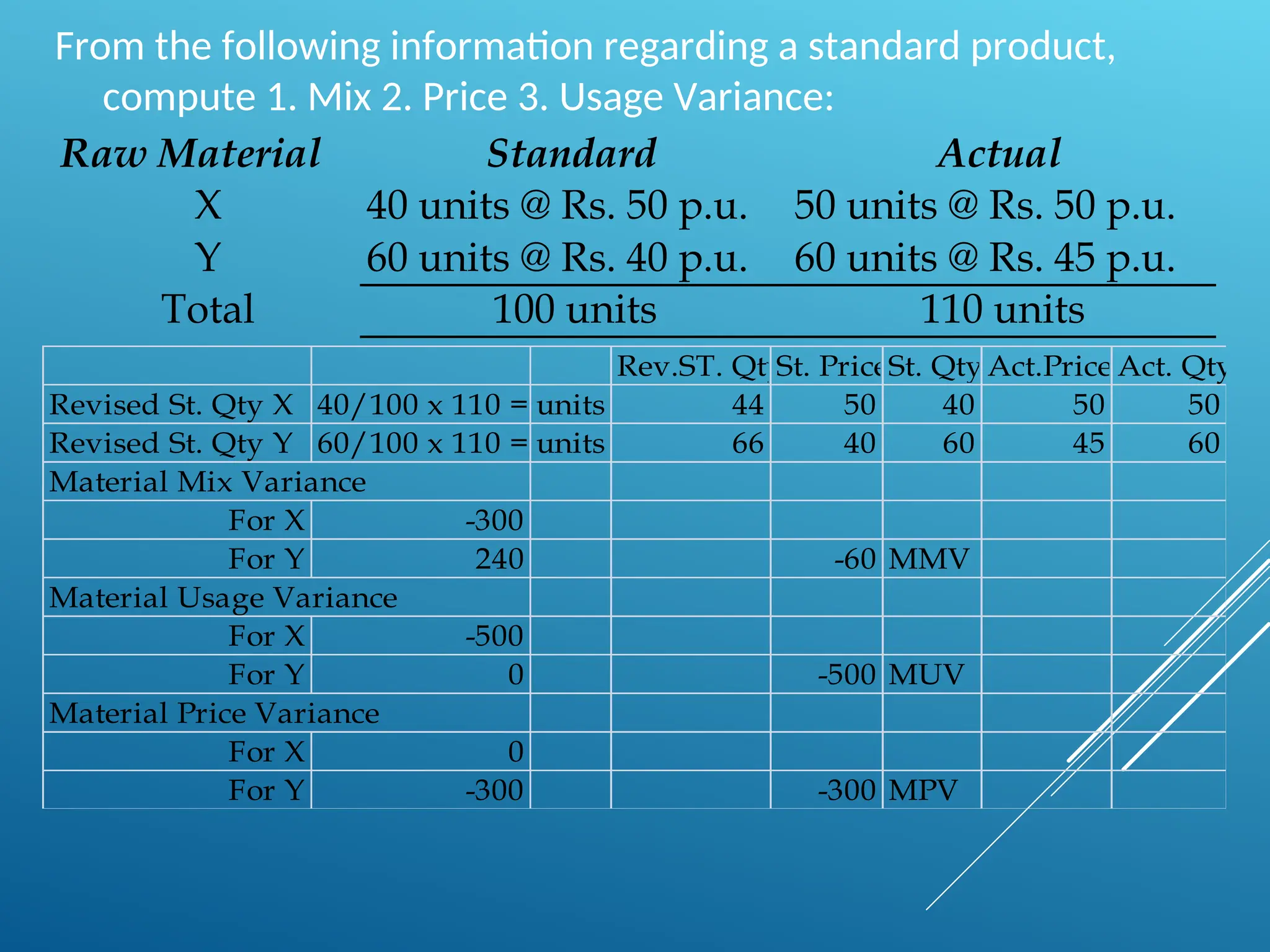
From the followinginformation regarding a standard product,
compute 1. Mix 2. Price 3. Usage Variance:
Raw Material Standard Actual
X 40 units @ Rs. 50 p.u. 50 units @ Rs. 50 p.u.
Y 60 units @ Rs. 40 p.u. 60 units @ Rs. 45 p.u.
Total 100 units 110 units
Rev.ST. Qty
St. PriceSt. QtyAct.Price Act. Qty
Revised St. Qty X 40/100 x 110 = units 44 50 40 50 50
Revised St. Qty Y 60/100 x 110 = units 66 40 60 45 60
Material Mix Variance
For X -300
For Y 240 -60 MMV
Material Usage Variance
For X -500
For Y 0 -500 MUV
Material Price Variance
For X 0
For Y -300 -300 MPV
43.
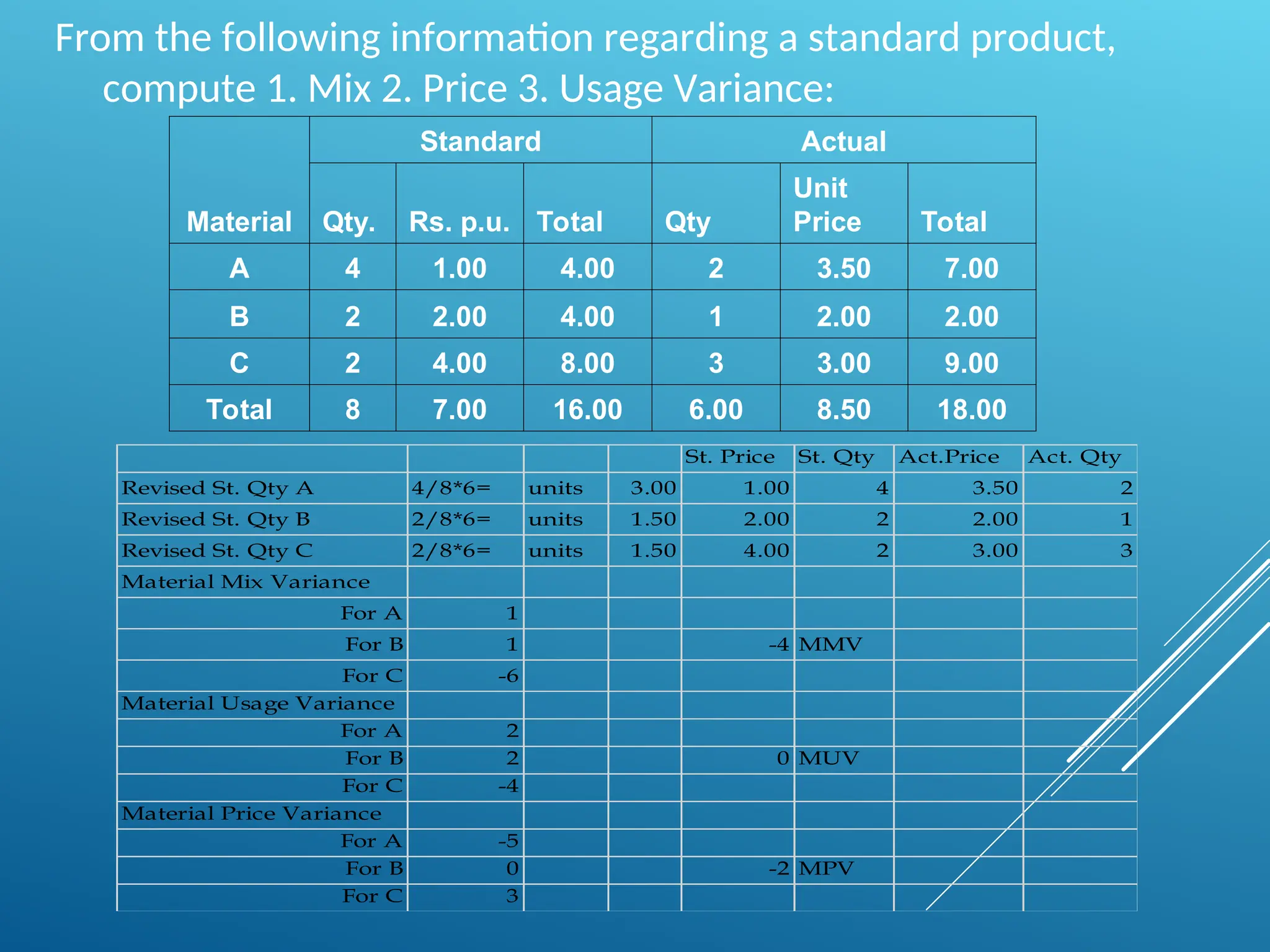
From the followinginformation regarding a standard product,
compute 1. Mix 2. Price 3. Usage Variance:
Material
Standard Actual
Qty. Rs. p.u. Total Qty
Unit
Price Total
A 4 1.00 4.00 2 3.50 7.00
B 2 2.00 4.00 1 2.00 2.00
C 2 4.00 8.00 3 3.00 9.00
Total 8 7.00 16.00 6.00 8.50 18.00
St. Price St. Qty Act.Price Act. Qty
Revised St. Qty A 4/8*6= units 3.00 1.00 4 3.50 2
Revised St. Qty B 2/8*6= units 1.50 2.00 2 2.00 1
Revised St. Qty C 2/8*6= units 1.50 4.00 2 3.00 3
Material Mix Variance
For A 1
For B 1 -4 MMV
For C -6
Material Usage Variance
For A 2
For B 2 0 MUV
For C -4
Material Price Variance
For A -5
For B 0 -2 MPV
For C 3
44.
Material variances
• LabourCost Variance SH*SR – AH*AR
• Labour Usage/Efficie. Var (SH-AHactual)*SR
• Labour Rate Variance (SR-AR)* AH
• Idle time Variance SR*Idle time
LABOUR VARIANCES
45.
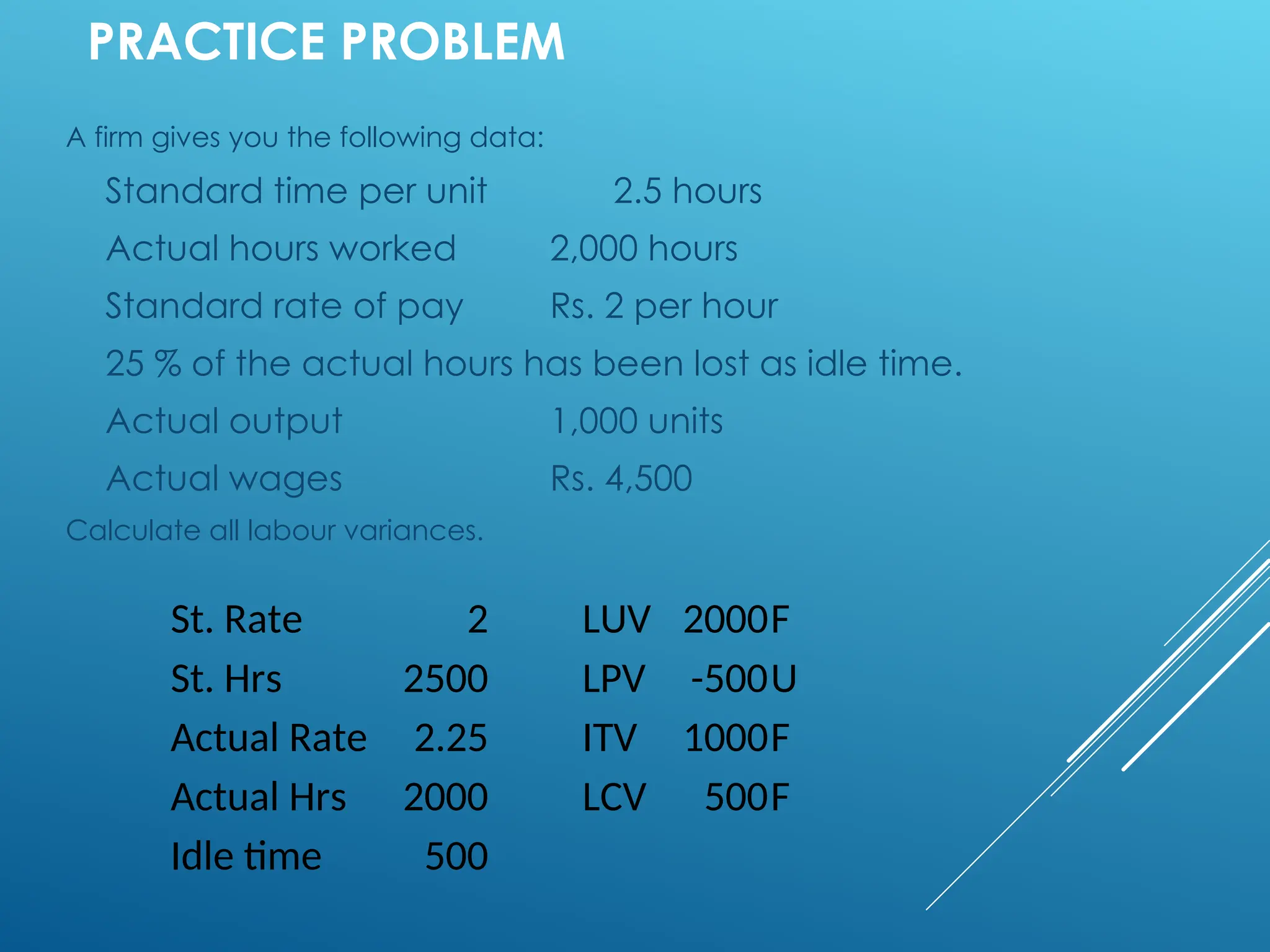
PRACTICE PROBLEM
A firmgives you the following data:
Standard time per unit 2.5 hours
Actual hours worked 2,000 hours
Standard rate of pay Rs. 2 per hour
25 % of the actual hours has been lost as idle time.
Actual output 1,000 units
Actual wages Rs. 4,500
Calculate all labour variances.
St. Rate 2 LUV 2000F
St. Hrs 2500 LPV -500U
Actual Rate 2.25 ITV 1000F
Actual Hrs 2000 LCV 500F
Idle time 500
46.
PRACTICE PROBLEMS
Compute theLabour variances from the
information given below:
Standard time 3 hours per unit
Standard rate of wages Rs. 6 per hour
Actual production 700 units
Actual time taken 2000 hours
Actual Wages Rs. 14000
Idle time 50 hours
St. Rate 6 LUV 900F
St. Hrs 2100 LPV -2000U
Actual Rate 7 LCV -1400U
Actual Hrs 2000 IDV 300
Idle time 50

![LABOUR VARINACE
When output is not given:
1.Labour Cost Variance: Total Standard
Labour Cost-Total Actual Labour Cost
2.Labour Rate Variance: AH[SR-AR]
3.Labour Efficiency Variance: SR[SH-
AH]
where
AH---Actual Hours SR---Standard Rate
AR---Actual Rate
SH---Standard Hours](https://image.slidesharecdn.com/unit2standardcosting-250311045920-51569f22/75/Unit-2-Standard-costing-ppt-finance-and-costing-30-2048.jpg)
![LABOUR VARINACE
When output is given
1. Labor cost
variance:
Standard cost
Standard output
X Actual Output –Total actual
labour cost
2.Labour Rate Variance: AH[SR-AR]
3.Labour Efficiency Variance:
SR[Standard Hrs. of A X Actual Output –Actual
Hrs.A] Standard Output](https://image.slidesharecdn.com/unit2standardcosting-250311045920-51569f22/75/Unit-2-Standard-costing-ppt-finance-and-costing-31-2048.jpg)
![LABOUR VARINACE
4. Labour Mix Variance:
SR[Standard Hrs. of A X Total Actual Hrs -Actual Hrs. of A]
Total Standard Hrs
5. Labour Yield Variance:
SR[Actual Yield-Standard output X Total Actual Hrs.
Total Standard Hrs.
Where SR=Standard Cost
Standard Output
6. Idle Time Variance:
Idle Time X Standard Rate
When Idle time=0,then LTEV=LEV](https://image.slidesharecdn.com/unit2standardcosting-250311045920-51569f22/75/Unit-2-Standard-costing-ppt-finance-and-costing-32-2048.jpg)
![MATERIAL MIX VARIANCE
Material Mix Variance
= [Revised St. Qty – Actual Qty] x St. Price
Rev. St. Qty = St. Qty of 1 Mat. x Actual Total
Standard Total](https://image.slidesharecdn.com/unit2standardcosting-250311045920-51569f22/75/Unit-2-Standard-costing-ppt-finance-and-costing-41-2048.jpg)