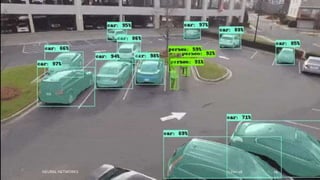
Neural Networks
Team Members
▪ SRINIVASH.R
▪ SRIRAM.S
▪ SANJAY.P
▪ SURAESH KRISHNAA.K.S
Guided By,
Ms. SRIMATHI.
7-Dec-18NEURAL NETWORKS 2
Contents:
▪ What is a Neural Network?
▪ Why use Neural Networks?
▪ History and evolutions
▪ An engineering approach
▪ Architecture of Neural Networks
▪ Image recognition by CNN
▪ Neural networks in medicine
▪ Applications of neural networks
▪ Conclusion
7-Dec-18NEURAL NETWORKS 3
What is Neural Network?
▪ An Artificial Neural Network (ANN) is an information processing
paradigm that is inspired by the way biological nervous systems, such
as the brain, process information.
▪ It consists of large number of highly interconnected neurons in it to
carry information.
▪ ANNs learn by example which we given as the data's.
▪ Ex:Pattern recognition or data classification, through a learning
process.
7-Dec-18NEURAL NETWORKS 4
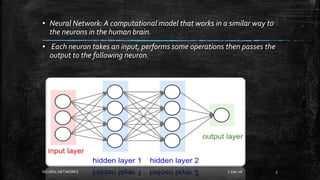
▪ Neural Network: A computational model that works in a similar way to
the neurons in the human brain.
▪ Each neuron takes an input, performs some operations then passes the
output to the following neuron.
7-Dec-18NEURAL NETWORKS 5
Why use Neural Network?
▪ Neural networks, with their remarkable ability to derive and detect
trends that are too complex to be noticed by either humans or other
computer techniques.
▪ A trained neural network can be thought of as an "expert" in the
category of information it has been given to analyse.
▪ Other advantages include:
7-Dec-18NEURAL NETWORKS 6
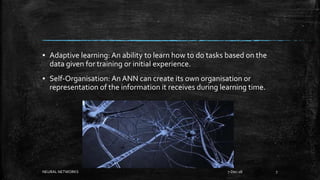
▪ Adaptive learning: An ability to learn how to do tasks based on the
data given for training or initial experience.
▪ Self-Organisation: An ANN can create its own organisation or
representation of the information it receives during learning time.
7-Dec-18NEURAL NETWORKS 7
History and evolutions
▪ Neural network simulations appear to be a recent development.
However, this field was established before the advent of computers,
and has survived at least one major setback and several eras.
▪ In 1943, neurophysiologistWarren McCulloch and mathematician
Walter Pitts wrote a paper on how neurons might work.
7-Dec-18NEURAL NETWORKS 8
▪ As computers became more advanced in the 1950's, it was finally
possible to simulate a hypothetical neural network.The first step
towards this was made by Nathanial Rochester from the IBM
research laboratories. Unfortunately for him, the first attempt to do
so failed.
▪ In 1959, BernardWidrow and Marcian Hoff of Stanford developed
models called "ADALINE" and "MADALINE." MADALINE was the first
neural network applied to a real world problem, using an adaptive
filter that eliminates echoes on phone lines.
▪ The first multi-layered network was developed in 1975, an
unsupervised network.
7-Dec-18NEURAL NETWORKS 9
An engineering approach:
SIMPLE NEURON:
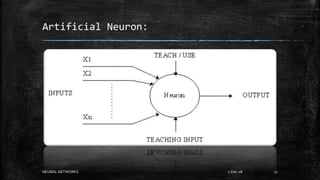
▪ An artificial neuron is a device with many inputs and one output.
▪ The neuron has two modes of operation; the training mode and the
using mode. In the training mode, the neuron can be trained to fire
(or not), for particular input patterns.
▪ In the using mode, when a taught input pattern is detected at the
input, its associated output becomes the current output.
▪ If the input pattern does not belong in the taught list of input
patterns, the firing rule is used to determine whether to fire or not.
7-Dec-18NEURAL NETWORKS 10
Artificial Neuron:
7-Dec-18NEURAL NETWORKS 11
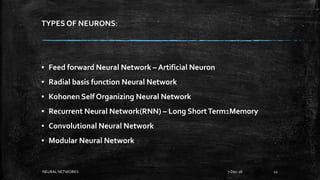
TYPES OF NEURONS:
▪ Feed forward Neural Network – Artificial Neuron
▪ Radial basis function Neural Network
▪ Kohonen Self Organizing Neural Network
▪ Recurrent Neural Network(RNN) – Long ShortTerm1Memory
▪ Convolutional Neural Network
▪ Modular Neural Network
7-Dec-18NEURAL NETWORKS 12
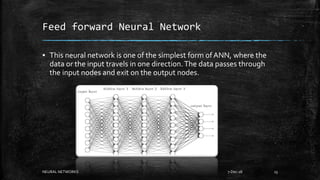
Feed forward Neural Network
▪ This neural network is one of the simplest form ofANN, where the
data or the input travels in one direction.The data passes through
the input nodes and exit on the output nodes.
7-Dec-18NEURAL NETWORKS 13
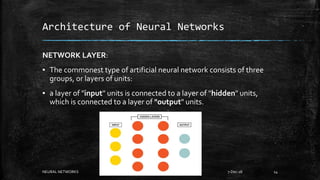
Architecture of Neural Networks
NETWORK LAYER:
▪ The commonest type of artificial neural network consists of three
groups, or layers of units:
▪ a layer of "input" units is connected to a layer of "hidden" units,
which is connected to a layer of "output" units.
7-Dec-18NEURAL NETWORKS 14
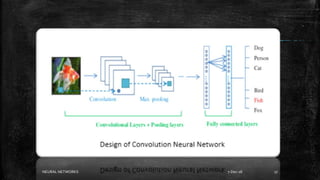
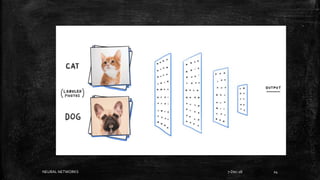
Image recognition by CNN
▪ One of the most popular techniques used in improving the accuracy
of image classification is Convolutional Neural Networks (CNNs for
short).
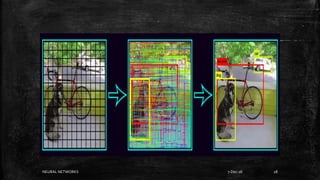
▪ Instead of feeding the entire image as an array of numbers, the
image is broken up into a number of tiles, the machine then tries to
predict what each tile is.
▪ Finally, the computer tries to predict what’s in the picture based on
the prediction of all the tiles.
▪ This allows the computer to parallelize the operations and detect the
object regardless of where it is located in the image.
7-Dec-18NEURAL NETWORKS 15
Convolutional layer
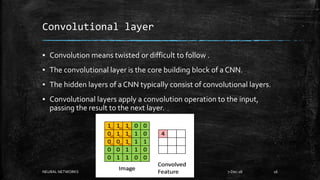
▪ Convolution means twisted or difficult to follow .
▪ The convolutional layer is the core building block of a CNN.
▪ The hidden layers of a CNN typically consist of convolutional layers.
▪ Convolutional layers apply a convolution operation to the input,
passing the result to the next layer.
NEURAL NETWORKS 7-Dec-18 16
7-Dec-18NEURAL NETWORKS 17
7-Dec-18NEURAL NETWORKS 18
INPUT AND OUTPUT SET:
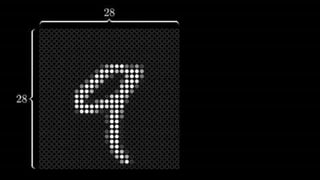
▪ When a computer sees an image (takes an image as input), it will see
an array of pixel values.
▪ Ex:28*28 Pixels.
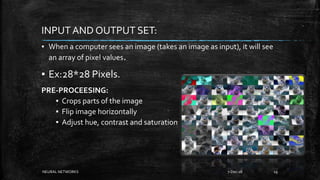
PRE-PROCEESING:
▪ Crops parts of the image
▪ Flip image horizontally
▪ Adjust hue, contrast and saturation
7-Dec-18NEURAL NETWORKS 19
Pre-processing
7-Dec-18NEURAL NETWORKS 20
7-Dec-18NEURAL NETWORKS 21
Splitting our
Dataset
NEURAL NETWORKS 7-Dec-18 22
Results
▪ The given datasets are recognized by the pre-processing and
splitting process;
▪ And the output is shown to us what image is given in the input .
7-Dec-18NEURAL NETWORKS 23
7-Dec-18NEURAL NETWORKS 24
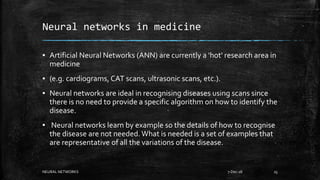
Neural networks in medicine
▪ Artificial Neural Networks (ANN) are currently a 'hot' research area in
medicine
▪ (e.g. cardiograms, CAT scans, ultrasonic scans, etc.).
▪ Neural networks are ideal in recognising diseases using scans since
there is no need to provide a specific algorithm on how to identify the
disease.
▪ Neural networks learn by example so the details of how to recognise
the disease are not needed.What is needed is a set of examples that
are representative of all the variations of the disease.
7-Dec-18NEURAL NETWORKS 25
Applications of neural networks
▪ Neural networks have broad applicability to real world business
problems. In fact, they have already been successfully applied in
many industries.
▪ Sales Forecasting
▪ Industrial Process Control
▪ Customer Research
▪ DataValidation
▪ Risk Management
▪ Target Marketing
7-Dec-18NEURAL NETWORKS 26
▪ ANN are also used in the following specific paradigms:
▪ Recognition of speakers in communications;
▪ Hand-written word recognition and
▪ Facial recognition.
7-Dec-18NEURAL NETWORKS 27
NEURAL NETWORKS 7-Dec-18 28
7-Dec-18NEURAL NETWORKS 29
Conclusion
▪ The computing world has a lot to gain from neural networks.
▪ Their ability to learn by example makes them very flexible and
powerful
▪ They are also very well suited for real time systems
▪ Neural networks also contribute to other areas of research such as
neurology and psychology
▪ Finally, I would like to state that even though neural networks have a
huge potential we will only get the best of them. when they are
integrated with computing,AI, fuzzy logic and related subjects.
7-Dec-18NEURAL NETWORKS 30
7-Dec-18NEURAL NETWORKS 31
7-Dec-18NEURAL NETWORKS 32

Neural networks.ppt

  • 1.
  • 2.
    Team Members ▪ SRINIVASH.R ▪SRIRAM.S ▪ SANJAY.P ▪ SURAESH KRISHNAA.K.S Guided By, Ms. SRIMATHI. 7-Dec-18NEURAL NETWORKS 2
  • 3.
    Contents: ▪ What isa Neural Network? ▪ Why use Neural Networks? ▪ History and evolutions ▪ An engineering approach ▪ Architecture of Neural Networks ▪ Image recognition by CNN ▪ Neural networks in medicine ▪ Applications of neural networks ▪ Conclusion 7-Dec-18NEURAL NETWORKS 3
  • 4.
    What is NeuralNetwork? ▪ An Artificial Neural Network (ANN) is an information processing paradigm that is inspired by the way biological nervous systems, such as the brain, process information. ▪ It consists of large number of highly interconnected neurons in it to carry information. ▪ ANNs learn by example which we given as the data's. ▪ Ex:Pattern recognition or data classification, through a learning process. 7-Dec-18NEURAL NETWORKS 4
  • 5.
    ▪ Neural Network:A computational model that works in a similar way to the neurons in the human brain. ▪ Each neuron takes an input, performs some operations then passes the output to the following neuron. 7-Dec-18NEURAL NETWORKS 5
  • 6.
    Why use NeuralNetwork? ▪ Neural networks, with their remarkable ability to derive and detect trends that are too complex to be noticed by either humans or other computer techniques. ▪ A trained neural network can be thought of as an "expert" in the category of information it has been given to analyse. ▪ Other advantages include: 7-Dec-18NEURAL NETWORKS 6
  • 7.
    ▪ Adaptive learning:An ability to learn how to do tasks based on the data given for training or initial experience. ▪ Self-Organisation: An ANN can create its own organisation or representation of the information it receives during learning time. 7-Dec-18NEURAL NETWORKS 7
  • 8.
    History and evolutions ▪Neural network simulations appear to be a recent development. However, this field was established before the advent of computers, and has survived at least one major setback and several eras. ▪ In 1943, neurophysiologistWarren McCulloch and mathematician Walter Pitts wrote a paper on how neurons might work. 7-Dec-18NEURAL NETWORKS 8
  • 9.
    ▪ As computersbecame more advanced in the 1950's, it was finally possible to simulate a hypothetical neural network.The first step towards this was made by Nathanial Rochester from the IBM research laboratories. Unfortunately for him, the first attempt to do so failed. ▪ In 1959, BernardWidrow and Marcian Hoff of Stanford developed models called "ADALINE" and "MADALINE." MADALINE was the first neural network applied to a real world problem, using an adaptive filter that eliminates echoes on phone lines. ▪ The first multi-layered network was developed in 1975, an unsupervised network. 7-Dec-18NEURAL NETWORKS 9
  • 10.
    An engineering approach: SIMPLENEURON: ▪ An artificial neuron is a device with many inputs and one output. ▪ The neuron has two modes of operation; the training mode and the using mode. In the training mode, the neuron can be trained to fire (or not), for particular input patterns. ▪ In the using mode, when a taught input pattern is detected at the input, its associated output becomes the current output. ▪ If the input pattern does not belong in the taught list of input patterns, the firing rule is used to determine whether to fire or not. 7-Dec-18NEURAL NETWORKS 10
  • 11.
  • 12.
    TYPES OF NEURONS: ▪Feed forward Neural Network – Artificial Neuron ▪ Radial basis function Neural Network ▪ Kohonen Self Organizing Neural Network ▪ Recurrent Neural Network(RNN) – Long ShortTerm1Memory ▪ Convolutional Neural Network ▪ Modular Neural Network 7-Dec-18NEURAL NETWORKS 12
  • 13.
    Feed forward NeuralNetwork ▪ This neural network is one of the simplest form ofANN, where the data or the input travels in one direction.The data passes through the input nodes and exit on the output nodes. 7-Dec-18NEURAL NETWORKS 13
  • 14.
    Architecture of NeuralNetworks NETWORK LAYER: ▪ The commonest type of artificial neural network consists of three groups, or layers of units: ▪ a layer of "input" units is connected to a layer of "hidden" units, which is connected to a layer of "output" units. 7-Dec-18NEURAL NETWORKS 14
  • 15.
    Image recognition byCNN ▪ One of the most popular techniques used in improving the accuracy of image classification is Convolutional Neural Networks (CNNs for short). ▪ Instead of feeding the entire image as an array of numbers, the image is broken up into a number of tiles, the machine then tries to predict what each tile is. ▪ Finally, the computer tries to predict what’s in the picture based on the prediction of all the tiles. ▪ This allows the computer to parallelize the operations and detect the object regardless of where it is located in the image. 7-Dec-18NEURAL NETWORKS 15
  • 16.
    Convolutional layer ▪ Convolutionmeans twisted or difficult to follow . ▪ The convolutional layer is the core building block of a CNN. ▪ The hidden layers of a CNN typically consist of convolutional layers. ▪ Convolutional layers apply a convolution operation to the input, passing the result to the next layer. NEURAL NETWORKS 7-Dec-18 16
  • 17.
  • 18.
  • 19.
    INPUT AND OUTPUTSET: ▪ When a computer sees an image (takes an image as input), it will see an array of pixel values. ▪ Ex:28*28 Pixels. PRE-PROCEESING: ▪ Crops parts of the image ▪ Flip image horizontally ▪ Adjust hue, contrast and saturation 7-Dec-18NEURAL NETWORKS 19
  • 20.
  • 21.
  • 22.
  • 23.
    Results ▪ The givendatasets are recognized by the pre-processing and splitting process; ▪ And the output is shown to us what image is given in the input . 7-Dec-18NEURAL NETWORKS 23
  • 24.
  • 25.
    Neural networks inmedicine ▪ Artificial Neural Networks (ANN) are currently a 'hot' research area in medicine ▪ (e.g. cardiograms, CAT scans, ultrasonic scans, etc.). ▪ Neural networks are ideal in recognising diseases using scans since there is no need to provide a specific algorithm on how to identify the disease. ▪ Neural networks learn by example so the details of how to recognise the disease are not needed.What is needed is a set of examples that are representative of all the variations of the disease. 7-Dec-18NEURAL NETWORKS 25
  • 26.
    Applications of neuralnetworks ▪ Neural networks have broad applicability to real world business problems. In fact, they have already been successfully applied in many industries. ▪ Sales Forecasting ▪ Industrial Process Control ▪ Customer Research ▪ DataValidation ▪ Risk Management ▪ Target Marketing 7-Dec-18NEURAL NETWORKS 26
  • 27.
    ▪ ANN arealso used in the following specific paradigms: ▪ Recognition of speakers in communications; ▪ Hand-written word recognition and ▪ Facial recognition. 7-Dec-18NEURAL NETWORKS 27
  • 28.
  • 29.
  • 30.
    Conclusion ▪ The computingworld has a lot to gain from neural networks. ▪ Their ability to learn by example makes them very flexible and powerful ▪ They are also very well suited for real time systems ▪ Neural networks also contribute to other areas of research such as neurology and psychology ▪ Finally, I would like to state that even though neural networks have a huge potential we will only get the best of them. when they are integrated with computing,AI, fuzzy logic and related subjects. 7-Dec-18NEURAL NETWORKS 30
  • 31.
  • 32.