Basic Entomology
BY KOMAL GUL
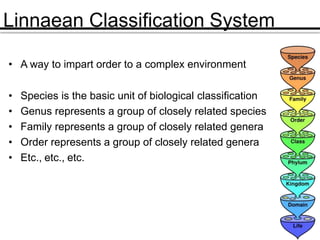
Linnaean Classification System
• A way to impart order to a complex environment
• Species is the basic unit of biological classification
• Genus represents a group of closely related species
• Family represents a group of closely related genera
• Order represents a group of closely related genera
• Etc., etc., etc.
Insect are successful in diversity
 Insects possess an amazing diversity
in size, form, and behavior.
 Protective shell or exoskeleton,
they are small, and they can fly.
 Small size and ability to fly permits
 Escape from enemies dispersal to
new environments.
 The Ant: A Most Successful Insect
 Insects are the dominant life-form on earth.
 Millions may exist in a single acre of land. About one million species
have been described, and there may be as many as ten times that many
yet to be identified.
 Of all creatures on earth, insects are the main consumers of plants.
 Play role in the breakdown of plant and animal material
 Food source for many other animals
 Insect populations also possess considerable genetic diversity
 A great potential for adaptation to different or changing environments
Arthropods, and Related Phyla
• Annelids (Segmented Worms)
– Segmented bodies
– No legs
– Appendages in the head (jaws, feelers, etc.)
• Onychophorans (Velvet Worms)
– Long, soft-bodied, carnivorous worms
– Head with eyes, rasping jaws
– Unjointed ‘lobopodia’
• Arthropods
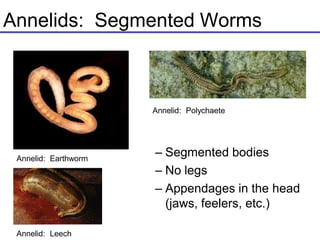
Annelids: Segmented Worms
– Segmented bodies
– No legs
– Appendages in the head
(jaws, feelers, etc.)
Annelid: Earthworm
Annelid: Leech
Annelid: Polychaete
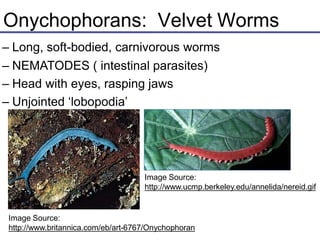
Onychophorans: Velvet Worms
– Long, soft-bodied, carnivorous worms
– NEMATODES ( intestinal parasites)
– Head with eyes, rasping jaws
– Unjointed ‘lobopodia’
Image Source:
http://www.ucmp.berkeley.edu/annelida/nereid.gif
Image Source:
http://www.britannica.com/eb/art-6767/Onychophoran
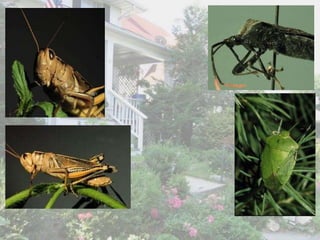
The Arthropod Phylum
• A phylum is a major group of organisms.
• Insects are a Class in the Phylum of
Arthropods.
• Characteristics of Arthropods Include:
– Segmented Bodies
– Jointed Legs
– Exoskeleton
– Open Circulatory System
– No Backbone
– Bi-lateral Symmetry
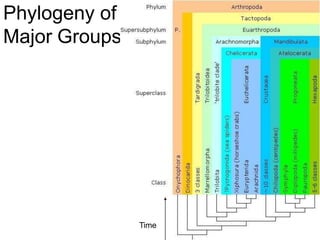
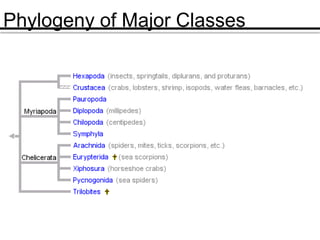
Phylogeny of
Major Groups
Defined by embryology
Blastopore becomes anus
Defined by:
Exoskeleton
Jointed legs
Time
Major Groups of Arthropods
• Class Xiphosura
– Common Name: Horseshoe Crabs
• Class Arachnida
– Includes Scorpions, Spiders and Mites
• Subphylum Mandibulata
– Includes Crustaceans, Millipedes, Centipedes
• Class Insecta
Major Classes of Arthropods
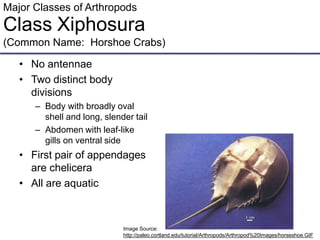
Class Xiphosura
(Common Name: Horshoe Crabs)
• No antennae
• Two distinct body
divisions
– Body with broadly oval
shell and long, slender tail
– Abdomen with leaf-like
gills on ventral side
• First pair of appendages
are chelicera
• All are aquatic
Image Source:
http://paleo.cortland.edu/tutorial/Arthropods/Arthropod%20Images/horseshoe.GIF
Major Classes of Arthropods
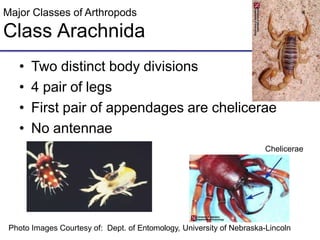
Class Arachnida
• Two distinct body divisions
• 4 pair of legs
• First pair of appendages are chelicerae
• No antennae
Chelicerae
Photo Images Courtesy of: Dept. of Entomology, University of Nebraska-Lincoln
Major Classes of Arthropods
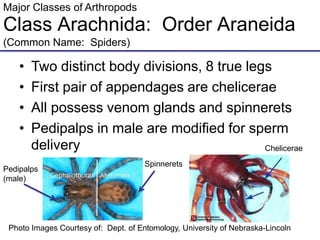
Class Arachnida: Order Araneida
(Common Name: Spiders)
• Two distinct body divisions, 8 true legs
• First pair of appendages are chelicerae
• All possess venom glands and spinnerets
• Pedipalps in male are modified for sperm
Photo Images Courtesy of: Dept. of Entomology, University of Nebraska-Lincoln
Spinnerets
Chelicerae
delivery
Pedipalps
(male)
Major Classes of Arthropods
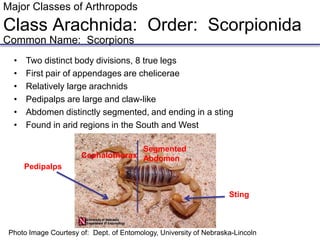
Class Arachnida: Order: Scorpionida
Common Name: Scorpions
• Two distinct body divisions, 8 true legs
• First pair of appendages are chelicerae
• Relatively large arachnids
• Pedipalps are large and claw-like
• Abdomen distinctly segmented, and ending in a sting
• Found in arid regions in the South and West
Segmented
Abdomen
Cephalothorax
Pedipalps
Sting
Photo Image Courtesy of: Dept. of Entomology, University of Nebraska-Lincoln
Major Classes of Arthropods
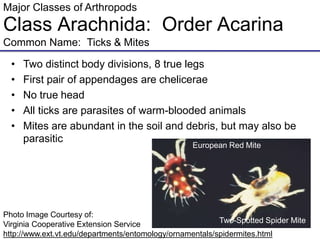
Class Arachnida: Order Acarina
Common Name: Ticks & Mites
• Two distinct body divisions, 8 true legs
• First pair of appendages are chelicerae
• No true head
• All ticks are parasites of warm-blooded animals
• Mites are abundant in the soil and debris, but may also be
parasitic
Photo Image Courtesy of:
Virginia Cooperative Extension Service
http://www.ext.vt.edu/departments/entomology/ornamentals/spidermites.html
European Red Mite
Two-Spotted Spider Mite
Major Classes of Arthropods
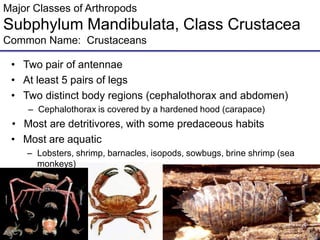
Subphylum Mandibulata, Class Crustacea
Common Name: Crustaceans
• Two pair of antennae
• At least 5 pairs of legs
• Two distinct body regions (cephalothorax and abdomen)
– Cephalothorax is covered by a hardened hood (carapace)
• Most are detritivores, with some predaceous habits
• Most are aquatic
– Lobsters, shrimp, barnacles, isopods, sowbugs, brine shrimp (sea
monkeys)
Major Classes of Arthropods
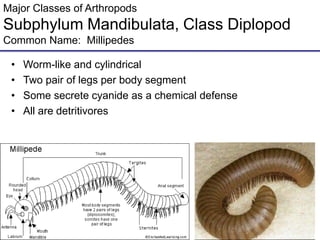
Subphylum Mandibulata, Class Diplopod
Common Name: Millipedes
• Worm-like and cylindrical
• Two pair of legs per body segment
• Some secrete cyanide as a chemical defense
• All are detritivores
Major Classes of Arthropods
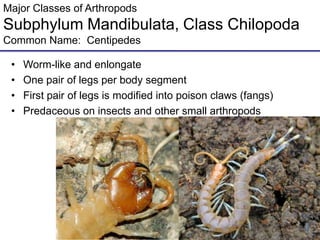
Subphylum Mandibulata, Class Chilopoda
Common Name: Centipedes
• Worm-like and enlongate
• One pair of legs per body segment
• First pair of legs is modified into poison claws (fangs)
• Predaceous on insects and other small arthropods
Major Classes of Arthropods
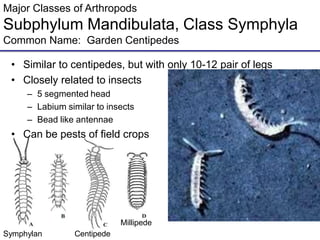
Subphylum Mandibulata, Class Symphyla
Common Name: Garden Centipedes
• Similar to centipedes, but with only 10-12 pair of legs
• Closely related to insects
– 5 segmented head
– Labium similar to insects
– Bead like antennae
• Can be pests of field crops
Symphylan Centipede
Millipede
Major Classes of Arthropods
Class Insecta
Common Name: Insects!!!
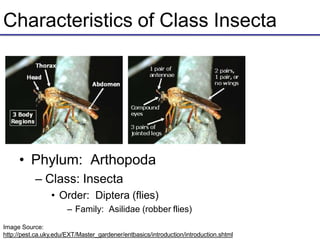
• Most adult insects have the following characters:
– All have body divided into three parts (head,
thorax and abdomen)
– All have three pairs of legs
– Usually one pair of antennae and a pair of
compound eyes (a few exceptions to these
characteristics are found)
– Usually two pairs of wings
• absent in many insects such as lice, fleas, ants; flies
have one pair of wings)
Characteristics of Class Insecta
• Phylum: Arthopoda
– Class: Insecta
• Order: Diptera (flies)
– Family: Asilidae (robber flies)
Image Source:
http://pest.ca.uky.edu/EXT/Master_gardener/entbasics/introduction/introduction.shtml
Phylogeny of Major Classes
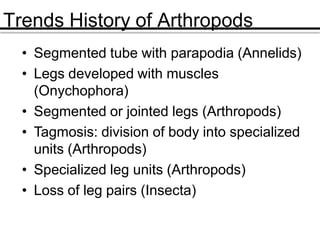
Trends History of Arthropods
• Segmented tube with parapodia (Annelids)
• Legs developed with muscles
(Onychophora)
• Segmented or jointed legs (Arthropods)
• Tagmosis: division of body into specialized
units (Arthropods)
• Specialized leg units (Arthropods)
• Loss of leg pairs (Insecta)
Module Objectives
• Part I
– Explain the hierarchical classification system used in biology.
– Name the principle characteristics used to separate the phyla
and classes of insects and their relatives.
• Part II
– Review the general anatomy of insects
– Review the major types of insect life cycles, and the associated
stages of development.
– Review the common orders of insects.
• Part III
– Discuss insect collection techniques
– Current ecological research on pollinators in gardens
• Part IV
– How to diagnose insect problems
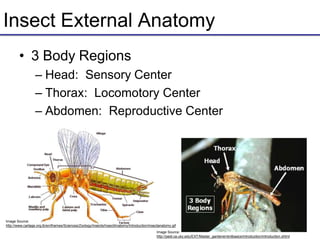
Insect External Anatomy
• 3 Body Regions
– Head: Sensory Center
– Thorax: Locomotory Center
– Abdomen: Reproductive Center
Image Source:
http://www.cartage.org.lb/en/themes/Sciences/Zoology/Insects/InsectAnatomy/Introduction/insectanatomy.gif
Image Source:
http://pest.ca.uky.edu/EXT/Master_gardener/entbasics/introduction/introduction.shtml
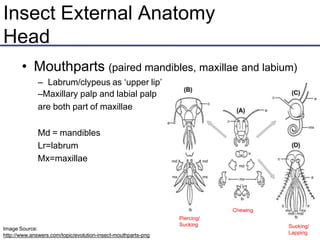
Insect External Anatomy
Head
• Mouthparts (paired mandibles, maxillae and labium)
– Labrum/clypeus as ‘upper lip’
–Maxillary palp and labial palp
are both part of maxillae
Md = mandibles
Lr=labrum
Mx=maxillae
Image Source:
http://www.answers.com/topic/evolution-insect-mouthparts-png
Chewing
Piercing/
Sucking Sucking/
Lapping
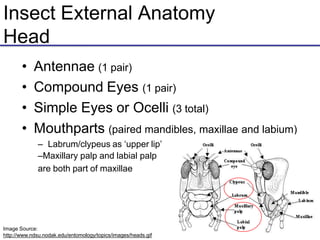
Insect External Anatomy
Head
• Antennae (1 pair)
• Compound Eyes (1 pair)
• Simple Eyes or Ocelli (3 total)
• Mouthparts (paired mandibles, maxillae and labium)
– Labrum/clypeus as ‘upper lip’
–Maxillary palp and labial palp
are both part of maxillae
Image Source:
http://www.ndsu.nodak.edu/entomology/topics/images/heads.gif
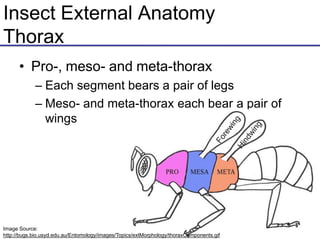
Insect External Anatomy
Thorax
• Pro-, meso- and meta-thorax
– Each segment bears a pair of legs
– Meso- and meta-thorax each bear a pair of
wings
Image Source:
http://bugs.bio.usyd.edu.au/Entomology/images/Topics/extMorphology/thoraxComponents.gif
Insect External Anatomy
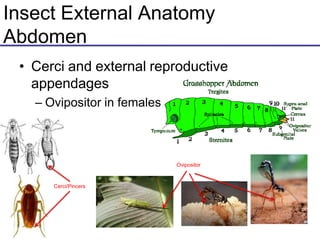
Abdomen
• Cerci and external reproductive
appendages
– Ovipositor in females
Cerci/Pincers
Ovipositor
Objectives
• Part I
– Explain the hierarchical classification system used in biology.
– Name the principle characteristics used to separate the phyla
and classes of insects and their relatives.
• Part II
– Review the general anatomy of insects
– Review the major types of insect life cycles, and the associated
stages of development.
– Review the common orders of insects.
• Part III
– Discuss insect collection techniques
– Current ecological research on pollinators in gardens
• Part IV
– How to diagnose insect problems
Insect Life Cycles
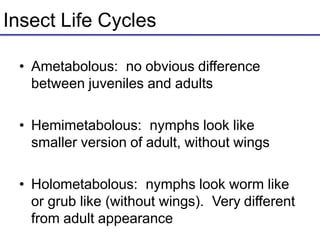
• Ametabolous: no obvious difference
between juveniles and adults
• Hemimetabolous: nymphs look like
smaller version of adult, without wings
• Holometabolous: nymphs look worm like
or grub like (without wings). Very different
from adult appearance
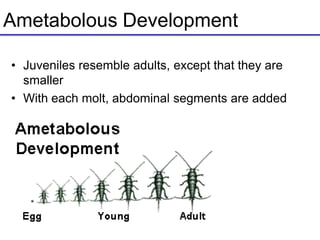
Ametabolous Development
• Juveniles resemble adults, except that they are
smaller
• With each molt, abdominal segments are added
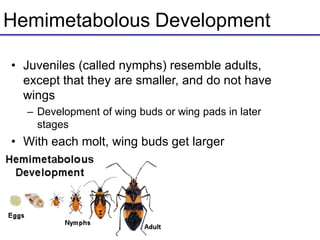
Hemimetabolous Development
• Juveniles (called nymphs) resemble adults,
except that they are smaller, and do not have
wings
– Development of wing buds or wing pads in later
stages
• With each molt, wing buds get larger
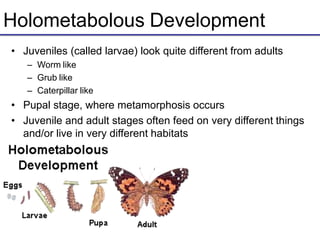
Holometabolous Development
• Juveniles (called larvae) look quite different from adults
– Worm like
– Grub like
– Caterpillar like
• Pupal stage, where metamorphosis occurs
• Juvenile and adult stages often feed on very different things
and/or live in very different habitats
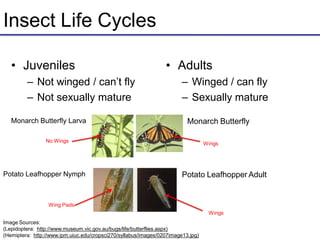
Insect Life Cycles
• Juveniles
– Not winged / can’t fly
– Not sexually mature
• Adults
– Winged / can fly
– Sexually mature
Monarch Butterfly
Potato Leafhopper Adult
Monarch Butterfly Larva
Potato Leafhopper Nymph
No Wings
Wing Pads
Wings
Image Sources:
(Lepidoptera: http://www.museum.vic.gov.au/bugs/life/butterflies.aspx)
(Hemiptera: http://www.ipm.uiuc.edu/cropsci270/syllabus/images/0207image13.jpg)
Wings
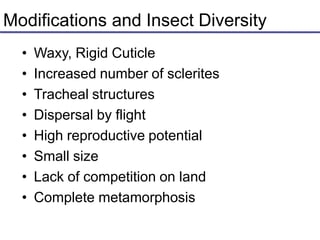
Modifications and Insect Diversity
• Waxy, Rigid Cuticle
• Increased number of sclerites
• Tracheal structures
• Dispersal by flight
• High reproductive potential
• Small size
• Lack of competition on land
• Complete metamorphosis
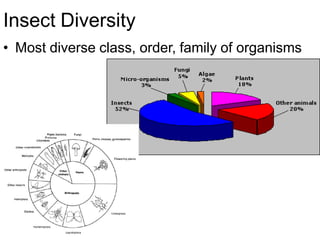
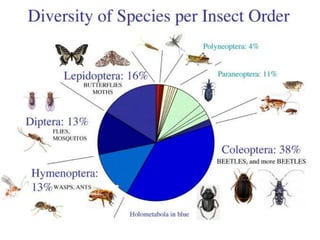
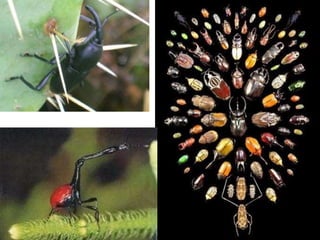
Insect Diversity
• Most diverse class, order, family of organisms
Objectives
• Part I
– Explain the hierarchical classification system used in biology.
– Name the principle characteristics used to separate the phyla
and classes of insects and their relatives.
• Part II
– Review the general anatomy of insects
– Review the major types of insect life cycles, and the associated
stages of development.
– Review the common orders of insects.
• Part III
– Discuss insect collection techniques
– Current ecological research on pollinators in gardens
• Part IV
– How to diagnose insect problems
Common Insect Orders
• 31 Insect Orders
– Most recent discovery in 2002! (Mantophasmatodea)
• Orders of particular interest to gardeners
include:
– Coleoptera, Dermaptera, Diptera, Hemiptera,
Hymenoptera, Lepidoptera, Neuroptera, Orthoptera,
Thysanoptera
• ‘-ptera’ means ‘wing’ (think Pteradactyl)
– To ID almost all insects to order, you should look at
the wings of the adults
– Juvenile IDs are much more difficult
Classification of Insect Orders
• Gullan and Cranston. 1994. The Insects: An
Outline of Entomology. Chapman and Hall,
London.
• Borror, Triplehorn and Johnson. 1989. An
Introduction to the Study of Insects. 6th Edition.
Harcourt Brace Jovanovich, Orlando.
• Borror and White. 2004. Introduction to the
Study of Insects. 7th Edition. Brooks Cole.
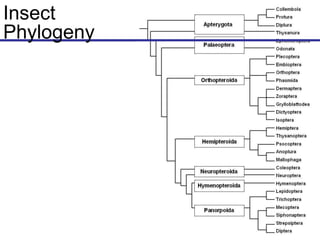
Insect
Phylogeny
Primitive Insects
• Ametabolous Development
• No wings (Apterygotes)
• Development of eyes occurs in this group
• Development of spiracles
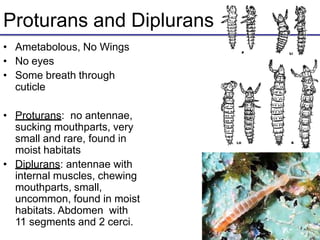
Proturans and Diplurans
• Ametabolous, No Wings
• No eyes
• Some breath through
cuticle
• Proturans: no antennae,
sucking mouthparts, very
small and rare, found in
moist habitats
• Diplurans: antennae with
internal muscles, chewing
mouthparts, small,
uncommon, found in moist
habitats. Abdomen with
11 segments and 2 cerci.
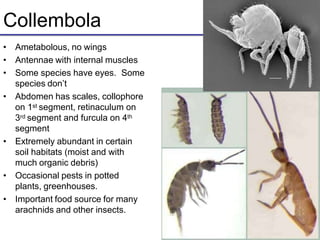
Collembola
• Ametabolous, no wings
• Antennae with internal muscles
• Some species have eyes. Some
species don’t
• Abdomen has scales, collophore
on 1st segment, retinaculum on
3rd segment and furcula on 4th
segment
• Extremely abundant in certain
soil habitats (moist and with
much organic debris)
• Occasional pests in potted
plants, greenhouses.
• Important food source for many
arachnids and other insects.
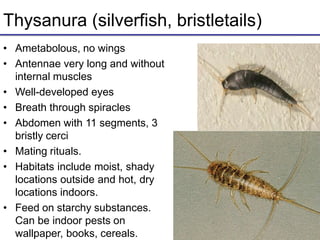
Thysanura (silverfish, bristletails)
• Ametabolous, no wings
• Antennae very long and without
internal muscles
• Well-developed eyes
• Breath through spiracles
• Abdomen with 11 segments, 3
bristly cerci
• Mating rituals.
• Habitats include moist, shady
locations outside and hot, dry
locations indoors.
• Feed on starchy substances.
Can be indoor pests on
wallpaper, books, cereals.
Paurometabolous Insects
• Hemimetabolous Development with a
subimago or subadult stage
• All are winged as adults.
• Naiads are aquatic. Adults are found flying
near water.
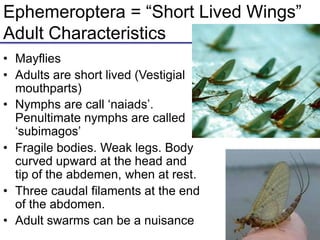
Ephemeroptera = “Short Lived Wings”
Adult Characteristics
• Mayflies
• Adults are short lived (Vestigial
mouthparts)
• Nymphs are call ‘naiads’.
Penultimate nymphs are called
‘subimagos’
• Fragile bodies. Weak legs. Body
curved upward at the head and
tip of the abdemen, when at rest.
• Three caudal filaments at the end
of the abdomen.
• Adult swarms can be a nuisance
Ephemeroptera = “Short Lived Wings”
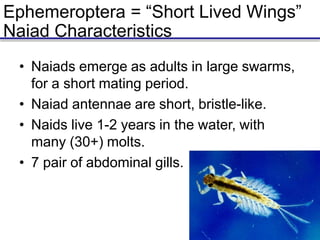
Naiad Characteristics
• Naiads emerge as adults in large swarms,
for a short mating period.
• Naiad antennae are short, bristle-like.
• Naids live 1-2 years in the water, with
many (30+) molts.
• 7 pair of abdominal gills.
Odonata = ‘tooth wing’
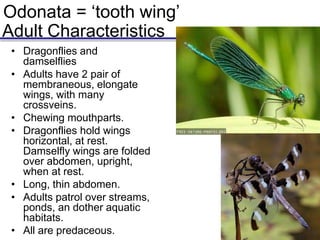
Adult Characteristics
• Dragonflies and
damselflies
• Adults have 2 pair of
membraneous, elongate
wings, with many
crossveins.
• Chewing mouthparts.
• Dragonflies hold wings
horizontal, at rest.
Damselfly wings are folded
over abdomen, upright,
when at rest.
• Long, thin abdomen.
• Adults patrol over streams,
ponds, an dother aquatic
habitats.
• All are predaceous.
Odonata = ‘tooth wing’
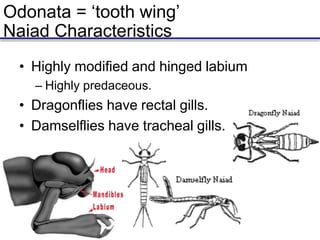
Naiad Characteristics
• Highly modified and hinged labium
– Highly predaceous.
• Dragonflies have rectal gills.
• Damselflies have tracheal gills.
Hemimetabolous Insects
• Hemimetabolous Development
• Most are winged
– Those without wings represent a secondary
loss of wings (e.g. aphids, scales
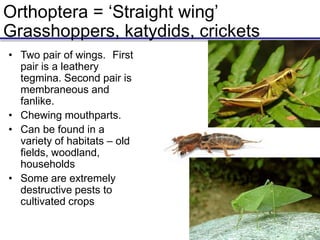
Orthoptera = ‘Straight wing’
Grasshoppers, katydids, crickets
• Two pair of wings. First
pair is a leathery
tegmina. Second pair is
membraneous and
fanlike.
• Chewing mouthparts.
• Can be found in a
variety of habitats – old
fields, woodland,
households
• Some are extremely
destructive pests to
cultivated crops
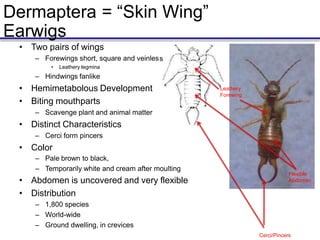
Dermaptera = “Skin Wing”
s
Earwigs
• Two pairs of wings
– Forewings short, square and veinles
• Leathery tegmina
– Hindwings fanlike
• Hemimetabolous Development
• Biting mouthparts
– Scavenge plant and animal matter
• Distinct Characteristics
– Cerci form pincers
• Color
– Pale brown to black,
– Temporarily white and cream after moulting
• Abdomen is uncovered and very flexible
• Distribution
– 1,800 species
– World-wide
– Ground dwelling, in crevices
Cerci/Pincers
Flexible
Abdomen
Leathery
Forewing
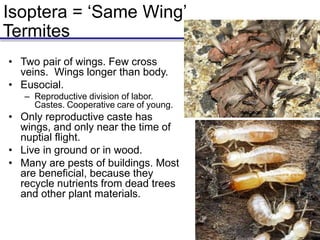
Isoptera = ‘Same Wing’
Termites
• Two pair of wings. Few cross
veins. Wings longer than body.
• Eusocial.
– Reproductive division of labor.
Castes. Cooperative care of young.
• Only reproductive caste has
wings, and only near the time of
nuptial flight.
• Live in ground or in wood.
• Many are pests of buildings. Most
are beneficial, because they
recycle nutrients from dead trees
and other plant materials.
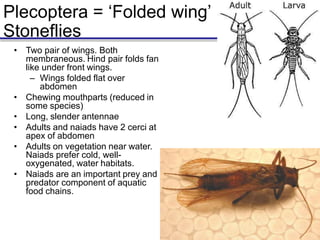
Plecoptera = ‘Folded wing’
Stoneflies
• Two pair of wings. Both
membraneous. Hind pair folds fan
like under front wings.
– Wings folded flat over
abdomen
• Chewing mouthparts (reduced in
some species)
• Long, slender antennae
• Adults and naiads have 2 cerci at
apex of abdomen
• Adults on vegetation near water.
Naiads prefer cold, well-
oxygenated, water habitats.
• Naiads are an important prey and
predator component of aquatic
food chains.
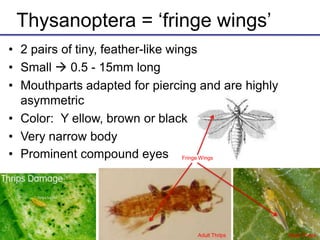
Thysanoptera = ‘fringe wings’
• 2 pairs of tiny, feather-like wings
• Small  0.5 - 15mm long
• Mouthparts adapted for piercing and are highly
asymmetric
• Color: Y ellow, brown or black
• Very narrow body
• Prominent compound eyes
Adult Thrips Adult Thrips
Fringe Wings
Hemiptera = ‘Half Wing’
• 2 pairs of wings (some species wingless)
– Forewings generally hardened to some extent
• 1mm - 100mm long
• Mouthparts suctorial and developed for piercing
– Cibarial pump
– Most vegetarian or omnivorous.
– Some strictly carnivorous species
• Most are terrestrial, plant feeders (or
omnivores). A few families are aquatic. A few
families are predaceous.
Hemiptera = ‘Half Wing’
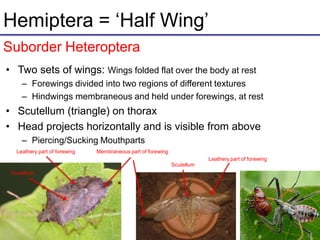
Suborder Heteroptera
• Two sets of wings: Wings folded flat over the body at rest
– Forewings divided into two regions of different textures
– Hindwings membraneous and held under forewings, at rest
• Scutellum (triangle) on thorax
• Head projects horizontally and is visible from above
– Piercing/Sucking Mouthparts
Leathery part of forewing Membraneous part of forewing
Scutellum
Leathery part of forewing
Scutellum
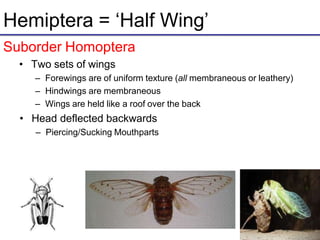
Hemiptera = ‘Half Wing’
• Two sets of wings
– Forewings are of uniform texture (all membraneous or leathery)
– Hindwings are membraneous
– Wings are held like a roof over the back
• Head deflected backwards
– Piercing/Sucking Mouthparts
Suborder Homoptera
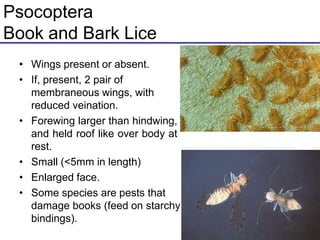
Psocoptera
Book and Bark Lice
• Wings present or absent.
• If, present, 2 pair of
membraneous wings, with
reduced veination.
• Forewing larger than hindwing,
and held roof like over body at
rest.
• Small (<5mm in length)
• Enlarged face.
• Some species are pests that
damage books (feed on starchy
bindings).
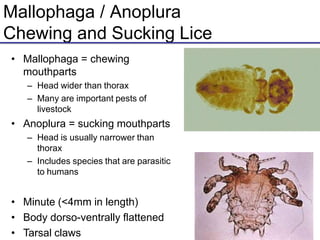
Mallophaga / Anoplura
Chewing and Sucking Lice
• Mallophaga = chewing
mouthparts
– Head wider than thorax
– Many are important pests of
livestock
• Anoplura = sucking mouthparts
– Head is usually narrower than
thorax
– Includes species that are parasitic
to humans
• Minute (<4mm in length)
• Body dorso-ventrally flattened
• Tarsal claws
Holometabolous Insects
• Holometabolous Development
• Most are winged
– Those without wings represent a secondary
loss of wings (e.g. velvet ants, ants)
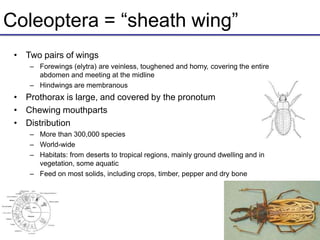
Coleoptera = “sheath wing”
• Two pairs of wings
– Forewings (elytra) are veinless, toughened and horny, covering the entire
abdomen and meeting at the midline
– Hindwings are membranous
• Prothorax is large, and covered by the pronotum
• Chewing mouthparts
• Distribution
– More than 300,000 species
– World-wide
– Habitats: from deserts to tropical regions, mainly ground dwelling and in
vegetation, some aquatic
– Feed on most solids, including crops, timber, pepper and dry bone
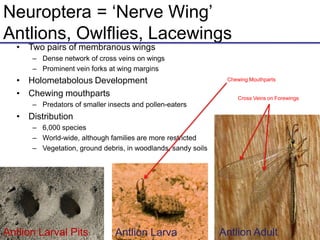
Neuroptera = ‘Nerve Wing’
Antlions, Owlflies, Lacewings
• Two pairs of membranous wings
– Dense network of cross veins on wings
– Prominent vein forks at wing margins
• Holometabolous Development
• Chewing mouthparts
– Predators of smaller insects and pollen-eaters
• Distribution
– 6,000 species
– World-wide, although families are more restricted
– Vegetation, ground debris, in woodlands, sandy soils
Antlion Larva
Antlion Larval Pits Antlion Adult
Cross Veins on Forewings
Chewing Mouthparts
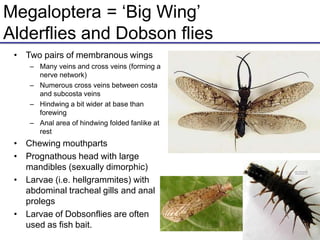
Megaloptera = ‘Big Wing’
Alderflies and Dobson flies
• Two pairs of membranous wings
– Many veins and cross veins (forming a
nerve network)
– Numerous cross veins between costa
and subcosta veins
– Hindwing a bit wider at base than
forewing
– Anal area of hindwing folded fanlike at
rest
• Chewing mouthparts
• Prognathous head with large
mandibles (sexually dimorphic)
• Larvae (i.e. hellgrammites) with
abdominal tracheal gills and anal
prolegs
• Larvae of Dobsonflies are often
used as fish bait.
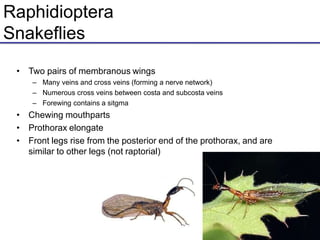
Raphidioptera
Snakeflies
• Two pairs of membranous wings
– Many veins and cross veins (forming a nerve network)
– Numerous cross veins between costa and subcosta veins
– Forewing contains a sitgma
• Chewing mouthparts
• Prothorax elongate
• Front legs rise from the posterior end of the prothorax, and are
similar to other legs (not raptorial)
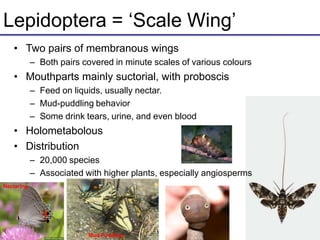
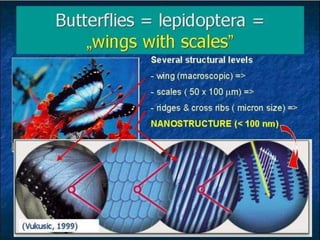
Lepidoptera = ‘Scale Wing’
• Two pairs of membranous wings
– Both pairs covered in minute scales of various colours
• Mouthparts mainly suctorial, with proboscis
– Feed on liquids, usually nectar.
– Mud-puddling behavior
– Some drink tears, urine, and even blood
• Holometabolous
• Distribution
– 20,000 species
– Associated with higher plants, especially angiosperms
Mud Puddling
Nectaring
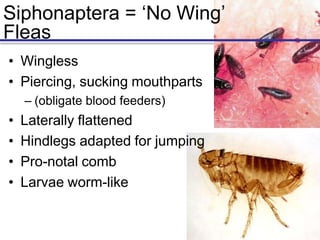
Siphonaptera = ‘No Wing’
Fleas
• Wingless
• Piercing, sucking mouthparts
– (obligate blood feeders)
• Laterally flattened
• Hindlegs adapted for jumping
• Pro-notal comb
• Larvae worm-like
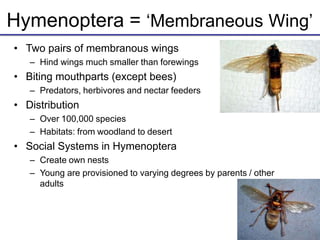
Hymenoptera = ‘Membraneous Wing’
• Two pairs of membranous wings
– Hind wings much smaller than forewings
• Biting mouthparts (except bees)
– Predators, herbivores and nectar feeders
• Distribution
– Over 100,000 species
– Habitats: from woodland to desert
• Social Systems in Hymenoptera
– Create own nests
– Young are provisioned to varying degrees by parents / other
adults
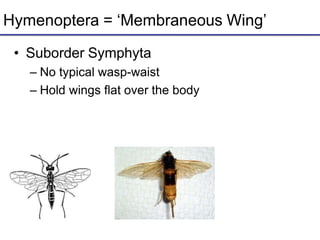
Hymenoptera = ‘Membraneous Wing’
• Suborder Symphyta
– No typical wasp-waist
– Hold wings flat over the body
Hymenoptera = ‘Membraneous Wing’
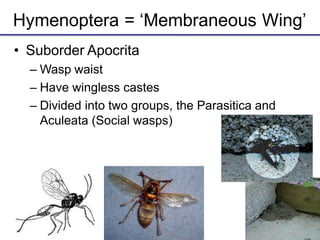
• Suborder Apocrita
– Wasp waist
– Have wingless castes
– Divided into two groups, the Parasitica and
Aculeata (Social wasps)
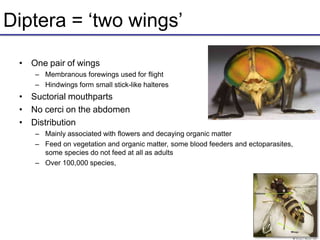
Diptera = ‘two wings’
• One pair of wings
– Membranous forewings used for flight
– Hindwings form small stick-like halteres
• Suctorial mouthparts
• No cerci on the abdomen
• Distribution
– Mainly associated with flowers and decaying organic matter
– Feed on vegetation and organic matter, some blood feeders and ectoparasites,
some species do not feed at all as adults
– Over 100,000 species,
Diptera = ‘two wings’
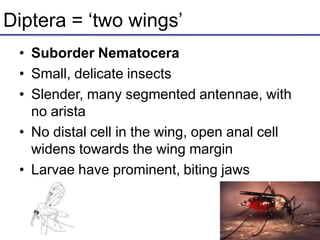
• Suborder Nematocera
• Small, delicate insects
• Slender, many segmented antennae, with
no arista
• No distal cell in the wing, open anal cell
widens towards the wing margin
• Larvae have prominent, biting jaws
Diptera = ‘two wings’
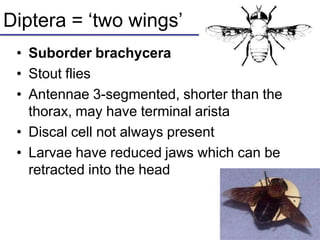
• Suborder brachycera
• Stout flies
• Antennae 3-segmented, shorter than the
thorax, may have terminal arista
• Discal cell not always present
• Larvae have reduced jaws which can be
retracted into the head
Diptera = ‘two wings’
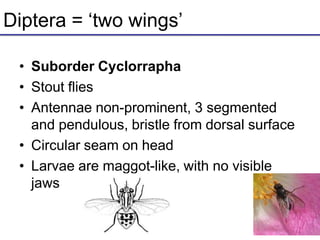
• Suborder Cyclorrapha
• Stout flies
• Antennae non-prominent, 3 segmented
and pendulous, bristle from dorsal surface
• Circular seam on head
• Larvae are maggot-like, with no visible
jaws
Module Objectives
• Part I
– Explain the hierarchical classification system used in biology.
– Name the principle characteristics used to separate the phyla
and classes of insects and their relatives.
• Part II
– Review the general anatomy of insects
– Review the common orders of insects.
– Review the major types of insect life cycles, and the associated
stages of development.
• Part III
– Discuss insect collection techniques
– Current ecological research on pollinators in gardens
• Part IV
– How to diagnose insect problems
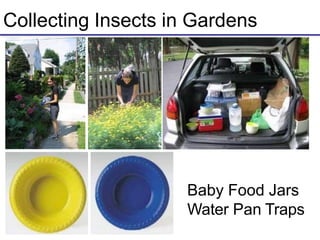
Collecting Insects in Gardens
Baby Food Jars
Water Pan Traps
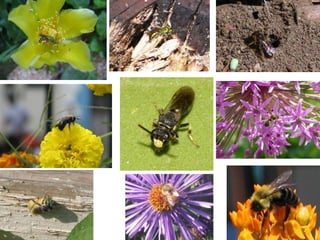
Impact of Polylectic Pollinators on
Ornamental Invasives
• Exotic plants are often less subject to
damage from insect herbivores
• Exotic plants are not discriminated
against by insect pollinators
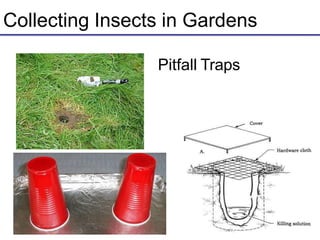
Collecting Insects in Gardens
Pitfall Traps
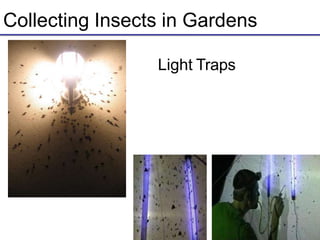
Collecting Insects in Gardens
Light Traps
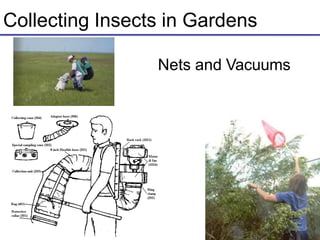
Collecting Insects in Gardens
Nets and Vacuums
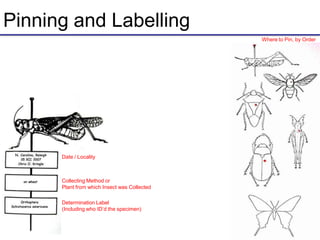
Date / Locality
Collecting Method or
Plant from which Insect was Collected
Determination Label
(Including who ID’d the specimen)
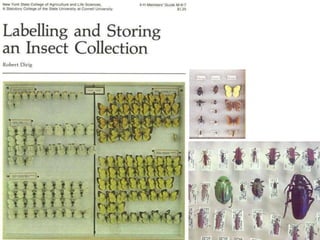
Pinning and Labelling
Where to Pin, by Order
Module Objectives
• Part I
– Explain the hierarchical classification system used in biology.
– Name the principle characteristics used to separate the phyla
and classes of insects and their relatives.
• Part II
– Review the general anatomy of insects
– Review the common orders of insects.
– Review the major types of insect life cycles, and the associated
stages of development.
• Part III
– Discuss insect collection techniques
– Current ecological research on pollinators in gardens
• Part IV
– How to diagnose insect problems
Diagnosing Insect Problems
• Do not, if at all possible, diagnose a pest problem from a
photo
• Get a sample of the ‘insect’
• Get a sample of the damage
• Make sure that the organism is indeed an insect
• Is it an adult or a juvenile?
• Identify the insect to order (easier to do for adults than
for juveniles)
• What do the wings look like? Are they membraneous? Are there
2 pair? What about cross veins? Are the wings held flat over the
body, or tent like over the body?
• Do the mouthparts of the insect match up with the type of
damage being reported?
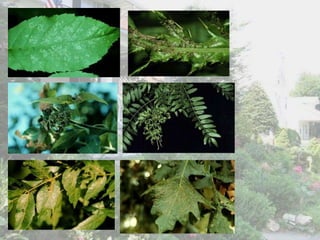
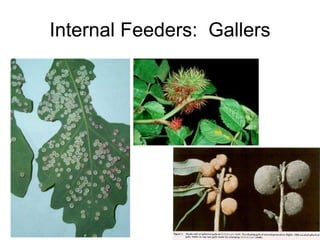
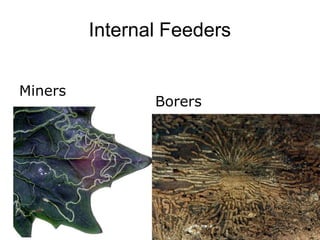
Internal Feeders: Gallers
Internal Feeders
Miners
Borers
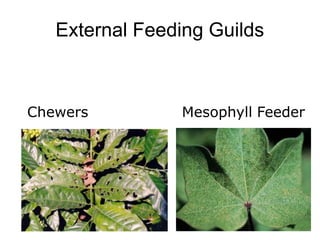
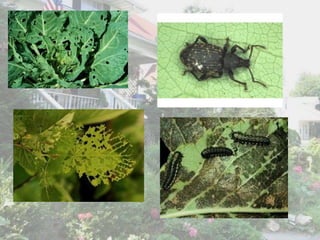
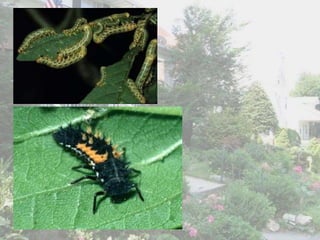
External Feeding Guilds
Chewers Mesophyll Feeder
Closing Remarks
• Insects are cool! Most are innocuous to
humans. Many are beneficial. Relatively
few are pests (but these pests make their
presence known!).
• Work your way through a standard set of
questions, when ID’ing insects to order.

Entomology LECTURE2 (1).pptx

  • 1.
  • 2.
    Linnaean Classification System •A way to impart order to a complex environment • Species is the basic unit of biological classification • Genus represents a group of closely related species • Family represents a group of closely related genera • Order represents a group of closely related genera • Etc., etc., etc.
  • 3.
    Insect are successfulin diversity  Insects possess an amazing diversity in size, form, and behavior.  Protective shell or exoskeleton, they are small, and they can fly.  Small size and ability to fly permits  Escape from enemies dispersal to new environments.  The Ant: A Most Successful Insect
  • 4.
     Insects arethe dominant life-form on earth.  Millions may exist in a single acre of land. About one million species have been described, and there may be as many as ten times that many yet to be identified.  Of all creatures on earth, insects are the main consumers of plants.  Play role in the breakdown of plant and animal material  Food source for many other animals  Insect populations also possess considerable genetic diversity  A great potential for adaptation to different or changing environments
  • 5.
    Arthropods, and RelatedPhyla • Annelids (Segmented Worms) – Segmented bodies – No legs – Appendages in the head (jaws, feelers, etc.) • Onychophorans (Velvet Worms) – Long, soft-bodied, carnivorous worms – Head with eyes, rasping jaws – Unjointed ‘lobopodia’ • Arthropods
  • 6.
    Annelids: Segmented Worms –Segmented bodies – No legs – Appendages in the head (jaws, feelers, etc.) Annelid: Earthworm Annelid: Leech Annelid: Polychaete
  • 7.
    Onychophorans: Velvet Worms –Long, soft-bodied, carnivorous worms – NEMATODES ( intestinal parasites) – Head with eyes, rasping jaws – Unjointed ‘lobopodia’ Image Source: http://www.ucmp.berkeley.edu/annelida/nereid.gif Image Source: http://www.britannica.com/eb/art-6767/Onychophoran
  • 8.
    The Arthropod Phylum •A phylum is a major group of organisms. • Insects are a Class in the Phylum of Arthropods. • Characteristics of Arthropods Include: – Segmented Bodies – Jointed Legs – Exoskeleton – Open Circulatory System – No Backbone – Bi-lateral Symmetry
  • 9.
    Phylogeny of Major Groups Definedby embryology Blastopore becomes anus Defined by: Exoskeleton Jointed legs Time
  • 10.
    Major Groups ofArthropods • Class Xiphosura – Common Name: Horseshoe Crabs • Class Arachnida – Includes Scorpions, Spiders and Mites • Subphylum Mandibulata – Includes Crustaceans, Millipedes, Centipedes • Class Insecta
  • 11.
    Major Classes ofArthropods Class Xiphosura (Common Name: Horshoe Crabs) • No antennae • Two distinct body divisions – Body with broadly oval shell and long, slender tail – Abdomen with leaf-like gills on ventral side • First pair of appendages are chelicera • All are aquatic Image Source: http://paleo.cortland.edu/tutorial/Arthropods/Arthropod%20Images/horseshoe.GIF
  • 12.
    Major Classes ofArthropods Class Arachnida • Two distinct body divisions • 4 pair of legs • First pair of appendages are chelicerae • No antennae Chelicerae Photo Images Courtesy of: Dept. of Entomology, University of Nebraska-Lincoln
  • 13.
    Major Classes ofArthropods Class Arachnida: Order Araneida (Common Name: Spiders) • Two distinct body divisions, 8 true legs • First pair of appendages are chelicerae • All possess venom glands and spinnerets • Pedipalps in male are modified for sperm Photo Images Courtesy of: Dept. of Entomology, University of Nebraska-Lincoln Spinnerets Chelicerae delivery Pedipalps (male)
  • 14.
    Major Classes ofArthropods Class Arachnida: Order: Scorpionida Common Name: Scorpions • Two distinct body divisions, 8 true legs • First pair of appendages are chelicerae • Relatively large arachnids • Pedipalps are large and claw-like • Abdomen distinctly segmented, and ending in a sting • Found in arid regions in the South and West Segmented Abdomen Cephalothorax Pedipalps Sting Photo Image Courtesy of: Dept. of Entomology, University of Nebraska-Lincoln
  • 15.
    Major Classes ofArthropods Class Arachnida: Order Acarina Common Name: Ticks & Mites • Two distinct body divisions, 8 true legs • First pair of appendages are chelicerae • No true head • All ticks are parasites of warm-blooded animals • Mites are abundant in the soil and debris, but may also be parasitic Photo Image Courtesy of: Virginia Cooperative Extension Service http://www.ext.vt.edu/departments/entomology/ornamentals/spidermites.html European Red Mite Two-Spotted Spider Mite
  • 16.
    Major Classes ofArthropods Subphylum Mandibulata, Class Crustacea Common Name: Crustaceans • Two pair of antennae • At least 5 pairs of legs • Two distinct body regions (cephalothorax and abdomen) – Cephalothorax is covered by a hardened hood (carapace) • Most are detritivores, with some predaceous habits • Most are aquatic – Lobsters, shrimp, barnacles, isopods, sowbugs, brine shrimp (sea monkeys)
  • 17.
    Major Classes ofArthropods Subphylum Mandibulata, Class Diplopod Common Name: Millipedes • Worm-like and cylindrical • Two pair of legs per body segment • Some secrete cyanide as a chemical defense • All are detritivores
  • 18.
    Major Classes ofArthropods Subphylum Mandibulata, Class Chilopoda Common Name: Centipedes • Worm-like and enlongate • One pair of legs per body segment • First pair of legs is modified into poison claws (fangs) • Predaceous on insects and other small arthropods
  • 19.
    Major Classes ofArthropods Subphylum Mandibulata, Class Symphyla Common Name: Garden Centipedes • Similar to centipedes, but with only 10-12 pair of legs • Closely related to insects – 5 segmented head – Labium similar to insects – Bead like antennae • Can be pests of field crops Symphylan Centipede Millipede
  • 20.
    Major Classes ofArthropods Class Insecta Common Name: Insects!!! • Most adult insects have the following characters: – All have body divided into three parts (head, thorax and abdomen) – All have three pairs of legs – Usually one pair of antennae and a pair of compound eyes (a few exceptions to these characteristics are found) – Usually two pairs of wings • absent in many insects such as lice, fleas, ants; flies have one pair of wings)
  • 21.
    Characteristics of ClassInsecta • Phylum: Arthopoda – Class: Insecta • Order: Diptera (flies) – Family: Asilidae (robber flies) Image Source: http://pest.ca.uky.edu/EXT/Master_gardener/entbasics/introduction/introduction.shtml
  • 22.
  • 23.
    Trends History ofArthropods • Segmented tube with parapodia (Annelids) • Legs developed with muscles (Onychophora) • Segmented or jointed legs (Arthropods) • Tagmosis: division of body into specialized units (Arthropods) • Specialized leg units (Arthropods) • Loss of leg pairs (Insecta)
  • 24.
    Module Objectives • PartI – Explain the hierarchical classification system used in biology. – Name the principle characteristics used to separate the phyla and classes of insects and their relatives. • Part II – Review the general anatomy of insects – Review the major types of insect life cycles, and the associated stages of development. – Review the common orders of insects. • Part III – Discuss insect collection techniques – Current ecological research on pollinators in gardens • Part IV – How to diagnose insect problems
  • 25.
    Insect External Anatomy •3 Body Regions – Head: Sensory Center – Thorax: Locomotory Center – Abdomen: Reproductive Center Image Source: http://www.cartage.org.lb/en/themes/Sciences/Zoology/Insects/InsectAnatomy/Introduction/insectanatomy.gif Image Source: http://pest.ca.uky.edu/EXT/Master_gardener/entbasics/introduction/introduction.shtml
  • 26.
    Insect External Anatomy Head •Mouthparts (paired mandibles, maxillae and labium) – Labrum/clypeus as ‘upper lip’ –Maxillary palp and labial palp are both part of maxillae Md = mandibles Lr=labrum Mx=maxillae Image Source: http://www.answers.com/topic/evolution-insect-mouthparts-png Chewing Piercing/ Sucking Sucking/ Lapping
  • 27.
    Insect External Anatomy Head •Antennae (1 pair) • Compound Eyes (1 pair) • Simple Eyes or Ocelli (3 total) • Mouthparts (paired mandibles, maxillae and labium) – Labrum/clypeus as ‘upper lip’ –Maxillary palp and labial palp are both part of maxillae Image Source: http://www.ndsu.nodak.edu/entomology/topics/images/heads.gif
  • 28.
    Insect External Anatomy Thorax •Pro-, meso- and meta-thorax – Each segment bears a pair of legs – Meso- and meta-thorax each bear a pair of wings Image Source: http://bugs.bio.usyd.edu.au/Entomology/images/Topics/extMorphology/thoraxComponents.gif
  • 29.
    Insect External Anatomy Abdomen •Cerci and external reproductive appendages – Ovipositor in females Cerci/Pincers Ovipositor
  • 30.
    Objectives • Part I –Explain the hierarchical classification system used in biology. – Name the principle characteristics used to separate the phyla and classes of insects and their relatives. • Part II – Review the general anatomy of insects – Review the major types of insect life cycles, and the associated stages of development. – Review the common orders of insects. • Part III – Discuss insect collection techniques – Current ecological research on pollinators in gardens • Part IV – How to diagnose insect problems
  • 31.
    Insect Life Cycles •Ametabolous: no obvious difference between juveniles and adults • Hemimetabolous: nymphs look like smaller version of adult, without wings • Holometabolous: nymphs look worm like or grub like (without wings). Very different from adult appearance
  • 32.
    Ametabolous Development • Juvenilesresemble adults, except that they are smaller • With each molt, abdominal segments are added
  • 33.
    Hemimetabolous Development • Juveniles(called nymphs) resemble adults, except that they are smaller, and do not have wings – Development of wing buds or wing pads in later stages • With each molt, wing buds get larger
  • 34.
    Holometabolous Development • Juveniles(called larvae) look quite different from adults – Worm like – Grub like – Caterpillar like • Pupal stage, where metamorphosis occurs • Juvenile and adult stages often feed on very different things and/or live in very different habitats
  • 35.
    Insect Life Cycles •Juveniles – Not winged / can’t fly – Not sexually mature • Adults – Winged / can fly – Sexually mature Monarch Butterfly Potato Leafhopper Adult Monarch Butterfly Larva Potato Leafhopper Nymph No Wings Wing Pads Wings Image Sources: (Lepidoptera: http://www.museum.vic.gov.au/bugs/life/butterflies.aspx) (Hemiptera: http://www.ipm.uiuc.edu/cropsci270/syllabus/images/0207image13.jpg) Wings
  • 36.
    Modifications and InsectDiversity • Waxy, Rigid Cuticle • Increased number of sclerites • Tracheal structures • Dispersal by flight • High reproductive potential • Small size • Lack of competition on land • Complete metamorphosis
  • 37.
    Insect Diversity • Mostdiverse class, order, family of organisms
  • 40.
    Objectives • Part I –Explain the hierarchical classification system used in biology. – Name the principle characteristics used to separate the phyla and classes of insects and their relatives. • Part II – Review the general anatomy of insects – Review the major types of insect life cycles, and the associated stages of development. – Review the common orders of insects. • Part III – Discuss insect collection techniques – Current ecological research on pollinators in gardens • Part IV – How to diagnose insect problems
  • 41.
    Common Insect Orders •31 Insect Orders – Most recent discovery in 2002! (Mantophasmatodea) • Orders of particular interest to gardeners include: – Coleoptera, Dermaptera, Diptera, Hemiptera, Hymenoptera, Lepidoptera, Neuroptera, Orthoptera, Thysanoptera • ‘-ptera’ means ‘wing’ (think Pteradactyl) – To ID almost all insects to order, you should look at the wings of the adults – Juvenile IDs are much more difficult
  • 42.
    Classification of InsectOrders • Gullan and Cranston. 1994. The Insects: An Outline of Entomology. Chapman and Hall, London. • Borror, Triplehorn and Johnson. 1989. An Introduction to the Study of Insects. 6th Edition. Harcourt Brace Jovanovich, Orlando. • Borror and White. 2004. Introduction to the Study of Insects. 7th Edition. Brooks Cole.
  • 43.
  • 44.
    Primitive Insects • AmetabolousDevelopment • No wings (Apterygotes) • Development of eyes occurs in this group • Development of spiracles
  • 45.
    Proturans and Diplurans •Ametabolous, No Wings • No eyes • Some breath through cuticle • Proturans: no antennae, sucking mouthparts, very small and rare, found in moist habitats • Diplurans: antennae with internal muscles, chewing mouthparts, small, uncommon, found in moist habitats. Abdomen with 11 segments and 2 cerci.
  • 46.
    Collembola • Ametabolous, nowings • Antennae with internal muscles • Some species have eyes. Some species don’t • Abdomen has scales, collophore on 1st segment, retinaculum on 3rd segment and furcula on 4th segment • Extremely abundant in certain soil habitats (moist and with much organic debris) • Occasional pests in potted plants, greenhouses. • Important food source for many arachnids and other insects.
  • 47.
    Thysanura (silverfish, bristletails) •Ametabolous, no wings • Antennae very long and without internal muscles • Well-developed eyes • Breath through spiracles • Abdomen with 11 segments, 3 bristly cerci • Mating rituals. • Habitats include moist, shady locations outside and hot, dry locations indoors. • Feed on starchy substances. Can be indoor pests on wallpaper, books, cereals.
  • 48.
    Paurometabolous Insects • HemimetabolousDevelopment with a subimago or subadult stage • All are winged as adults. • Naiads are aquatic. Adults are found flying near water.
  • 49.
    Ephemeroptera = “ShortLived Wings” Adult Characteristics • Mayflies • Adults are short lived (Vestigial mouthparts) • Nymphs are call ‘naiads’. Penultimate nymphs are called ‘subimagos’ • Fragile bodies. Weak legs. Body curved upward at the head and tip of the abdemen, when at rest. • Three caudal filaments at the end of the abdomen. • Adult swarms can be a nuisance
  • 50.
    Ephemeroptera = “ShortLived Wings” Naiad Characteristics • Naiads emerge as adults in large swarms, for a short mating period. • Naiad antennae are short, bristle-like. • Naids live 1-2 years in the water, with many (30+) molts. • 7 pair of abdominal gills.
  • 51.
    Odonata = ‘toothwing’ Adult Characteristics • Dragonflies and damselflies • Adults have 2 pair of membraneous, elongate wings, with many crossveins. • Chewing mouthparts. • Dragonflies hold wings horizontal, at rest. Damselfly wings are folded over abdomen, upright, when at rest. • Long, thin abdomen. • Adults patrol over streams, ponds, an dother aquatic habitats. • All are predaceous.
  • 52.
    Odonata = ‘toothwing’ Naiad Characteristics • Highly modified and hinged labium – Highly predaceous. • Dragonflies have rectal gills. • Damselflies have tracheal gills.
  • 53.
    Hemimetabolous Insects • HemimetabolousDevelopment • Most are winged – Those without wings represent a secondary loss of wings (e.g. aphids, scales
  • 54.
    Orthoptera = ‘Straightwing’ Grasshoppers, katydids, crickets • Two pair of wings. First pair is a leathery tegmina. Second pair is membraneous and fanlike. • Chewing mouthparts. • Can be found in a variety of habitats – old fields, woodland, households • Some are extremely destructive pests to cultivated crops
  • 55.
    Dermaptera = “SkinWing” s Earwigs • Two pairs of wings – Forewings short, square and veinles • Leathery tegmina – Hindwings fanlike • Hemimetabolous Development • Biting mouthparts – Scavenge plant and animal matter • Distinct Characteristics – Cerci form pincers • Color – Pale brown to black, – Temporarily white and cream after moulting • Abdomen is uncovered and very flexible • Distribution – 1,800 species – World-wide – Ground dwelling, in crevices Cerci/Pincers Flexible Abdomen Leathery Forewing
  • 56.
    Isoptera = ‘SameWing’ Termites • Two pair of wings. Few cross veins. Wings longer than body. • Eusocial. – Reproductive division of labor. Castes. Cooperative care of young. • Only reproductive caste has wings, and only near the time of nuptial flight. • Live in ground or in wood. • Many are pests of buildings. Most are beneficial, because they recycle nutrients from dead trees and other plant materials.
  • 57.
    Plecoptera = ‘Foldedwing’ Stoneflies • Two pair of wings. Both membraneous. Hind pair folds fan like under front wings. – Wings folded flat over abdomen • Chewing mouthparts (reduced in some species) • Long, slender antennae • Adults and naiads have 2 cerci at apex of abdomen • Adults on vegetation near water. Naiads prefer cold, well- oxygenated, water habitats. • Naiads are an important prey and predator component of aquatic food chains.
  • 58.
    Thysanoptera = ‘fringewings’ • 2 pairs of tiny, feather-like wings • Small  0.5 - 15mm long • Mouthparts adapted for piercing and are highly asymmetric • Color: Y ellow, brown or black • Very narrow body • Prominent compound eyes Adult Thrips Adult Thrips Fringe Wings
  • 59.
    Hemiptera = ‘HalfWing’ • 2 pairs of wings (some species wingless) – Forewings generally hardened to some extent • 1mm - 100mm long • Mouthparts suctorial and developed for piercing – Cibarial pump – Most vegetarian or omnivorous. – Some strictly carnivorous species • Most are terrestrial, plant feeders (or omnivores). A few families are aquatic. A few families are predaceous.
  • 60.
    Hemiptera = ‘HalfWing’ Suborder Heteroptera • Two sets of wings: Wings folded flat over the body at rest – Forewings divided into two regions of different textures – Hindwings membraneous and held under forewings, at rest • Scutellum (triangle) on thorax • Head projects horizontally and is visible from above – Piercing/Sucking Mouthparts Leathery part of forewing Membraneous part of forewing Scutellum Leathery part of forewing Scutellum
  • 61.
    Hemiptera = ‘HalfWing’ • Two sets of wings – Forewings are of uniform texture (all membraneous or leathery) – Hindwings are membraneous – Wings are held like a roof over the back • Head deflected backwards – Piercing/Sucking Mouthparts Suborder Homoptera
  • 62.
    Psocoptera Book and BarkLice • Wings present or absent. • If, present, 2 pair of membraneous wings, with reduced veination. • Forewing larger than hindwing, and held roof like over body at rest. • Small (<5mm in length) • Enlarged face. • Some species are pests that damage books (feed on starchy bindings).
  • 63.
    Mallophaga / Anoplura Chewingand Sucking Lice • Mallophaga = chewing mouthparts – Head wider than thorax – Many are important pests of livestock • Anoplura = sucking mouthparts – Head is usually narrower than thorax – Includes species that are parasitic to humans • Minute (<4mm in length) • Body dorso-ventrally flattened • Tarsal claws
  • 64.
    Holometabolous Insects • HolometabolousDevelopment • Most are winged – Those without wings represent a secondary loss of wings (e.g. velvet ants, ants)
  • 65.
    Coleoptera = “sheathwing” • Two pairs of wings – Forewings (elytra) are veinless, toughened and horny, covering the entire abdomen and meeting at the midline – Hindwings are membranous • Prothorax is large, and covered by the pronotum • Chewing mouthparts • Distribution – More than 300,000 species – World-wide – Habitats: from deserts to tropical regions, mainly ground dwelling and in vegetation, some aquatic – Feed on most solids, including crops, timber, pepper and dry bone
  • 66.
    Neuroptera = ‘NerveWing’ Antlions, Owlflies, Lacewings • Two pairs of membranous wings – Dense network of cross veins on wings – Prominent vein forks at wing margins • Holometabolous Development • Chewing mouthparts – Predators of smaller insects and pollen-eaters • Distribution – 6,000 species – World-wide, although families are more restricted – Vegetation, ground debris, in woodlands, sandy soils Antlion Larva Antlion Larval Pits Antlion Adult Cross Veins on Forewings Chewing Mouthparts
  • 67.
    Megaloptera = ‘BigWing’ Alderflies and Dobson flies • Two pairs of membranous wings – Many veins and cross veins (forming a nerve network) – Numerous cross veins between costa and subcosta veins – Hindwing a bit wider at base than forewing – Anal area of hindwing folded fanlike at rest • Chewing mouthparts • Prognathous head with large mandibles (sexually dimorphic) • Larvae (i.e. hellgrammites) with abdominal tracheal gills and anal prolegs • Larvae of Dobsonflies are often used as fish bait.
  • 68.
    Raphidioptera Snakeflies • Two pairsof membranous wings – Many veins and cross veins (forming a nerve network) – Numerous cross veins between costa and subcosta veins – Forewing contains a sitgma • Chewing mouthparts • Prothorax elongate • Front legs rise from the posterior end of the prothorax, and are similar to other legs (not raptorial)
  • 69.
    Lepidoptera = ‘ScaleWing’ • Two pairs of membranous wings – Both pairs covered in minute scales of various colours • Mouthparts mainly suctorial, with proboscis – Feed on liquids, usually nectar. – Mud-puddling behavior – Some drink tears, urine, and even blood • Holometabolous • Distribution – 20,000 species – Associated with higher plants, especially angiosperms Mud Puddling Nectaring
  • 71.
    Siphonaptera = ‘NoWing’ Fleas • Wingless • Piercing, sucking mouthparts – (obligate blood feeders) • Laterally flattened • Hindlegs adapted for jumping • Pro-notal comb • Larvae worm-like
  • 72.
    Hymenoptera = ‘MembraneousWing’ • Two pairs of membranous wings – Hind wings much smaller than forewings • Biting mouthparts (except bees) – Predators, herbivores and nectar feeders • Distribution – Over 100,000 species – Habitats: from woodland to desert • Social Systems in Hymenoptera – Create own nests – Young are provisioned to varying degrees by parents / other adults
  • 73.
    Hymenoptera = ‘MembraneousWing’ • Suborder Symphyta – No typical wasp-waist – Hold wings flat over the body
  • 74.
    Hymenoptera = ‘MembraneousWing’ • Suborder Apocrita – Wasp waist – Have wingless castes – Divided into two groups, the Parasitica and Aculeata (Social wasps)
  • 75.
    Diptera = ‘twowings’ • One pair of wings – Membranous forewings used for flight – Hindwings form small stick-like halteres • Suctorial mouthparts • No cerci on the abdomen • Distribution – Mainly associated with flowers and decaying organic matter – Feed on vegetation and organic matter, some blood feeders and ectoparasites, some species do not feed at all as adults – Over 100,000 species,
  • 76.
    Diptera = ‘twowings’ • Suborder Nematocera • Small, delicate insects • Slender, many segmented antennae, with no arista • No distal cell in the wing, open anal cell widens towards the wing margin • Larvae have prominent, biting jaws
  • 77.
    Diptera = ‘twowings’ • Suborder brachycera • Stout flies • Antennae 3-segmented, shorter than the thorax, may have terminal arista • Discal cell not always present • Larvae have reduced jaws which can be retracted into the head
  • 78.
    Diptera = ‘twowings’ • Suborder Cyclorrapha • Stout flies • Antennae non-prominent, 3 segmented and pendulous, bristle from dorsal surface • Circular seam on head • Larvae are maggot-like, with no visible jaws
  • 79.
    Module Objectives • PartI – Explain the hierarchical classification system used in biology. – Name the principle characteristics used to separate the phyla and classes of insects and their relatives. • Part II – Review the general anatomy of insects – Review the common orders of insects. – Review the major types of insect life cycles, and the associated stages of development. • Part III – Discuss insect collection techniques – Current ecological research on pollinators in gardens • Part IV – How to diagnose insect problems
  • 80.
    Collecting Insects inGardens Baby Food Jars Water Pan Traps
  • 84.
    Impact of PolylecticPollinators on Ornamental Invasives • Exotic plants are often less subject to damage from insect herbivores • Exotic plants are not discriminated against by insect pollinators
  • 85.
    Collecting Insects inGardens Pitfall Traps
  • 86.
    Collecting Insects inGardens Light Traps
  • 87.
    Collecting Insects inGardens Nets and Vacuums
  • 88.
    Date / Locality CollectingMethod or Plant from which Insect was Collected Determination Label (Including who ID’d the specimen) Pinning and Labelling Where to Pin, by Order
  • 90.
    Module Objectives • PartI – Explain the hierarchical classification system used in biology. – Name the principle characteristics used to separate the phyla and classes of insects and their relatives. • Part II – Review the general anatomy of insects – Review the common orders of insects. – Review the major types of insect life cycles, and the associated stages of development. • Part III – Discuss insect collection techniques – Current ecological research on pollinators in gardens • Part IV – How to diagnose insect problems
  • 91.
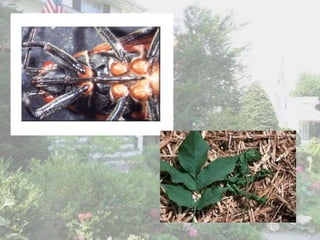
    Diagnosing Insect Problems •Do not, if at all possible, diagnose a pest problem from a photo • Get a sample of the ‘insect’ • Get a sample of the damage • Make sure that the organism is indeed an insect • Is it an adult or a juvenile? • Identify the insect to order (easier to do for adults than for juveniles) • What do the wings look like? Are they membraneous? Are there 2 pair? What about cross veins? Are the wings held flat over the body, or tent like over the body? • Do the mouthparts of the insect match up with the type of damage being reported?
  • 92.
  • 93.
  • 94.
  • 100.
    Closing Remarks • Insectsare cool! Most are innocuous to humans. Many are beneficial. Relatively few are pests (but these pests make their presence known!). • Work your way through a standard set of questions, when ID’ing insects to order.