Arrhythmogenic
right ventricular
dysplasia
DOMINA PETRIC, MD
Introduction
Arrhythmogenic right ventricular
dysplasia/cardiomyopathy (ARVD/ARVC) is
an inherited cardiomyopathy.
It is characterized by structural and functional
abnormalities in the right ventricle (RV)
resulting in ventricular arrhythmias.
Medscape.com
Clinical significance
It is an important cause
of sudden cardiac death
in young adults:
•11% of all cases and 22% of
cases among athletes
Medscape.com
Pathophysiology
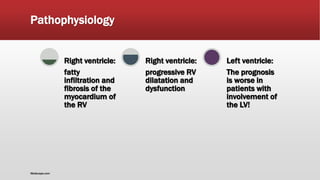
fatty
infiltration and
fibrosis of the
myocardium of
the RV
Right ventricle:
progressive RV
dilatation and
dysfunction
Right ventricle:
The prognosis
is worse in
patients with
involvement of
the LV!
Left ventricle:
Medscape.com
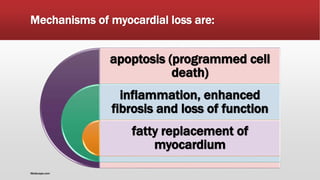
Mechanisms of myocardial loss are:
apoptosis (programmed cell
death)
inflammation, enhanced
fibrosis and loss of function
fatty replacement of
myocardium
Medscape.com
Etiology
▪ ARVD is an inherited disorder (present in the fetus).
▪ It may result from an acquired etiology such as viral
infection (myocarditis).
▪ Patients with a genetic predisposition are more likely to
develop myocarditis.
Disease manifests more frequently in active individuals:
▪ mechanical sheer stress can cause cell membrane
damage, inflammation, and fibrosis in genetically
predisposed individuals
Medscape.com
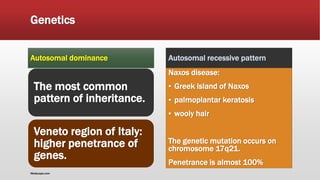
Genetics
Autosomal dominance
The most common
pattern of inheritance.
Veneto region of Italy:
higher penetrance of
genes.
Autosomal recessive pattern
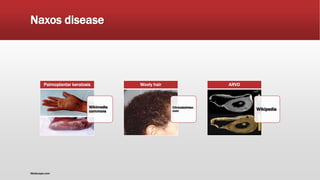
Naxos disease:
▪ Greek island of Naxos
▪ palmoplantar keratosis
▪ wooly hair
The genetic mutation occurs on
chromosome 17q21.
Penetrance is almost 100%
Medscape.com
Naxos disease
Wikimedia
commons
Palmoplantar keratosis
Clinicaladvisor.
com
Wooly hair
Wikipedia
ARVD
Medscape.com
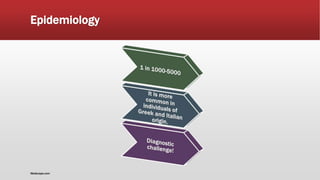
Epidemiology
Medscape.com
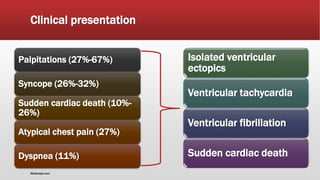
Clinical presentation
Palpitations (27%-67%)
Syncope (26%-32%)
Sudden cardiac death (10%-
26%)
Atypical chest pain (27%)
Dyspnea (11%)
Isolated ventricular
ectopics
Ventricular tachycardia
Ventricular fibrillation
Sudden cardiac death
Medscape.com
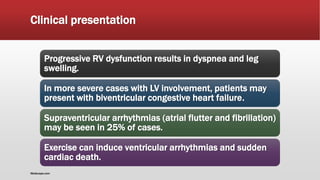
Clinical presentation
Progressive RV dysfunction results in dyspnea and leg
swelling.
In more severe cases with LV involvement, patients may
present with biventricular congestive heart failure.
Supraventricular arrhythmias (atrial flutter and fibrillation)
may be seen in 25% of cases.
Exercise can induce ventricular arrhythmias and sudden
cardiac death.
Medscape.com
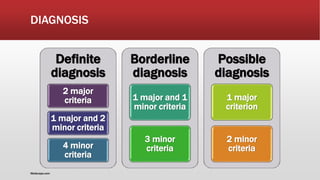
DIAGNOSIS
Medscape.com
Definite
diagnosis
2 major
criteria
1 major and 2
minor criteria
4 minor
criteria
Borderline
diagnosis
1 major and 1
minor criteria
3 minor
criteria
Possible
diagnosis
1 major
criterion
2 minor
criteria
ECG findings
▪ normal in the latent phase of ARVD
▪ intraventricular conduction
abnormality
▪ T wave abnormalities
▪ anteroseptal T wave inversion
▪ epsilon waves
Medscape.com
Major ECG criteria
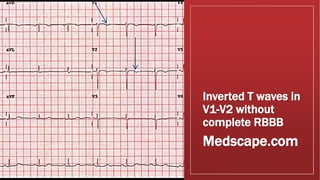
Inverted T waves in right precordial
leads in individuals older than 14 years
in the absence of complete right
bundle branch block (87% of patients).
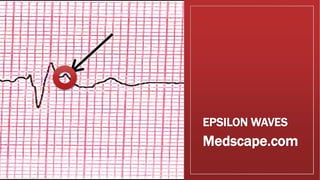
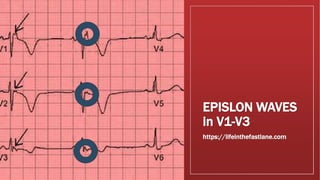
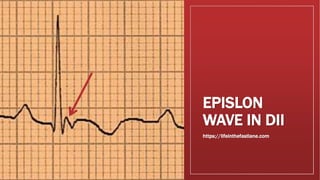
Epsilon waves (low-amplitude signals
between end of QRS complex and the
onset of T wave) in leads V1-V3 (33%
of patients).
Medscape.com
Inverted T waves in
V1-V2 without
complete RBBB
Medscape.com
Medscape.com
EPSILON WAVES
Medscape.com
EPISLON WAVES
in V1-V3
https://lifeinthefastlane.com
EPISLON
WAVE IN DII
https://lifeinthefastlane.com
Therapy
▪ The goal of therapy is to reduce the frequency and
severity of arrhythmias.
▪ Beta-blockers are the first line of drug therapy.
▪ Sotalol is the most effective drug for inducible or
noninducible ventricular tachycardia.
▪ An implantable cardioverter-defibrillator (ICD) is
recommended for secondary prevention of sudden
cardiac death in patients with sustained ventricular
tachycardia or ventricular fibrillation, and for primary
prevention in high-risk patients.
Medscape.com
Message at the end
Dear GENERAL
PRACTITIONERS be
ready to recognize ARVD
and send the patient to
the cardiologist!
Medscape.com
Literature
▪Medscape.com
▪Wikimedia commons
▪Clinicaladvisor.com
▪https://lifeinthefastlane.com
Medscape.com

Arrhythmogenic right ventricular dysplasia