DEEP BRAIN STIMULATION
By MEENAKSHY SUDEEP
BASAL GANGLIA ANATOMY
•The Basal ganglia are collection of nuclei
grouped based on there interconnections
•Important in coordinating movement and in
cognitive function
•work in concert with the pyramidal motor
pathway
COMPONENTS OF BASAL GANGLIA
• CORPUSTRAITUM
• Straitum ---- caudate nucleus and putamen
• Pallidum ---- globus pallidus
• SUBSTANTIA NIGRA
• pars compacta
• Pars reticulate
• SUBTHALAMIC NUCLEUS
• AMYGDALA
• CLAUSTRUM
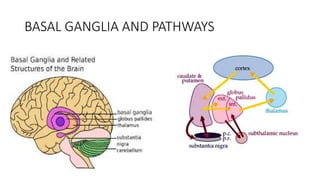
BASAL GANGLIA AND PATHWAYS
ROLE OF BASAL GANGLIA
• Motor and cognitive functions
• Controlling eye movements
• Role in motivation
• Decision making
• Working memory
CLINICAL SIGNIFICANCE
• Hyperkinetic and hypokinetic disorders
• Mainly movement disorders
• Common disorders associated with basalganglia dysfunctions are
chorea, wilsons disease, touretts syndrome, pd, kernictures, pap
syndrome etc,..
• In Parkinson disease the degeneration of dopaminergic neurons of
the substantia nigra pars compacta triggers a cascade of functional
changes affecting the whole basal ganglia network
DEEP BRAIN STIMULATION
• Inroduced in the 1990s
• By Benavides ET AL
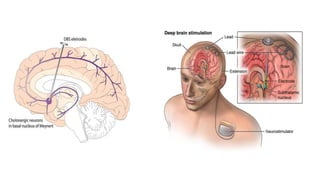
• neurosurgical procedure involving the implantation of a medical
device called a neurostimulator
• sends electrical impulses, through implanted electrodes, to specific
targets in the brain (brain nuclei) for the treatment of movement and
neuropsychiatric disorders
MECHANISM OF DBS
• Proposed mechanism of DBS can be grouped into 4 main catagories
1. INHIBITION OF TARGET
2. ACTIVATION OF TARGET
3. COMBINED INHIBITION AND ACTIVATION
4. DISRUPTION OF PATHOLOGICAL OSCILLATION TO RESTORE RHYTHMIC
ACTIVITY AND SYNCHRONISATION
• It involves decoupling of axonal and neuronal transport in bg that
takes place in corticospinopallidothalamic tract
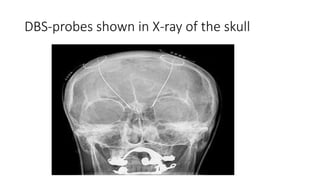
DBS-probes shown in X-ray of the skull
Components of DBS
• The LEAD or electrode : a thin, insulated wire—is inserted
through a small opening in the skull and implanted in the
brain. The tip of the electrode is positioned within the
targeted brain area
• The EXTENSION : Is an insulated wire that is passed under
the skin of the head, neck, and shoulder, connecting the lead
to the neuro stimulator
• The NEUROSTIMULTOR : is the third component and is
usually implanted under the skin near the collarbone
TARGET SITES FOR STIMULATION
• SUBTHALAMIC NUCLEUS
• GLOBUS PALLIDUS INTERNA
• THALAMUS
PATIENT SELECTION FOR DBS
• The best candidates for DBS therapy will meet most of the following
criteria:
• Patient have PD symptoms for 5 years
• On/off fluctuations with or without dyskinesia
• If pd symptoms interfere with daily activities
• continue to have a good response to PD medications, especially carbidopa/
levodopa
TECHNIQUE OF DBS
• The procedure is used only for patients whose symptoms cannot be
adequately controlled with medication
• Surgical implanatation
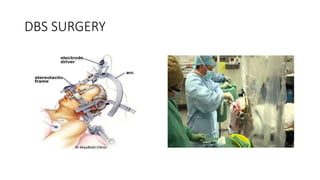
• Targeted area is located by ct or mri imaging
• Quadripolar leads are connected to stimulator and to battery
• Once electrodes are implanted it is attached top wires that run inside body
from head down to collar bone where battery operated stimulator are
implanted
• From stimulator electrical impulses are continuously delivered over wire to
electrode in brain
• Reprograming can be done with 3,4 months
DBS SURGERY
POST SURGERY PATIENT CARE
• Complications can develop during the first few weeks or even months
after surgery. Patient should be aware the signs and symptoms of
infection
• precautions that you can take to prevent an infection include the
following
• Never scratch, touch, or put any pressure on the incision
• Be sure pillows, sheets, and bedding are clean
• Keep the stitches clean and dry
• Return to have sutures or staples removed at the schedule time
• Look for sign of infection
SIDE EFFECTS and RISK
• Headache, nausea and vomiting
• Pain, inflammation and swelling at surgical site
• Confusion
• Numbness and weakness of body
• Difficulty in speech
• Mood changes
• Bleeding in brain
• Movement disorders etc…
COMPLICATION OF DBS SURGERY
• Hardware related complications
• Lead migration
• Lead fracture
• Lead erosion
• Lead malfunction
• Malfunctioning of neurostimulator
• Seizures
• Dystonis
• Hemorraghe etc….
ADVANTAGE OF DBS IN PARKINSON DISEASE
• DBS is not a cure for PD
• It is a treatment that helps relieve the motor symptoms of PD, as well
as some of the non-motor symptoms It is called a symptomatic
therapy
• Bilateral DBS is often required to improve gait, although sometimes
unilateral DBS has a marked effect on walking
• Smooths out on/off fluctuations
• Improves tremor, stiffness (rigidity), bradykinesia, and dyskinesia
• Decreases medications
DBS site Effect of therapy
• Thalamus (Vim) Reduces tremor but not the other of PD
• Globus pallidus (GPi): Reduces tremor, rigidity, bradykinesia, gait
problems, dyskinesia
• Subthalamic nucleus (STN): Reduces tremor, rigidity, bradykinesia,
gait problems, dyskinesia
INDICATION OF DBS
• Parkinson disease
• Essential tremor
• Dystonia
• Epilepsy
• Tournette syndrome
• Ocd
• Chronic pain
Advantages of DBS
• Reversibility
• Adjustability
• imp[rove quality of life
• Help to reduce medications
• Relatively safe procedure
• Improves energy level
Disadavantages
•Highly expensive
•Increased risk of infection due to
implantation of foreign object
Bibliography
• Guide_to_DBS_Stimulation_Therapy
• Parkinson.org

Deep brain stimulation

  • 1.
    DEEP BRAIN STIMULATION ByMEENAKSHY SUDEEP
  • 2.
    BASAL GANGLIA ANATOMY •TheBasal ganglia are collection of nuclei grouped based on there interconnections •Important in coordinating movement and in cognitive function •work in concert with the pyramidal motor pathway
  • 3.
    COMPONENTS OF BASALGANGLIA • CORPUSTRAITUM • Straitum ---- caudate nucleus and putamen • Pallidum ---- globus pallidus • SUBSTANTIA NIGRA • pars compacta • Pars reticulate • SUBTHALAMIC NUCLEUS • AMYGDALA • CLAUSTRUM
  • 4.
  • 5.
    ROLE OF BASALGANGLIA • Motor and cognitive functions • Controlling eye movements • Role in motivation • Decision making • Working memory
  • 6.
    CLINICAL SIGNIFICANCE • Hyperkineticand hypokinetic disorders • Mainly movement disorders • Common disorders associated with basalganglia dysfunctions are chorea, wilsons disease, touretts syndrome, pd, kernictures, pap syndrome etc,.. • In Parkinson disease the degeneration of dopaminergic neurons of the substantia nigra pars compacta triggers a cascade of functional changes affecting the whole basal ganglia network
  • 7.
    DEEP BRAIN STIMULATION •Inroduced in the 1990s • By Benavides ET AL • neurosurgical procedure involving the implantation of a medical device called a neurostimulator • sends electrical impulses, through implanted electrodes, to specific targets in the brain (brain nuclei) for the treatment of movement and neuropsychiatric disorders
  • 8.
    MECHANISM OF DBS •Proposed mechanism of DBS can be grouped into 4 main catagories 1. INHIBITION OF TARGET 2. ACTIVATION OF TARGET 3. COMBINED INHIBITION AND ACTIVATION 4. DISRUPTION OF PATHOLOGICAL OSCILLATION TO RESTORE RHYTHMIC ACTIVITY AND SYNCHRONISATION • It involves decoupling of axonal and neuronal transport in bg that takes place in corticospinopallidothalamic tract
  • 9.
    DBS-probes shown inX-ray of the skull
  • 10.
    Components of DBS •The LEAD or electrode : a thin, insulated wire—is inserted through a small opening in the skull and implanted in the brain. The tip of the electrode is positioned within the targeted brain area • The EXTENSION : Is an insulated wire that is passed under the skin of the head, neck, and shoulder, connecting the lead to the neuro stimulator • The NEUROSTIMULTOR : is the third component and is usually implanted under the skin near the collarbone
  • 12.
    TARGET SITES FORSTIMULATION • SUBTHALAMIC NUCLEUS • GLOBUS PALLIDUS INTERNA • THALAMUS
  • 13.
    PATIENT SELECTION FORDBS • The best candidates for DBS therapy will meet most of the following criteria: • Patient have PD symptoms for 5 years • On/off fluctuations with or without dyskinesia • If pd symptoms interfere with daily activities • continue to have a good response to PD medications, especially carbidopa/ levodopa
  • 14.
    TECHNIQUE OF DBS •The procedure is used only for patients whose symptoms cannot be adequately controlled with medication • Surgical implanatation • Targeted area is located by ct or mri imaging • Quadripolar leads are connected to stimulator and to battery • Once electrodes are implanted it is attached top wires that run inside body from head down to collar bone where battery operated stimulator are implanted • From stimulator electrical impulses are continuously delivered over wire to electrode in brain • Reprograming can be done with 3,4 months
  • 15.
  • 16.
    POST SURGERY PATIENTCARE • Complications can develop during the first few weeks or even months after surgery. Patient should be aware the signs and symptoms of infection • precautions that you can take to prevent an infection include the following • Never scratch, touch, or put any pressure on the incision • Be sure pillows, sheets, and bedding are clean • Keep the stitches clean and dry • Return to have sutures or staples removed at the schedule time • Look for sign of infection
  • 17.
    SIDE EFFECTS andRISK • Headache, nausea and vomiting • Pain, inflammation and swelling at surgical site • Confusion • Numbness and weakness of body • Difficulty in speech • Mood changes • Bleeding in brain • Movement disorders etc…
  • 18.
    COMPLICATION OF DBSSURGERY • Hardware related complications • Lead migration • Lead fracture • Lead erosion • Lead malfunction • Malfunctioning of neurostimulator • Seizures • Dystonis • Hemorraghe etc….
  • 19.
    ADVANTAGE OF DBSIN PARKINSON DISEASE • DBS is not a cure for PD • It is a treatment that helps relieve the motor symptoms of PD, as well as some of the non-motor symptoms It is called a symptomatic therapy • Bilateral DBS is often required to improve gait, although sometimes unilateral DBS has a marked effect on walking • Smooths out on/off fluctuations • Improves tremor, stiffness (rigidity), bradykinesia, and dyskinesia • Decreases medications
  • 20.
    DBS site Effectof therapy • Thalamus (Vim) Reduces tremor but not the other of PD • Globus pallidus (GPi): Reduces tremor, rigidity, bradykinesia, gait problems, dyskinesia • Subthalamic nucleus (STN): Reduces tremor, rigidity, bradykinesia, gait problems, dyskinesia
  • 21.
    INDICATION OF DBS •Parkinson disease • Essential tremor • Dystonia • Epilepsy • Tournette syndrome • Ocd • Chronic pain
  • 22.
    Advantages of DBS •Reversibility • Adjustability • imp[rove quality of life • Help to reduce medications • Relatively safe procedure • Improves energy level
  • 23.
    Disadavantages •Highly expensive •Increased riskof infection due to implantation of foreign object
  • 24.