Higher Cortical Functions
Bedside Examination
Yuttachai Likitjaroen MD,
Faculty of Medicine, Chulalongkorn University
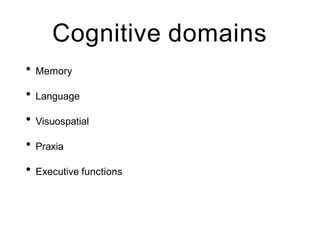
Cognitive domains
• Memory
• Language
• Visuospatial
• Praxia
• Executive functions
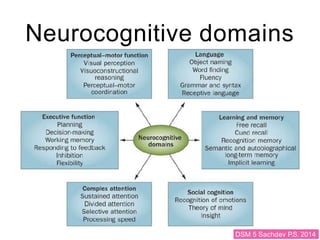
Neurocognitive domains
DSM 5 Sachdev P.S. 2014
Cognitive test
• Domain specific cognitive test
• Overall cognitive test
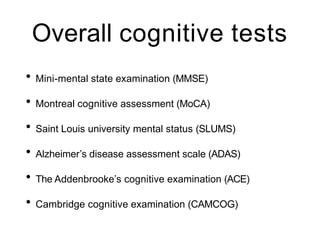
Overall cognitive tests
• Mini-mental state examination (MMSE)
• Montreal cognitive assessment (MoCA)
• Saint Louis university mental status (SLUMS)
• Alzheimer’s disease assessment scale (ADAS)
• The Addenbrooke’s cognitive examination (ACE)
• Cambridge cognitive examination (CAMCOG)
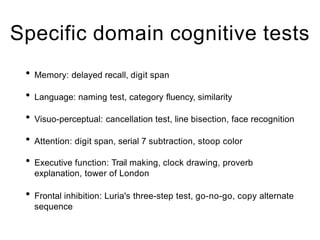
Specific domain cognitive tests
• Memory: delayed recall, digit span
• Language: naming test, category fluency, similarity
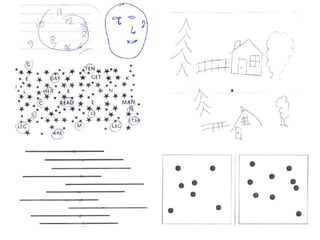
• Visuo-perceptual: cancellation test, line bisection, face recognition
• Attention: digit span, serial 7 subtraction, stoop color
• Executive function: Trail making, clock drawing, proverb
explanation, tower of London
• Frontal inhibition: Luria's three-step test, go-no-go, copy alternate
sequence
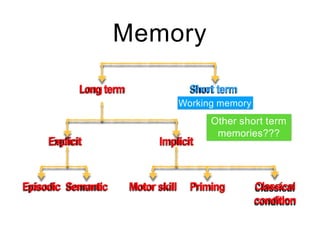
Memory
Longterm Shortterm
Explicit Implicit
Episodic Semantic Motorskill Classical
condition
Priming
Working memory
Other short term
memories???
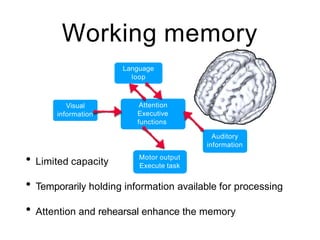
• Limited capacity
• Temporarily holding information available for processing
• Attention and rehearsal enhance the memory
Attention
Executive
functions
Working memory
Visual
information
Auditory
information
Language
loop
Motor output
Execute task
Working memory
assessment
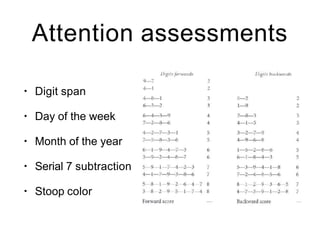
• Digit span forward and backward
• Delay recall
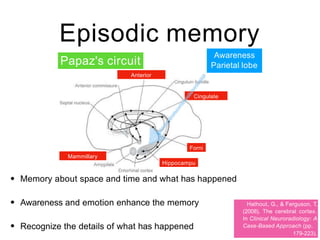
Episodic memory
Hathout, G., & Ferguson, T.
(2008). The cerebral cortex.
In Clinical Neuroradiology: A
Case-Based Approach (pp.
179-223).
Anterior
Cingulate
Hippocampu
Forni
Mammillary
Papaz's circuit
Awareness
Parietal lobe
•
•
•
Memory about space and time and what has happened
Awareness and emotion enhance the memory
Recognize the details of what has happened
Episodic memory
assessment
• Recent events with time or place tag (when, where, what)
• Delay recall
• Head turning signs
• Momentary confabulation
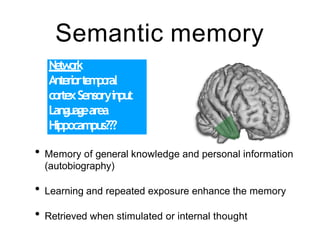
Semantic memory
Network
Anteriort
e
m
p
o
ral
cortexSensoryinput
Languagearea
Hippocampus???
• Memory of general knowledge and personal information
(autobiography)
• Learning and repeated exposure enhance the memory
• Retrieved when stimulated or internal thought
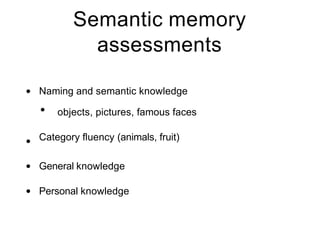
Semantic memory
assessments
• Naming and semantic knowledge
• objects, pictures, famous faces
Category fluency (animals, fruit)
•
•
•
General knowledge
Personal knowledge
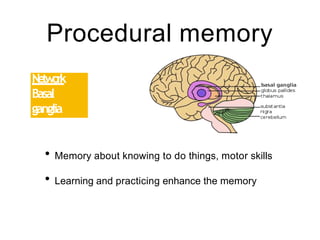
Procedural memory
Ne
two
rk
Basal
ganglia
Cerebellum
• Memory about knowing to do things, motor skills
• Learning and practicing enhance the memory
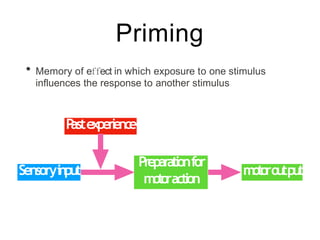
Priming
• Memory of effect in which exposure to one stimulus
influences the response to another stimulus
Sensoryinput
P
astexperience
Preparationfor
mo
to
raction
mo
to
routput
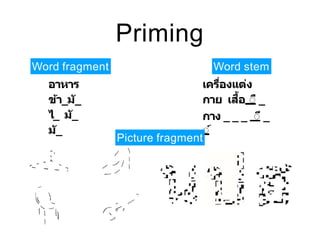
Priming
อาหาร
ข้า_มั_
ไ_ มั_
มั_
เครื่องแต่ง
กาย เสื้อ ืื _
กาง _ _ _ ื _
ื
Picture fragment
Word fragment Word stem
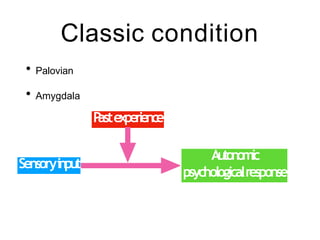
Classic condition
• Palovian
• Amygdala
Sensoryinput
P
astexperience
Autonomic
psychologicalresponse
Language
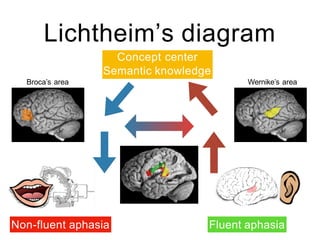
Lichtheim’s diagram
Broca’s area Wernike’s area
Concept center
Semantic knowledge
Fluent aphasia
Non-fluent aphasia
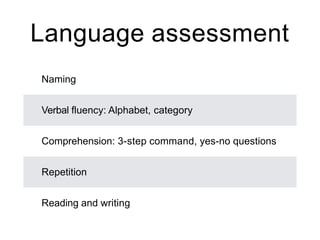
Language assessment
Naming
Verbal fluency: Alphabet, category
Comprehension: 3-step command, yes-no questions
Repetition
Reading and writing
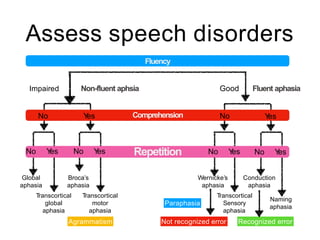
Assess speech disorders
Fluency
Good
Impaired
Comprehension
Repetition
Y
es
No Y
es
No
Transcortical
global
aphasia
Transcortical
motor
aphasia
Transcortical
Sensory
aphasia
Naming
aphasia
No Y
es
Wernicke’s
aphasia
No Y
es
Conduction
aphasia
No Y
es
Broca’s
aphasia
No Y
es
Global
aphasia
Non-fluent aphsia Fluent aphasia
Paraphasia
Not recognized error Recognized error
Agrammatism
Praxis
Apraxia
• Disorder of skill to execute tasks
• Not caused by weakness, abnormal tone, movement
disorders, akinesia, intellectual disorders
• Usually involving dominant hemisphere frontal and
parietal area
Limb-kinetic apraxia
• Inability to handle tools for the purpose intended
• Anatomy
- Supplementary motor area
- Basal ganglia
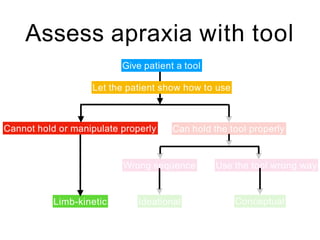
Assess apraxia with tool
Give patient a tool
Let the patient show how to use
Cannot hold or manipulate properly
Limb-kinetic Ideational
Use the tool wrong way
Conceptual
Can hold the tool properly
Wrong sequence
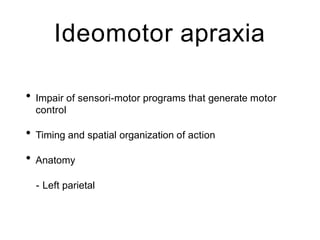
Ideomotor apraxia
• Impair of sensori-motor programs that generate motor
control
• Timing and spatial organization of action
• Anatomy
- Left parietal
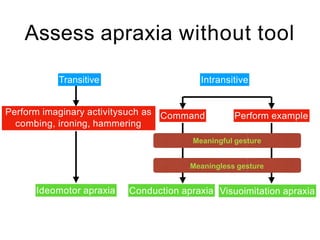
Assess apraxia without tool
Meaningful gesture
Meaningless gesture
Intransitive
Command
Conduction apraxia
Perform example
Visuoimitation apraxia
Ideomotor apraxia
Perform imaginary activitysuch as
combing, ironing, hammering
Transitive
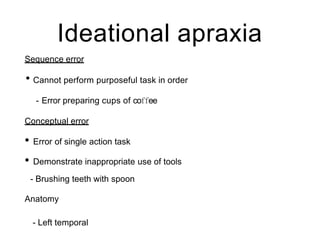
Ideational apraxia
Sequence error
• Cannot perform purposeful task in order
- Error preparing cups of coffee
Conceptual error
• Error of single action task
• Demonstrate inappropriate use of tools
- Brushing teeth with spoon
Anatomy
- Left temporal
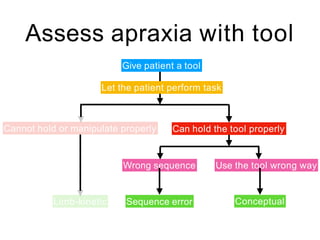
Assess apraxia with tool
Give patient a tool
Let the patient perform task
Cannot hold or manipulate properly
Limb-kinetic
Wrong sequence
Sequence error
Use the tool wrong way
Conceptual
Can hold the tool properly
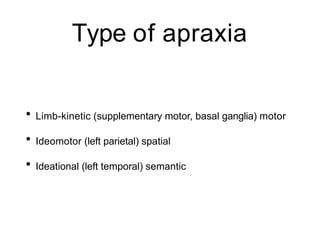
Type of apraxia
• Limb-kinetic (supplementary motor, basal ganglia) motor
• Ideomotor (left parietal) spatial
• Ideational (left temporal) semantic
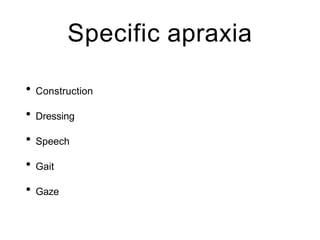
Specific apraxia
• Construction
• Dressing
• Speech
• Gait
• Gaze
Visuospatial
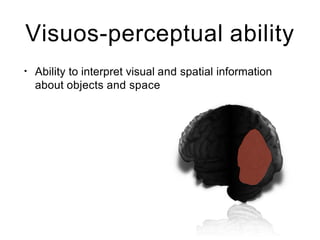
Visuos-perceptual ability
• Ability to interpret visual and spatial information
about objects and space
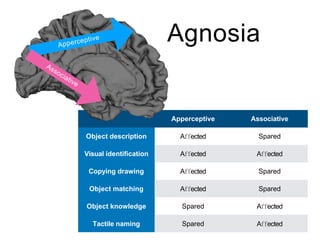
Agnosia
Apperceptive Associative
Object description Affected Spared
Visual identification Affected Affected
Copying drawing Affected Spared
Object matching Affected Spared
Object knowledge Spared Affected
Tactile naming Spared Affected
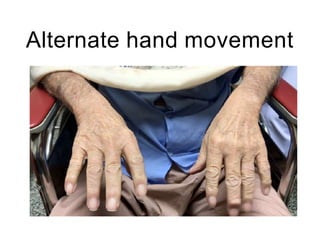
Alternate hand movement
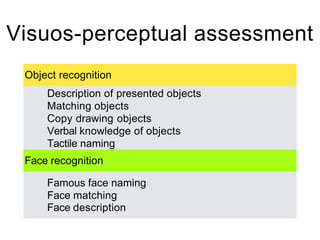
Visuos-perceptual assessment
Object recognition
Description of presented objects
Matching objects
Copy drawing objects
Verbal knowledge of objects
Tactile naming
Face recognition
Famous face naming
Face matching
Face description
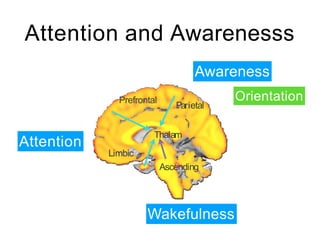
Attention
Attention and Awarenesss
Ascending
Limbic
Prefrontal
Parietal
Thalam
Attention
Awareness
Wakefulness
Orientation
Attention assessments
• Digit span
• Day of the week
• Month of the year
• Serial 7 subtraction
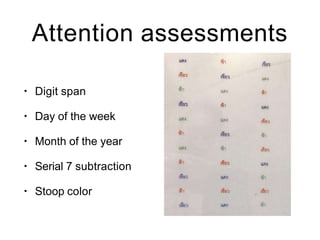
• Stoop color
Attention assessments
• Digit span
• Day of the week
• Month of the year
• Serial 7 subtraction
• Stoop color
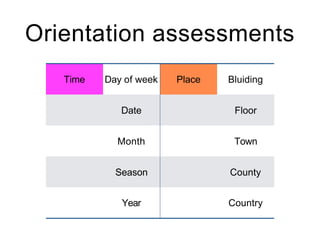
Orientation assessments
Time Day of week Place Bluiding
Date Floor
Month Town
Season County
Year Country
Social cognition
Behavioural symptoms
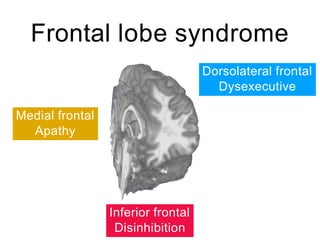
Frontal lobe syndrome
Medial frontal
Apathy
Dorsolateral frontal
Dysexecutive
Inferior frontal
Disinhibition
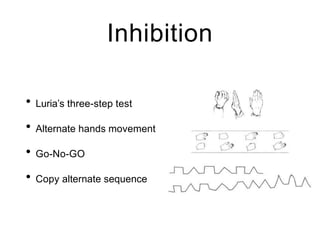
Inhibition
• Luria’s three-step test
• Alternate hands movement
• Go-No-GO
• Copy alternate sequence
Frontal lobe releasing signs
• Grasping reflex
• Palmomental reflex
• Glabella tap
• Snouting reflex
• Rooting reflex

Higher Cortical Functions Examination 4may2020.pptx