Tremor: Pathophysiology
arun
THE BASICS
• Rhythmic oscillation of a body part
• Described according to
• Parts of the body affected
• Frequency of oscillation, usually in Hertz - low frequency, < 4 Hz; mid-
frequency, 4 Hz to 7 Hz; high frequency, >7 Hz
• Amplitude: very small - fine tremors, large - coarse tremors, variable
in amplitude and frequency - jerky
• By the context – Rest, Postural, Kinetic; Postural and kinetic tremors -
together called action tremor
Four Principles of Tremor Genesis
• Oscillator - system able to produce rhythmic activity
• First - mechanical tremor of the extremity
• Second - reflex activation leading to oscillatory activity
• Third - central oscillators
• Fourth - oscillatory activity that may occur when feedforward or
feedback systems become unstable
Mechanical Tremor Of Extremity
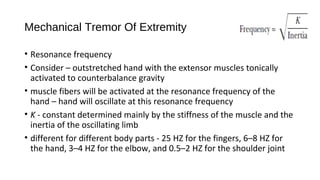
• Resonance frequency
• Consider – outstretched hand with the extensor muscles tonically
activated to counterbalance gravity
• muscle fibers will be activated at the resonance frequency of the
hand – hand will oscillate at this resonance frequency
• K - constant determined mainly by the stiffness of the muscle and the
inertia of the oscillating limb
• different for different body parts - 25 HZ for the fingers, 6–8 HZ for
the hand, 3–4 HZ for the elbow, and 0.5–2 HZ for the shoulder joint
• Resonance frequency - can be decreased by adding mass or increased
by adding stiffness
• Mechanical tremor component can be identified this way - add inertia
(e.g., by attaching rigidly a weight of 1 kg to the dorsum of the hand)
Reflexes Of The Central Nervous System
• Any movement in one direction - will stretch antagonistic muscles
and cause an afferent volley eliciting reflexes in the antagonists
• Eg – extensor is activated, the flexor will be stretched, causing an
afferent volley from the flexors
• When the reflex gains and the conduction time for the afferent and
efferent conduction are appropriate - an oscillation will result
Central Oscillation
• Two hypotheses
• First - rhythmic activity of a group of neurons within a nucleus
• Animal experiments - inferior olive and the thalamus
• Second - oscillations are generated within loops consisting of
neuronal populations or different nuclei and their axonal connections
Malfunction Of Feedforward/Feedback
Loops within the CNS
• Cerebellum - works through a feedforward and feedback control
system
• receives a copy of the movement signal from the cortex
• also received feedback from peripheral receptors
• adapts the specific parameters of the movement according to the
present status of the motor system
• Malfunction - tremor
Tremors in Normal Subjects
• Physiological and Enhanced Physiological Tremor
• Consists of three main components
• Mechanical component – responsible for the main frequency
component in most normal subjects
• Enhancement of the mechanical component - by reflexes
• Central component - 8–12-HZ
• Distinction between physiological and enhanced physiological tremor
is purely clinical - share common mechanisms
Pathological Tremors
The Anatomy of Tremor
• Dysfunction of
• basal ganglia
• cerebellar circuit - involving the VLp, motor cortex (MC), and
cerebellum
• several neurotransmitter systems projecting to both of these circuits
The Anatomy of Tremor
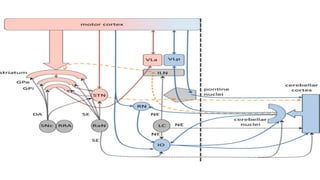
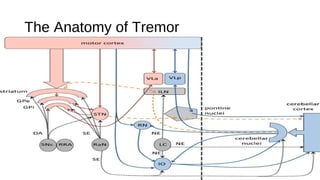
• Basal ganglia and cerebellum - project to separate thalamic nuclei
• Gpi - GABAergic, inhibitory projections to VLa
• Cerebellar nuclei - glutamatergic, excitatory projections to VLp
• Gpi - inhibits motor cortical activity
• Cerebellar nuclei - reinforces or facilitates motor cortical activity
• Cerebellum - reciprocally connected with the contralateral inferior
olive
• Basal ganglia and cerebellar circuits are anatomically connected -
converge in the motor cortex
• STN - important connectional hub in the tremor circuit
RESTING TREMOR
Classic Parkinson tremor
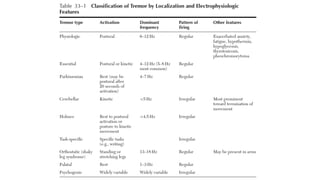
• PD can have many tremor types
• The classical Parkinson’s tremor - 75 % of PD patients
• preferentially occurs at rest
• Asymmetric - affects one limb or one side of the body (ie, arm and
leg)
• re-emerge in a stable position (i.e., re-emergent tremor)
• has a frequency of 4 to 6 Hz
Classic Tremor - Different
Pathophysiology
• Does not increase at the same pace as other motor symptoms
• Early symptom - often completely disappears as the disease
progresses
• Severity does not correlate with that of bradykinesia and rigidity
• Severity does not correlate with the degree of striatal dopamine
depletion
• Does not respond as well or as reliably to dopaminergic medication as
bradykinesia and rigidity
Dopaminergic Basis of Classic Tremor
• Pathological hallmark of PD - dopaminergic cell loss in the SNc - leads
to dopamine depletion in the striatum
• Postmortem studies - tremor-dominant PD patients and nontremor
PD patients
• differences in the pattern of dopaminergic cell loss
• Tremor dominant PD - more extensive loss of dopaminergic cells in
the retrorubral area (RRA) of the midbrain, milder degeneration of
SNc
• Jellinger KA. Neuropathology of sporadic Parkinson’s disease: evaluation and changes of concepts. Mov Disord
2012;27(1):8–30
• Animal models of PD
• After the administration of MPTP toxin
• Vervet monkeys - develop a tremor-dominant phenotype - damage to
the RRA
• RRA / brain regions receiving dopaminergic input from this area -
involved in the generation of resting tremor
• Deutch AY, Elsworth JD, Goldstein M, et al. Preferential vulnerability of A8 dopamine neurons in the primate
to the neurotoxin 1-methyl-4-phenyl-1,2,3,6-tetrahydropyridine. Neurosci Lett 1986;68(1):51–56
• Nuclear imaging studies - [123I]FP-CIT SPECT
• Dopamine transporter (DAT) density in the striatum - correlates with
the severity of all motor symptoms, except resting tremor
• DAT density in the pallidum - correlated with tremor severity, but not
with bradykinesia or rigidity
• Hypothesized - specific loss of dopaminergic cells in the RRA -
produce pallidal dopamine depletion - resting tremor
• Helmich RC, Janssen MJR, Oyen WJG, Bloem BR, Toni I. Pallidal dysfunction drives a cerebellothalamic circuit into Parkinson
tremor. Ann Neurol 2011;69(2):269–281
• Metabolic imaging (combined EMG-fMRI)
• Tremor dominant PD - dopaminergic medication specifically reduced
tremor-related activity in the pallidum and VLp
• Dopaminergic medication - specifically increased thalamic inhibition
in the VLp
• Dopaminergic projections to the cerebellothalamic circuit have a role
in PD resting tremor
• Dirkx MF, den Ouden HE, Aarts E, et al. Dopamine controls Parkinson’s tremor by inhibiting the cerebellar thalamus. Brain
2017
Role of Serotonin
• Several studies - pointed toward a role of serotonergic dysfunction in
the generation of classic PD tremor
• Some studies - report a relationship with action tremor
• Unclear whether serotonin depletion in the raphe - correlates with
resting tremor, with action tremor, or both
• Unclear how exactly serotonin contributes to the generation of
tremor
Role of Noradrenaline
• Clinically - tremor increases during stress
• NA - role in modulating tremor amplitude
• Locus coeruleus (LC) - produces NA, only mildly affected in tremor-
dominant patients
• Intact noradrenergic system is associated with tremor
• LC - sends noradrenergic projections to all nodes of the
cerebellothalamocortical circuit - strongly linked to tremor
• NA - projections to this circuit may facilitate tremulous activity,
resulting in tremor amplification
Role of Acetylcholine
• Established by the effectiveness of anticholinergic medication in
treating motor symptoms, including tremor
• Exact mechanism - remains unclear
• Striatal cholinergic interneurons - appear to be overactive as a result
of dopamine deficiency
• Inhibits further dopamine release, causing a vicious circle
• Explain why anticholinergic medication is not as as dopaminergic
medication
• Facilitates dopaminergic release - which requires the presence of
dopamine to begin with
The Cerebral Circuit of Parkinsonian Rest
Tremor
• Central mechanisms
• Both electrophysiological and neuroimaging studies - involvement of
the basal ganglia and/or a cerebellothalamocortical circuit
• Supported by strong clinical evidence
• DBS of the basal ganglia (GPi and STN) and VLp - effective in treating
tremor
• Electrophysiological studies using intraoperative recordings - neural
oscillations with the same frequency of tremor in the basal ganglia
(STN and GPi) and the VLp
• MEG studies – tremor related oscillatory activity within a cerebral
network consisting of a cerebello – diencephalic - cortical loop
• Several neuroimaging studies(PET and fMRI) - identified nodes from
the basal ganglia and the cerebellothalamocortical circuit to be
involved with tremor.
• Show the involvement of the basal ganglia and
cerebellothalamocortical circuit in the generation of tremor
• Recent fMRI DCM study –
• Tremulous activity starts in the basal ganglia
• Amplified in the cerebellothalamocortical circuit
Is Tremor Caused by a Single Oscillator?
• Several studies have argued
• either the basal ganglia or the thalamus may act as the tremor
pacemaker
The Thalamic Pacemaker Hypothesis
• Hyperpolarized cells in the thalamus might act as the tremor
pacemaker
• in vitro studies - intrinsic biophysical properties of thalamic neurons
allow them to serve as relay systems and as single cell oscillators
• slightly depolarized thalamic cells tend to oscillate at 10 Hz, whereas
hyperpolarized cells oscillate at 6 Hz
The Basal Ganglia Pacemaker
Hypothesis
• Basal ganglia circuitry forms the tremor pacemaker
• Loss-of segregation hypothesis
• STN-GPe pacemaker hypothesis - STN and GPe constitute a central
pacemaker that is modulated by striatal inhibition of GPe neurons
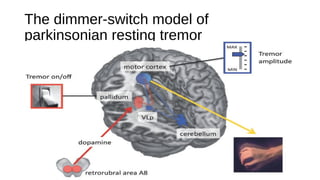
Dimmer-Switch Model
• Integrates the basal ganglia and cerebellothalamocortical circuits
• Specifies the unique role of each circuit in tremor
• Dopaminergic cell death in the RRA - dopamine depletion in the
pallidum
• Pallidal dopamine depletion - emergence of pathological activity in
the striato-pallidal circuit
• Triggers activity in the cerebello-thalamo-cortical circuit through the
primary motor cortex
• Striato-pallidal circuit - turns tremor on - analogues to a light switch
• Cerebello-thalamo-cortical circuit - modulates tremor amplitude -
analogous to a light dimmer
• These interactions occur in the motor cortex, where both circuits
converge
The dimmer-switch model of
parkinsonian resting tremor
• Explaining how the basal ganglia and the cerebello-thalamo-cortical
circuits interact with each other
• Explains why DBS in either the basal ganglia (STN or GPi) or the
cerebellothalamocortical circuit (VLp) can treat tremor
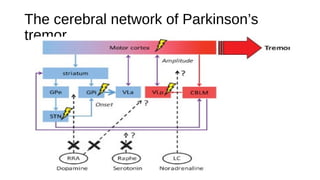
The cerebral network of Parkinson’s
tremor
ACTION TREMOR
ET - Heterogeneous Disorder
• Clinical diagnosis - relies heavily on the exclusion of alternative causes
of action tremor
• Overlap in clinical symptoms between PD and ET
• Studies showed that 68 % of patients with isolated action tremor had
an abnormal DAT scan - suggestive of nigrostriatal dopaminergic cell
loss
• Mainly a disease of central origin - involving the cerebellum, thalamus
and primary motor cortex
The Neurodegeneration Hypothesis
• Neuropathological studies - have focused on three brain regions: the
cerebellum, inferior olive, and locus coeruleus
• Most evidence - cerebellar disease - gliosis, purkinje cell loss, and
increased torpedoes (swellings) in the Purkinje cell axons
• Louis et al - largest postmortem study to date was performed in 33 ET
patients and 21 healthy controls
• eight ET patients (24 %) had Lewy bodies in the locus coeruleus
• average amount of cerebellar Purkinje cells was 25% lower
• Rajput et al - reported similar cerebellar Purkinje cell counts in 12 ET
patients and six controls, and no ET patients with Lewy bodies
• Neuroimaging findings - MRSI (reduction in NAA/tCr ratio), DTI (FA
reduction) and VBM (GM and WM volume loss) studies - suggest that
this disease could be neurodegenerative
• Overall, there is evidence for neurodegeneration of the cerebellum
Harmane and ET
• Emerging link with harmane, a neurotoxin
• Blood harmane concentration has been shown to be elevated in ET
• Louis et al. - assessed the correlation between blood harmane
concentration and cerebellar NAA/tCR
• Blood harmane concentration in ET is associated with cerebellar
neuronal damage
The GABA Hypothesis
• Several lines of evidence - support abnormal function of the
inhibitory neurotransmitter GABA
• Drugs that increase GABAergic transmission - primidone, topiramate,
gabapentin, and ethanol, are effective
• Reduced levels of GABA in the CSF of ET patients
• Experimental interference with GABAergic transmission in animals
can evoke an ET-like postural tremor
• Nuclear imaging studies - altered binding to GABA receptors in ET
• Reduction of the levels of dentate GABA receptors - may be a primary
deficit in ET
• Firm evidence for a reduction of GABAergic tone in ET - localized in
the same areas (cerebellum and locus coeruleus) where
neurodegenerative changes have been found
The Oscillating Network Hypothesis
• Generation of tremor - cerebello–thalamo–cortical circuit
• Motor controller involving the cerebellum is dysfunctional - Delay in
motor control processing
• Sets up oscillations in the cerebello–thalamo– cortical loop
• Decrease in GABA receptors in the cerebellum - disinhibition of
cerebellar pacemaker output activity, which propagates along the
cerebello-thalamo-cortical pathways to generate tremors
• Correction of such defective cerebellar GABA drive may have a
therapeutic effect in ET
Cerebellar Tremor
• classic cerebellar tremor - action tremor, both kinetic component as
well as a terminal worsening (ie, an intentional component)
• quite slow (3 Hz to 4 Hz), other cerebellar signs may also be present
• Defect of feedforward control – cerebello-thalamo-cortical circuits
• Nuclei involved - globose– emboliform nucleus
Midbrain (Rubral) Tremor
• Holmes tremor
• Damage in rubro-olivo-cerebello-rubral loops or cerebello-thalamic
pathways (red nucleus is an intermittent station and is thus not
necessarily involved)
• Affects cerebellar outflow tracts and dopaminergic nigrostriatal fibers
• Causes – MS, stroke, trauma, and direct tumor invasion, but is rarely
associated with paraneoplastic syndrome
• Imaging – lesion at the pontine-midbrain region, can occur with
lesions elsewhere
Orthostatic Tremor
• characterized by a subjective feeling of unsteadiness during stance
• high-frequency 13–18 HZ pattern
• central generator located in the posterior fossa
• Secondary OT associated with lesions in the pons or with cerebellar
atrophy
• some cases of secondary OT - subclinical or clinical dysregulation of
dopaminergic transmission - results in release of the posterior fossa
oscillator
Palatal Tremor
• Palatal myoclonus, palatal nystagmus
• characterized by rhythmic movements of the soft palate
• Divided - symptomatic (SPT) and essential palatal tremor (EPT)
• SPT is characterized by
• Preceding brainstem/cerebellum lesion with subsequent olivary
hypertrophy
• rhythmic movements of the soft palate (levator veli palatini) and
often of other brainstem-innervated or extremity muscles
• develops contralateral to the hypertrophied inferior olive
• EPT is characterized by
• absence of preceding lesion and absent olivary pseudohypertrophy
• presentation with an earclick
• Rhythmic movements of the soft palate involve mostly the tensor veli
palatini
• Extremity or eye muscles are not involved
Dystonic Tremor
• dystonic tremor syndromes
• dystonic tremor (DT) - postural/kinetic tremor occurring in the body
region affected by dystonia
• tremor associated with dystonia (TAD) - tremor occurring in a body
part not affected by dystonia like the upper limb postural tremor in
cervical dystonia (CD) patients
Peripheral Neuropathy - Related Tremor
• Postural and kinetic tremors, mild to moderate severity, frequency
between 3 and 6 HZ in arm and hand muscles
• There should be a coexisting peripheral neuropathy in the same limbs
• Neuropathy and the tremor should be temporally linked, with tremor
accompanying or following the neuropathy
• Demyelinating neuropathies in particular are frequent causes
• Abnormal reflex mechanism, central processing of the afferent
information is defective – distorted and mistimed peripheral inputs
Methods of Measuring Tremor
• Physiologic techniques (e.g., accelerometry, EMG, digitizing
tablets, or gyroscopic techniques)
• Subjective clinical measures (e.g., rating scales, spiral drawings, or
handwriting)
Electrophysiologic tools for diagnosis and monitoring
of tremors
• Electromyography of tremors
• Quantitative tremor analysis
• Graphic tablet analysis
• Long term recordings of tremor
References
• Hallett M. Tremor: pathophysiology. Parkinsonism Relat Disord. 2014
Jan;20 Suppl 1:S118-22. doi: 10.1016/S1353-8020(13)70029-4.
Review. PubMed PMID: 24262161.
• Helmich RC, Dirkx MF. Pathophysiology and Management of
Parkinsonian Tremor. Semin Neurol. 2017 Apr;37(2):127-134. doi:
10.1055/s-0037-1601558. Epub 2017 May 16. PubMed PMID:
28511253
• Deuschl G, Raethjen J, Lindemann M, Krack P. The pathophysiology of
tremor.Muscle Nerve. 2001 Jun;24(6):716-35. Review. PubMed PMID:
11360255.

Tremor Pathophysiology

  • 1.
  • 2.
    THE BASICS • Rhythmicoscillation of a body part • Described according to • Parts of the body affected • Frequency of oscillation, usually in Hertz - low frequency, < 4 Hz; mid- frequency, 4 Hz to 7 Hz; high frequency, >7 Hz • Amplitude: very small - fine tremors, large - coarse tremors, variable in amplitude and frequency - jerky • By the context – Rest, Postural, Kinetic; Postural and kinetic tremors - together called action tremor
  • 3.
    Four Principles ofTremor Genesis • Oscillator - system able to produce rhythmic activity • First - mechanical tremor of the extremity • Second - reflex activation leading to oscillatory activity • Third - central oscillators • Fourth - oscillatory activity that may occur when feedforward or feedback systems become unstable
  • 4.
    Mechanical Tremor OfExtremity • Resonance frequency • Consider – outstretched hand with the extensor muscles tonically activated to counterbalance gravity • muscle fibers will be activated at the resonance frequency of the hand – hand will oscillate at this resonance frequency • K - constant determined mainly by the stiffness of the muscle and the inertia of the oscillating limb • different for different body parts - 25 HZ for the fingers, 6–8 HZ for the hand, 3–4 HZ for the elbow, and 0.5–2 HZ for the shoulder joint
  • 5.
    • Resonance frequency- can be decreased by adding mass or increased by adding stiffness • Mechanical tremor component can be identified this way - add inertia (e.g., by attaching rigidly a weight of 1 kg to the dorsum of the hand)
  • 6.
    Reflexes Of TheCentral Nervous System • Any movement in one direction - will stretch antagonistic muscles and cause an afferent volley eliciting reflexes in the antagonists • Eg – extensor is activated, the flexor will be stretched, causing an afferent volley from the flexors • When the reflex gains and the conduction time for the afferent and efferent conduction are appropriate - an oscillation will result
  • 7.
    Central Oscillation • Twohypotheses • First - rhythmic activity of a group of neurons within a nucleus • Animal experiments - inferior olive and the thalamus • Second - oscillations are generated within loops consisting of neuronal populations or different nuclei and their axonal connections
  • 8.
    Malfunction Of Feedforward/Feedback Loopswithin the CNS • Cerebellum - works through a feedforward and feedback control system • receives a copy of the movement signal from the cortex • also received feedback from peripheral receptors • adapts the specific parameters of the movement according to the present status of the motor system • Malfunction - tremor
  • 9.
    Tremors in NormalSubjects • Physiological and Enhanced Physiological Tremor • Consists of three main components • Mechanical component – responsible for the main frequency component in most normal subjects • Enhancement of the mechanical component - by reflexes • Central component - 8–12-HZ • Distinction between physiological and enhanced physiological tremor is purely clinical - share common mechanisms
  • 10.
  • 12.
    The Anatomy ofTremor • Dysfunction of • basal ganglia • cerebellar circuit - involving the VLp, motor cortex (MC), and cerebellum • several neurotransmitter systems projecting to both of these circuits
  • 13.
  • 14.
    • Basal gangliaand cerebellum - project to separate thalamic nuclei • Gpi - GABAergic, inhibitory projections to VLa • Cerebellar nuclei - glutamatergic, excitatory projections to VLp • Gpi - inhibits motor cortical activity • Cerebellar nuclei - reinforces or facilitates motor cortical activity • Cerebellum - reciprocally connected with the contralateral inferior olive • Basal ganglia and cerebellar circuits are anatomically connected - converge in the motor cortex • STN - important connectional hub in the tremor circuit
  • 15.
  • 16.
    Classic Parkinson tremor •PD can have many tremor types • The classical Parkinson’s tremor - 75 % of PD patients • preferentially occurs at rest • Asymmetric - affects one limb or one side of the body (ie, arm and leg) • re-emerge in a stable position (i.e., re-emergent tremor) • has a frequency of 4 to 6 Hz
  • 17.
    Classic Tremor -Different Pathophysiology • Does not increase at the same pace as other motor symptoms • Early symptom - often completely disappears as the disease progresses • Severity does not correlate with that of bradykinesia and rigidity • Severity does not correlate with the degree of striatal dopamine depletion • Does not respond as well or as reliably to dopaminergic medication as bradykinesia and rigidity
  • 18.
    Dopaminergic Basis ofClassic Tremor • Pathological hallmark of PD - dopaminergic cell loss in the SNc - leads to dopamine depletion in the striatum • Postmortem studies - tremor-dominant PD patients and nontremor PD patients • differences in the pattern of dopaminergic cell loss • Tremor dominant PD - more extensive loss of dopaminergic cells in the retrorubral area (RRA) of the midbrain, milder degeneration of SNc • Jellinger KA. Neuropathology of sporadic Parkinson’s disease: evaluation and changes of concepts. Mov Disord 2012;27(1):8–30
  • 19.
    • Animal modelsof PD • After the administration of MPTP toxin • Vervet monkeys - develop a tremor-dominant phenotype - damage to the RRA • RRA / brain regions receiving dopaminergic input from this area - involved in the generation of resting tremor • Deutch AY, Elsworth JD, Goldstein M, et al. Preferential vulnerability of A8 dopamine neurons in the primate to the neurotoxin 1-methyl-4-phenyl-1,2,3,6-tetrahydropyridine. Neurosci Lett 1986;68(1):51–56
  • 20.
    • Nuclear imagingstudies - [123I]FP-CIT SPECT • Dopamine transporter (DAT) density in the striatum - correlates with the severity of all motor symptoms, except resting tremor • DAT density in the pallidum - correlated with tremor severity, but not with bradykinesia or rigidity • Hypothesized - specific loss of dopaminergic cells in the RRA - produce pallidal dopamine depletion - resting tremor • Helmich RC, Janssen MJR, Oyen WJG, Bloem BR, Toni I. Pallidal dysfunction drives a cerebellothalamic circuit into Parkinson tremor. Ann Neurol 2011;69(2):269–281
  • 21.
    • Metabolic imaging(combined EMG-fMRI) • Tremor dominant PD - dopaminergic medication specifically reduced tremor-related activity in the pallidum and VLp • Dopaminergic medication - specifically increased thalamic inhibition in the VLp • Dopaminergic projections to the cerebellothalamic circuit have a role in PD resting tremor • Dirkx MF, den Ouden HE, Aarts E, et al. Dopamine controls Parkinson’s tremor by inhibiting the cerebellar thalamus. Brain 2017
  • 22.
    Role of Serotonin •Several studies - pointed toward a role of serotonergic dysfunction in the generation of classic PD tremor • Some studies - report a relationship with action tremor • Unclear whether serotonin depletion in the raphe - correlates with resting tremor, with action tremor, or both • Unclear how exactly serotonin contributes to the generation of tremor
  • 23.
    Role of Noradrenaline •Clinically - tremor increases during stress • NA - role in modulating tremor amplitude • Locus coeruleus (LC) - produces NA, only mildly affected in tremor- dominant patients • Intact noradrenergic system is associated with tremor • LC - sends noradrenergic projections to all nodes of the cerebellothalamocortical circuit - strongly linked to tremor • NA - projections to this circuit may facilitate tremulous activity, resulting in tremor amplification
  • 24.
    Role of Acetylcholine •Established by the effectiveness of anticholinergic medication in treating motor symptoms, including tremor • Exact mechanism - remains unclear • Striatal cholinergic interneurons - appear to be overactive as a result of dopamine deficiency • Inhibits further dopamine release, causing a vicious circle • Explain why anticholinergic medication is not as as dopaminergic medication • Facilitates dopaminergic release - which requires the presence of dopamine to begin with
  • 25.
    The Cerebral Circuitof Parkinsonian Rest Tremor • Central mechanisms • Both electrophysiological and neuroimaging studies - involvement of the basal ganglia and/or a cerebellothalamocortical circuit • Supported by strong clinical evidence • DBS of the basal ganglia (GPi and STN) and VLp - effective in treating tremor
  • 26.
    • Electrophysiological studiesusing intraoperative recordings - neural oscillations with the same frequency of tremor in the basal ganglia (STN and GPi) and the VLp • MEG studies – tremor related oscillatory activity within a cerebral network consisting of a cerebello – diencephalic - cortical loop • Several neuroimaging studies(PET and fMRI) - identified nodes from the basal ganglia and the cerebellothalamocortical circuit to be involved with tremor. • Show the involvement of the basal ganglia and cerebellothalamocortical circuit in the generation of tremor
  • 27.
    • Recent fMRIDCM study – • Tremulous activity starts in the basal ganglia • Amplified in the cerebellothalamocortical circuit
  • 28.
    Is Tremor Causedby a Single Oscillator? • Several studies have argued • either the basal ganglia or the thalamus may act as the tremor pacemaker
  • 29.
    The Thalamic PacemakerHypothesis • Hyperpolarized cells in the thalamus might act as the tremor pacemaker • in vitro studies - intrinsic biophysical properties of thalamic neurons allow them to serve as relay systems and as single cell oscillators • slightly depolarized thalamic cells tend to oscillate at 10 Hz, whereas hyperpolarized cells oscillate at 6 Hz
  • 30.
    The Basal GangliaPacemaker Hypothesis • Basal ganglia circuitry forms the tremor pacemaker • Loss-of segregation hypothesis • STN-GPe pacemaker hypothesis - STN and GPe constitute a central pacemaker that is modulated by striatal inhibition of GPe neurons
  • 31.
    Dimmer-Switch Model • Integratesthe basal ganglia and cerebellothalamocortical circuits • Specifies the unique role of each circuit in tremor • Dopaminergic cell death in the RRA - dopamine depletion in the pallidum • Pallidal dopamine depletion - emergence of pathological activity in the striato-pallidal circuit • Triggers activity in the cerebello-thalamo-cortical circuit through the primary motor cortex
  • 32.
    • Striato-pallidal circuit- turns tremor on - analogues to a light switch • Cerebello-thalamo-cortical circuit - modulates tremor amplitude - analogous to a light dimmer • These interactions occur in the motor cortex, where both circuits converge
  • 33.
    The dimmer-switch modelof parkinsonian resting tremor
  • 34.
    • Explaining howthe basal ganglia and the cerebello-thalamo-cortical circuits interact with each other • Explains why DBS in either the basal ganglia (STN or GPi) or the cerebellothalamocortical circuit (VLp) can treat tremor
  • 35.
    The cerebral networkof Parkinson’s tremor
  • 36.
  • 37.
    ET - HeterogeneousDisorder • Clinical diagnosis - relies heavily on the exclusion of alternative causes of action tremor • Overlap in clinical symptoms between PD and ET • Studies showed that 68 % of patients with isolated action tremor had an abnormal DAT scan - suggestive of nigrostriatal dopaminergic cell loss • Mainly a disease of central origin - involving the cerebellum, thalamus and primary motor cortex
  • 38.
    The Neurodegeneration Hypothesis •Neuropathological studies - have focused on three brain regions: the cerebellum, inferior olive, and locus coeruleus • Most evidence - cerebellar disease - gliosis, purkinje cell loss, and increased torpedoes (swellings) in the Purkinje cell axons
  • 39.
    • Louis etal - largest postmortem study to date was performed in 33 ET patients and 21 healthy controls • eight ET patients (24 %) had Lewy bodies in the locus coeruleus • average amount of cerebellar Purkinje cells was 25% lower • Rajput et al - reported similar cerebellar Purkinje cell counts in 12 ET patients and six controls, and no ET patients with Lewy bodies
  • 40.
    • Neuroimaging findings- MRSI (reduction in NAA/tCr ratio), DTI (FA reduction) and VBM (GM and WM volume loss) studies - suggest that this disease could be neurodegenerative • Overall, there is evidence for neurodegeneration of the cerebellum
  • 41.
    Harmane and ET •Emerging link with harmane, a neurotoxin • Blood harmane concentration has been shown to be elevated in ET • Louis et al. - assessed the correlation between blood harmane concentration and cerebellar NAA/tCR • Blood harmane concentration in ET is associated with cerebellar neuronal damage
  • 42.
    The GABA Hypothesis •Several lines of evidence - support abnormal function of the inhibitory neurotransmitter GABA • Drugs that increase GABAergic transmission - primidone, topiramate, gabapentin, and ethanol, are effective • Reduced levels of GABA in the CSF of ET patients • Experimental interference with GABAergic transmission in animals can evoke an ET-like postural tremor • Nuclear imaging studies - altered binding to GABA receptors in ET
  • 43.
    • Reduction ofthe levels of dentate GABA receptors - may be a primary deficit in ET • Firm evidence for a reduction of GABAergic tone in ET - localized in the same areas (cerebellum and locus coeruleus) where neurodegenerative changes have been found
  • 44.
    The Oscillating NetworkHypothesis • Generation of tremor - cerebello–thalamo–cortical circuit • Motor controller involving the cerebellum is dysfunctional - Delay in motor control processing • Sets up oscillations in the cerebello–thalamo– cortical loop • Decrease in GABA receptors in the cerebellum - disinhibition of cerebellar pacemaker output activity, which propagates along the cerebello-thalamo-cortical pathways to generate tremors • Correction of such defective cerebellar GABA drive may have a therapeutic effect in ET
  • 46.
    Cerebellar Tremor • classiccerebellar tremor - action tremor, both kinetic component as well as a terminal worsening (ie, an intentional component) • quite slow (3 Hz to 4 Hz), other cerebellar signs may also be present • Defect of feedforward control – cerebello-thalamo-cortical circuits • Nuclei involved - globose– emboliform nucleus
  • 47.
    Midbrain (Rubral) Tremor •Holmes tremor • Damage in rubro-olivo-cerebello-rubral loops or cerebello-thalamic pathways (red nucleus is an intermittent station and is thus not necessarily involved) • Affects cerebellar outflow tracts and dopaminergic nigrostriatal fibers • Causes – MS, stroke, trauma, and direct tumor invasion, but is rarely associated with paraneoplastic syndrome • Imaging – lesion at the pontine-midbrain region, can occur with lesions elsewhere
  • 49.
    Orthostatic Tremor • characterizedby a subjective feeling of unsteadiness during stance • high-frequency 13–18 HZ pattern • central generator located in the posterior fossa • Secondary OT associated with lesions in the pons or with cerebellar atrophy • some cases of secondary OT - subclinical or clinical dysregulation of dopaminergic transmission - results in release of the posterior fossa oscillator
  • 50.
    Palatal Tremor • Palatalmyoclonus, palatal nystagmus • characterized by rhythmic movements of the soft palate • Divided - symptomatic (SPT) and essential palatal tremor (EPT) • SPT is characterized by • Preceding brainstem/cerebellum lesion with subsequent olivary hypertrophy • rhythmic movements of the soft palate (levator veli palatini) and often of other brainstem-innervated or extremity muscles • develops contralateral to the hypertrophied inferior olive
  • 52.
    • EPT ischaracterized by • absence of preceding lesion and absent olivary pseudohypertrophy • presentation with an earclick • Rhythmic movements of the soft palate involve mostly the tensor veli palatini • Extremity or eye muscles are not involved
  • 53.
    Dystonic Tremor • dystonictremor syndromes • dystonic tremor (DT) - postural/kinetic tremor occurring in the body region affected by dystonia • tremor associated with dystonia (TAD) - tremor occurring in a body part not affected by dystonia like the upper limb postural tremor in cervical dystonia (CD) patients
  • 54.
    Peripheral Neuropathy -Related Tremor • Postural and kinetic tremors, mild to moderate severity, frequency between 3 and 6 HZ in arm and hand muscles • There should be a coexisting peripheral neuropathy in the same limbs • Neuropathy and the tremor should be temporally linked, with tremor accompanying or following the neuropathy • Demyelinating neuropathies in particular are frequent causes • Abnormal reflex mechanism, central processing of the afferent information is defective – distorted and mistimed peripheral inputs
  • 55.
    Methods of MeasuringTremor • Physiologic techniques (e.g., accelerometry, EMG, digitizing tablets, or gyroscopic techniques) • Subjective clinical measures (e.g., rating scales, spiral drawings, or handwriting)
  • 56.
    Electrophysiologic tools fordiagnosis and monitoring of tremors • Electromyography of tremors • Quantitative tremor analysis • Graphic tablet analysis • Long term recordings of tremor
  • 59.
    References • Hallett M.Tremor: pathophysiology. Parkinsonism Relat Disord. 2014 Jan;20 Suppl 1:S118-22. doi: 10.1016/S1353-8020(13)70029-4. Review. PubMed PMID: 24262161. • Helmich RC, Dirkx MF. Pathophysiology and Management of Parkinsonian Tremor. Semin Neurol. 2017 Apr;37(2):127-134. doi: 10.1055/s-0037-1601558. Epub 2017 May 16. PubMed PMID: 28511253 • Deuschl G, Raethjen J, Lindemann M, Krack P. The pathophysiology of tremor.Muscle Nerve. 2001 Jun;24(6):716-35. Review. PubMed PMID: 11360255.

Editor's Notes

  • #14 The basal ganglia and its connections are shown in red, and the cerebellar system and its connections are shown in blue. Modulatory neurotransmitter projections are shown as dotted black lines. Anatomical connections between basal ganglia and the cerebellum are shown as dashed yellow lines. DA dopamine, GPi internal part of the globus pallidus, Gpe external part of the globus pallidus, ILN thalamic interlaminar nuclei, IO inferior olive, LC locus coeruleus, NE norepinephrine, RaN raphe nuclei, RN red nucleus, RRA retrorubral area, SE serotonin, SNc substantia nigra pars compacta, STN subthalamic nucleus, VLa anterior part of the ventrolateral thalamus, VLp posterior part of the ventrolateral thalamus
  • #36 The basal ganglia (in blue) and the cerebellothalamocortical circuit (in red) are regions where tremor-related activity has been found. Both circuits converge in the motor cortex (purple). Blue and red arrows indicate connections within each circuit; purple arrows indicate connections between the basal ganglia and cerebellothalamocortical circuits. The open circles indicate neurotransmitter systems that project to these circuits, and where changes have been reported in tremor-dominant Parkinson’s disease: reduced dopaminergic projections from the retrorubral area (RRA), reduced serotonergic projections from the raphe nuclei, and (possibly) increased noradrenergic projections from the locus coeruleus (LC). In italic, the hypothesized roles of nodes of this network in generating tremor: triggering the onset of tremor (globus pallidus internus [GPi]) and maintaining tremor amplitude (the cerebellothalamocortical circuit). CBLM, cerebellum; GPe, globus pallidus externus; STN, subthalamic nucleus; VLa, anterior ventrolateral nucleus; VLp, posterior ventrolateral nucleus