LEEP DISORDERS
What is sleep?
• Complex physiological state that occurs
periodically and is characterised by relative
quiescence, immobility and greatly decreased
responsiveness to external stimuli
Sleep Stages
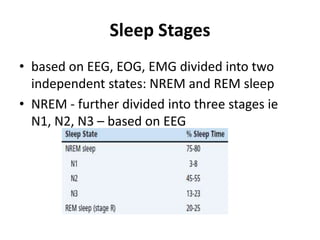
• based on EEG, EOG, EMG divided into two
independent states: NREM and REM sleep
• NREM - further divided into three stages ie
N1, N2, N3 – based on EEG
Sleep Requirements
• Sleep requirement is defined as the optimal
amount of sleep required to remain alert and
fully awake and to function adequately
throughout the day
• for an average adult is approximately 7.5 to 8
hours
Classification of Sleep Disorders
• I. Insomnia
• II. Sleep-related breathing disorders
• III. Hypersomnias of central origin
• IV. Circadian rhythm sleep disorders
• V. Parasomnias
• VI. Sleep-related movement disorders
Approach to the Patient
Common sleep complaints
• Insomnia - inability to initiate or maintain
sleep adequately at night
• EDS - chronic fatigue, sleepiness, or tiredness
during the day
• Inability to sleep at the right time
• Abnormal movements and behavioural
manifestation associated with sleep
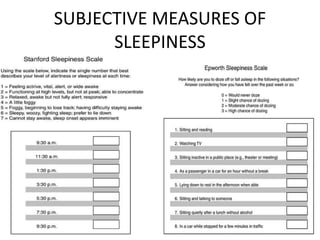
SUBJECTIVE MEASURES OF
SLEEPINESS
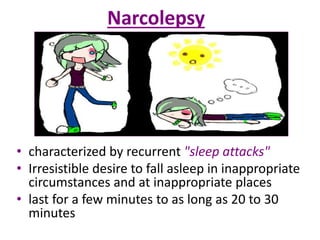
Narcolepsy
• characterized by recurrent "sleep attacks"
• Irresistible desire to fall asleep in inappropriate
circumstances and at inappropriate places
• last for a few minutes to as long as 20 to 30
minutes
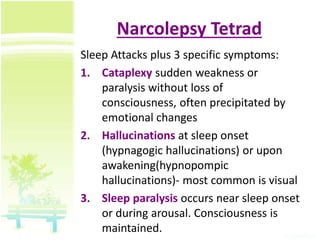
Narcolepsy Tetrad
Sleep Attacks plus 3 specific symptoms:
1. Cataplexy sudden weakness or
paralysis without loss of
consciousness, often precipitated by
emotional changes
2. Hallucinations at sleep onset
(hypnagogic hallucinations) or upon
awakening(hypnopompic
hallucinations)- most common is visual
3. Sleep paralysis occurs near sleep onset
or during arousal. Consciousness is
maintained.
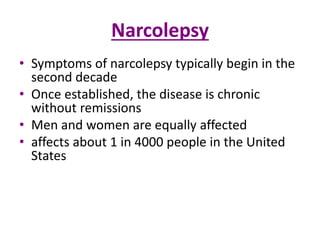
Narcolepsy
• Symptoms of narcolepsy typically begin in the
second decade
• Once established, the disease is chronic
without remissions
• Men and women are equally affected
• affects about 1 in 4000 people in the United
States
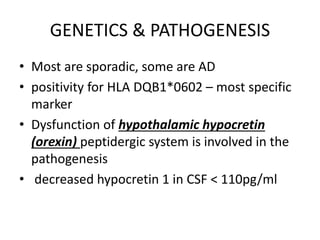
GENETICS & PATHOGENESIS
• Most are sporadic, some are AD
• positivity for HLA DQB1*0602 – most specific
marker
• Dysfunction of hypothalamic hypocretin
(orexin) peptidergic system is involved in the
pathogenesis
• decreased hypocretin 1 in CSF < 110pg/ml
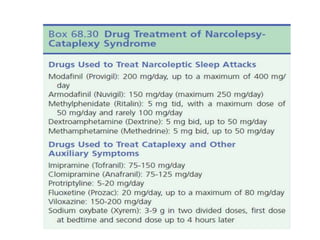
Treatment of Narcolepsy-Cataplexy
Syndrome
Nonpharmacological measures include
• scheduled short daytime naps,
• sleep hygiene measures
Breathing-related Sleep Disorders
syndromes in which the patient's sleep is
interrupted by problems with his or her
breathing
OBSTRUCTIVE SLEEP APNEA
• MC medical condition @ EDS
• defined as the coexistence of unexplained EDS
with at least five obstructed breathing events
(apnea or hypopnea) per hour of sleep
• repetitive episodes of complete (apnea) or
partial (hypopnea) upper airway obstruction
during sleep
• arterial oxygen desaturation and arousal from
sleep
Apnea-Hypopnea Index (AHI)
• number of apneas and hypopneas per hour of
sleep
• AHI score of 5 or below is considered normal
• 5 to 15 - mild OSAS
• 16 to 29 - moderate OSAS
• 30 or more - severe OSAS
Pathogenesis
• Collapse of the pharyngeal airway is the
fundamental factor
• During sleep, muscle tone decreases-
increasing upper airway resistance and
narrowing the upper airway space
Epidemiology
• prevalence is 4% in men and 2% in women
between the ages of 30 and 60
• also occurs in childhood—usually associated
with tonsil or adenoid enlargement
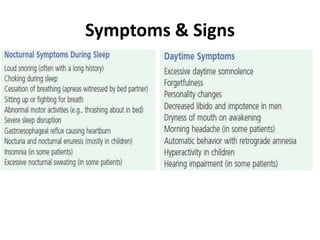
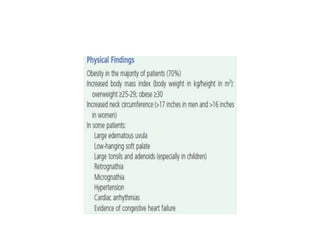
Symptoms & Signs
Consequences
• increased morbidity and mortality
• short-term consequences (impairment of
quality of life and increasing traffic- and work-
related accidents)
• long-term consequences from associated and
comorbid conditions such as systemic
hypertension, pulmonary hypertension, heart
failure, cardiac arrhythmias
General Measures
• Avoid alcohol and sedative-hypnotics,
especially in the evening
• Reduce body weight if overweight
• Avoid sleep deprivation
• Participate in regular exercise program
• Avoid supine sleeping position
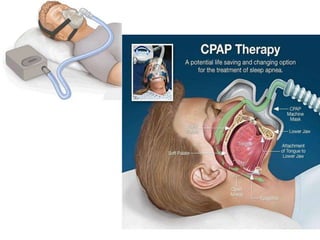
Mechanical Devices
• Continuous positive airway pressure (CPAP)
titration - treatment of choice
• Oral appliances, including mandibular
advancement device
• Tongue-retaining device
Surgical Techniques
• Uvulopalatopharyngoplasty (UPP)
• Laser-assisted UPP (LAUP)
• Radiofrequency UPP (somnoplasty)
• Palatal implants
• Nasal surgery
• Maxillomandibular advancement
• Anterior hyoid advancement
• Tonsillectomy and adenoidectomy
PARASOMNIAS
• abnormal movements or behaviours that
occur in sleep or during arousals from sleep
ICSD-2 (AASM, 2005)
Disorders of arousal (from NREM sleep),
• Confusional arousals
• Sleepwalking
• Sleep terror
Parasomnias associated with REM sleep
• RBD
• Recurrent isolated sleep paralysis
• Nightmare disorder
Other Parasomnias
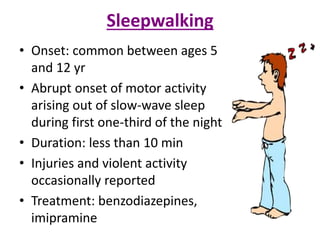
Sleepwalking
• Onset: common between ages 5
and 12 yr
• Abrupt onset of motor activity
arising out of slow-wave sleep
during first one-third of the night
• Duration: less than 10 min
• Injuries and violent activity
occasionally reported
• Treatment: benzodiazepines,
imipramine
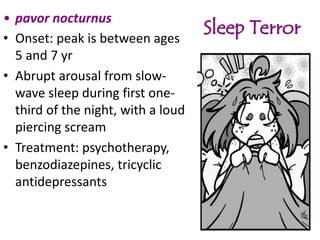
Sleep Terror
• pavor nocturnus
• Onset: peak is between ages
5 and 7 yr
• Abrupt arousal from slow-
wave sleep during first one-
third of the night, with a loud
piercing scream
• Treatment: psychotherapy,
benzodiazepines, tricyclic
antidepressants
Rapid Eye Movement Sleep
Behavior Disorder (RBD)
• Onset: middle-aged or elderly men
• Presents with violent dream-enacting
behavior during sleep, causing injury to self or
bed partner
• 40% idiopathic, 60% associated
neurodegenerative diseases - PD, MSA, CBD,
DLBD, PSP
• Treatment: clonazepam, melatonin
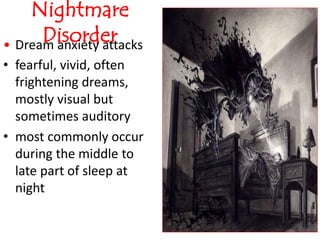
Nightmare
Disorder• Dream anxiety attacks
• fearful, vivid, often
frightening dreams,
mostly visual but
sometimes auditory
• most commonly occur
during the middle to
late part of sleep at
night
• mostly a normal phenomenon, up to 50% of
children have nightmares
• side effects of certain medications such as
antiparkinsonian drugs (pergolide, levodopa),
anticholinergics, and antihypertensive drugs,
particularly beta-blockers
• generally do not require any treatment except
reassurance
Sleep-Related
Movement Disorders
Restless Legs Syndrome (RLS)
• also known as Ekbom’s syndrome
• Unpleasant sensations in the legs when the
patient is tired in the evenings and at the
onset of sleep
• ameliorated by moving the legs
• mostly diagnosed in the middle or later years
• strong familial tendency
• can present with daytime somnolence due to
disturbed night-time sleep
Secondary - Medical Disorders
• Anemia: iron and folate deficiency
• Diabetes mellitus
• Amyloidosis
• Uremia
• Chronic obstructive pulmonary disease
• Peripheral vascular (arterial or venous)
disorder
• Rheumatoid arthritis
• Hypothyroidism
Pathophysiology
• iron-dopamine dysfunction
• abnormalities in the body’s use and storage of
iron
• dopamine dysfunction - changes in dopamine
receptors or dopamine uptake
Drug Treatment of Restless
Legs Syndrome
Dopaminergic agents:
• Pramipexole
• Ropinirole
Benzodiazepines:
• Clonazepam
• Temazepam
Antiepileptic agents:
• Gabapentin
• Pregabalin
Insomnia
• most common sleep disorder
• Inability to initiate or maintain sleep, early
awakening, inadequate sleep time, or poor
sleep quality associated with a lack of feeling
restored and refreshed in the morning,
leading to poor daytime functioning - AASM
(2005)
Medical Disorders Comorbid
with Insomnia
• Ischemic heart disease
• Congestive cardiac failure
• Chronic obstructive pulmonary disease
• Bronchial asthma
• Peptic ulcer disease
• Gastroesophageal reflux disease
• Rheumatic disorders
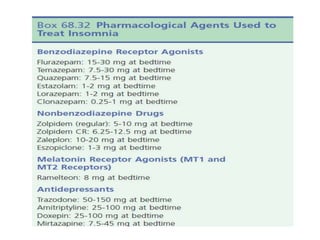
Treatment of Insomnia
• most commonly used hypnotics are the
benzodiazepine receptor agonists – zolpidem,
zaleplon, and eszopiclone
• Melatonin receptor agonists(ramelteon) -
sleep-onset insomnia
Laboratory Assessment of
Sleep Disorders
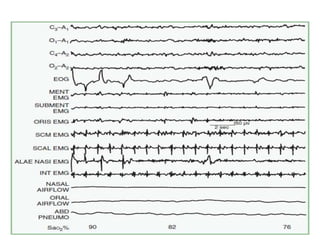
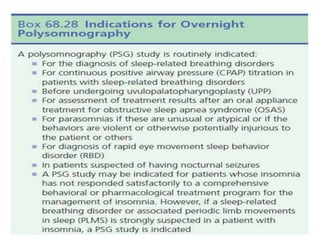
• The two most important laboratory tests for
diagnosis of sleep disturbance are PSG and the
MSLT
• overnight PSG study is the single most
important laboratory test for the diagnosis
and treatment of patients with sleep disorders
• EEG, EMG, EOG, ECG, SaO2, Nasal and oral
airflow, Respiratory effort (chest and
abdomen)
Multiple Sleep Latency Test
• important test to effectively document EDS
• Narcolepsy is the single most important
indication
• presence of two sleep-onset REMs on four or
five nap studies and sleep-onset latency of
less than 8 minutes strongly suggest a
diagnosis of narcolepsy
• circadian rhythm sleep disturbance - REM
sleep abnormalities

Sleep disorders2015

  • 1.
  • 2.
    What is sleep? •Complex physiological state that occurs periodically and is characterised by relative quiescence, immobility and greatly decreased responsiveness to external stimuli
  • 3.
    Sleep Stages • basedon EEG, EOG, EMG divided into two independent states: NREM and REM sleep • NREM - further divided into three stages ie N1, N2, N3 – based on EEG
  • 4.
    Sleep Requirements • Sleeprequirement is defined as the optimal amount of sleep required to remain alert and fully awake and to function adequately throughout the day • for an average adult is approximately 7.5 to 8 hours
  • 5.
    Classification of SleepDisorders • I. Insomnia • II. Sleep-related breathing disorders • III. Hypersomnias of central origin • IV. Circadian rhythm sleep disorders • V. Parasomnias • VI. Sleep-related movement disorders
  • 6.
    Approach to thePatient Common sleep complaints • Insomnia - inability to initiate or maintain sleep adequately at night • EDS - chronic fatigue, sleepiness, or tiredness during the day • Inability to sleep at the right time • Abnormal movements and behavioural manifestation associated with sleep
  • 7.
  • 8.
    Narcolepsy • characterized byrecurrent "sleep attacks" • Irresistible desire to fall asleep in inappropriate circumstances and at inappropriate places • last for a few minutes to as long as 20 to 30 minutes
  • 9.
    Narcolepsy Tetrad Sleep Attacksplus 3 specific symptoms: 1. Cataplexy sudden weakness or paralysis without loss of consciousness, often precipitated by emotional changes 2. Hallucinations at sleep onset (hypnagogic hallucinations) or upon awakening(hypnopompic hallucinations)- most common is visual 3. Sleep paralysis occurs near sleep onset or during arousal. Consciousness is maintained.
  • 10.
    Narcolepsy • Symptoms ofnarcolepsy typically begin in the second decade • Once established, the disease is chronic without remissions • Men and women are equally affected • affects about 1 in 4000 people in the United States
  • 12.
    GENETICS & PATHOGENESIS •Most are sporadic, some are AD • positivity for HLA DQB1*0602 – most specific marker • Dysfunction of hypothalamic hypocretin (orexin) peptidergic system is involved in the pathogenesis • decreased hypocretin 1 in CSF < 110pg/ml
  • 13.
    Treatment of Narcolepsy-Cataplexy Syndrome Nonpharmacologicalmeasures include • scheduled short daytime naps, • sleep hygiene measures
  • 15.
    Breathing-related Sleep Disorders syndromesin which the patient's sleep is interrupted by problems with his or her breathing
  • 16.
    OBSTRUCTIVE SLEEP APNEA •MC medical condition @ EDS • defined as the coexistence of unexplained EDS with at least five obstructed breathing events (apnea or hypopnea) per hour of sleep • repetitive episodes of complete (apnea) or partial (hypopnea) upper airway obstruction during sleep • arterial oxygen desaturation and arousal from sleep
  • 17.
    Apnea-Hypopnea Index (AHI) •number of apneas and hypopneas per hour of sleep • AHI score of 5 or below is considered normal • 5 to 15 - mild OSAS • 16 to 29 - moderate OSAS • 30 or more - severe OSAS
  • 18.
    Pathogenesis • Collapse ofthe pharyngeal airway is the fundamental factor • During sleep, muscle tone decreases- increasing upper airway resistance and narrowing the upper airway space
  • 19.
    Epidemiology • prevalence is4% in men and 2% in women between the ages of 30 and 60 • also occurs in childhood—usually associated with tonsil or adenoid enlargement
  • 21.
  • 23.
    Consequences • increased morbidityand mortality • short-term consequences (impairment of quality of life and increasing traffic- and work- related accidents) • long-term consequences from associated and comorbid conditions such as systemic hypertension, pulmonary hypertension, heart failure, cardiac arrhythmias
  • 24.
    General Measures • Avoidalcohol and sedative-hypnotics, especially in the evening • Reduce body weight if overweight • Avoid sleep deprivation • Participate in regular exercise program • Avoid supine sleeping position
  • 25.
    Mechanical Devices • Continuouspositive airway pressure (CPAP) titration - treatment of choice • Oral appliances, including mandibular advancement device • Tongue-retaining device
  • 27.
    Surgical Techniques • Uvulopalatopharyngoplasty(UPP) • Laser-assisted UPP (LAUP) • Radiofrequency UPP (somnoplasty) • Palatal implants • Nasal surgery • Maxillomandibular advancement • Anterior hyoid advancement • Tonsillectomy and adenoidectomy
  • 28.
    PARASOMNIAS • abnormal movementsor behaviours that occur in sleep or during arousals from sleep
  • 29.
    ICSD-2 (AASM, 2005) Disordersof arousal (from NREM sleep), • Confusional arousals • Sleepwalking • Sleep terror Parasomnias associated with REM sleep • RBD • Recurrent isolated sleep paralysis • Nightmare disorder Other Parasomnias
  • 30.
    Sleepwalking • Onset: commonbetween ages 5 and 12 yr • Abrupt onset of motor activity arising out of slow-wave sleep during first one-third of the night • Duration: less than 10 min • Injuries and violent activity occasionally reported • Treatment: benzodiazepines, imipramine
  • 31.
    Sleep Terror • pavornocturnus • Onset: peak is between ages 5 and 7 yr • Abrupt arousal from slow- wave sleep during first one- third of the night, with a loud piercing scream • Treatment: psychotherapy, benzodiazepines, tricyclic antidepressants
  • 32.
    Rapid Eye MovementSleep Behavior Disorder (RBD) • Onset: middle-aged or elderly men • Presents with violent dream-enacting behavior during sleep, causing injury to self or bed partner • 40% idiopathic, 60% associated neurodegenerative diseases - PD, MSA, CBD, DLBD, PSP • Treatment: clonazepam, melatonin
  • 33.
    Nightmare Disorder• Dream anxietyattacks • fearful, vivid, often frightening dreams, mostly visual but sometimes auditory • most commonly occur during the middle to late part of sleep at night
  • 34.
    • mostly anormal phenomenon, up to 50% of children have nightmares • side effects of certain medications such as antiparkinsonian drugs (pergolide, levodopa), anticholinergics, and antihypertensive drugs, particularly beta-blockers • generally do not require any treatment except reassurance
  • 35.
  • 36.
    Restless Legs Syndrome(RLS) • also known as Ekbom’s syndrome • Unpleasant sensations in the legs when the patient is tired in the evenings and at the onset of sleep • ameliorated by moving the legs • mostly diagnosed in the middle or later years • strong familial tendency • can present with daytime somnolence due to disturbed night-time sleep
  • 37.
    Secondary - MedicalDisorders • Anemia: iron and folate deficiency • Diabetes mellitus • Amyloidosis • Uremia • Chronic obstructive pulmonary disease • Peripheral vascular (arterial or venous) disorder • Rheumatoid arthritis • Hypothyroidism
  • 38.
    Pathophysiology • iron-dopamine dysfunction •abnormalities in the body’s use and storage of iron • dopamine dysfunction - changes in dopamine receptors or dopamine uptake
  • 39.
    Drug Treatment ofRestless Legs Syndrome Dopaminergic agents: • Pramipexole • Ropinirole Benzodiazepines: • Clonazepam • Temazepam Antiepileptic agents: • Gabapentin • Pregabalin
  • 40.
    Insomnia • most commonsleep disorder • Inability to initiate or maintain sleep, early awakening, inadequate sleep time, or poor sleep quality associated with a lack of feeling restored and refreshed in the morning, leading to poor daytime functioning - AASM (2005)
  • 41.
    Medical Disorders Comorbid withInsomnia • Ischemic heart disease • Congestive cardiac failure • Chronic obstructive pulmonary disease • Bronchial asthma • Peptic ulcer disease • Gastroesophageal reflux disease • Rheumatic disorders
  • 42.
    Treatment of Insomnia •most commonly used hypnotics are the benzodiazepine receptor agonists – zolpidem, zaleplon, and eszopiclone • Melatonin receptor agonists(ramelteon) - sleep-onset insomnia
  • 44.
    Laboratory Assessment of SleepDisorders • The two most important laboratory tests for diagnosis of sleep disturbance are PSG and the MSLT • overnight PSG study is the single most important laboratory test for the diagnosis and treatment of patients with sleep disorders • EEG, EMG, EOG, ECG, SaO2, Nasal and oral airflow, Respiratory effort (chest and abdomen)
  • 47.
    Multiple Sleep LatencyTest • important test to effectively document EDS • Narcolepsy is the single most important indication • presence of two sleep-onset REMs on four or five nap studies and sleep-onset latency of less than 8 minutes strongly suggest a diagnosis of narcolepsy • circadian rhythm sleep disturbance - REM sleep abnormalities