HND in Construction & Built Environment (Civil Engineering) BCAS DOHA QATAR
Unit 36: Applied Mathematics for Complex Engineering Problems Page 1
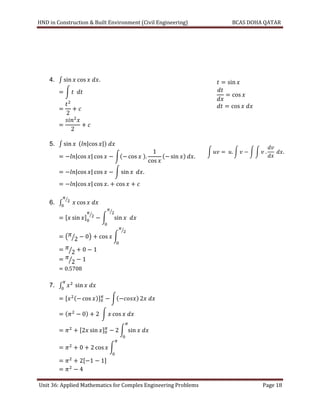
LO1 Understand the use of trigonometric functions.
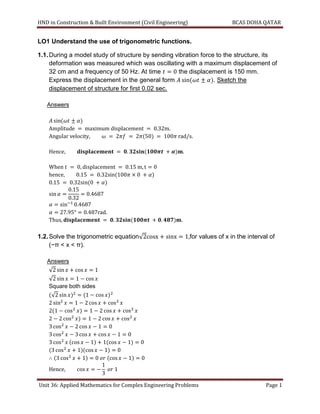
1.1.During a model study of structure by sending vibration force to the structure, its
deformation was measured which was oscillating with a maximum displacement of
32 cm and a frequency of 50 Hz. At time = 0 the displacement is 150 mm.
Express the displacement in the general form sin( ± ). Sketch the
displacement of structure for first 0.02 sec.
Answers
sin( ± )
Amplitude = maximum displacement = 0.32m.
Angular velocity, = 2 = 2 (50) = 100 rad/s.
Hence, = . ( + ) .
When = 0, displacement = 0.15 m, t = 0
hence, 0.15 = 0.32sin(100 × 0 + )
0.15 = 0.32sin(0 + )
sin =
0.15
0.32
= 0.4687
= sin 0.4687
= 27.95° = 0.487rad.
Thus, = . ( + . ) .
1.2.Solve the trigonometric equation√2cosx + sinx = 1,for values of x in the interval of
(−π < x < π).
Answers
√2 sin + cos = 1
√2 sin = 1 − cos
Square both sides
(√2 sin ) = (1 − cos )
2 sin = 1 − 2 cos + cos
2(1 − cos ) = 1 − 2 cos + cos
2 − 2 cos ) = 1 − 2 cos + cos
3 cos − 2 cos − 1 = 0
3 cos − 3 cos + cos − 1 = 0
3 cos (cos − 1) + 1(cos − 1) = 0
(3 cos + 1)(cos − 1) = 0
∴ (3 cos + 1) = 0 (cos − 1) = 0
Hence, cos = −
1
3
1
HND in Construction & Built Environment (Civil Engineering) BCAS DOHA QATAR
Unit 36: Applied Mathematics for Complex Engineering Problems Page 2
= cos −
1
3
cos 1
= 109.47˚ 0˚ (−π < x < π).
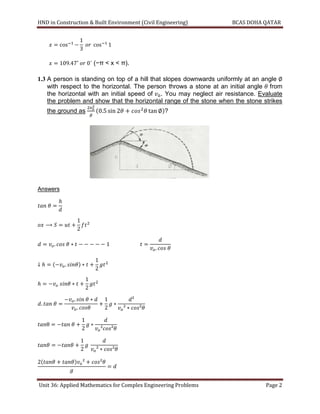
1.3 A person is standing on top of a hill that slopes downwards uniformly at an angle ∅
with respect to the horizontal. The person throws a stone at an initial angle from
the horizontal with an initial speed of . You may neglect air resistance. Evaluate
the problem and show that the horizontal range of the stone when the stone strikes
the ground as (0.5 sin 2 + tan ∅)?
Answers
=
ℎ
⟶ = +
1
2
= . ∗ − − − − − 1 =
.
↓ ℎ = (− . ) ∗ +
1
2
ℎ = − ∗ +
1
2
. =
− . ∗
.
+
1
2
∗
²
² ∗ ²
θ = − +
1
2
∗
² ²
= − +
1
2 ² ∗ ²
2( + ) ² + ²
=
HND in Construction & Built Environment (Civil Engineering) BCAS DOHA QATAR
Unit 36: Applied Mathematics for Complex Engineering Problems Page 3
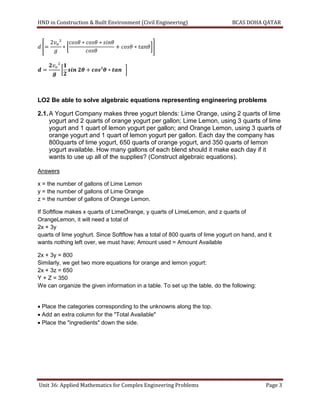
=
2 ²
∗
∗ ∗
+ ∗
=
²
+ ² ∗
LO2 Be able to solve algebraic equations representing engineering problems
2.1.A Yogurt Company makes three yogurt blends: Lime Orange, using 2 quarts of lime
yogurt and 2 quarts of orange yogurt per gallon; Lime Lemon, using 3 quarts of lime
yogurt and 1 quart of lemon yogurt per gallon; and Orange Lemon, using 3 quarts of
orange yogurt and 1 quart of lemon yogurt per gallon. Each day the company has
800quarts of lime yogurt, 650 quarts of orange yogurt, and 350 quarts of lemon
yogurt available. How many gallons of each blend should it make each day if it
wants to use up all of the supplies? (Construct algebraic equations).
Answers
x = the number of gallons of Lime Lemon
y = the number of gallons of Lime Orange
z = the number of gallons of Orange Lemon.
If Softflow makes x quarts of LimeOrange, y quarts of LimeLemon, and z quarts of
OrangeLemon, it will need a total of
2x + 3y
quarts of lime yoghurt. Since Softflow has a total of 800 quarts of lime yogurt on hand, and it
wants nothing left over, we must have; Amount used = Amount Available
2x + 3y = 800
Similarly, we get two more equations for orange and lemon yogurt:
2x + 3z = 650
Y + Z = 350
We can organize the given information in a table. To set up the table, do the following:
 Place the categories corresponding to the unknowns along the top.
 Add an extra column for the "Total Available"
 Place the "ingredients" down the side.
HND in Construction & Built Environment (Civil Engineering) BCAS DOHA QATAR
Unit 36: Applied Mathematics for Complex Engineering Problems Page 4
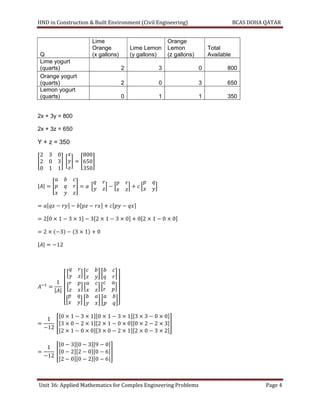
Q
Lime
Orange
(x gallons)
Lime Lemon
(y gallons)
Orange
Lemon
(z gallons)
Total
Available
Lime yogurt
(quarts) 2 3 0 800
Orange yogurt
(quarts) 2 0 3 650
Lemon yogurt
(quarts) 0 1 1 350
2x + 3y = 800
2x + 3z = 650
Y + z = 350
2 3 0
2 0 3
0 1 1
=
800
650
350
| | = = − +
= − − − + −
= 2 0 × 1 − 3 × 1 − 3 2 × 1 − 3 × 0 + 0 2 × 1 − 0 × 0
= 2 × (−3) − (3 × 1) + 0
| | = −12
=
1
| |
=
1
−12
0 × 1 − 3 × 1 0 × 1 − 3 × 1 3 × 3 − 0 × 0
3 × 0 − 2 × 1 2 × 1 − 0 × 0 0 × 2 − 2 × 3
2 × 1 − 0 × 0 3 × 0 − 2 × 1 2 × 0 − 3 × 2
=
1
−12
0 − 3 0 − 3 9 − 0
0 − 2 2 − 0 0 − 6
2 − 0 0 − 2 0 − 6
HND in Construction & Built Environment (Civil Engineering) BCAS DOHA QATAR
Unit 36: Applied Mathematics for Complex Engineering Problems Page 5
=
1
−12
−3 −3 9
−2 2 −6
2 −2 −6
Multiply each side of (ii) by the inverse metric
= =
−3 −3 9
−2 2 −6
2 −2 −6
800
650
350
=
1
−12
=
−3 × 800 −3 × 650 9 × 350
−2 × 800 2 × 650 −6 × 350
2 × 800 −2 × 650 −6 × 350
=
1
−12
=
−2400 −1950 3150
−1600 1300 −2100
1600 −1300 −2100
=
1
−12
=
−1200
−2400
−1800
= −
−1200
−12
= 100
= −
−2400
−12
= 200
= −
−1800
−12
= 150
2.2.(a) Prove that
1 + 1 1
1 1 + 1
1 1 1 +
= 1 + + +
(b) Use matrices to solve the simultaneous equations:.
x + 2y + 3z = 6
x + 3y + 5z = 9
2x + 5y + z = 8
Answers
(a)
1 + 1 1
1 1 + 1
1 1 1 +
= (1 + ) (1 + )(1 + ) − 1 − 1 + − 1 + 1 − (1 + )
= (1 + )( + + ) − −
HND in Construction & Built Environment (Civil Engineering) BCAS DOHA QATAR
Unit 36: Applied Mathematics for Complex Engineering Problems Page 6
= + + + + + − −
= + + +
= 1 +
1
+
1
+
1
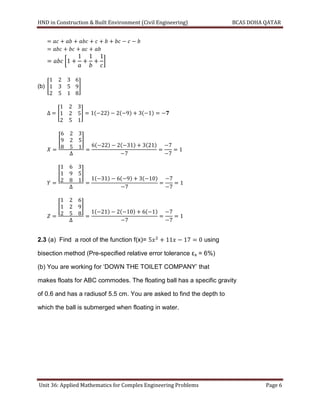
(b)
1 2 3
1 3 5
2 5 1
6
9
8
∆ =
1 2 3
1 2 5
2 5 1
= 1(−22) − 2(−9) + 3(−1) = −
=
6 2 3
9 2 5
8 5 1
∆
=
6(−22) − 2(−31) + 3(21)
−7
=
−7
−7
= 1
=
1 6 3
1 9 5
2 8 1
∆
=
1(−31) − 6(−9) + 3(−10)
−7
=
−7
−7
= 1
=
1 2 6
1 2 9
2 5 8
∆
=
1(−21) − 2(−10) + 6(−1)
−7
=
−7
−7
= 1
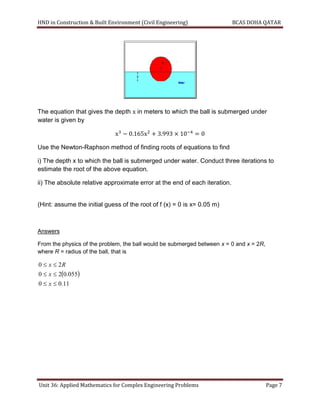
2.3 (a) Find a root of the function f(x)= 5 + 11 − 17 = 0 using
bisection method (Pre-specified relative error tolerance εs = 6%)
(b) You are working for ‘DOWN THE TOILET COMPANY’ that
makes floats for ABC commodes. The floating ball has a specific gravity
of 0.6 and has a radiusof 5.5 cm. You are asked to find the depth to
which the ball is submerged when floating in water.
HND in Construction & Built Environment (Civil Engineering) BCAS DOHA QATAR
Unit 36: Applied Mathematics for Complex Engineering Problems Page 7
The equation that gives the depth x in meters to which the ball is submerged under
water is given by
x − 0.165x + 3.993 × 10 = 0
Use the Newton-Raphson method of finding roots of equations to find
i) The depth x to which the ball is submerged under water. Conduct three iterations to
estimate the root of the above equation.
ii) The absolute relative approximate error at the end of each iteration.
(Hint: assume the initial guess of the root of f (x) = 0 is x= 0.05 m)
Answers
From the physics of the problem, the ball would be submerged between x = 0 and x = 2R,
where R = radius of the ball, that is
 
11.00
055.020
20



x
x
Rx
HND in Construction & Built Environment (Civil Engineering) BCAS DOHA QATAR
Unit 36: Applied Mathematics for Complex Engineering Problems Page 8
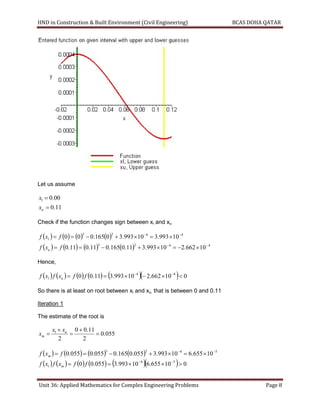
Let us assume
11.0
00.0


ux
xl
Check if the function changes sign between xl and xu
       
        4423
4423
10662.210993.311.0165.011.011.0
10993.310993.30165.000




fxf
fxf
u
l
Hence,
           010662.210993.311.00 44
 
ffxfxf ul
So there is at least on root between xl and xu, that is between 0 and 0.11
Iteration 1
The estimate of the root is
055.0
2
11.00
2




 u
m
xx
x l
       
           010655.610993.3055.00
10655.610993.3055.0165.0055.0055.0
54
5423




ffxfxf
fxf
ml
m
HND in Construction & Built Environment (Civil Engineering) BCAS DOHA QATAR
Unit 36: Applied Mathematics for Complex Engineering Problems Page 9
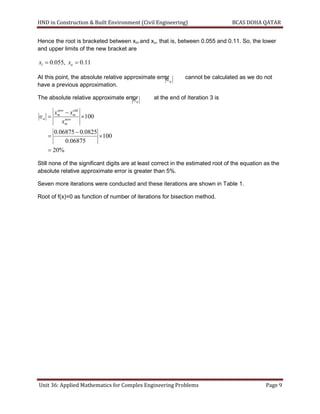
Hence the root is bracketed between xm and xu, that is, between 0.055 and 0.11. So, the lower
and upper limits of the new bracket are
11.0,055.0  ul xx
At this point, the absolute relative approximate error cannot be calculated as we do not
have a previous approximation.
The absolute relative approximate error at the end of Iteration 3 is
%20
100
06875.0
0825.006875.0
100






 new
m
old
m
new
m
a
x
xx
Still none of the significant digits are at least correct in the estimated root of the equation as the
absolute relative approximate error is greater than 5%.
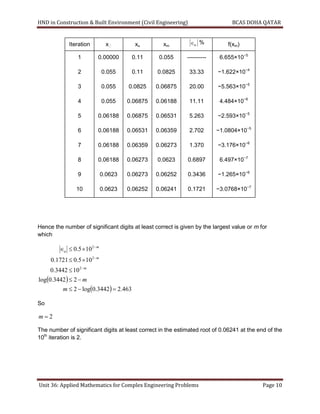
Seven more iterations were conducted and these iterations are shown in Table 1.
Root of f(x)=0 as function of number of iterations for bisection method.
a
a
HND in Construction & Built Environment (Civil Engineering) BCAS DOHA QATAR
Unit 36: Applied Mathematics for Complex Engineering Problems Page 10
Iteration x xu xm
a % f(xm)
1
2
3
4
5
6
7
8
9
10
0.00000
0.055
0.055
0.055
0.06188
0.06188
0.06188
0.06188
0.0623
0.0623
0.11
0.11
0.0825
0.06875
0.06875
0.06531
0.06359
0.06273
0.06273
0.06252
0.055
0.0825
0.06875
0.06188
0.06531
0.06359
0.06273
0.0623
0.06252
0.06241
----------
33.33
20.00
11.11
5.263
2.702
1.370
0.6897
0.3436
0.1721
6.655×10⁻⁵
−1.622×10⁻⁴
−5.563×10⁻⁵
4.484×10⁻⁶
−2.593×10⁻⁵
−1.0804×10⁻⁵
−3.176×10⁻⁶
6.497×10⁻⁷
−1.265×10⁻⁶
−3.0768×10⁻⁷
Hence the number of significant digits at least correct is given by the largest value or m for
which
 
  463.23442.0log2
23442.0log
103442.0
105.01721.0
105.0
2
2
2








m
m
m
m
m
a
So
2m
The number of significant digits at least correct in the estimated root of 0.06241 at the end of the
10th
iteration is 2.
HND in Construction & Built Environment (Civil Engineering) BCAS DOHA QATAR
Unit 36: Applied Mathematics for Complex Engineering Problems Page 11
LO3 Be able to apply calculus to engineering problems
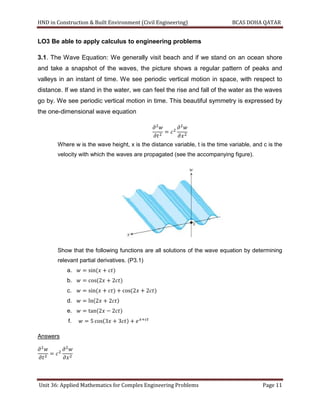
3.1. The Wave Equation: We generally visit beach and if we stand on an ocean shore
and take a snapshot of the waves, the picture shows a regular pattern of peaks and
valleys in an instant of time. We see periodic vertical motion in space, with respect to
distance. If we stand in the water, we can feel the rise and fall of the water as the waves
go by. We see periodic vertical motion in time. This beautiful symmetry is expressed by
the one-dimensional wave equation
=
Where w is the wave height, x is the distance variable, t is the time variable, and c is the
velocity with which the waves are propagated (see the accompanying figure).
Show that the following functions are all solutions of the wave equation by determining
relevant partial derivatives. (P3.1)
a. = sin( + )
b. = cos(2 + 2 )
c. = sin( + ) + cos(2 + 2 )
d. = ln(2 + 2 )
e. = tan(2 − 2 )
f. = 5 cos(3 + 3 ) +
Answers
=
HND in Construction & Built Environment (Civil Engineering) BCAS DOHA QATAR
Unit 36: Applied Mathematics for Complex Engineering Problems Page 12
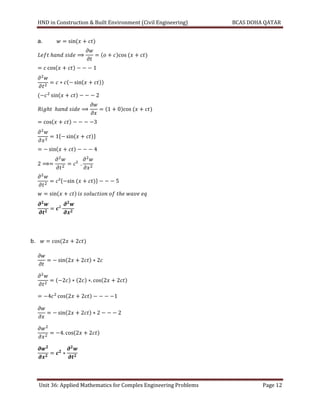
a. = sin( + )
ℎ ⟹ = ( + )cos ( + )
= cos( + ) − − − 1
= ∗ (− sin( + ))
(− sin( + ) − − − 2
ℎ ℎ ⟹ = (1 + 0)cos ( + )
= cos( + ) − − − −3
= 1 − sin( + )
= − sin( + ) − − − 4
2 ⟹= = ² .
= ² −sin ( + ) − − − 5
= sin( + ) ℎ
= ²
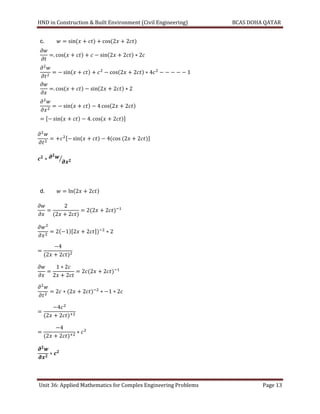
b. = cos(2 + 2 )
= − sin(2 + 2 ) ∗ 2
= (−2 ) ∗ (2 ) ∗. cos(2 + 2 )
= −4 cos(2 + 2 ) − − − −1
= − sin(2 + 2 ) ∗ 2 − − − 2
= −4. cos(2 + 2 )
= ∗
HND in Construction & Built Environment (Civil Engineering) BCAS DOHA QATAR
Unit 36: Applied Mathematics for Complex Engineering Problems Page 13
c. = sin( + ) + cos(2 + 2 )
=. cos( + ) + − sin(2 + 2 ) ∗ 2
= − sin( + ) + − cos(2 + 2 ) ∗ 4 − − − − − 1
=. cos( + ) − sin(2 + 2 ) ∗ 2
= − sin( + ) − 4 cos(2 + 2 )
= − sin( + ) − 4. cos( + 2 )
= + − sin( + ) − 4(cos (2 + 2 )
∗
d. = ln(2 + 2 )
=
2
(2 + 2 )
= 2(2 + 2 )
= 2(−1) 2 + 2 ) ∗ 2
=
−4
(2 + 2 )
=
1 ∗ 2
2 + 2
= 2 (2 + 2 )
= 2 ∗ (2 + 2 ) ∗ −1 ∗ 2
=
−4
(2 + 2 )
=
−4
(2 + 2 )
∗
∗
HND in Construction & Built Environment (Civil Engineering) BCAS DOHA QATAR
Unit 36: Applied Mathematics for Complex Engineering Problems Page 14
e. = tan(2 − 2 )
=
1 ∗ 2
1 + (2 − 2 )²
=
2
1 + 4 ² − 8 + 4 ² ²
= −2(1 + 4 − 8 + 4 ) ∗ (8 − 8 )
=
1 ∗ (−2 )
1 + (2 − 2 )²
=
−2
1 + 4 ² + 4 ² ² − 8
=
−2 (−1) 4 ² ∗ 2 − 8
1 + 4 + 4 − 8
=
2 ² 4 + 8 − 8
1 + 4 ² + 4 ² ² − 8 ²
=
−2 ² 8 − 8
1 + 4 ² + 4 ² ² − 8 ²
=
− 8 − 8 ∗ ²
1 + 4 ² − 8 + 4 ² ² ²
= ∗ ²
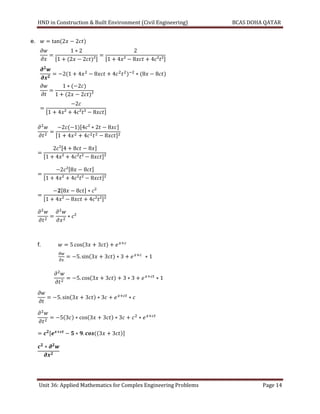
f. = 5 cos(3 + 3 ) +
= −5. sin(3 + 3 ) ∗ 3 + ∗ 1
= −5. cos(3 + 3 ) + 3 ∗ 3 + ∗ 1
= −5. sin(3 + 3 ) ∗ 3 + ∗
= −5(3 ) ∗ cos(3 + 3 ) ∗ 3 + ∗
= − ∗ . ((3 + 3 )
∗
HND in Construction & Built Environment (Civil Engineering) BCAS DOHA QATAR
Unit 36: Applied Mathematics for Complex Engineering Problems Page 15
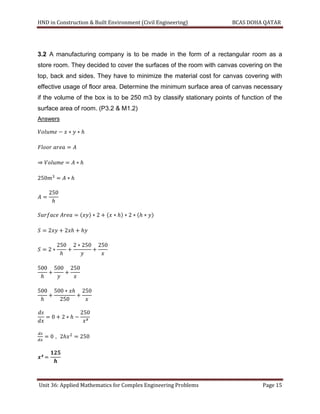
3.2 A manufacturing company is to be made in the form of a rectangular room as a
store room. They decided to cover the surfaces of the room with canvas covering on the
top, back and sides. They have to minimize the material cost for canvas covering with
effective usage of floor area. Determine the minimum surface area of canvas necessary
if the volume of the box is to be 250 m3 by classify stationary points of function of the
surface area of room. (P3.2 & M1.2)
Answers
− ∗ ∗ ℎ
=
⇒ = ∗ ℎ
250 = ∗ ℎ
=
250
ℎ
= ( ) ∗ 2 + ( ∗ ℎ) ∗ 2 ∗ (ℎ ∗ )
= 2 + 2 ℎ + ℎ
= 2 ∗
250
ℎ
+
2 ∗ 250
+
250
500
ℎ
+
500
+
250
500
ℎ
+
500 ∗ ℎ
250
+
250
= 0 + 2 ∗ ℎ −
250
²
= 0 , 2ℎ = 250
² =
HND in Construction & Built Environment (Civil Engineering) BCAS DOHA QATAR
Unit 36: Applied Mathematics for Complex Engineering Problems Page 16
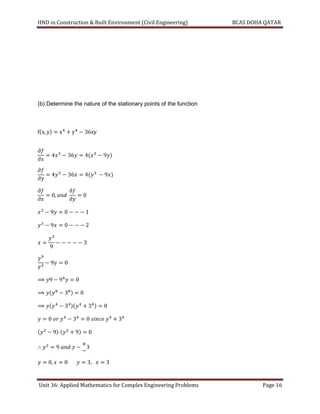
(b) Determine the nature of the stationary points of the function
f(x, y) = x + y − 36xy
= 4 − 36 = 4( − 9 )
= 4 − 36 = 4( − 9 )
= 0, = 0
− 9 = 0 − − − 1
− 9 = 0 − − − 2
=
9
− − − − − 3
− 9 = 0
⟹ 9 − 9 = 0
⟹ ( − 3 ) = 0
⟹ ( − 3 )( + 3 ) = 0
= 0 − 3 = 0 + 3
( − 9) ( + 9) = 0
∴ = 9 −
+
−
3
= 0, = 0 = 3, = 3
HND in Construction & Built Environment (Civil Engineering) BCAS DOHA QATAR
Unit 36: Applied Mathematics for Complex Engineering Problems Page 17
= −3, = −3
( , )(− , − ) ( , )
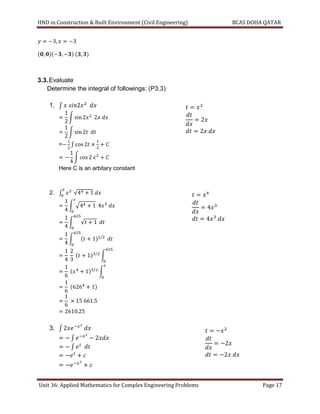
3.3.Evaluate
Determine the integral of followings: (P3.3)
1. 2
=
1
2
sin 2 2
=
1
2
sin 2
=− cos 2 × +
= −
1
4
cos 2 +
Here C is an arbitary constant
2. √4 + 1
=
1
4
4 + 1 4
=
1
4
√ + 1
=
1
4
( + 1) /
=
1
4
2
3
( + 1) /
=
1
6
( + 1) /
=
1
6
(626 + 1)
=
1
6
× 15 661.5
= 2610.25
3. 2
= − − 2
= −
= − +
= − +
=
= 2
= 2
=
= 4
= 4
= −
= −2
= −2
HND in Construction & Built Environment (Civil Engineering) BCAS DOHA QATAR
Unit 36: Applied Mathematics for Complex Engineering Problems Page 18
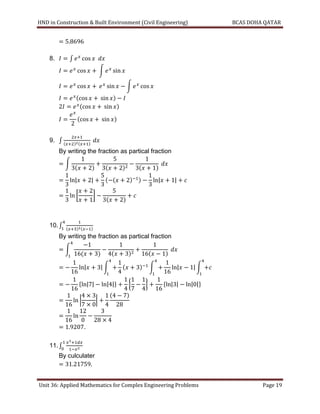
4. sin cos .
=
=
2
+
=
2
+
5. sin ( |cos |)
= − |cos | cos − (− cos ).
1
cos
(− sin ) .
= − |cos | cos − sin .
= − |cos | cos . + cos +
6. cos
= sin − sin
= 2 − 0 + cos
= 2 + 0 − 1
= 2 − 1
= 0.5708
7. sin
= (− cos ) − (− ) 2
= ( − 0) + 2 cos
= + 2 sin − 2 sin
= + 0 + 2 cos
= + 2 −1 − 1
= − 4
= sin
= cos
= cos
= . − . .
HND in Construction & Built Environment (Civil Engineering) BCAS DOHA QATAR
Unit 36: Applied Mathematics for Complex Engineering Problems Page 19
= 5.8696
8. = cos
= cos + sin
= cos + sin − cos
= (cos + sin ) −
2 = (cos + sin )
=
2
(cos + sin )
9. ( ) ( )
By writing the fraction as partical fraction
=
1
3( + 2)
+
5
3( + 2)
−
1
3( + 1)
=
1
3
ln| + 2| +
5
3
(−( + 2) ) −
1
3
ln| + 1| +
=
1
3
ln
+ 2
+ 1
−
5
3( + 2)
+
10. ( ) ( )
By writing the fraction as partical fraction
=
−1
16( + 3)
−
1
4( + 3)
+
1
16( − 1)
= −
1
16
ln| + 3| +
1
4
( + 3) +
1
16
ln| − 1| +
= −
1
16
ln|7| − ln|4| +
1
4
1
7
−
1
4
+
1
16
ln|3| − ln|0|
=
1
16
ln
4 × 3
7 × 0
+
1
4
(4 − 7)
28
=
1
16
ln
12
0
−
3
28 × 4
= 1.9207.
11.
By culculater
= 31.21759.
HND in Construction & Built Environment (Civil Engineering) BCAS DOHA QATAR
Unit 36: Applied Mathematics for Complex Engineering Problems Page 20
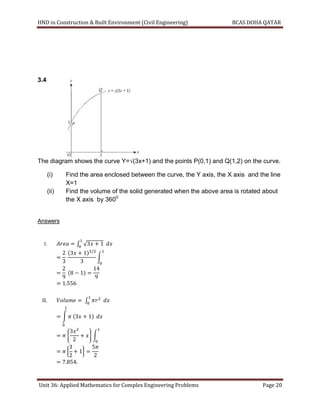
3.4
The diagram shows the curve Y=√(3x+1) and the points P(0,1) and Q(1,2) on the curve.
(i) Find the area enclosed between the curve, the Y axis, the X axis and the line
X=1
(ii) Find the volume of the solid generated when the above area is rotated about
the X axis by 3600
Answers
I. = √3 + 1
=
2
3
(3 + 1) /
3
=
2
9
(8 − 1) =
14
9
= 1.556
II. =
= (3 + 1)
=
3
2
+
=
3
2
+ 1 =
5
2
= 7.854.
HND in Construction & Built Environment (Civil Engineering) BCAS DOHA QATAR
Unit 36: Applied Mathematics for Complex Engineering Problems Page 21
LO5 Be able to apply statistical techniques to engineering problems.
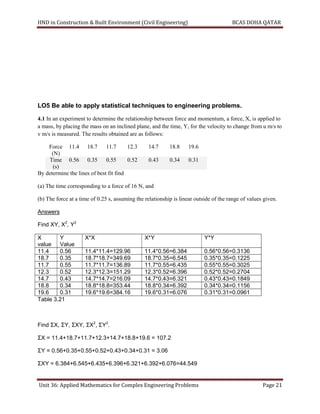
4.1 In an experiment to determine the relationship between force and momentum, a force, X, is applied to
a mass, by placing the mass on an inclined plane, and the time, Y, for the velocity to change from u m/s to
v m/s is measured. The results obtained are as follows:
Force
(N)
11.4 18.7 11.7 12.3 14.7 18.8 19.6
Time
(s)
0.56 0.35 0.55 0.52 0.43 0.34 0.31
By determine the lines of best fit find
(a) The time corresponding to a force of 16 N, and
(b) The force at a time of 0.25 s, assuming the relationship is linear outside of the range of values given.
Answers
Find XY, X2
, Y2
X
value
Y
Value
X*X X*Y Y*Y
11.4 0.56 11.4*11.4=129.96 11.4*0.56=6.384 0.56*0.56=0.3136
18.7 0.35 18.7*18.7=349.69 18.7*0.35=6.545 0.35*0.35=0.1225
11.7 0.55 11.7*11.7=136.89 11.7*0.55=6.435 0.55*0.55=0.3025
12.3 0.52 12.3*12.3=151.29 12.3*0.52=6.396 0.52*0.52=0.2704
14.7 0.43 14.7*14.7=216.09 14.7*0.43=6.321 0.43*0.43=0.1849
18.8 0.34 18.8*18.8=353.44 18.8*0.34=6.392 0.34*0.34=0.1156
19.6 0.31 19.6*19.6=384.16 19.6*0.31=6.076 0.31*0.31=0.0961
Table 3.21
Find ΣX, ΣY, ΣXY, ΣX2
, ΣY2
.
ΣX = 11.4+18.7+11.7+12.3+14.7+18.8+19.6 = 107.2
ΣY = 0.56+0.35+0.55+0.52+0.43+0.34+0.31 = 3.06
ΣXY = 6.384+6.545+6.435+6.396+6.321+6.392+6.076=44.549
HND in Construction & Built Environment (Civil Engineering) BCAS DOHA QATAR
Unit 36: Applied Mathematics for Complex Engineering Problems Page 22
ΣX2
= 129.96+349.69+136.89+151.29+216.09+353.44+384.16=1721.52
ΣY2
= 0.3136+0.1225+0.3025+0.2704+0.1849+0.1156+0.0961= 1.4056
The equation of the regression line of force on times is of the form Y=a0 + a1X and the constants
a0 and a1 are determined from the normal equations:
ΣY = a0N + a1ΣX
ΣXY = a0ΣX + a1ΣX2
Thus 3.06 = 7a0 + 107.2a1
And 44.549 = 107.2a0 + 1721.52a1
Solving for a1
3.06 = 7a0 + 107.2a1
3.06 - 107.2a1 = 7a0
(3.06 - 107.2a1)/7= a0
44.549 = 107.2a0 + 1721.52a1
44.549 = 107.2/7(3.06-107.2a1) + 1721.52a1
44.549 = 46.86171429-1641.691429a1 + 1721.52a1
44.549 = 46.8617429 +79.828571a1
-2.3127429 = 79.828571a1
a1 = -0.02897136790786346407228058736013
a1 = -0.029 (correct to 3 significant figures)
Solving for a0
3.06 = 7a0 + 107.2a1
3.06 = 7a0 + 107.2*-0.029
3.06 = 7a0-3.1088
a0 = 0.88125714285714285714285714285714
HND in Construction & Built Environment (Civil Engineering) BCAS DOHA QATAR
Unit 36: Applied Mathematics for Complex Engineering Problems Page 23
a0 = 0.881(correct to 3 significant figures)
Solving these simultaneous equations gives a0 = 4.873 and a1 = -0.029. Thus the equation of
the regression line of force on times is :
Y = a0 + a1
Y = 0.881- 0.029X
The equation of the regression line of force on times is of the form X=b0 + b1Y and the constants
b0 and b1 are determined from the normal equations:
ΣX = b0N + b1ΣY
ΣXY = b0ΣY + b1ΣY2
Thus 107.2 = 7b0 + 3.06b1
And 44.549 = 3.06b0 + 1.4056b1
Solving for b0
107.2 = 7b0 + 3.06b1
107.2 – 7b0 = 3.06b1
b1= (107.2 – 7b0)/ 3.06
44.549 = 3.06b0 + 1.4056b1
44.549 = 3.06b0 + 1.4056/3.06(107.2 – 7b0)
44.549 = 3.06b0 + 49.2419346 - 3.2154248b0
0.1554248b0= 4.6929346
b0 = 30.19424571
b0 = 30.194 (correct to 3 significant figures)
Solving for b1
HND in Construction & Built Environment (Civil Engineering) BCAS DOHA QATAR
Unit 36: Applied Mathematics for Complex Engineering Problems Page 24
107.2 = 7b0 + 3.06b1
107.2 = 7*30.194 + 3.06b1
107.2 = 211.358 + 3.06b1
3.06b1 = -104.158
b1 = -34.0385620915
b1 = -34.039 (correct to 3 significant figures)
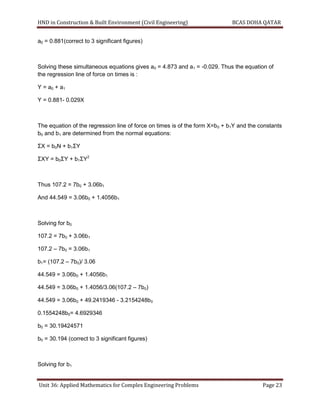
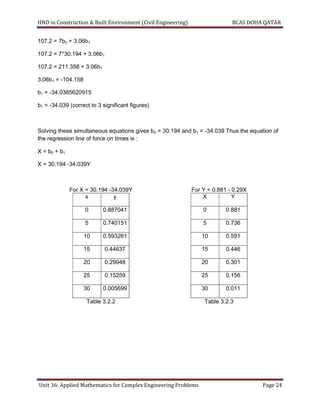
Solving these simultaneous equations gives b0 = 30.194 and b1 = -34.039 Thus the equation of
the regression line of force on times is :
X = b0 + b1
X = 30.194 -34.039Y
For X = 30.194 -34.039Y
x y
0 0.887041
5 0.740151
10 0.593261
15 0.44637
20 0.29948
25 0.15259
30 0.005699
Table 3.2.2
For Y = 0.881 - 0.29X
X Y
0 0.881
5 0.736
10 0.591
15 0.446
20 0.301
25 0.156
30 0.011
Table 3.2.3
HND in Construction & Built Environment (Civil Engineering) BCAS DOHA QATAR
Unit 36: Applied Mathematics for Complex Engineering Problems Page 25
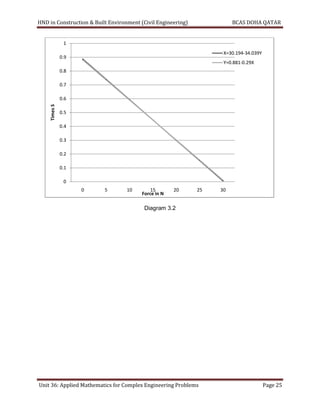
Diagram 3.2
0
0.1
0.2
0.3
0.4
0.5
0.6
0.7
0.8
0.9
1
0 5 10 15 20 25 30
TimesS
Force in N
X=30.194-34.039Y
Y=0.881-0.29X
HND in Construction & Built Environment (Civil Engineering) BCAS DOHA QATAR
Unit 36: Applied Mathematics for Complex Engineering Problems Page 26
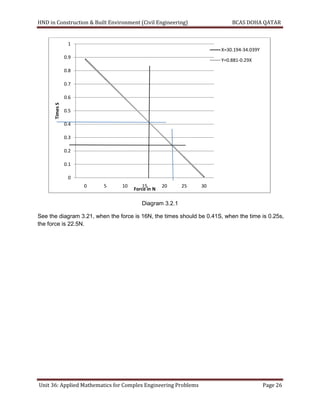
Diagram 3.2.1
See the diagram 3.21, when the force is 16N, the times should be 0.41S, when the time is 0.25s,
the force is 22.5N.
0
0.1
0.2
0.3
0.4
0.5
0.6
0.7
0.8
0.9
1
0 5 10 15 20 25 30
TimesS
Force in N
X=30.194-34.039Y
Y=0.881-0.29X

Applied mathematics for complex engineering

  • 1.
    HND in Construction& Built Environment (Civil Engineering) BCAS DOHA QATAR Unit 36: Applied Mathematics for Complex Engineering Problems Page 1 LO1 Understand the use of trigonometric functions. 1.1.During a model study of structure by sending vibration force to the structure, its deformation was measured which was oscillating with a maximum displacement of 32 cm and a frequency of 50 Hz. At time = 0 the displacement is 150 mm. Express the displacement in the general form sin( ± ). Sketch the displacement of structure for first 0.02 sec. Answers sin( ± ) Amplitude = maximum displacement = 0.32m. Angular velocity, = 2 = 2 (50) = 100 rad/s. Hence, = . ( + ) . When = 0, displacement = 0.15 m, t = 0 hence, 0.15 = 0.32sin(100 × 0 + ) 0.15 = 0.32sin(0 + ) sin = 0.15 0.32 = 0.4687 = sin 0.4687 = 27.95° = 0.487rad. Thus, = . ( + . ) . 1.2.Solve the trigonometric equation√2cosx + sinx = 1,for values of x in the interval of (−π < x < π). Answers √2 sin + cos = 1 √2 sin = 1 − cos Square both sides (√2 sin ) = (1 − cos ) 2 sin = 1 − 2 cos + cos 2(1 − cos ) = 1 − 2 cos + cos 2 − 2 cos ) = 1 − 2 cos + cos 3 cos − 2 cos − 1 = 0 3 cos − 3 cos + cos − 1 = 0 3 cos (cos − 1) + 1(cos − 1) = 0 (3 cos + 1)(cos − 1) = 0 ∴ (3 cos + 1) = 0 (cos − 1) = 0 Hence, cos = − 1 3 1
  • 2.
    HND in Construction& Built Environment (Civil Engineering) BCAS DOHA QATAR Unit 36: Applied Mathematics for Complex Engineering Problems Page 2 = cos − 1 3 cos 1 = 109.47˚ 0˚ (−π < x < π). 1.3 A person is standing on top of a hill that slopes downwards uniformly at an angle ∅ with respect to the horizontal. The person throws a stone at an initial angle from the horizontal with an initial speed of . You may neglect air resistance. Evaluate the problem and show that the horizontal range of the stone when the stone strikes the ground as (0.5 sin 2 + tan ∅)? Answers = ℎ ⟶ = + 1 2 = . ∗ − − − − − 1 = . ↓ ℎ = (− . ) ∗ + 1 2 ℎ = − ∗ + 1 2 . = − . ∗ . + 1 2 ∗ ² ² ∗ ² θ = − + 1 2 ∗ ² ² = − + 1 2 ² ∗ ² 2( + ) ² + ² =
  • 3.
    HND in Construction& Built Environment (Civil Engineering) BCAS DOHA QATAR Unit 36: Applied Mathematics for Complex Engineering Problems Page 3 = 2 ² ∗ ∗ ∗ + ∗ = ² + ² ∗ LO2 Be able to solve algebraic equations representing engineering problems 2.1.A Yogurt Company makes three yogurt blends: Lime Orange, using 2 quarts of lime yogurt and 2 quarts of orange yogurt per gallon; Lime Lemon, using 3 quarts of lime yogurt and 1 quart of lemon yogurt per gallon; and Orange Lemon, using 3 quarts of orange yogurt and 1 quart of lemon yogurt per gallon. Each day the company has 800quarts of lime yogurt, 650 quarts of orange yogurt, and 350 quarts of lemon yogurt available. How many gallons of each blend should it make each day if it wants to use up all of the supplies? (Construct algebraic equations). Answers x = the number of gallons of Lime Lemon y = the number of gallons of Lime Orange z = the number of gallons of Orange Lemon. If Softflow makes x quarts of LimeOrange, y quarts of LimeLemon, and z quarts of OrangeLemon, it will need a total of 2x + 3y quarts of lime yoghurt. Since Softflow has a total of 800 quarts of lime yogurt on hand, and it wants nothing left over, we must have; Amount used = Amount Available 2x + 3y = 800 Similarly, we get two more equations for orange and lemon yogurt: 2x + 3z = 650 Y + Z = 350 We can organize the given information in a table. To set up the table, do the following:  Place the categories corresponding to the unknowns along the top.  Add an extra column for the "Total Available"  Place the "ingredients" down the side.
  • 4.
    HND in Construction& Built Environment (Civil Engineering) BCAS DOHA QATAR Unit 36: Applied Mathematics for Complex Engineering Problems Page 4 Q Lime Orange (x gallons) Lime Lemon (y gallons) Orange Lemon (z gallons) Total Available Lime yogurt (quarts) 2 3 0 800 Orange yogurt (quarts) 2 0 3 650 Lemon yogurt (quarts) 0 1 1 350 2x + 3y = 800 2x + 3z = 650 Y + z = 350 2 3 0 2 0 3 0 1 1 = 800 650 350 | | = = − + = − − − + − = 2 0 × 1 − 3 × 1 − 3 2 × 1 − 3 × 0 + 0 2 × 1 − 0 × 0 = 2 × (−3) − (3 × 1) + 0 | | = −12 = 1 | | = 1 −12 0 × 1 − 3 × 1 0 × 1 − 3 × 1 3 × 3 − 0 × 0 3 × 0 − 2 × 1 2 × 1 − 0 × 0 0 × 2 − 2 × 3 2 × 1 − 0 × 0 3 × 0 − 2 × 1 2 × 0 − 3 × 2 = 1 −12 0 − 3 0 − 3 9 − 0 0 − 2 2 − 0 0 − 6 2 − 0 0 − 2 0 − 6
  • 5.
    HND in Construction& Built Environment (Civil Engineering) BCAS DOHA QATAR Unit 36: Applied Mathematics for Complex Engineering Problems Page 5 = 1 −12 −3 −3 9 −2 2 −6 2 −2 −6 Multiply each side of (ii) by the inverse metric = = −3 −3 9 −2 2 −6 2 −2 −6 800 650 350 = 1 −12 = −3 × 800 −3 × 650 9 × 350 −2 × 800 2 × 650 −6 × 350 2 × 800 −2 × 650 −6 × 350 = 1 −12 = −2400 −1950 3150 −1600 1300 −2100 1600 −1300 −2100 = 1 −12 = −1200 −2400 −1800 = − −1200 −12 = 100 = − −2400 −12 = 200 = − −1800 −12 = 150 2.2.(a) Prove that 1 + 1 1 1 1 + 1 1 1 1 + = 1 + + + (b) Use matrices to solve the simultaneous equations:. x + 2y + 3z = 6 x + 3y + 5z = 9 2x + 5y + z = 8 Answers (a) 1 + 1 1 1 1 + 1 1 1 1 + = (1 + ) (1 + )(1 + ) − 1 − 1 + − 1 + 1 − (1 + ) = (1 + )( + + ) − −
  • 6.
    HND in Construction& Built Environment (Civil Engineering) BCAS DOHA QATAR Unit 36: Applied Mathematics for Complex Engineering Problems Page 6 = + + + + + − − = + + + = 1 + 1 + 1 + 1 (b) 1 2 3 1 3 5 2 5 1 6 9 8 ∆ = 1 2 3 1 2 5 2 5 1 = 1(−22) − 2(−9) + 3(−1) = − = 6 2 3 9 2 5 8 5 1 ∆ = 6(−22) − 2(−31) + 3(21) −7 = −7 −7 = 1 = 1 6 3 1 9 5 2 8 1 ∆ = 1(−31) − 6(−9) + 3(−10) −7 = −7 −7 = 1 = 1 2 6 1 2 9 2 5 8 ∆ = 1(−21) − 2(−10) + 6(−1) −7 = −7 −7 = 1 2.3 (a) Find a root of the function f(x)= 5 + 11 − 17 = 0 using bisection method (Pre-specified relative error tolerance εs = 6%) (b) You are working for ‘DOWN THE TOILET COMPANY’ that makes floats for ABC commodes. The floating ball has a specific gravity of 0.6 and has a radiusof 5.5 cm. You are asked to find the depth to which the ball is submerged when floating in water.
  • 7.
    HND in Construction& Built Environment (Civil Engineering) BCAS DOHA QATAR Unit 36: Applied Mathematics for Complex Engineering Problems Page 7 The equation that gives the depth x in meters to which the ball is submerged under water is given by x − 0.165x + 3.993 × 10 = 0 Use the Newton-Raphson method of finding roots of equations to find i) The depth x to which the ball is submerged under water. Conduct three iterations to estimate the root of the above equation. ii) The absolute relative approximate error at the end of each iteration. (Hint: assume the initial guess of the root of f (x) = 0 is x= 0.05 m) Answers From the physics of the problem, the ball would be submerged between x = 0 and x = 2R, where R = radius of the ball, that is   11.00 055.020 20    x x Rx
  • 8.
    HND in Construction& Built Environment (Civil Engineering) BCAS DOHA QATAR Unit 36: Applied Mathematics for Complex Engineering Problems Page 8 Let us assume 11.0 00.0   ux xl Check if the function changes sign between xl and xu                 4423 4423 10662.210993.311.0165.011.011.0 10993.310993.30165.000     fxf fxf u l Hence,            010662.210993.311.00 44   ffxfxf ul So there is at least on root between xl and xu, that is between 0 and 0.11 Iteration 1 The estimate of the root is 055.0 2 11.00 2      u m xx x l                    010655.610993.3055.00 10655.610993.3055.0165.0055.0055.0 54 5423     ffxfxf fxf ml m
  • 9.
    HND in Construction& Built Environment (Civil Engineering) BCAS DOHA QATAR Unit 36: Applied Mathematics for Complex Engineering Problems Page 9 Hence the root is bracketed between xm and xu, that is, between 0.055 and 0.11. So, the lower and upper limits of the new bracket are 11.0,055.0  ul xx At this point, the absolute relative approximate error cannot be calculated as we do not have a previous approximation. The absolute relative approximate error at the end of Iteration 3 is %20 100 06875.0 0825.006875.0 100        new m old m new m a x xx Still none of the significant digits are at least correct in the estimated root of the equation as the absolute relative approximate error is greater than 5%. Seven more iterations were conducted and these iterations are shown in Table 1. Root of f(x)=0 as function of number of iterations for bisection method. a a
  • 10.
    HND in Construction& Built Environment (Civil Engineering) BCAS DOHA QATAR Unit 36: Applied Mathematics for Complex Engineering Problems Page 10 Iteration x xu xm a % f(xm) 1 2 3 4 5 6 7 8 9 10 0.00000 0.055 0.055 0.055 0.06188 0.06188 0.06188 0.06188 0.0623 0.0623 0.11 0.11 0.0825 0.06875 0.06875 0.06531 0.06359 0.06273 0.06273 0.06252 0.055 0.0825 0.06875 0.06188 0.06531 0.06359 0.06273 0.0623 0.06252 0.06241 ---------- 33.33 20.00 11.11 5.263 2.702 1.370 0.6897 0.3436 0.1721 6.655×10⁻⁵ −1.622×10⁻⁴ −5.563×10⁻⁵ 4.484×10⁻⁶ −2.593×10⁻⁵ −1.0804×10⁻⁵ −3.176×10⁻⁶ 6.497×10⁻⁷ −1.265×10⁻⁶ −3.0768×10⁻⁷ Hence the number of significant digits at least correct is given by the largest value or m for which     463.23442.0log2 23442.0log 103442.0 105.01721.0 105.0 2 2 2         m m m m m a So 2m The number of significant digits at least correct in the estimated root of 0.06241 at the end of the 10th iteration is 2.
  • 11.
    HND in Construction& Built Environment (Civil Engineering) BCAS DOHA QATAR Unit 36: Applied Mathematics for Complex Engineering Problems Page 11 LO3 Be able to apply calculus to engineering problems 3.1. The Wave Equation: We generally visit beach and if we stand on an ocean shore and take a snapshot of the waves, the picture shows a regular pattern of peaks and valleys in an instant of time. We see periodic vertical motion in space, with respect to distance. If we stand in the water, we can feel the rise and fall of the water as the waves go by. We see periodic vertical motion in time. This beautiful symmetry is expressed by the one-dimensional wave equation = Where w is the wave height, x is the distance variable, t is the time variable, and c is the velocity with which the waves are propagated (see the accompanying figure). Show that the following functions are all solutions of the wave equation by determining relevant partial derivatives. (P3.1) a. = sin( + ) b. = cos(2 + 2 ) c. = sin( + ) + cos(2 + 2 ) d. = ln(2 + 2 ) e. = tan(2 − 2 ) f. = 5 cos(3 + 3 ) + Answers =
  • 12.
    HND in Construction& Built Environment (Civil Engineering) BCAS DOHA QATAR Unit 36: Applied Mathematics for Complex Engineering Problems Page 12 a. = sin( + ) ℎ ⟹ = ( + )cos ( + ) = cos( + ) − − − 1 = ∗ (− sin( + )) (− sin( + ) − − − 2 ℎ ℎ ⟹ = (1 + 0)cos ( + ) = cos( + ) − − − −3 = 1 − sin( + ) = − sin( + ) − − − 4 2 ⟹= = ² . = ² −sin ( + ) − − − 5 = sin( + ) ℎ = ² b. = cos(2 + 2 ) = − sin(2 + 2 ) ∗ 2 = (−2 ) ∗ (2 ) ∗. cos(2 + 2 ) = −4 cos(2 + 2 ) − − − −1 = − sin(2 + 2 ) ∗ 2 − − − 2 = −4. cos(2 + 2 ) = ∗
  • 13.
    HND in Construction& Built Environment (Civil Engineering) BCAS DOHA QATAR Unit 36: Applied Mathematics for Complex Engineering Problems Page 13 c. = sin( + ) + cos(2 + 2 ) =. cos( + ) + − sin(2 + 2 ) ∗ 2 = − sin( + ) + − cos(2 + 2 ) ∗ 4 − − − − − 1 =. cos( + ) − sin(2 + 2 ) ∗ 2 = − sin( + ) − 4 cos(2 + 2 ) = − sin( + ) − 4. cos( + 2 ) = + − sin( + ) − 4(cos (2 + 2 ) ∗ d. = ln(2 + 2 ) = 2 (2 + 2 ) = 2(2 + 2 ) = 2(−1) 2 + 2 ) ∗ 2 = −4 (2 + 2 ) = 1 ∗ 2 2 + 2 = 2 (2 + 2 ) = 2 ∗ (2 + 2 ) ∗ −1 ∗ 2 = −4 (2 + 2 ) = −4 (2 + 2 ) ∗ ∗
  • 14.
    HND in Construction& Built Environment (Civil Engineering) BCAS DOHA QATAR Unit 36: Applied Mathematics for Complex Engineering Problems Page 14 e. = tan(2 − 2 ) = 1 ∗ 2 1 + (2 − 2 )² = 2 1 + 4 ² − 8 + 4 ² ² = −2(1 + 4 − 8 + 4 ) ∗ (8 − 8 ) = 1 ∗ (−2 ) 1 + (2 − 2 )² = −2 1 + 4 ² + 4 ² ² − 8 = −2 (−1) 4 ² ∗ 2 − 8 1 + 4 + 4 − 8 = 2 ² 4 + 8 − 8 1 + 4 ² + 4 ² ² − 8 ² = −2 ² 8 − 8 1 + 4 ² + 4 ² ² − 8 ² = − 8 − 8 ∗ ² 1 + 4 ² − 8 + 4 ² ² ² = ∗ ² f. = 5 cos(3 + 3 ) + = −5. sin(3 + 3 ) ∗ 3 + ∗ 1 = −5. cos(3 + 3 ) + 3 ∗ 3 + ∗ 1 = −5. sin(3 + 3 ) ∗ 3 + ∗ = −5(3 ) ∗ cos(3 + 3 ) ∗ 3 + ∗ = − ∗ . ((3 + 3 ) ∗
  • 15.
    HND in Construction& Built Environment (Civil Engineering) BCAS DOHA QATAR Unit 36: Applied Mathematics for Complex Engineering Problems Page 15 3.2 A manufacturing company is to be made in the form of a rectangular room as a store room. They decided to cover the surfaces of the room with canvas covering on the top, back and sides. They have to minimize the material cost for canvas covering with effective usage of floor area. Determine the minimum surface area of canvas necessary if the volume of the box is to be 250 m3 by classify stationary points of function of the surface area of room. (P3.2 & M1.2) Answers − ∗ ∗ ℎ = ⇒ = ∗ ℎ 250 = ∗ ℎ = 250 ℎ = ( ) ∗ 2 + ( ∗ ℎ) ∗ 2 ∗ (ℎ ∗ ) = 2 + 2 ℎ + ℎ = 2 ∗ 250 ℎ + 2 ∗ 250 + 250 500 ℎ + 500 + 250 500 ℎ + 500 ∗ ℎ 250 + 250 = 0 + 2 ∗ ℎ − 250 ² = 0 , 2ℎ = 250 ² =
  • 16.
    HND in Construction& Built Environment (Civil Engineering) BCAS DOHA QATAR Unit 36: Applied Mathematics for Complex Engineering Problems Page 16 (b) Determine the nature of the stationary points of the function f(x, y) = x + y − 36xy = 4 − 36 = 4( − 9 ) = 4 − 36 = 4( − 9 ) = 0, = 0 − 9 = 0 − − − 1 − 9 = 0 − − − 2 = 9 − − − − − 3 − 9 = 0 ⟹ 9 − 9 = 0 ⟹ ( − 3 ) = 0 ⟹ ( − 3 )( + 3 ) = 0 = 0 − 3 = 0 + 3 ( − 9) ( + 9) = 0 ∴ = 9 − + − 3 = 0, = 0 = 3, = 3
  • 17.
    HND in Construction& Built Environment (Civil Engineering) BCAS DOHA QATAR Unit 36: Applied Mathematics for Complex Engineering Problems Page 17 = −3, = −3 ( , )(− , − ) ( , ) 3.3.Evaluate Determine the integral of followings: (P3.3) 1. 2 = 1 2 sin 2 2 = 1 2 sin 2 =− cos 2 × + = − 1 4 cos 2 + Here C is an arbitary constant 2. √4 + 1 = 1 4 4 + 1 4 = 1 4 √ + 1 = 1 4 ( + 1) / = 1 4 2 3 ( + 1) / = 1 6 ( + 1) / = 1 6 (626 + 1) = 1 6 × 15 661.5 = 2610.25 3. 2 = − − 2 = − = − + = − + = = 2 = 2 = = 4 = 4 = − = −2 = −2
  • 18.
    HND in Construction& Built Environment (Civil Engineering) BCAS DOHA QATAR Unit 36: Applied Mathematics for Complex Engineering Problems Page 18 4. sin cos . = = 2 + = 2 + 5. sin ( |cos |) = − |cos | cos − (− cos ). 1 cos (− sin ) . = − |cos | cos − sin . = − |cos | cos . + cos + 6. cos = sin − sin = 2 − 0 + cos = 2 + 0 − 1 = 2 − 1 = 0.5708 7. sin = (− cos ) − (− ) 2 = ( − 0) + 2 cos = + 2 sin − 2 sin = + 0 + 2 cos = + 2 −1 − 1 = − 4 = sin = cos = cos = . − . .
  • 19.
    HND in Construction& Built Environment (Civil Engineering) BCAS DOHA QATAR Unit 36: Applied Mathematics for Complex Engineering Problems Page 19 = 5.8696 8. = cos = cos + sin = cos + sin − cos = (cos + sin ) − 2 = (cos + sin ) = 2 (cos + sin ) 9. ( ) ( ) By writing the fraction as partical fraction = 1 3( + 2) + 5 3( + 2) − 1 3( + 1) = 1 3 ln| + 2| + 5 3 (−( + 2) ) − 1 3 ln| + 1| + = 1 3 ln + 2 + 1 − 5 3( + 2) + 10. ( ) ( ) By writing the fraction as partical fraction = −1 16( + 3) − 1 4( + 3) + 1 16( − 1) = − 1 16 ln| + 3| + 1 4 ( + 3) + 1 16 ln| − 1| + = − 1 16 ln|7| − ln|4| + 1 4 1 7 − 1 4 + 1 16 ln|3| − ln|0| = 1 16 ln 4 × 3 7 × 0 + 1 4 (4 − 7) 28 = 1 16 ln 12 0 − 3 28 × 4 = 1.9207. 11. By culculater = 31.21759.
  • 20.
    HND in Construction& Built Environment (Civil Engineering) BCAS DOHA QATAR Unit 36: Applied Mathematics for Complex Engineering Problems Page 20 3.4 The diagram shows the curve Y=√(3x+1) and the points P(0,1) and Q(1,2) on the curve. (i) Find the area enclosed between the curve, the Y axis, the X axis and the line X=1 (ii) Find the volume of the solid generated when the above area is rotated about the X axis by 3600 Answers I. = √3 + 1 = 2 3 (3 + 1) / 3 = 2 9 (8 − 1) = 14 9 = 1.556 II. = = (3 + 1) = 3 2 + = 3 2 + 1 = 5 2 = 7.854.
  • 21.
    HND in Construction& Built Environment (Civil Engineering) BCAS DOHA QATAR Unit 36: Applied Mathematics for Complex Engineering Problems Page 21 LO5 Be able to apply statistical techniques to engineering problems. 4.1 In an experiment to determine the relationship between force and momentum, a force, X, is applied to a mass, by placing the mass on an inclined plane, and the time, Y, for the velocity to change from u m/s to v m/s is measured. The results obtained are as follows: Force (N) 11.4 18.7 11.7 12.3 14.7 18.8 19.6 Time (s) 0.56 0.35 0.55 0.52 0.43 0.34 0.31 By determine the lines of best fit find (a) The time corresponding to a force of 16 N, and (b) The force at a time of 0.25 s, assuming the relationship is linear outside of the range of values given. Answers Find XY, X2 , Y2 X value Y Value X*X X*Y Y*Y 11.4 0.56 11.4*11.4=129.96 11.4*0.56=6.384 0.56*0.56=0.3136 18.7 0.35 18.7*18.7=349.69 18.7*0.35=6.545 0.35*0.35=0.1225 11.7 0.55 11.7*11.7=136.89 11.7*0.55=6.435 0.55*0.55=0.3025 12.3 0.52 12.3*12.3=151.29 12.3*0.52=6.396 0.52*0.52=0.2704 14.7 0.43 14.7*14.7=216.09 14.7*0.43=6.321 0.43*0.43=0.1849 18.8 0.34 18.8*18.8=353.44 18.8*0.34=6.392 0.34*0.34=0.1156 19.6 0.31 19.6*19.6=384.16 19.6*0.31=6.076 0.31*0.31=0.0961 Table 3.21 Find ΣX, ΣY, ΣXY, ΣX2 , ΣY2 . ΣX = 11.4+18.7+11.7+12.3+14.7+18.8+19.6 = 107.2 ΣY = 0.56+0.35+0.55+0.52+0.43+0.34+0.31 = 3.06 ΣXY = 6.384+6.545+6.435+6.396+6.321+6.392+6.076=44.549
  • 22.
    HND in Construction& Built Environment (Civil Engineering) BCAS DOHA QATAR Unit 36: Applied Mathematics for Complex Engineering Problems Page 22 ΣX2 = 129.96+349.69+136.89+151.29+216.09+353.44+384.16=1721.52 ΣY2 = 0.3136+0.1225+0.3025+0.2704+0.1849+0.1156+0.0961= 1.4056 The equation of the regression line of force on times is of the form Y=a0 + a1X and the constants a0 and a1 are determined from the normal equations: ΣY = a0N + a1ΣX ΣXY = a0ΣX + a1ΣX2 Thus 3.06 = 7a0 + 107.2a1 And 44.549 = 107.2a0 + 1721.52a1 Solving for a1 3.06 = 7a0 + 107.2a1 3.06 - 107.2a1 = 7a0 (3.06 - 107.2a1)/7= a0 44.549 = 107.2a0 + 1721.52a1 44.549 = 107.2/7(3.06-107.2a1) + 1721.52a1 44.549 = 46.86171429-1641.691429a1 + 1721.52a1 44.549 = 46.8617429 +79.828571a1 -2.3127429 = 79.828571a1 a1 = -0.02897136790786346407228058736013 a1 = -0.029 (correct to 3 significant figures) Solving for a0 3.06 = 7a0 + 107.2a1 3.06 = 7a0 + 107.2*-0.029 3.06 = 7a0-3.1088 a0 = 0.88125714285714285714285714285714
  • 23.
    HND in Construction& Built Environment (Civil Engineering) BCAS DOHA QATAR Unit 36: Applied Mathematics for Complex Engineering Problems Page 23 a0 = 0.881(correct to 3 significant figures) Solving these simultaneous equations gives a0 = 4.873 and a1 = -0.029. Thus the equation of the regression line of force on times is : Y = a0 + a1 Y = 0.881- 0.029X The equation of the regression line of force on times is of the form X=b0 + b1Y and the constants b0 and b1 are determined from the normal equations: ΣX = b0N + b1ΣY ΣXY = b0ΣY + b1ΣY2 Thus 107.2 = 7b0 + 3.06b1 And 44.549 = 3.06b0 + 1.4056b1 Solving for b0 107.2 = 7b0 + 3.06b1 107.2 – 7b0 = 3.06b1 b1= (107.2 – 7b0)/ 3.06 44.549 = 3.06b0 + 1.4056b1 44.549 = 3.06b0 + 1.4056/3.06(107.2 – 7b0) 44.549 = 3.06b0 + 49.2419346 - 3.2154248b0 0.1554248b0= 4.6929346 b0 = 30.19424571 b0 = 30.194 (correct to 3 significant figures) Solving for b1
  • 24.
    HND in Construction& Built Environment (Civil Engineering) BCAS DOHA QATAR Unit 36: Applied Mathematics for Complex Engineering Problems Page 24 107.2 = 7b0 + 3.06b1 107.2 = 7*30.194 + 3.06b1 107.2 = 211.358 + 3.06b1 3.06b1 = -104.158 b1 = -34.0385620915 b1 = -34.039 (correct to 3 significant figures) Solving these simultaneous equations gives b0 = 30.194 and b1 = -34.039 Thus the equation of the regression line of force on times is : X = b0 + b1 X = 30.194 -34.039Y For X = 30.194 -34.039Y x y 0 0.887041 5 0.740151 10 0.593261 15 0.44637 20 0.29948 25 0.15259 30 0.005699 Table 3.2.2 For Y = 0.881 - 0.29X X Y 0 0.881 5 0.736 10 0.591 15 0.446 20 0.301 25 0.156 30 0.011 Table 3.2.3
  • 25.
    HND in Construction& Built Environment (Civil Engineering) BCAS DOHA QATAR Unit 36: Applied Mathematics for Complex Engineering Problems Page 25 Diagram 3.2 0 0.1 0.2 0.3 0.4 0.5 0.6 0.7 0.8 0.9 1 0 5 10 15 20 25 30 TimesS Force in N X=30.194-34.039Y Y=0.881-0.29X
  • 26.
    HND in Construction& Built Environment (Civil Engineering) BCAS DOHA QATAR Unit 36: Applied Mathematics for Complex Engineering Problems Page 26 Diagram 3.2.1 See the diagram 3.21, when the force is 16N, the times should be 0.41S, when the time is 0.25s, the force is 22.5N. 0 0.1 0.2 0.3 0.4 0.5 0.6 0.7 0.8 0.9 1 0 5 10 15 20 25 30 TimesS Force in N X=30.194-34.039Y Y=0.881-0.29X