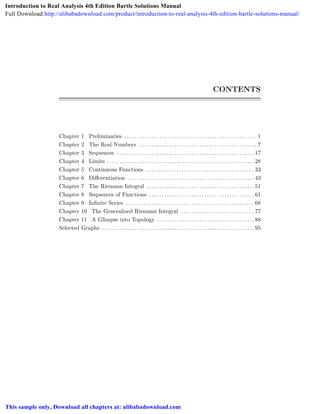
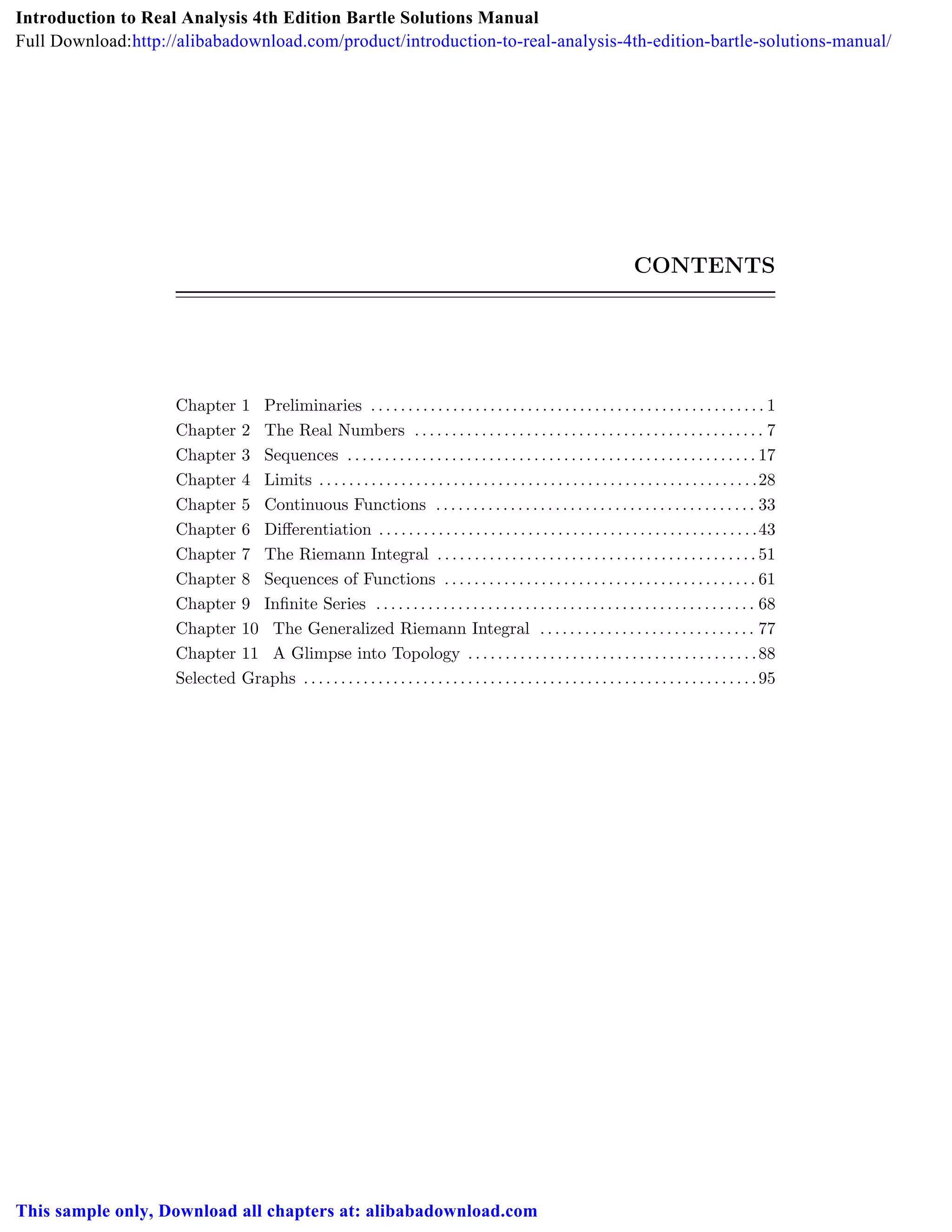
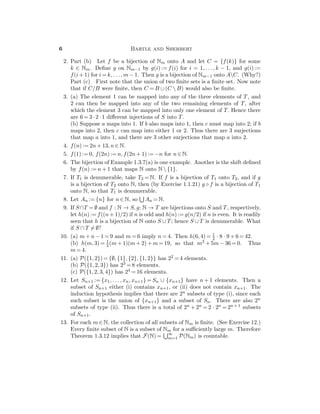
CONTENTS
Chapter 1 Preliminaries . . . . . . . . . . . . . . . . . . . . . . . . . . . . . . . . . . . . . . . . . . . . . . . . . . . . . 1
Chapter 2 The Real Numbers . . . . . . . . . . . . . . . . . . . . . . . . . . . . . . . . . . . . . . . . . . . . . . . 7
Chapter 3 Sequences . . . . . . . . . . . . . . . . . . . . . . . . . . . . . . . . . . . . . . . . . . . . . . . . . . . . . . . 17
Chapter 4 Limits . . . . . . . . . . . . . . . . . . . . . . . . . . . . . . . . . . . . . . . . . . . . . . . . . . . . . . . . . . .28
Chapter 5 Continuous Functions . . . . . . . . . . . . . . . . . . . . . . . . . . . . . . . . . . . . . . . . . . . 33
Chapter 6 Differentiation . . . . . . . . . . . . . . . . . . . . . . . . . . . . . . . . . . . . . . . . . . . . . . . . . . .43
Chapter 7 The Riemann Integral . . . . . . . . . . . . . . . . . . . . . . . . . . . . . . . . . . . . . . . . . . . 51
Chapter 8 Sequences of Functions . . . . . . . . . . . . . . . . . . . . . . . . . . . . . . . . . . . . . . . . . . 61
Chapter 9 Infinite Series . . . . . . . . . . . . . . . . . . . . . . . . . . . . . . . . . . . . . . . . . . . . . . . . . . . 68
Chapter 10 The Generalized Riemann Integral . . . . . . . . . . . . . . . . . . . . . . . . . . . . . 77
Chapter 11 A Glimpse into Topology . . . . . . . . . . . . . . . . . . . . . . . . . . . . . . . . . . . . . . .88
Selected Graphs . . . . . . . . . . . . . . . . . . . . . . . . . . . . . . . . . . . . . . . . . . . . . . . . . . . . . . . . . . . . .95
Introduction to Real Analysis 4th Edition Bartle Solutions Manual
Full Download:http://alibabadownload.com/product/introduction-to-real-analysis-4th-edition-bartle-solutions-manual/
This sample only, Download all chapters at: alibabadownload.com
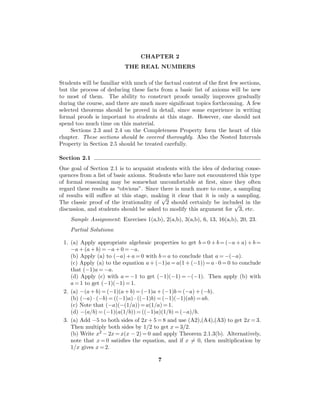
CHAPTER 1
PRELIMINARIES
We suggest that this chapter be treated as review and covered quickly, without
detailed classroom discussion. For one reason, many of these ideas will be already
familiar to the students — at least informally. Further, we believe that, in practice,
those notions of importance are best learned in the arena of real analysis, where
their use and significance are more apparent. Dwelling on the formal aspect of
sets and functions does not contribute very greatly to the students’ understanding
of real analysis.
If the students have already studied abstract algebra, number theory or com-
binatorics, they should be familiar with the use of mathematical induction. If not,
then some time should be spent on mathematical induction.
The third section deals with finite, infinite and countable sets. These notions
are important and should be briefly introduced. However, we believe that it is
not necessary to go into the proofs of these results at this time.
Section 1.1
Students are usually familiar with the notations and operations of set algebra,
so that a brief review is quite adequate. One item that should be mentioned is
that two sets A and B are often proved to be equal by showing that: (i) if x ∈ A,
then x ∈ B, and (ii) if x ∈ B, then x ∈ A. This type of element-wise argument is
very common in real analysis, since manipulations with set identities is often not
suitable when the sets are complicated.
Students are often not familiar with the notions of functions that are injective
(= one-one) or surjective (= onto).
Sample Assignment: Exercises 1, 3, 9, 14, 15, 20.
Partial Solutions:
1. (a) B ∩ C = {5, 11, 17, 23, . . .} = {6k − 1 : k ∈ N}, A ∩ (B ∩ C) = {5, 11, 17}
(b) (A ∩ B)  C = {2, 8, 14, 20}
(c) (A ∩ C)  B = {3, 7, 9, 13, 15, 19}
2. The sets are equal to (a) A, (b) A ∩ B, (c) the empty set.
3. If A ⊆ B, then x ∈ A implies x ∈ B, whence x ∈ A∩B, so that A ⊆ A ∩ B ⊆ A.
Thus, if A ⊆ B, then A = A ∩ B.
Conversely, if A = A ∩ B, then x ∈ A implies x ∈ A ∩ B, whence x ∈ B.
Thus if A = A ∩ B, then A ⊆ B.
4. If x is in A  (B ∩ C), then x is in A but x /∈ B ∩ C, so that x ∈ A and x is
either not in B or not in C. Therefore either x ∈ A  B or x ∈ A  C, which
implies that x ∈ (A  B) ∪ (A  C). Thus A  (B ∩ C) ⊆ (A  B) ∪ (A  C).
1
2 Bartle and Sherbert
Conversely, if x is in (A  B) ∪ (A  C), then x ∈ A  B or x ∈ A  C. Thus
x ∈ A and either x /∈ B or x /∈ C, which implies that x ∈ A but x /∈ B ∩ C,
so that x ∈ A  (B ∩ C). Thus (A  B) ∪ (A  C) ⊆ A  (B ∩ C).
Since the sets A  (B ∩C) and (A  B)∪(A  C) contain the same elements,
they are equal.
5. (a) If x ∈ A ∩ (B ∪ C), then x ∈ A and x ∈ B ∪ C. Hence we either have
(i) x ∈ A and x ∈ B, or we have (ii) x ∈ A and x ∈ C. Therefore, either
x ∈ A ∩ B or x ∈ A ∩ C, so that x ∈ (A ∩ B) ∪ (A ∩ C). This shows that
A ∩ (B ∪ C) is a subset of (A ∩ B) ∪ (A ∩ C).
Conversely, let y be an element of (A ∩ B) ∪ (A ∩ C). Then either (j) y ∈
A ∩ B, or (jj) y ∈ A ∩ C. It follows that y ∈ A and either y ∈ B or y ∈ C.
Therefore, y ∈ A and y ∈ B ∪ C, so that y ∈ A ∩ (B ∪ C). Hence (A ∩ B) ∪
(A ∩ C) is a subset of A ∩ (B ∪ C).
In view of Definition 1.1.1, we conclude that the sets A ∩ (B ∪ C) and
(A ∩ B) ∪ (A ∩ C) are equal.
(b) Similar to (a).
6. The set D is the union of {x : x ∈ A and x /∈ B} and {x : x /∈ A and x ∈ B}.
7. Here An = {n + 1, 2(n + 1), . . .}.
(a) A1 = {2, 4, 6, 8, . . .}, A2 = {3, 6, 9, 12, . . .}, A1 ∩ A2 = {6, 12, 18, 24, . . .} =
{6k : k ∈ N} = A5.
(b) An = N  {1}, because if n > 1, then n ∈ An−1; moreover 1 /∈ An.
Also An = ∅, because n /∈ An for any n ∈ N.
8. (a) The graph consists of four horizontal line segments.
(b) The graph consists of three vertical line segments.
9. No. For example, both (0, 1) and (0, − 1) belong to C.
10. (a) f(E) = {1/x2 : 1 ≤ x ≤ 2} = {y : 1
4 ≤ y ≤ 1} = [1
4 , 1].
(b) f−1(G) = {x : 1 ≤ 1/x2 ≤ 4} = {x : 1
4 ≤ x2 ≤ 1} = [−1, −1
2 ] ∪ [1
2 , 1].
11. (a) f(E) = {x + 2 : 0 ≤ x ≤ 1} = [2, 3], so h(E) = g(f(E)) = g([2, 3]) =
{y2 : 2 ≤ y ≤ 3} = [4, 9].
(b) g−1(G) = {y : 0 ≤ y2 ≤ 4} = [−2, 2], so h−1(G) = f−1(g−1(G)) =
f−1([−2, 2]) = {x : −2 ≤ x + 2 ≤ 2} = [−4, 0].
12. If 0 is removed from E and F, then their intersection is empty, but the
intersection of the images under f is {y : 0 < y ≤ 1}.
13. E  F = {x : −1 ≤ x < 0}, f(E)  f(F) is empty, and f(E  F) =
{y : 0 < y ≤ 1}.
14. If y ∈ f(E ∩ F), then there exists x ∈ E ∩ F such that y = f(x). Since x ∈ E
implies y ∈ f(E), and x ∈ F implies y ∈ f(F), we have y ∈ f(E) ∩ f(F). This
proves f(E ∩ F) ⊆ f(E) ∩ f(F).
15. If x ∈ f−1(G) ∩ f−1(H), then x ∈ f−1(G) and x ∈ f−1(H), so that f(x) ∈ G
and f(x) ∈ H. Then f(x) ∈ G ∩ H, and hence x ∈ f−1(G ∩ H). This shows
Chapter 1 — Preliminaries 3
that f−1(G) ∩ f−1(H) ⊆ f−1(G ∩ H). The opposite inclusion is shown in
Example 1.1.8(b). The proof for unions is similar.
16. If f(a) = f(b), then a/
√
a2 + 1 = b/
√
b2 + 1, from which it follows that a2 = b2.
Since a and b must have the same sign, we get a = b, and hence f is injective.
If −1 < y < 1, then x := y/ 1 − y2 satisfies f(x) = y (why?), so that f takes R
onto the set {y : − 1 < y < 1}. If x > 0, then x =
√
x2 <
√
x2 + 1, so it follows
that f(x) ∈ {y : 0 < y < 1}.
17. One bijection is the familiar linear function that maps a to 0 and b to 1,
namely, f(x) := (x − a)/(b − a). Show that this function works.
18. (a) Let f(x) = 2x, g(x) = 3x.
(b) Let f(x) = x2, g(x) = x, h(x) = 1. (Many examples are possible.)
19. (a) If x ∈ f−1(f(E)), then f(x) ∈ f(E), so that there exists x1 ∈ E such
that f(x1) = f(x). If f is injective, then x1 = x, whence x ∈ E. Therefore,
f−1(f(E)) ⊆ E. Since E ⊆ f−1(f(E)) holds for any f, we have set equality
when f is injective. See Example 1.1.8(a) for an example.
(b) If y ∈ H and f is surjective, then there exists x ∈ A such that f(x) = y.
Then x ∈ f−1(H) so that y ∈ f(f−1(H)). Therefore H ⊆ f(f−1(H)). Since
f(f−1(H)) ⊆ H for any f, we have set equality when f is surjective. See
Example 1.1.8(a) for an example.
20. (a) Since y = f(x) if and only if x = f−1(y), it follows that f−1(f(x)) = x and
f(f−1(y)) = y.
(b) Since f is injective, then f−1 is injective on R(f). And since f is surjec-
tive, then f−1 is defined on R(f) = B.
21. If g(f(x1)) = g(f(x2)), then f(x1) = f(x2), so that x1 = x2, which implies that
g ◦ f is injective. If w ∈ C, there exists y ∈ B such that g(y) = w, and there
exists x ∈ A such that f(x) = y. Then g(f(x)) = w, so that g ◦ f is surjective.
Thus g ◦ f is a bijection.
22. (a) If f(x1) = f(x2), then g(f(x1)) = g(f(x2)), which implies x1 = x2, since
g ◦ f is injective. Thus f is injective.
(b) Given w ∈ C, since g ◦ f is surjective, there exists x ∈ A such that
g(f(x)) = w. If y := f(x), then y ∈ B and g(y) = w. Thus g is surjective.
23. We have x ∈ f−1(g−1(H)) ⇐⇒ f(x) ∈ g−1(H) ⇐⇒ g(f(x)) ∈ H ⇐⇒ x ∈
(g ◦ f)−1(H).
24. If g(f(x)) = x for all x ∈ D(f), then g ◦ f is injective, and Exercise 22(a)
implies that f is injective on D(f). If f(g(y)) = y for all y ∈ D(g), then
Exercise 22(b) implies that f maps D(f) onto D(g). Thus f is a bijection of
D(f) onto D(g), and g = f−1.
Section 1.2
The method of proof known as Mathematical Induction is used frequently in real
analysis, but in many situations the details follow a routine patterns and are
4 Bartle and Sherbert
left to the reader by means of a phrase such as: “The proof is by Mathematical
Induction”. Since may students have only a hazy idea of what is involved, it may
be a good idea to spend some time explaining and illustrating what constitutes a
proof by induction.
Pains should be taken to emphasize that the induction hypothesis does not
entail “assuming what is to be proved”. The inductive step concerns the validity
of going from the assertion for k ∈ N to that for k + 1. The truth of falsity of the
individual assertion is not an issue here.
Sample Assignment: Exercises 1, 2, 6, 11, 13, 14, 20.
Partial Solutions:
1. The assertion is true for n = 1 because 1/(1 · 2) = 1/(1 + 1). If it is true
for n = k, then it follows for k + 1 because k/(k + 1) + 1/[(k + 1)(k + 2)] =
(k + 1)/(k + 2).
2. The statement is true for n = 1 because [1
2 · 1 · 2]2 = 1 = 13. For the inductive
step, use the fact that
1
2 k(k + 1)
2
+ (k + 1)3
= 1
2 (k + 1)(k + 2)
2
.
3. It is true for n = 1 since 3 = 4 − 1. If the equality holds for n = k, then
add 8(k + 1) − 5 = 8k + 3 to both sides and show that (4k2 − k) + (8k + 3) =
4(k + 1)2 − (k + 1) to deduce equality for the case n = k + 1.
4. It is true for n = 1 since 1 = (4 − 1)/3. If it is true for n = k, then add
(2k + 1)2 to both sides and use some algebra to show that
1
3 (4k3
− k) + (2k + 1)2
= 1
3 [4k3
+ 12k2
+ 11k + 3] = 1
3 [4(k + 1)3
− (k + 1)],
which establishes the case n = k + 1.
5. Equality holds for n = 1 since 12 = (−1)2(1 · 2)/2. The proof is completed by
showing (−1)k+1[k(k + 1)]/2 + (−1)k+2(k + 1)2 = (−1)k+2[(k + 1)(k + 2)]/2.
6. If n = 1, then 13 + 5 · 1 = 6 is divisible by 6. If k3 + 5k is divisible by 6,
then (k + 1)3 + 5(k + 1) = (k3 + 5k) + 3k(k + 1) + 6 is also, because k(k + 1)
is always even (why?) so that 3k(k + 1) is divisible by 6, and hence the sum
is divisible by 6.
7. If 52k − 1 is divisible by 8, then it follows that 52(k+1) − 1 = (52k − 1) + 24 · 52k
is also divisible by 8.
8. 5k+1 −4(k +1)−1=5·5k −4k − 5 = (5k − 4k − 1) + 4(5k − 1). Now show that
5k − 1 is always divisible by 4.
9. If k3 + (k + 1)3 + (k + 2)3 is divisible by 9, then (k + 1)3 + (k+2)3 + (k + 3)3 =
k3 + (k + 1)3 + (k + 2)3 + 9(k2 + 3k + 3) is also divisible by 9.
10. The sum is equal to n/(2n + 1).
Chapter 1 — Preliminaries 5
11. The sum is 1 + 3 + · · · + (2n − 1) = n2. Note that k2 + (2k + 1) = (k + 1)2.
12. If n0 > 1, let S1 := {n ∈ N : n − n0 + 1 ∈ S} Apply 1.2.2 to the set S1.
13. If k < 2k, then k + 1 < 2k + 1 < 2k + 2k = 2(2k) = 2k + 1.
14. If n = 4, then 24 = 16 < 24 = 4!. If 2k < k! and if k ≥ 4, then 2k+1 = 2 · 2k <
2 · k! < (k + 1) · k! = (k + 1)!. [Note that the inductive step is valid when-
ever 2 < k + 1, including k = 2, 3, even though the statement is false for these
values.]
15. For n = 5 we have 7 ≤ 23. If k ≥ 5 and 2k − 3 ≤ 2k−2, then 2(k + 1) − 3 =
(2k − 3) + 2 ≤ 2k−2 + 2k−2 = 2(k + 1)−2.
16. It is true for n = 1 and n ≥ 5, but false for n = 2, 3, 4. The inequality
2k + 1 < 2k, wich holds for k ≥ 3, is needed in the induction argument. [The
inductive step is valid for n = 3, 4 even though the inequality n2 < 2n is false
for these values.]
17. m = 6 trivially divides n3 − n for n = 1, and it is the largest integer to divide
23 − 2 = 6. If k3 − k is divisible by 6, then since k2 + k is even (why?), it
follows that (k + 1)3 − (k + 1) = (k3 − k) + 3(k2 + k) is also divisible by 6.
18.
√
k + 1/
√
k + 1 = (
√
k
√
k + 1 + 1)/
√
k + 1 > (k + 1)/
√
k + 1 =
√
k + 1.
19. First note that since 2 ∈ S, then the number 1 = 2 − 1 belongs to S. If m /∈ S,
then m < 2m ∈ S, so 2m − 1 ∈ S, etc.
20. If 1 ≤ xk−1 ≤ 2 and 1 ≤ xk ≤ 2, then 2 ≤ xk−1 + xk ≤ 4, so that 1 ≤ xk + 1 =
(xk−1 + xk)/2 ≤ 2.
Section 1.3
Every student of advanced mathematics needs to know the meaning of the words
“finite”, “infinite”, “countable” and “uncountable”. For most students at this
level it is quite enough to learn the definitions and read the statements of the
theorems in this section, but to skip the proofs. Probably every instructor will
want to show that Q is countable and R is uncountable (see Section 2.5).
Some students will not be able to comprehend that proofs are necessary for
“obvious” statements about finite sets. Others will find the material absolutely
fascinating and want to prolong the discussion forever. The teacher must avoid
getting bogged down in a protracted discussion of cardinal numbers.
Sample Assignment: Exercises 1, 5, 7, 9, 11.
Partial Solutions:
1. If T1 = ∅ is finite, then the definition of a finite set applies to T2 = Nn for
some n. If f is a bijection of T1 onto T2, and if g is a bijection of T2 onto Nn,
then (by Exercise 1.1.21) the composite g ◦ f is a bijection of T1 onto Nn, so
that T1 is finite.
6 Bartle and Sherbert
2. Part (b) Let f be a bijection of Nm onto A and let C = {f(k)} for some
k ∈ Nm. Define g on Nm−1 by g(i) := f(i) for i = 1, . . . , k − 1, and g(i) :=
f(i + 1) for i = k, . . . , m − 1. Then g is a bijection of Nm−1 onto AC. (Why?)
Part (c) First note that the union of two finite sets is a finite set. Now note
that if C/B were finite, then C = B ∪ (C  B) would also be finite.
3. (a) The element 1 can be mapped into any of the three elements of T, and
2 can then be mapped into any of the two remaining elements of T, after
which the element 3 can be mapped into only one element of T. Hence there
are 6 = 3 · 2 · 1 different injections of S into T.
(b) Suppose a maps into 1. If b also maps into 1, then c must map into 2; if b
maps into 2, then c can map into either 1 or 2. Thus there are 3 surjections
that map a into 1, and there are 3 other surjections that map a into 2.
4. f(n) := 2n + 13, n ∈ N.
5. f(1) := 0, f(2n) := n, f(2n + 1) := −n for n ∈ N.
6. The bijection of Example 1.3.7(a) is one example. Another is the shift defined
by f(n) := n + 1 that maps N onto N  {1}.
7. If T1 is denumerable, take T2 = N. If f is a bijection of T1 onto T2, and if g
is a bijection of T2 onto N, then (by Exercise 1.1.21) g ◦ f is a bijection of T1
onto N, so that T1 is denumerable.
8. Let An := {n} for n ∈ N, so An = N.
9. If S∩T = ∅ and f : N → S, g: N → T are bijections onto S and T, respectively,
let h(n) := f((n + 1)/2) if n is odd and h(n) := g(n/2) if n is even. It is readily
seen that h is a bijection of N onto S ∪ T; hence S ∪ T is denumerable. What
if S ∩ T = ∅?
10. (a) m + n − 1 = 9 and m = 6 imply n = 4. Then h(6, 4) = 1
2 · 8 · 9 + 6 = 42.
(b) h(m, 3) = 1
2 (m + 1)(m + 2) + m = 19, so that m2 + 5m − 36 = 0. Thus
m = 4.
11. (a) P({1, 2}) = {∅, {1}, {2}, {1, 2}} has 22 = 4 elements.
(b) P({1, 2, 3}) has 23 = 8 elements.
(c) P({1, 2, 3, 4}) has 24 = 16 elements.
12. Let Sn+1 := {x1, . . . , xn, xn+1} = Sn ∪ {xn+1} have n + 1 elements. Then a
subset of Sn+1 either (i) contains xn+1, or (ii) does not contain xn+1. The
induction hypothesis implies that there are 2n subsets of type (i), since each
such subset is the union of {xn+1} and a subset of Sn. There are also 2n
subsets of type (ii). Thus there is a total of 2n + 2n = 2 · 2n = 2n + 1 subsets
of Sn+1.
13. For each m ∈ N, the collection of all subsets of Nm is finite. (See Exercise 12.)
Every finite subset of N is a subset of Nm for a sufficiently large m. Therefore
Theorem 1.3.12 implies that F(N) = ∞
m=1 P(Nm) is countable.
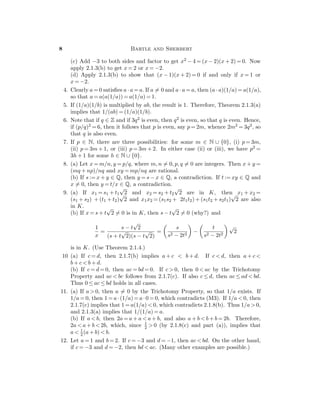
CHAPTER 2
THE REAL NUMBERS
Students will be familiar with much of the factual content of the first few sections,
but the process of deducing these facts from a basic list of axioms will be new
to most of them. The ability to construct proofs usually improves gradually
during the course, and there are much more significant topics forthcoming. A few
selected theorems should be proved in detail, since some experience in writing
formal proofs is important to students at this stage. However, one should not
spend too much time on this material.
Sections 2.3 and 2.4 on the Completeness Property form the heart of this
chapter. These sections should be covered thoroughly. Also the Nested Intervals
Property in Section 2.5 should be treated carefully.
Section 2.1
One goal of Section 2.1 is to acquaint students with the idea of deducing conse-
quences from a list of basic axioms. Students who have not encountered this type
of formal reasoning may be somewhat uncomfortable at first, since they often
regard these results as “obvious”. Since there is much more to come, a sampling
of results will suffice at this stage, making it clear that it is only a sampling.
The classic proof of the irrationality of
√
2 should certainly be included in the
discussion, and students should be asked to modify this argument for
√
3, etc.
Sample Assignment: Exercises 1(a,b), 2(a,b), 3(a,b), 6, 13, 16(a,b), 20, 23.
Partial Solutions:
1. (a) Apply appropriate algebraic properties to get b = 0 + b = (−a + a) + b =
−a + (a + b) = −a + 0 = −a.
(b) Apply (a) to (−a) + a = 0 with b = a to conclude that a = −(−a).
(c) Apply (a) to the equation a + (−1)a = a(1 + (−1)) = a · 0 = 0 to conclude
that (−1)a = −a.
(d) Apply (c) with a = −1 to get (−1)(−1) = −(−1). Then apply (b) with
a = 1 to get (−1)(−1) = 1.
2. (a) −(a + b) = (−1)(a + b) = (−1)a + (−1)b = (−a) + (−b).
(b) (−a) · (−b) = ((−1)a) · ((−1)b) = (−1)(−1)(ab) = ab.
(c) Note that (−a)(−(1/a)) = a(1/a) = 1.
(d) −(a/b) = (−1)(a(1/b)) = ((−1)a)(1/b) = (−a)/b.
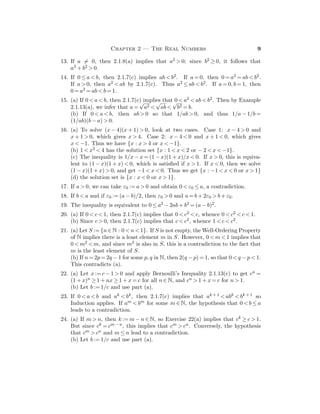
3. (a) Add −5 to both sides of 2x + 5 = 8 and use (A2),(A4),(A3) to get 2x = 3.
Then multiply both sides by 1/2 to get x = 3/2.
(b) Write x2 − 2x = x(x − 2) = 0 and apply Theorem 2.1.3(b). Alternatively,
note that x = 0 satisfies the equation, and if x = 0, then multiplication by
1/x gives x = 2.
7
8 Bartle and Sherbert
(c) Add −3 to both sides and factor to get x2 − 4 = (x − 2)(x + 2) = 0. Now
apply 2.1.3(b) to get x = 2 or x = −2.
(d) Apply 2.1.3(b) to show that (x − 1)(x + 2) = 0 if and only if x = 1 or
x = −2.
4. Clearly a = 0 satisfies a · a = a. If a = 0 and a · a = a, then (a · a)(1/a) = a(1/a),
so that a = a(a(1/a)) = a(1/a) = 1.
5. If (1/a)(1/b) is multiplied by ab, the result is 1. Therefore, Theorem 2.1.3(a)
implies that 1/(ab) = (1/a)(1/b).
6. Note that if q ∈ Z and if 3q2 is even, then q2 is even, so that q is even. Hence,
if (p/q)2 = 6, then it follows that p is even, say p = 2m, whence 2m2 = 3q2, so
that q is also even.
7. If p ∈ N, there are three possibilities: for some m ∈ N ∪ {0}, (i) p = 3m,
(ii) p = 3m + 1, or (iii) p = 3m + 2. In either case (ii) or (iii), we have p2 =
3h + 1 for some h ∈ N ∪ {0}.
8. (a) Let x = m/n, y = p/q, where m, n = 0, p, q = 0 are integers. Then x + y =
(mq + np)/nq and xy = mp/nq are rational.
(b) If s := x + y ∈ Q, then y = s − x ∈ Q, a contradiction. If t := xy ∈ Q and
x = 0, then y = t/x ∈ Q, a contradiction.
9. (a) If x1 = s1 + t1
√
2 and x2 = s2 + t2
√
2 are in K, then x1 + x2 =
(s1 + s2) + (t1 + t2)
√
2 and x1x2 = (s1s2 + 2t1t2) + (s1t2 + s2t1)
√
2 are also
in K.
(b) If x = s + t
√
2 = 0 is in K, then s − t
√
2 = 0 (why?) and
1
x
=
s − t
√
2
(s + t
√
2)(s − t
√
2)
=
s
s2 − 2t2
−
t
s2 − 2t2
√
2
is in K. (Use Theorem 2.1.4.)
10 (a) If c = d, then 2.1.7(b) implies a + c < b + d. If c < d, then a + c <
b + c < b + d.
(b) If c = d = 0, then ac = bd = 0. If c > 0, then 0 < ac by the Trichotomy
Property and ac < bc follows from 2.1.7(c). If also c ≤ d, then ac ≤ ad < bd.
Thus 0 ≤ ac ≤ bd holds in all cases.
11. (a) If a > 0, then a = 0 by the Trichotomy Property, so that 1/a exists. If
1/a = 0, then 1 = a·(1/a) = a·0 = 0, which contradicts (M3). If 1/a < 0, then
2.1.7(c) implies that 1 = a(1/a) < 0, which contradicts 2.1.8(b). Thus 1/a > 0,
and 2.1.3(a) implies that 1/(1/a) = a.
(b) If a < b, then 2a = a + a < a + b, and also a + b < b + b = 2b. Therefore,
2a < a + b < 2b, which, since 1
2 > 0 (by 2.1.8(c) and part (a)), implies that
a < 1
2 (a + b) < b.
12. Let a = 1 and b = 2. If c = −3 and d = −1, then ac < bd. On the other hand,
if c = −3 and d = −2, then bd < ac. (Many other examples are possible.)
Chapter 2 — The Real Numbers 9
13. If a = 0, then 2.1.8(a) implies that a2 > 0; since b2 ≥ 0, it follows that
a2 + b2 > 0.
14. If 0 ≤ a < b, then 2.1.7(c) implies ab < b2. If a = 0, then 0 = a2 = ab < b2.
If a > 0, then a2 < ab by 2.1.7(c). Thus a2 ≤ ab < b2. If a = 0, b = 1, then
0 = a2 = ab < b = 1.
15. (a) If 0 < a < b, then 2.1.7(c) implies that 0 < a2 < ab < b2. Then by Example
2.1.13(a), we infer that a =
√
a2 <
√
ab <
√
b2 = b.
(b) If 0 < a < b, then ab > 0 so that 1/ab > 0, and thus 1/a − 1/b =
(1/ab)(b − a) > 0.
16. (a) To solve (x − 4)(x + 1) > 0, look at two cases. Case 1: x − 4 > 0 and
x + 1 > 0, which gives x > 4. Case 2: x − 4 < 0 and x + 1 < 0, which gives
x < −1. Thus we have {x : x > 4 or x < −1}.
(b) 1 < x2 < 4 has the solution set {x : 1 < x < 2 or − 2 < x < −1}.
(c) The inequality is 1/x − x = (1 − x)(1 + x)/x < 0. If x > 0, this is equiva-
lent to (1 − x)(1 + x) < 0, which is satisfied if x > 1. If x < 0, then we solve
(1 − x)(1 + x) > 0, and get −1 < x < 0. Thus we get {x : −1 < x < 0 or x > 1}
(d) the solution set is {x : x < 0 or x > 1}.
17. If a > 0, we can take ε0 := a > 0 and obtain 0 < ε0 ≤ a, a contradiction.
18. If b < a and if ε0 := (a − b)/2, then ε0 > 0 and a = b + 2ε0 > b + ε0.
19. The inequality is equivalent to 0 ≤ a2 − 2ab + b2 = (a − b)2.
20. (a) If 0 < c < 1, then 2.1.7(c) implies that 0 < c2 < c, whence 0 < c2 < c < 1.
(b) Since c > 0, then 2.1.7(c) implies that c < c2, whence 1 < c < c2.
21. (a) Let S := {n ∈ N : 0 < n < 1}. If S is not empty, the Well-Ordering Property
of N implies there is a least element m in S. However, 0 < m < 1 implies that
0 < m2 < m, and since m2 is also in S, this is a contradiction to the fact that
m is the least element of S.
(b) If n = 2p = 2q − 1 for some p, q in N, then 2(q − p) = 1, so that 0 < q − p < 1.
This contradicts (a).
22. (a) Let x := c − 1 > 0 and apply Bernoulli’s Inequality 2.1.13(c) to get cn =
(1 + x)n ≥ 1 + nx ≥ 1 + x = c for all n ∈ N, and cn > 1 + x = c for n > 1.
(b) Let b := 1/c and use part (a).
23. If 0 < a < b and ak < bk, then 2.1.7(c) implies that ak + 1 < abk < bk + 1 so
Induction applies. If am < bm for some m ∈ N, the hypothesis that 0 < b ≤ a
leads to a contradiction.
24. (a) If m > n, then k := m − n ∈ N, so Exercise 22(a) implies that ck ≥ c > 1.
But since ck = cm − n, this implies that cm > cn. Conversely, the hypothesis
that cm > cn and m ≤ n lead to a contradiction.
(b) Let b := 1/c and use part (a).
10 Bartle and Sherbert
25. Let b := c1/mn. We claim that b > 1; for if b ≤ 1, then Exercise 22(b) implies
that 1 < c = bmn ≤ b ≤ 1, a contradiction. Therefore Exercise 24(a) implies
that c1/n = bm > bn = c1/m if and only if m > n.
26. Fix m ∈ N and use Mathematical Induction to prove that am + n = aman and
(am)n = amn for all n ∈ N. Then, for a given n ∈ N, prove that the equalities
are valid for all m ∈ N.
Section 2.2
The notion of absolute value of a real number is defined in terms of the basic order
properties of R. We have put it in a separate section to give it emphasis. Many
students need extra work to become comfortable with manipulations involving
absolute values, especially when inequalities are involved.
We have also used this section to give students an early introduction to the
notion of the ε-neighborhood of a point. As a preview of the role of
ε-neighborhoods, we have recast Theorem 2.1.9 in terms of ε-neighborhhoods in
Theorem 2.2.8.
Sample Assignment: Exercises 1, 4, 5, 6(a,b), 8(a,b), 9, 12(a,b), 15.
Partial Solutions:
1. (a) If a ≥ 0, then |a| = a =
√
a2; if a < 0, then |a| = −a =
√
a2.
(b) It suffices to show that |1/b| = 1/|b| for b = 0 (why?). If b > 0, then
1/b > 0 (why?), so that |1/b| = 1/b = 1/|b|. If b < 0, then 1/b < 0, so that
|1/b| = −(1/b) = 1/(−b) = 1/|b|.
2. First show that ab ≥ 0 if an only if |ab| = ab. Then show that (|a| + |b|)2 =
(a + b)2 if and only if |ab| = ab.
3. If x ≤ y ≤ z, then |x − y| + |y − z| = (y − x) + (z − y) = z − x = |z − x|. To
establish the converse, show that y < x and y > z are impossible. For example,
if y < x ≤ z, it follows from what we have shown and the given relationship
that |x − y| = 0, so that y = x, a contradiction.
4. |x − a| < ε ⇐⇒ −ε < x − a < ε ⇐⇒ a − ε < x < a + ε.
5. If a < x < b and −b < −y < −a, it follows that a − b < x − y < b − a. Since
a − b = −(b − a), the argument in 2.2.2(c) gives the conclusion |x − y| < b − a.
The distance between x and y is less than or equal to b − a.
6. (a) |4x − 5| ≤ 13 ⇐⇒ −13 ≤ 4x − 5 ≤ 13 ⇐⇒ −8 ≤ 4x ≤ 18 ⇐⇒ −2 ≤
x ≤ 9/2.
(b) |x2 − 1| ≤ 3 ⇐⇒ −3 ≤ x2 − 1 ≤ 3 ⇐⇒ −2 ≤ x2 ≤ 4 ⇐⇒ 0 ≤ x2 ≤ 4 ⇐⇒
−2 ≤ x ≤ 2.
7. Case 1: x ≥ 2 ⇒ (x + 1) + (x − 2) = 2x − 1 = 7, so x = 4.
Case 2: −1 < x < 2 ⇒ (x + 1) + (2 − x) = 3 = 7, so no solution.
Case 3: x ≤ −1 ⇒ (−x − 1) + (2 − x) = −2x + 1 = 7, so x = −3.
Combining these cases, we get x = 4 or x = −3.
Chapter 2 — The Real Numbers 11
8. (a) If x > 1/2, then x + 1 = 2x − 1, so that x = 2. If x ≤ 1/2, then x + 1 =
−2x + 1, so that x = 0. There are two solutions {0, 2}.
(b) If x ≥ 5, the equation implies x = −4, so no solutions. If x < 5, then x = 2.
9. (a) If x ≥ 2, the inequality becomes −2 ≤ 1. If x ≤ 2, the inequality is x ≥ 1/2,
so this case contributes 1/2 ≤ x ≤ 2. Combining the cases gives us all x ≥ 1/2.
(b) x ≥ 0 yields x ≤ 1/2, so that we get 0 ≤ x ≤ 1/2. x ≤ 0 yields x ≥ −1, so
that −1 ≤ x ≤ 0. Combining cases, we get −1 ≤ x ≤ 1/2.
10. (a) Either consider the three cases: x < −1, −1 ≤ x ≤ 1 and 1 < x; or, square
both sides to get −2x > 2x. Either approach gives x < 0.
(b) Consider the three cases x ≥ 0, − 1 ≤ x < 0 and x < − 1 to get − 3/2 <
x < 1/2.
11. y = f(x) where f(x) := −1 for x < 0, f(x) := 2x − 1 for 0 ≤ x ≤ 1, and f(x) := 1
for x > 1.
12. Case 1: x ≥ 1 ⇒ 4 < (x + 2) + (x − 1) < 5, so 3/2 < x < 2.
Case 2: −2 < x < 1 ⇒ 4 < (x + 2) + (1 − x) < 5, so there is no solution.
Case 3: x < −2 ⇒ 4 < (−x − 2) + (1 − x) < 5, so −3 < x < −5/2.
Thus the solution set is {x : −3 < x < −5/2 or 3/2 < x < 2}.
13. |2x − 3| < 5 ⇐⇒ −1 < x < 4, and |x + 1| > 2 ⇐⇒ x < −3 or x > 1. The two
inequalities are satisfied simultaneously by points in the intersection {x :
1 < x < 4}.
14. (a) |x| = |y| ⇐⇒ x2 = y2 ⇐⇒ (x − y)(x + y) = 0 ⇐⇒ y = x or y = −x. Thus
{(x, y) : y = x or y = −x}.
(b) Consider four cases. If x ≥ 0, y ≥ 0, we get the line segment joining the
points (0, 1) and (1, 0). If x ≤ 0, y ≥ 0, we get the line segment joining (−1, 0)
and (0, 1), and so on.
(c) The hyperbolas y = 2/x and y = −2/x.
(d) Consider four cases corresponding to the four quadrants. The graph
consists of a portion of a line segment in each quadrant. For example, if
x ≥ 0, y ≥ 0, we obtain the portion of the line y = x − 2 in this quadrant.
15. (a) If y ≥ 0, then −y ≤ x ≤ y and we get the region in the upper half-plane on
or between the lines y = x and y = −x. If y ≤ 0, then we get the region in the
lower half-plane on or between the lines y = x and y = −x.
(b) This is the region on and inside the diamond with vertices (1, 0), (0, 1),
(−1, 0) and (0, −1).
16. For the intersection, let γ be the smaller of ε and δ. For the union, let γ be
the larger of ε and δ.
17. Choose any ε > 0 such that ε < |a − b|.
18. (a) If a ≤ b, then max{a, b} = b = 1
2 [a + b + (b − a)] and min{a, b} = a =
1
2 [a + b − (b − a)].
(b) If a = min {a, b, c}, then min{min{a, b}, c} = a = min{a, b, c}. Similarly, if
b or c is min{a, b, c}.
12 Bartle and Sherbert
19. If a ≤ b ≤ c, then mid{a, b, c} = b = min{b, c, c} = min{max{a, b}, max{b, c},
max{c, a}}. The other cases are similar.
Section 2.3
This section completes the description of the real number system by introducing
the fundamental completeness property in the form of the Supremum Property.
This property is vital to real analysis and students should attain a working under-
standing of it. Effort expended in this section and the one following will be richly
rewarded later.
Sample Assignment: Exercises 1, 2, 5, 6, 9, 10, 12, 14.
Partial Solutions:
1. Any negative number or 0 is a lower bound. For any x ≥ 0, the larger number
x + 1 is in S1, so that x is not an upper bound of S1. Since 0 ≤ x for all x ∈ S1,
then u = 0 is a lower bound of S1. If v > 0, then v is not a lower bound of S1
because v/2 ∈ S1 and v/2 < v. Therefore inf S1 = 0.
2. S2 has lower bounds, so that inf S2 exists. The argument used for S1 also
shows that inf S2 = 0, but that inf S2 does not belong to S2. S2 does not
have upper bounds, so that sup S2 does not exists.
3. Since 1/n ≤ 1 for all n ∈ N, then 1 is an upper bound for S3. But 1 is a
member of S3, so that 1 = sup S3. (See Exercise 7 below.)
4. sup S4 = 2 and inf S4 = 1/2. (Note that both are members of S4.)
5. It is interesting to compare algebraic and geometric approaches to these
problems.
(a) inf A = −5/2, sup A does not exist,
(b) sup B = 2, inf B = −1,
(c) sup C = 1, inf B does not exist,
(d) sup D = 1 +
√
6, inf D = 1 −
√
6.
6. If S is bounded below, then S := {−s : s ∈ S} is bounded above, so that
u := sup S exists. If v ≤ s for all s ∈ S, then −v ≥ −s for all s ∈ S, so that
−v ≥ u, and hence v ≤ −u. Thus inf S = −u.
7. Let u ∈ S be an upper bound of S. If v is another upper bound of S, then
u ≤ v. Hence u = sup S.
8. If t > u and t ∈ S, then u is not an upper bound of S.
9. Let u := sup S. Since u is an upper bound of S, so is u + 1/n for all n ∈ N.
Since u is the supremum of S and u − 1/n < u, then there exists s0 ∈ S with
u − 1/n < s0, whence u − 1/n is not an upper bound of S.
10. Let u := sup A, v := sup B and w := sup{u, v}. Then w is an upper bound of
A ∪ B, because if x ∈ A, then x ≤ u ≤ w, and if x ∈ B, then x ≤ v ≤ w. If z is
Chapter 2 — The Real Numbers 13
any upper bound of A ∪ B, then z is an upper bound of A and of B, so that
u ≤ z and v ≤ z. Hence w ≤ z. Therefore, w = sup(A ∪ B).
11. Since sup S is an upper bound of S, it is an upper bound of S0, and hence
sup S0 ≤ sup S.
12. Consider two cases. If u ≥ s∗, then u = sup(S ∪ {u}). If u < s∗, then there
exists s ∈ S such that u < s ≤ s∗, so that s∗ = sup(S ∪ {u}).
13. If S1 := {x1}, show that x1 = sup S1. If Sk := {x1, . . . , xk} is such that sup
Sk ∈ Sk, then preceding exercise implies that sup{x1, . . . , xk, xk + 1} is the
larger of sup Sk and xk + 1 and so is in Sk + 1.
14. If w = inf S and ε > 0, then w + ε is not a lower bound so that there exists t
in S such that t < w + ε. If w is a lower bound of S that satisfies the stated
condition, and if z > w, let ε = z − w > 0. Then there is t in S such that
t < w + ε = z, so that z is not a lower bound of S. Thus, w = inf S.
Section 2.4
This section exhibits how the supremum is used in practice, and contains some
important properties of R that will often be used later. The Archimedean Proper-
ties 2.4.3–2.4.6 and the Density Properties 2.4.8 and 2.4.9 are the most significant.
The exercises also contain some results that will be used later.
Sample Assignment: Exercises 1, 2, 4(b), 5, 7, 10, 12, 13, 14.
Partial Solutions:
1. Since 1 − 1/n < 1 for all n ∈ N, the number 1 is an upper bound. To show
that 1 is the supremum, it must be shown that for each ε > 0 there exists
n ∈ N such that 1 − 1/n > 1 − ε, which is equivalent to 1/n < ε. Apply the
Archimedean Property 2.4.3 or 2.4.5.
2. inf S = −1 and sup S = 1. To see the latter note that 1/n − 1/m ≤ 1 for all
m, n ∈ N. On the other hand if ε > 0 there exists m ∈ N such that 1/m < ε,
so that 1/1 − 1/m > 1 − ε.
3. Suppose that u ∈ R is not the supremum of S. Then either (i) u is not an
upper bound of S (so that there exists s1 ∈ S with u < s1, whence we take
n ∈ N with 1/n < s1 − u to show that u + 1/n is not an upper bound of S), or
(ii) there exists an upper bound u1 of S with u1 < u (in which case we take
1/n < u − u1 to show that u − 1/n is not an upper bound of S).
4. (a) Let u := sup S and a > 0. Then x ≤ u for all x ∈ S, whence ax ≤ au for all
x ∈ S, whence it follows that au is an upper bound of aS. If v is another upper
bound of aS, then ax ≤ v for all x ∈ S, whence x ≤ v/a for all x ∈ S, showing
that v/a is an upper bound for S so that u ≤ v/a, from which we conclude
that au ≤ v. Therefore au = sup(aS). The statement about the infimum is
proved similarly.
14 Bartle and Sherbert
(b) Let u := sup S and b < 0. If x ∈ S, then (since b < 0) bu ≤ bx so that
bu is a lower bound of bS. If v ≤ bx for all x ∈ S, then x ≤ v/b (since b < 0),
so that v/b is an upper bound for S. Hence u ≤ v/b whence v ≤ bu. Therefore
bu = inf(bS).
5. If x ∈ S, then 0 ≤ x ≤ u, so that x2 ≤ u2 which implies sup T ≤ u2. If t is any
upper bound of T, then x ∈ S implies x2 ≤ t so that x ≤
√
t. It follows that
u ≤
√
t, so that u2 ≤ t. Thus u2 ≤ sup T.
6. Let u := sup f(X). Then f(x) ≤ u for all x ∈ X, so that a + f(x) ≤ a + u for
all x ∈ X, whence sup{a + f(x) : x ∈ X} ≤ a + u. If w < a + u, then w − a < u,
so that there exists xw ∈ X with w − a < f(xw), whence w < a + f(xw), and
thus w is not an upper bound for {a + f(x) : x ∈ X}.
7. Let u := sup S, v := sup B, w := sup(A + B). If x ∈ A and y ∈ B, then
x + y ≤ u + v, so that w ≤ u + v. Now, fix y ∈ B and note that x ≤ w − y
for all x ∈ A; thus w − y is an upper bound for A so that u ≤ w − y. Then
y ≤ w − u for all y ∈ B, so v ≤ w − u and hence u + v ≤ w. Combining these
inequalities, we have w = u + v.
8. If u := sup f(X) and v := sup g(X), then f(x) ≤ u and g(x) ≤ v for all x ∈ X,
whence f(x) + g(x) ≤ u + v for all x ∈ X. Thus u + v is an upper bound
for the set {f(x) + g(x) : x ∈ X}. Therefore sup{f(x) + g(x) : x ∈ X} ≤
u + v.
9. (a) f(x) = 2x + 1, inf{f(x) : x ∈ X} = 1.
(b) g(y) = y, sup{g(y) : y ∈ Y } = 1.
10. (a) f(x) = 1 for x ∈ X. (b) g(y) = 0 for y ∈ Y .
11. If x ∈ X, y ∈ Y , then g(y) ≤ h(x, y) ≤ f(x). If we fix y ∈ Y and take the
infimum over x ∈ X, then we get g(y) ≤ inf{f(x) : x ∈ X} for each y ∈ Y .
Now take the supremum over y ∈ Y .
12. Let S := {h(x, y) : x ∈ X, y ∈ Y }. We have h(x, y) ≤ F(x) for all x ∈ X, y ∈ Y
so that sup S ≤ sup{F(x) : x ∈ X}. If w < sup{F(x) : x ∈ X}, then there
exists x0 ∈ X with w < F(x0) = sup {h(x0, y) : y ∈ Y }, whence there exists
y0 ∈ Y with w < h(x0, y0). Thus w is not an upper bound of S, and so
w < sup S. Since this is true for any w such that w < sup{F(x) : x ∈ X},
we conclude that sup{F(x) : x ∈ X} ≤ sup S.
13. If x ∈ Z, take n := x + 1. If x /∈ Z, we have two cases: (i) x > 0 (which is
covered by Cor. 2.4.6), and (ii) x < 0. In case (ii), let z := −x and use 2.4.6.
If n1 < n2 are integers, then n1 ≤ n2 − 1 so the sets {y : n1 − 1 ≤ y < n1} and
{y : n2 − 1 ≤ y < n2} are disjoint; thus the integer n such that n − 1 ≤ x < n
is unique.
14. Note that n < 2n (whence 1/2n < 1/n) for any n ∈ N.
15. Let S3 := {s ∈ R : 0 ≤ s, s2 < 3}. Show that S3 is nonempty and bounded
by 3 and let y := sup S3. If y2 < 3 and 1/n < (3 − y2)/(2y + 1) show that
Chapter 2 — The Real Numbers 15
y + 1/n ∈ S3. If y2 > 3 and 1/m < (y2 − 3)/2y show that y − 1/m ∈ S3.
Therefore y2 = 3.
16. Case 1: If a > 1, let Sa := {s ∈ R : 0 ≤ s, s2 < a}. Show that Sa is nonempty
and bounded above by a and let z := sup Sa. Now show that z2 = a.
Case 2: If 0 < a < 1, there exists k ∈ N such that k2a > 1 (why?). If z2 = k2a,
then (z/k)2 = a.
17. Consider T := {t ∈ R : 0 ≤ t, t3 < 2}. If t > 2, then t3 > 2 so that t /∈ T. Hence
y := sup T exists. If y3 < 2, choose 1/n < (2 − y3)/(3y2 + 3y + 1) and show
that (y + 1/n)3 < 2, a contradiction, and so on.
18. If x < 0 < y, then we can take r = 0. If x < y < 0, we apply 2.4.8 to obtain a
rational number between −y and −x.
19. There exists r ∈ Q such that x/u < r < y/u.
Section 2.5
Another important consequence of the Supremum Property of R is the Nested
Intervals Property 2.5.2. It is an interesting fact that if we assume the validity of
both the Archimedean Property 2.4.3 and the Nested Intervals Property, then we
can prove the Supremum Property. Hence these two properties could be taken
as the completeness axiom for R. However, establishing this logical equivalence
would consume valuable time and not significantly advance the study of real anal-
ysis, so we will not do so. (There are other properties that could be taken as the
completeness axiom.)
The discussion of binary and decimal representations is included to give the
student a concrete illustration of the rather abstract ideas developed to this point.
However, this material is not vital for what follows and can be omitted or treated
lightly. We have kept this discussion informal to avoid getting buried in technical
details that are not central to the course.
Sample Assignment: Exercises 3, 4, 5, 6, 7, 8, 10, 11.
Partial Solutions:
1. Note that [a, b] ⊆ [a , b ] if and only if a ≤ a ≤ b ≤ b .
2. S has an upper bound b and a lower bound a if and only if S is contained in
the interval [a, b].
3. Since inf S is a lower bound for S and sup S is an upper bound for S, then
S ⊆ IS. Moreover, if S ⊆ [a, b], then a is a lower bound for S and b is an
upper bound for S, so that [a, b] ⊇ IS.
4. Because z is neither a lower bound or an upper bound of S.
5. If z ∈ R, then z is not a lower bound of S so there exists xz ∈ S such that
xz ≤ z. Also z is not an upper bound of S so there exists yz ∈ S such that
z ≤ yz. Since z belongs to [xz, yz], it follows from the property (1) that z ∈ S.
Introduction to Real Analysis 4th Edition Bartle Solutions Manual
Full Download: http://alibabadownload.com/product/introduction-to-real-analysis-4th-edition-bartle-solutions-manual/
This sample only, Download all chapters at: alibabadownload.com

Introduction to Real Analysis 4th Edition Bartle Solutions Manual

  • 1.
    CONTENTS Chapter 1 Preliminaries. . . . . . . . . . . . . . . . . . . . . . . . . . . . . . . . . . . . . . . . . . . . . . . . . . . . . 1 Chapter 2 The Real Numbers . . . . . . . . . . . . . . . . . . . . . . . . . . . . . . . . . . . . . . . . . . . . . . . 7 Chapter 3 Sequences . . . . . . . . . . . . . . . . . . . . . . . . . . . . . . . . . . . . . . . . . . . . . . . . . . . . . . . 17 Chapter 4 Limits . . . . . . . . . . . . . . . . . . . . . . . . . . . . . . . . . . . . . . . . . . . . . . . . . . . . . . . . . . .28 Chapter 5 Continuous Functions . . . . . . . . . . . . . . . . . . . . . . . . . . . . . . . . . . . . . . . . . . . 33 Chapter 6 Differentiation . . . . . . . . . . . . . . . . . . . . . . . . . . . . . . . . . . . . . . . . . . . . . . . . . . .43 Chapter 7 The Riemann Integral . . . . . . . . . . . . . . . . . . . . . . . . . . . . . . . . . . . . . . . . . . . 51 Chapter 8 Sequences of Functions . . . . . . . . . . . . . . . . . . . . . . . . . . . . . . . . . . . . . . . . . . 61 Chapter 9 Infinite Series . . . . . . . . . . . . . . . . . . . . . . . . . . . . . . . . . . . . . . . . . . . . . . . . . . . 68 Chapter 10 The Generalized Riemann Integral . . . . . . . . . . . . . . . . . . . . . . . . . . . . . 77 Chapter 11 A Glimpse into Topology . . . . . . . . . . . . . . . . . . . . . . . . . . . . . . . . . . . . . . .88 Selected Graphs . . . . . . . . . . . . . . . . . . . . . . . . . . . . . . . . . . . . . . . . . . . . . . . . . . . . . . . . . . . . .95 Introduction to Real Analysis 4th Edition Bartle Solutions Manual Full Download:http://alibabadownload.com/product/introduction-to-real-analysis-4th-edition-bartle-solutions-manual/ This sample only, Download all chapters at: alibabadownload.com
  • 2.
    CHAPTER 1 PRELIMINARIES We suggestthat this chapter be treated as review and covered quickly, without detailed classroom discussion. For one reason, many of these ideas will be already familiar to the students — at least informally. Further, we believe that, in practice, those notions of importance are best learned in the arena of real analysis, where their use and significance are more apparent. Dwelling on the formal aspect of sets and functions does not contribute very greatly to the students’ understanding of real analysis. If the students have already studied abstract algebra, number theory or com- binatorics, they should be familiar with the use of mathematical induction. If not, then some time should be spent on mathematical induction. The third section deals with finite, infinite and countable sets. These notions are important and should be briefly introduced. However, we believe that it is not necessary to go into the proofs of these results at this time. Section 1.1 Students are usually familiar with the notations and operations of set algebra, so that a brief review is quite adequate. One item that should be mentioned is that two sets A and B are often proved to be equal by showing that: (i) if x ∈ A, then x ∈ B, and (ii) if x ∈ B, then x ∈ A. This type of element-wise argument is very common in real analysis, since manipulations with set identities is often not suitable when the sets are complicated. Students are often not familiar with the notions of functions that are injective (= one-one) or surjective (= onto). Sample Assignment: Exercises 1, 3, 9, 14, 15, 20. Partial Solutions: 1. (a) B ∩ C = {5, 11, 17, 23, . . .} = {6k − 1 : k ∈ N}, A ∩ (B ∩ C) = {5, 11, 17} (b) (A ∩ B) C = {2, 8, 14, 20} (c) (A ∩ C) B = {3, 7, 9, 13, 15, 19} 2. The sets are equal to (a) A, (b) A ∩ B, (c) the empty set. 3. If A ⊆ B, then x ∈ A implies x ∈ B, whence x ∈ A∩B, so that A ⊆ A ∩ B ⊆ A. Thus, if A ⊆ B, then A = A ∩ B. Conversely, if A = A ∩ B, then x ∈ A implies x ∈ A ∩ B, whence x ∈ B. Thus if A = A ∩ B, then A ⊆ B. 4. If x is in A (B ∩ C), then x is in A but x /∈ B ∩ C, so that x ∈ A and x is either not in B or not in C. Therefore either x ∈ A B or x ∈ A C, which implies that x ∈ (A B) ∪ (A C). Thus A (B ∩ C) ⊆ (A B) ∪ (A C). 1
  • 3.
    2 Bartle andSherbert Conversely, if x is in (A B) ∪ (A C), then x ∈ A B or x ∈ A C. Thus x ∈ A and either x /∈ B or x /∈ C, which implies that x ∈ A but x /∈ B ∩ C, so that x ∈ A (B ∩ C). Thus (A B) ∪ (A C) ⊆ A (B ∩ C). Since the sets A (B ∩C) and (A B)∪(A C) contain the same elements, they are equal. 5. (a) If x ∈ A ∩ (B ∪ C), then x ∈ A and x ∈ B ∪ C. Hence we either have (i) x ∈ A and x ∈ B, or we have (ii) x ∈ A and x ∈ C. Therefore, either x ∈ A ∩ B or x ∈ A ∩ C, so that x ∈ (A ∩ B) ∪ (A ∩ C). This shows that A ∩ (B ∪ C) is a subset of (A ∩ B) ∪ (A ∩ C). Conversely, let y be an element of (A ∩ B) ∪ (A ∩ C). Then either (j) y ∈ A ∩ B, or (jj) y ∈ A ∩ C. It follows that y ∈ A and either y ∈ B or y ∈ C. Therefore, y ∈ A and y ∈ B ∪ C, so that y ∈ A ∩ (B ∪ C). Hence (A ∩ B) ∪ (A ∩ C) is a subset of A ∩ (B ∪ C). In view of Definition 1.1.1, we conclude that the sets A ∩ (B ∪ C) and (A ∩ B) ∪ (A ∩ C) are equal. (b) Similar to (a). 6. The set D is the union of {x : x ∈ A and x /∈ B} and {x : x /∈ A and x ∈ B}. 7. Here An = {n + 1, 2(n + 1), . . .}. (a) A1 = {2, 4, 6, 8, . . .}, A2 = {3, 6, 9, 12, . . .}, A1 ∩ A2 = {6, 12, 18, 24, . . .} = {6k : k ∈ N} = A5. (b) An = N {1}, because if n > 1, then n ∈ An−1; moreover 1 /∈ An. Also An = ∅, because n /∈ An for any n ∈ N. 8. (a) The graph consists of four horizontal line segments. (b) The graph consists of three vertical line segments. 9. No. For example, both (0, 1) and (0, − 1) belong to C. 10. (a) f(E) = {1/x2 : 1 ≤ x ≤ 2} = {y : 1 4 ≤ y ≤ 1} = [1 4 , 1]. (b) f−1(G) = {x : 1 ≤ 1/x2 ≤ 4} = {x : 1 4 ≤ x2 ≤ 1} = [−1, −1 2 ] ∪ [1 2 , 1]. 11. (a) f(E) = {x + 2 : 0 ≤ x ≤ 1} = [2, 3], so h(E) = g(f(E)) = g([2, 3]) = {y2 : 2 ≤ y ≤ 3} = [4, 9]. (b) g−1(G) = {y : 0 ≤ y2 ≤ 4} = [−2, 2], so h−1(G) = f−1(g−1(G)) = f−1([−2, 2]) = {x : −2 ≤ x + 2 ≤ 2} = [−4, 0]. 12. If 0 is removed from E and F, then their intersection is empty, but the intersection of the images under f is {y : 0 < y ≤ 1}. 13. E F = {x : −1 ≤ x < 0}, f(E) f(F) is empty, and f(E F) = {y : 0 < y ≤ 1}. 14. If y ∈ f(E ∩ F), then there exists x ∈ E ∩ F such that y = f(x). Since x ∈ E implies y ∈ f(E), and x ∈ F implies y ∈ f(F), we have y ∈ f(E) ∩ f(F). This proves f(E ∩ F) ⊆ f(E) ∩ f(F). 15. If x ∈ f−1(G) ∩ f−1(H), then x ∈ f−1(G) and x ∈ f−1(H), so that f(x) ∈ G and f(x) ∈ H. Then f(x) ∈ G ∩ H, and hence x ∈ f−1(G ∩ H). This shows
  • 4.
    Chapter 1 —Preliminaries 3 that f−1(G) ∩ f−1(H) ⊆ f−1(G ∩ H). The opposite inclusion is shown in Example 1.1.8(b). The proof for unions is similar. 16. If f(a) = f(b), then a/ √ a2 + 1 = b/ √ b2 + 1, from which it follows that a2 = b2. Since a and b must have the same sign, we get a = b, and hence f is injective. If −1 < y < 1, then x := y/ 1 − y2 satisfies f(x) = y (why?), so that f takes R onto the set {y : − 1 < y < 1}. If x > 0, then x = √ x2 < √ x2 + 1, so it follows that f(x) ∈ {y : 0 < y < 1}. 17. One bijection is the familiar linear function that maps a to 0 and b to 1, namely, f(x) := (x − a)/(b − a). Show that this function works. 18. (a) Let f(x) = 2x, g(x) = 3x. (b) Let f(x) = x2, g(x) = x, h(x) = 1. (Many examples are possible.) 19. (a) If x ∈ f−1(f(E)), then f(x) ∈ f(E), so that there exists x1 ∈ E such that f(x1) = f(x). If f is injective, then x1 = x, whence x ∈ E. Therefore, f−1(f(E)) ⊆ E. Since E ⊆ f−1(f(E)) holds for any f, we have set equality when f is injective. See Example 1.1.8(a) for an example. (b) If y ∈ H and f is surjective, then there exists x ∈ A such that f(x) = y. Then x ∈ f−1(H) so that y ∈ f(f−1(H)). Therefore H ⊆ f(f−1(H)). Since f(f−1(H)) ⊆ H for any f, we have set equality when f is surjective. See Example 1.1.8(a) for an example. 20. (a) Since y = f(x) if and only if x = f−1(y), it follows that f−1(f(x)) = x and f(f−1(y)) = y. (b) Since f is injective, then f−1 is injective on R(f). And since f is surjec- tive, then f−1 is defined on R(f) = B. 21. If g(f(x1)) = g(f(x2)), then f(x1) = f(x2), so that x1 = x2, which implies that g ◦ f is injective. If w ∈ C, there exists y ∈ B such that g(y) = w, and there exists x ∈ A such that f(x) = y. Then g(f(x)) = w, so that g ◦ f is surjective. Thus g ◦ f is a bijection. 22. (a) If f(x1) = f(x2), then g(f(x1)) = g(f(x2)), which implies x1 = x2, since g ◦ f is injective. Thus f is injective. (b) Given w ∈ C, since g ◦ f is surjective, there exists x ∈ A such that g(f(x)) = w. If y := f(x), then y ∈ B and g(y) = w. Thus g is surjective. 23. We have x ∈ f−1(g−1(H)) ⇐⇒ f(x) ∈ g−1(H) ⇐⇒ g(f(x)) ∈ H ⇐⇒ x ∈ (g ◦ f)−1(H). 24. If g(f(x)) = x for all x ∈ D(f), then g ◦ f is injective, and Exercise 22(a) implies that f is injective on D(f). If f(g(y)) = y for all y ∈ D(g), then Exercise 22(b) implies that f maps D(f) onto D(g). Thus f is a bijection of D(f) onto D(g), and g = f−1. Section 1.2 The method of proof known as Mathematical Induction is used frequently in real analysis, but in many situations the details follow a routine patterns and are
  • 5.
    4 Bartle andSherbert left to the reader by means of a phrase such as: “The proof is by Mathematical Induction”. Since may students have only a hazy idea of what is involved, it may be a good idea to spend some time explaining and illustrating what constitutes a proof by induction. Pains should be taken to emphasize that the induction hypothesis does not entail “assuming what is to be proved”. The inductive step concerns the validity of going from the assertion for k ∈ N to that for k + 1. The truth of falsity of the individual assertion is not an issue here. Sample Assignment: Exercises 1, 2, 6, 11, 13, 14, 20. Partial Solutions: 1. The assertion is true for n = 1 because 1/(1 · 2) = 1/(1 + 1). If it is true for n = k, then it follows for k + 1 because k/(k + 1) + 1/[(k + 1)(k + 2)] = (k + 1)/(k + 2). 2. The statement is true for n = 1 because [1 2 · 1 · 2]2 = 1 = 13. For the inductive step, use the fact that 1 2 k(k + 1) 2 + (k + 1)3 = 1 2 (k + 1)(k + 2) 2 . 3. It is true for n = 1 since 3 = 4 − 1. If the equality holds for n = k, then add 8(k + 1) − 5 = 8k + 3 to both sides and show that (4k2 − k) + (8k + 3) = 4(k + 1)2 − (k + 1) to deduce equality for the case n = k + 1. 4. It is true for n = 1 since 1 = (4 − 1)/3. If it is true for n = k, then add (2k + 1)2 to both sides and use some algebra to show that 1 3 (4k3 − k) + (2k + 1)2 = 1 3 [4k3 + 12k2 + 11k + 3] = 1 3 [4(k + 1)3 − (k + 1)], which establishes the case n = k + 1. 5. Equality holds for n = 1 since 12 = (−1)2(1 · 2)/2. The proof is completed by showing (−1)k+1[k(k + 1)]/2 + (−1)k+2(k + 1)2 = (−1)k+2[(k + 1)(k + 2)]/2. 6. If n = 1, then 13 + 5 · 1 = 6 is divisible by 6. If k3 + 5k is divisible by 6, then (k + 1)3 + 5(k + 1) = (k3 + 5k) + 3k(k + 1) + 6 is also, because k(k + 1) is always even (why?) so that 3k(k + 1) is divisible by 6, and hence the sum is divisible by 6. 7. If 52k − 1 is divisible by 8, then it follows that 52(k+1) − 1 = (52k − 1) + 24 · 52k is also divisible by 8. 8. 5k+1 −4(k +1)−1=5·5k −4k − 5 = (5k − 4k − 1) + 4(5k − 1). Now show that 5k − 1 is always divisible by 4. 9. If k3 + (k + 1)3 + (k + 2)3 is divisible by 9, then (k + 1)3 + (k+2)3 + (k + 3)3 = k3 + (k + 1)3 + (k + 2)3 + 9(k2 + 3k + 3) is also divisible by 9. 10. The sum is equal to n/(2n + 1).
  • 6.
    Chapter 1 —Preliminaries 5 11. The sum is 1 + 3 + · · · + (2n − 1) = n2. Note that k2 + (2k + 1) = (k + 1)2. 12. If n0 > 1, let S1 := {n ∈ N : n − n0 + 1 ∈ S} Apply 1.2.2 to the set S1. 13. If k < 2k, then k + 1 < 2k + 1 < 2k + 2k = 2(2k) = 2k + 1. 14. If n = 4, then 24 = 16 < 24 = 4!. If 2k < k! and if k ≥ 4, then 2k+1 = 2 · 2k < 2 · k! < (k + 1) · k! = (k + 1)!. [Note that the inductive step is valid when- ever 2 < k + 1, including k = 2, 3, even though the statement is false for these values.] 15. For n = 5 we have 7 ≤ 23. If k ≥ 5 and 2k − 3 ≤ 2k−2, then 2(k + 1) − 3 = (2k − 3) + 2 ≤ 2k−2 + 2k−2 = 2(k + 1)−2. 16. It is true for n = 1 and n ≥ 5, but false for n = 2, 3, 4. The inequality 2k + 1 < 2k, wich holds for k ≥ 3, is needed in the induction argument. [The inductive step is valid for n = 3, 4 even though the inequality n2 < 2n is false for these values.] 17. m = 6 trivially divides n3 − n for n = 1, and it is the largest integer to divide 23 − 2 = 6. If k3 − k is divisible by 6, then since k2 + k is even (why?), it follows that (k + 1)3 − (k + 1) = (k3 − k) + 3(k2 + k) is also divisible by 6. 18. √ k + 1/ √ k + 1 = ( √ k √ k + 1 + 1)/ √ k + 1 > (k + 1)/ √ k + 1 = √ k + 1. 19. First note that since 2 ∈ S, then the number 1 = 2 − 1 belongs to S. If m /∈ S, then m < 2m ∈ S, so 2m − 1 ∈ S, etc. 20. If 1 ≤ xk−1 ≤ 2 and 1 ≤ xk ≤ 2, then 2 ≤ xk−1 + xk ≤ 4, so that 1 ≤ xk + 1 = (xk−1 + xk)/2 ≤ 2. Section 1.3 Every student of advanced mathematics needs to know the meaning of the words “finite”, “infinite”, “countable” and “uncountable”. For most students at this level it is quite enough to learn the definitions and read the statements of the theorems in this section, but to skip the proofs. Probably every instructor will want to show that Q is countable and R is uncountable (see Section 2.5). Some students will not be able to comprehend that proofs are necessary for “obvious” statements about finite sets. Others will find the material absolutely fascinating and want to prolong the discussion forever. The teacher must avoid getting bogged down in a protracted discussion of cardinal numbers. Sample Assignment: Exercises 1, 5, 7, 9, 11. Partial Solutions: 1. If T1 = ∅ is finite, then the definition of a finite set applies to T2 = Nn for some n. If f is a bijection of T1 onto T2, and if g is a bijection of T2 onto Nn, then (by Exercise 1.1.21) the composite g ◦ f is a bijection of T1 onto Nn, so that T1 is finite.
  • 7.
    6 Bartle andSherbert 2. Part (b) Let f be a bijection of Nm onto A and let C = {f(k)} for some k ∈ Nm. Define g on Nm−1 by g(i) := f(i) for i = 1, . . . , k − 1, and g(i) := f(i + 1) for i = k, . . . , m − 1. Then g is a bijection of Nm−1 onto AC. (Why?) Part (c) First note that the union of two finite sets is a finite set. Now note that if C/B were finite, then C = B ∪ (C B) would also be finite. 3. (a) The element 1 can be mapped into any of the three elements of T, and 2 can then be mapped into any of the two remaining elements of T, after which the element 3 can be mapped into only one element of T. Hence there are 6 = 3 · 2 · 1 different injections of S into T. (b) Suppose a maps into 1. If b also maps into 1, then c must map into 2; if b maps into 2, then c can map into either 1 or 2. Thus there are 3 surjections that map a into 1, and there are 3 other surjections that map a into 2. 4. f(n) := 2n + 13, n ∈ N. 5. f(1) := 0, f(2n) := n, f(2n + 1) := −n for n ∈ N. 6. The bijection of Example 1.3.7(a) is one example. Another is the shift defined by f(n) := n + 1 that maps N onto N {1}. 7. If T1 is denumerable, take T2 = N. If f is a bijection of T1 onto T2, and if g is a bijection of T2 onto N, then (by Exercise 1.1.21) g ◦ f is a bijection of T1 onto N, so that T1 is denumerable. 8. Let An := {n} for n ∈ N, so An = N. 9. If S∩T = ∅ and f : N → S, g: N → T are bijections onto S and T, respectively, let h(n) := f((n + 1)/2) if n is odd and h(n) := g(n/2) if n is even. It is readily seen that h is a bijection of N onto S ∪ T; hence S ∪ T is denumerable. What if S ∩ T = ∅? 10. (a) m + n − 1 = 9 and m = 6 imply n = 4. Then h(6, 4) = 1 2 · 8 · 9 + 6 = 42. (b) h(m, 3) = 1 2 (m + 1)(m + 2) + m = 19, so that m2 + 5m − 36 = 0. Thus m = 4. 11. (a) P({1, 2}) = {∅, {1}, {2}, {1, 2}} has 22 = 4 elements. (b) P({1, 2, 3}) has 23 = 8 elements. (c) P({1, 2, 3, 4}) has 24 = 16 elements. 12. Let Sn+1 := {x1, . . . , xn, xn+1} = Sn ∪ {xn+1} have n + 1 elements. Then a subset of Sn+1 either (i) contains xn+1, or (ii) does not contain xn+1. The induction hypothesis implies that there are 2n subsets of type (i), since each such subset is the union of {xn+1} and a subset of Sn. There are also 2n subsets of type (ii). Thus there is a total of 2n + 2n = 2 · 2n = 2n + 1 subsets of Sn+1. 13. For each m ∈ N, the collection of all subsets of Nm is finite. (See Exercise 12.) Every finite subset of N is a subset of Nm for a sufficiently large m. Therefore Theorem 1.3.12 implies that F(N) = ∞ m=1 P(Nm) is countable.
  • 8.
    CHAPTER 2 THE REALNUMBERS Students will be familiar with much of the factual content of the first few sections, but the process of deducing these facts from a basic list of axioms will be new to most of them. The ability to construct proofs usually improves gradually during the course, and there are much more significant topics forthcoming. A few selected theorems should be proved in detail, since some experience in writing formal proofs is important to students at this stage. However, one should not spend too much time on this material. Sections 2.3 and 2.4 on the Completeness Property form the heart of this chapter. These sections should be covered thoroughly. Also the Nested Intervals Property in Section 2.5 should be treated carefully. Section 2.1 One goal of Section 2.1 is to acquaint students with the idea of deducing conse- quences from a list of basic axioms. Students who have not encountered this type of formal reasoning may be somewhat uncomfortable at first, since they often regard these results as “obvious”. Since there is much more to come, a sampling of results will suffice at this stage, making it clear that it is only a sampling. The classic proof of the irrationality of √ 2 should certainly be included in the discussion, and students should be asked to modify this argument for √ 3, etc. Sample Assignment: Exercises 1(a,b), 2(a,b), 3(a,b), 6, 13, 16(a,b), 20, 23. Partial Solutions: 1. (a) Apply appropriate algebraic properties to get b = 0 + b = (−a + a) + b = −a + (a + b) = −a + 0 = −a. (b) Apply (a) to (−a) + a = 0 with b = a to conclude that a = −(−a). (c) Apply (a) to the equation a + (−1)a = a(1 + (−1)) = a · 0 = 0 to conclude that (−1)a = −a. (d) Apply (c) with a = −1 to get (−1)(−1) = −(−1). Then apply (b) with a = 1 to get (−1)(−1) = 1. 2. (a) −(a + b) = (−1)(a + b) = (−1)a + (−1)b = (−a) + (−b). (b) (−a) · (−b) = ((−1)a) · ((−1)b) = (−1)(−1)(ab) = ab. (c) Note that (−a)(−(1/a)) = a(1/a) = 1. (d) −(a/b) = (−1)(a(1/b)) = ((−1)a)(1/b) = (−a)/b. 3. (a) Add −5 to both sides of 2x + 5 = 8 and use (A2),(A4),(A3) to get 2x = 3. Then multiply both sides by 1/2 to get x = 3/2. (b) Write x2 − 2x = x(x − 2) = 0 and apply Theorem 2.1.3(b). Alternatively, note that x = 0 satisfies the equation, and if x = 0, then multiplication by 1/x gives x = 2. 7
  • 9.
    8 Bartle andSherbert (c) Add −3 to both sides and factor to get x2 − 4 = (x − 2)(x + 2) = 0. Now apply 2.1.3(b) to get x = 2 or x = −2. (d) Apply 2.1.3(b) to show that (x − 1)(x + 2) = 0 if and only if x = 1 or x = −2. 4. Clearly a = 0 satisfies a · a = a. If a = 0 and a · a = a, then (a · a)(1/a) = a(1/a), so that a = a(a(1/a)) = a(1/a) = 1. 5. If (1/a)(1/b) is multiplied by ab, the result is 1. Therefore, Theorem 2.1.3(a) implies that 1/(ab) = (1/a)(1/b). 6. Note that if q ∈ Z and if 3q2 is even, then q2 is even, so that q is even. Hence, if (p/q)2 = 6, then it follows that p is even, say p = 2m, whence 2m2 = 3q2, so that q is also even. 7. If p ∈ N, there are three possibilities: for some m ∈ N ∪ {0}, (i) p = 3m, (ii) p = 3m + 1, or (iii) p = 3m + 2. In either case (ii) or (iii), we have p2 = 3h + 1 for some h ∈ N ∪ {0}. 8. (a) Let x = m/n, y = p/q, where m, n = 0, p, q = 0 are integers. Then x + y = (mq + np)/nq and xy = mp/nq are rational. (b) If s := x + y ∈ Q, then y = s − x ∈ Q, a contradiction. If t := xy ∈ Q and x = 0, then y = t/x ∈ Q, a contradiction. 9. (a) If x1 = s1 + t1 √ 2 and x2 = s2 + t2 √ 2 are in K, then x1 + x2 = (s1 + s2) + (t1 + t2) √ 2 and x1x2 = (s1s2 + 2t1t2) + (s1t2 + s2t1) √ 2 are also in K. (b) If x = s + t √ 2 = 0 is in K, then s − t √ 2 = 0 (why?) and 1 x = s − t √ 2 (s + t √ 2)(s − t √ 2) = s s2 − 2t2 − t s2 − 2t2 √ 2 is in K. (Use Theorem 2.1.4.) 10 (a) If c = d, then 2.1.7(b) implies a + c < b + d. If c < d, then a + c < b + c < b + d. (b) If c = d = 0, then ac = bd = 0. If c > 0, then 0 < ac by the Trichotomy Property and ac < bc follows from 2.1.7(c). If also c ≤ d, then ac ≤ ad < bd. Thus 0 ≤ ac ≤ bd holds in all cases. 11. (a) If a > 0, then a = 0 by the Trichotomy Property, so that 1/a exists. If 1/a = 0, then 1 = a·(1/a) = a·0 = 0, which contradicts (M3). If 1/a < 0, then 2.1.7(c) implies that 1 = a(1/a) < 0, which contradicts 2.1.8(b). Thus 1/a > 0, and 2.1.3(a) implies that 1/(1/a) = a. (b) If a < b, then 2a = a + a < a + b, and also a + b < b + b = 2b. Therefore, 2a < a + b < 2b, which, since 1 2 > 0 (by 2.1.8(c) and part (a)), implies that a < 1 2 (a + b) < b. 12. Let a = 1 and b = 2. If c = −3 and d = −1, then ac < bd. On the other hand, if c = −3 and d = −2, then bd < ac. (Many other examples are possible.)
  • 10.
    Chapter 2 —The Real Numbers 9 13. If a = 0, then 2.1.8(a) implies that a2 > 0; since b2 ≥ 0, it follows that a2 + b2 > 0. 14. If 0 ≤ a < b, then 2.1.7(c) implies ab < b2. If a = 0, then 0 = a2 = ab < b2. If a > 0, then a2 < ab by 2.1.7(c). Thus a2 ≤ ab < b2. If a = 0, b = 1, then 0 = a2 = ab < b = 1. 15. (a) If 0 < a < b, then 2.1.7(c) implies that 0 < a2 < ab < b2. Then by Example 2.1.13(a), we infer that a = √ a2 < √ ab < √ b2 = b. (b) If 0 < a < b, then ab > 0 so that 1/ab > 0, and thus 1/a − 1/b = (1/ab)(b − a) > 0. 16. (a) To solve (x − 4)(x + 1) > 0, look at two cases. Case 1: x − 4 > 0 and x + 1 > 0, which gives x > 4. Case 2: x − 4 < 0 and x + 1 < 0, which gives x < −1. Thus we have {x : x > 4 or x < −1}. (b) 1 < x2 < 4 has the solution set {x : 1 < x < 2 or − 2 < x < −1}. (c) The inequality is 1/x − x = (1 − x)(1 + x)/x < 0. If x > 0, this is equiva- lent to (1 − x)(1 + x) < 0, which is satisfied if x > 1. If x < 0, then we solve (1 − x)(1 + x) > 0, and get −1 < x < 0. Thus we get {x : −1 < x < 0 or x > 1} (d) the solution set is {x : x < 0 or x > 1}. 17. If a > 0, we can take ε0 := a > 0 and obtain 0 < ε0 ≤ a, a contradiction. 18. If b < a and if ε0 := (a − b)/2, then ε0 > 0 and a = b + 2ε0 > b + ε0. 19. The inequality is equivalent to 0 ≤ a2 − 2ab + b2 = (a − b)2. 20. (a) If 0 < c < 1, then 2.1.7(c) implies that 0 < c2 < c, whence 0 < c2 < c < 1. (b) Since c > 0, then 2.1.7(c) implies that c < c2, whence 1 < c < c2. 21. (a) Let S := {n ∈ N : 0 < n < 1}. If S is not empty, the Well-Ordering Property of N implies there is a least element m in S. However, 0 < m < 1 implies that 0 < m2 < m, and since m2 is also in S, this is a contradiction to the fact that m is the least element of S. (b) If n = 2p = 2q − 1 for some p, q in N, then 2(q − p) = 1, so that 0 < q − p < 1. This contradicts (a). 22. (a) Let x := c − 1 > 0 and apply Bernoulli’s Inequality 2.1.13(c) to get cn = (1 + x)n ≥ 1 + nx ≥ 1 + x = c for all n ∈ N, and cn > 1 + x = c for n > 1. (b) Let b := 1/c and use part (a). 23. If 0 < a < b and ak < bk, then 2.1.7(c) implies that ak + 1 < abk < bk + 1 so Induction applies. If am < bm for some m ∈ N, the hypothesis that 0 < b ≤ a leads to a contradiction. 24. (a) If m > n, then k := m − n ∈ N, so Exercise 22(a) implies that ck ≥ c > 1. But since ck = cm − n, this implies that cm > cn. Conversely, the hypothesis that cm > cn and m ≤ n lead to a contradiction. (b) Let b := 1/c and use part (a).
  • 11.
    10 Bartle andSherbert 25. Let b := c1/mn. We claim that b > 1; for if b ≤ 1, then Exercise 22(b) implies that 1 < c = bmn ≤ b ≤ 1, a contradiction. Therefore Exercise 24(a) implies that c1/n = bm > bn = c1/m if and only if m > n. 26. Fix m ∈ N and use Mathematical Induction to prove that am + n = aman and (am)n = amn for all n ∈ N. Then, for a given n ∈ N, prove that the equalities are valid for all m ∈ N. Section 2.2 The notion of absolute value of a real number is defined in terms of the basic order properties of R. We have put it in a separate section to give it emphasis. Many students need extra work to become comfortable with manipulations involving absolute values, especially when inequalities are involved. We have also used this section to give students an early introduction to the notion of the ε-neighborhood of a point. As a preview of the role of ε-neighborhoods, we have recast Theorem 2.1.9 in terms of ε-neighborhhoods in Theorem 2.2.8. Sample Assignment: Exercises 1, 4, 5, 6(a,b), 8(a,b), 9, 12(a,b), 15. Partial Solutions: 1. (a) If a ≥ 0, then |a| = a = √ a2; if a < 0, then |a| = −a = √ a2. (b) It suffices to show that |1/b| = 1/|b| for b = 0 (why?). If b > 0, then 1/b > 0 (why?), so that |1/b| = 1/b = 1/|b|. If b < 0, then 1/b < 0, so that |1/b| = −(1/b) = 1/(−b) = 1/|b|. 2. First show that ab ≥ 0 if an only if |ab| = ab. Then show that (|a| + |b|)2 = (a + b)2 if and only if |ab| = ab. 3. If x ≤ y ≤ z, then |x − y| + |y − z| = (y − x) + (z − y) = z − x = |z − x|. To establish the converse, show that y < x and y > z are impossible. For example, if y < x ≤ z, it follows from what we have shown and the given relationship that |x − y| = 0, so that y = x, a contradiction. 4. |x − a| < ε ⇐⇒ −ε < x − a < ε ⇐⇒ a − ε < x < a + ε. 5. If a < x < b and −b < −y < −a, it follows that a − b < x − y < b − a. Since a − b = −(b − a), the argument in 2.2.2(c) gives the conclusion |x − y| < b − a. The distance between x and y is less than or equal to b − a. 6. (a) |4x − 5| ≤ 13 ⇐⇒ −13 ≤ 4x − 5 ≤ 13 ⇐⇒ −8 ≤ 4x ≤ 18 ⇐⇒ −2 ≤ x ≤ 9/2. (b) |x2 − 1| ≤ 3 ⇐⇒ −3 ≤ x2 − 1 ≤ 3 ⇐⇒ −2 ≤ x2 ≤ 4 ⇐⇒ 0 ≤ x2 ≤ 4 ⇐⇒ −2 ≤ x ≤ 2. 7. Case 1: x ≥ 2 ⇒ (x + 1) + (x − 2) = 2x − 1 = 7, so x = 4. Case 2: −1 < x < 2 ⇒ (x + 1) + (2 − x) = 3 = 7, so no solution. Case 3: x ≤ −1 ⇒ (−x − 1) + (2 − x) = −2x + 1 = 7, so x = −3. Combining these cases, we get x = 4 or x = −3.
  • 12.
    Chapter 2 —The Real Numbers 11 8. (a) If x > 1/2, then x + 1 = 2x − 1, so that x = 2. If x ≤ 1/2, then x + 1 = −2x + 1, so that x = 0. There are two solutions {0, 2}. (b) If x ≥ 5, the equation implies x = −4, so no solutions. If x < 5, then x = 2. 9. (a) If x ≥ 2, the inequality becomes −2 ≤ 1. If x ≤ 2, the inequality is x ≥ 1/2, so this case contributes 1/2 ≤ x ≤ 2. Combining the cases gives us all x ≥ 1/2. (b) x ≥ 0 yields x ≤ 1/2, so that we get 0 ≤ x ≤ 1/2. x ≤ 0 yields x ≥ −1, so that −1 ≤ x ≤ 0. Combining cases, we get −1 ≤ x ≤ 1/2. 10. (a) Either consider the three cases: x < −1, −1 ≤ x ≤ 1 and 1 < x; or, square both sides to get −2x > 2x. Either approach gives x < 0. (b) Consider the three cases x ≥ 0, − 1 ≤ x < 0 and x < − 1 to get − 3/2 < x < 1/2. 11. y = f(x) where f(x) := −1 for x < 0, f(x) := 2x − 1 for 0 ≤ x ≤ 1, and f(x) := 1 for x > 1. 12. Case 1: x ≥ 1 ⇒ 4 < (x + 2) + (x − 1) < 5, so 3/2 < x < 2. Case 2: −2 < x < 1 ⇒ 4 < (x + 2) + (1 − x) < 5, so there is no solution. Case 3: x < −2 ⇒ 4 < (−x − 2) + (1 − x) < 5, so −3 < x < −5/2. Thus the solution set is {x : −3 < x < −5/2 or 3/2 < x < 2}. 13. |2x − 3| < 5 ⇐⇒ −1 < x < 4, and |x + 1| > 2 ⇐⇒ x < −3 or x > 1. The two inequalities are satisfied simultaneously by points in the intersection {x : 1 < x < 4}. 14. (a) |x| = |y| ⇐⇒ x2 = y2 ⇐⇒ (x − y)(x + y) = 0 ⇐⇒ y = x or y = −x. Thus {(x, y) : y = x or y = −x}. (b) Consider four cases. If x ≥ 0, y ≥ 0, we get the line segment joining the points (0, 1) and (1, 0). If x ≤ 0, y ≥ 0, we get the line segment joining (−1, 0) and (0, 1), and so on. (c) The hyperbolas y = 2/x and y = −2/x. (d) Consider four cases corresponding to the four quadrants. The graph consists of a portion of a line segment in each quadrant. For example, if x ≥ 0, y ≥ 0, we obtain the portion of the line y = x − 2 in this quadrant. 15. (a) If y ≥ 0, then −y ≤ x ≤ y and we get the region in the upper half-plane on or between the lines y = x and y = −x. If y ≤ 0, then we get the region in the lower half-plane on or between the lines y = x and y = −x. (b) This is the region on and inside the diamond with vertices (1, 0), (0, 1), (−1, 0) and (0, −1). 16. For the intersection, let γ be the smaller of ε and δ. For the union, let γ be the larger of ε and δ. 17. Choose any ε > 0 such that ε < |a − b|. 18. (a) If a ≤ b, then max{a, b} = b = 1 2 [a + b + (b − a)] and min{a, b} = a = 1 2 [a + b − (b − a)]. (b) If a = min {a, b, c}, then min{min{a, b}, c} = a = min{a, b, c}. Similarly, if b or c is min{a, b, c}.
  • 13.
    12 Bartle andSherbert 19. If a ≤ b ≤ c, then mid{a, b, c} = b = min{b, c, c} = min{max{a, b}, max{b, c}, max{c, a}}. The other cases are similar. Section 2.3 This section completes the description of the real number system by introducing the fundamental completeness property in the form of the Supremum Property. This property is vital to real analysis and students should attain a working under- standing of it. Effort expended in this section and the one following will be richly rewarded later. Sample Assignment: Exercises 1, 2, 5, 6, 9, 10, 12, 14. Partial Solutions: 1. Any negative number or 0 is a lower bound. For any x ≥ 0, the larger number x + 1 is in S1, so that x is not an upper bound of S1. Since 0 ≤ x for all x ∈ S1, then u = 0 is a lower bound of S1. If v > 0, then v is not a lower bound of S1 because v/2 ∈ S1 and v/2 < v. Therefore inf S1 = 0. 2. S2 has lower bounds, so that inf S2 exists. The argument used for S1 also shows that inf S2 = 0, but that inf S2 does not belong to S2. S2 does not have upper bounds, so that sup S2 does not exists. 3. Since 1/n ≤ 1 for all n ∈ N, then 1 is an upper bound for S3. But 1 is a member of S3, so that 1 = sup S3. (See Exercise 7 below.) 4. sup S4 = 2 and inf S4 = 1/2. (Note that both are members of S4.) 5. It is interesting to compare algebraic and geometric approaches to these problems. (a) inf A = −5/2, sup A does not exist, (b) sup B = 2, inf B = −1, (c) sup C = 1, inf B does not exist, (d) sup D = 1 + √ 6, inf D = 1 − √ 6. 6. If S is bounded below, then S := {−s : s ∈ S} is bounded above, so that u := sup S exists. If v ≤ s for all s ∈ S, then −v ≥ −s for all s ∈ S, so that −v ≥ u, and hence v ≤ −u. Thus inf S = −u. 7. Let u ∈ S be an upper bound of S. If v is another upper bound of S, then u ≤ v. Hence u = sup S. 8. If t > u and t ∈ S, then u is not an upper bound of S. 9. Let u := sup S. Since u is an upper bound of S, so is u + 1/n for all n ∈ N. Since u is the supremum of S and u − 1/n < u, then there exists s0 ∈ S with u − 1/n < s0, whence u − 1/n is not an upper bound of S. 10. Let u := sup A, v := sup B and w := sup{u, v}. Then w is an upper bound of A ∪ B, because if x ∈ A, then x ≤ u ≤ w, and if x ∈ B, then x ≤ v ≤ w. If z is
  • 14.
    Chapter 2 —The Real Numbers 13 any upper bound of A ∪ B, then z is an upper bound of A and of B, so that u ≤ z and v ≤ z. Hence w ≤ z. Therefore, w = sup(A ∪ B). 11. Since sup S is an upper bound of S, it is an upper bound of S0, and hence sup S0 ≤ sup S. 12. Consider two cases. If u ≥ s∗, then u = sup(S ∪ {u}). If u < s∗, then there exists s ∈ S such that u < s ≤ s∗, so that s∗ = sup(S ∪ {u}). 13. If S1 := {x1}, show that x1 = sup S1. If Sk := {x1, . . . , xk} is such that sup Sk ∈ Sk, then preceding exercise implies that sup{x1, . . . , xk, xk + 1} is the larger of sup Sk and xk + 1 and so is in Sk + 1. 14. If w = inf S and ε > 0, then w + ε is not a lower bound so that there exists t in S such that t < w + ε. If w is a lower bound of S that satisfies the stated condition, and if z > w, let ε = z − w > 0. Then there is t in S such that t < w + ε = z, so that z is not a lower bound of S. Thus, w = inf S. Section 2.4 This section exhibits how the supremum is used in practice, and contains some important properties of R that will often be used later. The Archimedean Proper- ties 2.4.3–2.4.6 and the Density Properties 2.4.8 and 2.4.9 are the most significant. The exercises also contain some results that will be used later. Sample Assignment: Exercises 1, 2, 4(b), 5, 7, 10, 12, 13, 14. Partial Solutions: 1. Since 1 − 1/n < 1 for all n ∈ N, the number 1 is an upper bound. To show that 1 is the supremum, it must be shown that for each ε > 0 there exists n ∈ N such that 1 − 1/n > 1 − ε, which is equivalent to 1/n < ε. Apply the Archimedean Property 2.4.3 or 2.4.5. 2. inf S = −1 and sup S = 1. To see the latter note that 1/n − 1/m ≤ 1 for all m, n ∈ N. On the other hand if ε > 0 there exists m ∈ N such that 1/m < ε, so that 1/1 − 1/m > 1 − ε. 3. Suppose that u ∈ R is not the supremum of S. Then either (i) u is not an upper bound of S (so that there exists s1 ∈ S with u < s1, whence we take n ∈ N with 1/n < s1 − u to show that u + 1/n is not an upper bound of S), or (ii) there exists an upper bound u1 of S with u1 < u (in which case we take 1/n < u − u1 to show that u − 1/n is not an upper bound of S). 4. (a) Let u := sup S and a > 0. Then x ≤ u for all x ∈ S, whence ax ≤ au for all x ∈ S, whence it follows that au is an upper bound of aS. If v is another upper bound of aS, then ax ≤ v for all x ∈ S, whence x ≤ v/a for all x ∈ S, showing that v/a is an upper bound for S so that u ≤ v/a, from which we conclude that au ≤ v. Therefore au = sup(aS). The statement about the infimum is proved similarly.
  • 15.
    14 Bartle andSherbert (b) Let u := sup S and b < 0. If x ∈ S, then (since b < 0) bu ≤ bx so that bu is a lower bound of bS. If v ≤ bx for all x ∈ S, then x ≤ v/b (since b < 0), so that v/b is an upper bound for S. Hence u ≤ v/b whence v ≤ bu. Therefore bu = inf(bS). 5. If x ∈ S, then 0 ≤ x ≤ u, so that x2 ≤ u2 which implies sup T ≤ u2. If t is any upper bound of T, then x ∈ S implies x2 ≤ t so that x ≤ √ t. It follows that u ≤ √ t, so that u2 ≤ t. Thus u2 ≤ sup T. 6. Let u := sup f(X). Then f(x) ≤ u for all x ∈ X, so that a + f(x) ≤ a + u for all x ∈ X, whence sup{a + f(x) : x ∈ X} ≤ a + u. If w < a + u, then w − a < u, so that there exists xw ∈ X with w − a < f(xw), whence w < a + f(xw), and thus w is not an upper bound for {a + f(x) : x ∈ X}. 7. Let u := sup S, v := sup B, w := sup(A + B). If x ∈ A and y ∈ B, then x + y ≤ u + v, so that w ≤ u + v. Now, fix y ∈ B and note that x ≤ w − y for all x ∈ A; thus w − y is an upper bound for A so that u ≤ w − y. Then y ≤ w − u for all y ∈ B, so v ≤ w − u and hence u + v ≤ w. Combining these inequalities, we have w = u + v. 8. If u := sup f(X) and v := sup g(X), then f(x) ≤ u and g(x) ≤ v for all x ∈ X, whence f(x) + g(x) ≤ u + v for all x ∈ X. Thus u + v is an upper bound for the set {f(x) + g(x) : x ∈ X}. Therefore sup{f(x) + g(x) : x ∈ X} ≤ u + v. 9. (a) f(x) = 2x + 1, inf{f(x) : x ∈ X} = 1. (b) g(y) = y, sup{g(y) : y ∈ Y } = 1. 10. (a) f(x) = 1 for x ∈ X. (b) g(y) = 0 for y ∈ Y . 11. If x ∈ X, y ∈ Y , then g(y) ≤ h(x, y) ≤ f(x). If we fix y ∈ Y and take the infimum over x ∈ X, then we get g(y) ≤ inf{f(x) : x ∈ X} for each y ∈ Y . Now take the supremum over y ∈ Y . 12. Let S := {h(x, y) : x ∈ X, y ∈ Y }. We have h(x, y) ≤ F(x) for all x ∈ X, y ∈ Y so that sup S ≤ sup{F(x) : x ∈ X}. If w < sup{F(x) : x ∈ X}, then there exists x0 ∈ X with w < F(x0) = sup {h(x0, y) : y ∈ Y }, whence there exists y0 ∈ Y with w < h(x0, y0). Thus w is not an upper bound of S, and so w < sup S. Since this is true for any w such that w < sup{F(x) : x ∈ X}, we conclude that sup{F(x) : x ∈ X} ≤ sup S. 13. If x ∈ Z, take n := x + 1. If x /∈ Z, we have two cases: (i) x > 0 (which is covered by Cor. 2.4.6), and (ii) x < 0. In case (ii), let z := −x and use 2.4.6. If n1 < n2 are integers, then n1 ≤ n2 − 1 so the sets {y : n1 − 1 ≤ y < n1} and {y : n2 − 1 ≤ y < n2} are disjoint; thus the integer n such that n − 1 ≤ x < n is unique. 14. Note that n < 2n (whence 1/2n < 1/n) for any n ∈ N. 15. Let S3 := {s ∈ R : 0 ≤ s, s2 < 3}. Show that S3 is nonempty and bounded by 3 and let y := sup S3. If y2 < 3 and 1/n < (3 − y2)/(2y + 1) show that
  • 16.
    Chapter 2 —The Real Numbers 15 y + 1/n ∈ S3. If y2 > 3 and 1/m < (y2 − 3)/2y show that y − 1/m ∈ S3. Therefore y2 = 3. 16. Case 1: If a > 1, let Sa := {s ∈ R : 0 ≤ s, s2 < a}. Show that Sa is nonempty and bounded above by a and let z := sup Sa. Now show that z2 = a. Case 2: If 0 < a < 1, there exists k ∈ N such that k2a > 1 (why?). If z2 = k2a, then (z/k)2 = a. 17. Consider T := {t ∈ R : 0 ≤ t, t3 < 2}. If t > 2, then t3 > 2 so that t /∈ T. Hence y := sup T exists. If y3 < 2, choose 1/n < (2 − y3)/(3y2 + 3y + 1) and show that (y + 1/n)3 < 2, a contradiction, and so on. 18. If x < 0 < y, then we can take r = 0. If x < y < 0, we apply 2.4.8 to obtain a rational number between −y and −x. 19. There exists r ∈ Q such that x/u < r < y/u. Section 2.5 Another important consequence of the Supremum Property of R is the Nested Intervals Property 2.5.2. It is an interesting fact that if we assume the validity of both the Archimedean Property 2.4.3 and the Nested Intervals Property, then we can prove the Supremum Property. Hence these two properties could be taken as the completeness axiom for R. However, establishing this logical equivalence would consume valuable time and not significantly advance the study of real anal- ysis, so we will not do so. (There are other properties that could be taken as the completeness axiom.) The discussion of binary and decimal representations is included to give the student a concrete illustration of the rather abstract ideas developed to this point. However, this material is not vital for what follows and can be omitted or treated lightly. We have kept this discussion informal to avoid getting buried in technical details that are not central to the course. Sample Assignment: Exercises 3, 4, 5, 6, 7, 8, 10, 11. Partial Solutions: 1. Note that [a, b] ⊆ [a , b ] if and only if a ≤ a ≤ b ≤ b . 2. S has an upper bound b and a lower bound a if and only if S is contained in the interval [a, b]. 3. Since inf S is a lower bound for S and sup S is an upper bound for S, then S ⊆ IS. Moreover, if S ⊆ [a, b], then a is a lower bound for S and b is an upper bound for S, so that [a, b] ⊇ IS. 4. Because z is neither a lower bound or an upper bound of S. 5. If z ∈ R, then z is not a lower bound of S so there exists xz ∈ S such that xz ≤ z. Also z is not an upper bound of S so there exists yz ∈ S such that z ≤ yz. Since z belongs to [xz, yz], it follows from the property (1) that z ∈ S. Introduction to Real Analysis 4th Edition Bartle Solutions Manual Full Download: http://alibabadownload.com/product/introduction-to-real-analysis-4th-edition-bartle-solutions-manual/ This sample only, Download all chapters at: alibabadownload.com