What is VectorCalculus?
Vector calculus is a fundamental branch of mathematics that explores the
behavior of fields and flows in three-dimensional space. It provides the
essential tools to analyze physical phenomena with precision and depth.
3D Spatial Analysis
Deals with vector fields and
their derivatives, enabling a
deeper understanding of
space.
Physical Phenomena
Crucial for describing fluid
flow, electromagnetism,
gravitational forces, and more.
Integration &
Differentiation
Combines these core calculus
operations, extended to
vector-valued functions.
3.
Scalar and VectorPoint Functions
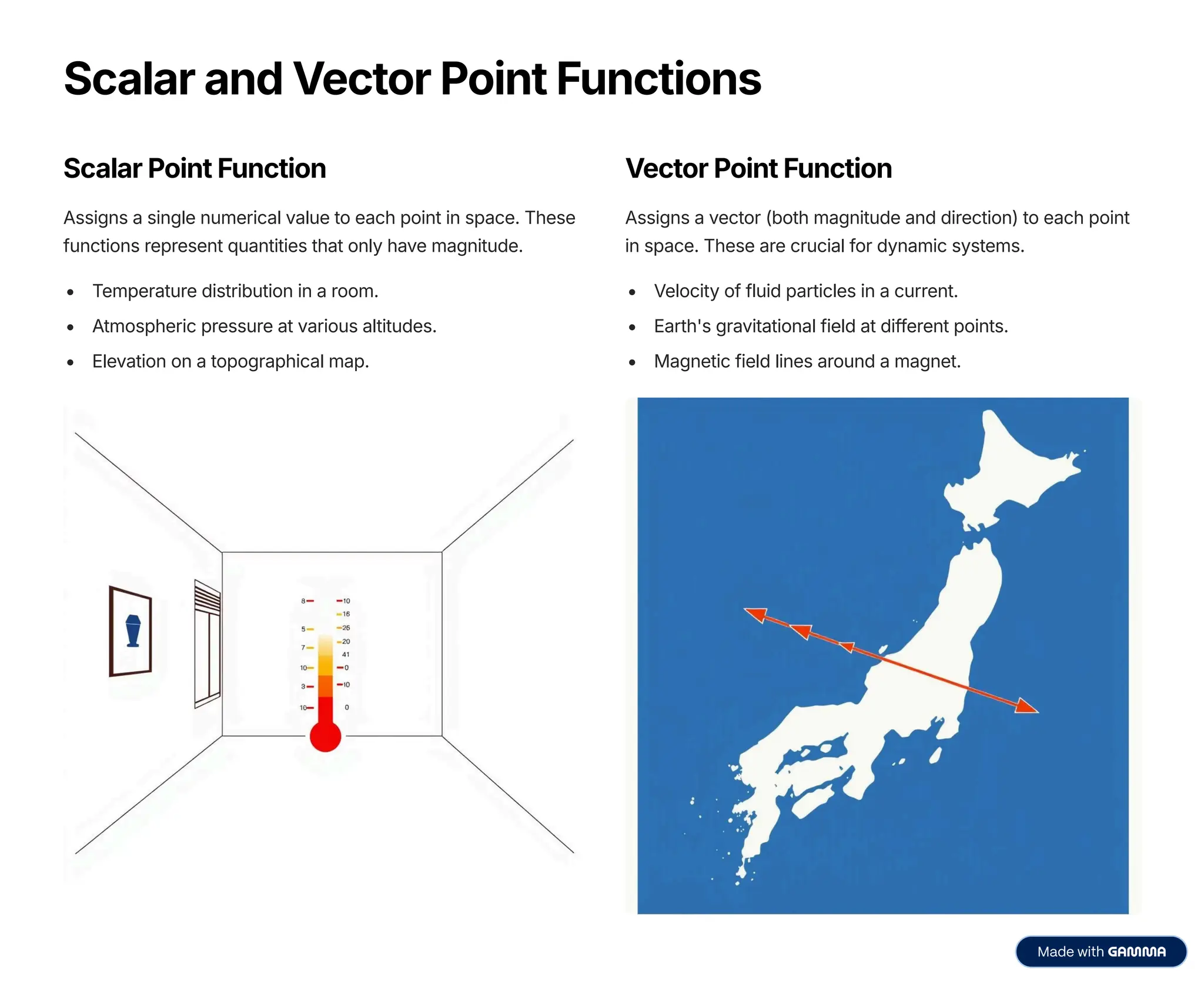
Scalar Point Function
Assigns a single numerical value to each point in space. These
functions represent quantities that only have magnitude.
Temperature distribution in a room.
Atmospheric pressure at various altitudes.
Elevation on a topographical map.
Vector Point Function
Assigns a vector (both magnitude and direction) to each point
in space. These are crucial for dynamic systems.
Velocity of fluid particles in a current.
Earth's gravitational field at different points.
Magnetic field lines around a magnet.
4.
Scalar and VectorFields in Nature
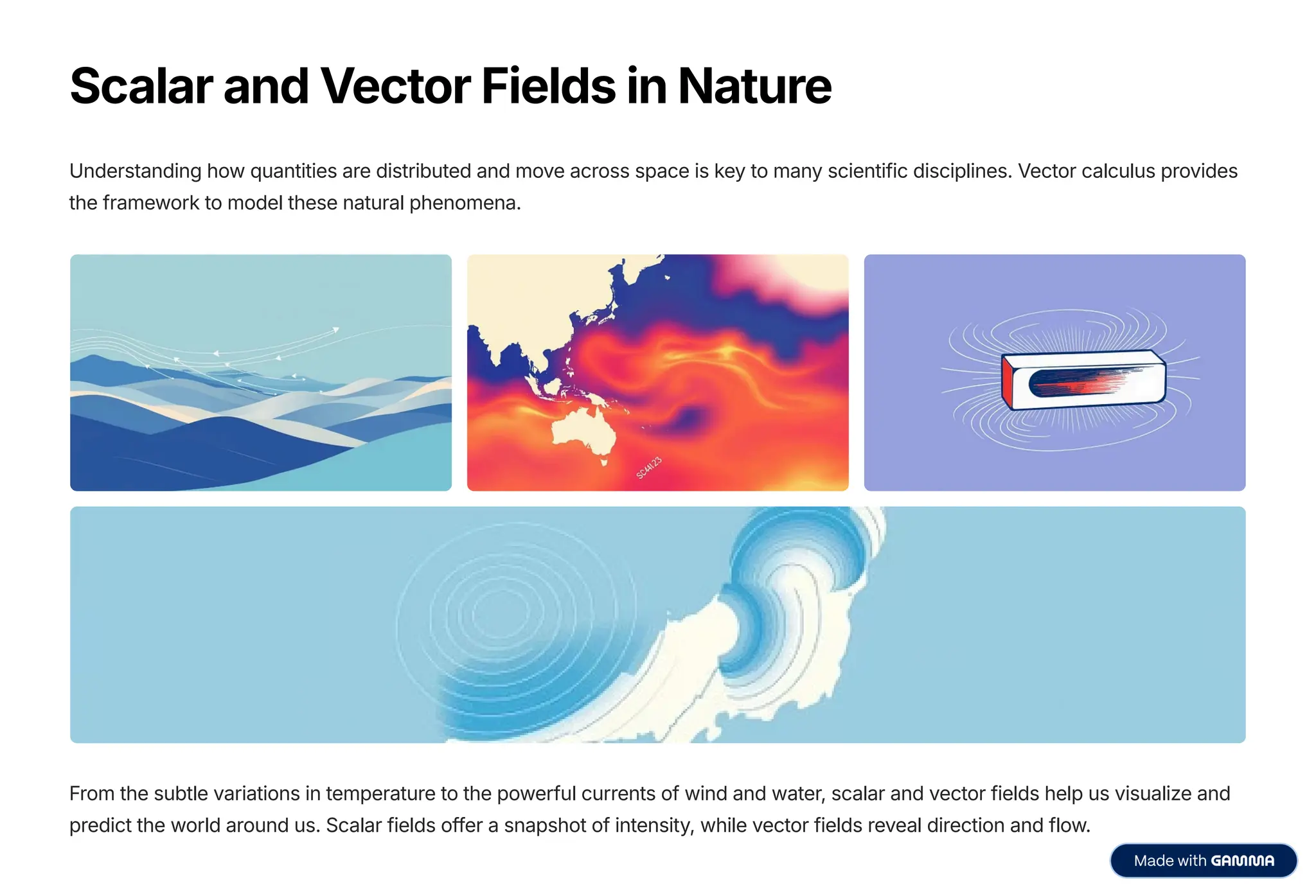
Understanding how quantities are distributed and move across space is key to many scientific disciplines. Vector calculus provides
the framework to model these natural phenomena.
From the subtle variations in temperature to the powerful currents of wind and water, scalar and vector fields help us visualize and
predict the world around us. Scalar fields offer a snapshot of intensity, while vector fields reveal direction and flow.
5.
The Del Operator('): The Heart of Vector Calculus
The 'Del' operator, represented as ', is a powerful vector differential operator that forms the cornerstone of vector calculus. It acts
on both scalar and vector fields to reveal critical information about their spatial variation.
Mathematical Powerhouse
A crucial vector differential
operator, it simplifies complex
calculations in multi-dimensional
space.
Field Analysis
Enables the computation of
gradient, divergence, and curl,
essential for understanding field
behavior.
Spatial Change
Fundamental for analyzing how
scalar and vector fields change and
interact within their environments.
6.
Gradient,Divergence,and
Curl Explained
These threeoperations, derived using the Del operator, unlock the secrets
of how fields transform and behave in space.
Gradient ('§)
Indicates the direction and magnitude of the steepest increase
of a scalar field, like a temperature map or elevation.
Divergence ('·F)
Measures the outward flux of a vector field from a point. It
quantifies how much a field spreads out or converges.
Curl ('×F)
Measures the rotation or swirling tendency of a vector field
around a point. Imagine the spin in a fluid flow.
7.
Line and SurfaceIntegrals: Measuring Along Paths
and Surfaces
Integrals in vector calculus allow us to sum up the effects of fields over specific paths and surfaces, moving beyond point-wise
analysis to cumulative impact.
Line Integrals
Quantify the total effect of a vector field along a given curve or
path. They are used to calculate quantities like the work done
by a force or the circulation of a fluid.
Work done by a force along a displacement.
Flow of heat along a wire.
Electric potential along a path.
Surface Integrals
Sum the effects of a vector field across a two-dimensional
surface. This is vital for determining flux, such as the flow of a
fluid or electric field through an area.
Flux of a fluid through a membrane.
Total charge enclosed by a surface.
Heat transfer through a material's surface.
8.
Gauss's Divergence Theorem& Stokes' Theorem
These two powerful theorems are fundamental bridges in vector calculus, connecting different types of integrals and offering
profound insights into the behavior of fields.
Gauss's Divergence Theorem
Relates the flux of a vector field through a closed surface to
the divergence of the field within the volume it encloses. It
simplifies the calculation of flux.
Stokes' Theorem
Connects the circulation of a vector field around a closed
curve to the curl of the field over any surface bounded by
that curve. It simplifies line integral calculations.
These theorems allow us to convert complex calculations in higher dimensions to simpler ones in lower dimensions, greatly
enhancing our analytical capabilities.
9.
Real-World Applications
Vector calculusisn't just theoretical; it's the language used to describe, predict, and engineer many aspects of our physical world.
Fluid Dynamics
Modeling water flow in pipes,
air currents around aircraft,
and ocean tides.
Electromagnetism
Understanding electric and
magnetic fields, crucial for
motors, generators, and
wireless communication.
Structural Engineering
Analyzing stress, strain, and
material behavior in buildings,
bridges, and other structures.
Signal Processing
From medical imaging to
telecommunications, vector
calculus underpins advanced
signal analysis.
10.
Unlocking
Tomorrow's
Innovations
Vector calculus providesthe foundational mathematics to explore and
innovate in a world defined by dynamic fields and complex flows.
How can a deeper understanding of vector
calculus push the boundaries of future
technological advancements,from renewable
energy to advanced robotics?
By mastering the mathematics of fields, we can design more efficient
systems, predict environmental changes, and create smarter, more
integrated technologies. Its principles are continuously applied to solve the
most pressing challenges of our time.