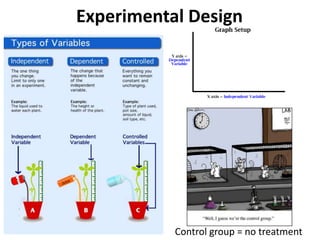
Experimental Design
Control group = no treatment
*IQ tests: mean =100
Standard deviation = 15
Z score
Milgram Experiment
*unethical- coercion
Zimbardo’s (Stanford) Prison
Experiment
*Asch experiment
Social Loafing
Group Polarization
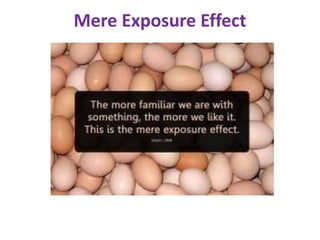
Mere Exposure Effect
Fundamental Attribution Error
Low-ball technique
• Ask your friend for a ride. Then you tell them
after they agree that the place is a half hour
away.
Foot-in-the-door technique
“Can I copy the homework from last night?”
“Sure.”
Later on…
“Can you write this paper for me?”
“Okay.”
Start with a small request to increase the chances someone
will comply to a larger request later.
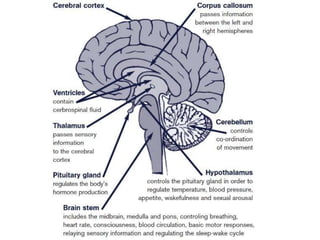
*medulla
The Neuron
Endocrine System
Sensory Adaptation
• Decreased responsiveness to sensory stimuli
due to prolonged exposure (uncontrollable;
based on receptor cells)
ex. going “nose blind”
Sensory Habituation
• Tendency of the brain to stop responding to
unchanging stimuli (intentionally blocking out;
conscious)
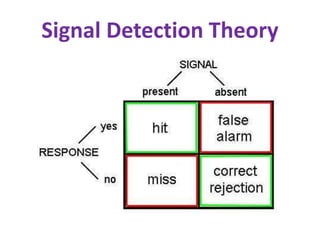
Signal Detection Theory
Trichromatic
Theory
Opponent Process
Theory
(*explains afterimage)
Color Vision
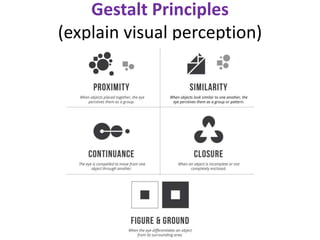
Gestalt Principles
(explain visual perception)
Parts of the Ear
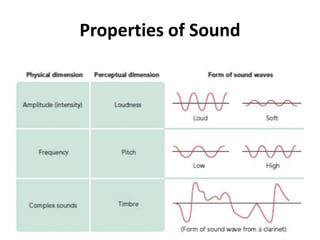
Properties of Sound
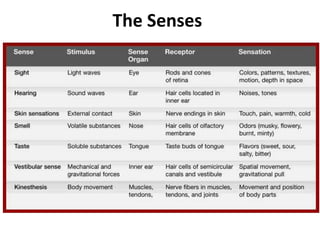
The Senses
**Stages 3+4 are now combined into 1 stage. So it goes stage 1,
2, 3 and REM.
Pavlov’s Classical Conditioning
Watson’s Little
Albert
Experiment
(Classical
Conditioning)
Skinner’s Operant Conditioning
Bandura’s Observational
Learning/Social Learning Theory
Memory
Interference (memory)
Can’t remember new
stuff b/c old stuff gets
in the way
Can’t remember old stuff
b/c new stuff gets in the
way
Problem Solving (cognition)
Representativeness Heuristic
• Overestimate probability/judge based on our
prototype
Ex. You think it’s likely to have
an older, male history teacher
because that’s the prototype
(when really, most teachers in
our SS dept. are young and
many are female)
Availability heuristic
• Overestimate probability or judge things
based on information that is available/shown
to you
Ex. Ms. Sturgess hears about a
plane crash on the news and
thinks her chances of getting in
a plane crash are higher now
Projective Tests
Rorschach Inkblot
Thematic Apperception Test
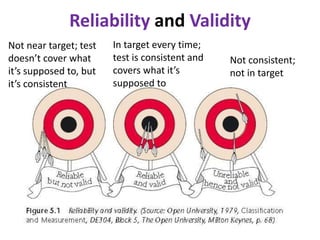
Reliability and Validity
Not near target; test
doesn’t cover what
it’s supposed to, but
it’s consistent
In target every time;
test is consistent and
covers what it’s
supposed to
Not consistent;
not in target
Gardner’s Multiple Intelligence Theory
Goleman’s Emotional Intelligence
Drive Reduction Theory
Arousal Theory (Motivation)
• Seeking to increase or decrease stimulation
– Ex. Being on your phone when bored in class
Incentive Theory
• Motivation through rewards (extrinsic or
intrinsic)
Theories of Emotion
Selye’s General Adaption Syndrome
(responses to stress)
Fight or flight
kicks in
Bodily responses
level off/plateau
Bodily sources
become depleted
from prolonged
stress
Inverted U Hypothesis
A certain amount of arousal/stress is needed for us to
perform well. Too much stress though will impair
performance.
Mary Ainsworth
Piaget’s Stages of Cognitive
Development
No object permanence
No conservation
egocentrism
Piaget’s Assimilation + Accommodation
Kohlberg’s Moral Reasoning
Baumrind’s Parenting Styles
Big Five Personality Traits
(McCrae and Costa)
Rotter’s Locus of Control
Freud’s Components of Personality
Defense Mechanisms
Schizophrenia
Somatoform Disorders
Anxiety Disorders
Systematic Desensitization
Psychopharmacology
Antianxiety Antidepressants
Antipsychotics Mood Stabilizers
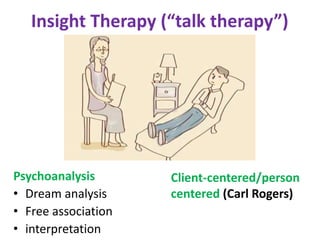
Insight Therapy (“talk therapy”)
Psychoanalysis
• Dream analysis
• Free association
• interpretation
Client-centered/person
centered (Carl Rogers)

AP Psych Visual review