Things to RememberThings to Remember
-Get a good night’s rest
-Eat something before the exam
-Leave your cell phone in your locker
-Bring a black pen and #2 pencil
-Wear a watch to watch the time
-Answer as much of the FRQs as possible
-Don’t give up…take deep breaths
-Think WWBD “What Would Bolinsky Do?”
A Review of EverythingA Review of Everything
you learned this year!!!you learned this year!!!
Psychology
What is it?
The study of our inner
feelings and behaviors.
Do our feelings always match our behaviors?
If you call me a
dumbass, I may feel
sad inside.
But I will
still act
tough.
(but I will be
crying on the
inside, so be
gentle).
History of PsychologyHistory of Psychology
• Although the science of psychology
started in the late 1800’s, the concept has
been around a lot longer.
• There was evidence of trephination
(cutting holes into a skull to let evil spirits
out) back in the stone age.
It was like a bad SAW movie!!!!
Waves of PsychologyWaves of Psychology
• The science of psychology has gone
through about 5 different waves since
it started.
• Waves are different ways of thinking
over time.
Wave One: IntrospectionWave One: Introspection
Kickin it old school
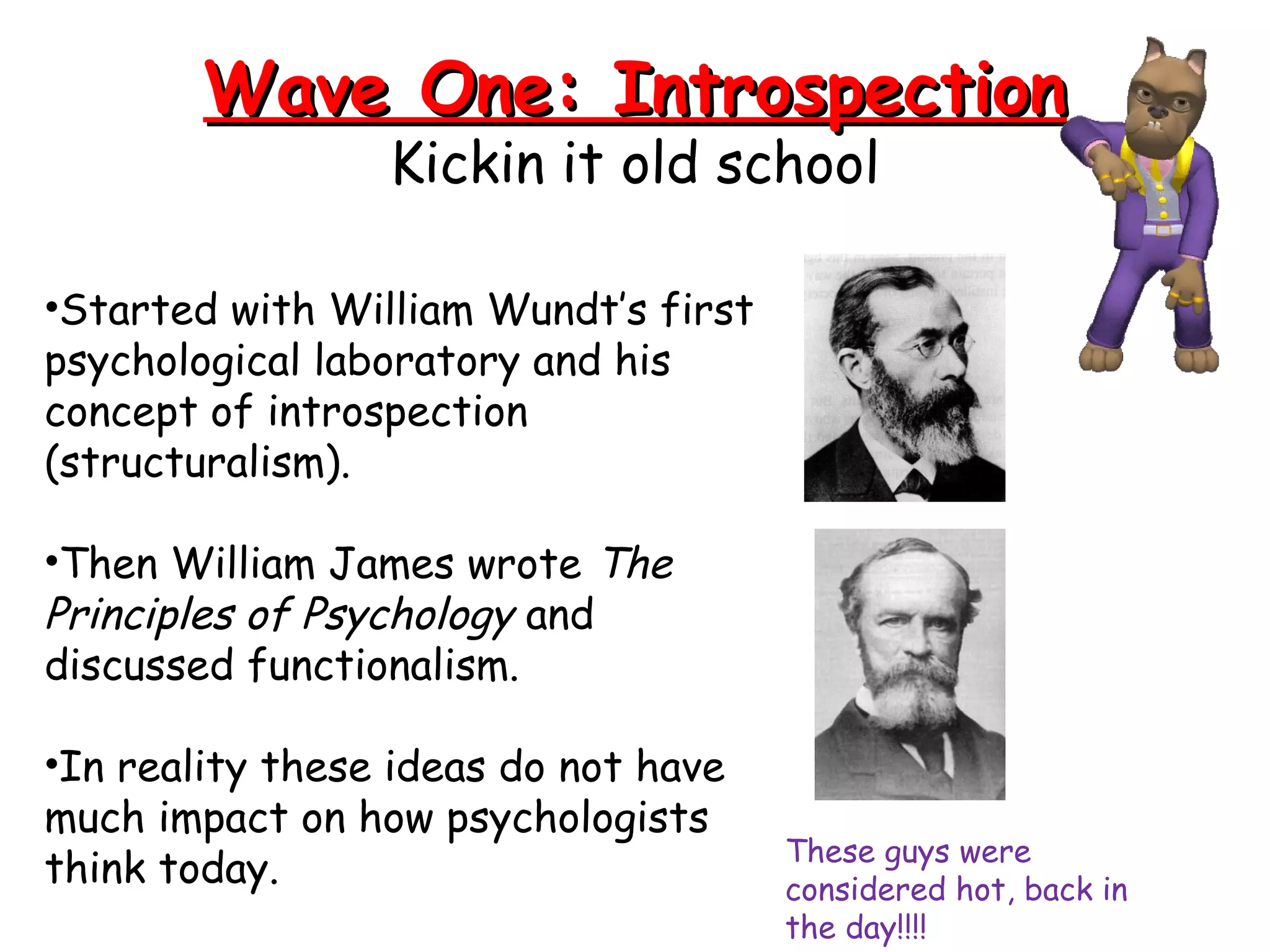
•Started with William Wundt’s first
psychological laboratory and his
concept of introspection
(structuralism).
•Then William James wrote The
Principles of Psychology and
discussed functionalism.
•In reality these ideas do not have
much impact on how psychologists
think today. These guys were
considered hot, back in
the day!!!!
Wave Two: Gestalt PsychologyWave Two: Gestalt Psychology
• Led by Max Wertheimer, these guys focused not on how
we feel, but on how we experience the world.
• The whole of an experience can be more than the sum
of its parts.
Think for a moment of all the reasons that you love your mom.
If you add all those reasons up, do they equal your love for your mom?
Hopefully not!!!
This may seem like
one picture, but it can
be perceived as 3
different faces. Can
you find them?
Wave Three: PsychoanalysisWave Three: Psychoanalysis
• This wave of thinking started with
Sigmund Freud (in the early 1900’s).
• In a nutshell, during this time period
people believed that most of your
feelings come from a hidden place in
your mind called the unconscious.
• We protect ourselves from our real
feeling by using defense mechanisms.
Wave Four: BehaviorismWave Four: Behaviorism
• During this time period (early to mid
1900s), people started to ignore how you
feel inside.
• All that mattered was how you acted.
• If you they could change your behavior,
who cares how you feel.
• Very popular during the conservative
1950’s when social appearance mattered
more than self expression.
Wave Five: EclecticWave Five: Eclectic
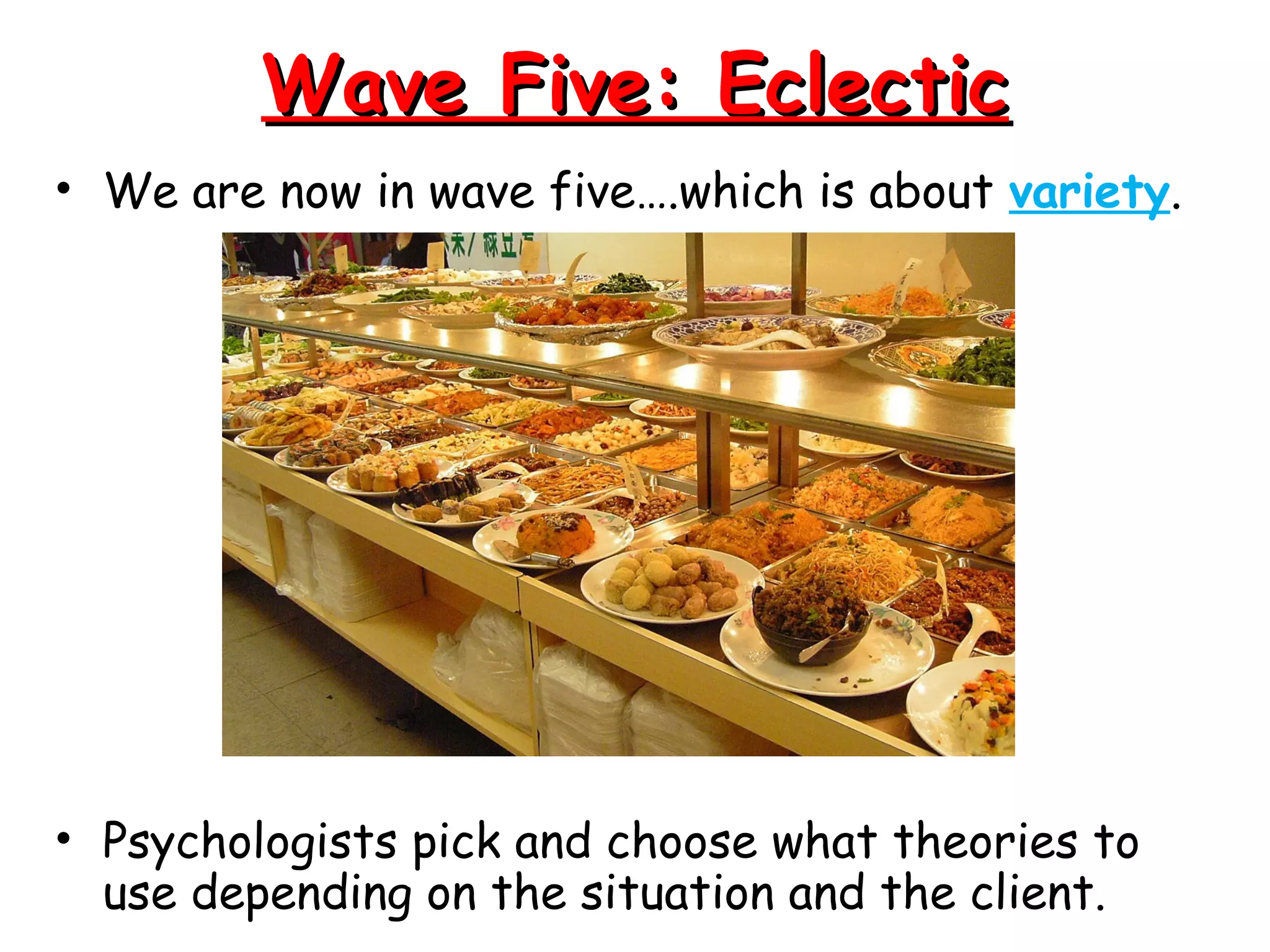
• We are now in wave five….which is about variety.
• Psychologists pick and choose what theories to
use depending on the situation and the client.
Wave Five is made up of about 7Wave Five is made up of about 7
different perspectives.different perspectives.
In other words, psychologists today, pick
and choose from about 7 schools of
thought to help you with your problems.
Thus we have:
THE SEVEN SCHOOLS OF PSYCHOLOGY
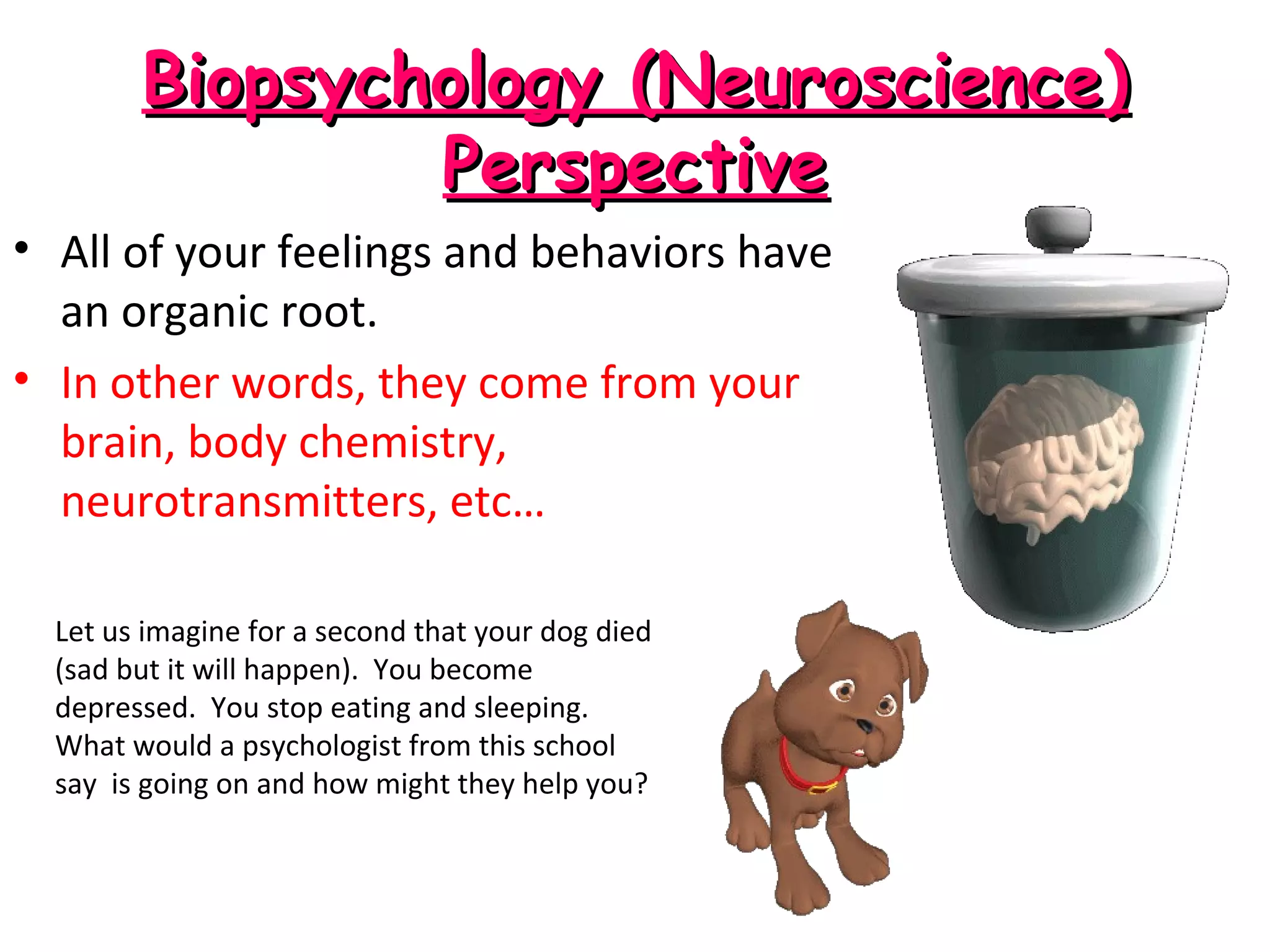
Biopsychology (Neuroscience)Biopsychology (Neuroscience)
PerspectivePerspective
• All of your feelings and behaviors have
an organic root.
• In other words, they come from your
brain, body chemistry,
neurotransmitters, etc…
Let us imagine for a second that your dog died
(sad but it will happen). You become
depressed. You stop eating and sleeping.
What would a psychologist from this school
say is going on and how might they help you?
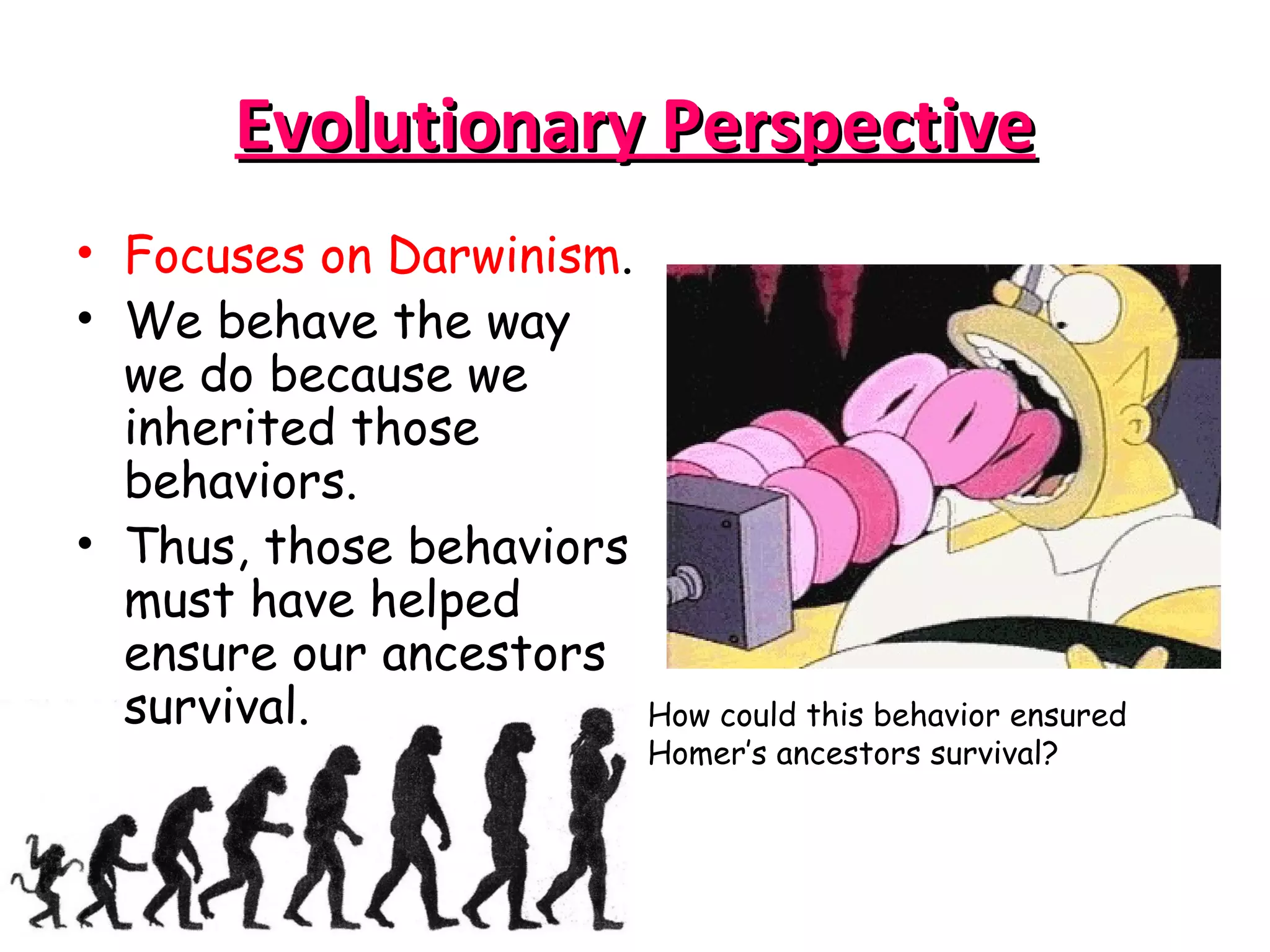
Evolutionary PerspectiveEvolutionary Perspective
• Focuses on Darwinism.
• We behave the way
we do because we
inherited those
behaviors.
• Thus, those behaviors
must have helped
ensure our ancestors
survival. How could this behavior ensured
Homer’s ancestors survival?
Psychoanalytic PerspectivePsychoanalytic Perspective
• Focuses on the
unconscious mind.
• We repress many of
our true feelings
and are not aware
of them.
• In order to get
better, we must
bring forward the
true feelings we
have in our
unconscious.
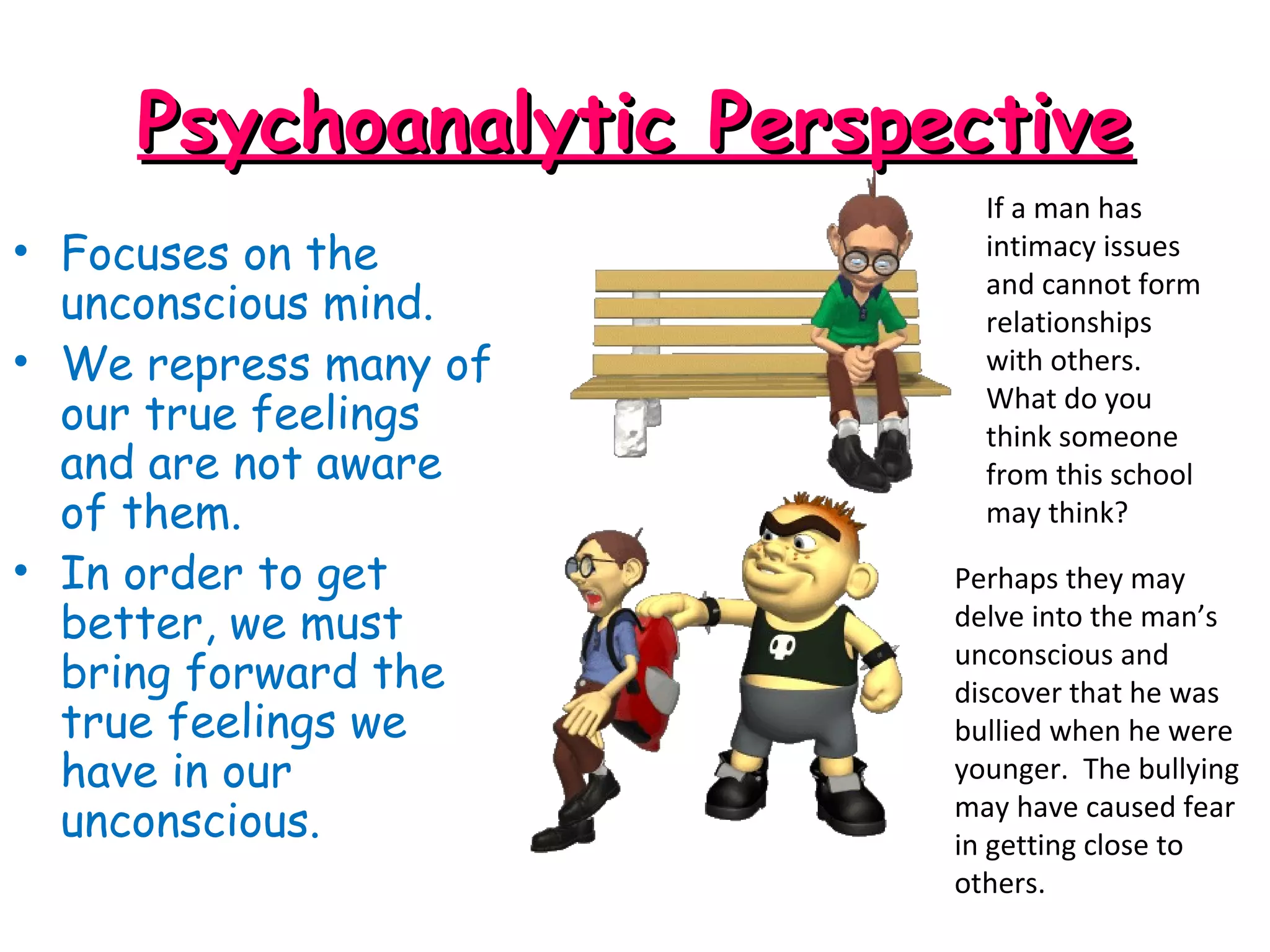
If a man has
intimacy issues
and cannot form
relationships
with others.
What do you
think someone
from this school
may think?
Perhaps they may
delve into the man’s
unconscious and
discover that he was
bullied when he were
younger. The bullying
may have caused fear
in getting close to
others.
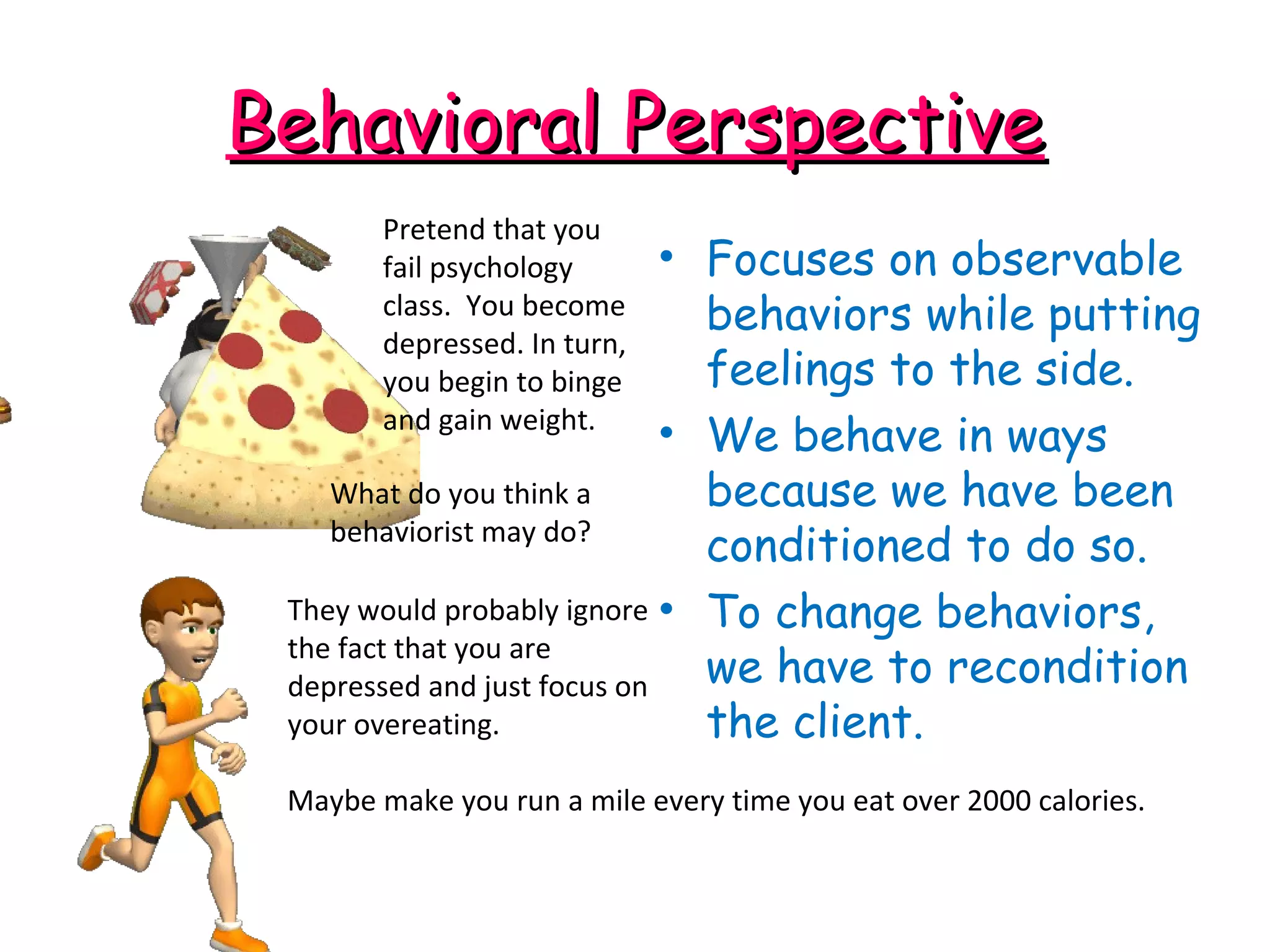
Behavioral PerspectiveBehavioral Perspective
• Focuses on observable
behaviors while putting
feelings to the side.
• We behave in ways
because we have been
conditioned to do so.
• To change behaviors,
we have to recondition
the client.
Pretend that you
fail psychology
class. You become
depressed. In turn,
you begin to binge
and gain weight.
What do you think a
behaviorist may do?
They would probably ignore
the fact that you are
depressed and just focus on
your overeating.
Maybe make you run a mile every time you eat over 2000 calories.
Humanist PerspectiveHumanist Perspective
• Peaked in the late
1960’s and 70’s….so it
focused on spirituality
and free will.
• We have to strive to
be the best we can be
“self-actualization”.
• Happiness is defined
by the distance
between our “self-
concept” and “ideal
self”.
Cognitive PerspectiveCognitive Perspective
• Focuses on how we
think (or encode
information)
• How do we see the
world?
• How did we learn to act
to sad or happy events?
• Cognitive Therapist
attempt to change the
way you think.
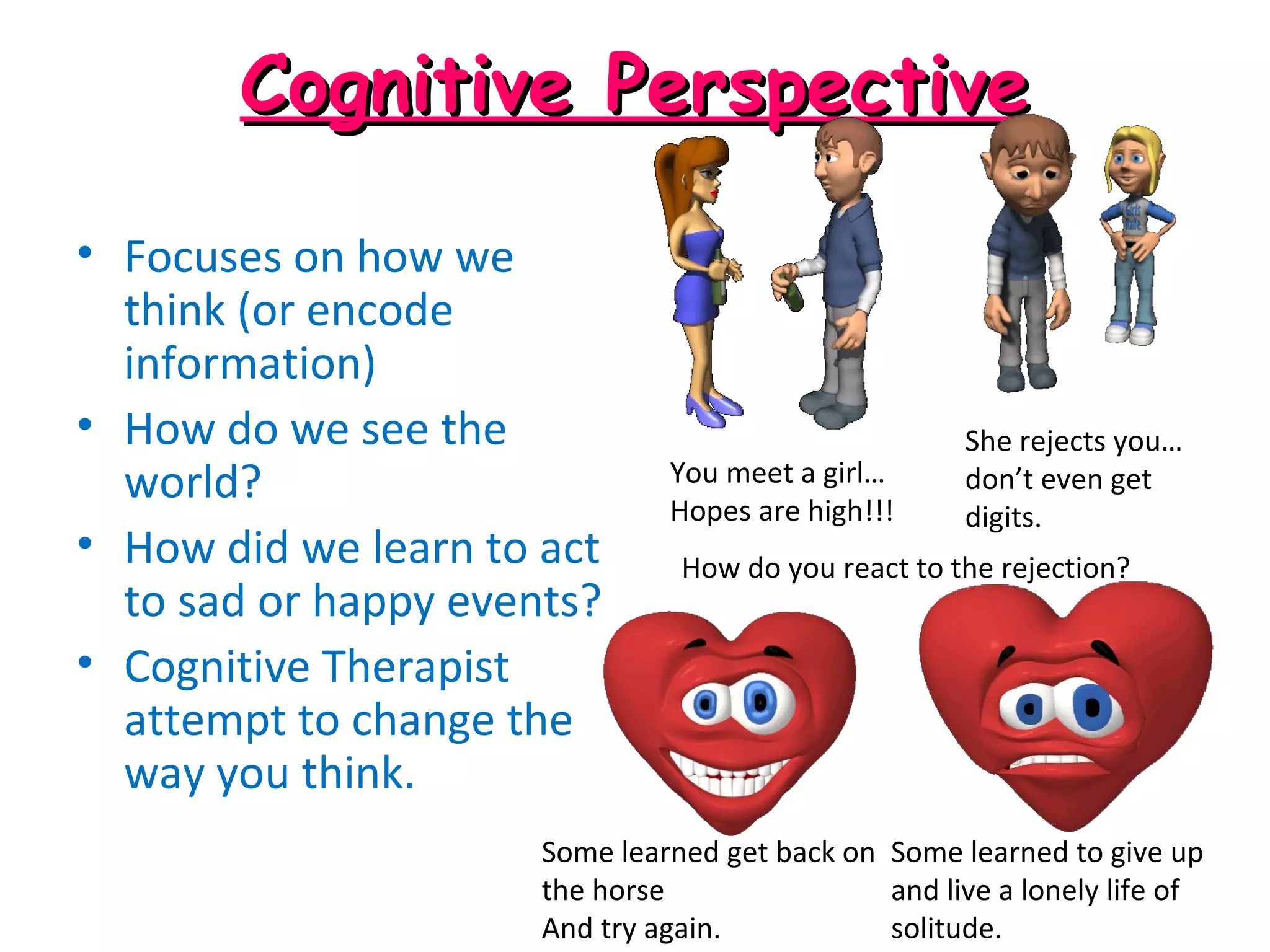
You meet a girl…
Hopes are high!!!
She rejects you…
don’t even get
digits.
How do you react to the rejection?
Some learned get back on
the horse
And try again.
Some learned to give up
and live a lonely life of
solitude.
Social-Cultural PerspectiveSocial-Cultural Perspective
• Says that much of your
behavior and your
feelings are dictated by
the culture you live in.
• Some cultures kiss each
other when greeting,
some just bow.
• Does your culture place
value on individual or
the group?
Psychology’s Three Big DebatesPsychology’s Three Big Debates
• Nature Versus Nurture
• Stability Versus Change
• Continuity Versus
Discontinuity
Things to RememberThings to Remember
-Get a good night’s rest
-Eat something before the exam
-Leave your cell phone in your locker
-Bring a black pen and #2 pencil
-Wear a watch to watch the time
-Answer as much of the FRQs as possible
-Don’t give up…take deep breaths
-Think WWBD “What Would Bolinsky Do?”

AP Psych Review

  • 1.
    Things to RememberThingsto Remember -Get a good night’s rest -Eat something before the exam -Leave your cell phone in your locker -Bring a black pen and #2 pencil -Wear a watch to watch the time -Answer as much of the FRQs as possible -Don’t give up…take deep breaths -Think WWBD “What Would Bolinsky Do?”
  • 2.
    A Review ofEverythingA Review of Everything you learned this year!!!you learned this year!!!
  • 4.
    Psychology What is it? Thestudy of our inner feelings and behaviors. Do our feelings always match our behaviors? If you call me a dumbass, I may feel sad inside. But I will still act tough. (but I will be crying on the inside, so be gentle).
  • 5.
    History of PsychologyHistoryof Psychology • Although the science of psychology started in the late 1800’s, the concept has been around a lot longer. • There was evidence of trephination (cutting holes into a skull to let evil spirits out) back in the stone age. It was like a bad SAW movie!!!!
  • 6.
    Waves of PsychologyWavesof Psychology • The science of psychology has gone through about 5 different waves since it started. • Waves are different ways of thinking over time.
  • 7.
    Wave One: IntrospectionWaveOne: Introspection Kickin it old school •Started with William Wundt’s first psychological laboratory and his concept of introspection (structuralism). •Then William James wrote The Principles of Psychology and discussed functionalism. •In reality these ideas do not have much impact on how psychologists think today. These guys were considered hot, back in the day!!!!
  • 8.
    Wave Two: GestaltPsychologyWave Two: Gestalt Psychology • Led by Max Wertheimer, these guys focused not on how we feel, but on how we experience the world. • The whole of an experience can be more than the sum of its parts. Think for a moment of all the reasons that you love your mom. If you add all those reasons up, do they equal your love for your mom? Hopefully not!!! This may seem like one picture, but it can be perceived as 3 different faces. Can you find them?
  • 9.
    Wave Three: PsychoanalysisWaveThree: Psychoanalysis • This wave of thinking started with Sigmund Freud (in the early 1900’s). • In a nutshell, during this time period people believed that most of your feelings come from a hidden place in your mind called the unconscious. • We protect ourselves from our real feeling by using defense mechanisms.
  • 10.
    Wave Four: BehaviorismWaveFour: Behaviorism • During this time period (early to mid 1900s), people started to ignore how you feel inside. • All that mattered was how you acted. • If you they could change your behavior, who cares how you feel. • Very popular during the conservative 1950’s when social appearance mattered more than self expression.
  • 11.
    Wave Five: EclecticWaveFive: Eclectic • We are now in wave five….which is about variety. • Psychologists pick and choose what theories to use depending on the situation and the client.
  • 12.
    Wave Five ismade up of about 7Wave Five is made up of about 7 different perspectives.different perspectives. In other words, psychologists today, pick and choose from about 7 schools of thought to help you with your problems. Thus we have: THE SEVEN SCHOOLS OF PSYCHOLOGY
  • 13.
    Biopsychology (Neuroscience)Biopsychology (Neuroscience) PerspectivePerspective •All of your feelings and behaviors have an organic root. • In other words, they come from your brain, body chemistry, neurotransmitters, etc… Let us imagine for a second that your dog died (sad but it will happen). You become depressed. You stop eating and sleeping. What would a psychologist from this school say is going on and how might they help you?
  • 14.
    Evolutionary PerspectiveEvolutionary Perspective •Focuses on Darwinism. • We behave the way we do because we inherited those behaviors. • Thus, those behaviors must have helped ensure our ancestors survival. How could this behavior ensured Homer’s ancestors survival?
  • 15.
    Psychoanalytic PerspectivePsychoanalytic Perspective •Focuses on the unconscious mind. • We repress many of our true feelings and are not aware of them. • In order to get better, we must bring forward the true feelings we have in our unconscious. If a man has intimacy issues and cannot form relationships with others. What do you think someone from this school may think? Perhaps they may delve into the man’s unconscious and discover that he was bullied when he were younger. The bullying may have caused fear in getting close to others.
  • 16.
    Behavioral PerspectiveBehavioral Perspective •Focuses on observable behaviors while putting feelings to the side. • We behave in ways because we have been conditioned to do so. • To change behaviors, we have to recondition the client. Pretend that you fail psychology class. You become depressed. In turn, you begin to binge and gain weight. What do you think a behaviorist may do? They would probably ignore the fact that you are depressed and just focus on your overeating. Maybe make you run a mile every time you eat over 2000 calories.
  • 17.
    Humanist PerspectiveHumanist Perspective •Peaked in the late 1960’s and 70’s….so it focused on spirituality and free will. • We have to strive to be the best we can be “self-actualization”. • Happiness is defined by the distance between our “self- concept” and “ideal self”.
  • 18.
    Cognitive PerspectiveCognitive Perspective •Focuses on how we think (or encode information) • How do we see the world? • How did we learn to act to sad or happy events? • Cognitive Therapist attempt to change the way you think. You meet a girl… Hopes are high!!! She rejects you… don’t even get digits. How do you react to the rejection? Some learned get back on the horse And try again. Some learned to give up and live a lonely life of solitude.
  • 19.
    Social-Cultural PerspectiveSocial-Cultural Perspective •Says that much of your behavior and your feelings are dictated by the culture you live in. • Some cultures kiss each other when greeting, some just bow. • Does your culture place value on individual or the group?
  • 20.
    Psychology’s Three BigDebatesPsychology’s Three Big Debates • Nature Versus Nurture • Stability Versus Change • Continuity Versus Discontinuity
  • 21.
    Things to RememberThingsto Remember -Get a good night’s rest -Eat something before the exam -Leave your cell phone in your locker -Bring a black pen and #2 pencil -Wear a watch to watch the time -Answer as much of the FRQs as possible -Don’t give up…take deep breaths -Think WWBD “What Would Bolinsky Do?”