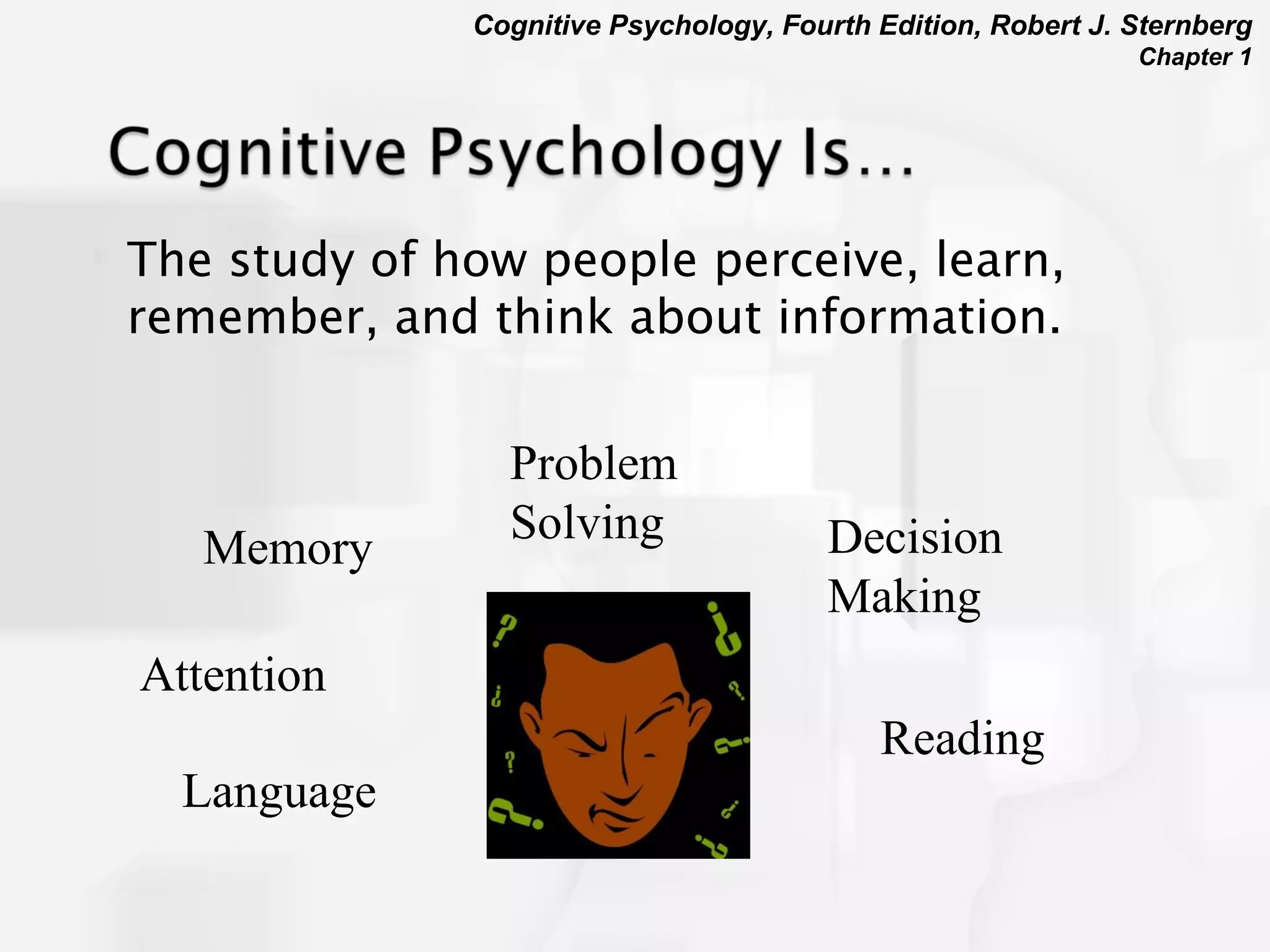
The study of how people perceive, learn, remember, and think about information. Problem Solving Attention Memory Decision Making Reading Language
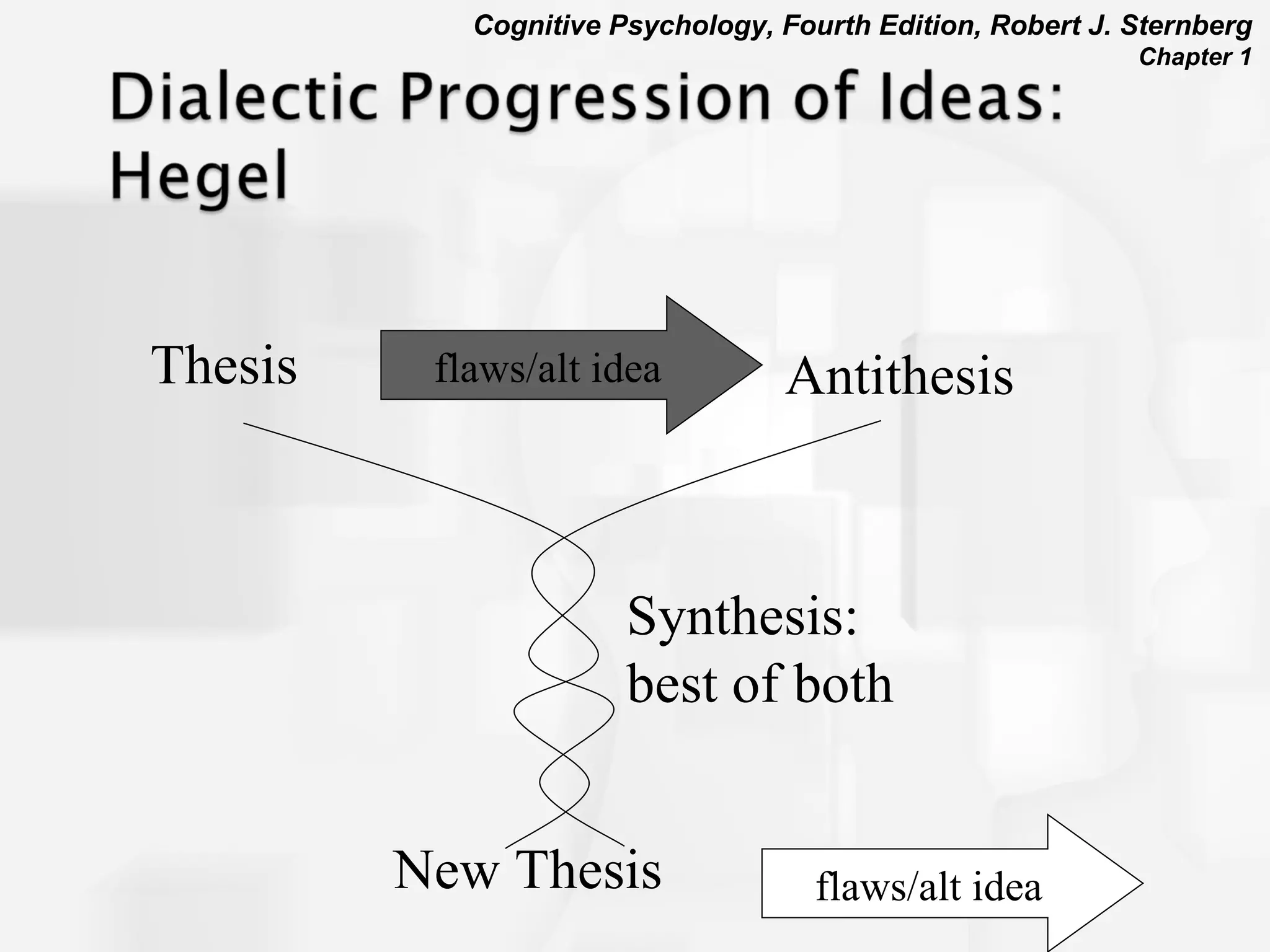
Thesis Antithesis flaws/alt idea Synthesis:  best of both New Thesis flaws/alt idea
Rationalist Logic & reasoning  is key Empiricist  Experience & observation is key Philosophical Roots
Rationalism (Descartes) Empiricism (Locke) Synthesis:  Both have a role (Kant)
Structuralism (Titchener) Functionalism (James) led to Pragmatists Synthesis:   Associationism (Ebbinghaus &  Thorndike)
Associationism (Thorndike) Behaviorism (Pavlov)  Synthesis:  Extreme form of Behaviorism took hold. Psychology should study only observable behavior (Watson & Skinner).
Behaviorism Dominated until…. Synthesis:  Cognitions should play an active role in psychology (Gestalt, Bandura) Less radical Behaviorist Cognitive Map (Tolman)
Hebb & Lashley emphasize how cognition could be explained by neuroscience. Chompsky’s review of Skinner’s Verbal Behavior: “ reductio ad absurdum ” Development of Computers and Artificial Intelligence These developments led to the “ cognitive revolution ” and increased interest in the study of mental processes (cognitions)
Experiments Psychobiological studies Self report Case studies Naturalistic Observation Computer Simulations
Random sample of participants Manipulate the Independent Variable Create experimental group Create control group Randomly assign participants Measure the Dependent Variable Same for all groups Control all other variables Prevent confounds
Manipulate stimulus materials Compare words to non-words Compare color diagrams to black and white Compare Yes questions to No questions Control how participants process materials Use imagery to study versus repetition Vary speed of presentation of materials
Reaction Time (milliseconds) Mental events take time  Accuracy/Error analysis  How well the participant does on a task
Postmortem studies Examine the cortex of dyslexics after death Brain damaged individuals and their deficits Study amnesiacs with hippocampus damage Monitor a participant doing a cognitive task Measure brain activity while a participant is reciting a poem
Verbal Protocol Participants describe their conscious thoughts while solving a story problem Diary Study Participants keep track of memory failures Naturalistic Observation Monitor decision making of pilots during flights
Intensive studies of individuals May examine archival records, interviews,  direct observation, or participant-observations  Creativity of successful individuals The deficits of a neglected child
Analogy for human Cognition The sequence of symbol manipulation that underlies thinking  The goal: discovery of the programs in humans’ memory Computer simulations of Artificial Intelligence Recreate human processes using computers
Nature vs. Nurture Rationalism vs. Empiricism Structures vs. Processes Domain Generality vs. Domain Specificity Causal Inferences vs. Ecological validity Applied vs. Basic Research Biological vs. Behavioral Methods
Theory Data Data can only be fully explained with theories, and theories are insufficient without data – thus creating the cycle of science.
Cognition is typically adaptive, but errors made can be informative. Example- Spoonerisms:  A lack of pies (A pack of lies)  It's roaring with pain (It's pouring with rain)  Errors can be used to infer how speech production occurs.
Cognitive processes interact with each other and with non-cognitive processes Emotions may affect decisions Working memory capacity contributes to reading speed Perception contributes to memory decisions
Many different methods are used to study cognition Experiments Individual differences Case studies Clinical studies
Basic research often leads to important applications and applied research often contributes to a more basic understanding of cognition Priming is explained by spreading activation in memory, and can also explain why skilled readers may read faster Studying the common errors that 1 st  graders make in math class can help us to better understand how humans process mathematical information

Chapter1introcogpsych

  • 1.
    The study ofhow people perceive, learn, remember, and think about information. Problem Solving Attention Memory Decision Making Reading Language
  • 2.
    Thesis Antithesis flaws/altidea Synthesis: best of both New Thesis flaws/alt idea
  • 3.
    Rationalist Logic &reasoning is key Empiricist Experience & observation is key Philosophical Roots
  • 4.
    Rationalism (Descartes) Empiricism(Locke) Synthesis: Both have a role (Kant)
  • 5.
    Structuralism (Titchener) Functionalism(James) led to Pragmatists Synthesis: Associationism (Ebbinghaus & Thorndike)
  • 6.
    Associationism (Thorndike) Behaviorism(Pavlov) Synthesis: Extreme form of Behaviorism took hold. Psychology should study only observable behavior (Watson & Skinner).
  • 7.
    Behaviorism Dominated until….Synthesis: Cognitions should play an active role in psychology (Gestalt, Bandura) Less radical Behaviorist Cognitive Map (Tolman)
  • 8.
    Hebb & Lashleyemphasize how cognition could be explained by neuroscience. Chompsky’s review of Skinner’s Verbal Behavior: “ reductio ad absurdum ” Development of Computers and Artificial Intelligence These developments led to the “ cognitive revolution ” and increased interest in the study of mental processes (cognitions)
  • 9.
    Experiments Psychobiological studiesSelf report Case studies Naturalistic Observation Computer Simulations
  • 10.
    Random sample ofparticipants Manipulate the Independent Variable Create experimental group Create control group Randomly assign participants Measure the Dependent Variable Same for all groups Control all other variables Prevent confounds
  • 11.
    Manipulate stimulus materialsCompare words to non-words Compare color diagrams to black and white Compare Yes questions to No questions Control how participants process materials Use imagery to study versus repetition Vary speed of presentation of materials
  • 12.
    Reaction Time (milliseconds)Mental events take time Accuracy/Error analysis How well the participant does on a task
  • 13.
    Postmortem studies Examinethe cortex of dyslexics after death Brain damaged individuals and their deficits Study amnesiacs with hippocampus damage Monitor a participant doing a cognitive task Measure brain activity while a participant is reciting a poem
  • 14.
    Verbal Protocol Participantsdescribe their conscious thoughts while solving a story problem Diary Study Participants keep track of memory failures Naturalistic Observation Monitor decision making of pilots during flights
  • 15.
    Intensive studies ofindividuals May examine archival records, interviews, direct observation, or participant-observations Creativity of successful individuals The deficits of a neglected child
  • 16.
    Analogy for humanCognition The sequence of symbol manipulation that underlies thinking The goal: discovery of the programs in humans’ memory Computer simulations of Artificial Intelligence Recreate human processes using computers
  • 17.
    Nature vs. NurtureRationalism vs. Empiricism Structures vs. Processes Domain Generality vs. Domain Specificity Causal Inferences vs. Ecological validity Applied vs. Basic Research Biological vs. Behavioral Methods
  • 18.
    Theory Data Datacan only be fully explained with theories, and theories are insufficient without data – thus creating the cycle of science.
  • 19.
    Cognition is typicallyadaptive, but errors made can be informative. Example- Spoonerisms: A lack of pies (A pack of lies) It's roaring with pain (It's pouring with rain) Errors can be used to infer how speech production occurs.
  • 20.
    Cognitive processes interactwith each other and with non-cognitive processes Emotions may affect decisions Working memory capacity contributes to reading speed Perception contributes to memory decisions
  • 21.
    Many different methodsare used to study cognition Experiments Individual differences Case studies Clinical studies
  • 22.
    Basic research oftenleads to important applications and applied research often contributes to a more basic understanding of cognition Priming is explained by spreading activation in memory, and can also explain why skilled readers may read faster Studying the common errors that 1 st graders make in math class can help us to better understand how humans process mathematical information