The Magic of it. By: Lina Rose Tiongson
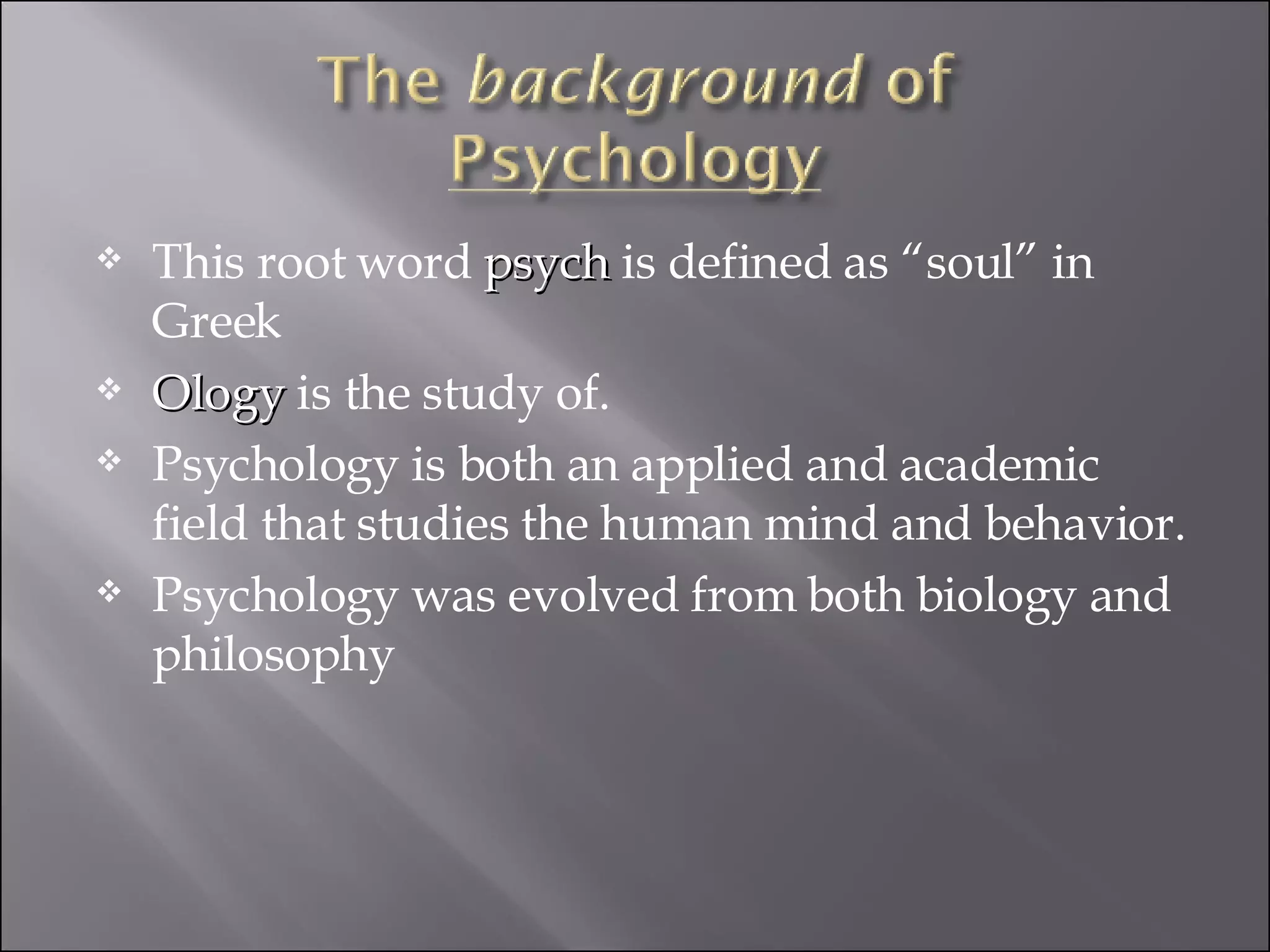
This root word  psych  is defined as “soul” in Greek Ology  is the study of.  Psychology is both an applied and academic field that studies the human mind and behavior.  Psychology was evolved from both biology and philosophy
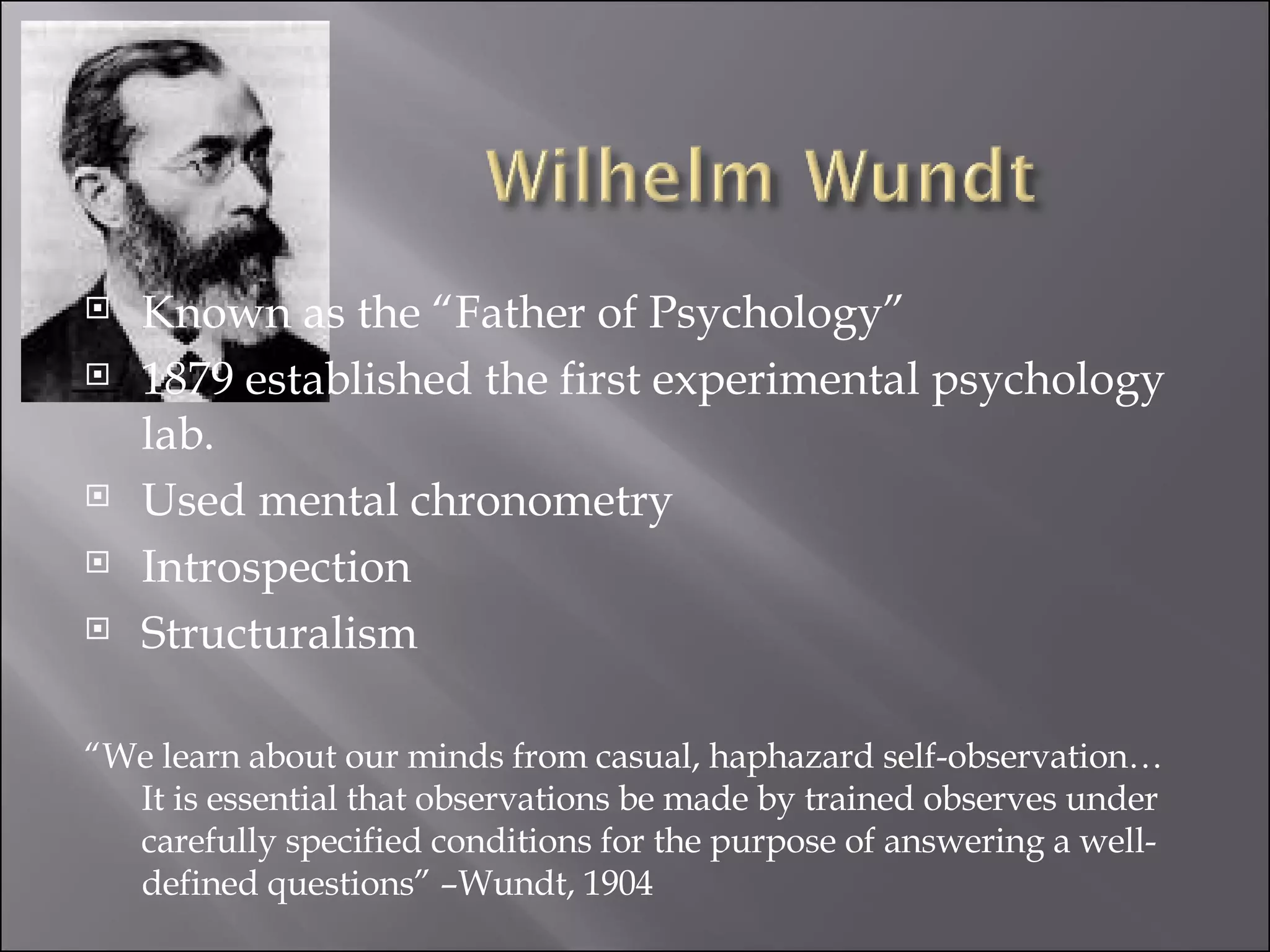
Known as the “Father of Psychology” 1879 established the first experimental psychology lab.  Used mental chronometry Introspection Structuralism “ We learn about our minds from casual, haphazard self-observation…It is essential that observations be made by trained observes under carefully specified conditions for the purpose of answering a well-defined questions” –Wundt, 1904
Science Goals: Describe Explain Predict Control Psychological studies are highly structured, beginning with a hypothesis that is then empirically tested.
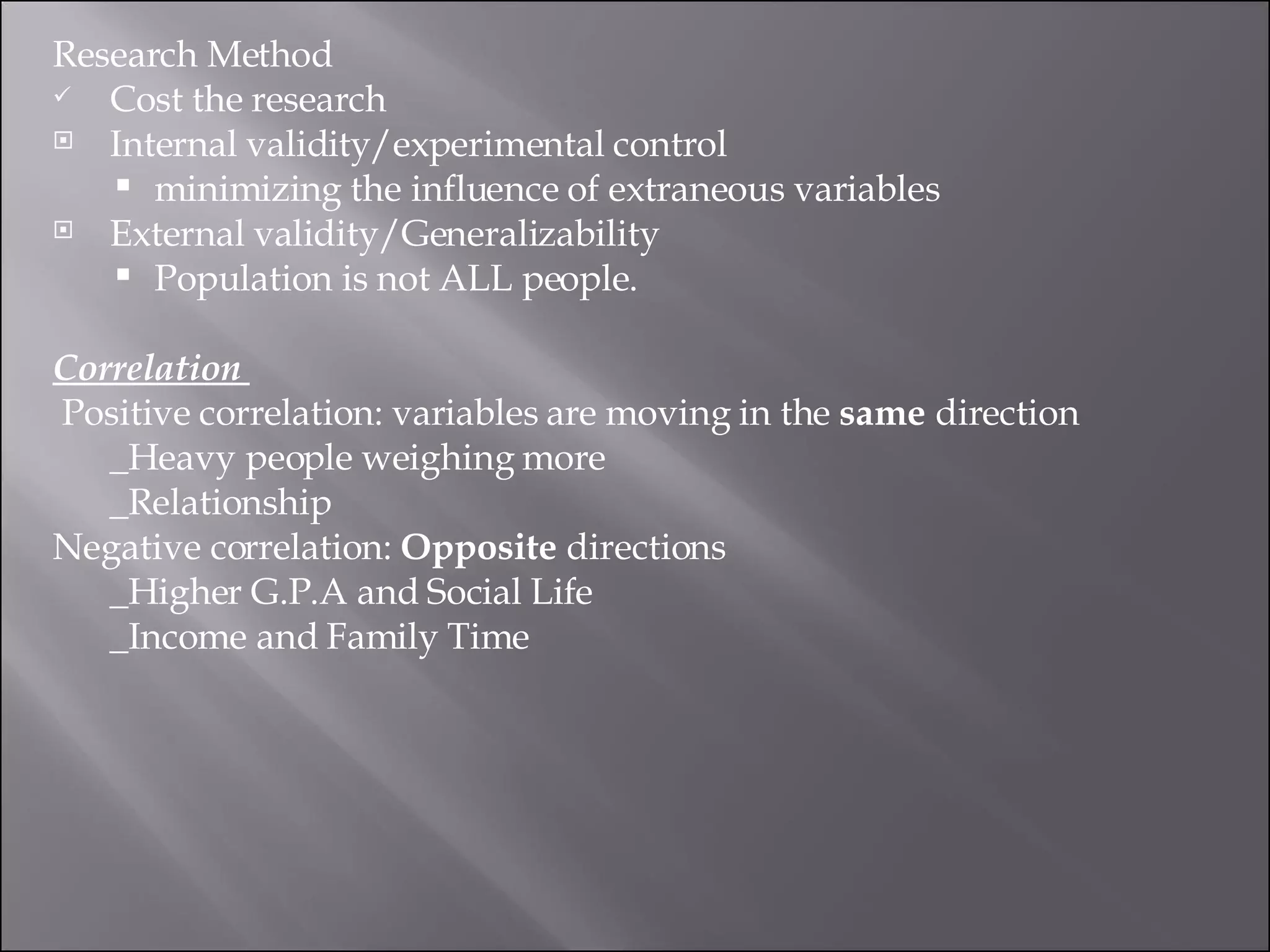
Research Method Cost the research  Internal validity/experimental control  minimizing the influence of extraneous variables External validity/Generalizability  Population is not ALL people.  Correlation    Positive correlation: variables are moving in the  same  direction  _Heavy people weighing more  _Relationship Negative correlation:  Opposite  directions _Higher G.P.A and Social Life  _Income and Family Time
He was known to be the “father of the psychoanalysis Freud had strong feelings for many things such as: - Unconscious wish fulfilling  - He took basic ideas and spun it into science. - He believed we are all born primitive.
Id: primitive & unconscious Pleasure principle Ego: reality principle Delay gratification Superego: moral ideal of society Freud believed that the Id was the most dominant.
Sigmund Freud was the founder of the Psychodynamic School Psychodynamics also known as “ dynamic psychology  “is the study of the interrelationship of various parts of the  mind ,  personality , or  psyche  as they relate to mental, emotional, or  motivational  forces especially at the  unconscious  level and based on the assumption that an individual's total  personality  and reactions at any given time are the product of the interaction between his  genetic  constitution and his  environment . (Wikipedia.org) Two of his students were Carl Jung & Karen Horney
Carl Jung Although Jung was one of Freud’s favorite student, Jung believed that Freud had something wrong with his theory, the unconscious. He believed that the unconscious was capable of being controlled by inspiration, that the “collective unconscious” symbolizes a large emotional component. Explanation to why people behave the way they do. Karen Horney Became one of the most popular psychiatrist and was the first of her gender to present a paper regarding feminine psychiatry. She takes Freud’s whole theory and admits he’s right except men develop womb envy
Psych comes from the  mind  and Sexual comes from  creation Libido:  Psychic energy Close energy system Energy cannot be destroyed Defense Mechanism: used to protest ego from harm caused by the Id’s wishes. Freud example was repression; unconscious exclusion from memory.
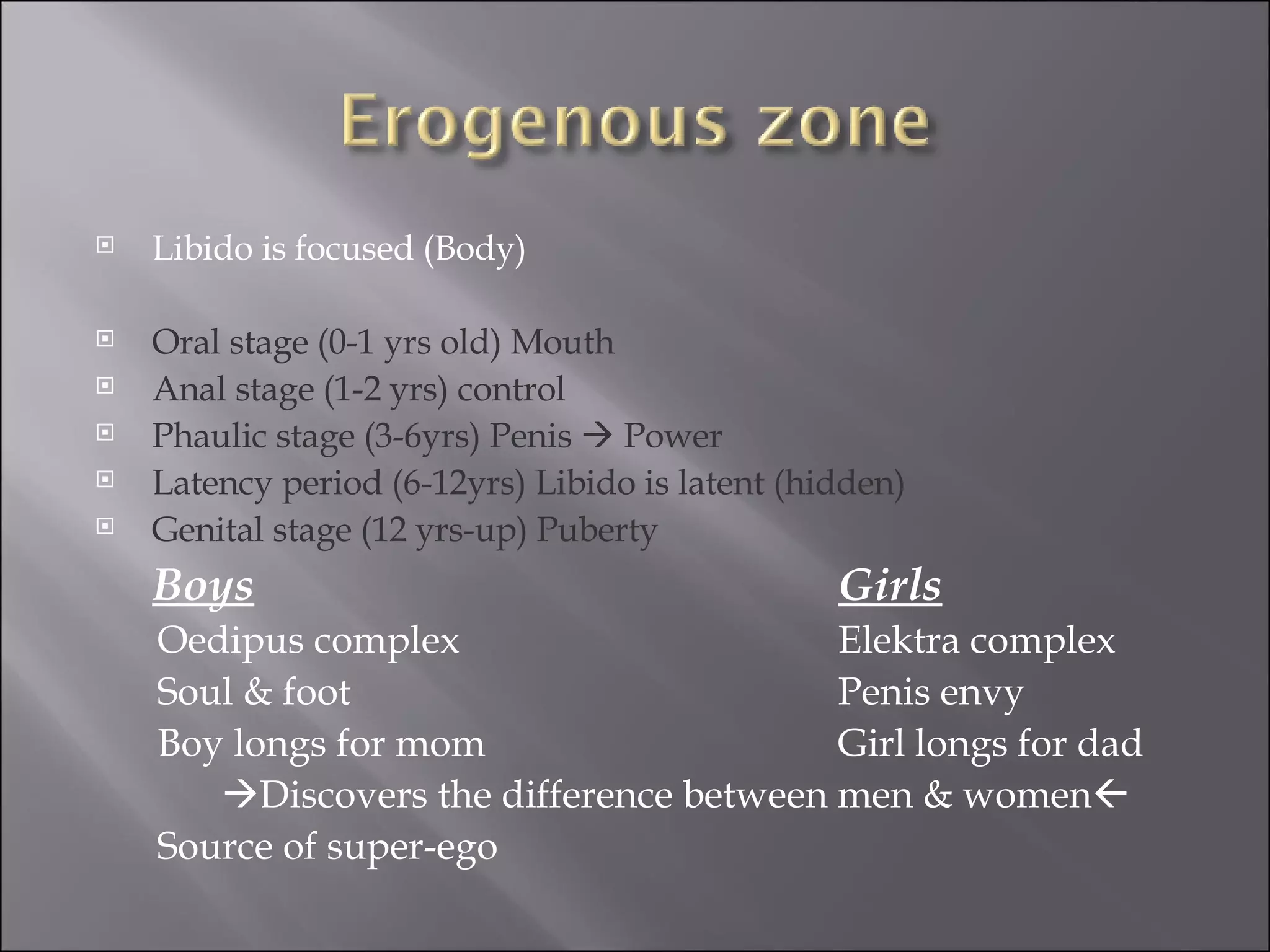
Libido is focused (Body) Oral stage (0-1 yrs old) Mouth Anal stage (1-2 yrs) control Phaulic stage (3-6yrs) Penis    Power Latency period (6-12yrs) Libido is latent (hidden) Genital stage (12 yrs-up) Puberty Boys Girls Oedipus complex Elektra complex Soul & foot Penis envy Boy longs for mom Girl longs for dad  Discovers the difference between men & women  Source of super-ego
Ivan Pavlov , a Russian physiologist studied digestions and dogs and discovered what is known to be “classical conditioning” Classical condition is a technique used in behavioral training A naturally occurring stimulus is paired with a response. a previously neutral stimulus is paired with the naturally occurring stimulus. Eventually, the previous neutral stimulus comes to evoke the response without the presence of naturally occurring stimulus.  Ex:
James B. Watson Father of Behaviorism “ Little Albert” Studied the adjustment of organisms to their environments, more specifically the particular stimuli leading organisms to make their responses. Example on FEAR Loud noise    startle  White rat + loud noise    startle  White rat    startle  “ Give me a dozen healthy infants, well-formed, and my own specified world to bring them up in and I’ll guarantee to take any one at random and train him to become any type of specialist I might select -- doctor, lawyer, artist, merchant-chief and, yes, even beggar-man and thief, regardless of his talents, penchants, tendencies, abilities, vocations, and race of his ancestors.” –Watson, 1930
Edward Thorndike Law of effects : behaviors that help an organism achieve its goal are strengthened.  Only the “fit” behavior survives.  Operant conditioning Sometimes it is known as “instrumental conditioning”  A method that occurs through reward and punishment. Through operant conditioning an association is made between a behavior and a consequence.  Reinforcement + Apply as a desire stimulus - remove or avoid an aversive stimulus (Ex: avoiding loud noises)
Punishment +apply an assertive stimulus - removing or avoiding desire stimulus (Ex: taking away something important from you) Punishment should be  immediate  Punishment must be  consistent  Punishment should be  explained  Desire Assertive  + Positive reinforcement Positive punishment - Negative punishment Negative reinforcement
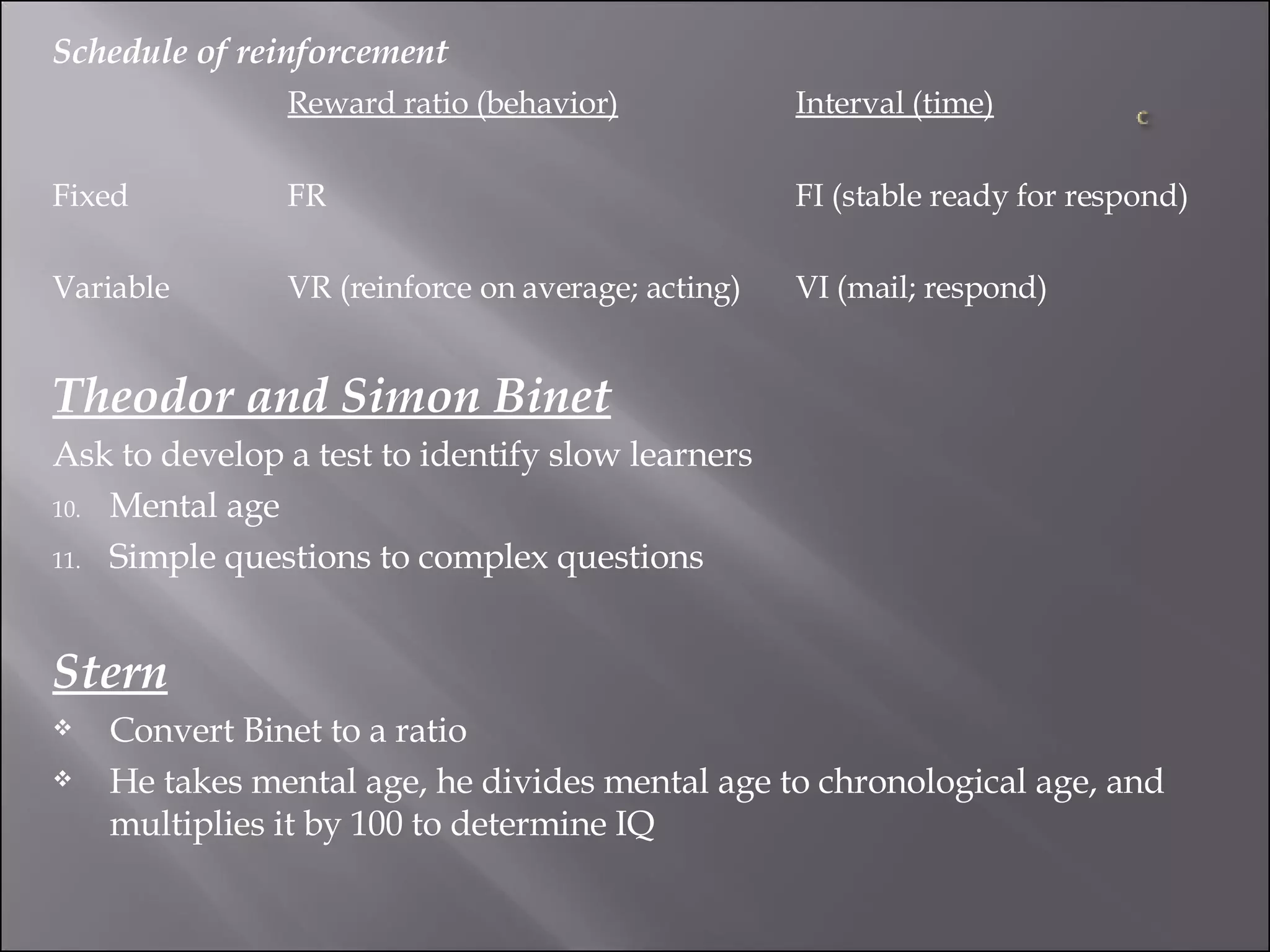
Schedule of reinforcement Reward ratio (behavior) Interval (time) Fixed FR FI (stable ready for respond) Variable VR (reinforce on average; acting) VI (mail; respond) Theodor and Simon Binet Ask to develop a test to identify slow learners Mental age Simple questions to complex questions Stern Convert Binet to a ratio  He takes mental age, he divides mental age to chronological age, and multiplies it by 100 to determine IQ
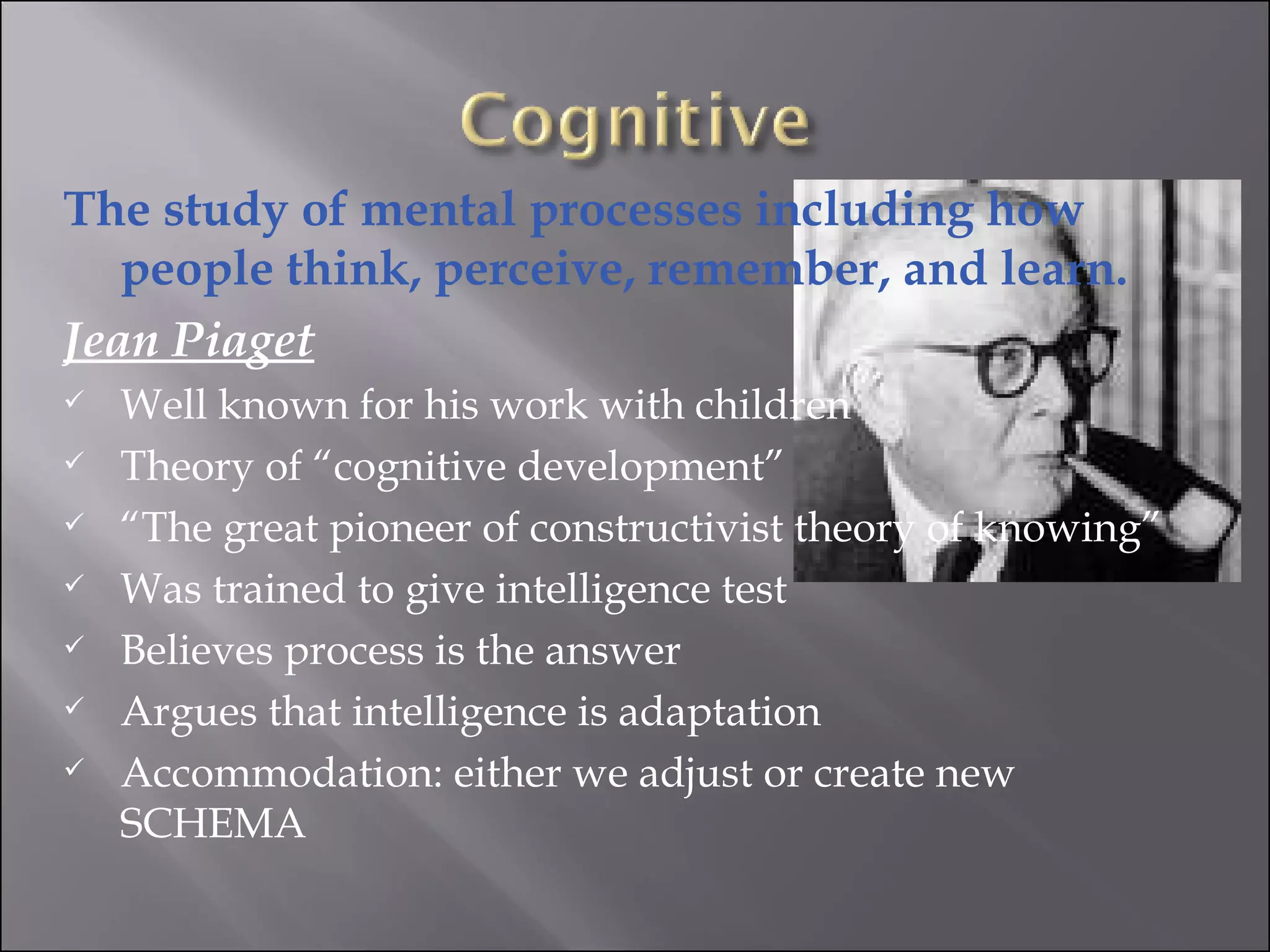
The study of mental processes including how people think, perceive, remember, and learn.  Jean Piaget Well known for his work with children  Theory of “cognitive development” “ The great pioneer of constructivist theory of knowing” Was trained to give intelligence test Believes process is the answer Argues that intelligence is adaptation  Accommodation: either we adjust or create new SCHEMA
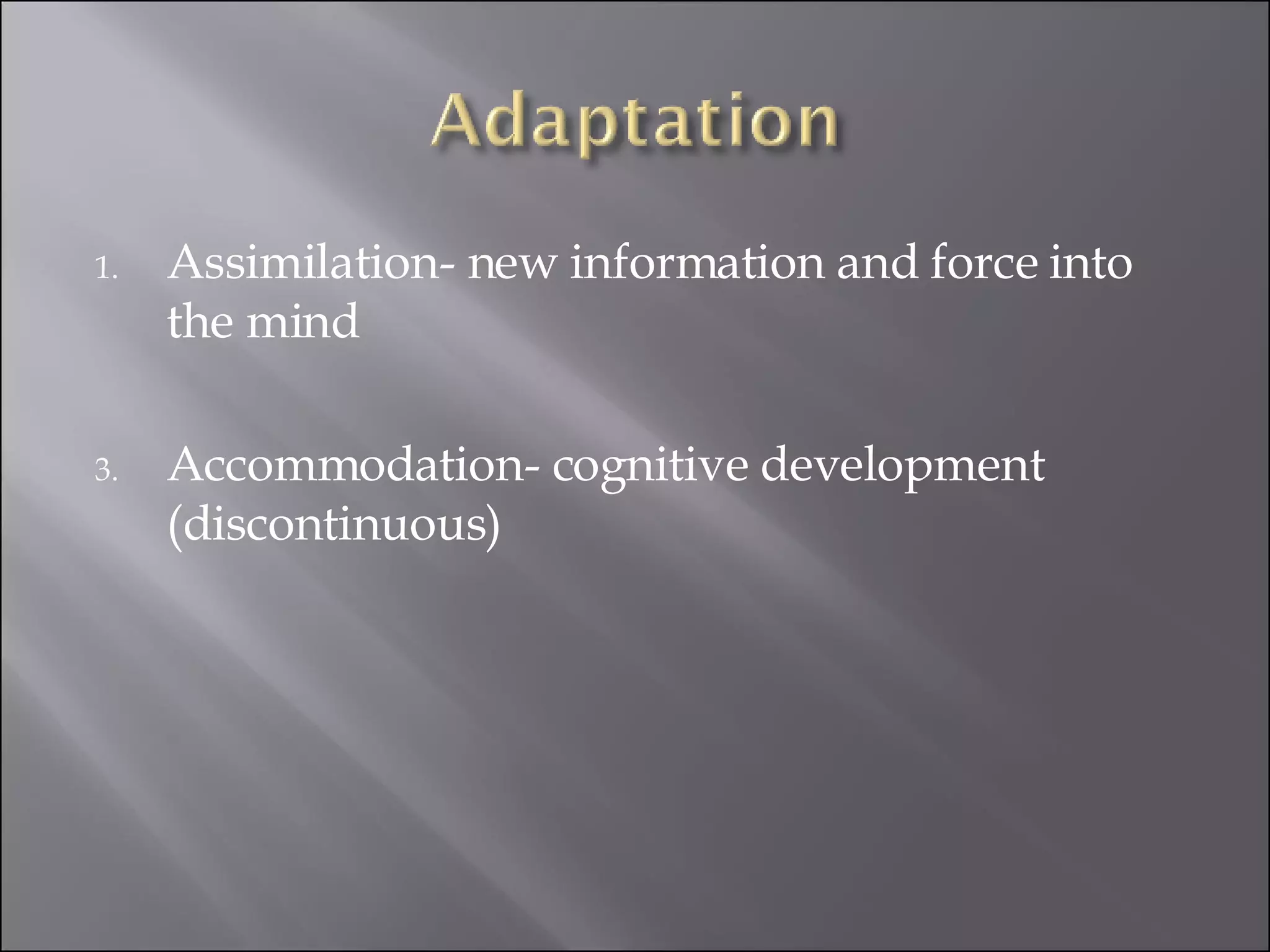
Assimilation- new information and force into the mind Accommodation- cognitive development (discontinuous)
1. Sensorimotor (0-2yrs) Uses basic symbols, object performance.  awareness that an object exist even when it is out of sight Stable 2. Preoperational (2-6yrs) Can’t undo their thinking.  Wouldn’t be able to know that multiply backwards will have the same results Lacks conservation Egocentric: unable to look at other peoples views
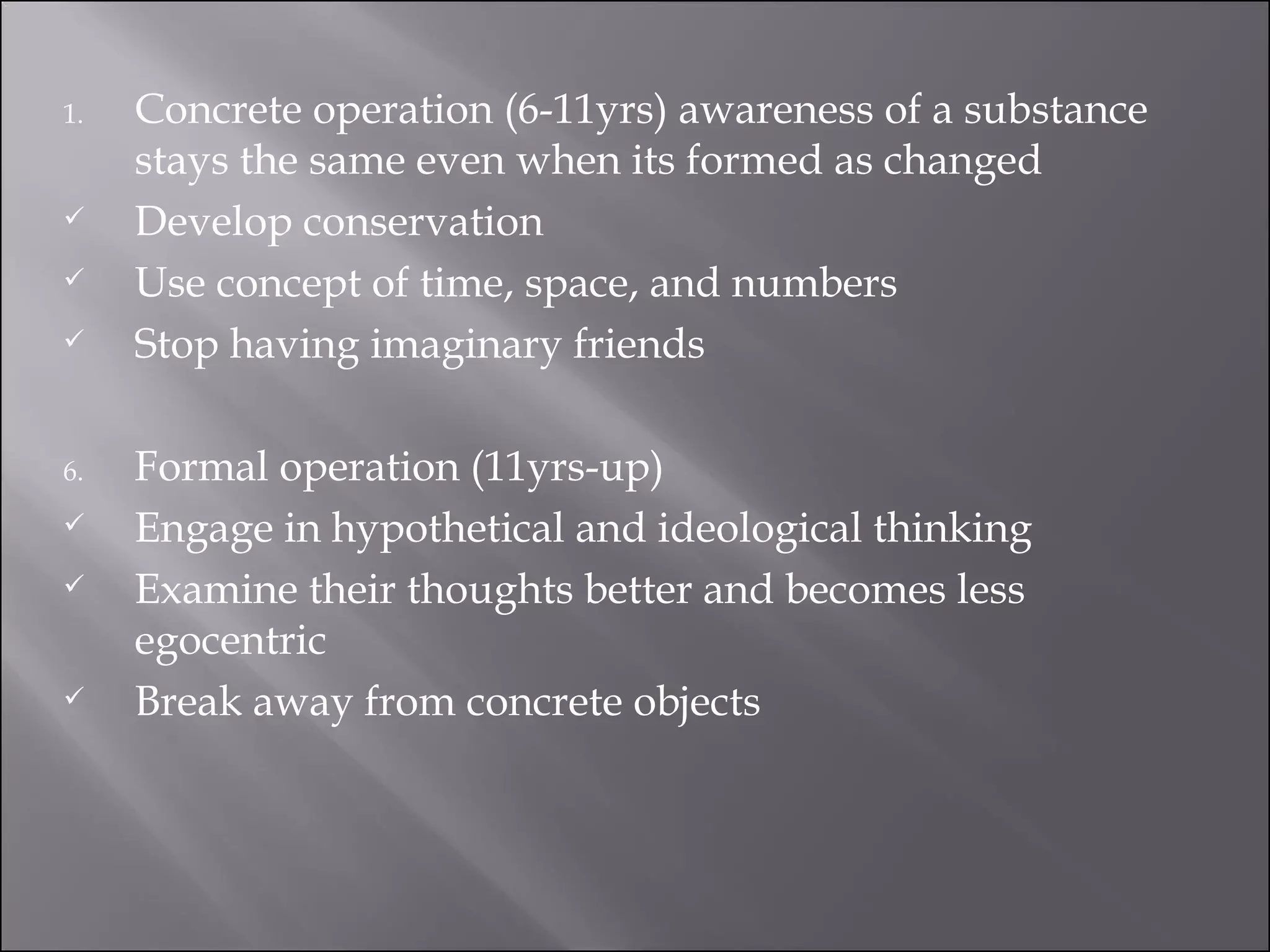
Concrete operation (6-11yrs) awareness of a substance stays the same even when its formed as changed Develop conservation Use concept of time, space, and numbers Stop having imaginary friends Formal operation (11yrs-up) Engage in hypothetical and ideological thinking Examine their thoughts better and becomes less egocentric Break away from concrete objects
Tolman (1948)  Latent learning: learning that occurs in the absence of a reinforcer but is not behaviorally demonstrated until one is available  Rat developed a  cognitive map
Humanistic psychology was instead focused on each individual’s potential and stressed the importance of growth and self-actualization.  Free will  Personal responsibilities  Opposite from Freud’s thought
Abraham Maslow In 1962, Abraham Maslow published  Toward a Psychology of Being , in which he described humanistic psychology as the “third force” in psychology.  People are born with innate predisposition to actualize their tendencies.  We have the potential to do something great.  Real self & ideal self  People develop a need for congruence between the real and the ideal.  The further apart the more threaten and anxious a person feels.
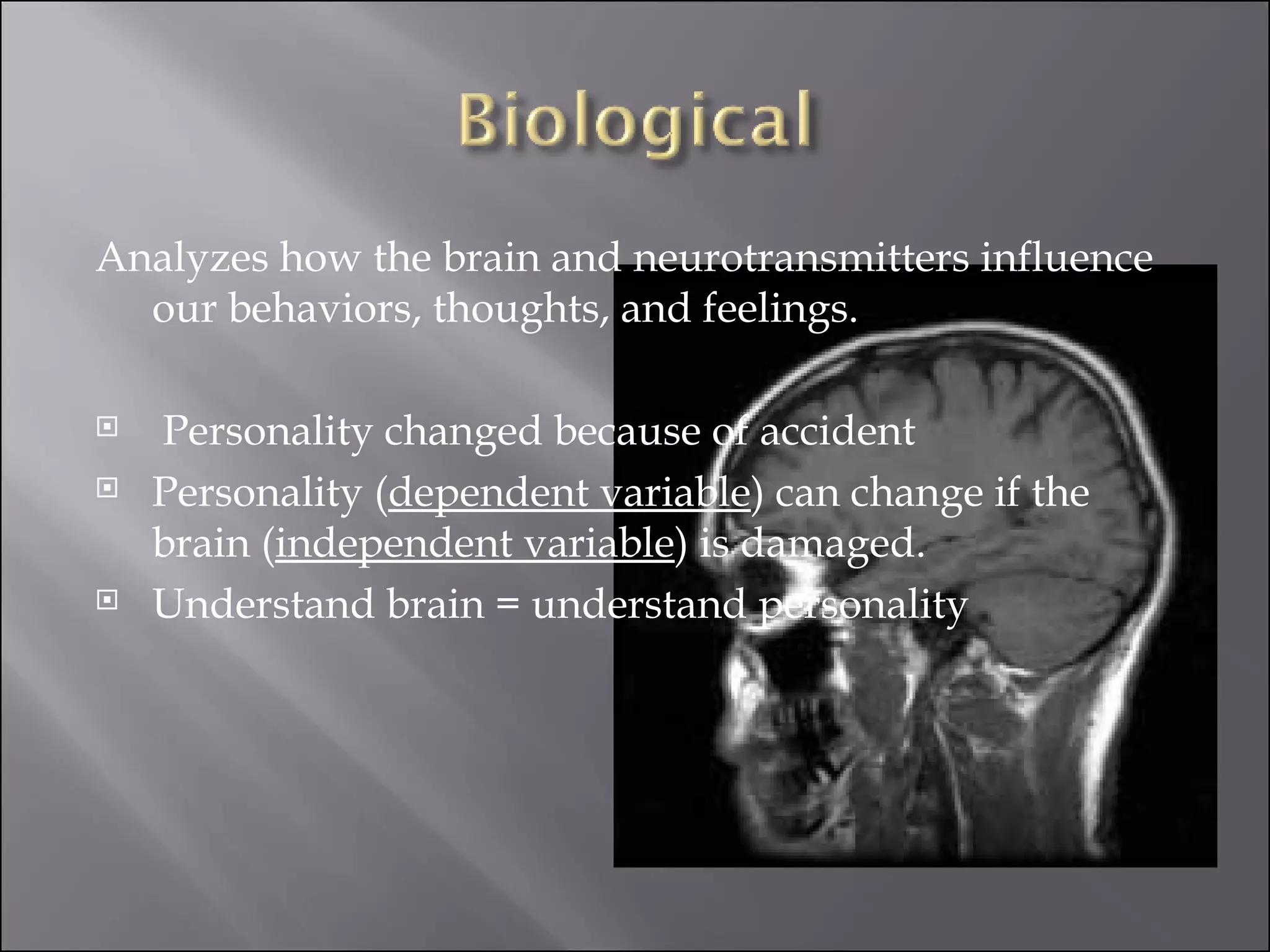
Analyzes how the brain and neurotransmitters influence our behaviors, thoughts, and feelings. Personality changed because of accident  Personality ( dependent variable ) can change if the brain ( independent variable ) is damaged.  Understand brain = understand personality
Olds & Milner   Discover the nucleus accumbency  Reward CTR   Experienced rats  Electrochemical communication  movement of charged particles  Action potential Rapid reversal of a cell of a neuron potential.   Negative then comes back up.  Pre synaptic neurons is active  Synaptic vesicle binds to the cell membrane and releases the neurotransmitters(key) to the synapse  Neurotransmitter binds to the receptor site; if it binds, it actives ion channel.
Alcohol It works on neurotransmitter system called Gaba (primary inhibitory)  Inhibitory ion rushes negative system  Alcohol will take the body in the bloodstream  Transports energy
Serotonin Modulates our emotional experience.  Impacts sleep and energy level  Unable to think  Concentration  Sensory perception  Excitatory  Marijuana Canvas  THC -> ANANDAMINE (joy)  -> Binds and  Short term memory system  -> Hippocampus (seahorse) Norepinephrine Intense / immediate arousal  Excitatory  Dopamine  reward / concentration  inhibitory  excitatory  After it actives the ion channel, it recycles; reuptake  Degradation (de-action)  MAO
MAO-inhibitors   Block MAO and increase neurotransmitter  Numbers of side affects goes down
Stresses the importance of social norms and culture. Children should learn other people’s behaviors in order to learn the values and norms of their society Stresses the importance of unique experiences in family, school, community, etc.
Stanley Sue  Known to be the “father of sociocultural psycholog” Dr. Sue is a clinical psychologist whose research interests include ethnic and cross-cultural influences on behavior. (psychology.ucdavis.edu)
Sociocultural psychologists emphasize that: Learning occurs in historically unique social and cultural settings Vygotsky Worked on  ideas about cognitive development The unit of analysis is  cultural practice

Final Psych7

  • 1.
    The Magic ofit. By: Lina Rose Tiongson
  • 2.
    This root word psych is defined as “soul” in Greek Ology is the study of. Psychology is both an applied and academic field that studies the human mind and behavior. Psychology was evolved from both biology and philosophy
  • 3.
    Known as the“Father of Psychology” 1879 established the first experimental psychology lab. Used mental chronometry Introspection Structuralism “ We learn about our minds from casual, haphazard self-observation…It is essential that observations be made by trained observes under carefully specified conditions for the purpose of answering a well-defined questions” –Wundt, 1904
  • 4.
    Science Goals: DescribeExplain Predict Control Psychological studies are highly structured, beginning with a hypothesis that is then empirically tested.
  • 5.
    Research Method Costthe research Internal validity/experimental control minimizing the influence of extraneous variables External validity/Generalizability Population is not ALL people. Correlation   Positive correlation: variables are moving in the same direction _Heavy people weighing more _Relationship Negative correlation: Opposite directions _Higher G.P.A and Social Life _Income and Family Time
  • 6.
    He was knownto be the “father of the psychoanalysis Freud had strong feelings for many things such as: - Unconscious wish fulfilling - He took basic ideas and spun it into science. - He believed we are all born primitive.
  • 7.
    Id: primitive &unconscious Pleasure principle Ego: reality principle Delay gratification Superego: moral ideal of society Freud believed that the Id was the most dominant.
  • 8.
    Sigmund Freud wasthe founder of the Psychodynamic School Psychodynamics also known as “ dynamic psychology “is the study of the interrelationship of various parts of the mind , personality , or psyche as they relate to mental, emotional, or motivational forces especially at the unconscious level and based on the assumption that an individual's total personality and reactions at any given time are the product of the interaction between his genetic constitution and his environment . (Wikipedia.org) Two of his students were Carl Jung & Karen Horney
  • 9.
    Carl Jung AlthoughJung was one of Freud’s favorite student, Jung believed that Freud had something wrong with his theory, the unconscious. He believed that the unconscious was capable of being controlled by inspiration, that the “collective unconscious” symbolizes a large emotional component. Explanation to why people behave the way they do. Karen Horney Became one of the most popular psychiatrist and was the first of her gender to present a paper regarding feminine psychiatry. She takes Freud’s whole theory and admits he’s right except men develop womb envy
  • 10.
    Psych comes fromthe mind and Sexual comes from creation Libido: Psychic energy Close energy system Energy cannot be destroyed Defense Mechanism: used to protest ego from harm caused by the Id’s wishes. Freud example was repression; unconscious exclusion from memory.
  • 11.
    Libido is focused(Body) Oral stage (0-1 yrs old) Mouth Anal stage (1-2 yrs) control Phaulic stage (3-6yrs) Penis  Power Latency period (6-12yrs) Libido is latent (hidden) Genital stage (12 yrs-up) Puberty Boys Girls Oedipus complex Elektra complex Soul & foot Penis envy Boy longs for mom Girl longs for dad  Discovers the difference between men & women  Source of super-ego
  • 12.
    Ivan Pavlov ,a Russian physiologist studied digestions and dogs and discovered what is known to be “classical conditioning” Classical condition is a technique used in behavioral training A naturally occurring stimulus is paired with a response. a previously neutral stimulus is paired with the naturally occurring stimulus. Eventually, the previous neutral stimulus comes to evoke the response without the presence of naturally occurring stimulus. Ex:
  • 13.
    James B. WatsonFather of Behaviorism “ Little Albert” Studied the adjustment of organisms to their environments, more specifically the particular stimuli leading organisms to make their responses. Example on FEAR Loud noise  startle White rat + loud noise  startle White rat  startle “ Give me a dozen healthy infants, well-formed, and my own specified world to bring them up in and I’ll guarantee to take any one at random and train him to become any type of specialist I might select -- doctor, lawyer, artist, merchant-chief and, yes, even beggar-man and thief, regardless of his talents, penchants, tendencies, abilities, vocations, and race of his ancestors.” –Watson, 1930
  • 14.
    Edward Thorndike Lawof effects : behaviors that help an organism achieve its goal are strengthened. Only the “fit” behavior survives. Operant conditioning Sometimes it is known as “instrumental conditioning” A method that occurs through reward and punishment. Through operant conditioning an association is made between a behavior and a consequence. Reinforcement + Apply as a desire stimulus - remove or avoid an aversive stimulus (Ex: avoiding loud noises)
  • 15.
    Punishment +apply anassertive stimulus - removing or avoiding desire stimulus (Ex: taking away something important from you) Punishment should be immediate Punishment must be consistent Punishment should be explained Desire Assertive  + Positive reinforcement Positive punishment - Negative punishment Negative reinforcement
  • 16.
    Schedule of reinforcementReward ratio (behavior) Interval (time) Fixed FR FI (stable ready for respond) Variable VR (reinforce on average; acting) VI (mail; respond) Theodor and Simon Binet Ask to develop a test to identify slow learners Mental age Simple questions to complex questions Stern Convert Binet to a ratio He takes mental age, he divides mental age to chronological age, and multiplies it by 100 to determine IQ
  • 17.
    The study ofmental processes including how people think, perceive, remember, and learn. Jean Piaget Well known for his work with children Theory of “cognitive development” “ The great pioneer of constructivist theory of knowing” Was trained to give intelligence test Believes process is the answer Argues that intelligence is adaptation Accommodation: either we adjust or create new SCHEMA
  • 18.
    Assimilation- new informationand force into the mind Accommodation- cognitive development (discontinuous)
  • 19.
    1. Sensorimotor (0-2yrs)Uses basic symbols, object performance. awareness that an object exist even when it is out of sight Stable 2. Preoperational (2-6yrs) Can’t undo their thinking. Wouldn’t be able to know that multiply backwards will have the same results Lacks conservation Egocentric: unable to look at other peoples views
  • 20.
    Concrete operation (6-11yrs)awareness of a substance stays the same even when its formed as changed Develop conservation Use concept of time, space, and numbers Stop having imaginary friends Formal operation (11yrs-up) Engage in hypothetical and ideological thinking Examine their thoughts better and becomes less egocentric Break away from concrete objects
  • 21.
    Tolman (1948) Latent learning: learning that occurs in the absence of a reinforcer but is not behaviorally demonstrated until one is available Rat developed a cognitive map
  • 22.
    Humanistic psychology wasinstead focused on each individual’s potential and stressed the importance of growth and self-actualization. Free will Personal responsibilities Opposite from Freud’s thought
  • 23.
    Abraham Maslow In1962, Abraham Maslow published Toward a Psychology of Being , in which he described humanistic psychology as the “third force” in psychology. People are born with innate predisposition to actualize their tendencies. We have the potential to do something great. Real self & ideal self People develop a need for congruence between the real and the ideal. The further apart the more threaten and anxious a person feels.
  • 24.
    Analyzes how thebrain and neurotransmitters influence our behaviors, thoughts, and feelings. Personality changed because of accident Personality ( dependent variable ) can change if the brain ( independent variable ) is damaged. Understand brain = understand personality
  • 25.
    Olds & Milner Discover the nucleus accumbency Reward CTR  Experienced rats Electrochemical communication movement of charged particles Action potential Rapid reversal of a cell of a neuron potential.  Negative then comes back up. Pre synaptic neurons is active Synaptic vesicle binds to the cell membrane and releases the neurotransmitters(key) to the synapse Neurotransmitter binds to the receptor site; if it binds, it actives ion channel.
  • 26.
    Alcohol It workson neurotransmitter system called Gaba (primary inhibitory) Inhibitory ion rushes negative system Alcohol will take the body in the bloodstream Transports energy
  • 27.
    Serotonin Modulates ouremotional experience. Impacts sleep and energy level Unable to think Concentration Sensory perception Excitatory Marijuana Canvas THC -> ANANDAMINE (joy) -> Binds and Short term memory system -> Hippocampus (seahorse) Norepinephrine Intense / immediate arousal Excitatory Dopamine reward / concentration inhibitory excitatory After it actives the ion channel, it recycles; reuptake Degradation (de-action) MAO
  • 28.
    MAO-inhibitors Block MAO and increase neurotransmitter Numbers of side affects goes down
  • 29.
    Stresses the importanceof social norms and culture. Children should learn other people’s behaviors in order to learn the values and norms of their society Stresses the importance of unique experiences in family, school, community, etc.
  • 30.
    Stanley Sue Known to be the “father of sociocultural psycholog” Dr. Sue is a clinical psychologist whose research interests include ethnic and cross-cultural influences on behavior. (psychology.ucdavis.edu)
  • 31.
    Sociocultural psychologists emphasizethat: Learning occurs in historically unique social and cultural settings Vygotsky Worked on ideas about cognitive development The unit of analysis is cultural practice