PPSSYYCCHHOOLLOOGGYY 
PRINCIPLES IN PRACTICE 
HOLT, RINEHART AND WINSTON 
CChhaapptteerr 22 
Conducting Research (general info) 
1 
 Psychology is an experimental science 
 Assumptions must be supported by evidence 
 Procedures consists of five steps: 
1) Forming a research question 
2) Forming a hypothesis 
3) Testing the hypothesis 
4) Analyzing the results 
5) Drawing conclusions
PPSSYYCCHHOOLLOOGGYY 
PRINCIPLES IN PRACTICE 
CChhaapptteerr 22 
Replication 
 Findings may represent a random occurrence 
 For a study to be confirmed it must be 
HOLT, RINEHART AND WINSTON 
2 
replicated (repeated) to show the same results 
 If the results are repeated and obtain different 
results, the findings of the first study are 
questioned 
 It is important to study both males and females 
if the goal is to make generalizations about all 
members of the species.
PPSSYYCCHHOOLLOOGGYY 
PRINCIPLES IN PRACTICE 
New Questions 
Whether the findings of the research study 
HOLT, RINEHART AND WINSTON 
CChhaapptteerr 22 
3 
support or contradict the hypothesis, they are 
likely to lead to new research questions. 
 Once new questions are asked, the process 
begins all over again.
PPSSYYCCHHOOLLOOGGYY 
PRINCIPLES IN PRACTICE 
HOLT, RINEHART AND WINSTON 
CChhaapptteerr 22 
4
PPSSYYCCHHOOLLOOGGYY 
PRINCIPLES IN PRACTICE 
Question: Why are proper sampling techniques important? 
HOLT, RINEHART AND WINSTON 
CChhaapptteerr 22 
5 
Surveys are taken to find out about people’s attitudes 
and behaviors directly. 
Two survey methods—written questionnaires and 
interviewing 
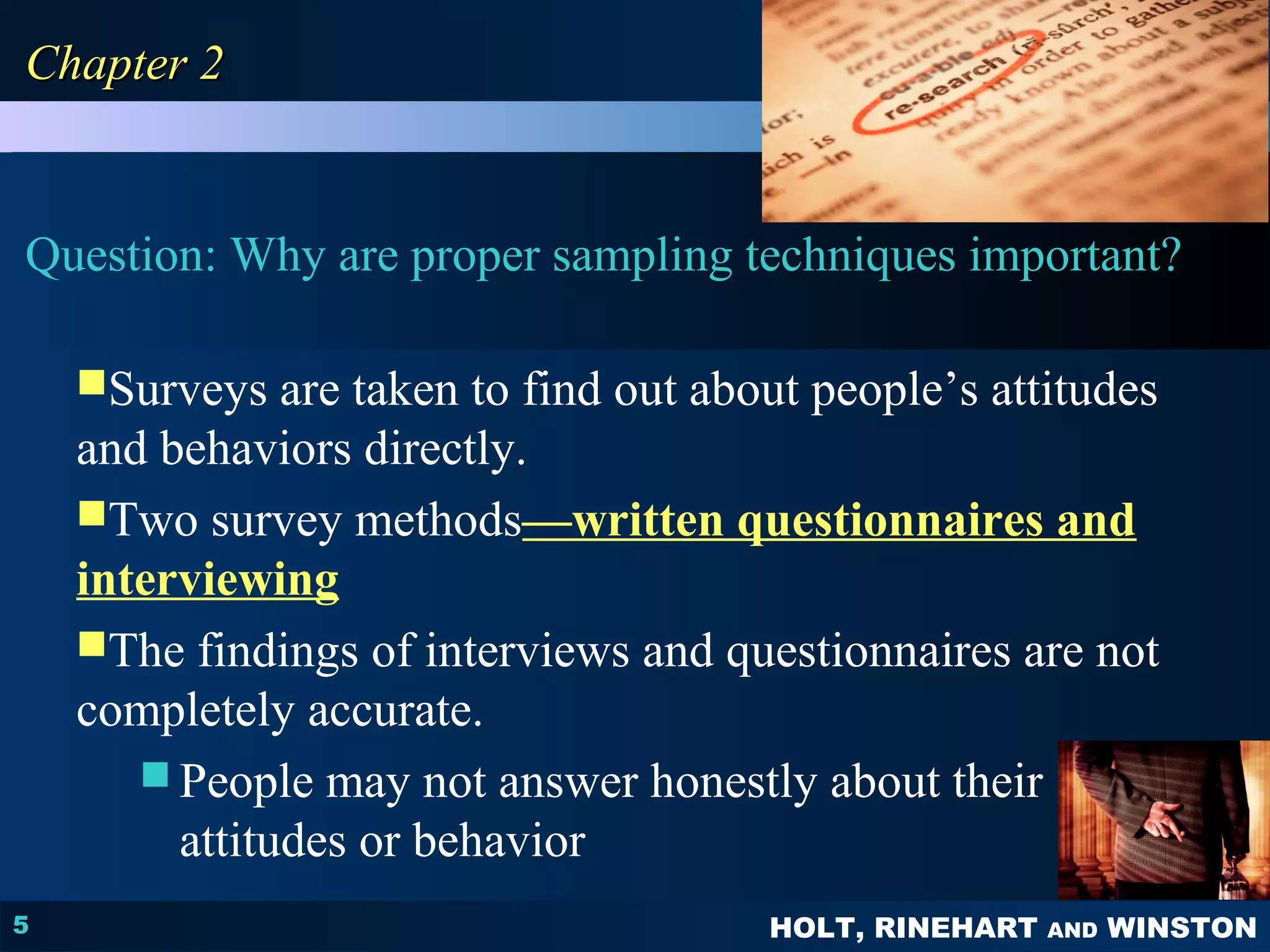
The findings of interviews and questionnaires are not 
completely accurate. 
People may not answer honestly about their 
attitudes or behavior
PPSSYYCCHHOOLLOOGGYY 
PRINCIPLES IN PRACTICE 
HOLT, RINEHART AND WINSTON 
CChhaapptteerr 22 
Populations and Samples 
6 
Must decide what group or groups of people 
they wish to examine and how they will be 
selected. 
 Target population—is the whole group you 
want to study or describe. 
 Researchers study a sample of the target 
population
PPSSYYCCHHOOLLOOGGYY 
PRINCIPLES IN PRACTICE 
Selecting Samples 
 Samples must be selected scientifically to ensure that 
HOLT, RINEHART AND WINSTON 
CChhaapptteerr 22 
7 
the samples accurately represent the populations they 
are supposed to represent. 
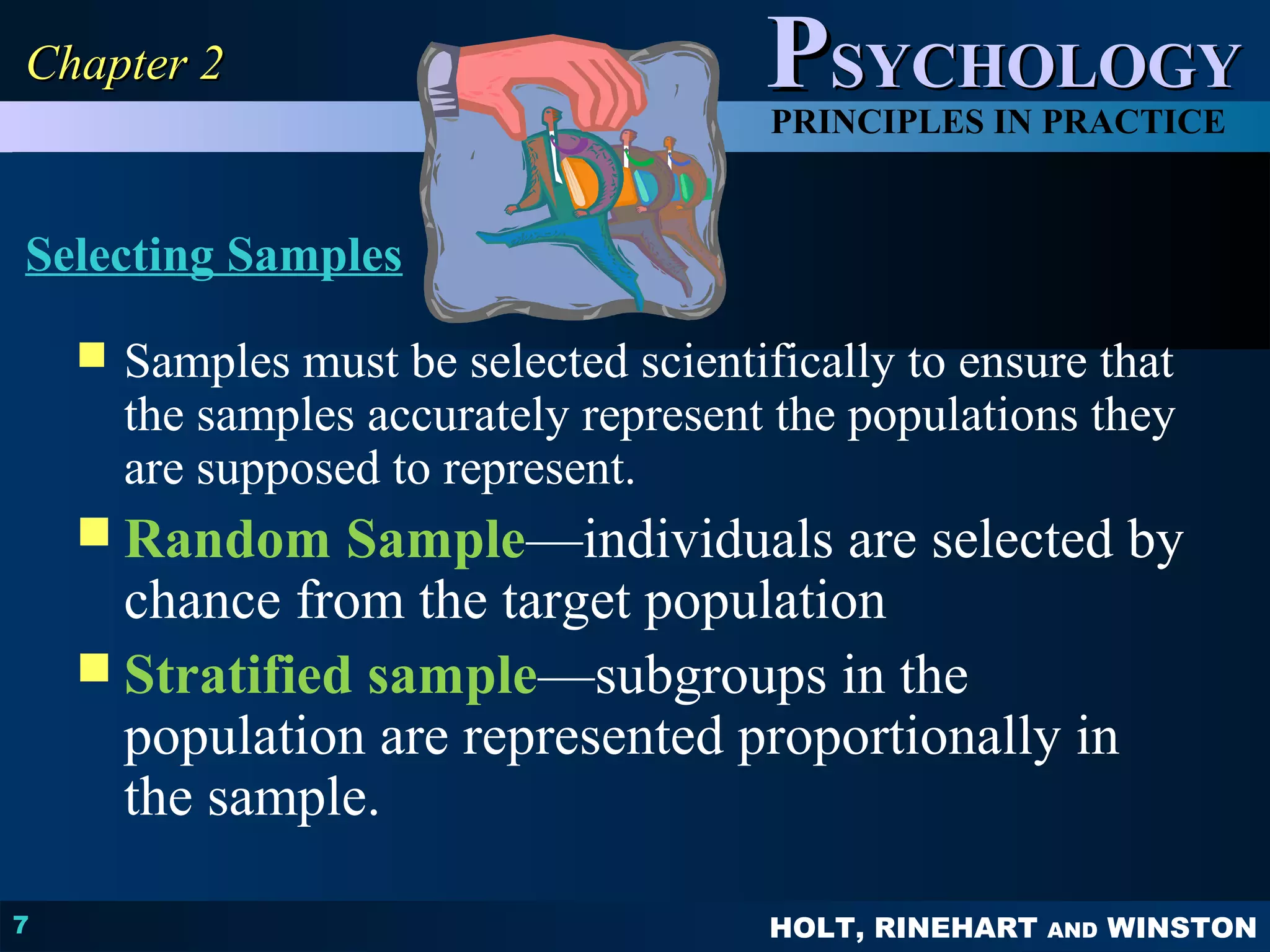
 Random Sample—individuals are selected by 
chance from the target population 
 Stratified sample—subgroups in the 
population are represented proportionally in 
the sample.
PPSSYYCCHHOOLLOOGGYY 
PRINCIPLES IN PRACTICE 
CChhaapptteerr 22 
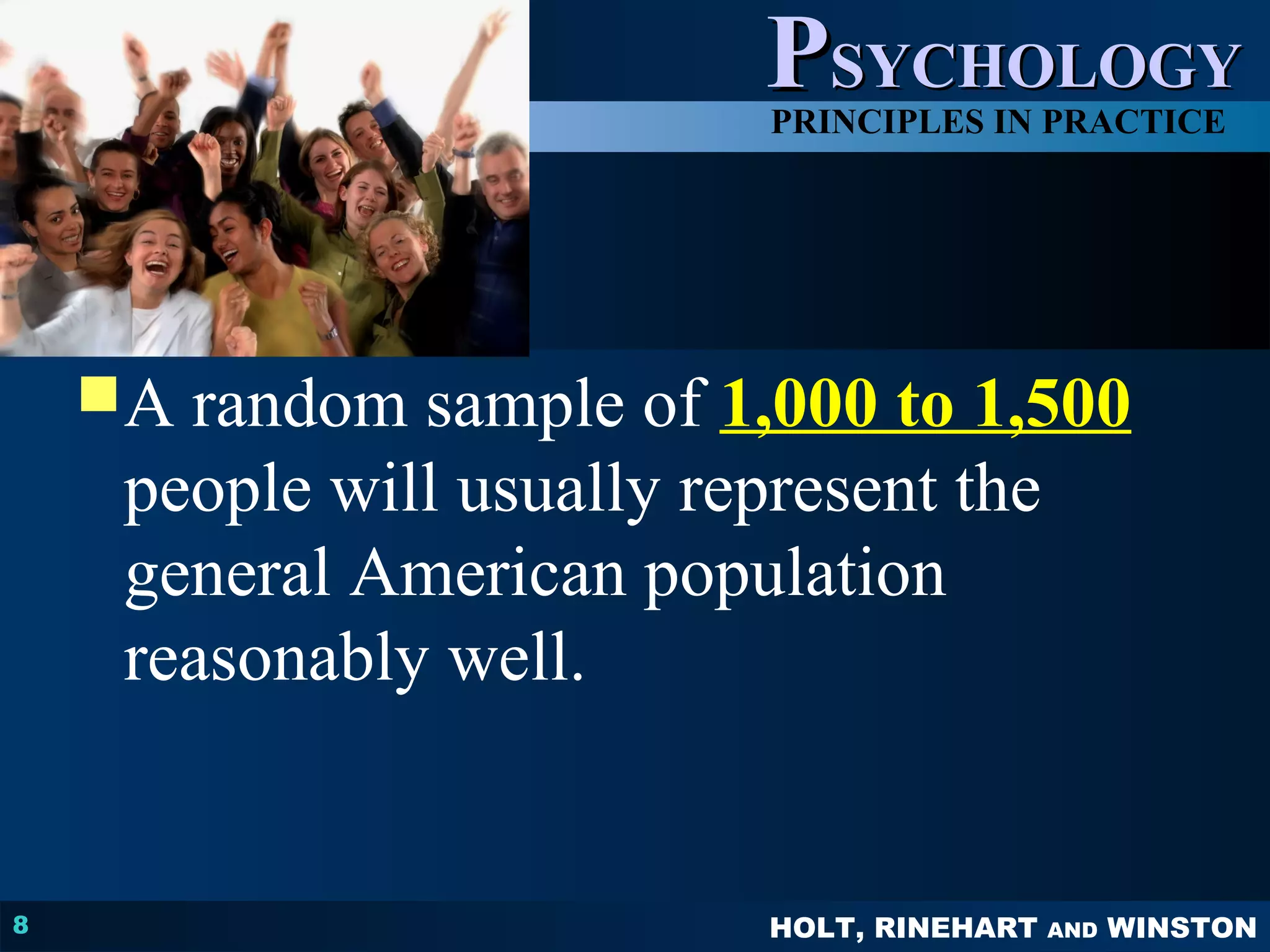
A random sample of 1,000 to 1,500 
people will usually represent the 
general American population 
reasonably well. 
HOLT, RINEHART AND WINSTON 
8
PPSSYYCCHHOOLLOOGGYY 
PRINCIPLES IN PRACTICE 
Generalizing Results 
 Researchers do not use a sample that represents an 
HOLT, RINEHART AND WINSTON 
CChhaapptteerr 22 
9 
entire population 
 Researchers want to know about only one group 
within the population 
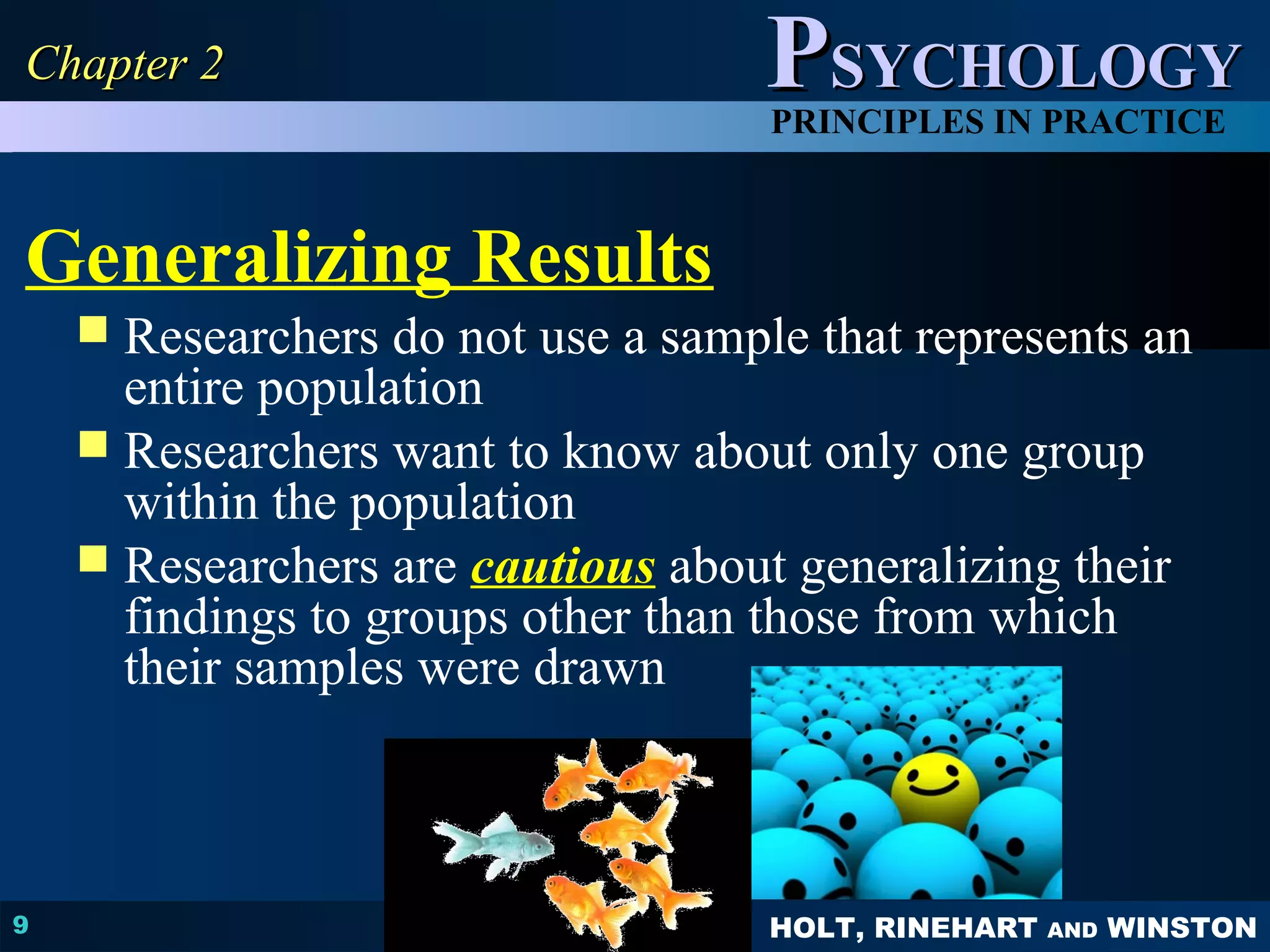
 Researchers are cautious about generalizing their 
findings to groups other than those from which 
their samples were drawn
PPSSYYCCHHOOLLOOGGYY 
PRINCIPLES IN PRACTICE 
Volunteer Bias 
 Researchers have little control over who responds to 
HOLT, RINEHART AND WINSTON 
CChhaapptteerr 22 
10 
surveys or participates in research studies. 
 They cannot force people to complete the 
questionnaires. 
 Bias—a predisposition to a certain point of view. 
 People who volunteer to participate in studies often 
bring with them a volunteer bias.

Ch 2 Intro

  • 1.
    PPSSYYCCHHOOLLOOGGYY PRINCIPLES INPRACTICE HOLT, RINEHART AND WINSTON CChhaapptteerr 22 Conducting Research (general info) 1  Psychology is an experimental science  Assumptions must be supported by evidence  Procedures consists of five steps: 1) Forming a research question 2) Forming a hypothesis 3) Testing the hypothesis 4) Analyzing the results 5) Drawing conclusions
  • 2.
    PPSSYYCCHHOOLLOOGGYY PRINCIPLES INPRACTICE CChhaapptteerr 22 Replication  Findings may represent a random occurrence  For a study to be confirmed it must be HOLT, RINEHART AND WINSTON 2 replicated (repeated) to show the same results  If the results are repeated and obtain different results, the findings of the first study are questioned  It is important to study both males and females if the goal is to make generalizations about all members of the species.
  • 3.
    PPSSYYCCHHOOLLOOGGYY PRINCIPLES INPRACTICE New Questions Whether the findings of the research study HOLT, RINEHART AND WINSTON CChhaapptteerr 22 3 support or contradict the hypothesis, they are likely to lead to new research questions.  Once new questions are asked, the process begins all over again.
  • 4.
    PPSSYYCCHHOOLLOOGGYY PRINCIPLES INPRACTICE HOLT, RINEHART AND WINSTON CChhaapptteerr 22 4
  • 5.
    PPSSYYCCHHOOLLOOGGYY PRINCIPLES INPRACTICE Question: Why are proper sampling techniques important? HOLT, RINEHART AND WINSTON CChhaapptteerr 22 5 Surveys are taken to find out about people’s attitudes and behaviors directly. Two survey methods—written questionnaires and interviewing The findings of interviews and questionnaires are not completely accurate. People may not answer honestly about their attitudes or behavior
  • 6.
    PPSSYYCCHHOOLLOOGGYY PRINCIPLES INPRACTICE HOLT, RINEHART AND WINSTON CChhaapptteerr 22 Populations and Samples 6 Must decide what group or groups of people they wish to examine and how they will be selected.  Target population—is the whole group you want to study or describe.  Researchers study a sample of the target population
  • 7.
    PPSSYYCCHHOOLLOOGGYY PRINCIPLES INPRACTICE Selecting Samples  Samples must be selected scientifically to ensure that HOLT, RINEHART AND WINSTON CChhaapptteerr 22 7 the samples accurately represent the populations they are supposed to represent.  Random Sample—individuals are selected by chance from the target population  Stratified sample—subgroups in the population are represented proportionally in the sample.
  • 8.
    PPSSYYCCHHOOLLOOGGYY PRINCIPLES INPRACTICE CChhaapptteerr 22 A random sample of 1,000 to 1,500 people will usually represent the general American population reasonably well. HOLT, RINEHART AND WINSTON 8
  • 9.
    PPSSYYCCHHOOLLOOGGYY PRINCIPLES INPRACTICE Generalizing Results  Researchers do not use a sample that represents an HOLT, RINEHART AND WINSTON CChhaapptteerr 22 9 entire population  Researchers want to know about only one group within the population  Researchers are cautious about generalizing their findings to groups other than those from which their samples were drawn
  • 10.
    PPSSYYCCHHOOLLOOGGYY PRINCIPLES INPRACTICE Volunteer Bias  Researchers have little control over who responds to HOLT, RINEHART AND WINSTON CChhaapptteerr 22 10 surveys or participates in research studies.  They cannot force people to complete the questionnaires.  Bias—a predisposition to a certain point of view.  People who volunteer to participate in studies often bring with them a volunteer bias.