Acute coronary
syndrome
ACS:
 results primarily from diminished myocardial blood flow secondary to
an occlusive or partially occlusive coronary artery thrombus (imbalance
between myocardial oxygen demand and supply).
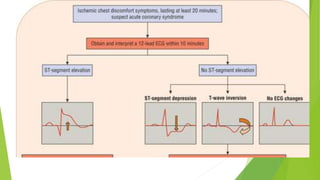
 ACS is classified according to electrocardiogram (ECG) changes into
STEMI or NSTE-ACS (NSTEMI and UA).
STEMI :
 A STEMI occurs when symptoms of myocardial ischemia occur in conjunction
with new ST-segment elevation with subsequent release of biomarkers of
myocardial necrosis, mainly troponins T or I.
NSTEMI
 NSTEMI is limited to the subendocardial myocardium and is not as extensive as
STEMI.
 NSTEMI differs from UA in that ischemia is severe enough to produce
myocardial necrosis resulting in the release of a detectable amount of
troponins T or I, from the necrotic myocytes in the bloodstream
 For NSTEMI AND STEMI mortality rate is lower in patient
undergoing PCI compered to patient receiving no
revascularization in hospital.
 In hospital mortality rate for NSETMI is lower than STEMI.
 post-discharge mortality rates may be higher for NSTEMI
than STEMI.
Ventricular Remodeling Following an
Acute MI
 it is characterized by left ventricular (LV) dilation and reduced pumping
function of the LV, leading to HF.
 ACE inhibitors, ARBs, β-blockers, and aldosterone antagonists are all agents
that slow down or reverse ventricular remodeling through inhibition of the
renin–angiotensin–aldosterone system and/or through improvement in
hemodynamics (decreasing preload, afterload ),also improve survival.
Symptoms
 midline anterior anginal chest pain(Crushing , burning and heavy pressure)
 It most often occurs when an individual is at rest, it last for at least 20
minutes in duration.
 The chest discomfort may radiate to the shoulder, down the left arm, and to
the back or to the jaw
 nausea, vomiting, or shortness of breath.
Signs
No signs are classic for ACS.
 Patients with ACS may present with signs of acute decompensated HF
including jugular venous distention.
 Patients may also present with arrhythmias, and therefore may have
tachycardia, bradycardia, or heart block.
Labs
 Troponin I or T are measured at the time of first assessment and repeated at
least once after 3 to 6 hours. And beyond 6 hours in whom normal troponin
level where obtained at first with a suspension of ACS.
 CBC, K, Mg, Scr, APTT, INR.
 mean length of hospital stay is 3 days
Other Diagnostic Tests
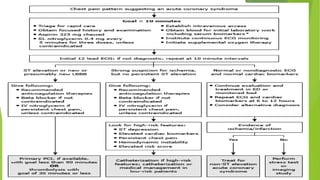
 The 12-lead ECG is the first step in management.
 echocardiogram, is performed to identify patients with low LV ejection
fractions (EF) (≤40%) who are at high risk of death following hospital
discharge.
 Selected low-risk patients may undergo early stress testing
TIMI Risk Score for NSTE-ACS
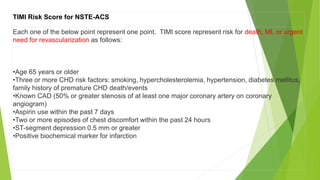
Each one of the below point represent one point. TIMI score represent risk for death, MI, or urgent
need for revascularization as follows:
•Age 65 years or older
•Three or more CHD risk factors: smoking, hypercholesterolemia, hypertension, diabetes mellitus,
family history of premature CHD death/events
•Known CAD (50% or greater stenosis of at least one major coronary artery on coronary
angiogram)
•Aspirin use within the past 7 days
•Two or more episodes of chest discomfort within the past 24 hours
•ST-segment depression 0.5 mm or greater
•Positive biochemical marker for infarction
High-Risk Medium-Risk Low-Risk
TIMI Risk Score 5-7 points TIMI Risk Score 3-4 points TIMI Risk Score 0-2 points
TIMI Risk Score Mortality, MI, or Severe Recurrent Ischemia
Requiring Urgent Revascularization Through 14
Days
0/1 4.7%
2 8.3%
3 13.2%
4 19.9%
5 26.2%
6/7 40.9%
General Approach to Treatment
 oxygen administration (if oxygen saturation is low, less than 90%).
 continuous multi-lead ST-segment monitoring for arrhythmias and ischemia.
 frequent measurement of vital signs.
 bed rest for 12 hours in hemodynamically stable patients.
 and pain relief
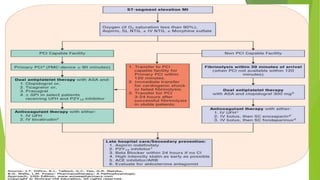
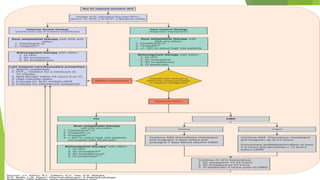
in case of non PCI:
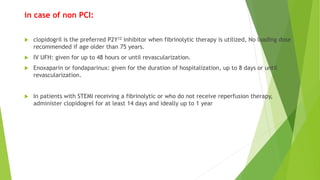
 clopidogril is the preferred P2Y12 inhibitor when fibrinolytic therapy is utilized, No loading dose
recommended if age older than 75 years.
 IV UFH: given for up to 48 hours or until revascularization.
 Enoxaparin or fondaparinux: given for the duration of hospitalization, up to 8 days or until
revascularization.
 In patients with STEMI receiving a fibrinolytic or who do not receive reperfusion therapy,
administer clopidogrel for at least 14 days and ideally up to 1 year
PCI (SETMI):
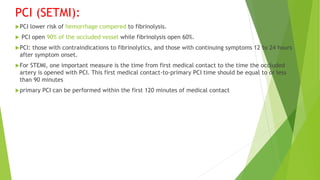
PCI lower risk of hemorrhage compered to fibrinolysis.
 PCI open 90% of the occluded vessel while fibrinolysis open 60%.
PCI: those with contraindications to fibrinolytics, and those with continuing symptoms 12 to 24 hours
after symptom onset.
For STEMI, one important measure is the time from first medical contact to the time the occluded
artery is opened with PCI. This first medical contact-to-primary PCI time should be equal to or less
than 90 minutes
primary PCI can be performed within the first 120 minutes of medical contact
Treatment of STEMI (fibrinolytic) :
 Administration of a fibrinolytic agent is indicated in patients with STEMI who present within 12 hours of the
onset of chest discomfort to a hospital not capable of primary PCI.
 not able to be transferred and undergo primary PCI within 120 minutes of medical contact.
 The mortality benefit of fibrinolysis is highest with early administration and diminishes after 12 hours. The
use of fibrinolytics between 12 and 24 hours after symptom onset should be limited to patients with ongoing
ischemia.
 In patients who have a contraindication to fibrinolytics and PCI, or who do not have access to a facility that
can perform PCI, treatment with an anticoagulant (other than UFH) for up to 8 days can be administered.
 alteplase, reteplase, and tenecteplase are acceptable as first-line agents.
 Streptokinase is second line.
Indications
1.Ischemic chest discomfort at least 20 minutes in duration but 12 hours or less since
symptom onset and ST-segment elevation of at least two contiguous leads of ≥2 mm in
men and ≥1.5 mm in women in leads V2-V3 and/or of ≥1 mm in other leads, or new or
presumed new left bundle-branch block
2.Ongoing ischemic chest discomfort at least 20 minutes in duration 12-24 hours since
symptom onset and ST-segment elevation of at least 1 mm in height in two or more
contiguous leads
Absolute Contraindications
•Active internal bleeding (not including menses)
•Previous intracranial hemorrhage at any time; ischemic stroke within 3 months (except acute ischemic
stroke within 4.5 hours)
•Known intracranial neoplasm
•Known structural cerebral vascular lesion (eg, arteriovenous malformation)
•Suspected aortic dissection
•Significant closed head or facial trauma within 3 month
Indications and Contraindications to Fibrinolytic Therapy for Management of ST-Segment Elevation Myocardial
Infarction2
Aspirin:
 MOA: inhibiting the synthesis of TXA2 through an irreversible inhibition of platelet cyclooxygenase-1.
 Current data suggest that an initial dose of 162 to 325 mg is required
 long-term therapy with doses 81-162 mg once daily orally starting hospital day 2.
 Because of increased bleeding risk in patients receiving aspirin plus a P2Y12 inhibitor compared with aspirin
alone, low-dose aspirin (81 mg daily) is preferred following PCI. Low-dose aspirin should be continued
indefinitely.
 SE:GI bleeding , dyspepsia and nausea.
Platelet P2Y12 Inhibitors
 Clopidogrel, prasugrel, and ticagrelor are oral agents that block a subtype of the
ADP receptor, the P2Y12 receptor, on platelets, preventing the binding of ADP to
the receptor and subsequent expression of platelet GP IIb/IIIa receptors, reducing
platelet activation and aggregation.
 Clopidogrel(CYP2C19) and prasugrel(CYP 3A4 and 2B )are prodrugs, Ticagrelor is
metabolized primarily by CYP3A.
 Prasugrel has the fewest significant drug–drug interactions of the oral P2Y12 inhibitors.
 Both prasugrel and ticagrelor are more potent ADP inhibitors than clopidogrel.
 Clopidogril is associated withCYP2C19 genotype, while Prasugrel and ticagrelor efficacy are not associated
with it.
 clopidogrel loading dose of 600 mg is recommended over administration of 300 mg for patients undergoing
PCI, then 75 mg daily.
 consider alternative P2Y12 receptor inhibitor if documented clopidogrel ineffectiveness (eg, poor
metabolism, stent thrombosis during clopidogrel therapy) or drug–drug interactions (eg, avoid moderate
and strong CYP2C19 inhibitors);
 The recommended duration of P2Y12 inhibitors for a patient undergoing PCI for ACS, either STEMI or NSTE-
ACS, is at least 12 months for patients receiving either a BMS or DES
 If CABG surgery is planned, clopidogrel and ticagrelor should be withheld preferably for 5 days, and
prasugrel at least 7 days, to reduce the risk of postoperative bleeding, and restarted postoperatively,
unless the need for immediate revascularization outweighs the bleeding risk. Low-dose aspirin should
be continued
 Do not use prasugrel in patients with active pathologic bleeding or a history of transient ischemic
attack ,stroke or >75 year.
 Do not use ticagrelor in patients with active pathologic bleeding or a history of intracranial
hemorrhage, or in patients planned to undergo urgent CABG surgery;
Glycoprotein IIb/IIIa Receptor Inhibitors: abciximab, eptifibatide,
or tirofiban
 block the final common pathway of platelet aggregation, namely, cross-linking of
platelets by fibrinogen bridges between the GP IIb and IIIa receptors on the
platelet surface.
 STEMI undergoing primary PCI who are treated with UFH, abciximab (IV or
intracoronary administration), eptifibatide, or tirofiban may be administered.
 Don’t use if fibrinolytic therapy or not doing PCI.
 Don’t use in hemogenic o ischemic stroke.
 The dose of tirofiban should be halved in patients with CrCl less than 30 mL/min
(0.50 mL/s). No dosage adjustment for renal function is necessary for abciximab.
 immune-mediated thrombocytopenia when stop treatment specially abciximab
Anticoagulants: UFH, enoxaparin or fondaparinux , bivalirudin
 If PCI, anticoagulation is discontinued immediately following the PCI procedures.
 In patients receiving an anticoagulant plus a fibrinolytic, UFH is continued for a minimum of 48
hours and if either enoxaparin or fondaparinux is selected, those agents are continued for the
duration of hospitalization, up to 8 days.
 In patients who do not undergo reperfusion therapy, it is reasonable to administer anticoagulant
therapy for up to 48 hours for UFH or for the duration of hospitalization for enoxaparin or
fondaparinux
 Most common side effect of UFH and enoxaparin is heparin-induced thrombocytopenia,in this case
use bivalirudin.
 If pretreated with UFH, stop UFH infusion for 30 minutes prior to administration of bivalirudin (bolus
plus infusion).
beta blockers
 β-blockers should be initiated within 24 hours of hospital admission to all patients in the absence of
contraindications.
 Oral beta blockers are preferred over IV in the contemporary management of ACS.
 The most serious side effects of β-blocker are hypotension, acute HF, bradycardia, and heart block.
 initial acute administration of β-blockers is not appropriate for patients who present with acute HF, in this
case it is initiated before discharge after acute HF treatment.
 β-Blockers should be continued for at least 3 years in patients with normal LV function and indefinitely in
patients with LV systolic dysfunction and an LVEF less than or equal to 40% (0.40)
 Patients already taking β-blockers can continue taking them.2
Statins
 A high-intensity statin (either atorvastatin 80 mg or rosuvastatin 40 mg) should be administered to all
patients without contraindications prior to PCI and continued after that.
 Calcium Channel Blockers
 Calcium channel blockers in the setting of STEMI are used for relief of ischemic symptoms in patients
who have certain contraindications to β-blockers.
 Administration of an agent that lowers HR, either diltiazem or verapamil, is preferred unless the
patient has LV systolic dysfunction, bradycardia, or heart block, and then either amlodipine or
felodipine is preferred.
nitrates One SL NTG tablet should be administered every 5 minutes for up to three doses in order to relieve
myocardial ischemia.
 IV NTG should then be initiated in all patients with an ACS who have persistent ischemia, HF, or
uncontrolled high BP in the absence of contraindications. IV NTG should be continued for
approximately 24 hours after ischemia is relieved
 nitrates are tachycardia, flushing, headache, and hypotension.
 Nitrate administration is contraindicated in patients who have received oral phosphodiesterase-5
inhibitors, such as sildenafil and vardenafil, within the last 24 hours, and tadalafil within the last 48
hour
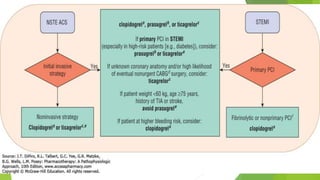
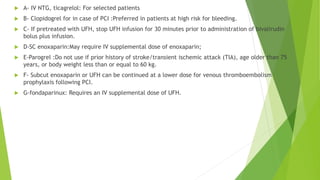
 A- IV NTG, ticagrelol: For selected patients
 B- Clopidogrel for in case of PCI :Preferred in patients at high risk for bleeding.
 C- If pretreated with UFH, stop UFH infusion for 30 minutes prior to administration of bivalirudin
bolus plus infusion.
 D-SC enoxaparin:May require IV supplemental dose of enoxaparin;
 E-Parogrel :Do not use if prior history of stroke/transient ischemic attack (TIA), age older than 75
years, or body weight less than or equal to 60 kg.
 F- Subcut enoxaparin or UFH can be continued at a lower dose for venous thromboembolism
prophylaxis following PCI.
 G-fondaparinux: Requires an IV supplemental dose of UFH.
 All patient with NSTE-ACS should receive intranasal oxygen (if oxygen saturation is low), sublingual
(SL) nitroglycerin (NTG), asoirin, a P2Y12 inhibitor (clopidogrel, prasugrel, or ticagrelor depending on
reperfusion strategy), and anticoagulation with bivalirudin, unfractionated heparin (UFH),
enoxaparin, or fondaparinux (within the first day of hospitalization, and preferably in the ED).
 Oral β-blockers should be initiated within the first 24 hours in patients without cardiogenic shock.
 Morphine is also administered to patients with refractory angina as described previously.
 Fibrinolytic Therapy
 Fibrinolytic therapy is not indicated in any patient with NSTE-ACS because increased mortality
Nitrates,B-blokersCalcium Channel Blockers and aspirin:
Same as STEMI.
Anticoagulant:
 If fondaparinux is chosen for a patient initially receiving a conservative strategy who subsequently
undergoes angiography and PCI, should be administered in combination with UFH .
 Therapy should be continued for up to at least 48 hours for UFH until the patient is discharged from
the hospital, or 8 days, whichever is shorter for either enoxaparin or fondaparinux, or until the end of
PCI or angiography procedure (or up to 72 hours following PCI for bivalirudin).
 For patients undergoing CABG during the same hospitalization, UFH can be continued until a few
hours before CABG and LMWH should be stopped 12 hours prior to the surgery.
 patients with NSTE-ACS with an initial ischemia-guided approach, either clopidogrel (a 300 or 600-mg
loading dose followed by 75 mg daily) or ticagrelor can be used in addition to low-dose
aspirin.(ticagrelol is preferred for up to 12 month)
 In PCI ticagrelor and prasugrel are preferred in patients not at high-risk of bleeding. Initiate within 1
hour following PCI
Glycoprotein IIb/IIIa Receptor Inhibitors
 The role of GPIs in NSTE-ACS is diminishing as P2Y12 inhibitors are used earlier in therapy, and
bivalirudin is selected more commonly as the anticoagulant in patients receiving an early
intervention approach
 The most recent practice guidelines recommend an early invasive (within 24
hours) strategy with coronary angiography and revascularization with either PCI
or coronary artery bypass graft (CABG) surgery for patients with NSTE-ACS at an
elevated risk for death or MI, including those with a high risk score or patients
with refractory angina, acute HF, other symptoms of cardiogenic shock, or
arrhythmias
Antiplatelet Therapy Pharmacotherapy in PCI and STEMI
and NSTE-ACS
 All patients undergoing PCI with ACS should receive an initial dose of 162- or 325-mg of aspirin followed by a
daily aspirin dose of 81 mg/day indefinitely.
 A P2Y12 inhibitor antiplatelet should be administered as early as possible concomitantly with asoirin and then
an oral P2Y12 agent should ideally be continued for at least 12 months following PCI
 Earlier discontinuation of the P2Y12 inhibitor can be reasonable in patients at a high bleeding risk or with
overt bleeding
drug-eluting stent (DES) and a bare
metal stent (BMS)
 Compared to BMS, DES reduce the rate of smooth muscle cell growth and thus
stent restenosis.
 DES has a high risk of developing stent thrombosis.
 dual antiplatelet therapy (DAPT—aspirin plus a P2Y12 inhibitor) is indicated for
at least 1 year regardless of whether or not a patient with STEMI or NSTE-ACS
receives a stent.
 The use of a BMS over a DES should be considered in patients who are
anticipated to be nonadherent to 12 months of DAPT.
Secondary Prevention Following MI
 goals
(a) control modifiable CHD risk factors.
(b) prevent the development of systolic HF;
(c) prevent recurrent MI and stroke;
(d) prevent death, including sudden cardiac death; and (e) prevent stent
thrombosis following PCI
 β-blocker should be continued for at least 3 years in patients with normal LV function and indefinitely in
patients with LVEF of less than or equal to 40% (0.40) or HF symptoms.46 It may be reasonable to continue
a β-blocker indefinitely in patients without contraindications and with normal LVEF.
 P2Y12 inhibitor should be continued for at least 12 months for patients undergoing PCI and for patients
with NSTE-ACS receiving an ischemia-guided strategy of treatment. For patients with STEMI managed with
fibrinolytics, clopidogrel should be continued for at least 14 days and ideally 1 year.
 All patients should receive aspirin indefinitely (75-100 mg daily).
 For patient not at high-risk of bleeding and who have not had overt bleeding, new guidelines indicate it is
reasonable to continue dual antiplatelet therapy after 12 months.
 Beta blockers and calcium channel blockers as described before.
 all patients should be prescribed short-acting, SL NTG or lingual NTG spray to relieve any
anginal symptoms when necessary and instructed on its use.
 Administration of ACE inhibitors should be continued indefinitely. Hypotension should be
avoided because coronary artery filling may be compromised.
 Administration of ACE inhibitors, candesartan, valsartan, and losartan should be continued
indefinitely. Hypotension should be avoided because coronary artery filling may be compromised.
Aldosterone Antagonists
 To reduce mortality, administration of an aldosterone antagonist, either eplerenone or
spironolactone, should be considered within the first 7 days following MI in all patients who are
already receiving an ACE inhibitor (or ARB) and a β-blocker and have an LVEF of less than or equal to
40% (0.40) and either HF symptoms or DM
 patients with serum potassium concentrations greater than 5 mmol/L (5 mEq/L) or SCr greater than
2.5 mg/dL (221 μmol/L) for men, 2 mg/dL (177 μmol/L) for women should not receive an aldosterone
antagonist.
Statins:
 all patients, regardless of low-density lipoprotein cholesterol level, should ideally be prescribed a
high-intensity statin. Patients aged greater than 75 years may be prescribed a moderate-intensity
statin
But what antithrombotic therapy is best for patients with a chronic or new indication
for longer-term anticoagulant therapy following hospital discharge such as atrial
fibrillation, the presence of a mechanical heart valve, venous thromboembolism, or
LV thrombus?
 TT, when needed, should consist of warfarin (INR target 2-2.5), low-dose aspirin 81 mg orally daily, and
clopidogrel 75 mg orally daily. The anticoagulant should be discontinued if possible (such as in 3-6 months
post-MI in patients at risk of LV thrombus but without actual thrombi present), and then either clopidogrel or
preferably aspirin, discontinued after at least 1 month in a patient with a BMS and after at least 6 months in
a patient with a DES.
 Concomitant use of a proton pump inhibitor is recommended in patients receiving TT undergoing PCI.