 The coagulation process that leads to hemostasis involves a complex set of
reactions involving approximately 30 different proteins
 These reactions convert fibrinogen, a soluble protein, to insoluble strands of
fibrin, which, together with platelets, forms a stable thrombus
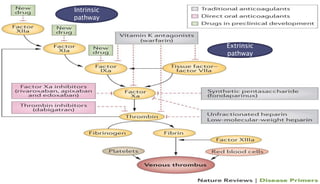
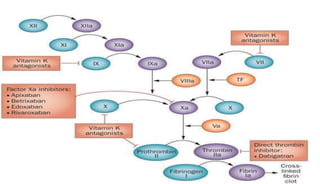
Extrinsic
pathway
Intrinsic
pathway
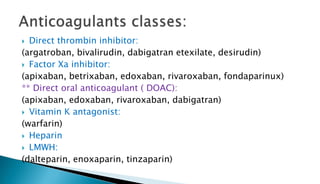
 Direct thrombin inhibitor:
(argatroban, bivalirudin, dabigatran etexilate, desirudin)
 Factor Xa inhibitor:
(apixaban, betrixaban, edoxaban, rivaroxaban, fondaparinux)
** Direct oral anticoagulant ( DOAC):
(apixaban, edoxaban, rivaroxaban, dabigatran)
 Vitamin K antagonist:
(warfarin)
 Heparin
 LMWH:
(dalteparin, enoxaparin, tinzaparin)
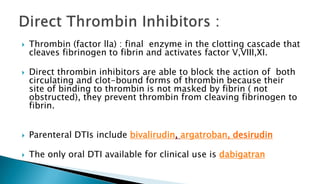
 Thrombin (factor lla) : final enzyme in the clotting cascade that
cleaves fibrinogen to fibrin and activates factor V,VIII,XI.
 Direct thrombin inhibitors are able to block the action of both
circulating and clot-bound forms of thrombin because their
site of binding to thrombin is not masked by fibrin ( not
obstructed), they prevent thrombin from cleaving fibrinogen to
fibrin.
 Parenteral DTIs include bivalirudin, argatroban, desirudin
 The only oral DTI available for clinical use is dabigatran
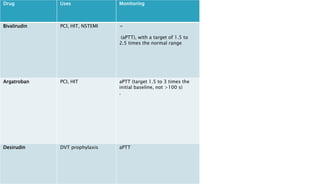
Drug Uses Monitoring
Bivalirudin PCI, HIT, NSTEMI =
(aPTT), with a target of 1.5 to
2.5 times the normal range
Argatroban PCI, HIT aPTT (target 1.5 to 3 times the
initial baseline, not >100 s)
.
Desirudin DVT prophylaxis aPTT
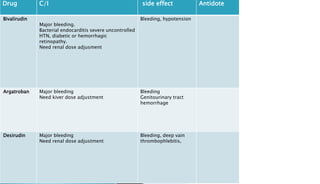
Drug C/I side effect Antidote
Bivalirudin
Major bleeding.
Bacterial endocarditis severe uncontrolled
HTN, diabetic or hemorrhagic
retinopathy.
Need renal dose adjusment
Bleeding, hypotension
Argatroban Major bleeding
Need kiver dose adjustment
Bleeding
Genitourinary tract
hemorrhage
Desirudin Major bleeding
Need renal dose adjustment
Bleeding, deep vain
thrombophlebitis,
Dabigatran is the only oral direct thrombin inhibitor available for
clinical use. Additional agents are under development
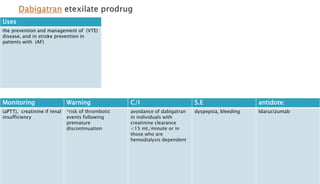
Monitoring Warning C/I S.E antidote:
(aPTT), creatinine if renal
insufficiency
*risk of thrombotic
events following
premature
discontinuation
avoidance of dabigatran
in individuals with
creatinine clearance
<15 mL/minute or in
those who are
hemodialysis dependent
dyspepsia, bleeding Idarucizumab
Uses
the prevention and management of (VTE)
disease, and in stroke prevention in
patients with (AF)
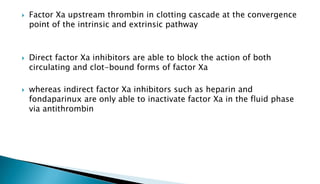
 Factor Xa upstream thrombin in clotting cascade at the convergence
point of the intrinsic and extrinsic pathway
 Direct factor Xa inhibitors are able to block the action of both
circulating and clot-bound forms of factor Xa
 whereas indirect factor Xa inhibitors such as heparin and
fondaparinux are only able to inactivate factor Xa in the fluid phase
via antithrombin
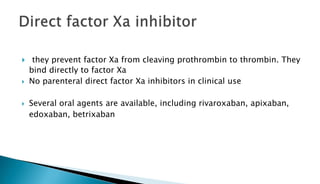
 they prevent factor Xa from cleaving prothrombin to thrombin. They
bind directly to factor Xa
 No parenteral direct factor Xa inhibitors in clinical use
 Several oral agents are available, including rivaroxaban, apixaban,
edoxaban, betrixaban
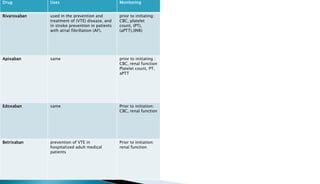
Drug Uses Monitoring
Rivaroxaban used in the prevention and
treatment of (VTE) disease, and
in stroke prevention in patients
with atrial fibrillation (AF).
prior to initiating:
CBC, platelet
count, (PT),
(aPTT),(INR)
Apixaban same prior to initiating :
CBC, renal function
Platelet count, PT,
aPTT
Edoxaban same Prior to initiation:
CBC, renal function
Betrixaban prevention of VTE in
hospitalized adult medical
patients
Prior to initiation:
renal function
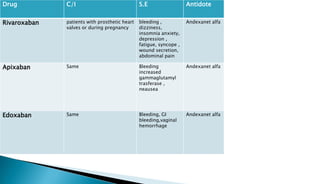
Drug C/I S.E Antidote
Rivaroxaban patients with prosthetic heart
valves or during pregnancy
bleeding ,
dizziness,
insomnia anxiety,
depression ,
fatigue, syncope ,
wound secretion,
abdominal pain
Andexanet alfa
Apixaban Same Bleeding
increased
gammaglutamyl
trasferase ,
neausea
Andexanet alfa
Edoxaban Same Bleeding, GI
bleeding,vaginal
hemorrhage
Andexanet alfa
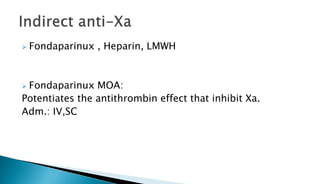
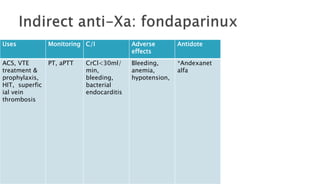
 Fondaparinux , Heparin, LMWH
 Fondaparinux MOA:
Potentiates the antithrombin effect that inhibit Xa.
Adm.: IV,SC
Uses Monitoring C/I Adverse
effects
Antidote
ACS, VTE
treatment &
prophylaxis,
HIT, superfic
ial vein
thrombosis
PT, aPTT CrCl<30ml/
min,
bleeding,
bacterial
endocarditis
Bleeding,
anemia,
hypotension,
*Andexanet
alfa
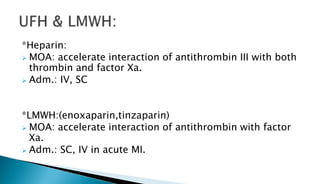
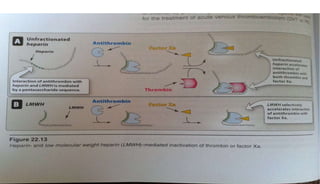
*Heparin:
 MOA: accelerate interaction of antithrombin III with both
thrombin and factor Xa.
 Adm.: IV, SC
*LMWH:(enoxaparin,tinzaparin)
 MOA: accelerate interaction of antithrombin with factor
Xa.
 Adm.: SC, IV in acute MI.
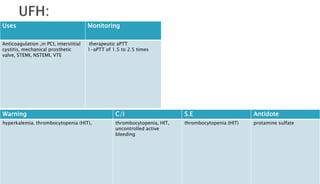
Uses Monitoring
Anticoagulation ,in PCI, interstitial
cystitis, mechanical prosthetic
valve, STEMI, NSTEMI, VTE
therapeutic aPTT
1-aPTT of 1.5 to 2.5 times
Warning C/I S.E Antidote
hyperkalemia, thrombocytopenia (HIT), thrombocytopenia, HIT,
uncontrolled active
bleeding
thrombocytopenia (HIT) protamine sulfate
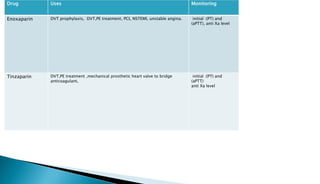
Drug Uses Monitoring
Enoxaparin DVT prophylaxis, DVT,PE treatment, PCI, NSTEMI, unstable angina. initial :(PT) and
(aPTT), anti Xa level
Tinzaparin DVT,PE treatment ,mechanical prosthetic heart valve to bridge
anticoagulant,
initial :(PT) and
(aPTT)
anti Xa level
Drug Warning C/I S.E Antidote
Enoxaparin ]hyperkalemia,
thrombocytopenia,
Hypersensitivity to enoxaparin or heparin,
history of HIT in the past 100days, active
major bleeding
Need renal dose adjustment
Anemia, hemorrhage,
peripheral edema,
confusion
1 mg protamine
per 1 mg of
enoxaparin.
Tinzaparin hyperkalemia,
thrombocytopenia
Hypersensitivity to it or other LMWH or
heparin, active bleeding, History of HIT,
endocarditis, severe uncontrolled pressure,
Spinal/epidural anesthesia
Increase ALT, hematoma
at injection site, chest
pain
1 mg protamine
per 100 anti-
factor Xa units of
LMW heparin.
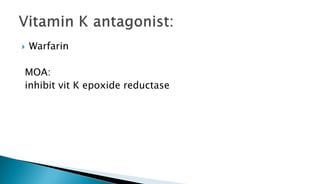
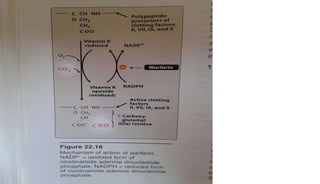
 Warfarin
MOA:
inhibit vit K epoxide reductase
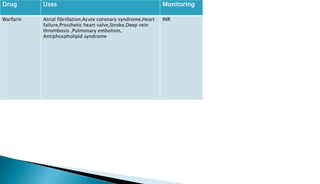
Drug Uses Monitoring
Warfarin Atrial fibrillation,Acute coronary syndrome,Heart
failure,Prosthetic heart valve,Stroke,Deep vein
thrombosis ,Pulmonary embolism,
Antiphospholipid syndrome
INR
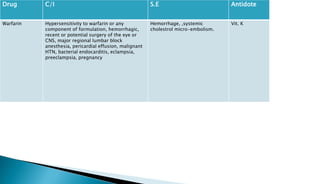
Drug C/I S.E Antidote
Warfarin Hypersensitivity to warfarin or any
component of formulation, hemorrhagic,
recent or potential surgery of the eye or
CNS, major regional lumbar block
anesthesia, pericardial effusion, malignant
HTN, bacterial endocarditis, eclampsia,
preeclampsia, pregnancy
Hemorrhage, ,systemic
cholestrol micro-embolism.
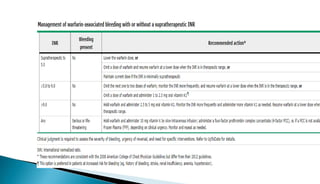
Vit. K
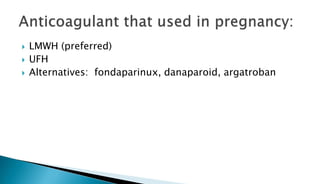
 LMWH (preferred)
 UFH
 Alternatives: fondaparinux, danaparoid, argatroban