Anti-Depressant and its
Classification
By
Natasha Puri
M.Sc Forensic Science
(3rd
Sem.)
What is Depression ???
 Serious disorder of mood, ranges from mild to
very serious condition
 Most serious mental problem which people facing
today
 Most common Psychological Disorder
 Some people referred depression as “Common
Cold” of mental illness
 Can affect people of all ages,religion and race
 Twice common in female as compared to male
 Risk of suicide is high
Type of Depression
 Depression are of Following types :
a. Uni-polar - Mind of subject swing in some
direction
b. Bi-polar - Depression associated with
mania some times called as
manic depression
c. Endogenous – Depression due to shock or
stressful life events
Causes
Following are the main causes :
 Family History
 Positive and negative events
 Certain medication
 Use of alcohol
 Imbalance of certain chemicals in the brain
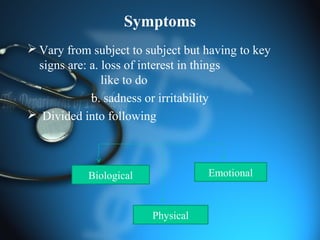
Symptoms
 Vary from subject to subject but having to key
signs are: a. loss of interest in things
like to do
b. sadness or irritability
 Divided into following
Biological Emotional
Physical
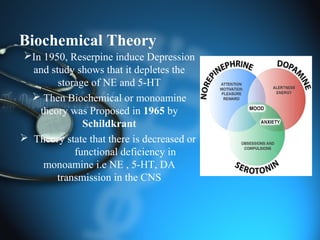
Biochemical Theory
In 1950, Reserpine induce Depression
and study shows that it depletes the
storage of NE and 5-HT
 Then Biochemical or monoamine
theory was Proposed in 1965 by
Schildkrant
 Theory state that there is decreased or
functional deficiency in
monoamine i.e NE , 5-HT, DA
transmission in the CNS
Treatment
Psychotherapy
 Electroconvulsive Therapy
 Natural alternatives
 Medication
The drug which is used for the
relieve or prevention of depression and its
symptoms known as Anti-depressant Drugs
Anti Depressant Drugs
Drugs which are used to relieve or prevent
depression known as Anti depressant
 Anti depressant was first developed in
1950’s
 Work by stabilize and normalize the level of
neurotransmitter in brain.Neurotransmitter
like NE,5-HT,DA play an important role in
regulating the mood
 Practically all antidepressants affect
monoaminergic transmission in the brain
Classification
 Tricyclic Antidepressants (TCAs)
i. NA+5-HT reuptake inhibitor
- Imipramine
- Trimipramine
- Amitriptyline
- Doxepin
ii. Predominantly NA reuptake inhibitors
- Desipramine
- Nortriptyline
- Reboxetine
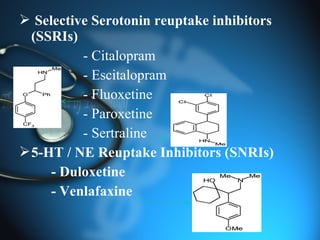
 Selective Serotonin reuptake inhibitors
(SSRIs)
- Citalopram
- Escitalopram
- Fluoxetine
- Paroxetine
- Sertraline
5-HT / NE Reuptake Inhibitors (SNRIs)
- Duloxetine
- Venlafaxine
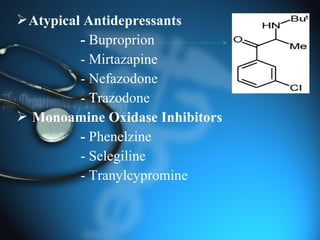
Atypical Antidepressants
- Buproprion
- Mirtazapine
- Nefazodone
- Trazodone
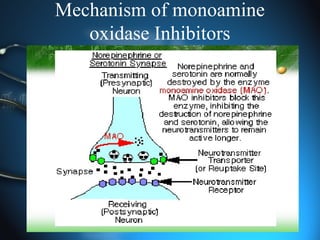
 Monoamine Oxidase Inhibitors
- Phenelzine
- Selegiline
- Tranylcypromine
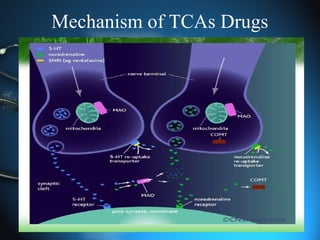
Mechanism of TCAs Drugs
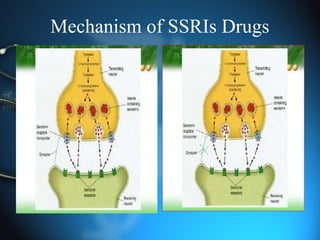
Mechanism of SSRIs Drugs
Mechanism of monoamine
oxidase Inhibitors
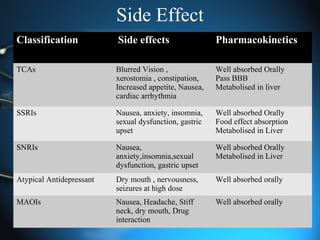
Side Effect
Classification Side effects Pharmacokinetics
TCAs Blurred Vision ,
xerostomia , constipation,
Increased appetite, Nausea,
cardiac arrhythmia
Well absorbed Orally
Pass BBB
Metabolised in liver
SSRIs Nausea, anxiety, insomnia,
sexual dysfunction, gastric
upset
Well absorbed Orally
Food effect absorption
Metabolised in Liver
SNRIs Nausea,
anxiety,insomnia,sexual
dysfunction, gastric upset
Well absorbed Orally
Metabolised in Liver
Atypical Antidepressant Dry mouth , nervousness,
seizures at high dose
Well absorbed orally
MAOIs Nausea, Headache, Stiff
neck, dry mouth, Drug
interaction
Well absorbed orally
References
 Tripathi K.D “Essential of Medical Pharmacology” 6th
Edition , Jaypee
Brothers Medical Publishers(P)ltd.
 Goodman and Gilman’s “Manual of Pharmacology and Therapeutics”
10th
Edition, McGraw Hill Companies
 Finkel Richard et.al., “Pharmacolgy”,4th
Edition, Lippincott Williams
and Wilkin
 Hollinger A. Mannfred, “ Introduction to Pharmacology” ,2nd
Edition ,
Taylor & Francis Group
 Dipiro T. Joseph, et.al “ Pharmacotherapy” ,7th
Edition , McGraw Hill
Companies
 Stahl SM. Essential Psychopharmacology,2nd
Edition, Cambridge
University Press, New York
 Foye O.William, Principles of Medicinal Chemistry,3rd
Edition,
Varghese Publishing House
 http://www.springerlink.com/content/b9b8668ff59f89d7/fulltext.pdf
 http://www.slideshare.net
 http://www.authorstream.com
Anti depressant and its classifications

Anti depressant and its classifications

  • 1.
    Anti-Depressant and its Classification By NatashaPuri M.Sc Forensic Science (3rd Sem.)
  • 2.
    What is Depression???  Serious disorder of mood, ranges from mild to very serious condition  Most serious mental problem which people facing today  Most common Psychological Disorder  Some people referred depression as “Common Cold” of mental illness  Can affect people of all ages,religion and race  Twice common in female as compared to male  Risk of suicide is high
  • 3.
    Type of Depression Depression are of Following types : a. Uni-polar - Mind of subject swing in some direction b. Bi-polar - Depression associated with mania some times called as manic depression c. Endogenous – Depression due to shock or stressful life events
  • 4.
    Causes Following are themain causes :  Family History  Positive and negative events  Certain medication  Use of alcohol  Imbalance of certain chemicals in the brain
  • 5.
    Symptoms  Vary fromsubject to subject but having to key signs are: a. loss of interest in things like to do b. sadness or irritability  Divided into following Biological Emotional Physical
  • 6.
    Biochemical Theory In 1950,Reserpine induce Depression and study shows that it depletes the storage of NE and 5-HT  Then Biochemical or monoamine theory was Proposed in 1965 by Schildkrant  Theory state that there is decreased or functional deficiency in monoamine i.e NE , 5-HT, DA transmission in the CNS
  • 7.
    Treatment Psychotherapy  Electroconvulsive Therapy Natural alternatives  Medication The drug which is used for the relieve or prevention of depression and its symptoms known as Anti-depressant Drugs
  • 8.
    Anti Depressant Drugs Drugswhich are used to relieve or prevent depression known as Anti depressant  Anti depressant was first developed in 1950’s  Work by stabilize and normalize the level of neurotransmitter in brain.Neurotransmitter like NE,5-HT,DA play an important role in regulating the mood  Practically all antidepressants affect monoaminergic transmission in the brain
  • 9.
    Classification  Tricyclic Antidepressants(TCAs) i. NA+5-HT reuptake inhibitor - Imipramine - Trimipramine - Amitriptyline - Doxepin ii. Predominantly NA reuptake inhibitors - Desipramine - Nortriptyline - Reboxetine
  • 10.
     Selective Serotoninreuptake inhibitors (SSRIs) - Citalopram - Escitalopram - Fluoxetine - Paroxetine - Sertraline 5-HT / NE Reuptake Inhibitors (SNRIs) - Duloxetine - Venlafaxine
  • 11.
    Atypical Antidepressants - Buproprion -Mirtazapine - Nefazodone - Trazodone  Monoamine Oxidase Inhibitors - Phenelzine - Selegiline - Tranylcypromine
  • 12.
  • 13.
  • 14.
  • 15.
    Side Effect Classification Sideeffects Pharmacokinetics TCAs Blurred Vision , xerostomia , constipation, Increased appetite, Nausea, cardiac arrhythmia Well absorbed Orally Pass BBB Metabolised in liver SSRIs Nausea, anxiety, insomnia, sexual dysfunction, gastric upset Well absorbed Orally Food effect absorption Metabolised in Liver SNRIs Nausea, anxiety,insomnia,sexual dysfunction, gastric upset Well absorbed Orally Metabolised in Liver Atypical Antidepressant Dry mouth , nervousness, seizures at high dose Well absorbed orally MAOIs Nausea, Headache, Stiff neck, dry mouth, Drug interaction Well absorbed orally
  • 16.
    References  Tripathi K.D“Essential of Medical Pharmacology” 6th Edition , Jaypee Brothers Medical Publishers(P)ltd.  Goodman and Gilman’s “Manual of Pharmacology and Therapeutics” 10th Edition, McGraw Hill Companies  Finkel Richard et.al., “Pharmacolgy”,4th Edition, Lippincott Williams and Wilkin  Hollinger A. Mannfred, “ Introduction to Pharmacology” ,2nd Edition , Taylor & Francis Group  Dipiro T. Joseph, et.al “ Pharmacotherapy” ,7th Edition , McGraw Hill Companies  Stahl SM. Essential Psychopharmacology,2nd Edition, Cambridge University Press, New York  Foye O.William, Principles of Medicinal Chemistry,3rd Edition, Varghese Publishing House  http://www.springerlink.com/content/b9b8668ff59f89d7/fulltext.pdf  http://www.slideshare.net  http://www.authorstream.com