
Sedative & Hypnotics
By
Mrs. Babitha K Devu
Assistant Professor
SEDATIVE & HYPNOTICS
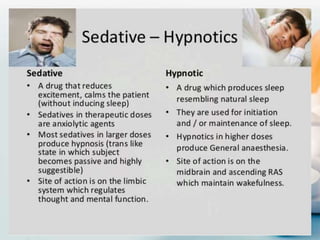
Sedative is a drug that produces calming or
quietening effect and reduces excitement, it may
induce drowsiness.
Drugs that clam the patient and reduce anxiety
without inducing normal sleep.
Hypnotics is a drug that induces sleep,
resembling natural sleep.
Drugs that initiate and maintain the normal
sleep.
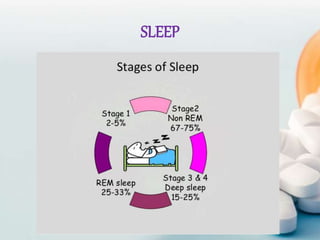
SLEEP
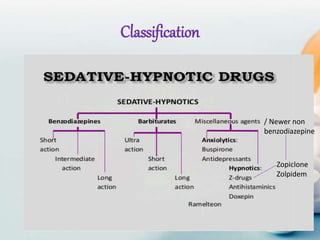
Classification
/ Newer non
benzodiazepine
Zopiclone
Zolpidem
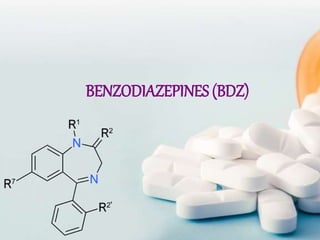
BENZODIAZEPINES (BDZ)
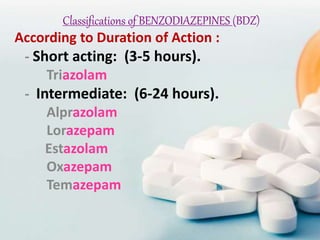
Classifications of BENZODIAZEPINES (BDZ)
According to Duration of Action :
- Short acting: (3-5 hours).
Triazolam
- Intermediate: (6-24 hours).
Alprazolam
Lorazepam
Estazolam
Oxazepam
Temazepam
- Long acting: ( 24-72 hours)
Chlorazepate
Chlordiazepoxide
Diazepam
Flurazepam.
Quazepam
Prazepam
Nitrazepam
BENZODIAZEPINES (BDZ)
Chlordiazepoxide and diazepam was the first BZD
introduced around 1960 as antianxiety drugs.
• Pharmacological Action
It includes
1. Sedation and Hypnosis
2. Reduction in anxiety
3. Anaesthetic
4. Muscle Relaxation
5. Anti – Convulsion effect
6. Amnesia
7. Other actions such as decreases nocturnal
gastric secretion and prevents stress ulcers
MECHANISMOF ACTION
• Gamma - aminobutric acid(GABA) is the
principle inhibitory neurotransmitter of the CNS
and it acts through GABA receptors. BZD bind
to the GABA-A receptor and increase the
frequency of chloride channel opening. This in
turn leads to increased flow of chloride into the
neurons, resulting in hyperpolarisation. This
result in inhibition of propagation of action
potential further result in inhibitory effect on
different sites of the brain especially motor
cortex, and limbic system.
Pharmacokinectics
BZD are completely absorbed on oral
administration .IM absorption is slow hence
oral route is preferred. they are extensively
bound to plasma protein metabolized in the
liver. And excreted through kidney.
ADVERSE EFFECT
1.Ataxia (motor in coordination), cognitive
impairment.
2.Hangover Sleep tendency, drowsiness, confusion
especially in long acting drugs.
3. Tolerance
4. Physical and Psychological dependence
5. withdrawal symptoms
Rebound Insomnia, anorexia, anxiety, agitation,
tremors and convulsion.
6. Drug Interaction
 Synergistic effect with other CNS
depressants
 Enzyme Modulators.
Rifampicin (decreases half life)
Cimetidine (increases half life)
7. Skin rash
8. Teratogenic effect.
FLUMAZENIL
 a selective competitive antagonist of BZD
receptors (Bz1).
 Blocks action of benzodiazepines, zaleplon
and zolpidem but not other sedative /hypnotics.
 Blocks psychomotor, cognitive and memory
impairment of BZs.
Nurses Responsibility
• Nursing considerations for benzodiazepines
also involve careful monitoring of the patient’s
condition and education of medication
regimen.
• Benzodiazepines are a Schedule IV drug, so
the patient should be assessed for drug-abuse
potential and dependence.
• These drugs are a pregnancy-risk category D.
Nurses Responsibility
• Since benzodiazepines change intraocular
pressure, patients with narrow-angle glaucoma
should not receive these drugs. Liver and kidney
function should also be monitored, and
respiratory depression may result if the patient is
taking other CNS depressants.
• Common side effects include drowsiness and
dizziness. If a patient receives an overdose of
benzodiazepines, flumazenil (Romazicon) should
be administered to reverse the CNS depression.
Nurses Responsibility
• Oxygen and resuscitation equipment should be
nearby to treat respiratory depression, since
flumazenil (Romazicon) should not be given
because of the need to stop the seizures.
• Do not mix these drugs with others because they
tend to precipitate and are irritating to the veins.
• Patient teaching should include avoiding alcohol,
OTC drugs, and herbal medications without
notifying the prescriber, due to CNS depression.
Nurses Responsibility
• All forms of nicotine should be avoided because
they can decrease the effectiveness of
benzodiazepines.
• Patients should avoid driving or hazardous
activities until they know how they respond to
the drug.
• Rebound seizures may result if the drug is
abruptly stopped.
• The drug should be taken with food to prevent GI
disturbances.
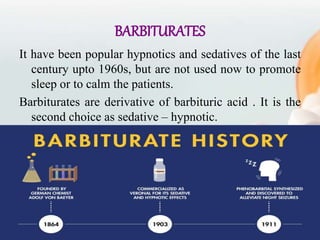
BARBITURATES
BARBITURATES
It have been popular hypnotics and sedatives of the last
century upto 1960s, but are not used now to promote
sleep or to calm the patients.
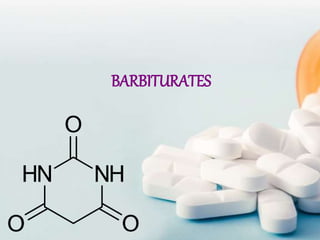
Barbiturates are derivative of barbituric acid . It is the
second choice as sedative – hypnotic.
BARBITURATES
Pharmacological Action
They are general depressants for all excitable cells,
CNS is most sensitive where the effect is almost
global; but certain areas are more susceptible.
1. CNS: Produce dose – dependent effects.
• Hypnotics dose shortens the time taken to fall asleep
and increase duration.
• Sedative dose given at day time can produce
drowsiness, reduction in anxiety and excitability.
• No analgesic effect but can cause hyperalgesia.
• Anti convulsant property.
BARBITURATES
Pharmacological Action
2. Other systems
• Respiration: is depressed in higher dose.
• CVS: Slight decrease in BP and heart rate.
• Skeletal muscles: Hypnotic dose has little effect but
anaesthetic dose reduces muscle contraction by action
on NMJ.
• Smooth muscles: Tone and motility of bowel is
decreased by hypnotic dose.
• Kidney: Tend to reduce urine flow.
Mechanism of Action
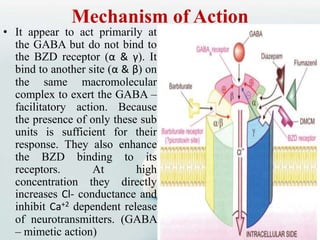
• It appear to act primarily at
the GABA but do not bind to
the BZD receptor (α & γ). It
bind to another site (α & β) on
the same macromolecular
complex to exert the GABA –
facilitatory action. Because
the presence of only these sub
units is sufficient for their
response. They also enhance
the BZD binding to its
receptors. At high
concentration they directly
increases Cl- conductance and
inhibit Ca+2 dependent release
of neurotransmitters. (GABA
– mimetic action)
Mechanism of Action
• In addition they depress glutamate induced neuronal
depolarization through AMPA receptors (a type of
excitatory amino acid receptors).
• At high concentrations, barbiturates depress voltage
sensitive Na+ and K + channels as well.
• A dose dependent effect on multiple neuronal targets
appears to confer the ability to produce any grade of
CNS depression.
Pharmacokinetics
1. Barbiturates are well absorbed from the GI tract and
widely distributed in the body.
2. The rate of entry into CNS depends on the lipid
solubility. (Highly soluble more instant entry)
3. The highly lipid soluble barbiturates like
thiopentone have a fast onset of action.
4. Redistribution: from CNS to skeletal muscles,
adipose tissue) (for termination of action).
5. It metabolized in liver by oxidation, dealkylation
and conjugation.
6. The metabolites are excreted in urine.
Uses
• Except for phenobarbitone in epilepsy and
thiopentone in anesthesia no other barbiturates
are used now.
• Occasionally used as adjuvants in
psychosomatic disorders.
• Hypnotic and anxiolytic have been superseded
by BZDs.
Adverse effects
• Hangover
• Tolerance and dependence on repeated usage.
• Mental confusion, impaired performance and
traffic accidents.
• Idiosyncrasy
• Hypersensitivity
• Withdrawal symptoms: excitement,
hallucinations, delirium, convulsions, death
Acute barbiturates poisoning
• Mostly suicidal and sometimes accidental.
• Symptoms: respiratory depression, slow and
shallow breathing , hypotension, skin
eruption, cardiovascular collapse, and renal
failure.
• Dose: Depends upon lipid solubility. 2-3 g for
more and 5-10 g for less lipid soluble.
Acute barbiturates poisoning
• Treatment
There is no specific antidote.
Gastric lavage followed by administration of
activated charcoal to prevent further absorption of
barbiturates.
General supportive measures like maintenance of
BP, adequate ventilation, blood volume maintenance
by IV fluids and oxygen administration.
Forced alkaline diuresis with sodium bicarbonate 1
mEq/kg IV with or without mannitol.
Hemodialysis should be done especially if there is
renal failure.
Advantages of BZD over barbiturates
1. Selective: minimal respiratory and
cardiovascular depression.
2. High therapeutic index.
3. Less hangover.
4. Not enzyme inducer.
5. Less dependence with minimal withdrawal
symptoms.
6. Has specific antagonist.
Non-Benzodiazepine hypnotics
• This lately developed group of hypnotics are
chemically different from BZDs, but act as
agonists on a specific subset of BZD receptors.
The newer drugs have similar efficacy as BZD
in the treatment of insomnia. But minimum
day after drowsiness and less amnesia. Given
their shorter duration of action, they are being
preferred over BZDs for the treatment of
insomnia.
Non-Benzodiazepine hypnotics
• Zopiclone: This is the first of the non-BZD
hypnotics, which acts as an agonist at a
subtype of BZD receptor involved in the
hypnotic action.
• Indication: Short term insomnia (< 2weeks)
• Side effects: Metallic or bitter taste, impaired
judgment and alertness, psychological
disturbances, dry mouth and mild dependence.
miscellaneous
• PARALDEHYDE
It is a colorless, transparent, pungent,
inflammable liquid. It is an irritant and can
dissolve plastic cannot be given by a plastic
syringe. It also has anticonvulsant properties.
• Route: It is given rectally , IM, or orally.
• USES
1. As Convulsant in status epileptics particularly in
children.
2. Hypnotic rarely used.
miscellaneous
• MELATONIN:
The hormone secreted by the pineal gland is known
to regulate sleep. Melatonin act on melatonin
receptors. It does not depress the CNS it improves
the quality of sleep and helps in withdrawing
BZD after long term use.
• RAMELTEON:
It is an agonist at the melatonin receptors is a novel
hypnotic drug. It does not modify the sleep. The
duration of action is prolonged. Adverse effect are
dizziness and fatigue.
Notes sedative & hypnotics

Notes sedative & hypnotics

  • 1.
    Sedative & Hypnotics By Mrs.Babitha K Devu Assistant Professor
  • 2.
    SEDATIVE & HYPNOTICS Sedativeis a drug that produces calming or quietening effect and reduces excitement, it may induce drowsiness. Drugs that clam the patient and reduce anxiety without inducing normal sleep. Hypnotics is a drug that induces sleep, resembling natural sleep. Drugs that initiate and maintain the normal sleep.
  • 4.
  • 5.
  • 6.
  • 7.
    Classifications of BENZODIAZEPINES(BDZ) According to Duration of Action : - Short acting: (3-5 hours). Triazolam - Intermediate: (6-24 hours). Alprazolam Lorazepam Estazolam Oxazepam Temazepam
  • 8.
    - Long acting:( 24-72 hours) Chlorazepate Chlordiazepoxide Diazepam Flurazepam. Quazepam Prazepam Nitrazepam
  • 9.
    BENZODIAZEPINES (BDZ) Chlordiazepoxide anddiazepam was the first BZD introduced around 1960 as antianxiety drugs. • Pharmacological Action It includes 1. Sedation and Hypnosis 2. Reduction in anxiety 3. Anaesthetic 4. Muscle Relaxation 5. Anti – Convulsion effect 6. Amnesia 7. Other actions such as decreases nocturnal gastric secretion and prevents stress ulcers
  • 10.
    MECHANISMOF ACTION • Gamma- aminobutric acid(GABA) is the principle inhibitory neurotransmitter of the CNS and it acts through GABA receptors. BZD bind to the GABA-A receptor and increase the frequency of chloride channel opening. This in turn leads to increased flow of chloride into the neurons, resulting in hyperpolarisation. This result in inhibition of propagation of action potential further result in inhibitory effect on different sites of the brain especially motor cortex, and limbic system.
  • 11.
    Pharmacokinectics BZD are completelyabsorbed on oral administration .IM absorption is slow hence oral route is preferred. they are extensively bound to plasma protein metabolized in the liver. And excreted through kidney.
  • 12.
    ADVERSE EFFECT 1.Ataxia (motorin coordination), cognitive impairment. 2.Hangover Sleep tendency, drowsiness, confusion especially in long acting drugs. 3. Tolerance 4. Physical and Psychological dependence 5. withdrawal symptoms Rebound Insomnia, anorexia, anxiety, agitation, tremors and convulsion.
  • 13.
    6. Drug Interaction Synergistic effect with other CNS depressants  Enzyme Modulators. Rifampicin (decreases half life) Cimetidine (increases half life) 7. Skin rash 8. Teratogenic effect.
  • 14.
    FLUMAZENIL  a selectivecompetitive antagonist of BZD receptors (Bz1).  Blocks action of benzodiazepines, zaleplon and zolpidem but not other sedative /hypnotics.  Blocks psychomotor, cognitive and memory impairment of BZs.
  • 15.
    Nurses Responsibility • Nursingconsiderations for benzodiazepines also involve careful monitoring of the patient’s condition and education of medication regimen. • Benzodiazepines are a Schedule IV drug, so the patient should be assessed for drug-abuse potential and dependence. • These drugs are a pregnancy-risk category D.
  • 16.
    Nurses Responsibility • Sincebenzodiazepines change intraocular pressure, patients with narrow-angle glaucoma should not receive these drugs. Liver and kidney function should also be monitored, and respiratory depression may result if the patient is taking other CNS depressants. • Common side effects include drowsiness and dizziness. If a patient receives an overdose of benzodiazepines, flumazenil (Romazicon) should be administered to reverse the CNS depression.
  • 17.
    Nurses Responsibility • Oxygenand resuscitation equipment should be nearby to treat respiratory depression, since flumazenil (Romazicon) should not be given because of the need to stop the seizures. • Do not mix these drugs with others because they tend to precipitate and are irritating to the veins. • Patient teaching should include avoiding alcohol, OTC drugs, and herbal medications without notifying the prescriber, due to CNS depression.
  • 18.
    Nurses Responsibility • Allforms of nicotine should be avoided because they can decrease the effectiveness of benzodiazepines. • Patients should avoid driving or hazardous activities until they know how they respond to the drug. • Rebound seizures may result if the drug is abruptly stopped. • The drug should be taken with food to prevent GI disturbances.
  • 19.
  • 20.
    BARBITURATES It have beenpopular hypnotics and sedatives of the last century upto 1960s, but are not used now to promote sleep or to calm the patients. Barbiturates are derivative of barbituric acid . It is the second choice as sedative – hypnotic.
  • 22.
    BARBITURATES Pharmacological Action They aregeneral depressants for all excitable cells, CNS is most sensitive where the effect is almost global; but certain areas are more susceptible. 1. CNS: Produce dose – dependent effects. • Hypnotics dose shortens the time taken to fall asleep and increase duration. • Sedative dose given at day time can produce drowsiness, reduction in anxiety and excitability. • No analgesic effect but can cause hyperalgesia. • Anti convulsant property.
  • 23.
    BARBITURATES Pharmacological Action 2. Othersystems • Respiration: is depressed in higher dose. • CVS: Slight decrease in BP and heart rate. • Skeletal muscles: Hypnotic dose has little effect but anaesthetic dose reduces muscle contraction by action on NMJ. • Smooth muscles: Tone and motility of bowel is decreased by hypnotic dose. • Kidney: Tend to reduce urine flow.
  • 24.
    Mechanism of Action •It appear to act primarily at the GABA but do not bind to the BZD receptor (α & γ). It bind to another site (α & β) on the same macromolecular complex to exert the GABA – facilitatory action. Because the presence of only these sub units is sufficient for their response. They also enhance the BZD binding to its receptors. At high concentration they directly increases Cl- conductance and inhibit Ca+2 dependent release of neurotransmitters. (GABA – mimetic action)
  • 25.
    Mechanism of Action •In addition they depress glutamate induced neuronal depolarization through AMPA receptors (a type of excitatory amino acid receptors). • At high concentrations, barbiturates depress voltage sensitive Na+ and K + channels as well. • A dose dependent effect on multiple neuronal targets appears to confer the ability to produce any grade of CNS depression.
  • 26.
    Pharmacokinetics 1. Barbiturates arewell absorbed from the GI tract and widely distributed in the body. 2. The rate of entry into CNS depends on the lipid solubility. (Highly soluble more instant entry) 3. The highly lipid soluble barbiturates like thiopentone have a fast onset of action. 4. Redistribution: from CNS to skeletal muscles, adipose tissue) (for termination of action). 5. It metabolized in liver by oxidation, dealkylation and conjugation. 6. The metabolites are excreted in urine.
  • 27.
    Uses • Except forphenobarbitone in epilepsy and thiopentone in anesthesia no other barbiturates are used now. • Occasionally used as adjuvants in psychosomatic disorders. • Hypnotic and anxiolytic have been superseded by BZDs.
  • 28.
    Adverse effects • Hangover •Tolerance and dependence on repeated usage. • Mental confusion, impaired performance and traffic accidents. • Idiosyncrasy • Hypersensitivity • Withdrawal symptoms: excitement, hallucinations, delirium, convulsions, death
  • 29.
    Acute barbiturates poisoning •Mostly suicidal and sometimes accidental. • Symptoms: respiratory depression, slow and shallow breathing , hypotension, skin eruption, cardiovascular collapse, and renal failure. • Dose: Depends upon lipid solubility. 2-3 g for more and 5-10 g for less lipid soluble.
  • 30.
    Acute barbiturates poisoning •Treatment There is no specific antidote. Gastric lavage followed by administration of activated charcoal to prevent further absorption of barbiturates. General supportive measures like maintenance of BP, adequate ventilation, blood volume maintenance by IV fluids and oxygen administration. Forced alkaline diuresis with sodium bicarbonate 1 mEq/kg IV with or without mannitol. Hemodialysis should be done especially if there is renal failure.
  • 31.
    Advantages of BZDover barbiturates 1. Selective: minimal respiratory and cardiovascular depression. 2. High therapeutic index. 3. Less hangover. 4. Not enzyme inducer. 5. Less dependence with minimal withdrawal symptoms. 6. Has specific antagonist.
  • 32.
    Non-Benzodiazepine hypnotics • Thislately developed group of hypnotics are chemically different from BZDs, but act as agonists on a specific subset of BZD receptors. The newer drugs have similar efficacy as BZD in the treatment of insomnia. But minimum day after drowsiness and less amnesia. Given their shorter duration of action, they are being preferred over BZDs for the treatment of insomnia.
  • 33.
    Non-Benzodiazepine hypnotics • Zopiclone:This is the first of the non-BZD hypnotics, which acts as an agonist at a subtype of BZD receptor involved in the hypnotic action. • Indication: Short term insomnia (< 2weeks) • Side effects: Metallic or bitter taste, impaired judgment and alertness, psychological disturbances, dry mouth and mild dependence.
  • 34.
    miscellaneous • PARALDEHYDE It isa colorless, transparent, pungent, inflammable liquid. It is an irritant and can dissolve plastic cannot be given by a plastic syringe. It also has anticonvulsant properties. • Route: It is given rectally , IM, or orally. • USES 1. As Convulsant in status epileptics particularly in children. 2. Hypnotic rarely used.
  • 35.
    miscellaneous • MELATONIN: The hormonesecreted by the pineal gland is known to regulate sleep. Melatonin act on melatonin receptors. It does not depress the CNS it improves the quality of sleep and helps in withdrawing BZD after long term use. • RAMELTEON: It is an agonist at the melatonin receptors is a novel hypnotic drug. It does not modify the sleep. The duration of action is prolonged. Adverse effect are dizziness and fatigue.