Drugs acting on CNS
Psychopharmacological agents
By: Kirankumar Solanki
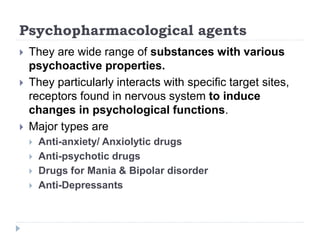
Psychopharmacological agents
 They are wide range of substances with various
psychoactive properties.
 They particularly interacts with specific target sites,
receptors found in nervous system to induce
changes in psychological functions.
 Major types are
 Anti-anxiety/ Anxiolytic drugs
 Anti-psychotic drugs
 Drugs for Mania & Bipolar disorder
 Anti-Depressants
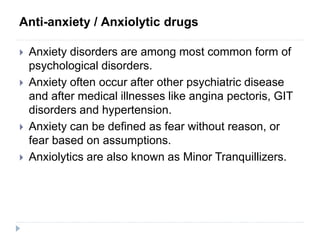
Anti-anxiety / Anxiolytic drugs
 Anxiety disorders are among most common form of
psychological disorders.
 Anxiety often occur after other psychiatric disease
and after medical illnesses like angina pectoris, GIT
disorders and hypertension.
 Anxiety can be defined as fear without reason, or
fear based on assumptions.
 Anxiolytics are also known as Minor Tranquillizers.
Anxiolytics can be classified as
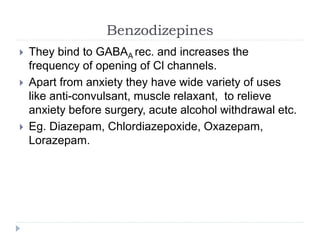
Benzodizepines
 They bind to GABAA rec. and increases the
frequency of opening of Cl channels.
 Apart from anxiety they have wide variety of uses
like anti-convulsant, muscle relaxant, to relieve
anxiety before surgery, acute alcohol withdrawal etc.
 Eg. Diazepam, Chlordiazepoxide, Oxazepam,
Lorazepam.
Sedative Anti-Histamines
 Generally Hydroxyzine is used as sedative, to treat
anxiety & tension and as mild anti-obsessive
Antipsychotic.
 It antagonizes Histamine on H1rec.
 It shows Drowsiness, sneezing, runny nose,
abdominal pain, increase in appetite & weight,
edema, urinary retention as side effects.
Azapirones
 They act as partial agonist for 5-HT receptor and
cause selective anxiolytic effect.
 Used to treat anxiety, fear, tension, irritability,
dizziness, pounding heart beat etc.
 They show restlessness, nervousness & unusual
excitement as side effects.
 Eg. Buspirone.
Beta Blockers
 They blocks Beta adrenergic rec. and reduces
sympathetic activity.
 They are used to treat tachycardia, palpitation,
tremors etc.
 Productive cough, difficulty in breathing, chest
tightness are their side effects.
 Eg. Propranolol.
Anti-Psychotic Drugs (Neuroleptics)
 These drugs are used to treat Schizophrenia or
Psychosis.
 These drugs are also known as Major tranquilizers.
 Schizophrenia is a major mental illness or a group of
illnesses, manifested by disordered thought process
including disturbances in attention and associations.
 Pathophysiology of mental illness is not clear, though
some ideas have been formed, e.g. dopaminergic
over activity in the limbic system may be involved in
schizophrenia and mania, while mono aminergic
(NA, 5-HT) deficit may underlie depression.
 Treatment is empirical, symptom oriented and not
disease specific. However, it is highly effective in
many situations.
Key features of schizophrenia
 Schizophrenia is a complex illness which varies
greatly in presentation.
 Positive symptoms such as hallucinations, delusions
and thought disorder, which commonly occur in the
acute phase of the illness, usually respond to
treatment with antipsychotic drugs.
 Negative symptoms such as apathy, social
withdrawal and lack of drive, which occur commonly
in the chronic phase of the illness, are more resistant
to drug treatment.
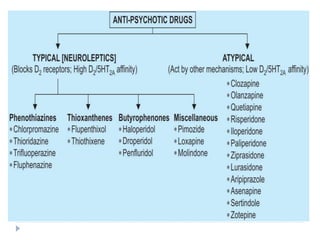
 Anti-psychotic drugs are classified as following :
 Typical antipsychotic drugs are often associated with
anticholinergic, sedative and cardiovascular side effects
in addition to extrapyramidal side effects.
 Long-term treatment with typical antipsychotic drugs is
associated with the development of tardive dyskinesia.
 The term ‘atypical’ is used to describe the newer
antipsychotic drugs that do not cause extrapyramidal side
effects.
 The atypical antipsychotics are associated with a range
of metabolic side effects including weight gain and
diabetes.
 Most typical and atypical antipsychotic drugs have similar
efficacy in the treatment of schizophrenia.
 Decisions about which antipsychotic drug to use should
be a mutual decision based on an informed discussion
involving individual preference, previous efficacy and side
effects.
 Clozapine has a broader spectrum of activity than
traditional antipsychotic drugs with some efficacy for
Mechanism of action
 All antipsychotics (except clozapine-like atypical ones)
have potent dopamine D2 receptor blocking action.
 Antipsychotic potency has shown good correlation with
their capacity to bind to D2 receptor.
 Phenothiazines and thioxanthenes also block DI , D3 and
D4 receptors, but there is no correlation of such blockade
with their antipsychotic potency.
 Blockade of dopaminergic projections to the temporal
and prefrontal areas constituting the 'limbic system' and
in mesocortical areas is probably responsible for the
antipsychotic action.
 This contention is strengthened by the observation that
drugs which increase DA activity (amphetamines,
levodopa, bromocriptine) induce or exacerbate
schizophrenia.
Mechanism of action
 Most of the newer atypical antipsychotic agents have
higher affinities for other receptors than for the D2
receptor. For example, α adrenoceptor-blocking action
correlates well with antipsychotic effect for many of the
drugs.
 Clozapine, a drug with significant D4 and 5-HT2 receptor-
blocking actions, has virtually no affinity for D2 receptors.
 Most of the newer atypical drugs (eg, olanzapine,
quetiapine, and risperidone) also have high affinity for 5-
HT2A receptors, although they may also interact with D2
and other receptors. Ziprasidone is an antagonist at the
D2, 5-HT2A, and 5-HT1D receptors and an agonist at the
5-HT1A receptor.
 The newer antipsychotic agent aripiprazole is a partial
agonist at D2 and 5-HT1A receptors but is a strong
antagonist at 5-HT2A receptors.
Clinical Uses
 Treatment of schizophrenia
 Antipsychotic drugs reduce some of the positive
symptoms of schizophrenia, including hyperactivity,
bizarre ideation, hallucinations, and delusions.
 Other psychiatric and neurologic indications
 The newer antipsychotic drugs are often used with lithium
in the initial treatment of mania.
 Nonpsychiatric indications
 With the exception of thioridazine, most phenothiazines
have antiemetic actions; prochlorperazine is promoted
solely for this indication.
Adverse effects
 Reversible neurologic effects
 Dose-dependent extrapyramidal effects include a Parkinson-
like syndrome with bradykinesia, rigidity, and tremor. This
toxicity may be reversed by a decrease in dose and may be
antagonized by concomitant use of muscarinic blocking agents.
 Tardive dyskinesias
 This important toxicity includes choreoathetoid (Involuntery)
movements of the muscles of the lips and buccal cavity and
may be irreversible. Tardive dyskinesias tend to develop after
several years of antipsychotic drug therapy but have appeared
as early as 6 mo.
 Autonomic effects
 Autonomic effects result from blockade of peripheral muscarinic
receptors and α adrenoceptors and are more difficult to
manage in elderly patients.
 It includes dry mouth, constipation, urinary retention,and visual
problems and Postural hypotension.
Adverse effects
 Endocrine and metabolic effects
 It include hyperprolactinemia, gynecomastia, the
amenorrhea-galactorrhea syndrome, infertility & elevated
prolactin.
 Significant weight gain and hyperglycemia due to a
diabetogenic action occur with several of the atypical
agents, especially clozapine and olanzapine.
 Neuroleptic malignant syndrome
 The symptoms include muscle rigidity, impairment of
sweating, hyperpyrexia, and autonomic instability, which
may be life threatening.
 Sedation
 This is more marked with chlorpromazine.
Adverse effects
 Miscellaneous toxicities
 Visual impairment caused by retinal deposits has
occurred with thioridazine; at high doses, this drug may
also cause severe conduction defects in the heart
resulting in fatal ventricular arrhythmias.
 Most of the atypicals,especially quetiapine and
ziprasidone, prolong the QT interval of the
electrocardiogram (ECG).
 Clozapine causes a small but important (1–2%) incidence
of agranulocytosis and blood counts must be monitored;
at high doses the drug has caused seizures.
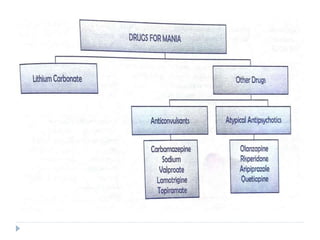
Drugs for mania and bipolar disorder
 These drugs are used to treat mania( characterized
by over elevated mood), and bipolar disorder
(characterized by cyclic elevation and depression of
mood).
 Lithium is effective in treatment of the manic phase
of bipolar disorder and continues to be used for
acute-phase illness and for prevention of recurrent
manic and depressive episodes.
 These drugs are broadly classified as following :
LITHIUM CARBONATE
 It is a small monovalent cation that does not produce any
acute effect but on prolonged use, acts as a mood
stabilizer.
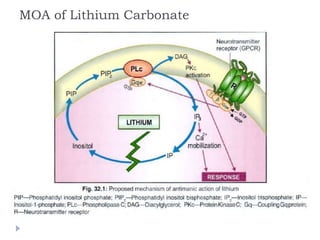
 It has no psychotropic effect in normal persons. It acts by
inhibiting the hydrolysis of inositol-1-phosphate (required
for the regeneration of IP3 and DAG in GPCR)
 It has narrow margin of safety (low therapeutic index) and
therapeutic drug monitoring (TDM) is essential.
 It takes 1-2 weeks to exert its maximum effect. It is the
drug of choice for the prophylaxis of bipolar disorder.
 Its Half-life (t1/2) is 24 hours.
 It can be used in acute mania but benzodiazepines like
lorazepam must be added (due to slow action of Li).
 In patients not controlled by BZDs, antipsychotics like
olanzapine may be added.
LITHIUM CARBONATE
 Plasma concentration of lithium should be 0.5-0.8 mEq/L
for maintenance therapy of bipolar disorder and 0.8-1.2
mEq/L for acute mania.
 Toxic symptoms are seen if plasma concentration
exceeds 1.5mEq/L.
 Diuretics (particularly thiazides) decrease the renal
excretion of lithium and thus may result in toxicity. This is
due to increased reabsorption of Na+ and lithium ions (as
a compensatory response to excessive loss of Na+)
 Acne and weight gain (due to Na+ and water retention)
are the other adverse effects.
 • It can cause benign and reversible elevation of T waves
in ECG.
Alternatives to Lithium
 Carbamazepine and valproate are useful in manic
depressive psychosis (bipolar disorder). These can
also be used for acute mania.
 Valproic acid is the drug of choice for treatment of
rapid cycles (> 4 cycles/year).
 Benzodiazepines like lorazepam are the drugs of
choice for acute mania when combined with lithium.
 Olanzapine and other atypical antipsychotics show
efficacy in bipolar disorder as well as acute mania.
 Lamotrigine is specifically useful for depressive
phase of bipolar disorder. It is the first agent to be
approved by FDA for bipolar disorder without an
indication for acute mania.
Lithium: Mechanism of Action
 The mechanism of action of lithium is not well
defined.
 The drug inhibits several enzymes involved in the
recycling of neuronal membrane phosphoinositides.
 This action may result in depletion of the second
messenger source, phosphatidylinositol
bisphosphate (PIP2), which, in turn, would decrease
generation of inositol trisphosphate (IP3) and
diacylglycerol (DAG).
 These second messengers are important in amine
neurotransmission, including that mediated by
central adrenoceptors and muscarinic receptors.
 In short it blocks the IP3 & DAG pathway of GPCRs.
MOA of Lithium Carbonate
Other Drugs Used in Mania & Bipolar
Disorder
 The manic phase in bipolar disorder can be treated with
antipsychotic drugs, and both olanzapine and quetiapine
are approved as monotherapy for this indication.
 Several antiseizure drugs are used in bipolar disorder.
 Valproic acid has antimanic effects equivalent to those of
lithium and is now widely used in the Unites States for
this indication, often as a first choice in acute illness.
 Valproic acid may be effective in patients who fail to
respond to lithium, and in some instances it has been
used in combination with lithium.
 The antiseizure drugs carbamazepine and lamotrigine
are also used both in acute mania and for prophylaxis in
the depressive phase.
Antidepressant Drugs
 Depression results due to decreased monoaminergic
(5-HT and NA) activity in the brain.
 Therefore drugs increasing their activity are called
typical anti-depressants.
 Drugs acting by other mechanisms are called
atypical anti-depressants.
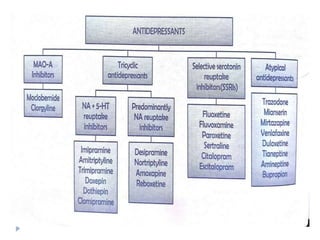
 First 3 types in the below mentioned chart are
Typical anti-depressants.
Typical anti-depressants
 MAO Inhibitors
 Two types of monoamine oxidase enzymes
(MAO-A and MAO-B) are involved in the
metabolism of monoamines.
 MAO-A predominantly metabolizes NA, 5-HT and DA
and is present in the intestine, peripheral nerve
endings and liver.
 MAO-B preferentially metabolizes dopamine and is
present in the brain, platelets and liver.
MAO Inhibitors
 Non selective MAO inhibitors
 Tranylcypromine, isocarboxazid and phenelzine inhibits
both isoforms of MAO irreversibly.
 Their anti-depressant effect takes 3-4 weeks to develop.
These drugs exhibit a large number of drug and food
interactions.
 The important ones are:
 Cheese reaction: Cheese, beer and red wine contain
tyramine (indirectly acting sympathomimetic).
 Normally it is metabolized by MAO-A present in the intestine
and is not absorbed. In persons taking non-selective MAO
inhibitors, tyramine escapes degradation and can lead to
hypertensive crisis. It is known as cheese reaction.
 So, cheese etc. should not be given to patients on long term
non selective MAO inhibitor therapy.
 Phentolamine is the drug of choice for cheese reaction.
MAO Inhibitors
 Non selective MAO inhibitors
 Non-selective MAO inhibitors increase the risk of
seizures if given along with pethidine due to
enhanced generation of excitatory metabolite nor-
meperidine.
 Serotonin syndrome:
 If given along with or just after discontinuation of MAO
inhibitors, SSRIs can result in serotonin syndrome.
 To avoid this fatal condition,SSRIs should be started at
least 14 days after discontinuation of MAO inhibitors.
 It allows sufficient time for regeneration of MAO.
MAO Inhibitors
 Reversible inhibitors of MAO -A (RIMA )
 Moclebemide inhibits MAO-A selectively and reversibly.
Because of its reversible and short action, it does not
exhibit cheese reaction with foods. It can be used as an
alternative to TCAs for the treatment of depression.
 Selective MAO -B inhibitors
 Selegiline inhibits only MAO-B and is useful in
Parkinsonism.
 It is available as a transdermal patch for treatment of
depression.
Tricyclic Antidepressants (TCA)
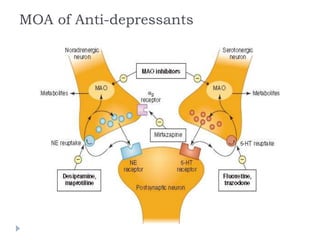
 These drugs act by inhibiting the reuptake of both
serotonin and noradrenaline.
 This results in increased concentration of these
transmitters in the synaptic cleft. Bupropion also inhibits
dopamine reuptake.
 NA and serotonin initially act on presynaptic a2 and
5HT1A receptors respectively and decrease the firing of
NA & 5HT.
 On long term administration, desensitization of these
receptors occurs and enhanced transmission is seen.
 This explains the long latency (2-3 weeks) for the anti-
depressant action of TCA and SSRIs despite immediate
inhibition of reuptake process.
Mechanism of action
 The TCAs and related drugs inhibit Mono amine
transporters which mediate active reuptake of biogenic
amines NA and 5-HT into their respective neurones and
thus potentiate them.
 They, however, differ markedly in their selectivity and
potency for different amines.
 Most of the compounds do not inhibit DA uptake, except
bupropion.
 Moreover, amphetamine and cocaine (which are not
antidepressants but CNS stimulants) are strong inhibitors
of DA uptake.
 However, it has been proposed that TCAs indirectly
facilitate dopaminergic transmission in forebrain that may
add to the mood elevating action.
MOA of Anti-depressants
Mechanism of action
 Reuptake inhibition results in increased
concentration of the amines in the synaptic cleft in
both CNS and periphery.
 Tentative conclusions drawn are:
 Inhibition of DA uptake correlates with stimulant action;
but is not primarily involved in antidepressant action.
 Inhibition of NA and 5-HT uptake is associated with
antidepressant action.
Adverse Effects
 Sedative action of TCAs appears immediately and
these drugs (particularly clomipramine, maprotiline and
bupropion) lower the seizure threshold.
 Weight gain is another problem with the use of TCAs.
 Most TCAs possess powerful anticholinergic and weak α
blocking property.
 Overdose manifestations are mainly anticholinergic
(delirium, urinary retention, blurred vision and
constipation) in nature.
 These also cause postural hypotension (due to α
blockade) and cardiac arrythmias at toxic levels.
 TCAs have low safety margin.
 Amoxapine increases the risk of extrapyramidal
symptoms and convulsions.
Selective Serotonin Reuptake Inhibitors
(SSRIs)
 These drugs inhibit the reuptake of 5-HT only (not
NA) and lack anticholinergic and α blocking
properties.
 SSRIs are now the first choice drugs for depression,
phobias, OCD, PTSD, bulimia, premenstrual tension
syndrome and panic attacks because they offer
several advantages over TCAs like:
 No anticholinergic adverse effects
 No sedation or weight gain
 Do not cause seizures or arrhythmias
Mechanism of action
 The acute effect of SSRIs is a highly selective action
on the serotonin transporter (SERT).
 SSRIs allosterically inhibit the transporter,binding at
a site other than that of serotonin.
 They have minimal inhibitory effects on the NE
transporter, or blocking actions on adrenergic and
cholinergic receptors.
Adverse effects
 Nausea is the most frequent complaint with the
use of SSRIs.
 Anxiety is the next most common adverse effect
followed by diarrhea.
 These can also cause inhibition of ejaculation.
 Co-administration of SSRIs with MAO inhibitors can
result in serotonin syndrome.
 SSRIs can cause akathisia. Because SSRIs affect
platelet serotonin levels, abnormal bleeding can
occur.
 Sertraline and citalopram appear to be safest SSRIs
to be used with warfarin.
Important SSRI compounds
 Fluoxetine: It is a prototype SSRI and is longest
acting drug in this group.
 It is metabolized to nor-fluoxetine that retains the
anti-depressant activity.
 Fluvoxamine is the shortest acting SSRI.
 Paroxetine, sertraline and citalopram are other
SSRIs.
 Escitalopram is most specific SSRI.
 Paroxetine is most teratogenic among SSRIs.
Atypical Anti-depressants
 These drugs may or may not increase monoaminergic levels
and possess different antidepressant mechanisms.
 Trazodone is a prominent α blocker and weak 5-HT2
antagonist. It produces sedation, priapism (prolonged and
painful erection) and postural hypotension as adverse effects.
 Mianserin acts by blocking presynaptic a2 receptors but
seizure augmenting and bone marrow depressant actions
restrict its use.
 Tianeptin and amineptine acts by enhancing the serotonin
reuptake (action opposite to SSRI).
 Venlafaxine, milnacipran, levo-milnacipran and duloxetine
inhibit reuptake of serotonin and NA but lack anticholinergic
and alpha blocking properties. These are also referred to as
serotonin and nor-adrenaline reuptake inhibitors (SNRI).
 Venlafaxine has faster onset of action. It has minimum drug-
drug interactions.
Atypical Anti-depressants
 Mirtazapine: It inhibits presynaptic alpha2 receptors and thus
increases NA and 5-HT release due to inhibition of auto- and
hetero-receptors respectively.
 Although it increases serotonin levels in synapse, there is
selective activation of 5-HT1 receptors due to antagonistic
activity at 5-HT2 and 5-HT3 receptors. Therefore it is also
known as nor-adrenergic and specific serotonergic anti-
depressant (NSSA).
 It has minimal sexual side effects compared with SSRIs. It
commonly causes sedation, weight gain, lipid abnormalities
and dizziness.
 Bupropion: It inhibits the uptake of NA and DA.
 It is metabolized to amphetamine like compound and
possesses excitatory property.
 It is used for smoking cessation as sustained release
formulation. It can precipitate seizures at high dose.
Atypical Anti-depressants
 Nafazodone: It blocks serotonin reuptake and
antagonizes 5-HT2 receptors.
 It lacks anticholinergic effects (of TCAs) and
agitation (seen with SSRI).
 It has very short half life and is hepatotoxic.
 Atomoxetine: It is a selective inhibitor of NA
reuptake and is useful for Attention Deficit
Hyperkinetic Disorder (efficacy similar to
methylphenidate).
 Duloxetine (a mixed NA and 5HT reuptake inhibitor)
is also useful in treating chronic neuropathic pain
e.g. in diabetic neuropathy and fibromyalgia.
Uses of anti depressants
 D - Depression
 E - Enuresis (Imipramine)
 P - Phobia
 R - Recurrent panic attacks
 E - Eating disorders (Bulimia)
 S - Smoking cessation(Bupropion)
 S - Stress disorder (Post traumatic)
 I - Impulse disorder (Kleptomania)
 O - Obsessive compulsive disorder
 N - Neuropathic pain
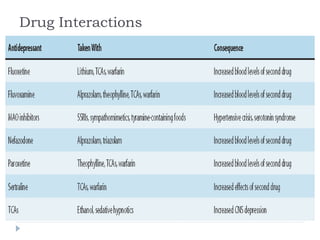
Drug Interactions

Psycho pharmacological agents.

  • 1.
    Drugs acting onCNS Psychopharmacological agents By: Kirankumar Solanki
  • 2.
    Psychopharmacological agents  Theyare wide range of substances with various psychoactive properties.  They particularly interacts with specific target sites, receptors found in nervous system to induce changes in psychological functions.  Major types are  Anti-anxiety/ Anxiolytic drugs  Anti-psychotic drugs  Drugs for Mania & Bipolar disorder  Anti-Depressants
  • 3.
    Anti-anxiety / Anxiolyticdrugs  Anxiety disorders are among most common form of psychological disorders.  Anxiety often occur after other psychiatric disease and after medical illnesses like angina pectoris, GIT disorders and hypertension.  Anxiety can be defined as fear without reason, or fear based on assumptions.  Anxiolytics are also known as Minor Tranquillizers.
  • 4.
    Anxiolytics can beclassified as
  • 5.
    Benzodizepines  They bindto GABAA rec. and increases the frequency of opening of Cl channels.  Apart from anxiety they have wide variety of uses like anti-convulsant, muscle relaxant, to relieve anxiety before surgery, acute alcohol withdrawal etc.  Eg. Diazepam, Chlordiazepoxide, Oxazepam, Lorazepam.
  • 6.
    Sedative Anti-Histamines  GenerallyHydroxyzine is used as sedative, to treat anxiety & tension and as mild anti-obsessive Antipsychotic.  It antagonizes Histamine on H1rec.  It shows Drowsiness, sneezing, runny nose, abdominal pain, increase in appetite & weight, edema, urinary retention as side effects.
  • 7.
    Azapirones  They actas partial agonist for 5-HT receptor and cause selective anxiolytic effect.  Used to treat anxiety, fear, tension, irritability, dizziness, pounding heart beat etc.  They show restlessness, nervousness & unusual excitement as side effects.  Eg. Buspirone.
  • 8.
    Beta Blockers  Theyblocks Beta adrenergic rec. and reduces sympathetic activity.  They are used to treat tachycardia, palpitation, tremors etc.  Productive cough, difficulty in breathing, chest tightness are their side effects.  Eg. Propranolol.
  • 9.
    Anti-Psychotic Drugs (Neuroleptics) These drugs are used to treat Schizophrenia or Psychosis.  These drugs are also known as Major tranquilizers.  Schizophrenia is a major mental illness or a group of illnesses, manifested by disordered thought process including disturbances in attention and associations.  Pathophysiology of mental illness is not clear, though some ideas have been formed, e.g. dopaminergic over activity in the limbic system may be involved in schizophrenia and mania, while mono aminergic (NA, 5-HT) deficit may underlie depression.  Treatment is empirical, symptom oriented and not disease specific. However, it is highly effective in many situations.
  • 10.
    Key features ofschizophrenia  Schizophrenia is a complex illness which varies greatly in presentation.  Positive symptoms such as hallucinations, delusions and thought disorder, which commonly occur in the acute phase of the illness, usually respond to treatment with antipsychotic drugs.  Negative symptoms such as apathy, social withdrawal and lack of drive, which occur commonly in the chronic phase of the illness, are more resistant to drug treatment.  Anti-psychotic drugs are classified as following :
  • 12.
     Typical antipsychoticdrugs are often associated with anticholinergic, sedative and cardiovascular side effects in addition to extrapyramidal side effects.  Long-term treatment with typical antipsychotic drugs is associated with the development of tardive dyskinesia.  The term ‘atypical’ is used to describe the newer antipsychotic drugs that do not cause extrapyramidal side effects.  The atypical antipsychotics are associated with a range of metabolic side effects including weight gain and diabetes.  Most typical and atypical antipsychotic drugs have similar efficacy in the treatment of schizophrenia.  Decisions about which antipsychotic drug to use should be a mutual decision based on an informed discussion involving individual preference, previous efficacy and side effects.  Clozapine has a broader spectrum of activity than traditional antipsychotic drugs with some efficacy for
  • 13.
    Mechanism of action All antipsychotics (except clozapine-like atypical ones) have potent dopamine D2 receptor blocking action.  Antipsychotic potency has shown good correlation with their capacity to bind to D2 receptor.  Phenothiazines and thioxanthenes also block DI , D3 and D4 receptors, but there is no correlation of such blockade with their antipsychotic potency.  Blockade of dopaminergic projections to the temporal and prefrontal areas constituting the 'limbic system' and in mesocortical areas is probably responsible for the antipsychotic action.  This contention is strengthened by the observation that drugs which increase DA activity (amphetamines, levodopa, bromocriptine) induce or exacerbate schizophrenia.
  • 14.
    Mechanism of action Most of the newer atypical antipsychotic agents have higher affinities for other receptors than for the D2 receptor. For example, α adrenoceptor-blocking action correlates well with antipsychotic effect for many of the drugs.  Clozapine, a drug with significant D4 and 5-HT2 receptor- blocking actions, has virtually no affinity for D2 receptors.  Most of the newer atypical drugs (eg, olanzapine, quetiapine, and risperidone) also have high affinity for 5- HT2A receptors, although they may also interact with D2 and other receptors. Ziprasidone is an antagonist at the D2, 5-HT2A, and 5-HT1D receptors and an agonist at the 5-HT1A receptor.  The newer antipsychotic agent aripiprazole is a partial agonist at D2 and 5-HT1A receptors but is a strong antagonist at 5-HT2A receptors.
  • 15.
    Clinical Uses  Treatmentof schizophrenia  Antipsychotic drugs reduce some of the positive symptoms of schizophrenia, including hyperactivity, bizarre ideation, hallucinations, and delusions.  Other psychiatric and neurologic indications  The newer antipsychotic drugs are often used with lithium in the initial treatment of mania.  Nonpsychiatric indications  With the exception of thioridazine, most phenothiazines have antiemetic actions; prochlorperazine is promoted solely for this indication.
  • 16.
    Adverse effects  Reversibleneurologic effects  Dose-dependent extrapyramidal effects include a Parkinson- like syndrome with bradykinesia, rigidity, and tremor. This toxicity may be reversed by a decrease in dose and may be antagonized by concomitant use of muscarinic blocking agents.  Tardive dyskinesias  This important toxicity includes choreoathetoid (Involuntery) movements of the muscles of the lips and buccal cavity and may be irreversible. Tardive dyskinesias tend to develop after several years of antipsychotic drug therapy but have appeared as early as 6 mo.  Autonomic effects  Autonomic effects result from blockade of peripheral muscarinic receptors and α adrenoceptors and are more difficult to manage in elderly patients.  It includes dry mouth, constipation, urinary retention,and visual problems and Postural hypotension.
  • 17.
    Adverse effects  Endocrineand metabolic effects  It include hyperprolactinemia, gynecomastia, the amenorrhea-galactorrhea syndrome, infertility & elevated prolactin.  Significant weight gain and hyperglycemia due to a diabetogenic action occur with several of the atypical agents, especially clozapine and olanzapine.  Neuroleptic malignant syndrome  The symptoms include muscle rigidity, impairment of sweating, hyperpyrexia, and autonomic instability, which may be life threatening.  Sedation  This is more marked with chlorpromazine.
  • 18.
    Adverse effects  Miscellaneoustoxicities  Visual impairment caused by retinal deposits has occurred with thioridazine; at high doses, this drug may also cause severe conduction defects in the heart resulting in fatal ventricular arrhythmias.  Most of the atypicals,especially quetiapine and ziprasidone, prolong the QT interval of the electrocardiogram (ECG).  Clozapine causes a small but important (1–2%) incidence of agranulocytosis and blood counts must be monitored; at high doses the drug has caused seizures.
  • 19.
    Drugs for maniaand bipolar disorder  These drugs are used to treat mania( characterized by over elevated mood), and bipolar disorder (characterized by cyclic elevation and depression of mood).  Lithium is effective in treatment of the manic phase of bipolar disorder and continues to be used for acute-phase illness and for prevention of recurrent manic and depressive episodes.  These drugs are broadly classified as following :
  • 21.
    LITHIUM CARBONATE  Itis a small monovalent cation that does not produce any acute effect but on prolonged use, acts as a mood stabilizer.  It has no psychotropic effect in normal persons. It acts by inhibiting the hydrolysis of inositol-1-phosphate (required for the regeneration of IP3 and DAG in GPCR)  It has narrow margin of safety (low therapeutic index) and therapeutic drug monitoring (TDM) is essential.  It takes 1-2 weeks to exert its maximum effect. It is the drug of choice for the prophylaxis of bipolar disorder.  Its Half-life (t1/2) is 24 hours.  It can be used in acute mania but benzodiazepines like lorazepam must be added (due to slow action of Li).  In patients not controlled by BZDs, antipsychotics like olanzapine may be added.
  • 22.
    LITHIUM CARBONATE  Plasmaconcentration of lithium should be 0.5-0.8 mEq/L for maintenance therapy of bipolar disorder and 0.8-1.2 mEq/L for acute mania.  Toxic symptoms are seen if plasma concentration exceeds 1.5mEq/L.  Diuretics (particularly thiazides) decrease the renal excretion of lithium and thus may result in toxicity. This is due to increased reabsorption of Na+ and lithium ions (as a compensatory response to excessive loss of Na+)  Acne and weight gain (due to Na+ and water retention) are the other adverse effects.  • It can cause benign and reversible elevation of T waves in ECG.
  • 23.
    Alternatives to Lithium Carbamazepine and valproate are useful in manic depressive psychosis (bipolar disorder). These can also be used for acute mania.  Valproic acid is the drug of choice for treatment of rapid cycles (> 4 cycles/year).  Benzodiazepines like lorazepam are the drugs of choice for acute mania when combined with lithium.  Olanzapine and other atypical antipsychotics show efficacy in bipolar disorder as well as acute mania.  Lamotrigine is specifically useful for depressive phase of bipolar disorder. It is the first agent to be approved by FDA for bipolar disorder without an indication for acute mania.
  • 24.
    Lithium: Mechanism ofAction  The mechanism of action of lithium is not well defined.  The drug inhibits several enzymes involved in the recycling of neuronal membrane phosphoinositides.  This action may result in depletion of the second messenger source, phosphatidylinositol bisphosphate (PIP2), which, in turn, would decrease generation of inositol trisphosphate (IP3) and diacylglycerol (DAG).  These second messengers are important in amine neurotransmission, including that mediated by central adrenoceptors and muscarinic receptors.  In short it blocks the IP3 & DAG pathway of GPCRs.
  • 25.
    MOA of LithiumCarbonate
  • 26.
    Other Drugs Usedin Mania & Bipolar Disorder  The manic phase in bipolar disorder can be treated with antipsychotic drugs, and both olanzapine and quetiapine are approved as monotherapy for this indication.  Several antiseizure drugs are used in bipolar disorder.  Valproic acid has antimanic effects equivalent to those of lithium and is now widely used in the Unites States for this indication, often as a first choice in acute illness.  Valproic acid may be effective in patients who fail to respond to lithium, and in some instances it has been used in combination with lithium.  The antiseizure drugs carbamazepine and lamotrigine are also used both in acute mania and for prophylaxis in the depressive phase.
  • 27.
    Antidepressant Drugs  Depressionresults due to decreased monoaminergic (5-HT and NA) activity in the brain.  Therefore drugs increasing their activity are called typical anti-depressants.  Drugs acting by other mechanisms are called atypical anti-depressants.  First 3 types in the below mentioned chart are Typical anti-depressants.
  • 29.
    Typical anti-depressants  MAOInhibitors  Two types of monoamine oxidase enzymes (MAO-A and MAO-B) are involved in the metabolism of monoamines.  MAO-A predominantly metabolizes NA, 5-HT and DA and is present in the intestine, peripheral nerve endings and liver.  MAO-B preferentially metabolizes dopamine and is present in the brain, platelets and liver.
  • 30.
    MAO Inhibitors  Nonselective MAO inhibitors  Tranylcypromine, isocarboxazid and phenelzine inhibits both isoforms of MAO irreversibly.  Their anti-depressant effect takes 3-4 weeks to develop. These drugs exhibit a large number of drug and food interactions.  The important ones are:  Cheese reaction: Cheese, beer and red wine contain tyramine (indirectly acting sympathomimetic).  Normally it is metabolized by MAO-A present in the intestine and is not absorbed. In persons taking non-selective MAO inhibitors, tyramine escapes degradation and can lead to hypertensive crisis. It is known as cheese reaction.  So, cheese etc. should not be given to patients on long term non selective MAO inhibitor therapy.  Phentolamine is the drug of choice for cheese reaction.
  • 31.
    MAO Inhibitors  Nonselective MAO inhibitors  Non-selective MAO inhibitors increase the risk of seizures if given along with pethidine due to enhanced generation of excitatory metabolite nor- meperidine.  Serotonin syndrome:  If given along with or just after discontinuation of MAO inhibitors, SSRIs can result in serotonin syndrome.  To avoid this fatal condition,SSRIs should be started at least 14 days after discontinuation of MAO inhibitors.  It allows sufficient time for regeneration of MAO.
  • 32.
    MAO Inhibitors  Reversibleinhibitors of MAO -A (RIMA )  Moclebemide inhibits MAO-A selectively and reversibly. Because of its reversible and short action, it does not exhibit cheese reaction with foods. It can be used as an alternative to TCAs for the treatment of depression.  Selective MAO -B inhibitors  Selegiline inhibits only MAO-B and is useful in Parkinsonism.  It is available as a transdermal patch for treatment of depression.
  • 33.
    Tricyclic Antidepressants (TCA) These drugs act by inhibiting the reuptake of both serotonin and noradrenaline.  This results in increased concentration of these transmitters in the synaptic cleft. Bupropion also inhibits dopamine reuptake.  NA and serotonin initially act on presynaptic a2 and 5HT1A receptors respectively and decrease the firing of NA & 5HT.  On long term administration, desensitization of these receptors occurs and enhanced transmission is seen.  This explains the long latency (2-3 weeks) for the anti- depressant action of TCA and SSRIs despite immediate inhibition of reuptake process.
  • 34.
    Mechanism of action The TCAs and related drugs inhibit Mono amine transporters which mediate active reuptake of biogenic amines NA and 5-HT into their respective neurones and thus potentiate them.  They, however, differ markedly in their selectivity and potency for different amines.  Most of the compounds do not inhibit DA uptake, except bupropion.  Moreover, amphetamine and cocaine (which are not antidepressants but CNS stimulants) are strong inhibitors of DA uptake.  However, it has been proposed that TCAs indirectly facilitate dopaminergic transmission in forebrain that may add to the mood elevating action.
  • 35.
  • 36.
    Mechanism of action Reuptake inhibition results in increased concentration of the amines in the synaptic cleft in both CNS and periphery.  Tentative conclusions drawn are:  Inhibition of DA uptake correlates with stimulant action; but is not primarily involved in antidepressant action.  Inhibition of NA and 5-HT uptake is associated with antidepressant action.
  • 37.
    Adverse Effects  Sedativeaction of TCAs appears immediately and these drugs (particularly clomipramine, maprotiline and bupropion) lower the seizure threshold.  Weight gain is another problem with the use of TCAs.  Most TCAs possess powerful anticholinergic and weak α blocking property.  Overdose manifestations are mainly anticholinergic (delirium, urinary retention, blurred vision and constipation) in nature.  These also cause postural hypotension (due to α blockade) and cardiac arrythmias at toxic levels.  TCAs have low safety margin.  Amoxapine increases the risk of extrapyramidal symptoms and convulsions.
  • 38.
    Selective Serotonin ReuptakeInhibitors (SSRIs)  These drugs inhibit the reuptake of 5-HT only (not NA) and lack anticholinergic and α blocking properties.  SSRIs are now the first choice drugs for depression, phobias, OCD, PTSD, bulimia, premenstrual tension syndrome and panic attacks because they offer several advantages over TCAs like:  No anticholinergic adverse effects  No sedation or weight gain  Do not cause seizures or arrhythmias
  • 39.
    Mechanism of action The acute effect of SSRIs is a highly selective action on the serotonin transporter (SERT).  SSRIs allosterically inhibit the transporter,binding at a site other than that of serotonin.  They have minimal inhibitory effects on the NE transporter, or blocking actions on adrenergic and cholinergic receptors.
  • 40.
    Adverse effects  Nauseais the most frequent complaint with the use of SSRIs.  Anxiety is the next most common adverse effect followed by diarrhea.  These can also cause inhibition of ejaculation.  Co-administration of SSRIs with MAO inhibitors can result in serotonin syndrome.  SSRIs can cause akathisia. Because SSRIs affect platelet serotonin levels, abnormal bleeding can occur.  Sertraline and citalopram appear to be safest SSRIs to be used with warfarin.
  • 41.
    Important SSRI compounds Fluoxetine: It is a prototype SSRI and is longest acting drug in this group.  It is metabolized to nor-fluoxetine that retains the anti-depressant activity.  Fluvoxamine is the shortest acting SSRI.  Paroxetine, sertraline and citalopram are other SSRIs.  Escitalopram is most specific SSRI.  Paroxetine is most teratogenic among SSRIs.
  • 42.
    Atypical Anti-depressants  Thesedrugs may or may not increase monoaminergic levels and possess different antidepressant mechanisms.  Trazodone is a prominent α blocker and weak 5-HT2 antagonist. It produces sedation, priapism (prolonged and painful erection) and postural hypotension as adverse effects.  Mianserin acts by blocking presynaptic a2 receptors but seizure augmenting and bone marrow depressant actions restrict its use.  Tianeptin and amineptine acts by enhancing the serotonin reuptake (action opposite to SSRI).  Venlafaxine, milnacipran, levo-milnacipran and duloxetine inhibit reuptake of serotonin and NA but lack anticholinergic and alpha blocking properties. These are also referred to as serotonin and nor-adrenaline reuptake inhibitors (SNRI).  Venlafaxine has faster onset of action. It has minimum drug- drug interactions.
  • 43.
    Atypical Anti-depressants  Mirtazapine:It inhibits presynaptic alpha2 receptors and thus increases NA and 5-HT release due to inhibition of auto- and hetero-receptors respectively.  Although it increases serotonin levels in synapse, there is selective activation of 5-HT1 receptors due to antagonistic activity at 5-HT2 and 5-HT3 receptors. Therefore it is also known as nor-adrenergic and specific serotonergic anti- depressant (NSSA).  It has minimal sexual side effects compared with SSRIs. It commonly causes sedation, weight gain, lipid abnormalities and dizziness.  Bupropion: It inhibits the uptake of NA and DA.  It is metabolized to amphetamine like compound and possesses excitatory property.  It is used for smoking cessation as sustained release formulation. It can precipitate seizures at high dose.
  • 44.
    Atypical Anti-depressants  Nafazodone:It blocks serotonin reuptake and antagonizes 5-HT2 receptors.  It lacks anticholinergic effects (of TCAs) and agitation (seen with SSRI).  It has very short half life and is hepatotoxic.  Atomoxetine: It is a selective inhibitor of NA reuptake and is useful for Attention Deficit Hyperkinetic Disorder (efficacy similar to methylphenidate).  Duloxetine (a mixed NA and 5HT reuptake inhibitor) is also useful in treating chronic neuropathic pain e.g. in diabetic neuropathy and fibromyalgia.
  • 45.
    Uses of antidepressants  D - Depression  E - Enuresis (Imipramine)  P - Phobia  R - Recurrent panic attacks  E - Eating disorders (Bulimia)  S - Smoking cessation(Bupropion)  S - Stress disorder (Post traumatic)  I - Impulse disorder (Kleptomania)  O - Obsessive compulsive disorder  N - Neuropathic pain
  • 46.