Anti-Psychotics
Mgr. Malek Azar
CHARLES UNIVERSITY IN PRAGUE
FACULTY OF PHARMACY
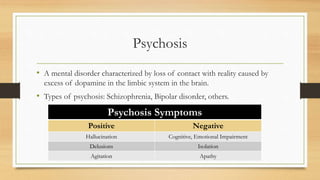
Psychosis
• A mental disorder characterized by loss of contact with reality caused by
excess of dopamine in the limbic system in the brain.
• Types of psychosis: Schizophrenia, Bipolar disorder, others.
Psychosis Symptoms
Positive Negative
Hallucination Cognitive, Emotional Impairment
Delusions Isolation
Agitation Apathy
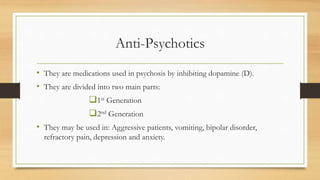
Anti-Psychotics
• They are medications used in psychosis by inhibiting dopamine (D).
• They are divided into two main parts:
1st Generation
2nd Generation
• They may be used in: Aggressive patients, vomiting, bipolar disorder,
refractory pain, depression and anxiety.
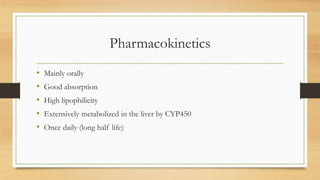
Pharmacokinetics
• Mainly orally
• Good absorption
• High lipophilicity
• Extensively metabolized in the liver by CYP450
• Once daily (long half life)
Side Effects
Mainly they inhibit dopamine receptors so they cause Extra-pyramidal side
effects:
• Dystonia: sustained muscle contraction
• Akathisia: restlessness, constant movement
• Parkinsonism
• Dyskinesia: involuntary muscle movement
Other Side Effects
Many of them inhibit many receptors
• Alpha: hypotension, sexual dysfunction
• Muscarinic: dry mouth, blurred vision, constipation, urinary retention,…
• Histaminic: sedation, weight gain
• QT prolongation.
1st GENERATION ANTI-PSYCHOTICS
• These are divided into two parts:
Basal
Incisive
Incisive Anti-Psychotics
• High affinity to D2 receptors
• Low affinity to other types of receptors.
• They affect positive symptoms of schizophrenia mainly.
• They bring extrapyramidal symptoms (EPS).
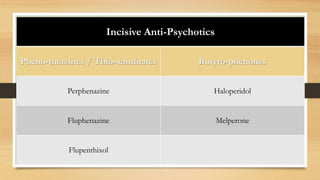
Incisive Anti-Psychotics
Pheno-thiazines / Thio-xanthenes Butyro-phenones
Perphenazine Haloperidol
Fluphenazine Melperone
Flupenthixol
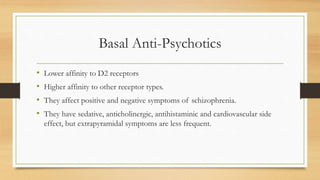
Basal Anti-Psychotics
• Lower affinity to D2 receptors
• Higher affinity to other receptor types.
• They affect positive and negative symptoms of schizophrenia.
• They have sedative, anticholinergic, antihistaminic and cardiovascular side
effect, but extrapyramidal symptoms are less frequent.
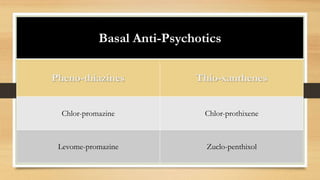
Basal Anti-Psychotics
Pheno-thiazines Thio-xanthenes
Chlor-promazine Chlor-prothixene
Levome-promazine Zuclo-penthixol
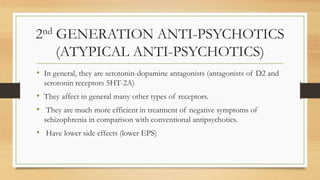
2nd GENERATION ANTI-PSYCHOTICS
(ATYPICAL ANTI-PSYCHOTICS)
• In general, they are serotonin-dopamine antagonists (antagonists of D2 and
serotonin receptors 5HT-2A)
• They affect in general many other types of receptors.
• They are much more efficient in treatment of negative symptoms of
schizophrenia in comparison with conventional antipsychotics.
• Have lower side effects (lower EPS)
2nd GENERATION ANTI-PSYCHOTICS
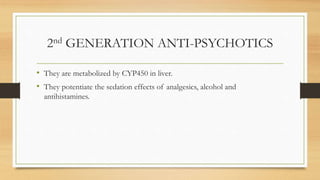
• They are metabolized by CYP450 in liver.
• They potentiate the sedation effects of analgesics, alcohol and
antihistamines.
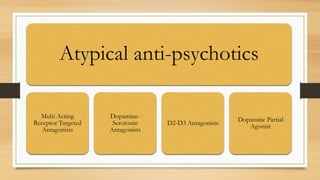
Atypical anti-psychotics
Multi Acting
Receptor Targeted
Antagonists
Dopamine-
Serotonin
Antagonists
D2-D3 Antagonists
Dopamine Partial
Agonist
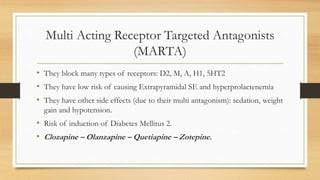
Multi Acting Receptor Targeted Antagonists
(MARTA)
• They block many types of receptors: D2, M, A, H1, 5HT2
• They have low risk of causing Extrapyramidal SE and hyperprolactenemia
• They have other side effects (due to their multi antagonism): sedation, weight
gain and hypotension.
• Risk of induction of Diabetes Mellitus 2.
• Clozapine – Olanzapine – Quetiapine – Zotepine.
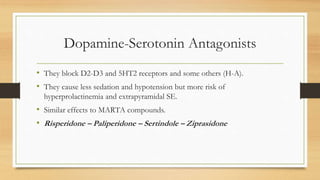
Dopamine-Serotonin Antagonists
• They block D2-D3 and 5HT2 receptors and some others (H-A).
• They cause less sedation and hypotension but more risk of
hyperprolactinemia and extrapyramidal SE.
• Similar effects to MARTA compounds.
• Risperidone – Paliperidone – Sertindole – Ziprasidone
Dopamine D2-D3 Antagonists
• They block selectively D2-D3 receptors
• In low dose, they block the presynaptic receptors affect negative symp.
• In high dose, they block the postsynaptic ones affect positive symp.
• High risk of Extrapyramidal and hyperprolactinemia SE.
• Sulpiride – Amisulpiride
Dopamine Partial Agonist
• It has D2 , 5HT1A partial agonism and 5HT2A antagonism.
• It has a very low incidence of side effects.
• Aripiprazole
Therapeutic Strategy
• Atypical anti-psychotics are the drugs of choice.
• Onset of beneficial effects may take 2-3 weeks and till the optimal effects, it
requires 4-6 weeks of therapy.
• Discontinuation may lead to relapse.

Anti psychotics

  • 1.
    Anti-Psychotics Mgr. Malek Azar CHARLESUNIVERSITY IN PRAGUE FACULTY OF PHARMACY
  • 2.
    Psychosis • A mentaldisorder characterized by loss of contact with reality caused by excess of dopamine in the limbic system in the brain. • Types of psychosis: Schizophrenia, Bipolar disorder, others. Psychosis Symptoms Positive Negative Hallucination Cognitive, Emotional Impairment Delusions Isolation Agitation Apathy
  • 3.
    Anti-Psychotics • They aremedications used in psychosis by inhibiting dopamine (D). • They are divided into two main parts: 1st Generation 2nd Generation • They may be used in: Aggressive patients, vomiting, bipolar disorder, refractory pain, depression and anxiety.
  • 4.
    Pharmacokinetics • Mainly orally •Good absorption • High lipophilicity • Extensively metabolized in the liver by CYP450 • Once daily (long half life)
  • 5.
    Side Effects Mainly theyinhibit dopamine receptors so they cause Extra-pyramidal side effects: • Dystonia: sustained muscle contraction • Akathisia: restlessness, constant movement • Parkinsonism • Dyskinesia: involuntary muscle movement
  • 6.
    Other Side Effects Manyof them inhibit many receptors • Alpha: hypotension, sexual dysfunction • Muscarinic: dry mouth, blurred vision, constipation, urinary retention,… • Histaminic: sedation, weight gain • QT prolongation.
  • 7.
    1st GENERATION ANTI-PSYCHOTICS •These are divided into two parts: Basal Incisive
  • 8.
    Incisive Anti-Psychotics • Highaffinity to D2 receptors • Low affinity to other types of receptors. • They affect positive symptoms of schizophrenia mainly. • They bring extrapyramidal symptoms (EPS).
  • 9.
    Incisive Anti-Psychotics Pheno-thiazines /Thio-xanthenes Butyro-phenones Perphenazine Haloperidol Fluphenazine Melperone Flupenthixol
  • 10.
    Basal Anti-Psychotics • Loweraffinity to D2 receptors • Higher affinity to other receptor types. • They affect positive and negative symptoms of schizophrenia. • They have sedative, anticholinergic, antihistaminic and cardiovascular side effect, but extrapyramidal symptoms are less frequent.
  • 11.
    Basal Anti-Psychotics Pheno-thiazines Thio-xanthenes Chlor-promazineChlor-prothixene Levome-promazine Zuclo-penthixol
  • 12.
    2nd GENERATION ANTI-PSYCHOTICS (ATYPICALANTI-PSYCHOTICS) • In general, they are serotonin-dopamine antagonists (antagonists of D2 and serotonin receptors 5HT-2A) • They affect in general many other types of receptors. • They are much more efficient in treatment of negative symptoms of schizophrenia in comparison with conventional antipsychotics. • Have lower side effects (lower EPS)
  • 13.
    2nd GENERATION ANTI-PSYCHOTICS •They are metabolized by CYP450 in liver. • They potentiate the sedation effects of analgesics, alcohol and antihistamines.
  • 14.
    Atypical anti-psychotics Multi Acting ReceptorTargeted Antagonists Dopamine- Serotonin Antagonists D2-D3 Antagonists Dopamine Partial Agonist
  • 15.
    Multi Acting ReceptorTargeted Antagonists (MARTA) • They block many types of receptors: D2, M, A, H1, 5HT2 • They have low risk of causing Extrapyramidal SE and hyperprolactenemia • They have other side effects (due to their multi antagonism): sedation, weight gain and hypotension. • Risk of induction of Diabetes Mellitus 2. • Clozapine – Olanzapine – Quetiapine – Zotepine.
  • 16.
    Dopamine-Serotonin Antagonists • Theyblock D2-D3 and 5HT2 receptors and some others (H-A). • They cause less sedation and hypotension but more risk of hyperprolactinemia and extrapyramidal SE. • Similar effects to MARTA compounds. • Risperidone – Paliperidone – Sertindole – Ziprasidone
  • 17.
    Dopamine D2-D3 Antagonists •They block selectively D2-D3 receptors • In low dose, they block the presynaptic receptors affect negative symp. • In high dose, they block the postsynaptic ones affect positive symp. • High risk of Extrapyramidal and hyperprolactinemia SE. • Sulpiride – Amisulpiride
  • 18.
    Dopamine Partial Agonist •It has D2 , 5HT1A partial agonism and 5HT2A antagonism. • It has a very low incidence of side effects. • Aripiprazole
  • 19.
    Therapeutic Strategy • Atypicalanti-psychotics are the drugs of choice. • Onset of beneficial effects may take 2-3 weeks and till the optimal effects, it requires 4-6 weeks of therapy. • Discontinuation may lead to relapse.