Hypertensive urgencies and
emergencies
1
 elevated blood pressure (systolic blood pressure >220
mm Hg or diastolic pressure > 125 mm Hg)
 no acute, end-organ injury
 Partial reduction of blood pressure with relief of
symptoms is the goal
 Blood pressure must be reduced within a few hours.
Hypertensive urgency:
2
 severe hypertension is associated with acute end-organ damage.
 hypertensive encephalopathy, acute pulmonary edema, aortic
dissection, and rebound after abrupt withdrawal of
antihypertensive medications.
 require substantial reduction of blood pressure within 1 hour to
avoid the risk of serious morbidity or death
 Hypertensive emergencies can develop in patients with or
without known preexisting hypertension.
Hypertensive emergency:
3
severely elevated BP + whether or not any of the following are present:
●Acute head injury or trauma
●Generalized neurologic symptoms, such as agitation, delirium, stupor, seizures, or visual disturbances
●Focal neurologic symptoms that could be due to an ischemic or hemorrhagic stroke
●Nausea and vomiting, which may be a sign of increased intracranial pressure
●Chest discomfort, which may be due to myocardial ischemia or aortic dissection
●Acute, severe back pain, which might be due to heart failure
●Dyspnea, which may be due to pulmonary edema
●Pregnancy
●Use of drugs, such as cocaine, amphetamine(s), or monoamine oxidase inhibitors, or recent
discontinuation of clonidine.
EVALUATION AND DIAGNOSIS
4
●Electrocardiography
●Conventional chest radiography
●Urinalysis
●Serum electrolytes and serum creatinine
●Cardiac biomarkers (if an acute coronary syndrome is
suspected)
●CT scan, MRI of chest and brain
Test to evaluate the presence of
target-organ damage
5
 The initial goal in hypertensive emergencies is to
reduce the pressure by no more than 25% (within
minutes to 1 or 2 hours)
 Then toward a level of 160/100 mm Hg within 2–6
hours
 Excessive reductions in pressure may precipitate
coronary, cerebral, or renal ischemia
Goals of therapy
6
 Often associated with marked elevation of blood
pressure, which will usually fall spontaneously.
 Antihypertensives should only be used if the systolic
blood pressure >180–200 mm Hg
 BP should be reduced cautiously by 10–15%.
 If thrombolytics are to be given, blood pressure
should be maintained at <185/110 mm Hg during
treatment and for 24 hours following treatment.
Acute ischemic stroke
7
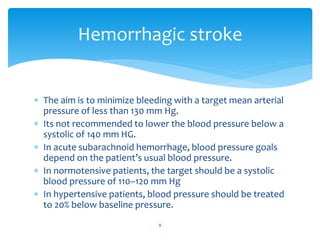
 The aim is to minimize bleeding with a target mean arterial
pressure of less than 130 mm Hg.
 Its not recommended to lower the blood pressure below a
systolic of 140 mm HG.
 In acute subarachnoid hemorrhage, blood pressure goals
depend on the patient’s usual blood pressure.
 In normotensive patients, the target should be a systolic
blood pressure of 110–120 mm Hg
 In hypertensive patients, blood pressure should be treated
to 20% below baseline pressure.
Hemorrhagic stroke
8
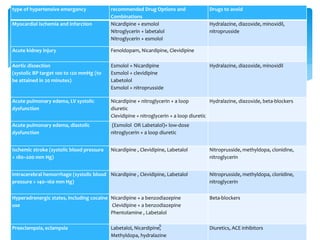
type of hypertensive emergency recommended Drug Options and
Combinations
Drugs to avoid
Myocardial ischemia and infarction Nicardipine + esmolol
Nitroglycerin + labetalol
Nitroglycerin + esmolol
Hydralazine, diazoxide, minoxidil,
nitroprusside
Acute kidney injury Fenoldopam, Nicardipine, Clevidipine
Aortic dissection
(systolic BP target 100 to 120 mmHg (to
be attained in 20 minutes)
Esmolol + Nicardipine
Esmolol + clevidipine
Labetolol
Esmolol + nitroprusside
Hydralazine, diazoxide, minoxidil
Acute pulmonary edema, LV systolic
dysfunction
Nicardipine + nitroglycerin + a loop
diuretic
Clevidipine + nitroglycerin + a loop diuretic
Hydralazine, diazoxide, beta-blockers
Acute pulmonary edema, diastolic
dysfunction
(Esmolol OR Labetalol)+ low-dose
nitroglycerin + a loop diuretic
Ischemic stroke (systolic blood pressure
> 180–200 mm Hg)
Nicardipine , Clevidipine, Labetalol Nitroprusside, methyldopa, clonidine,
nitroglycerin
Intracerebral hemorrhage (systolic blood
pressure > 140–160 mm Hg)
Nicardipine , Clevidipine, Labetalol Nitroprusside, methyldopa, clonidine,
nitroglycerin
Hyperadrenergic states, including cocaine
use
Nicardipine + a benzodiazepine
Clevidipine + a benzodiazepine
Phentolamine , Labetalol
Beta-blockers
Preeclampsia, eclampsia Labetalol, Nicardipine,
Methyldopa, hydralazine
Diuretics, ACE inhibitors
9
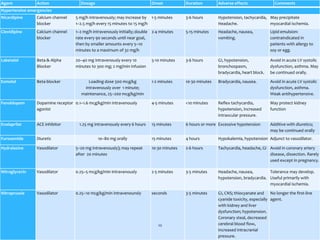
Agent Action Dosage Onset Duration Adverse effects Comments
Hypertensive emergencies
Nicardipine Calcium channel
blocker
5 mg/h intravenously; may increase by
1–2.5 mg/h every 15 minutes to 15 mg/h
1-5 minutes 3-6 hours Hypotension, tachycardia,
Headache.
May precipitate
myocardial ischemia.
Clevidipine Calcium channel
blocker
1–2 mg/h intravenously initially; double
rate every 90 seconds until near goal,
then by smaller amounts every 5–10
minutes to a maximum of 32 mg/h
2-4 minutes 5-15 minutes Headache, nausea,
vomiting.
Lipid emulsion:
contraindicated in
patients with allergy to
soy or egg.
Labetalol Beta-& Alpha
Blocker
20–40 mg intravenously every 10
minutes to 300 mg; 2 mg/min infusion
5-10 minutes 3-6 hours GI, hypotension,
bronchospasm,
bradycardia, heart block.
Avoid in acute LV systolic
dysfunction, asthma. May
be continued orally.
Esmolol Beta-blocker Loading dose 500 mcg/kg
intravenously over 1 minute;
maintenance, 25–200 mcg/kg/min
1-2 minutes 10-30 minutes Bradycardia, nausea. Avoid in acute LV systolic
dysfunction, asthma.
Weak antihypertensive.
Fenoldopam Dopamine receptor
agonist
0.1–1.6 mcg/kg/min intravenously 4-5 minutes <10 minutes Reflex tachycardia,
hypotension, increased
intraocular pressure.
May protect kidney
function
Enalaprilat ACE inhibitor 1.25 mg intravenously every 6 hours 15 minutes 6 hours or more Excessive hypotension Additive with diuretics;
may be continued orally
Furosemide Diuretic 10–80 mg orally 15 minutes 4 hours Hypokalemia, hypotension Adjunct to vasodilator.
Hydralazine Vasodilator 5–20 mg intravenously); may repeat
after 20 minutes
10-30 minutes 2-6 hours Tachycardia, headache, GI Avoid in coronary artery
disease, dissection. Rarely
used except in pregnancy.
Nitroglycerin Vasodilator 0.25–5 mcg/kg/min intravenously 2-5 minutes 3-5 minutes Headache, nausea,
hypotension, bradycardia.
Tolerance may develop.
Useful primarily with
myocardial ischemia.
Nitroprussie Vasodilator 0.25–10 mcg/kg/min intravenounsly seconds 3-5 minutes GI, CNS; thiocyanate and
cyanide toxicity, especially
with kidney and liver
dysfunction; hypotension.
Coronary steal, decreased
cerebral blood flow,
increased intracranial
pressure.
No longer the first-line
agent.
10
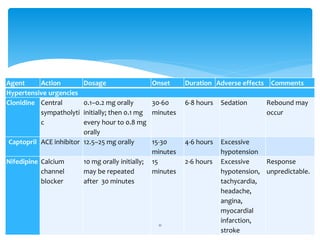
Agent Action Dosage Onset Duration Adverse effects Comments
Hypertensive urgencies
Clonidine Central
sympatholyti
c
0.1–0.2 mg orally
initially; then 0.1 mg
every hour to 0.8 mg
orally
30-60
minutes
6-8 hours Sedation Rebound may
occur
Captopril ACE inhibitor 12.5–25 mg orally 15-30
minutes
4-6 hours Excessive
hypotension
Nifedipine Calcium
channel
blocker
10 mg orally initially;
may be repeated
after 30 minutes
15
minutes
2-6 hours Excessive
hypotension,
tachycardia,
headache,
angina,
myocardial
infarction,
stroke
Response
unpredictable.
11
 When the blood pressure has been brought under
control, combinations of oral antihypertensive agents
can be added as parenteral drugs are tapered off over
a period of 2–3 days.
Subsequent Therapy
12

Hypertensive urgencies and emergencies

  • 1.
  • 2.
     elevated bloodpressure (systolic blood pressure >220 mm Hg or diastolic pressure > 125 mm Hg)  no acute, end-organ injury  Partial reduction of blood pressure with relief of symptoms is the goal  Blood pressure must be reduced within a few hours. Hypertensive urgency: 2
  • 3.
     severe hypertensionis associated with acute end-organ damage.  hypertensive encephalopathy, acute pulmonary edema, aortic dissection, and rebound after abrupt withdrawal of antihypertensive medications.  require substantial reduction of blood pressure within 1 hour to avoid the risk of serious morbidity or death  Hypertensive emergencies can develop in patients with or without known preexisting hypertension. Hypertensive emergency: 3
  • 4.
    severely elevated BP+ whether or not any of the following are present: ●Acute head injury or trauma ●Generalized neurologic symptoms, such as agitation, delirium, stupor, seizures, or visual disturbances ●Focal neurologic symptoms that could be due to an ischemic or hemorrhagic stroke ●Nausea and vomiting, which may be a sign of increased intracranial pressure ●Chest discomfort, which may be due to myocardial ischemia or aortic dissection ●Acute, severe back pain, which might be due to heart failure ●Dyspnea, which may be due to pulmonary edema ●Pregnancy ●Use of drugs, such as cocaine, amphetamine(s), or monoamine oxidase inhibitors, or recent discontinuation of clonidine. EVALUATION AND DIAGNOSIS 4
  • 5.
    ●Electrocardiography ●Conventional chest radiography ●Urinalysis ●Serumelectrolytes and serum creatinine ●Cardiac biomarkers (if an acute coronary syndrome is suspected) ●CT scan, MRI of chest and brain Test to evaluate the presence of target-organ damage 5
  • 6.
     The initialgoal in hypertensive emergencies is to reduce the pressure by no more than 25% (within minutes to 1 or 2 hours)  Then toward a level of 160/100 mm Hg within 2–6 hours  Excessive reductions in pressure may precipitate coronary, cerebral, or renal ischemia Goals of therapy 6
  • 7.
     Often associatedwith marked elevation of blood pressure, which will usually fall spontaneously.  Antihypertensives should only be used if the systolic blood pressure >180–200 mm Hg  BP should be reduced cautiously by 10–15%.  If thrombolytics are to be given, blood pressure should be maintained at <185/110 mm Hg during treatment and for 24 hours following treatment. Acute ischemic stroke 7
  • 8.
     The aimis to minimize bleeding with a target mean arterial pressure of less than 130 mm Hg.  Its not recommended to lower the blood pressure below a systolic of 140 mm HG.  In acute subarachnoid hemorrhage, blood pressure goals depend on the patient’s usual blood pressure.  In normotensive patients, the target should be a systolic blood pressure of 110–120 mm Hg  In hypertensive patients, blood pressure should be treated to 20% below baseline pressure. Hemorrhagic stroke 8
  • 9.
    type of hypertensiveemergency recommended Drug Options and Combinations Drugs to avoid Myocardial ischemia and infarction Nicardipine + esmolol Nitroglycerin + labetalol Nitroglycerin + esmolol Hydralazine, diazoxide, minoxidil, nitroprusside Acute kidney injury Fenoldopam, Nicardipine, Clevidipine Aortic dissection (systolic BP target 100 to 120 mmHg (to be attained in 20 minutes) Esmolol + Nicardipine Esmolol + clevidipine Labetolol Esmolol + nitroprusside Hydralazine, diazoxide, minoxidil Acute pulmonary edema, LV systolic dysfunction Nicardipine + nitroglycerin + a loop diuretic Clevidipine + nitroglycerin + a loop diuretic Hydralazine, diazoxide, beta-blockers Acute pulmonary edema, diastolic dysfunction (Esmolol OR Labetalol)+ low-dose nitroglycerin + a loop diuretic Ischemic stroke (systolic blood pressure > 180–200 mm Hg) Nicardipine , Clevidipine, Labetalol Nitroprusside, methyldopa, clonidine, nitroglycerin Intracerebral hemorrhage (systolic blood pressure > 140–160 mm Hg) Nicardipine , Clevidipine, Labetalol Nitroprusside, methyldopa, clonidine, nitroglycerin Hyperadrenergic states, including cocaine use Nicardipine + a benzodiazepine Clevidipine + a benzodiazepine Phentolamine , Labetalol Beta-blockers Preeclampsia, eclampsia Labetalol, Nicardipine, Methyldopa, hydralazine Diuretics, ACE inhibitors 9
  • 10.
    Agent Action DosageOnset Duration Adverse effects Comments Hypertensive emergencies Nicardipine Calcium channel blocker 5 mg/h intravenously; may increase by 1–2.5 mg/h every 15 minutes to 15 mg/h 1-5 minutes 3-6 hours Hypotension, tachycardia, Headache. May precipitate myocardial ischemia. Clevidipine Calcium channel blocker 1–2 mg/h intravenously initially; double rate every 90 seconds until near goal, then by smaller amounts every 5–10 minutes to a maximum of 32 mg/h 2-4 minutes 5-15 minutes Headache, nausea, vomiting. Lipid emulsion: contraindicated in patients with allergy to soy or egg. Labetalol Beta-& Alpha Blocker 20–40 mg intravenously every 10 minutes to 300 mg; 2 mg/min infusion 5-10 minutes 3-6 hours GI, hypotension, bronchospasm, bradycardia, heart block. Avoid in acute LV systolic dysfunction, asthma. May be continued orally. Esmolol Beta-blocker Loading dose 500 mcg/kg intravenously over 1 minute; maintenance, 25–200 mcg/kg/min 1-2 minutes 10-30 minutes Bradycardia, nausea. Avoid in acute LV systolic dysfunction, asthma. Weak antihypertensive. Fenoldopam Dopamine receptor agonist 0.1–1.6 mcg/kg/min intravenously 4-5 minutes <10 minutes Reflex tachycardia, hypotension, increased intraocular pressure. May protect kidney function Enalaprilat ACE inhibitor 1.25 mg intravenously every 6 hours 15 minutes 6 hours or more Excessive hypotension Additive with diuretics; may be continued orally Furosemide Diuretic 10–80 mg orally 15 minutes 4 hours Hypokalemia, hypotension Adjunct to vasodilator. Hydralazine Vasodilator 5–20 mg intravenously); may repeat after 20 minutes 10-30 minutes 2-6 hours Tachycardia, headache, GI Avoid in coronary artery disease, dissection. Rarely used except in pregnancy. Nitroglycerin Vasodilator 0.25–5 mcg/kg/min intravenously 2-5 minutes 3-5 minutes Headache, nausea, hypotension, bradycardia. Tolerance may develop. Useful primarily with myocardial ischemia. Nitroprussie Vasodilator 0.25–10 mcg/kg/min intravenounsly seconds 3-5 minutes GI, CNS; thiocyanate and cyanide toxicity, especially with kidney and liver dysfunction; hypotension. Coronary steal, decreased cerebral blood flow, increased intracranial pressure. No longer the first-line agent. 10
  • 11.
    Agent Action DosageOnset Duration Adverse effects Comments Hypertensive urgencies Clonidine Central sympatholyti c 0.1–0.2 mg orally initially; then 0.1 mg every hour to 0.8 mg orally 30-60 minutes 6-8 hours Sedation Rebound may occur Captopril ACE inhibitor 12.5–25 mg orally 15-30 minutes 4-6 hours Excessive hypotension Nifedipine Calcium channel blocker 10 mg orally initially; may be repeated after 30 minutes 15 minutes 2-6 hours Excessive hypotension, tachycardia, headache, angina, myocardial infarction, stroke Response unpredictable. 11
  • 12.
     When theblood pressure has been brought under control, combinations of oral antihypertensive agents can be added as parenteral drugs are tapered off over a period of 2–3 days. Subsequent Therapy 12