OM NAMAH SHIVAYAH SHREE KRISHANA SHARNAM MAMAH
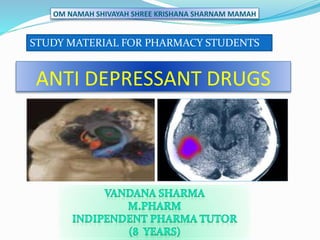
ANTI DEPRESSANT DRUGS
STUDY MATERIAL FOR PHARMACY STUDENTS
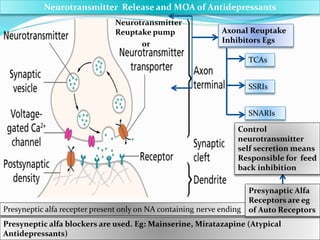
Neurotransmitter Release and MOA of Antidepressants
Neurotransmitter
Reuptake pump
or
Axonal Reuptake
Inhibitors Egs
TCAs
SSRIs
SNARIs
Presyneptic alfa recepter present only on NA containing nerve ending
Presyneptic alfa blockers are used. Eg: Mainserine, Miratazapine (Atypical
Antidepressants)
Presynaptic Alfa
Receptors are eg
of Auto Receptors
Control
neurotransmitter
self secretion means
Responsible for feed
back inhibition
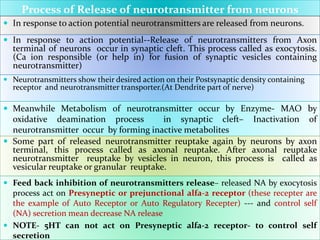
Process of Release of neurotransmitter from neurons
 In response to action potential neurotransmitters are released from neurons.
 In response to action potential--Release of neurotransmitters from Axon
terminal of neurons occur in synaptic cleft. This process called as exocytosis.
(Ca ion responsible (or help in) for fusion of synaptic vesicles containing
neurotransmitter)
 Neurotransmitters show their desired action on their Postsynaptic density containing
receptor and neurotransmitter transporter.(At Dendrite part of nerve)
 Meanwhile Metabolism of neurotransmitter occur by Enzyme- MAO by
oxidative deamination process in synaptic cleft– Inactivation of
neurotransmitter occur by forming inactive metabolites
 Some part of released neurotransmitter reuptake again by neurons by axon
terminal, this process called as axonal reuptake. After axonal reuptake
neurotransmitter reuptake by vesicles in neuron, this process is called as
vesicular reuptake or granular reuptake.
 Feed back inhibition of neurotransmitters release– released NA by exocytosis
process act on Presyneptic or prejunctional alfa-2 receptor (these recepter are
the example of Auto Receptor or Auto Regulatory Recepter) --- and control self
(NA) secretion mean decrease NA release
 NOTE- 5HT can not act on Presyneptic alfa-2 receptor- to control self
secretion
Sign and symptom of depression
 Depression is a state of low mood and aversion to activity that
can affect a person's thoughts, behavior, feelings and sense of
well-being.
 Patients with depression may have an imbalance in
neurotransmitters (decrease level of NA and 5HT), chemicals that
nerves make and use to communicate with other nerves.
 People with a depressed mood can feel sad, anxious, empty, hopeless,
helpless, worthless, guilty, irritable, angry, ashamed or restless. They
may lose interest in activities that were once pleasurable, experience loss
of appetite or overeating, have problems concentrating, remembering
details or making decisions, experience relationship difficulties and may
contemplate, attempt or commit suicide. Insomnia, excessive
sleeping, fatigue, aches, pains, digestive problems or reduced energy
may also be present.
Depression
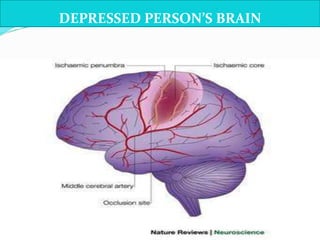
DEPRESSED PERSON’S BRAIN
 Different kinds of depression include:
 Major depressive disorder (MDD): MDD includes a
collection of symptoms which do not allow an individual to
perform his daily activities. MDD is also known a major
depression or clinical depression.
 Dysthymic disorder: Depression lasting for two years or
more are termed dysthymia or chronic depression. The
symptoms aren’t very severe but it prevents one from feeling
well or leading a normal life.
 Psychotic depression: Is a type of depression accompanied
by psychotic symptoms like delusions and hallucinations.
 Postpartum depression: This usually occurs after a month
of delivery in new mothers.
 Seasonal affective disorder (SAD): Depression seen during
winter months is termed as SAD.
Types of Depression
Anti Depressants Drugs
 Antidepressants are the most prescribed therapy for depression.
 The antidepressants increase the concentration of one or more brain chemicals
(neurotransmitters) that nerves in the brain use to communicate with one another.
 The neurotransmitters affected by antidepressants are NA (norepinephrine or
Noradrinaline), serotonin (5HT), and dopamine. (increase NA and 5HT level in Brain.)
 First-generation antidepressants Eg:
 tricyclic antidepressants (TCAs) and
 monoamine oxidase inhibitors (MAOIs)
as the drugs of choice for the treatment of MDD. This is mainly because of their
improved tolerability and safety profile.
 Other are called as Second generation Antidepressants.
 The different classes of antidepressants differ in the neurotransmitters they affect.
 This determines some of their side effects and potential drug interactions.
 Side effects and potential drug interactions are major factors that influence selection of
antidepressants and compliance with therapy.
Classification of Antidepressant Drugs
 Tricyclic antidepressants (TCAs)
 Selective serotonin reuptake inhibitors (SSRIs)
 Monoamine oxidase inhibitors (MAOIs)
 Atypical Antidepressant
NOTE-
5HT- serotonin (Only 5HT1 recepor involve in antidepressant activity
NA- Noradrinaline or Norepinephrine
 Selective Noradrinaline reuptake inhibitors (SNARIs)
Tricyclic Anti Depressants
TCAs Inhibit axonal reuptake of NA and 5HT in neurons – and
increase concentration of these neurotransmitters in brain
Classification of TCAs
 5HT>NA(Inhibit more axonal reuptake of 5HT than NA)
 (Potent anti cholinergic, more sedetive)
Eg. Imipramine,
Clomipramine,
Trimipramine,
Amitryptyline
 NA>5HT(Inhibit more axonal reuptake of NA than 5HT)
 (Less sedative )
Eg. Desipramine,(It is a metabolite of Imipramine)
Nortriptyline, (It is a metabolite of Amitryptyline)
Amoxapine
Mechanism of action of TCAs
 TriCyclic antidepressants block the absorption (reuptake) of the
neurotransmitters serotonin (ser-o-TOE-nin) and norepinephrine (nor-ep-ih-
NEF-rin), increasing the levels of these two neurotransmitters in the brain.
TriCyclic antidepressants also affect other chemical messengers, which can lead
to a number of side effects.
 In case of serotonin reuptake inhibitors, blockage of 5HT1 receptor give
Antidepressant action. (receptor named as 5HT2, 5HT3 blockage - not have any
relation with their antidepressant action.
 Some TCAs also are antihistamines (block the action of histamine) or
anticholinergic (block the action of acetylcholine, a neurotransmitter), and
these additional actions allow for uses of TCAs other than for treating
depression as well as additional side effects.
USES of TCAs
Tricyclic antidepressants are approved by the Food and Drug
Administration (FDA) for treating
 several types of depression, (Primary drug for depression)
 obsessive compulsive disorder, (NOTE- SSRIs primarily used in this
state)
 Bedwetting (nocturnal enurasis) Imipramine at low dose(50mg)
In addition, they are used for several off-label (non-FDA approved) uses such as:
 panic disorder,
 bulimia,
 chronic pain (for example, migraine, tension headaches, diabetic neuropathy,
and post herpetic neuralgia),
 phantom limb pain,
 chronic itching, and
 premenstrual symptoms.
Structure and IUPAC Name of TCAs
Imipramine (IUPAC Name-
3-(10,11-dihydro-5H-dibenzo[b,f]azepin-5-
yl)-N,N-dimethylpropan-1-amine)
Trimipramine (IUPAC Name-
(±)-3-(10,11-dihydro-5H-dibenzo[b,f]azepin-5-
yl)-N,N,2-trimethylpropan-1-amine)
Amitryptyline (IUPAC Name-
3-(10,11-Dihydro-5H-dibenzo [a,d]
cycloheptene-5-ylidene)-N,N-
dimethylpropan-1-amine)
Clomipramine (IUPAC Name
3-(3-chloro-10,11-dihydro-5H-dibenzo[b,f]
azepin-5-yl)-N,N-dimethylpropan-1-amine)
Structure and IUPAC Name of TCAs
Desipramine (IUPAC Name-
3-(10,11-Dihydro-5H-dibenzo[b,f]azepin-5-
yl)-N-methylpropan-1-amine
Nortriptyline (IUPAC Name-
3-(10,11-Dihydro-5H-dibenzo [a,d]
cyclohepten-5-ylidene)-N-methyl-1-
propanamine
Amoxapine (IUPAC Name-
2-chloro-11-(piperazin-1-yl) dibenzo [b,f]
[1,4]oxazepine)
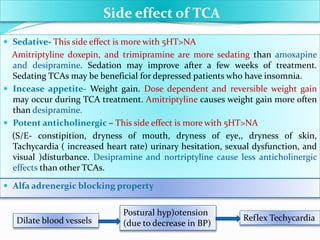
Side effect of TCA
 Sedative- This side effect is more with 5HT>NA
Amitriptyline doxepin, and trimipramine are more sedating than amoxapine
and desipramine. Sedation may improve after a few weeks of treatment.
Sedating TCAs may be beneficial for depressed patients who have insomnia.
 Incease appetite- Weight gain. Dose dependent and reversible weight gain
may occur during TCA treatment. Amitriptyline causes weight gain more often
than desipramine.
 Potent anticholinergic – This side effect is more with 5HT>NA
(S/E- constipition, dryness of mouth, dryness of eye,, dryness of skin,
Tachycardia ( increased heart rate) urinary hesitation, sexual dysfunction, and
visual )disturbance. Desipramine and nortriptyline cause less anticholinergic
effects than other TCAs.
 Alfa adrenergic blocking property
Dilate blood vessels
Postural hyp)otension
(due to decrease in BP)
Reflex Techycardia
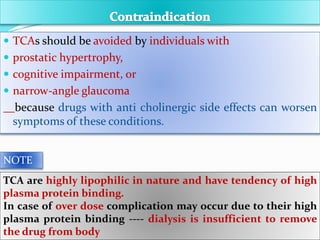
 TCAs should be avoided by individuals with
 prostatic hypertrophy,
 cognitive impairment, or
 narrow-angle glaucoma
because drugs with anti cholinergic side effects can worsen
symptoms of these conditions.
TCA are highly lipophilic in nature and have tendency of high
plasma protein binding.
In case of over dose complication may occur due to their high
plasma protein binding ---- dialysis is insufficient to remove
the drug from body
NOTE
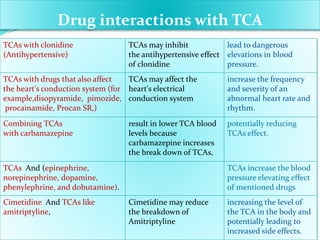
TCAs with clonidine
(Antihypertensive)
TCAs may inhibit
the antihypertensive effect
of clonidine
lead to dangerous
elevations in blood
pressure.
TCAs with drugs that also affect
the heart's conduction system (for
example,disopyramide, pimozide,
procainamide, Procan SR,)
TCAs may affect the
heart's electrical
conduction system
increase the frequency
and severity of an
abnormal heart rate and
rhythm.
Combining TCAs
with carbamazepine
result in lower TCA blood
levels because
carbamazepine increases
the break down of TCAs,
potentially reducing
TCAs effect.
TCAs And (epinephrine,
norepinephrine, dopamine,
phenylephrine, and dobutamine).
TCAs increase the blood
pressure elevating effect
of mentioned drugs
Cimetidine And TCAs like
amitriptyline,
Cimetidine may reduce
the breakdown of
Amitriptyline
increasing the level of
the TCA in the body and
potentially leading to
increased side effects.
Drug interactions with TCA
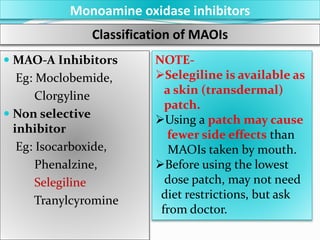
Monoamine oxidase inhibitors
 MAO-A Inhibitors
Eg: Moclobemide,
Clorgyline
 Non selective
inhibitor
Eg: Isocarboxide,
Phenalzine,
Selegiline
Tranylcyromine
NOTE-
Selegiline is available as
a skin (transdermal)
patch.
Using a patch may cause
fewer side effects than
MAOIs taken by mouth.
Before using the lowest
dose patch, may not need
diet restrictions, but ask
from doctor.
Classification of MAOIs
 Monoamine oxidase inhibitors (MAOIs) were the first type of antidepressant
developed. They're effective, but they've generally been replaced by
antidepressants that are safer and cause fewer side effects.
 Use of MAOIs typically requires diet restrictions because they can cause
dangerously high blood pressure when taken with certain foods or medications.
 In spite of side effects, these medications are still a good option for some
people. In certain cases, they relieve depression when other treatments have
failed.
Monoamine oxidase inhibitors
Mechanism of Action
• Antidepressants such as MAOIs ease depression by affecting chemical
messengers (neurotransmitters) used to communicate between brain
cells. Like most antidepressants, MAOIs work by ultimately effecting
changes in the brain chemistry that are operational in depression.
 An enzyme called monoamine oxidase is involved in removing the
neurotransmitters norepinephrine, serotonin and dopamine from the
brain. MAOIs prevent this from happening, which makes more of these
brain chemicals available to effect changes in both cells and circuits that
have been impacted by depression.
Note-
 MAOIs also affect other neurotransmitters in the brain and digestive
system, causing side effects. MAOIs are sometimes used to treat
conditions other than depression, such as Parkinson's disease.
Side Effects of MAOIs
Because of side effects and safety concerns, MAOIs are most often
tried when other antidepressants don't work.
The most common side effects of MAOIs include:
 Dry mouth
 Nausea, diarrhea or constipation
 Headache
 Drowsiness
 Insomnia
 Dizziness or lightheadedness
 Skin reaction at the patch site
Other possible side effects include:
 Involuntary muscle jerks
 Low blood pressure
 Reduced sexual desire or difficulty reaching orgasm
 Weight gain
 Difficulty starting a urine flow
 Muscle cramps
 Prickling or tingling sensation in the skin (paresthesia)
Side Effects of MAOIs
 Food and beverage interactions.
MAOIs can cause dangerous interactions with certain foods and beverages.
Need to avoid foods containing high levels of tyramine ― an amino acid that
regulates blood pressure ― such as aged cheeses, sauerkraut, cured meats,
draft beer and fermented soy products (for example, soy sauce, miso and tofu),
alcohol.
 Drug interactions.
MAOIs can cause serious reactions when taken them with certain medications,
such as other antidepressants, certain pain drugs, certain cold and allergy
medications, and some herbal supplements.
 Serotonin syndrome.
Rarely, an MAOI can cause dangerously high levels of serotonin, known as
serotonin syndrome. It most often occurs when two medications that raise
serotonin are combined. These include other antidepressants, certain pain or
headache medications, and the herbal supplement St. John's wort.
NOTE- Signs and symptoms of serotonin syndrome include anxiety, agitation,
sweating, confusion, tremors, restlessness, lack of coordination and rapid heart
rate. Seek immediate medical attention if have any of these signs or symptoms.
 Antidepressants and pregnancy. Some antidepressants may harm
childduring pregnancy or while breast-feeding.
Safety concerns with MAOIs
 Suicide risk and antidepressants
 FDA requires that all antidepressants carry black box warnings, the strictest warnings for
prescriptions. In some cases, children, teenagers and young adults under 25 may have an
increase in suicidal thoughts or behavior when taking antidepressants, especially in the
first few weeks after starting or when the dose is changed.
 MAOIs are generally not prescribed for children, but anyone taking an antidepressant
should be watched closely for worsening depression or unusual behavior. If you or
someone you know has suicidal thoughts when taking an antidepressant, immediately
contact a doctor or get emergency help.
 Keep in mind that antidepressants are more likely to reduce suicide risk in the long run
by improving mood.
 Stopping treatment with MAOIs
 Stopping treatment with MAOIs has been associated with flu-like symptoms, including
anxiety, agitation, insomnia, sweating, chills, nausea, headache and feeling generally
unwell (malaise).
 If stop an MAOI suddenly, you're more likely to experience a withdrawal-type reaction.
Rarely, discontinuation syndrome can occur, which causes uncommon withdrawal
symptoms such as confusion, detachment from reality (psychosis) and convulsions.
 May need to wait two or more weeks between the use of MAOIs and other
antidepressants to avoid serotonin syndrome. During those two weeks, you should
continue food and beverage restrictions and avoid taking drugs that can cause serious
interactions with MAOIs.
 Doctor gradually and safely decrease dose.
Summary of MAO Inhibitors
MAO means –
Monoamine oxidase
Type of MAO
MAO-A-present in
Brain and Liver
MAO-B
MAO-A Inhibitors- Inhibits Brain MAO and Liver MAO
Inhibits Brain MAO- Target of action– come therapeutic action–
Increase conc. Of NA and 5HT in Brain—Decrease depression
Inhibition of liver MAO- Side effect comes
NOTE-
Full form of-
NA- Noradrinaline or Norepinephrine
5HT- Serotonin
Summary of MAO Inhibitors
Side effect- Cheese Reaction
This reaction mostly come with Nonselective MAO Inhibitor
Cheese Reaction-
Tyramine Metabolized by liver MAO.
MAO inhibitors Inhibits Tyramine metabolism
Increase Tyramine Level- Sever hypertension or
hypertensive crisis
Tyramine Rich Diet- Eg: Non veg, Fermented product (Paneer, cheese,
Bread, Toast, Yeast, Alcohol containing drink, Chocolates)
Use of MAOIs---MAOIs are used only in case of TCAs Resistance,
because MAOI have numerous dietary and drug interactions.
 Note-
 MAO-A Inhibitors are used as Anti depressant
 MAO-B Inhibitors are used as Anti parkinsonism agents not used as
antidepressant
 Selective serotonin re-uptake inhibitors or serotonin-specific reuptake
inhibitors (SSRIs) are a class of drugs that are typically used as antidepressants in
the treatment of major depressive disorder and anxiety disorders.
 In case of serotonin reuptake inhibitors, blockage of 5HT1 receptor give
Antidepressant action. (Receptor named as 5HT2, 5HT3 blockage - not have any
relation with their antidepressant action.)
 SSRIs are the most widely prescribed antidepressants in many countries.The
efficacy of SSRIs in mild or moderate cases of depression has been disputed.
Selective Serotonin (5HT) Reuptake Inhibitors
Classifications of SSRIs
Fluoxetine
Fluvoxamine
Paroxetine
Sertraline
Citalopram
Note-
Fluvoxetine
Additionally have Anxiolytic activity.
So used as effective Antidepressant and Anxiolytic
agent in practice
More important one is Fluvoxetine inhibit liver
microtonal enzyme---- so potentiate effect of TCAs
and other Drugs
Citalopram
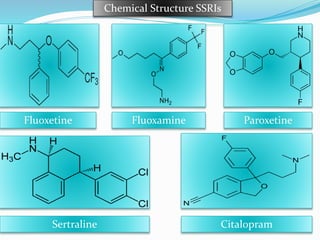
Fluoxetine Fluoxamine Paroxetine
Sertraline
Chemical Structure SSRIs
Mechanism of Action SSRIs in Brief
 SSRIs are believed to increase the extracellular level of the
neurotransmitter serotonin by limiting its reabsorption into
the presynaptic cell, increasing the level of serotonin in
the synaptic cleft available to bind to the postsynaptic
receptor.
 They have varying degrees of selectivity for the
other monoamine transporters, with pure SSRIs having only
weak affinity for the norepinephrine (NA or
Noradrinaline) and dopamine transporters.
Detailed Mechanism of action of SSRIs
 In the brain, messages are passed from a nerve cell to another via a chemical synapse, a
small gap between the cells.
 The presynaptic cell that sends the information releases neurotransmitters including
serotonin into that gap.
 The neurotransmitters are then recognized by receptors on the surface of the recipient
postsynaptic cell, which upon this stimulation, in turn, relays the signal. About 10% of
the neurotransmitters are lost in this process; the other 90% are released from the
receptors and taken up again by monoamine transporters into the sending presynaptic
cell, a process called reuptake.
 SSRIs inhibit the reuptake of serotonin. As a result, the serotonin stays in the synaptic
gap longer than it normally would, and may repeatedly stimulate the receptors of the
recipient cell. In the short run this leads to an increase in signalling across synapses in
which serotonin serves as the primary neurotransmitter.
 On chronic dosing, the increased occupancy of pre-synaptic serotonin receptors signals
the pre-synaptic neuron to synthesize and release less serotonin. Serotonin levels within
the synapse drop, then rise again, ultimately leading to downregulation of post-synaptic
serotonin receptors.
 Other, indirect effects may include increased norepinephrine output, increased
neuronal cyclic AMP levels, and increased levels of regulatory factors such
as BDNF and CREB. Owing to the lack of a widely accepted comprehensive theory of the
biology of mood disorders, there is no widely accepted theory of how these changes lead
to the mood-elevating and anti-anxiety effects of SSRIs.
Uses of SSRIs
 The main indication for SSRIs is major depressive disorder (also
called "major depression", "clinical depression" and often simply
"depression").
 SSRIs are frequently prescribed for
 anxiety disorders, such as
 social anxiety disorder,
 panic disorders,
 obsessive–compulsive disorder (OCD),
 eating disorders,
 chronic pain and occasionally,
 for posttraumatic stress disorder (PTSD).
 They are also frequently used to treat depersonalization disorder,
although generally with poor results.
Adverse effects of SSRIs
 Side effects vary among the individual drugs of this class.
 However, certain types of adverse effects are found broadly
among most if not all members of this class:
increased risk of bone fractures by 1.7 fold
akathisia
suicidal ideation (thoughts of suicide)
Photosensitivity
Nausea and vomiting- initially come- but this side effect
disappears gradually
 Nisoxetine
 Reboxetine
Norepinephrine reuptake inhibitor
Classification  Norepinephrine
 Epinephrine
 A norepinephrine reuptake
inhibitor (SNARI, SNERI) or adrenergic
reuptake inhibitor (ARI), is a type
of drug that acts as a reuptake inhibitor for
the neurotransmitters norepinephrine
(noradrenaline) and epinephrine (adrenaline)
by blocking the action of the norepinephrine
transporter (NET).
 This in turn leads to increased extracellular
concentrations of norepinephrine and
epinephrine and therefore can increase
in adrenergic neurotransmission
Mechanism
of action
Norepinephrine reuptake inhibitor
USES
 SNARIs frequently used as antidepressants for the
treatment of
major depressive disorder,
Anxiety and
panic disorder. .
Atypical Antidepressant
 Presyneptic alfa-2 blocker (Auto receptor desensitizer)
 Mainserine
 Mirtazapine-Additionally block 5HT2 and 5HT3 receptors
Indirectely increase serotonin (5HT) action on 5HT1 receptors
 Dibenzoxazipine
 Amoxapine- Antidepressants
 Azaspirodecane-di-one dvt
 Buspirone– Partial 5HT1A agonist (Activate 5HT1A Receptor)
 Use –
 Antidepressant
 Antianxiety
 5HT Reuptake inhibitors and additional 5HT2 Blocker
 Trazodone- Suitable for Seizure associated depression
 Nefazodine
Atypical Antidepressant
 Venlafaxine- MOA similar to TCAs
 Advantage- TCAs like side effects are not come
 Eg No sedation
 No anti cholinergic side effect
Antidepressants

Antidepressants

  • 1.
    OM NAMAH SHIVAYAHSHREE KRISHANA SHARNAM MAMAH ANTI DEPRESSANT DRUGS STUDY MATERIAL FOR PHARMACY STUDENTS
  • 2.
    Neurotransmitter Release andMOA of Antidepressants Neurotransmitter Reuptake pump or Axonal Reuptake Inhibitors Egs TCAs SSRIs SNARIs Presyneptic alfa recepter present only on NA containing nerve ending Presyneptic alfa blockers are used. Eg: Mainserine, Miratazapine (Atypical Antidepressants) Presynaptic Alfa Receptors are eg of Auto Receptors Control neurotransmitter self secretion means Responsible for feed back inhibition
  • 3.
    Process of Releaseof neurotransmitter from neurons  In response to action potential neurotransmitters are released from neurons.  In response to action potential--Release of neurotransmitters from Axon terminal of neurons occur in synaptic cleft. This process called as exocytosis. (Ca ion responsible (or help in) for fusion of synaptic vesicles containing neurotransmitter)  Neurotransmitters show their desired action on their Postsynaptic density containing receptor and neurotransmitter transporter.(At Dendrite part of nerve)  Meanwhile Metabolism of neurotransmitter occur by Enzyme- MAO by oxidative deamination process in synaptic cleft– Inactivation of neurotransmitter occur by forming inactive metabolites  Some part of released neurotransmitter reuptake again by neurons by axon terminal, this process called as axonal reuptake. After axonal reuptake neurotransmitter reuptake by vesicles in neuron, this process is called as vesicular reuptake or granular reuptake.  Feed back inhibition of neurotransmitters release– released NA by exocytosis process act on Presyneptic or prejunctional alfa-2 receptor (these recepter are the example of Auto Receptor or Auto Regulatory Recepter) --- and control self (NA) secretion mean decrease NA release  NOTE- 5HT can not act on Presyneptic alfa-2 receptor- to control self secretion
  • 4.
    Sign and symptomof depression  Depression is a state of low mood and aversion to activity that can affect a person's thoughts, behavior, feelings and sense of well-being.  Patients with depression may have an imbalance in neurotransmitters (decrease level of NA and 5HT), chemicals that nerves make and use to communicate with other nerves.  People with a depressed mood can feel sad, anxious, empty, hopeless, helpless, worthless, guilty, irritable, angry, ashamed or restless. They may lose interest in activities that were once pleasurable, experience loss of appetite or overeating, have problems concentrating, remembering details or making decisions, experience relationship difficulties and may contemplate, attempt or commit suicide. Insomnia, excessive sleeping, fatigue, aches, pains, digestive problems or reduced energy may also be present. Depression
  • 5.
  • 6.
     Different kindsof depression include:  Major depressive disorder (MDD): MDD includes a collection of symptoms which do not allow an individual to perform his daily activities. MDD is also known a major depression or clinical depression.  Dysthymic disorder: Depression lasting for two years or more are termed dysthymia or chronic depression. The symptoms aren’t very severe but it prevents one from feeling well or leading a normal life.  Psychotic depression: Is a type of depression accompanied by psychotic symptoms like delusions and hallucinations.  Postpartum depression: This usually occurs after a month of delivery in new mothers.  Seasonal affective disorder (SAD): Depression seen during winter months is termed as SAD. Types of Depression
  • 7.
    Anti Depressants Drugs Antidepressants are the most prescribed therapy for depression.  The antidepressants increase the concentration of one or more brain chemicals (neurotransmitters) that nerves in the brain use to communicate with one another.  The neurotransmitters affected by antidepressants are NA (norepinephrine or Noradrinaline), serotonin (5HT), and dopamine. (increase NA and 5HT level in Brain.)  First-generation antidepressants Eg:  tricyclic antidepressants (TCAs) and  monoamine oxidase inhibitors (MAOIs) as the drugs of choice for the treatment of MDD. This is mainly because of their improved tolerability and safety profile.  Other are called as Second generation Antidepressants.  The different classes of antidepressants differ in the neurotransmitters they affect.  This determines some of their side effects and potential drug interactions.  Side effects and potential drug interactions are major factors that influence selection of antidepressants and compliance with therapy.
  • 8.
    Classification of AntidepressantDrugs  Tricyclic antidepressants (TCAs)  Selective serotonin reuptake inhibitors (SSRIs)  Monoamine oxidase inhibitors (MAOIs)  Atypical Antidepressant NOTE- 5HT- serotonin (Only 5HT1 recepor involve in antidepressant activity NA- Noradrinaline or Norepinephrine  Selective Noradrinaline reuptake inhibitors (SNARIs)
  • 9.
    Tricyclic Anti Depressants TCAsInhibit axonal reuptake of NA and 5HT in neurons – and increase concentration of these neurotransmitters in brain Classification of TCAs  5HT>NA(Inhibit more axonal reuptake of 5HT than NA)  (Potent anti cholinergic, more sedetive) Eg. Imipramine, Clomipramine, Trimipramine, Amitryptyline  NA>5HT(Inhibit more axonal reuptake of NA than 5HT)  (Less sedative ) Eg. Desipramine,(It is a metabolite of Imipramine) Nortriptyline, (It is a metabolite of Amitryptyline) Amoxapine
  • 10.
    Mechanism of actionof TCAs  TriCyclic antidepressants block the absorption (reuptake) of the neurotransmitters serotonin (ser-o-TOE-nin) and norepinephrine (nor-ep-ih- NEF-rin), increasing the levels of these two neurotransmitters in the brain. TriCyclic antidepressants also affect other chemical messengers, which can lead to a number of side effects.  In case of serotonin reuptake inhibitors, blockage of 5HT1 receptor give Antidepressant action. (receptor named as 5HT2, 5HT3 blockage - not have any relation with their antidepressant action.  Some TCAs also are antihistamines (block the action of histamine) or anticholinergic (block the action of acetylcholine, a neurotransmitter), and these additional actions allow for uses of TCAs other than for treating depression as well as additional side effects.
  • 11.
    USES of TCAs Tricyclicantidepressants are approved by the Food and Drug Administration (FDA) for treating  several types of depression, (Primary drug for depression)  obsessive compulsive disorder, (NOTE- SSRIs primarily used in this state)  Bedwetting (nocturnal enurasis) Imipramine at low dose(50mg) In addition, they are used for several off-label (non-FDA approved) uses such as:  panic disorder,  bulimia,  chronic pain (for example, migraine, tension headaches, diabetic neuropathy, and post herpetic neuralgia),  phantom limb pain,  chronic itching, and  premenstrual symptoms.
  • 12.
    Structure and IUPACName of TCAs Imipramine (IUPAC Name- 3-(10,11-dihydro-5H-dibenzo[b,f]azepin-5- yl)-N,N-dimethylpropan-1-amine) Trimipramine (IUPAC Name- (±)-3-(10,11-dihydro-5H-dibenzo[b,f]azepin-5- yl)-N,N,2-trimethylpropan-1-amine) Amitryptyline (IUPAC Name- 3-(10,11-Dihydro-5H-dibenzo [a,d] cycloheptene-5-ylidene)-N,N- dimethylpropan-1-amine) Clomipramine (IUPAC Name 3-(3-chloro-10,11-dihydro-5H-dibenzo[b,f] azepin-5-yl)-N,N-dimethylpropan-1-amine)
  • 13.
    Structure and IUPACName of TCAs Desipramine (IUPAC Name- 3-(10,11-Dihydro-5H-dibenzo[b,f]azepin-5- yl)-N-methylpropan-1-amine Nortriptyline (IUPAC Name- 3-(10,11-Dihydro-5H-dibenzo [a,d] cyclohepten-5-ylidene)-N-methyl-1- propanamine Amoxapine (IUPAC Name- 2-chloro-11-(piperazin-1-yl) dibenzo [b,f] [1,4]oxazepine)
  • 14.
    Side effect ofTCA  Sedative- This side effect is more with 5HT>NA Amitriptyline doxepin, and trimipramine are more sedating than amoxapine and desipramine. Sedation may improve after a few weeks of treatment. Sedating TCAs may be beneficial for depressed patients who have insomnia.  Incease appetite- Weight gain. Dose dependent and reversible weight gain may occur during TCA treatment. Amitriptyline causes weight gain more often than desipramine.  Potent anticholinergic – This side effect is more with 5HT>NA (S/E- constipition, dryness of mouth, dryness of eye,, dryness of skin, Tachycardia ( increased heart rate) urinary hesitation, sexual dysfunction, and visual )disturbance. Desipramine and nortriptyline cause less anticholinergic effects than other TCAs.  Alfa adrenergic blocking property Dilate blood vessels Postural hyp)otension (due to decrease in BP) Reflex Techycardia
  • 15.
     TCAs shouldbe avoided by individuals with  prostatic hypertrophy,  cognitive impairment, or  narrow-angle glaucoma because drugs with anti cholinergic side effects can worsen symptoms of these conditions. TCA are highly lipophilic in nature and have tendency of high plasma protein binding. In case of over dose complication may occur due to their high plasma protein binding ---- dialysis is insufficient to remove the drug from body NOTE
  • 16.
    TCAs with clonidine (Antihypertensive) TCAsmay inhibit the antihypertensive effect of clonidine lead to dangerous elevations in blood pressure. TCAs with drugs that also affect the heart's conduction system (for example,disopyramide, pimozide, procainamide, Procan SR,) TCAs may affect the heart's electrical conduction system increase the frequency and severity of an abnormal heart rate and rhythm. Combining TCAs with carbamazepine result in lower TCA blood levels because carbamazepine increases the break down of TCAs, potentially reducing TCAs effect. TCAs And (epinephrine, norepinephrine, dopamine, phenylephrine, and dobutamine). TCAs increase the blood pressure elevating effect of mentioned drugs Cimetidine And TCAs like amitriptyline, Cimetidine may reduce the breakdown of Amitriptyline increasing the level of the TCA in the body and potentially leading to increased side effects. Drug interactions with TCA
  • 17.
    Monoamine oxidase inhibitors MAO-A Inhibitors Eg: Moclobemide, Clorgyline  Non selective inhibitor Eg: Isocarboxide, Phenalzine, Selegiline Tranylcyromine NOTE- Selegiline is available as a skin (transdermal) patch. Using a patch may cause fewer side effects than MAOIs taken by mouth. Before using the lowest dose patch, may not need diet restrictions, but ask from doctor. Classification of MAOIs
  • 18.
     Monoamine oxidaseinhibitors (MAOIs) were the first type of antidepressant developed. They're effective, but they've generally been replaced by antidepressants that are safer and cause fewer side effects.  Use of MAOIs typically requires diet restrictions because they can cause dangerously high blood pressure when taken with certain foods or medications.  In spite of side effects, these medications are still a good option for some people. In certain cases, they relieve depression when other treatments have failed. Monoamine oxidase inhibitors Mechanism of Action • Antidepressants such as MAOIs ease depression by affecting chemical messengers (neurotransmitters) used to communicate between brain cells. Like most antidepressants, MAOIs work by ultimately effecting changes in the brain chemistry that are operational in depression.  An enzyme called monoamine oxidase is involved in removing the neurotransmitters norepinephrine, serotonin and dopamine from the brain. MAOIs prevent this from happening, which makes more of these brain chemicals available to effect changes in both cells and circuits that have been impacted by depression.
  • 19.
    Note-  MAOIs alsoaffect other neurotransmitters in the brain and digestive system, causing side effects. MAOIs are sometimes used to treat conditions other than depression, such as Parkinson's disease. Side Effects of MAOIs Because of side effects and safety concerns, MAOIs are most often tried when other antidepressants don't work. The most common side effects of MAOIs include:  Dry mouth  Nausea, diarrhea or constipation  Headache  Drowsiness  Insomnia  Dizziness or lightheadedness  Skin reaction at the patch site
  • 20.
    Other possible sideeffects include:  Involuntary muscle jerks  Low blood pressure  Reduced sexual desire or difficulty reaching orgasm  Weight gain  Difficulty starting a urine flow  Muscle cramps  Prickling or tingling sensation in the skin (paresthesia) Side Effects of MAOIs
  • 21.
     Food andbeverage interactions. MAOIs can cause dangerous interactions with certain foods and beverages. Need to avoid foods containing high levels of tyramine ― an amino acid that regulates blood pressure ― such as aged cheeses, sauerkraut, cured meats, draft beer and fermented soy products (for example, soy sauce, miso and tofu), alcohol.  Drug interactions. MAOIs can cause serious reactions when taken them with certain medications, such as other antidepressants, certain pain drugs, certain cold and allergy medications, and some herbal supplements.  Serotonin syndrome. Rarely, an MAOI can cause dangerously high levels of serotonin, known as serotonin syndrome. It most often occurs when two medications that raise serotonin are combined. These include other antidepressants, certain pain or headache medications, and the herbal supplement St. John's wort. NOTE- Signs and symptoms of serotonin syndrome include anxiety, agitation, sweating, confusion, tremors, restlessness, lack of coordination and rapid heart rate. Seek immediate medical attention if have any of these signs or symptoms.  Antidepressants and pregnancy. Some antidepressants may harm childduring pregnancy or while breast-feeding. Safety concerns with MAOIs
  • 22.
     Suicide riskand antidepressants  FDA requires that all antidepressants carry black box warnings, the strictest warnings for prescriptions. In some cases, children, teenagers and young adults under 25 may have an increase in suicidal thoughts or behavior when taking antidepressants, especially in the first few weeks after starting or when the dose is changed.  MAOIs are generally not prescribed for children, but anyone taking an antidepressant should be watched closely for worsening depression or unusual behavior. If you or someone you know has suicidal thoughts when taking an antidepressant, immediately contact a doctor or get emergency help.  Keep in mind that antidepressants are more likely to reduce suicide risk in the long run by improving mood.  Stopping treatment with MAOIs  Stopping treatment with MAOIs has been associated with flu-like symptoms, including anxiety, agitation, insomnia, sweating, chills, nausea, headache and feeling generally unwell (malaise).  If stop an MAOI suddenly, you're more likely to experience a withdrawal-type reaction. Rarely, discontinuation syndrome can occur, which causes uncommon withdrawal symptoms such as confusion, detachment from reality (psychosis) and convulsions.  May need to wait two or more weeks between the use of MAOIs and other antidepressants to avoid serotonin syndrome. During those two weeks, you should continue food and beverage restrictions and avoid taking drugs that can cause serious interactions with MAOIs.  Doctor gradually and safely decrease dose.
  • 23.
    Summary of MAOInhibitors MAO means – Monoamine oxidase Type of MAO MAO-A-present in Brain and Liver MAO-B MAO-A Inhibitors- Inhibits Brain MAO and Liver MAO Inhibits Brain MAO- Target of action– come therapeutic action– Increase conc. Of NA and 5HT in Brain—Decrease depression Inhibition of liver MAO- Side effect comes NOTE- Full form of- NA- Noradrinaline or Norepinephrine 5HT- Serotonin
  • 24.
    Summary of MAOInhibitors Side effect- Cheese Reaction This reaction mostly come with Nonselective MAO Inhibitor Cheese Reaction- Tyramine Metabolized by liver MAO. MAO inhibitors Inhibits Tyramine metabolism Increase Tyramine Level- Sever hypertension or hypertensive crisis Tyramine Rich Diet- Eg: Non veg, Fermented product (Paneer, cheese, Bread, Toast, Yeast, Alcohol containing drink, Chocolates) Use of MAOIs---MAOIs are used only in case of TCAs Resistance, because MAOI have numerous dietary and drug interactions.  Note-  MAO-A Inhibitors are used as Anti depressant  MAO-B Inhibitors are used as Anti parkinsonism agents not used as antidepressant
  • 25.
     Selective serotoninre-uptake inhibitors or serotonin-specific reuptake inhibitors (SSRIs) are a class of drugs that are typically used as antidepressants in the treatment of major depressive disorder and anxiety disorders.  In case of serotonin reuptake inhibitors, blockage of 5HT1 receptor give Antidepressant action. (Receptor named as 5HT2, 5HT3 blockage - not have any relation with their antidepressant action.)  SSRIs are the most widely prescribed antidepressants in many countries.The efficacy of SSRIs in mild or moderate cases of depression has been disputed. Selective Serotonin (5HT) Reuptake Inhibitors Classifications of SSRIs Fluoxetine Fluvoxamine Paroxetine Sertraline Citalopram Note- Fluvoxetine Additionally have Anxiolytic activity. So used as effective Antidepressant and Anxiolytic agent in practice More important one is Fluvoxetine inhibit liver microtonal enzyme---- so potentiate effect of TCAs and other Drugs
  • 26.
  • 27.
    Mechanism of ActionSSRIs in Brief  SSRIs are believed to increase the extracellular level of the neurotransmitter serotonin by limiting its reabsorption into the presynaptic cell, increasing the level of serotonin in the synaptic cleft available to bind to the postsynaptic receptor.  They have varying degrees of selectivity for the other monoamine transporters, with pure SSRIs having only weak affinity for the norepinephrine (NA or Noradrinaline) and dopamine transporters.
  • 28.
    Detailed Mechanism ofaction of SSRIs  In the brain, messages are passed from a nerve cell to another via a chemical synapse, a small gap between the cells.  The presynaptic cell that sends the information releases neurotransmitters including serotonin into that gap.  The neurotransmitters are then recognized by receptors on the surface of the recipient postsynaptic cell, which upon this stimulation, in turn, relays the signal. About 10% of the neurotransmitters are lost in this process; the other 90% are released from the receptors and taken up again by monoamine transporters into the sending presynaptic cell, a process called reuptake.  SSRIs inhibit the reuptake of serotonin. As a result, the serotonin stays in the synaptic gap longer than it normally would, and may repeatedly stimulate the receptors of the recipient cell. In the short run this leads to an increase in signalling across synapses in which serotonin serves as the primary neurotransmitter.  On chronic dosing, the increased occupancy of pre-synaptic serotonin receptors signals the pre-synaptic neuron to synthesize and release less serotonin. Serotonin levels within the synapse drop, then rise again, ultimately leading to downregulation of post-synaptic serotonin receptors.  Other, indirect effects may include increased norepinephrine output, increased neuronal cyclic AMP levels, and increased levels of regulatory factors such as BDNF and CREB. Owing to the lack of a widely accepted comprehensive theory of the biology of mood disorders, there is no widely accepted theory of how these changes lead to the mood-elevating and anti-anxiety effects of SSRIs.
  • 29.
    Uses of SSRIs The main indication for SSRIs is major depressive disorder (also called "major depression", "clinical depression" and often simply "depression").  SSRIs are frequently prescribed for  anxiety disorders, such as  social anxiety disorder,  panic disorders,  obsessive–compulsive disorder (OCD),  eating disorders,  chronic pain and occasionally,  for posttraumatic stress disorder (PTSD).  They are also frequently used to treat depersonalization disorder, although generally with poor results.
  • 30.
    Adverse effects ofSSRIs  Side effects vary among the individual drugs of this class.  However, certain types of adverse effects are found broadly among most if not all members of this class: increased risk of bone fractures by 1.7 fold akathisia suicidal ideation (thoughts of suicide) Photosensitivity Nausea and vomiting- initially come- but this side effect disappears gradually
  • 31.
     Nisoxetine  Reboxetine Norepinephrinereuptake inhibitor Classification  Norepinephrine  Epinephrine  A norepinephrine reuptake inhibitor (SNARI, SNERI) or adrenergic reuptake inhibitor (ARI), is a type of drug that acts as a reuptake inhibitor for the neurotransmitters norepinephrine (noradrenaline) and epinephrine (adrenaline) by blocking the action of the norepinephrine transporter (NET).  This in turn leads to increased extracellular concentrations of norepinephrine and epinephrine and therefore can increase in adrenergic neurotransmission Mechanism of action
  • 32.
    Norepinephrine reuptake inhibitor USES SNARIs frequently used as antidepressants for the treatment of major depressive disorder, Anxiety and panic disorder. .
  • 33.
    Atypical Antidepressant  Presynepticalfa-2 blocker (Auto receptor desensitizer)  Mainserine  Mirtazapine-Additionally block 5HT2 and 5HT3 receptors Indirectely increase serotonin (5HT) action on 5HT1 receptors  Dibenzoxazipine  Amoxapine- Antidepressants  Azaspirodecane-di-one dvt  Buspirone– Partial 5HT1A agonist (Activate 5HT1A Receptor)  Use –  Antidepressant  Antianxiety
  • 34.
     5HT Reuptakeinhibitors and additional 5HT2 Blocker  Trazodone- Suitable for Seizure associated depression  Nefazodine Atypical Antidepressant  Venlafaxine- MOA similar to TCAs  Advantage- TCAs like side effects are not come  Eg No sedation  No anti cholinergic side effect