Learning objectives
By theend of this session student should be able to know
Definition of antigen
Factors influencing immunogenicity
Biological classes of antigens
3.
ANTIGEN
Defined as anysubstance that satisfies two distinct
immunologic properties-
oImmunogenicity
oAntigenicity.
4.
Immunogenicity
Ability of anantigen to induce immune response in the body (both
humoral and/or cell mediated).
o B cells + antigen → effector B cells (plasma cell) + memory B cells
o T cells + antigen → effector T cells (helper T cell or cytotoxic T
cell) + memory T cells
Substance that satisfies this property i.e. immunogenicity - more
appropriately called as ‘immunogen’ rather than ‘antigen’.
5.
Antigenicity (immunological reactivity)
Ability of an antigen to combine specifically with the final products antibodies and/or T cell-surface
receptors.
All molecules having immunogenicity property, also show antigenicity, but the reverse is not true
o E.g. Haptens- which are antigenic but not immunogenic.
6.
Epitope or antigenicdeterminant
Smallest unit of antigenicity.
Definition - Small area present on the antigen comprising of
few (four to five) amino acids or monosaccharide residues,
that is capable of sensitizing T and B cells and reacting with
specific site of T cell receptor or an antibody.
Specific site of an antibody that reacts with the
corresponding epitope of an antigen is called as paratope.
7.
Types of epitope
Sequential or linear epitope- Present as a single linear sequence of few amino acid residues.
Conformational or non sequential epitopes
o Found on the flexible region of complex antigens having tertiary structures.
o Formed by bringing together the surface residues from different sites of the peptide chain during its folding into
tertiary structure.
T cells recognize sequential epitopes, while B cells bind to the conformational epitopes.
8.
HAPTENS
Low molecular weightmolecules that lack immunogenicity
(cannot induce immune response) but retain antigenicity or
immunological reactivity (i.e. can bind to their specific
antibody or T cell receptor).
Haptens can become immunogenic when combined with a
larger protein molecule called ‘carrier’.
The hapten-carrier complex is capable of inducing immune
response in the body.
9.
HAPTENS
It is observedthat animals immunized with such a
hapten-carrier conjugate produce antibodies specific
for-
oEpitopes of hapten
oUnaltered epitopes on the carrier protein &
oNew epitopes formed by combined parts of both the
hapten and carrier.
10.
Haptens - Classification
Complex haptens:
o Contain two or more epitopes.
Simple haptens:
o Contain only one epitope (univalent).
11.
ANTIGEN AND HOSTRELATIONSHIP
Based on the antigen-host relationship, antigens can be grouped into two groups:
o Self or auto antigens
o Non-self or foreign antigens
12.
Self or autoantigens
Belong to the host itself - not immunogenic.
Hosts do not react to their own antigens by exhibiting a
mechanism called immunological tolerance.
Sometimes, the self-antigens are biologically altered
(e.g. as in cancer cells) and can become immunogenic.
13.
Non-self or foreignantigens-
Immunogenic and are of three types based on their phylogenetic distance to the host.
o Alloantigens are species specific. Tissues of all individuals in a species contain species-specific antigens.
o Isoantigens are type of antigens which are present only in subsets of a species, e.g. blood group antigens and
histocompatibility antigens. The histocompatibility antigens are highly specific as they are unique to every
individual of a species.
o Heteroantigens – Antigens belonging to two different species are called as heteroantigens, e.g. antigens of
plant or animal or microorganisms etc.
FACTORS INFLUENCING IMMUNOGENICITY
Size of the antigen
Chemical nature of the antigen
Susceptibility of antigen to tissue enzymes
Structural complexity
Foreignness to the host
Genetic factor
Optimal dose of antigen
Route of antigen administration
Repeated Number of doses of antigens
Multiple antigens
Effect of prior administration of antibody
17.
Size of theantigen
Larger is the size; more potent is the molecule as an
immunogen.
Molecules of > 10,000 Dalton molecular weight only
can induce immune response
18.
Chemical nature ofthe antigen
Proteins are stronger immunogens than
carbohydrates followed by lipid and nucleic acids.
19.
Susceptibility of antigento tissue
enzymes
Only substances that are susceptible to the action of tissue enzymes are immunogenic.
Degradation of the antigen by the tissue enzymes produces several immunogenic fragments having
more number of epitopes exposed.
20.
Structural complexity
Simplehomopolymers made up of single amino acid lack immunogenicity.
Polymers made up of two or more amino acids are immunogenic.
Addition of aromatic amino acids increases immunogenicity.
21.
Foreignness to thehost
Key factor which determines immunogenicity.
Higher is the phylogenetic distance between the antigen and the host; more is the immunogenicity.
22.
Genetic factor
Different individualsof a given species show different types of
immune responses towards the same antigen.
o Responders- are the individuals who produce antibody faster
o Slow responders- are the individuals who produce antibody
slowly and may need repeated antigenic exposures
o Non-responders - are the individuals who do not produce
antibody in spite of repeated antigenic exposures.
23.
Optimal dose ofantigen
An antigen is immunologically active only in the
optimal dose range.
24.
Route of antigenadministration
Immune response is better induced following parenteral administration of an antigen.
Site of injection may influence immunogenicity:
25.
Repeated doses ofantigens
Repeated doses of antigens over a period of time are
needed to generate an adequate immune response.
This is due to the role of memory cells in secondary
immune response.
However, after a certain doses of antigens, no further
increase in antibody response is seen.
26.
Multiple antigens
When twoor more antigens are administered
simultaneously, the effects may vary.
Antibody response to one or the other antigen may
be equal or diminished (due to antigenic competition)
or enhanced (due to adjuvant like action).
27.
Adjuvant
Any substancethat enhances the immunogenicity of an antigen.
Added to vaccines to increase the immunogenicity of the vaccine antigen.
28.
Adjuvants
o Alum (aluminiumhydroxide or phosphate)
o Mineral oil (liquid paraffin)
o Freund's incomplete adjuvant- It is a water-in-oil emulsion containing a protein antigen in the aqueous phase.
o Freund's complete adjuvant is the mixture of Freund's incomplete adjuvant & suspension of killed tubercle
bacilli in the oil phase.
o Lipopolysaccharide (LPS) fraction of Gram-negative bacilli
o Other bacteria or their products-
Mycobacterium bovis
Toxoid (diphtheria toxoid and tetanus toxoid act as adjuvant for Haemophilus influenzae-b vaccine)
o Nonbacterial products: Silica particles, beryllium sulfate, squalene, and thimerosal.
29.
Mechanism of adjuvantaction
Delaying the release of antigen
By activating phagocytosis
By activating TH cells
By granuloma formation
30.
Effect of prioradministration of
antibody
Primary immune response is more susceptible to get suppressed than the secondary immune
response.
Therapeutic application
o In Rh negative women carrying an Rh positive fetus, the anti-Rh globulin is administrated immediately
following delivery (within 72 hours) which prevents the Rh sensitization in Rh negative women by a negative
feedback mechanism.
31.
BIOLOGICAL CLASSES OFANTIGENS
Depending on the mechanisms of inducing antibody formation, antigens
are classified as:
o T cell dependent (TD) antigens.
o T cell independent (TI) antigens.
32.
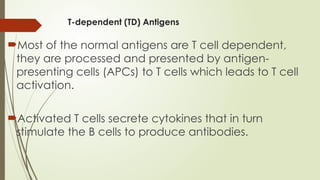
T-dependent (TD) Antigens
Mostof the normal antigens are T cell dependent,
they are processed and presented by antigen-
presenting cells (APCs) to T cells which leads to T cell
activation.
Activated T cells secrete cytokines that in turn
stimulate the B cells to produce antibodies.
33.
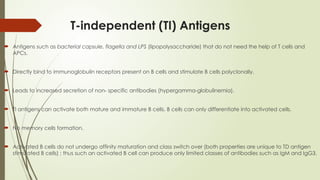
T-independent (TI) Antigens
Antigens such as bacterial capsule, flagella and LPS (lipopolysaccharide) that do not need the help of T cells and
APCs.
Directly bind to immunoglobulin receptors present on B cells and stimulate B cells polyclonally.
Leads to increased secretion of non- specific antibodies (hypergamma-globulinemia).
TI antigens can activate both mature and immature B cells. B cells can only differentiate into activated cells.
No memory cells formation.
Activated B cells do not undergo affinity maturation and class switch over (both properties are unique to TD antigen
stimulated B cells) ; thus such an activated B cell can produce only limited classes of antibodies such as IgM and IgG3.
34.
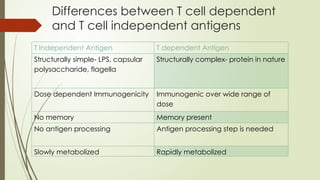
Differences between Tcell dependent
and T cell independent antigens
T Independent Antigen T dependent Antigen
Structurally simple- LPS, capsular
polysaccharide, flagella
Structurally complex- protein in nature
Dose dependent Immunogenicity Immunogenic over wide range of
dose
No memory Memory present
No antigen processing Antigen processing step is needed
Slowly metabolized Rapidly metabolized
35.
Differences between Tcell dependent
and T cell independent antigens
T Independent Antigen T dependent Antigen
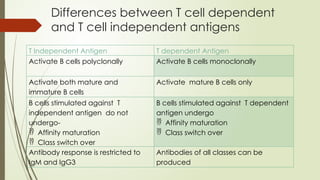
Activate B cells polyclonally Activate B cells monoclonally
Activate both mature and
immature B cells
Activate mature B cells only
B cells stimulated against T
independent antigen do not
undergo-
Affinity maturation
Class switch over
B cells stimulated against T dependent
antigen undergo
Affinity maturation
Class switch over
Antibody response is restricted to
IgM and IgG3
Antibodies of all classes can be
produced
36.
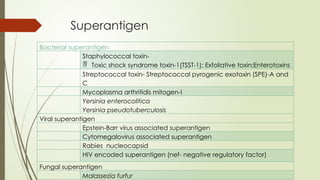
Superantigens
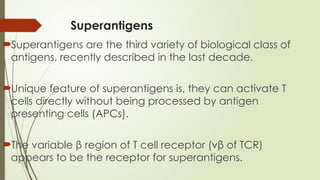
Superantigens are thethird variety of biological class of
antigens, recently described in the last decade.
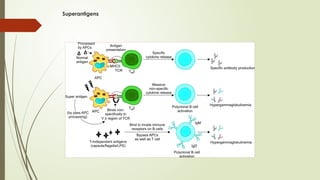
Unique feature of superantigens is, they can activate T
cells directly without being processed by antigen
presenting cells (APCs).
The variable β region of T cell receptor (vβ of TCR)
appears to be the receptor for superantigens.
37.
Superantigens
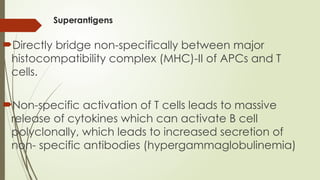
Directly bridge non-specificallybetween major
histocompatibility complex (MHC)-II of APCs and T
cells.
Non-specific activation of T cells leads to massive
release of cytokines which can activate B cell
polyclonally, which leads to increased secretion of
non- specific antibodies (hypergammaglobulinemia)
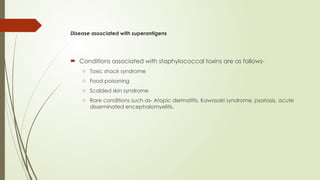
Disease associated withsuperantigens
Conditions associated with staphylococcal toxins are as follows-
o Toxic shock syndrome
o Food poisoning
o Scalded skin syndrome
o Rare conditions such as- Atopic dermatitis, Kawasaki syndrome, psoriasis, acute
disseminated encephalomyelitis.

 Most read
 Most read