ASSISTANT PROFESSOR,
DEPARTMENT OF BIOCHEMISTRY,
D.K.M. COLLEGE FOR WOMEN,
SAINATHAPURAM,
VELLORE.
IMMUNOGENICITY AND ANTIGENICITY
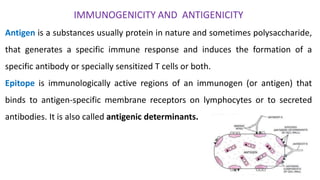
Antigen is a substances usually protein in nature and sometimes polysaccharide,
that generates a specific immune response and induces the formation of a
specific antibody or specially sensitized T cells or both.
Epitope is immunologically active regions of an immunogen (or antigen) that
binds to antigen-specific membrane receptors on lymphocytes or to secreted
antibodies. It is also called antigenic determinants.
Immunogenicity - Ability to induce a Humoral or cell mediated immune
response
Antigenicity - Ability to combine specifically with the final products of the
Immune response (i.e. Secreted antibodies or Surface receptors onT-cells).
DETERMINANTS OF ANTIGENS (OR) ANTIGENICITY
Some of the Determinants of Antigenicity or Antigens are:
(i) Molecular Size,
(ii)Chemical nature,
(iii)Foriegnness,
(iv) Physical form,
(v) Antigenic specificity,
(vi) Species specificity,
(vii) Organ specificity,
(viii) Isospecificity
(ix)Autospecificity,
(x) Heterogenic specificity,
(xi)Genetic factors,
(xii)Age,
(xiii)Degradability,
(xiv) Dose of Antigen,
(xv) Route of Administration and
(xvi) Adjuvants
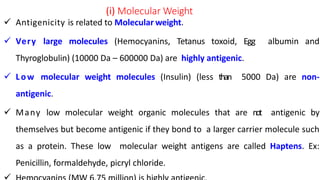
(i) Molecular Weight
 Antigenicity is related to Molecular weight.
 Very large molecules (Hemocyanins, Tetanus toxoid, Egg albumin and
Thyroglobulin) (10000 Da – 600000 Da) are highly antigenic.
 Low molecular weight molecules (Insulin) (less than 5000 Da) are non-
antigenic.
 Many low molecular weight organic molecules that are not antigenic by
themselves but become antigenic if they bond to a larger carrier molecule such
as a protein. These low molecular weight antigens are called Haptens. Ex:
Penicillin, formaldehyde, picryl chloride.
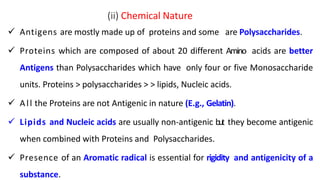
(ii) Chemical Nature
 Antigens are mostly made up of proteins and some are Polysaccharides.
 Proteins which are composed of about 20 different Amino acids are better
Antigens than Polysaccharides which have only four or five Monosaccharide
units. Proteins > polysaccharides > > lipids, Nucleic acids.
 All the Proteins are not Antigenic in nature (E.g., Gelatin).
 Lipids and Nucleic acids are usually non-antigenic but they become antigenic
when combined with Proteins and Polysaccharides.
 Presence of an Aromatic radical is essential for rigidity and antigenicity of a
substance.
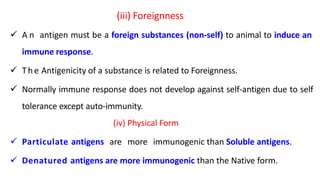
(iii) Foreignness
 A n antigen must be a foreign substances (non-self) to animal to induce an
immune response.
 The Antigenicity of a substance is related to Foreignness.
 Normally immune response does not develop against self-antigen due to self
tolerance except auto-immunity.
(iv) Physical Form
 Particulate antigens are more immunogenic than Soluble antigens.
 Denatured antigens are more immunogenic than the Native form.
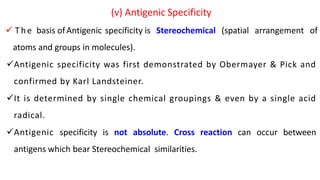
(v) Antigenic Specificity
 The basis ofAntigenic specificity is Stereochemical (spatial arrangement of
atoms and groups in molecules).
Antigenic specificity was first demonstrated by Obermayer & Pick and
confirmed by Karl Landsteiner.
It is determined by single chemical groupings & even by a single acid
radical.
Antigenic specificity is not absolute. Cross reaction can occur between
antigens which bear Stereochemical similarities.
 Antigen Specificity depends on the specific active site on the antigenic
molecules (Antigenic determinants).
 Antigenic determinants or Epitopes are the part of an Antigen that is
recognized by the Immune system, B – cells or T –cells.
 The Epitopes are divided into twocategories:
 Conformational Epitopes - Composed of discontinuous sections of the
antigen’s amino acid sequence.
 Linear Epitopes - Formed by a continuous sequence of amino acids from the
antigen.
(vi) Species Specificity
 Tissues of all individuals in a particular species possess, Species - specific antigen.
 Human Blood proteins can be differentiated from Animal protein by Specific
antigen-antibody reaction.
 Uses:
 Tracing evolutionary relationship
 Forensic application for identification of the species from blood and seminal stain.
 An individual sensitized to horse serum will react with serum from other equines but
they not do the same with bovine serum.
(vii) Organ Specificity
 Organ specific antigens are confined to particular organ or tissue.
 Certain proteins of Brain, Kidney, Thyroglobulin and protein of one
species share specificity with that of another species.
(viii) Isospecificity
Isoantigens are antigens found in some species but not in all member of
species (E.g., Human erythrocyte antigen based on which individuals can
be classified into different Blood groups)
Isoantigens are of clinical importance in
 Blood Transfusion,
 Iso -immunization during Pregnancy.
 Determining disputed paternity cases.
 Blood grouping in anthropology.
(ix) Autospecificity
The Autologous or Self - antigens are ordinarily not Immunogenic, but
under certain circumstances Lens protein, sperm protein,
Thyroglobulin and others may act as an Autoantigens.
(X) Heterogenic specificity
 The same or closely related antigens may sometimes occurs in
different biological species, classes or kingdoms.
 Forssman antigen- A lipid carbohydrate complex widely distributed
among bacteria, animals, birds, plants.
(xi) Genetic Factors
 Some substances are Antigenic or Immunogenic in one species but not in
another. Similarly, some substances are Antigenic or Immunogenic in one
individual but not in others.
 The species or individuals may lack or have altered genes that code for the
receptors for antigen on B cells and Tcells.
(xii) Age
 Age can also influence Antigenicity or Immunogenic.
 Usually the very young and the very old have a diminished ability to elicit and
immune response in response to an Immunogen.
(xiii) Degradability
 Antigens (T – dependent antigens) that are easily phagocytosed are generally
more immunogenic because the development of an immune response
requires that the antigen be phagocytosed, processed and presented to
Helper T - cells by an Antigen presenting cell(APC).
(xiv) Dose of Antigen
 The dose of administration of an antigen can influence itsimmunogenicity.
 Dose of antigen above or below which the immune response will not be
optimal.
(xiv) Route of Administration
 Generally the subcutaneous route is better than the intravenous or intragastric
routes.
 The route of antigen administration can also alter the natureof the response.
 Antigen administered intravenously is carried first to the spleen, whereas
antigen administered subcutaneously moves first to local lymph nodes.
(xv) Adjuvants
 Adjuvants are substances that, when mixed with an antigen and injected with it,
enhance the immunogenicity of that antigen.
 Adjuvants are often used to boost the immune response when an antigen has
low immunogenicity or when only small amounts of an antigen are available.
 Adjuvants may be added to a Vaccine to modify the Immune response.