Hand Hygiene
Dr. Abhijeet Mane
Assistant Professor
Department of Microbiology
Bharati Vidyapeeth Deemed University Medical College
Pune
Thursday, August 24, 2017 1
Introduction
• Health Care Associated Infections (HCAIs) - a
major problem for patient safety.
• Impact of HCAIs
• What is Hand Hygiene (HH)?
Thursday, August 24, 2017 2
How it all started…
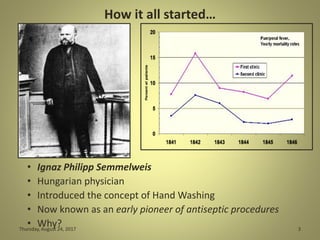
• Ignaz Philipp Semmelweis
• Hungarian physician
• Introduced the concept of Hand Washing
• Now known as an early pioneer of antiseptic procedures
• Why?Thursday, August 24, 2017 3
Normal flora of hand
• 2 types of microbes colonize the hands
• Resident flora –
– microorganisms residing under the superficial cells
of stratum corneum
• Transient flora –
– colonize superficial layers
– More amenable to removal by routine HH
Thursday, August 24, 2017 4
• Transient microorganisms survive but usually
do not multiply on the skin
• Acquired by HCW during direct contact with
patients or surrounding associated with HAIs
Thursday, August 24, 2017 5
Colonisatioin of hands and role in
transmission
• Hands of HCWs are commonly colonised with
pathogens like MRSA, VRE, MDR GNB, Candida
spp & Cl. Difficle
• Approx 1000000 squames containing viable
organisms shed daily
• Contaminate fomites
• Hand carriage of above pathogens linked to HAI
• Highest rate in critical areas
• MRSA and VRE can survive for months on fomites
Thursday, August 24, 2017 6
• Long survival on surfaces together with short
survival on hand --- suggest that contaminated
surfaces maybe source of transient
colonization despite negative hand cultures
• Hands become contaminated by merely
touching patients
• Rhinovirus, adenovirus, rotavirus have been
found on hands of HCW
Thursday, August 24, 2017 7
Steps involved in transmission of HCA pathogens from
one patient to another via HCWs: *
Organisms present
on patient skin
Organisms
transferred to
hands of HCW
Organisms must be
capable of surviving
on HCWs hands
HH by HCW inadequate or
entirely omitted
Contaminated hands
of HCW - direct
contact with
another patient
Thursday, August 24, 2017 8
5 moments of Hand Hygiene by WHO
Thursday, August 24, 2017 9
5 moments of hand hygiene
1. Before pt contact – shaking hands, helping a pt
move around, clinical examination
2. Before an aseptic task – oral / dental care,
secretion aspiration, wound dressing
3. After body fluid exposure risk - oral / dental
care, secretion aspiration, phlebotomy, clearing
urine, etc.
4. After pt contact – shaking hands, helping a pt
move around, clinical examination
5. After contact with pt surroundings – changing
bed linen, perfusion speed adjustment
Thursday, August 24, 2017 10
Organisms present on patient skin or
the immediate environment
Thursday, August 24, 2017 11
Organism transfer from patient to
HCWs’ hands
Thursday, August 24, 2017 12
Organism survival on HCWs’ hands
Thursday, August 24, 2017 13
Incorrect hand cleansing
Thursday, August 24, 2017 14
Thursday, August 24, 2017 15
Failure to cleanse hands during patient care results in
within-patient cross-transmission
Thursday, August 24, 2017 16
Thursday, August 24, 2017 17
Definitions
• Hand hygiene
– General term that applies to either hand washing,
antiseptic handwash, antispetic hand rub or Sx
hand antisepsis
• Surgical hand wash / rub
– The cleansing of hands with antimicrobial soap
and water preoperatively by Sx team
Thursday, August 24, 2017 18
Indications for HH
• With soap and water
1. Visibly dirty
2. Contaminated with
proteinaceous material,
blood
3. Body fluids
4. After using rest room
5. Before and after having
food
• Using ABHR
1. Before direct contact
with pt
2. Before donning sterile
gloves
3. After contact with pt
intact skin
4. After contact with
inanimate objects
surrounding pt
5. After removing gloves
Thursday, August 24, 2017 19Alcohol Based Hand Rub
Missed spots when hand washing
Thursday, August 24, 2017 21
Agents of hand hygiene
• Non medicated soap
• Alcohols
• Chlorhexidine
• Iodine and iodophores
• Quaternary ammonium compounds
• Etc.
Thursday, August 24, 2017 22
Reasons for poor HH compliance
• Physician status
• Nursing assistant status
• Male sex
• Working in icu
• Wearing gloves/gown
• Lack of role model
• Under staff, overcrowding
• Dryness due to HH
• Inconvenient sinks
• Forgetfulness
Thursday, August 24, 2017 23
How to increase HH compliance
• Targeted, multifaceted approaches focusing
on system change, ABHR
• Positive role modeling
• Adequate supply of HH products
• Performance feedback
Thursday, August 24, 2017 24
Checking efficiency of HH campaign
• HH audit form
• Check HH with handrub and fluorescent dye
• Monitor consumption of alcohol and soap
Thursday, August 24, 2017 25
Method of hand washing
• Remove jewellery, rinse hands under running
water
• Lather with soap and using friction cover all
surfaces
• Wash under running water
• Turn tap off with wrist / elbow
• Dry hand with single use towel or forced air
drying
• Pat skin rather than rubbing to avoid cracking
Thursday, August 24, 2017 26
Thursday, August 24, 2017 27
Steps of Surgical hand preparation
• Prerequisites
1. Keep nails short and pay attention to them
2. Don't wear artificial nails / nail polish
3. Remove jewellery
4. Wash hands with non medicated soap before
entering OT
5. Clean subungal areas with nail file. Not nail
brush
Thursday, August 24, 2017 28
Procedure- 3 -5 mins
1. Start timing
2. Scrub each side of each finger, between fingers,
back and front of hand for 2 mins
3. Proceed to scrub the arms , keeping the hands
higher than the arm at all times
4. Repeat process on other hand and arm – 1 min
5. Rinse hands – not back and forth
6. Proceed to OT holding hands above elbows
7. Dry hand s with sterile and aseptic technique
before donning gown and gloves
Thursday, August 24, 2017 29
Thursday, August 24, 2017 30

Hand hygiene

  • 1.
    Hand Hygiene Dr. AbhijeetMane Assistant Professor Department of Microbiology Bharati Vidyapeeth Deemed University Medical College Pune Thursday, August 24, 2017 1
  • 2.
    Introduction • Health CareAssociated Infections (HCAIs) - a major problem for patient safety. • Impact of HCAIs • What is Hand Hygiene (HH)? Thursday, August 24, 2017 2
  • 3.
    How it allstarted… • Ignaz Philipp Semmelweis • Hungarian physician • Introduced the concept of Hand Washing • Now known as an early pioneer of antiseptic procedures • Why?Thursday, August 24, 2017 3
  • 4.
    Normal flora ofhand • 2 types of microbes colonize the hands • Resident flora – – microorganisms residing under the superficial cells of stratum corneum • Transient flora – – colonize superficial layers – More amenable to removal by routine HH Thursday, August 24, 2017 4
  • 5.
    • Transient microorganismssurvive but usually do not multiply on the skin • Acquired by HCW during direct contact with patients or surrounding associated with HAIs Thursday, August 24, 2017 5
  • 6.
    Colonisatioin of handsand role in transmission • Hands of HCWs are commonly colonised with pathogens like MRSA, VRE, MDR GNB, Candida spp & Cl. Difficle • Approx 1000000 squames containing viable organisms shed daily • Contaminate fomites • Hand carriage of above pathogens linked to HAI • Highest rate in critical areas • MRSA and VRE can survive for months on fomites Thursday, August 24, 2017 6
  • 7.
    • Long survivalon surfaces together with short survival on hand --- suggest that contaminated surfaces maybe source of transient colonization despite negative hand cultures • Hands become contaminated by merely touching patients • Rhinovirus, adenovirus, rotavirus have been found on hands of HCW Thursday, August 24, 2017 7
  • 8.
    Steps involved intransmission of HCA pathogens from one patient to another via HCWs: * Organisms present on patient skin Organisms transferred to hands of HCW Organisms must be capable of surviving on HCWs hands HH by HCW inadequate or entirely omitted Contaminated hands of HCW - direct contact with another patient Thursday, August 24, 2017 8
  • 9.
    5 moments ofHand Hygiene by WHO Thursday, August 24, 2017 9
  • 10.
    5 moments ofhand hygiene 1. Before pt contact – shaking hands, helping a pt move around, clinical examination 2. Before an aseptic task – oral / dental care, secretion aspiration, wound dressing 3. After body fluid exposure risk - oral / dental care, secretion aspiration, phlebotomy, clearing urine, etc. 4. After pt contact – shaking hands, helping a pt move around, clinical examination 5. After contact with pt surroundings – changing bed linen, perfusion speed adjustment Thursday, August 24, 2017 10
  • 11.
    Organisms present onpatient skin or the immediate environment Thursday, August 24, 2017 11
  • 12.
    Organism transfer frompatient to HCWs’ hands Thursday, August 24, 2017 12
  • 13.
    Organism survival onHCWs’ hands Thursday, August 24, 2017 13
  • 14.
  • 15.
  • 16.
    Failure to cleansehands during patient care results in within-patient cross-transmission Thursday, August 24, 2017 16
  • 17.
  • 18.
    Definitions • Hand hygiene –General term that applies to either hand washing, antiseptic handwash, antispetic hand rub or Sx hand antisepsis • Surgical hand wash / rub – The cleansing of hands with antimicrobial soap and water preoperatively by Sx team Thursday, August 24, 2017 18
  • 19.
    Indications for HH •With soap and water 1. Visibly dirty 2. Contaminated with proteinaceous material, blood 3. Body fluids 4. After using rest room 5. Before and after having food • Using ABHR 1. Before direct contact with pt 2. Before donning sterile gloves 3. After contact with pt intact skin 4. After contact with inanimate objects surrounding pt 5. After removing gloves Thursday, August 24, 2017 19Alcohol Based Hand Rub
  • 20.
    Missed spots whenhand washing Thursday, August 24, 2017 21
  • 21.
    Agents of handhygiene • Non medicated soap • Alcohols • Chlorhexidine • Iodine and iodophores • Quaternary ammonium compounds • Etc. Thursday, August 24, 2017 22
  • 22.
    Reasons for poorHH compliance • Physician status • Nursing assistant status • Male sex • Working in icu • Wearing gloves/gown • Lack of role model • Under staff, overcrowding • Dryness due to HH • Inconvenient sinks • Forgetfulness Thursday, August 24, 2017 23
  • 23.
    How to increaseHH compliance • Targeted, multifaceted approaches focusing on system change, ABHR • Positive role modeling • Adequate supply of HH products • Performance feedback Thursday, August 24, 2017 24
  • 24.
    Checking efficiency ofHH campaign • HH audit form • Check HH with handrub and fluorescent dye • Monitor consumption of alcohol and soap Thursday, August 24, 2017 25
  • 25.
    Method of handwashing • Remove jewellery, rinse hands under running water • Lather with soap and using friction cover all surfaces • Wash under running water • Turn tap off with wrist / elbow • Dry hand with single use towel or forced air drying • Pat skin rather than rubbing to avoid cracking Thursday, August 24, 2017 26
  • 26.
  • 27.
    Steps of Surgicalhand preparation • Prerequisites 1. Keep nails short and pay attention to them 2. Don't wear artificial nails / nail polish 3. Remove jewellery 4. Wash hands with non medicated soap before entering OT 5. Clean subungal areas with nail file. Not nail brush Thursday, August 24, 2017 28
  • 28.
    Procedure- 3 -5mins 1. Start timing 2. Scrub each side of each finger, between fingers, back and front of hand for 2 mins 3. Proceed to scrub the arms , keeping the hands higher than the arm at all times 4. Repeat process on other hand and arm – 1 min 5. Rinse hands – not back and forth 6. Proceed to OT holding hands above elbows 7. Dry hand s with sterile and aseptic technique before donning gown and gloves Thursday, August 24, 2017 29
  • 29.

Editor's Notes

  • #12 A bedridden patient colonized with Gram-positive cocci, in particular at nasal, perineal, and inguinal areas (not shown), as well as axillae and upper extremities. Some environmental surfaces close to the patient are contaminated with Gram-positive cocci, presumably shed by the patient.
  • #13 Contact between the HCW and the patient results in cross-transmission of microorganisms. In this case, Gram-positive cocci from the patient’s own flora transfer to HCW’s hands
  • #14 Microorganisms (in this case Gram-positive cocci) survive on hands. Reprinted from Pittet, 2006885 with permission from Elsevier. (B) When growing conditions are optimal (temperature, humidity, absence of hand cleansing, or friction), microorganisms can continue to grow.
  • #15 Inappropriate handwashing can result in hands remaining contaminated
  • #17 The doctor is in close contact with the patient. He touched the urinary catheter bag previously and his hands are contaminated with Gramnegative rods from touching the bag and a lack of subsequent hand cleansing. Direct contact with patients or patients’ devices would probably result in cross-transmission.