
Hand Hygiene
Dr. Abhijeet Mane
Associate Professor (Microbiology) &
Coordinator – Infection Control
Bharati Vidyapeeth (DTU) Medical College &
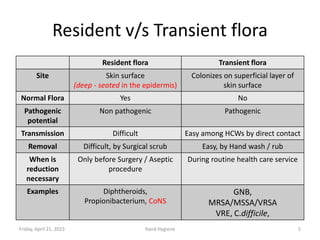
Hospital, Pune
Abhijeet Mane - YouTube
Introduction
• Health Care Associated Infections (HCAIs) - a
major problem for patient safety.
• Hands of Health care worker (HCW) remain a
common mode of transmission of HAIs – think
AMR is transferred…
• Bacterial counts on the hands of HCWs have been
reported to range from 39,000 – 4,60,000 CFUs /
cm2
• Hence effective hand Hygiene (HH) is cornerstone
among all measures to prevent HAIs
Friday, April 21, 2023 Hand Hygiene 2
How it all started…
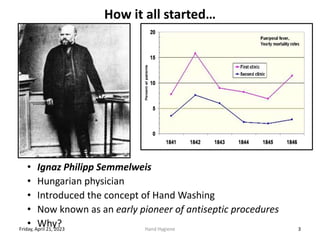
• Ignaz Philipp Semmelweis
• Hungarian physician
• Introduced the concept of Hand Washing
• Now known as an early pioneer of antiseptic procedures
• Why?
Friday, April 21, 2023 Hand Hygiene 3
Microbial flora of Hand
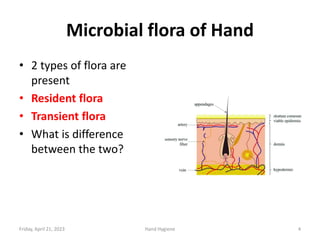
• 2 types of flora are
present
• Resident flora
• Transient flora
• What is difference
between the two?
Friday, April 21, 2023 Hand Hygiene 4
Resident v/s Transient flora
Resident flora Transient flora
Site Skin surface
(deep - seated in the epidermis)
Colonizes on superficial layer of
skin surface
Normal Flora Yes No
Pathogenic
potential
Non pathogenic Pathogenic
Transmission Difficult Easy among HCWs by direct contact
Removal Difficult, by Surgical scrub Easy, by Hand wash / rub
When is
reduction
necessary
Only before Surgery / Aseptic
procedure
During routine health care service
Examples Diphtheroids,
Propionibacterium, CoNS
GNB,
MRSA/MSSA/VRSA
VRE, C.difficile,
Friday, April 21, 2023 Hand Hygiene 5
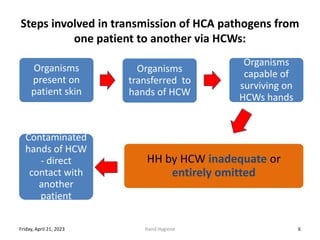
Steps involved in transmission of HCA pathogens from
one patient to another via HCWs:
Friday, April 21, 2023 Hand Hygiene 6
Organisms
present on
patient skin
Organisms
transferred to
hands of HCW
Organisms
capable of
surviving on
HCWs hands
HH by HCW inadequate or
entirely omitted
Contaminated
hands of HCW
- direct
contact with
another
patient
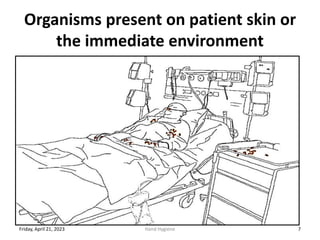
Organisms present on patient skin or
the immediate environment
Friday, April 21, 2023 Hand Hygiene 7
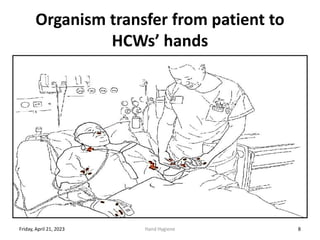
Organism transfer from patient to
HCWs’ hands
Friday, April 21, 2023 Hand Hygiene 8
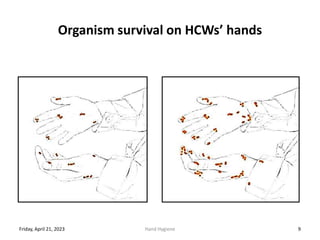
Organism survival on HCWs’ hands
Friday, April 21, 2023 Hand Hygiene 9
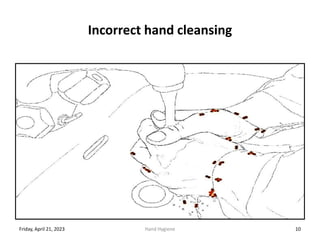
Incorrect hand cleansing
Friday, April 21, 2023 Hand Hygiene 10
Friday, April 21, 2023 Hand Hygiene 11
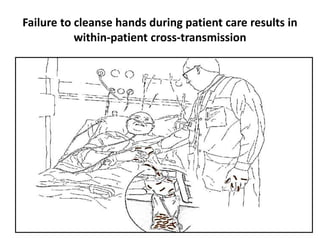
Failure to cleanse hands during patient care results in
within-patient cross-transmission
Friday, April 21, 2023 Hand Hygiene 12
What is Hand Hygiene?
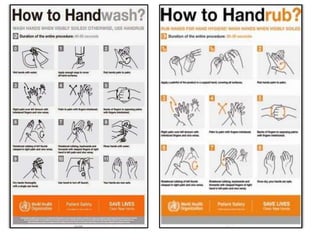
• Hand hygiene: A general term referring to any
action of hand cleansing
• It includes Hand washing and using Alcohol
Based Hand Rub
Friday, April 21, 2023 Hand Hygiene 13
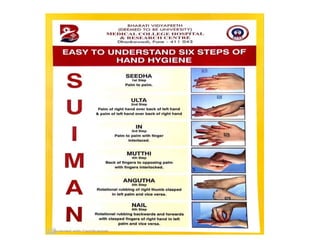
For effective HH
Following criteria must be met:
• using an effective compound,
• sufficient amount of product available to
cover hands, (atleast 1.5ml x 2 times)
• use of correct technique to cover all areas,
and
• performing HH at the right moment.
Friday, April 21, 2023 Hand Hygiene 14
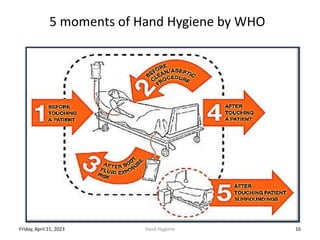
5 moments of Hand Hygiene by WHO
Friday, April 21, 2023 Hand Hygiene 16
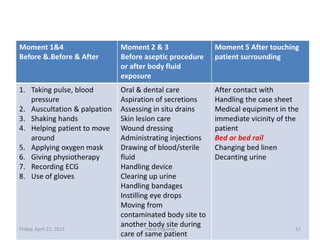
Moment 1&4
Before &.Before & After
Moment 2 & 3
Before aseptic procedure
or after body fluid
exposure
Moment 5 After touching
patient surrounding
1. Taking pulse, blood
pressure
2. Auscultation & palpation
3. Shaking hands
4. Helping patient to move
around
5. Applying oxygen mask
6. Giving physiotherapy
7. Recording ECG
8. Use of gloves
Oral & dental care
Aspiration of secretions
Assessing in situ drains
Skin lesion care
Wound dressing
Administrating injections
Drawing of blood/sterile
fluid
Handling device
Clearing up urine
Handling bandages
Instilling eye drops
Moving from
contaminated body site to
another body site during
care of same patient
After contact with
Handling the case sheet
Medical equipment in the
immediate vicinity of the
patient
Bed or bed rail
Changing bed linen
Decanting urine
Friday, April 21, 2023 Hand Hygiene 17
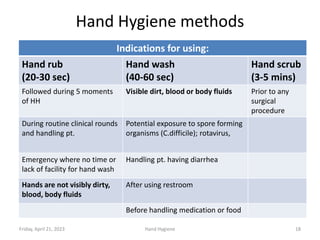
Hand Hygiene methods
Friday, April 21, 2023 Hand Hygiene 18
Indications for using:
Hand rub
(20-30 sec)
Hand wash
(40-60 sec)
Hand scrub
(3-5 mins)
Followed during 5 moments
of HH
Visible dirt, blood or body fluids Prior to any
surgical
procedure
During routine clinical rounds
and handling pt.
Potential exposure to spore forming
organisms (C.difficile); rotavirus,
Emergency where no time or
lack of facility for hand wash
Handling pt. having diarrhea
Hands are not visibly dirty,
blood, body fluids
After using restroom
Before handling medication or food
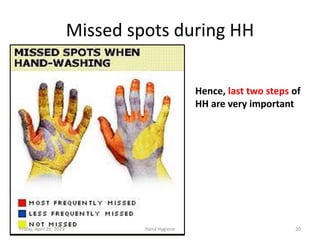
Missed spots during HH
Friday, April 21, 2023 Hand Hygiene 20
Hence, last two steps of
HH are very important
• Hand wash products
• Water
• Plain soap
– Action
– For routine Hand wash
– Liquid soaps
Friday, April 21, 2023 Hand Hygiene 21
• Hand rub products
– Alcohol based hand rubs recommended by WHO
– 60-80% ethanol recommended
– Duration 20-30 sec
– Volume – 3-5 ml
• Alcohol – chlorhexidine (2%) combination – High risk
areas
• Routine use of antiseptic soap solution (e.g.
chlorhexidine gluconate, povidone iodine, or triclosan)
is not necessary for everyday HW even in intensive
and high dependency, neonatal, transplant, burns, and
renal units.
Friday, April 21, 2023 Hand Hygiene 22
Points to note…
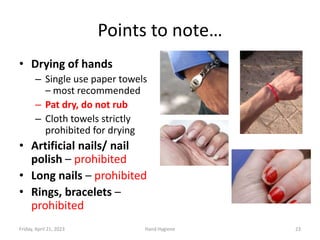
• Drying of hands
– Single use paper towels
– most recommended
– Pat dry, do not rub
– Cloth towels strictly
prohibited for drying
• Artificial nails/ nail
polish – prohibited
• Long nails – prohibited
• Rings, bracelets –
prohibited
Friday, April 21, 2023 Hand Hygiene 23
Gloves
• Not substitute for hand hygiene. HH to be
performed immediately after removing
gloves.
• Gloves creates a moist, warm, and occlusive
environment - the skin and glove; supports
microbial growth.
• Even new gloves may have microscopic holes.
Friday, April 21, 2023 Hand Hygiene 24
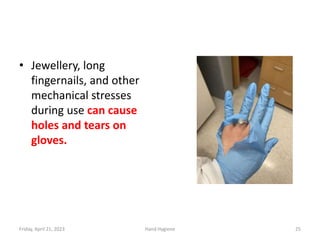
• Jewellery, long
fingernails, and other
mechanical stresses
during use can cause
holes and tears on
gloves.
Friday, April 21, 2023 Hand Hygiene 25
• Hand Care
– Frequent use leads to chronic dermatitis
– Can be reduced by addition of humectants – to
moisturize
• Prevent dermatitis by:
– Avoid washing hands immediately before or after
using ABHR
– Don’t wear gloves when hands are still wet
– Apply an emollient hand cream regularly to protect
skin from drying
– Avoid use of very hot water
Friday, April 21, 2023 Hand Hygiene 26
References
• WHO document on Hand Hygiene in Outpatient and Home-based Care and
Long-term Care Facilities
• Study material – JIPMER HIC and AMSP National Workshop August 2022
• Manual of Infection Prevention and Control 4th edn. by Nizam Damani
2019
• WHO Guidelines on Hand Hygiene in Health Care 2009
Friday, April 21, 2023 Hand Hygiene 27
Further learning…
Open WHO courses.. Self learning, self paced
1. Basic microbiology
2. Infection Prevention and Control (IPC) core components and multimodal
strategies
3. Introduction to Infection Prevention and Control (IPC)
4. Standard precautions: Hand hygiene
5. Standard precautions: Environmental cleaning and disinfection
6. Standard precautions: Injection safety and needle-stick injury management
7. Health-care associated infection surveillance
8. Bloodstream infections
9. Antimicrobial resistance and infection prevention and control
10. Surgical site infections
11. Catheter-associated urinary tract infections
12. Infection Prevention and Control in Maternal and Neonatal Care
13. Standard precautions: The role of personal protective equipment
14. Transmission-based Precautions
15. Decontamination and sterilization of medical devices
16. Outbreak investigations in health facilities
Friday, April 21, 2023 Hand Hygiene 28
Thank You!
Friday, April 21, 2023 Hand Hygiene 29
Visit, like, subscribe - Abhijeet Mane - YouTube

Hand Hygiene latest.pptx

  • 1.
    Hand Hygiene Dr. AbhijeetMane Associate Professor (Microbiology) & Coordinator – Infection Control Bharati Vidyapeeth (DTU) Medical College & Hospital, Pune Abhijeet Mane - YouTube
  • 2.
    Introduction • Health CareAssociated Infections (HCAIs) - a major problem for patient safety. • Hands of Health care worker (HCW) remain a common mode of transmission of HAIs – think AMR is transferred… • Bacterial counts on the hands of HCWs have been reported to range from 39,000 – 4,60,000 CFUs / cm2 • Hence effective hand Hygiene (HH) is cornerstone among all measures to prevent HAIs Friday, April 21, 2023 Hand Hygiene 2
  • 3.
    How it allstarted… • Ignaz Philipp Semmelweis • Hungarian physician • Introduced the concept of Hand Washing • Now known as an early pioneer of antiseptic procedures • Why? Friday, April 21, 2023 Hand Hygiene 3
  • 4.
    Microbial flora ofHand • 2 types of flora are present • Resident flora • Transient flora • What is difference between the two? Friday, April 21, 2023 Hand Hygiene 4
  • 5.
    Resident v/s Transientflora Resident flora Transient flora Site Skin surface (deep - seated in the epidermis) Colonizes on superficial layer of skin surface Normal Flora Yes No Pathogenic potential Non pathogenic Pathogenic Transmission Difficult Easy among HCWs by direct contact Removal Difficult, by Surgical scrub Easy, by Hand wash / rub When is reduction necessary Only before Surgery / Aseptic procedure During routine health care service Examples Diphtheroids, Propionibacterium, CoNS GNB, MRSA/MSSA/VRSA VRE, C.difficile, Friday, April 21, 2023 Hand Hygiene 5
  • 6.
    Steps involved intransmission of HCA pathogens from one patient to another via HCWs: Friday, April 21, 2023 Hand Hygiene 6 Organisms present on patient skin Organisms transferred to hands of HCW Organisms capable of surviving on HCWs hands HH by HCW inadequate or entirely omitted Contaminated hands of HCW - direct contact with another patient
  • 7.
    Organisms present onpatient skin or the immediate environment Friday, April 21, 2023 Hand Hygiene 7
  • 8.
    Organism transfer frompatient to HCWs’ hands Friday, April 21, 2023 Hand Hygiene 8
  • 9.
    Organism survival onHCWs’ hands Friday, April 21, 2023 Hand Hygiene 9
  • 10.
    Incorrect hand cleansing Friday,April 21, 2023 Hand Hygiene 10
  • 11.
    Friday, April 21,2023 Hand Hygiene 11
  • 12.
    Failure to cleansehands during patient care results in within-patient cross-transmission Friday, April 21, 2023 Hand Hygiene 12
  • 13.
    What is HandHygiene? • Hand hygiene: A general term referring to any action of hand cleansing • It includes Hand washing and using Alcohol Based Hand Rub Friday, April 21, 2023 Hand Hygiene 13
  • 14.
    For effective HH Followingcriteria must be met: • using an effective compound, • sufficient amount of product available to cover hands, (atleast 1.5ml x 2 times) • use of correct technique to cover all areas, and • performing HH at the right moment. Friday, April 21, 2023 Hand Hygiene 14
  • 16.
    5 moments ofHand Hygiene by WHO Friday, April 21, 2023 Hand Hygiene 16
  • 17.
    Moment 1&4 Before &.Before& After Moment 2 & 3 Before aseptic procedure or after body fluid exposure Moment 5 After touching patient surrounding 1. Taking pulse, blood pressure 2. Auscultation & palpation 3. Shaking hands 4. Helping patient to move around 5. Applying oxygen mask 6. Giving physiotherapy 7. Recording ECG 8. Use of gloves Oral & dental care Aspiration of secretions Assessing in situ drains Skin lesion care Wound dressing Administrating injections Drawing of blood/sterile fluid Handling device Clearing up urine Handling bandages Instilling eye drops Moving from contaminated body site to another body site during care of same patient After contact with Handling the case sheet Medical equipment in the immediate vicinity of the patient Bed or bed rail Changing bed linen Decanting urine Friday, April 21, 2023 Hand Hygiene 17
  • 18.
    Hand Hygiene methods Friday,April 21, 2023 Hand Hygiene 18 Indications for using: Hand rub (20-30 sec) Hand wash (40-60 sec) Hand scrub (3-5 mins) Followed during 5 moments of HH Visible dirt, blood or body fluids Prior to any surgical procedure During routine clinical rounds and handling pt. Potential exposure to spore forming organisms (C.difficile); rotavirus, Emergency where no time or lack of facility for hand wash Handling pt. having diarrhea Hands are not visibly dirty, blood, body fluids After using restroom Before handling medication or food
  • 20.
    Missed spots duringHH Friday, April 21, 2023 Hand Hygiene 20 Hence, last two steps of HH are very important
  • 21.
    • Hand washproducts • Water • Plain soap – Action – For routine Hand wash – Liquid soaps Friday, April 21, 2023 Hand Hygiene 21
  • 22.
    • Hand rubproducts – Alcohol based hand rubs recommended by WHO – 60-80% ethanol recommended – Duration 20-30 sec – Volume – 3-5 ml • Alcohol – chlorhexidine (2%) combination – High risk areas • Routine use of antiseptic soap solution (e.g. chlorhexidine gluconate, povidone iodine, or triclosan) is not necessary for everyday HW even in intensive and high dependency, neonatal, transplant, burns, and renal units. Friday, April 21, 2023 Hand Hygiene 22
  • 23.
    Points to note… •Drying of hands – Single use paper towels – most recommended – Pat dry, do not rub – Cloth towels strictly prohibited for drying • Artificial nails/ nail polish – prohibited • Long nails – prohibited • Rings, bracelets – prohibited Friday, April 21, 2023 Hand Hygiene 23
  • 24.
    Gloves • Not substitutefor hand hygiene. HH to be performed immediately after removing gloves. • Gloves creates a moist, warm, and occlusive environment - the skin and glove; supports microbial growth. • Even new gloves may have microscopic holes. Friday, April 21, 2023 Hand Hygiene 24
  • 25.
    • Jewellery, long fingernails,and other mechanical stresses during use can cause holes and tears on gloves. Friday, April 21, 2023 Hand Hygiene 25
  • 26.
    • Hand Care –Frequent use leads to chronic dermatitis – Can be reduced by addition of humectants – to moisturize • Prevent dermatitis by: – Avoid washing hands immediately before or after using ABHR – Don’t wear gloves when hands are still wet – Apply an emollient hand cream regularly to protect skin from drying – Avoid use of very hot water Friday, April 21, 2023 Hand Hygiene 26
  • 27.
    References • WHO documenton Hand Hygiene in Outpatient and Home-based Care and Long-term Care Facilities • Study material – JIPMER HIC and AMSP National Workshop August 2022 • Manual of Infection Prevention and Control 4th edn. by Nizam Damani 2019 • WHO Guidelines on Hand Hygiene in Health Care 2009 Friday, April 21, 2023 Hand Hygiene 27
  • 28.
    Further learning… Open WHOcourses.. Self learning, self paced 1. Basic microbiology 2. Infection Prevention and Control (IPC) core components and multimodal strategies 3. Introduction to Infection Prevention and Control (IPC) 4. Standard precautions: Hand hygiene 5. Standard precautions: Environmental cleaning and disinfection 6. Standard precautions: Injection safety and needle-stick injury management 7. Health-care associated infection surveillance 8. Bloodstream infections 9. Antimicrobial resistance and infection prevention and control 10. Surgical site infections 11. Catheter-associated urinary tract infections 12. Infection Prevention and Control in Maternal and Neonatal Care 13. Standard precautions: The role of personal protective equipment 14. Transmission-based Precautions 15. Decontamination and sterilization of medical devices 16. Outbreak investigations in health facilities Friday, April 21, 2023 Hand Hygiene 28
  • 29.
    Thank You! Friday, April21, 2023 Hand Hygiene 29 Visit, like, subscribe - Abhijeet Mane - YouTube

Editor's Notes

  • #8 A bedridden patient colonized with Gram-positive cocci, in particular at nasal, perineal, and inguinal areas (not shown), as well as axillae and upper extremities. Some environmental surfaces close to the patient are contaminated with Gram-positive cocci, presumably shed by the patient.
  • #9 Contact between the HCW and the patient results in cross-transmission of microorganisms. In this case, Gram-positive cocci from the patient’s own flora transfer to HCW’s hands
  • #10 Microorganisms (in this case Gram-positive cocci) survive on hands. Reprinted from Pittet, 2006885 with permission from Elsevier. (B) When growing conditions are optimal (temperature, humidity, absence of hand cleansing, or friction), microorganisms can continue to grow.
  • #11 Inappropriate hand washing can result in hands remaining contaminated
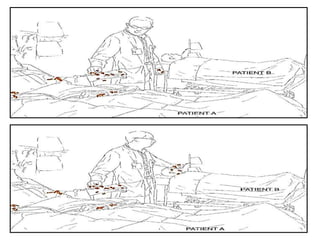
  • #13 The doctor is in close contact with the patient. He touched the urinary catheter bag previously and his hands are contaminated with Gramnegative rods from touching the bag and a lack of subsequent hand cleansing. Direct contact with patients or patients’ devices would probably result in cross-transmission.