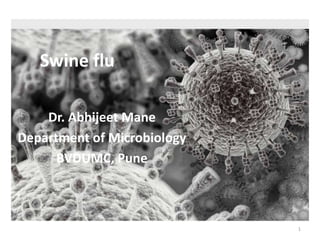

Swine flu
Dr. Abhijeet Mane
Department of Microbiology
BVDUMC, Pune
1
Introduction
• Influenza viruses cause significant morbidity
and mortality throughout the world
• It occurs globally with an annual attack rate
estimated at 5%–10% in adults and 20%–30%
in children.
• Worldwide, annual epidemics: 3 to 5 million
cases of severe illness, and about 250 000 to
500 000 deaths.
2
Contd…
• Influenza viruses belong to the family
Orthomyxoviridae.
• Immunologically, there are three types of
influenza virus: Types A, B and C.
• Type A : major cause of epidemics and
pandemics
• Type B : usually causes epidemics
• Type C: causes sporadic upper respiratory
tract illness.
3
Influenza A
• Influenza A viruses are divided into subtypes
based on two proteins on the surface of the
virus:
– Hemagglutinin (HA): 16 different subtypes
– Neuraminidase (NA): 9 different subtypes
• Occur in different combinations in a variety of
strains that infect humans, animals (equine,
swine, seals) and birds (avian).
4
Pandemic Influenza A(H1N1) 2009
virus
• On 11 June 2009, a new strain of H1N1 influenza
was declared to have caused a global pandemic
(Stage 6) by the World Health Organization on
the basis of being widespread.
• This influenza A virus had never been identified
as a cause of infections in people before the 2009
H1N1 pandemic.
• Thought to be a reassortment of 4 known strains
endemic in humans, birds and pigs
5
Contd…
• Transmission:
– human to human
– via coughing, sneezing or touching contaminated surfaces
and then mouth / nose
• Symptoms :
– similar to seasonal flu
– Virus can cause very severe and fatal illness in young and
healthy people, though majority recover.
– Most ICU admissions: underlying conditions like asthma,
DM, heart disease or weak immune system
• Cause of death : Respiratory failure, Secondary
bacterial pneumonia
6
Laboratory diagnosis
• Only for inpatient, not OPD basis.
• Sample collection preferably before antiviral
treatment.
• Sample is collected under aseptic precautions.
– Nasopharyngeal swab
– Nasal swab
– Throat swab
– Combined oropharyngeal / nasopharyngeal swab
– Nasal aspirate
– ET aspirate (Intubated patient)
7
Laboratory diagnosis (contd.)
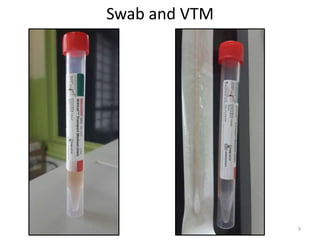
• Swabs with synthetic tips (polyester / Dacron)
and aluminum / plastic shaft should be used
• Cotton tips and wooden shafts : NOT
RECOMMENDED
• After sample collection, place swab in 1-3ml of
Viral Transport Medium (VTM)
– VTM: inorganic salts, organic compounds,
antibiotics, CHO, etc.
8
Swab and VTM
9
Laboratory diagnosis (contd.)
• Labeled samples with duly filled performa
(demographics, clinical history, co-morbidities,
etc) sent to CENTRAL laboratory immediately.
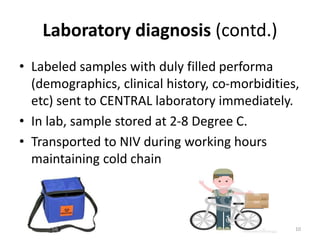
• In lab, sample stored at 2-8 Degree C.
• Transported to NIV during working hours
maintaining cold chain
10
…at NIV
• Recommended procedure is Real Time (RT)
PCR or Viral Culture
• Have a BSL-3 level lab for processing samples.
• Performs RT- PCR test for diagnosis
• Highly sensitive and specific
• Reports generated within 48 hours and
emailed as pdf to dedicated Gmail account of
CENTRAL laboratory.
11
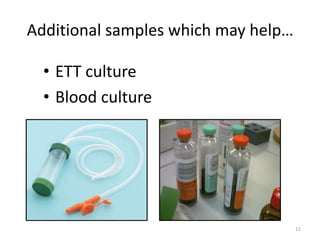
Additional samples which may help…
• ETT culture
• Blood culture
12
Thank you
13

Swine flu

  • 1.
    Swine flu Dr. AbhijeetMane Department of Microbiology BVDUMC, Pune 1
  • 2.
    Introduction • Influenza virusescause significant morbidity and mortality throughout the world • It occurs globally with an annual attack rate estimated at 5%–10% in adults and 20%–30% in children. • Worldwide, annual epidemics: 3 to 5 million cases of severe illness, and about 250 000 to 500 000 deaths. 2
  • 3.
    Contd… • Influenza virusesbelong to the family Orthomyxoviridae. • Immunologically, there are three types of influenza virus: Types A, B and C. • Type A : major cause of epidemics and pandemics • Type B : usually causes epidemics • Type C: causes sporadic upper respiratory tract illness. 3
  • 4.
    Influenza A • InfluenzaA viruses are divided into subtypes based on two proteins on the surface of the virus: – Hemagglutinin (HA): 16 different subtypes – Neuraminidase (NA): 9 different subtypes • Occur in different combinations in a variety of strains that infect humans, animals (equine, swine, seals) and birds (avian). 4
  • 5.
    Pandemic Influenza A(H1N1)2009 virus • On 11 June 2009, a new strain of H1N1 influenza was declared to have caused a global pandemic (Stage 6) by the World Health Organization on the basis of being widespread. • This influenza A virus had never been identified as a cause of infections in people before the 2009 H1N1 pandemic. • Thought to be a reassortment of 4 known strains endemic in humans, birds and pigs 5
  • 6.
    Contd… • Transmission: – humanto human – via coughing, sneezing or touching contaminated surfaces and then mouth / nose • Symptoms : – similar to seasonal flu – Virus can cause very severe and fatal illness in young and healthy people, though majority recover. – Most ICU admissions: underlying conditions like asthma, DM, heart disease or weak immune system • Cause of death : Respiratory failure, Secondary bacterial pneumonia 6
  • 7.
    Laboratory diagnosis • Onlyfor inpatient, not OPD basis. • Sample collection preferably before antiviral treatment. • Sample is collected under aseptic precautions. – Nasopharyngeal swab – Nasal swab – Throat swab – Combined oropharyngeal / nasopharyngeal swab – Nasal aspirate – ET aspirate (Intubated patient) 7
  • 8.
    Laboratory diagnosis (contd.) •Swabs with synthetic tips (polyester / Dacron) and aluminum / plastic shaft should be used • Cotton tips and wooden shafts : NOT RECOMMENDED • After sample collection, place swab in 1-3ml of Viral Transport Medium (VTM) – VTM: inorganic salts, organic compounds, antibiotics, CHO, etc. 8
  • 9.
  • 10.
    Laboratory diagnosis (contd.) •Labeled samples with duly filled performa (demographics, clinical history, co-morbidities, etc) sent to CENTRAL laboratory immediately. • In lab, sample stored at 2-8 Degree C. • Transported to NIV during working hours maintaining cold chain 10
  • 11.
    …at NIV • Recommendedprocedure is Real Time (RT) PCR or Viral Culture • Have a BSL-3 level lab for processing samples. • Performs RT- PCR test for diagnosis • Highly sensitive and specific • Reports generated within 48 hours and emailed as pdf to dedicated Gmail account of CENTRAL laboratory. 11
  • 12.
    Additional samples whichmay help… • ETT culture • Blood culture 12
  • 13.