Antibiotic Groups
Sulfonamides
History
 The sulfonamides were the first effective chemotherapeutic
agents to be employed systemically for the prevention and
cure of bacterial infections in humans.
History
1933
 Foerster reported the first clinical case study of prontosil.
1935
 Prontosil was shown to be a pro-drug of sulfanilamide.
1939
 Domagk was awarded the Nobel Prize in Physiology or
Medicine for discovering the chemotherapeutic value of
prontosil.
Description
 The sulfonamide class contains a large number of
antibacterial drugs, including:
1. Sulfadiazine
2. Sulfamethazine (sulfadimidine)
3. Sulfathiazole
4. Sulfamethoxazole
Cont. …
 There are what is called “Potentiated sulfonamides” which
are combinations of sulfonamide and an antibacterial
diaminopyrimidine such as trimethoprim.
 Potentiated sulfonamides demonstrate improved efficacy
compared with sulfonamides alone.
Mechanism of Action
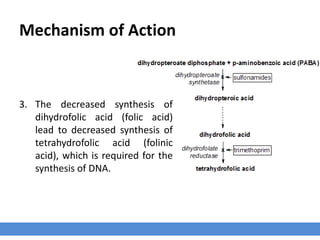
1. Sulfonamides are the structural
analogues of PABA
paraaminobenzoic acid.
1. Sulfonamides competitively
inhibit dihydropteroate
synthetase, which is an enzyme
that catalyzes the synthesis of
dihydrofolic acid (folic acid)
Mechanism of Action
3. The decreased synthesis of
dihydrofolic acid (folic acid)
lead to decreased synthesis of
tetrahydrofolic acid (folinic
acid), which is required for the
synthesis of DNA.
Cont. …
 A variety of effects may result in susceptible organisms,
including:
1. Suppression of protein synthesis.
2. Impairment of metabolic processes.
3. Inhibition of growth and multiplication.
Cont. …
Potentiated sulfonamides
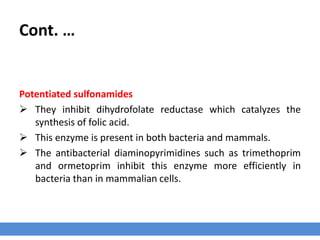
 They inhibit dihydrofolate reductase which catalyzes the
synthesis of folic acid.
 This enzyme is present in both bacteria and mammals.
 The antibacterial diaminopyrimidines such as trimethoprim
and ormetoprim inhibit this enzyme more efficiently in
bacteria than in mammalian cells.
Cont. …
Notre that;
 Before such activity is exhibited, existing stores of folic acid,
folinic acid, purines, thymidine and amino acids are utilized
by bacteria.
Spectrum
 Organisms susceptible to sulfonamides must synthesize their
own folic acid, unlike mammalian cells, which utilize
preformed folic acid.
 Sulfonamides are not efficacious in the presence of purulent
material
Spectrum
 Sulfonamides are bacteriostatic
 Sulfonamides inhibit:
1. Gram positive
2. Gram negative
3. Some chlamydia, Nocardia, and Actinomyces species
4. Some protozoa including coccidia and Toxoplasma species
Cont. …
Potentiated sulfonamides
 Diaminopyrimidines such as trimethoprim and ormetoprim
are bacteriostatic when used alone.
 When combined with sulfonamides, the sequential blockade
of dihydropteroate synthetase and dihydrofolate reductase
elicits a bactericidal effect.
Cont. …
 Potentiated sulfonamide are active against Gram positive and
Gram negative organisms, including:
- Actinomyces - Bordetella
- Clostridium - Corynebacterium
- Fusobacterium - Haemophilus
- Klebsiella - Pasteurella
- Proteus - Salmonella
- Shigella - Campylobacter species
- E. coli - Streptococci
- Staphylococci
Resistance
 Organisms resistant to sulfonamides include:
1. Pseudomonas
2. Klebsiella
3. Proteus
4. Clostridium
5. Leptospira species
 Organisms resistant to potentiated sulfonamides include:
1. Pseudomonas
2. Mycobacterium species
Cont. …
 Resistance to sulfonamides is widespread in bacteria isolated
from animals, and may involve:
1. Chromosomal mutations
2. Plasmid-mediated mechanisms
Cont. …
Chromosomal mutations cause:
1. Impaired drug penetration.
2. production of altered forms of dihydropteroate synthetase for which
sulfonamides have a lowered affinity.
3. production of excessive PABA that overcomes the metabolic block
imposed by the inhibition of dihydropteroate synthetase.
Plasmid-mediated mechanisms, may result in;
1. Impaired drug penetration.
2. Synthesis of sulfonamide-resistant dihydropteroate synthetase.
 There is cross-resistance among sulfonamides.
Cont. …
 Resistance potentiated sulfonamides develops very rapidly
and results from:
1. Chromosomal mutations
• It allows bacteria to utilize exogenous sources of folinic acid or
thymidine, thereby overcoming the drug-imposed blockade.
2. Plasmid-mediated mechanisms
• It result in the synthesis of dihydrofolate reductase
characterized by a reduced affinity for antibacterial
diaminopyrimidines.
Indications
 Compared to most classes of antimicrobial drugs, the usage of
sulfonamides and potentiated sulfonamides in veterinary
medicine is high.
Cont. …
 Sulfonamides are used to treat or prevent acute systemic or
local infections, including:
1. Actinobacillosis
2. Coccidiosis
3. Mastitis
4. Metritis
5. Colibacillosis
6. Pododermatitis
7. Polyarthritis
8. Respiratory infections
9. Toxoplasmosis
Cont. …
 Sulfonamides in combination with pyrimethamine are used to
treat protozoal diseases such as leishmaniasis and
toxoplasmosis.
Administration
 Sulfonamides are most effective in the early stages of acute
infections when organisms are rapidly multiplying.
 Sulfonamides are administered as:
– Additives to feed
– In drinking water
– Controlled release oral boluses
– Intrauterine infusions
 Highly insoluble sulfonamides such as phthalylsulfathiazole
are absorbed from the gastrointestinal tract very slowly and
are used to treat enteric infections.
Side Effects
 The majority of adverse effects to sulfonamides are mild in
nature and reversible;
1. Urinary tract disturbances, including sulfonamide
crystalluria and hematuria which can be minimized by
maintaining an adequate water intake to maintain a high
urine flow.
2. Bone marrow depression and dermatologic.

Antibiotics Groups - Sulfonamides

  • 1.
  • 2.
    History  The sulfonamideswere the first effective chemotherapeutic agents to be employed systemically for the prevention and cure of bacterial infections in humans.
  • 3.
    History 1933  Foerster reportedthe first clinical case study of prontosil. 1935  Prontosil was shown to be a pro-drug of sulfanilamide. 1939  Domagk was awarded the Nobel Prize in Physiology or Medicine for discovering the chemotherapeutic value of prontosil.
  • 4.
    Description  The sulfonamideclass contains a large number of antibacterial drugs, including: 1. Sulfadiazine 2. Sulfamethazine (sulfadimidine) 3. Sulfathiazole 4. Sulfamethoxazole
  • 5.
    Cont. …  Thereare what is called “Potentiated sulfonamides” which are combinations of sulfonamide and an antibacterial diaminopyrimidine such as trimethoprim.  Potentiated sulfonamides demonstrate improved efficacy compared with sulfonamides alone.
  • 6.
    Mechanism of Action 1.Sulfonamides are the structural analogues of PABA paraaminobenzoic acid. 1. Sulfonamides competitively inhibit dihydropteroate synthetase, which is an enzyme that catalyzes the synthesis of dihydrofolic acid (folic acid)
  • 7.
    Mechanism of Action 3.The decreased synthesis of dihydrofolic acid (folic acid) lead to decreased synthesis of tetrahydrofolic acid (folinic acid), which is required for the synthesis of DNA.
  • 8.
    Cont. …  Avariety of effects may result in susceptible organisms, including: 1. Suppression of protein synthesis. 2. Impairment of metabolic processes. 3. Inhibition of growth and multiplication.
  • 9.
    Cont. … Potentiated sulfonamides They inhibit dihydrofolate reductase which catalyzes the synthesis of folic acid.  This enzyme is present in both bacteria and mammals.  The antibacterial diaminopyrimidines such as trimethoprim and ormetoprim inhibit this enzyme more efficiently in bacteria than in mammalian cells.
  • 10.
    Cont. … Notre that; Before such activity is exhibited, existing stores of folic acid, folinic acid, purines, thymidine and amino acids are utilized by bacteria.
  • 11.
    Spectrum  Organisms susceptibleto sulfonamides must synthesize their own folic acid, unlike mammalian cells, which utilize preformed folic acid.  Sulfonamides are not efficacious in the presence of purulent material
  • 12.
    Spectrum  Sulfonamides arebacteriostatic  Sulfonamides inhibit: 1. Gram positive 2. Gram negative 3. Some chlamydia, Nocardia, and Actinomyces species 4. Some protozoa including coccidia and Toxoplasma species
  • 13.
    Cont. … Potentiated sulfonamides Diaminopyrimidines such as trimethoprim and ormetoprim are bacteriostatic when used alone.  When combined with sulfonamides, the sequential blockade of dihydropteroate synthetase and dihydrofolate reductase elicits a bactericidal effect.
  • 14.
    Cont. …  Potentiatedsulfonamide are active against Gram positive and Gram negative organisms, including: - Actinomyces - Bordetella - Clostridium - Corynebacterium - Fusobacterium - Haemophilus - Klebsiella - Pasteurella - Proteus - Salmonella - Shigella - Campylobacter species - E. coli - Streptococci - Staphylococci
  • 15.
    Resistance  Organisms resistantto sulfonamides include: 1. Pseudomonas 2. Klebsiella 3. Proteus 4. Clostridium 5. Leptospira species  Organisms resistant to potentiated sulfonamides include: 1. Pseudomonas 2. Mycobacterium species
  • 16.
    Cont. …  Resistanceto sulfonamides is widespread in bacteria isolated from animals, and may involve: 1. Chromosomal mutations 2. Plasmid-mediated mechanisms
  • 17.
    Cont. … Chromosomal mutationscause: 1. Impaired drug penetration. 2. production of altered forms of dihydropteroate synthetase for which sulfonamides have a lowered affinity. 3. production of excessive PABA that overcomes the metabolic block imposed by the inhibition of dihydropteroate synthetase. Plasmid-mediated mechanisms, may result in; 1. Impaired drug penetration. 2. Synthesis of sulfonamide-resistant dihydropteroate synthetase.  There is cross-resistance among sulfonamides.
  • 18.
    Cont. …  Resistancepotentiated sulfonamides develops very rapidly and results from: 1. Chromosomal mutations • It allows bacteria to utilize exogenous sources of folinic acid or thymidine, thereby overcoming the drug-imposed blockade. 2. Plasmid-mediated mechanisms • It result in the synthesis of dihydrofolate reductase characterized by a reduced affinity for antibacterial diaminopyrimidines.
  • 19.
    Indications  Compared tomost classes of antimicrobial drugs, the usage of sulfonamides and potentiated sulfonamides in veterinary medicine is high.
  • 20.
    Cont. …  Sulfonamidesare used to treat or prevent acute systemic or local infections, including: 1. Actinobacillosis 2. Coccidiosis 3. Mastitis 4. Metritis 5. Colibacillosis 6. Pododermatitis 7. Polyarthritis 8. Respiratory infections 9. Toxoplasmosis
  • 21.
    Cont. …  Sulfonamidesin combination with pyrimethamine are used to treat protozoal diseases such as leishmaniasis and toxoplasmosis.
  • 22.
    Administration  Sulfonamides aremost effective in the early stages of acute infections when organisms are rapidly multiplying.  Sulfonamides are administered as: – Additives to feed – In drinking water – Controlled release oral boluses – Intrauterine infusions  Highly insoluble sulfonamides such as phthalylsulfathiazole are absorbed from the gastrointestinal tract very slowly and are used to treat enteric infections.
  • 23.
    Side Effects  Themajority of adverse effects to sulfonamides are mild in nature and reversible; 1. Urinary tract disturbances, including sulfonamide crystalluria and hematuria which can be minimized by maintaining an adequate water intake to maintain a high urine flow. 2. Bone marrow depression and dermatologic.