ANTIMICROBIAL PAPER
                   By
           Dr Anjum Hashmi
         MBBS,CCS(USA),MPH
       Infection Control Director
     Maternity & Children’s Hospital
               Najran KSA
RISK OF INFECTIONS
• Patient may acquire infection before admission to an
  hospital known as Community acquired infection.
• Patient may get infected inside the hospital known as
  Nosocomial infection/Healthcare Associated Infection.
• It includes
   infections not present nor incubating at time of
      admission,
   infections that appear more than 48 hours after
      admission,
   infections those acquired in the hospital but appear
      after discharge,
   and also occupational infections among staff.
PREVALENCE HEALTHCARE
       ASSOCIATED INFECTIONS
• The problem is huge, it is estimated that there
  are over 1.4 million cases of HAI at any given
  time, although this is likely to be a gross
  underestimation, due to the lack of proper
  surveillance.
• Although no health-care setting across the globe
  can claim to be free of HAI, there is a difference
  between developed and developing countries in
  terms of the incidence and type of infections.
PREVALENCE OF HAIs
• Developed countries
• In developed countries, with sophisticated treatments and
  technologies, HAI continues to account for complications in
  5-10% of admissions to acute-care hospitals. For example, in
  the U.S. alone there are at least 80,000 fatalities each year
  (about 200 deaths/day) from HAI. (WHO 2013)
• Developing countries
• In developing countries, the impact of HAI is far greater, with the
  risk being two- to twenty-fold higher than those in the
  developed world, and prevalence studies report hospital-wide
  infection rates usually higher than 15%. (WHO 2013)
• In these countries, over 4000 children die of HAI every day.
• Approximately half of all patients admitted to neonatal intensive
  care units acquire an infection, and over half of them die.
HAND
     HYGIENE/WASHING
• Hand hygiene is the single most important
  intervention to prevent transmission of
  infection and should be a quality standard in
  all health care institutions.
• Each and every HCW has a responsibility to
  prevent transmission of infection.

                                         (CDC, 2005)
HAND WASHING
• Scientific evidences showed that microbes
  causing HAI are most frequently spread
  between patients on the hands of health-care
  workers.
• Hand hygiene is a simple, low-cost action to
  prevent the spread of the microbes that cause
  health care-associated infections (HAI).
• Though hand hygiene is not, the only measure
  to counter HAI, but its compliance alone can
  dramatically enhance patient safety.
FEW FACTS
• Bacteria survive on average 20 minutes to 2 hours on hard
  surfaces such as desks, doorknobs and tables.
• A surface as small as a pinhead may contain up to
  10 million bacteria.
• Bacteria can double their number in 20 minutes.
• We can eliminate 90% of germs through proper hand
  washing.
• Wet hands spread 60,400 bacteria, while dry hand can only
  spread 200.
• Residual moisture left on improperly dried hands is the key
  factor for bacterial contamination and transmission.
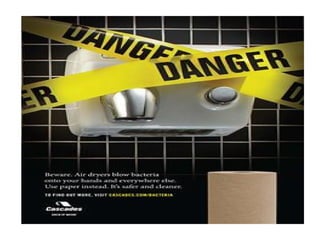
• Thus drying of hands is a key factor in reducing the risk of
  infection.
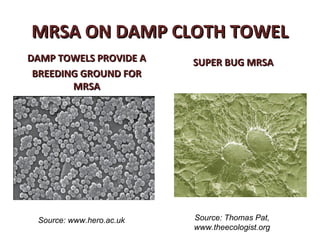
MRSA ON DAMP CLOTH TOWEL
DAMP TOWELS PROVIDE A     SUPER BUG MRSA
 BREEDING GROUND FOR
        MRSA


 Source: www.hero.ac.uk   Source: Thomas Pat,
                          www.theecologist.org
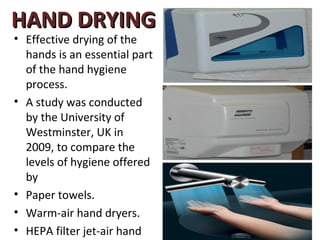
HAND DRYING
• Effective drying of the
  hands is an essential part
  of the hand hygiene
  process.
• A study was conducted
  by the University of
  Westminster, UK in
  2009, to compare the
  levels of hygiene offered
  by
• Paper towels.
• Warm-air hand dryers.
• HEPA filter jet-air hand
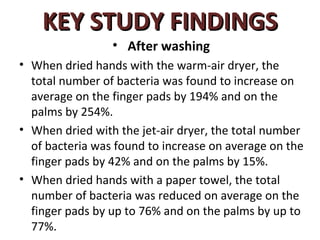
KEY STUDY FINDINGS
                 • After washing
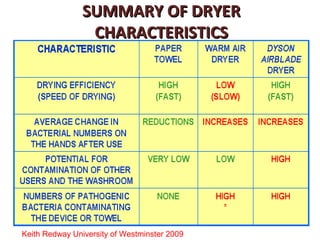
• When dried hands with the warm-air dryer, the
  total number of bacteria was found to increase on
  average on the finger pads by 194% and on the
  palms by 254%.
• When dried with the jet-air dryer, the total number
  of bacteria was found to increase on average on the
  finger pads by 42% and on the palms by 15%.
• When dried hands with a paper towel, the total
  number of bacteria was reduced on average on the
  finger pads by up to 76% and on the palms by up to
  77%.
SUMMARY OF DRYER
                 CHARACTERISTICS


Keith Redway University of Westminster 2009
ANTIMICROBIAL TOWEL
• Washing and drying hands, although
  proved to helpful in eliminating microbes,
  but does not completely eliminates the
  microbes on skin.
• Antibacterial Paper Towels can provide a
  simple and effective way to further
  reduce bacterial contamination and
  transmission thus reduce HAIs.
HOW IT WORKS
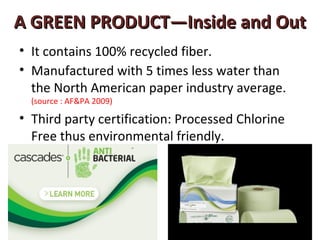
• Cascades has added an active antibacterial
  ingredient benzalkonium chloride to its paper towel.
• Incorporate a high-tech antibacterial coating on the
  surface of paper in micro-capsules which release a
  sterilizing agent, as towel absorbs water from hands,
  and the highly soluble antibacterial ingredient is
  transferred from the towel to the skin. This simple
  action is what quickly kills 99.9% of residual bacteria.
• The paper towel is green to distinguish it from
  regular paper hand towels.
•   Conform and approved by FDA regulations and policies.
•   Based on 3rd party laboratory testing, Processed Chlorine Free)
A GREEN PRODUCT—Inside and Out
• It contains 100% recycled fiber.
• Manufactured with 5 times less water than
  the North American paper industry average.
  (source : AF&PA 2009)

• Third party certification: Processed Chlorine
  Free thus environmental friendly.
OTHER
ANTIMICROBIAL PAPER
          &
   PAPER PRODUCTS
      TO REDUCE
     HEALTHCARE
ASSOCIATED INFECTIONS
ANTIBACTERIAL PAPERS & BOARDS
• Garnett has developed an antibacterial paper which helps
  to fight the MRSA super bug in hospitals.
• According to a research finding from University College of
  London hospital’s NHS trust, patients’ notes and medical
  records are helping to spread the bug.
• The special antibacterial products have been incorporated
  into the raw materials used to make medical record cards
  and patient files, which help to stop the spread of bacterial
  infections such as MRSA.
• This is the first step towards developing a range of products
  for the healthcare industry that will help counter the effects
  of disease transmission through paper products.

•   Paper Technology, 47, 1 February 2006, p. 46.
ANTIBACTERIAL OFFICE PAPER
• Domtar, has begun producing paper containing a silver
  compound to guard against bacteria, odors and the
  growth of fungus, mould and mildew.
• Independent laboratory tests on this product
  demonstrated a 99% reduction of MRSA (Methicillin-
  resistant Staphylococcus aureus) and K. pneumoniae.
• This paper maintains its antimicrobial features
  throughout its shelf life and even after printing and
  varnishing.
• It is ideal for the healthcare, laboratory, hospitality,
  education and government sectors.
•   Tappi Online, ‘New antibacterial paper cuts germ spread in offices’ (18 January 2007).
•   Scranton moans, Domtar Launches Antimicrobial Office Paper, www. rssfabrick.nl (25 January
    2007).
ANTIBACTERIAL WALLPAPER
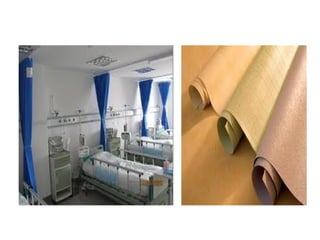
• A variety of wallpapers with antibacterial
  properties are available.
• Along with the other features, the
  antibacterial action is more than 97% in
  these products.
• The wallpapers can be used in hospitals,
  doctor offices, hostels, living rooms,
  bedrooms, commercial areas, study rooms,
  etc.
•   Michael Berger, ‘Antibacterial wallpaper through nanotechnology’, Honolulu, United
    States, www.newswiretoday.com; www.nanowerk.com.
NANOTECHNOLOGY BEHIND MEDICAL
CHART PAPER, WALLPAPER OTHER PAPERS
• In antibacterial paper non-toxic compounds are
  used, which composed of calcium phosphate,
  aluminum sulphate hydroxide and silica as carrier.
• Silver nanoparticles coating is done on paper
  which release antibacterial silver ions , which are
  harmless to the human.
• Zinc oxide nanoparticles coating can also done
  onto paper, giving it an antibacterial surface
  suitable for use as wallpaper in hospitals.
•   Toshihiro Kasuga, Masayuki Nogami, Yoshihiro Abe, ‘Titanium phosphate glassceramics with silver ion
    exchangeability’, J. American Ceram. Soc. 82, 3, 1999, p.765.
•   Ghule Kalyani, Ghule Anil Vithal, Chen Bo-Jung and Ling Yong-Chien, ‘Preparation and characterization of ZnO
    nanoparticles coated paper and its antibacterial activity study’, Green Chem.,8, 2006, pp. 1034–41.
NANOTECHNOLOGY IN MAGNETIC,
WATERPROOF ANTIBACTERIAL PAPER
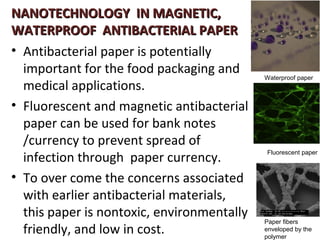
• Antibacterial paper is potentially
  important for the food packaging and      Waterproof paper
  medical applications.
• Fluorescent and magnetic antibacterial
  paper can be used for bank notes
  /currency to prevent spread of
  infection through paper currency.
                                            Fluorescent paper


• To over come the concerns associated
  with earlier antibacterial materials,
  this paper is nontoxic, environmentally
                                            Paper fibers
  friendly, and low in cost.                enveloped by the
                                            polymer
HOW IT WORKS
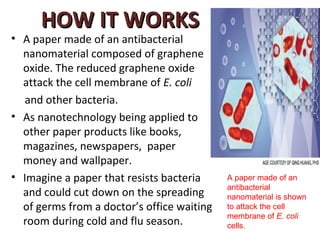
• A paper made of an antibacterial
  nanomaterial composed of graphene
  oxide. The reduced graphene oxide
  attack the cell membrane of E. coli
   and other bacteria.
• As nanotechnology being applied to
  other paper products like books,
  magazines, newspapers, paper
  money and wallpaper.
• Imagine a paper that resists bacteria     A paper made of an
                                            antibacterial
  and could cut down on the spreading       nanomaterial is shown
  of germs from a doctor’s office waiting   to attack the cell
                                            membrane of E. coli
  room during cold and flu season.          cells.

Antibacterial paper

  • 1.
    ANTIMICROBIAL PAPER By Dr Anjum Hashmi MBBS,CCS(USA),MPH Infection Control Director Maternity & Children’s Hospital Najran KSA
  • 2.
    RISK OF INFECTIONS •Patient may acquire infection before admission to an hospital known as Community acquired infection. • Patient may get infected inside the hospital known as Nosocomial infection/Healthcare Associated Infection. • It includes infections not present nor incubating at time of admission, infections that appear more than 48 hours after admission, infections those acquired in the hospital but appear after discharge, and also occupational infections among staff.
  • 3.
    PREVALENCE HEALTHCARE ASSOCIATED INFECTIONS • The problem is huge, it is estimated that there are over 1.4 million cases of HAI at any given time, although this is likely to be a gross underestimation, due to the lack of proper surveillance. • Although no health-care setting across the globe can claim to be free of HAI, there is a difference between developed and developing countries in terms of the incidence and type of infections.
  • 4.
    PREVALENCE OF HAIs •Developed countries • In developed countries, with sophisticated treatments and technologies, HAI continues to account for complications in 5-10% of admissions to acute-care hospitals. For example, in the U.S. alone there are at least 80,000 fatalities each year (about 200 deaths/day) from HAI. (WHO 2013) • Developing countries • In developing countries, the impact of HAI is far greater, with the risk being two- to twenty-fold higher than those in the developed world, and prevalence studies report hospital-wide infection rates usually higher than 15%. (WHO 2013) • In these countries, over 4000 children die of HAI every day. • Approximately half of all patients admitted to neonatal intensive care units acquire an infection, and over half of them die.
  • 5.
    HAND HYGIENE/WASHING • Hand hygiene is the single most important intervention to prevent transmission of infection and should be a quality standard in all health care institutions. • Each and every HCW has a responsibility to prevent transmission of infection. (CDC, 2005)
  • 6.
    HAND WASHING • Scientificevidences showed that microbes causing HAI are most frequently spread between patients on the hands of health-care workers. • Hand hygiene is a simple, low-cost action to prevent the spread of the microbes that cause health care-associated infections (HAI). • Though hand hygiene is not, the only measure to counter HAI, but its compliance alone can dramatically enhance patient safety.
  • 7.
    FEW FACTS • Bacteriasurvive on average 20 minutes to 2 hours on hard surfaces such as desks, doorknobs and tables. • A surface as small as a pinhead may contain up to 10 million bacteria. • Bacteria can double their number in 20 minutes. • We can eliminate 90% of germs through proper hand washing. • Wet hands spread 60,400 bacteria, while dry hand can only spread 200. • Residual moisture left on improperly dried hands is the key factor for bacterial contamination and transmission. • Thus drying of hands is a key factor in reducing the risk of infection.
  • 8.
    MRSA ON DAMPCLOTH TOWEL DAMP TOWELS PROVIDE A SUPER BUG MRSA BREEDING GROUND FOR MRSA Source: www.hero.ac.uk Source: Thomas Pat, www.theecologist.org
  • 9.
    HAND DRYING • Effectivedrying of the hands is an essential part of the hand hygiene process. • A study was conducted by the University of Westminster, UK in 2009, to compare the levels of hygiene offered by • Paper towels. • Warm-air hand dryers. • HEPA filter jet-air hand
  • 10.
    KEY STUDY FINDINGS • After washing • When dried hands with the warm-air dryer, the total number of bacteria was found to increase on average on the finger pads by 194% and on the palms by 254%. • When dried with the jet-air dryer, the total number of bacteria was found to increase on average on the finger pads by 42% and on the palms by 15%. • When dried hands with a paper towel, the total number of bacteria was reduced on average on the finger pads by up to 76% and on the palms by up to 77%.
  • 11.
    SUMMARY OF DRYER CHARACTERISTICS Keith Redway University of Westminster 2009
  • 13.
    ANTIMICROBIAL TOWEL • Washingand drying hands, although proved to helpful in eliminating microbes, but does not completely eliminates the microbes on skin. • Antibacterial Paper Towels can provide a simple and effective way to further reduce bacterial contamination and transmission thus reduce HAIs.
  • 15.
    HOW IT WORKS •Cascades has added an active antibacterial ingredient benzalkonium chloride to its paper towel. • Incorporate a high-tech antibacterial coating on the surface of paper in micro-capsules which release a sterilizing agent, as towel absorbs water from hands, and the highly soluble antibacterial ingredient is transferred from the towel to the skin. This simple action is what quickly kills 99.9% of residual bacteria. • The paper towel is green to distinguish it from regular paper hand towels. • Conform and approved by FDA regulations and policies. • Based on 3rd party laboratory testing, Processed Chlorine Free)
  • 16.
    A GREEN PRODUCT—Insideand Out • It contains 100% recycled fiber. • Manufactured with 5 times less water than the North American paper industry average. (source : AF&PA 2009) • Third party certification: Processed Chlorine Free thus environmental friendly.
  • 18.
    OTHER ANTIMICROBIAL PAPER & PAPER PRODUCTS TO REDUCE HEALTHCARE ASSOCIATED INFECTIONS
  • 19.
    ANTIBACTERIAL PAPERS &BOARDS • Garnett has developed an antibacterial paper which helps to fight the MRSA super bug in hospitals. • According to a research finding from University College of London hospital’s NHS trust, patients’ notes and medical records are helping to spread the bug. • The special antibacterial products have been incorporated into the raw materials used to make medical record cards and patient files, which help to stop the spread of bacterial infections such as MRSA. • This is the first step towards developing a range of products for the healthcare industry that will help counter the effects of disease transmission through paper products. • Paper Technology, 47, 1 February 2006, p. 46.
  • 21.
    ANTIBACTERIAL OFFICE PAPER •Domtar, has begun producing paper containing a silver compound to guard against bacteria, odors and the growth of fungus, mould and mildew. • Independent laboratory tests on this product demonstrated a 99% reduction of MRSA (Methicillin- resistant Staphylococcus aureus) and K. pneumoniae. • This paper maintains its antimicrobial features throughout its shelf life and even after printing and varnishing. • It is ideal for the healthcare, laboratory, hospitality, education and government sectors. • Tappi Online, ‘New antibacterial paper cuts germ spread in offices’ (18 January 2007). • Scranton moans, Domtar Launches Antimicrobial Office Paper, www. rssfabrick.nl (25 January 2007).
  • 23.
    ANTIBACTERIAL WALLPAPER • Avariety of wallpapers with antibacterial properties are available. • Along with the other features, the antibacterial action is more than 97% in these products. • The wallpapers can be used in hospitals, doctor offices, hostels, living rooms, bedrooms, commercial areas, study rooms, etc. • Michael Berger, ‘Antibacterial wallpaper through nanotechnology’, Honolulu, United States, www.newswiretoday.com; www.nanowerk.com.
  • 25.
    NANOTECHNOLOGY BEHIND MEDICAL CHARTPAPER, WALLPAPER OTHER PAPERS • In antibacterial paper non-toxic compounds are used, which composed of calcium phosphate, aluminum sulphate hydroxide and silica as carrier. • Silver nanoparticles coating is done on paper which release antibacterial silver ions , which are harmless to the human. • Zinc oxide nanoparticles coating can also done onto paper, giving it an antibacterial surface suitable for use as wallpaper in hospitals. • Toshihiro Kasuga, Masayuki Nogami, Yoshihiro Abe, ‘Titanium phosphate glassceramics with silver ion exchangeability’, J. American Ceram. Soc. 82, 3, 1999, p.765. • Ghule Kalyani, Ghule Anil Vithal, Chen Bo-Jung and Ling Yong-Chien, ‘Preparation and characterization of ZnO nanoparticles coated paper and its antibacterial activity study’, Green Chem.,8, 2006, pp. 1034–41.
  • 26.
    NANOTECHNOLOGY IN MAGNETIC, WATERPROOFANTIBACTERIAL PAPER • Antibacterial paper is potentially important for the food packaging and Waterproof paper medical applications. • Fluorescent and magnetic antibacterial paper can be used for bank notes /currency to prevent spread of infection through paper currency. Fluorescent paper • To over come the concerns associated with earlier antibacterial materials, this paper is nontoxic, environmentally Paper fibers friendly, and low in cost. enveloped by the polymer
  • 27.
    HOW IT WORKS •A paper made of an antibacterial nanomaterial composed of graphene oxide. The reduced graphene oxide attack the cell membrane of E. coli and other bacteria. • As nanotechnology being applied to other paper products like books, magazines, newspapers, paper money and wallpaper. • Imagine a paper that resists bacteria A paper made of an antibacterial and could cut down on the spreading nanomaterial is shown of germs from a doctor’s office waiting to attack the cell membrane of E. coli room during cold and flu season. cells.